Journal of Criminal Law and Criminology
Volume 44 | Issue 2
Article 14
1953
The Application of Paper Chromatography to the
Analysis of Narcotics
Murray S. Dobro
Satoru Kusafuka
Follow this and additional works at:
https://scholarlycommons.law.northwestern.edu/jclc
Part of the
Criminal Law Commons
,
Criminology Commons
, and the
Criminology and Criminal
Justice Commons
This Criminology is brought to you for free and open access by Northwestern University School of Law Scholarly Commons. It has been accepted for inclusion in Journal of Criminal Law and Criminology by an authorized editor of Northwestern University School of Law Scholarly Commons.
Recommended Citation
THE APPLICATION OF PAPER CHROMATOGRAPHY TO THE ANALYSIS OF NARCOTICS
Murray S. Dobro and Satorn Kusafuka
Murray S. Dobro is a graduate of Northeastern University in the field of chemical engineering. Prior to his induction into the armed services, he was a member of the staff of the Massachusetts Food and Drug Laboratory. In January 1951 he was assigned to the Far East Criminal Investigation Laboratory, Tokyo, Japan, and remained on the staff of this laboratory until his separation from service early this year.
Satoru Kusafuka graduated from the University of Science (formerly Tokyo College of Physics) in 1941. From 1945 to 1948 he was employed by the Tokai Wireless Telegraph Company as an electrical inspector. Since 1948 he has been a physicist in the Far East Crime Laboratory.
The paper presented by these authors is based on research conducted at the Far East Criminal Investigation Laboratory during the period of March-August 1952.-Errm.
The interest of the Far East Criminal Investigation Laboratory in the use of the paper chromatograph in the identification and separation of narcotics was aroused by the published works of Matsumoto (1) and Munier and Macheboeuf (2).
The principle of chromatography is "based on the adsorption affinities of several substances, in a common solution, showing different degrees of activity to the same adsorbent(3)." In this technique an aqueous solu-tion of the substance is applied to a strip of filter paper; the end of the filter paper is immersed in an organic solvent which is absorbed by capillary action of the filter paper. When the solvent reaches the applied material, the substance begins to migrate at a rate which differs from that of the solvent and varies with the nature of the material. At the end of a specified period of time or when the solvent has reached a predetermined level, the filter paper is withdrawn from the solvent. The ratio between the height of migration of the substance and the height of migration of the solvent is known as the ratio factor or Rf of that substance.
PURPOSE AND SCOPE
MURRAY S. DOBRO AND SATORU KUSAFUKA
of narcotic present is so small as to make identification exceedingly difficult and quantitative analysis impossible. By chemical means (spot plate color reactions) it is often possible to definitely establish the pres-ence of an opium alkaloid in the sample, but it may not be possible to identify the specific alkaloid. Some method must be devised for the identification of even infinitesimally small samples. Furthermore, some samples contain a mixture of two or more narcotics (principally heroin, morphine, and codeine), where separation should be made before the various constituents can be identified.
This study was undertaken in order to develop a practical applica-tion of chromatography to the analysis of narcotics; to ascertain the potentialities of this method for approximate quantitative analysis; to compare the relative efficiency of two dimensional chromatography and one dimensional chromatogiaphy; and to study the effects of the follow-ing variables: temperature, pH, apparatus, procedure, stainfollow-ing reagents, and time.
CHEMICALS AND APPARATUS
Allkaloids:
(1) Codeine Sulfate, USP
(2) Morphine Hydrochloride, 99.7% (Assayed in FECIL) (7)
(3) Diacetylmorphine Hydrochloride (Heroin), 99.5% (Assayed in FECIL)
(4) Ethylmorphine Hydrochloride (Dionin), USP (5) Papaverine Hydrochloride, USP
(6) Cocaine Hydrochloride, USP (7) Atropine Sulfate, USP (8) Quinine Hydrochloride, USP
Solvents:
J-1 (2) N-Butanol, USP ... 15
Glacial acetic acid, USP ... 1
Distilled water ... 4
A-9 (1) N-Butanol, USP ... 10
Glacial acetic acid, USP ... 1
Distilled water ... 3
A-1 Distilled water ... 100
Ammonium Hydroxide (28%) ... 1.5 (In the preparation of solvents J-1 and A-9, the constituents were mixed, the mixture allowed to stand for three days, and the top layer of the mixture used for running the tests.) Stains: Platinic Chloride (1)-Platinic chloride solution (10%) ... 1
Potassium iodide solution (4%) ... 25
Distilled water ... 24
3ANALYSIS OF NARCOTICS
by a solution of 4 grams of potassium iodide, CP, dissolved in 10 cc of distilled
water. The solution is filtered, any precipitate discarded, and the filtrate stored in a dark bottle. Prior to use, the solution is diluted according to the following proportion: Stock solution, 5; Glacial acetic acid, USP, 10; and distilled water, 85.
Paper:
Whatman #1, Eaton & Dickman #615, Toyo #2 and #50 (manufactured by Toyo Filter Paper Co., Ltd., Tokyo, Japan).
PROCEDURE
Capillaries were calibrated with mercury and marked to contain a definite volume. Calculations were made to ascertain the concentration
of solution necessary to contain 10 gamma of substance in this known volume. The mercury was first drawn into the capillary by means of rubber tubing to a level of approximately 5mm and the tubing removed. The volume of mercury was measured at various parts of the capillary to determine if the diameter of the capillary was constant. The mer-cury was then weighed and the volume in cc calculated:
Height of mercury-5 mm Weight of mercury-0.0092 gm
Volume of 5 mm 0.0092 gm - 0.00068 cc
13.6 gm/cc
To make a solution of 10 gamma in 0.00068 cc:
0.000010 gm - 0.0147 gm/cc 0.00068
Portions of approximately 10 gamma of known narcotics in aqueous solution were applied to the filter paper, 2.5 cm from the bottom and
2 cm apart, by means of these calibrated capillaries.
The paper was then immersed in the jar (fig. 1) containing the solvent, the jar tightly sealed, and the solvent and narcotic were al-lowed to rise by capillary action. The absorption was permitted to continue until the solvent reached the desired height. The time neces-sary to reach this height (approximately .25 cm) varied with each solvent and filter paper, but in cases where solvents A-9 and J-1 were used with Whatman #1 filter paper (at 230C), the time of absorption was between 15-16 hours. After removing the filter paper from the con-tainer the height of solvent was immediately marked and the paper al-lowed to dry. The narcotics were then developed by platinic chloride stain applied with a hand atomizer, and the concentrated area of migra-tion was outlined in colored pencil to permit a permanent record after
MURRA4Y S. DOBRO AND SATORU KUSAFUKA4
Figure 1
Diagram of Apparatus
the stain had faded. The Rf values were then calculated, and their results interpreted.
In examination of simulated mixtures of narcotics the various con-stituents were applied successively to the same area by calibrated capillaries, with each solution being allowed to dry before the next ap-plication was made. This was done so that an accurate control of the amounts of the compounds could be maintained and so that the total area of penetration remained the same as that obtained from a single application. This procedure yields a resulting mixture identical with one made from equivalent amounts of the various narcotics. The pro-cedure then mentioned above was followed.
The procedure used in quantitative analysis was also fundamentally the same. To increase the concentration of succeeding applications, a volume of solution equal to 10 gamma was added and allowed to dry, then this volume was added repeatedly until the desired concentrations were obtained.
When two dimensional chromatography was used, the basic procedure was followed, with the exception that the initial quantity of narcotic used was approximately 20-25 gamma and the narcotic was not stained in the usual manner after removal from the solvent. The paper was dried, stained with iodine vapor (optional), marked, and rotated at a 90' angle and inserted into the second solvent, (the same or a different
3ANALYSIS OF NARCOTICS
solvent, depending upon the narcotics being tested). Upon completion of the test, the chromatograph was removed, dried, and stained with platinic chloride solution.
Where syringes, needles, cotton, and other similar items are tested, the minute quantity of narcotics present must be extracted with water. This extract is divided into two portions. One portion is then made slightly alkaline with 10% ammonium hydroxide solution, extracted with a chloroform-alcohol mixture to obtain the free base, and used to obtain the characteristic color reactions (Froehde, Mecke, Marquis) for opium alkaloids(7). If an alkaloid of the morphine group is de-tected by the color tests, an indication as to the particular narcotic pres-ent is obtained. The unused portion of the water extract is then evap-orated on the steam bath, and a drop of water is added to dissolve the residue. A series of applications is added to the filter paper with geo-metrically increasing concentrations of the solute. To the same paper standard narcotics of the morphine group (diacetylmorphine hydrochlo-ride, morphine hydrochlohydrochlo-ride, coedine sulfate, ethylmorphine hydro-chloride, etc.) are applied. Because of the differences in Rf values of the various narcotics, comparison with the known samples gives the identity of the unknown. It is desirable that the quantity of the unknown be ap-proximately 10 gamma, therefore this series of applications is necessary to obtain the desired concentration.
Where sufficient sample is present for weighing, a solution is made equivalent to that of the standard sample (0.0t47 gm/cc) and applied to the paper as mentioned above. An approximate quantitative analysis can be obtained from comparison with the standards; this will be
dis-cussed later.
INTRODUCTION TO DATA
All of the examples of chromatographs included herein were made using approximately 10 gamma of each alkaloid, Whatman #1 filter paper, stained with a platinic chloride stain.
The following abbreviations are used:
Morphine Hydrochloride Mo.
Diacetylmorphine Hydrochloride (Heroin) He.
Codeine Sulfate Cod.
Ethylmorphine Hydrochloride (Dionin) Dio.
Cocaine Hydrochloride Coc.
Papavarine Hydrochloride Pap.
Atropine Sulfate Atr.
Quinine Hydrochloride Qui.
MURRAY S..DOBRO AND SJTORU KUSAFUKV.
DISCUSSION OF RESULTS
The key to the identification of an unknown by chromatography is the Rf value of that substance, the Rf being the ratio of the height of migration of the unknown to the height of migration of the solvent. The work was initiated by obtaining Rf values of various pure com-pounds, with special attention being given to heroin, dionin, codeine, and morphine. In doing this it Was noted that many variables had an
effect upon the Rf.
The largest single variable was the solvent that was used. The solvents which gave best results were A-9 and J-1 (n-butanol-acetic acid water mixtures). A slight change in the proportions (pH and water
content) produced large changes in Rf values.
Shute states that the type of paper used and the moisture content of the paper are of prime importance(5). Experiments in the FECIL showed that paper with a high moisture content gave higher Rf values for morphine, codeine, heroin, and dionin than did paper with a low moisture content. Experiments were made with various filter papers, and it was found that Whatman #1 seemed to be most satisfactory for this work.
Practically no change was noted in the Rf in the temperature range 21°-25oC. According to Shute(5) temperature has little effect on re-sults. Tsunematsu and Sakurai(4), however, in work with atropine, found that at temperatures higher than 300C, and lower than 10oC, the Rf values changed, and it was necessary to use different solvents in summer and winter.
Normally the Rf values are measured from the center of the area of migration of the narcotic. Where the quantity of narcotic is large, a larger area of migration will result, and the Rf will be lower. (The top of the migration rises to approximately the same height in the majority of cases.) This problem occurs when dealing with samples of unknown purity. In such cases, a series of applications of the unknown is made on the paper (mentioned in Procedure), and the area of migra-tion comparable to that of the standard sample is used for calculamigra-tion. Dragendorff's and platinic chloride stains were both satisfactory, but the platinic chloride stain had an advantage in that morphine stained a blue-purple, while codeine, dionin, and heroin stained purple. This dif-ference in coloration was a supplementary aid in the identification of unknowns. '
]ANALYSIS OF NARCOTICS
using Whatman #1 filter paper, A-9 and J-1 solvents, and platinic chloride stain.
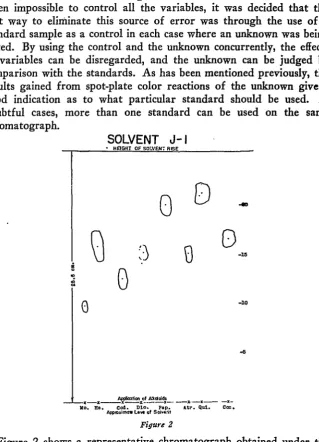
Since these variables exert a great effect on the Rf, and because it is often impossible to control all the variables, it was decided that the best way to eliminate this source of error was through the use of a standard sample as a control in each case where an unknown was being tested. By using the control and the unknown concurrently, the effects of variables can be disregarded, and the unknown can be judged by comparison with the standards. As has been mentioned previously, the results gained from spot-plate color reactions of the unknown give a good indication as to what particular standard should be used. In doubtful cases, more than one standard can be used on the same chromatograph.
SOLVENT J-
I
HEIC41T OF SOLVENT RISE0
Q D
-2
0
-10-6
App~ictn vf .aIdods
[image:8.454.75.395.103.546.2]Mo. Ho. Cod. DIo. Pop. Atr. Quoi. CM. Appro.ilm0 Low of SlcJ-ot
Figure 2
Figure 2 shows a representative chromatograph obtained under the conditions previously stated. It must be remembered that variables (i. e. pH, moisture content of paper, temperature, etc.) exert an influence upon the Rf. Even though the use of a control reduces the margin of error, the Rf may vary slightly, since all variables can not
MURRAY S. DOBRO AND SATORU KUSAFUKA[
Table 1.
RF VALUES OF SOME ALKALOIDS Using Whatman No. I Paper (23°C.)
Alkaloids J-1 (pH3.0) A-9(pH3.4)
Morphine Hydrochloride ... 0.39 0.45 Diacetylmorphine Hydrochloride (Heroin) ... 0.62 0.67 Codeine Sulfate ... 0.49 0.53 Ethylmorphine Hydrochloride (Dionin) ... 0.60 0.65 Cocaine Hydrochloride ... 0.64- 0.77 Papaverine Hydrochloride ... 0.77 0.82 Atropine Sulfate ... 0.59 0.68 Quinine Hydrochloride ... 0.82 0.88
be completely controlled. The numerical values given in Table 1, therefore, are mean values derived from many experiments, with values in the individual tests subject to a variation of plus or minus 3%. How-ever, this is unimportant since a control is run against each unknown, and the Rf values of heroin, codeine, and morphine (the most com-mon narcotics used) vary greatly.
Because of the difference noted in the Rf values for heroin, codeine, and morphine, it was found that very good separation of mixtures could be obtained from the chromatograph (fig. 4). Solvents A-9 and J-1 were suitable except when the quantity of the substance with the higher
Rf value was substantially greater than the quantity of the substance
SOLVENT A- I
S) pa) e ion of pmnTaed mxtures of Morphine ,Heroin, Codeine
using J -I solvent.
c2o
0
0
o.He. Cod. D1.
Figure 3--- --- - -- u--- re
Figure 3 Figure 4
3ANALYSIS OF NARCOTICS
with the lower Rf value. In such cases, interference from the long tails of the substances with the higher Rf values made it difficult to ac-curately determine the Rf values of the other compounds. Further ex-perimentation with a large variety of solvents showed that the use of solvent A-1 offered the most satisfactory solution to this problem. In-sufficient experiments were done to provide mean numerical values with solvent A-i, but it can be stated that where narcotics with high Rf values predominate, satisfactory separation can be obtained because of the change in Rf caused by this solvent (fig. 3). With solvent A-i, Rf values of heroin and morphine were significantly higher than those of codeine and dionin.
It was noted that dionin and heroin have similar Rf values with solvents A-9 and J-1, thus, when the unknown is suspected of containing dionin (even a trace), the use of solvent A-1 is advisable. In separa--tion of mixtures, two dimensional chromatography can also be used.
(This procedure is presently being investigated by the authors.) As has been noted, interference from the long tails of a compound having a high Rf value occurred when large quantities of a substance with a high Rf were mixed with another substance of lower Rf. When small quantities of compounds with high Rf values were run on the chromatograph these long tails did not result. This fact led into further work concerning the relation, if any, between these long tails and a function of the concentration. It was found that Flood(6) had done previous work in quantitative analysis using paper chromatography with
inorganic metals, and had evolved the following formula:
h-f (logC+A)
where:
h --length of migration
C - Concentration in moles/liter A = Constant for paper
Working along the same lines as Flood, it was found that the constant
could be eliminated if the conditions (paper, solvent, etc.) of the
ex-periment remained the same. Exex-perimentation showed that in the 10-70 gamma range an approximate straight line curve resulted; therefore, within these limits the equation may be simplified to:
L = f (C), (where L = length of migration),
but beyond these limits the length of migration increases only slightly
with increasing concentration, and the log of concentration would be
necessary to evaluate results graphically. Morphine hydrochloride in
256 MURRAY S. DOBRO AND SATORU KUSAFUKA [Vol. 44
GRAP1FOR'APPROXIMATE QUANTITiTIVE ANALYSIS OF'DACETYL, -'MORPkkt& iI OMRINE HYROVHLbR'ESEtUSfNG ViWATMAN# "
.;-RLTER .1'
W
.0
[image:11.454.84.358.63.418.2]I CETRAT"* $XWm%
Figure 5
varying concentrations (10-80 gamma), is plotted in Figure
5.
Adulter-ants such as sugars, starches, and sodium bicarbonate do not effect the results of this method.ANALYSIS OF NARCOTICS
/30 0 x 100 \
. (In
forensic chemistry even an approximate quantitativeanalysis of a narcotic may be of great value to an agent in tracing the narcotic to its source.)
It was noted -that when large concentrations of heroin (above 80 gamma) were run on the chromatograph that two distinct areas of migration were sometimes found. (This may be due to hydrolysis of a small portion of the heroin to morphine, or to the presence of traces of incompletely acetylated morphine in the sample of heroin.)
Plans for future research in chromatography at the FECIL include: (1) The investigation of other alkaloids; (2) further work in two dimensional chromatography; and (3) development of more precise chromatographic techniques for quantitative analysis. It is hoped that other laboratories will be interested in a study of these problems, and that attention also will be given to better control of variables (i. e. through the use of a constant temperature and humidity room for running the tests and for the storage of solvents and paper).
CONCLUSIONS
Identification of minute quantities of narcotics can be made by the use of chromatography in conjunction with spot plate color reactions. Separation and identification of morphine hydrochloride, diacetyl-morphine hydrochloride, codeine sulfate, and ethyldiacetyl-morphine hydro-chloride may be* accomplished by the use of solvents J-1 and A-1 in the chromatograph.
Quantitative analysis of the above narcotics of the morphine group can be approximated by means of the chromatograph and calculations.
BIBLIOGRAPHY
1. Munier, R. and Macheboeuf, M., Bulletin de Societe de la Chimie Biologique (Paris),
31: 1144-1162, (July 1949).
2. Matsumoto, T., Report of Gifu Prefectural Hygienic Laboratory, (Gifu, Japan),
2: 3-6, (Dec. 1950).
3. Zechmeister and Cholnoky (Translated by Bacharach and Robinson), "Principles and Practice of Chromatography," pp. 1-20, New York, John Wiley & Sons, 1951.
4. Tsunematsu, F., and Sakurai, H., Japan J. Pharm. & Chem., (Toyko), 248-250,
(May 1951).
5. Shute, J. B., Pharm JVeekblad, (Leiden), 86: 201-212, 1951. 6. Flood, A. E., Zeitschrift Anal. Chem., 120: 327-335, (Aug. 1940).
7. United States Pharmacopoeial Convention, In., "The Pharmacopoeia of the United States of America," XIII, pp. 330-332, Easton, Pa., Mack Publishing Co., 1947.