MOHAMAD SYAH RIZAL BIN ABDULLAH
A project report submitted in partial fulfillment of the requirement for the award of the
Degree of Master of Electrical Engineering
Faculty of Electrical and Electronic Engineering Universiti Tun Hussein Onn Malaysia
ABSTRACT
This project focused on development of precise position control with a DC motor as an actuator using neural network controller. Neural network controller develop is proposed to overcome the problem of conventional controller weaknesses. Neural network controller is implemented using backpropagation training algorithm. Neural network has ability to map unknown relationship input/output system and also non-linear system. To have knowledge about the system, the neural network is trained using existing controller on the position control system, in this case PID controller. On the training process, neural network controller and PID controller are having same inputs, which are errors. After that, the outputs are compared and the delta of them will used to adjust the network weight until the delta value in the acceptance level. Then, neural network controller is set convergence. At this time, neural network controller ready use to replace PID controller to control the system. To interface between computer where neural network controller is embedded with the DC motor as a position controller system actuator are done using RAPCON platform. Based on the experimental results, show that neural network controller has better performance with the rise time ( ) is 0.02s, the peak time ( ) is 0.05s, settling time ( ) is 0.05s, and percentage overshoot ( ) is 2.0%.
ABSTRAK
CONTENTS
ACKNOWLEDGEMENTS iv
ABSTRACT v
ABSTRAK vi
CONTENTS vii
LIST OF TABLES x
LIST OF FIGURES xi
LIST OF ABBREVIATIONS xiv
LIST OF APPENDICES xv
CHAPTER 1 INTRODUCTION 1
1.1 Introduction 1
1.2 Problem statement 2
1.3 Aim and objectives 2
1.4 Scopes and limitations 3
1.5 Thesis outline 3
CHAPTER 2 LITERATURE REVIEW 5
2.1 Introduction 5
2.2 Related work 5
2.3 Literature review comparison 9
2.4 Control requirement 10
2.5 PID controller 11
2.6 Neural network design 12
2.6.1 Backpropagation training method
13
2.6.2 Neural network transfer function
3.1 Introduction 17
3.2 System architecture 19
3.3 RAPCON hardware (board) 21
3.4 RAPCON software 21
3.5 DC motor with encoder 22
3.6 DC motor modeling 23
3.7 Feedback control 26
3.8 PID controller design 27
3.9 Neural network controller design 30 3.9.1 Neural network controller structure 31 3.9.2 Neural network design steps 33 3.9.2.1 Collect input and target data 33 3.9.2.2 Create feedforward neural
network
35
3.9.2.3 Neural network training 36 3.9.2.4 Neural network simulation 40 3.9.2.5 Neural network control block 42
CHAPTER 4 RESULTS AND ANALYSIS 45
4.1 Introduction 45
4.2 DC motor system response 46
4.3 PID controller test 48
4.3.1 PID controller simulation response 48 4.3.2 Real-time PID controller experiment 51
4.4 Neural network controller test 53
4.4.1 Neural network controller simulation response
53
4.4.2 Real-time neural network controller experiment
56
4.5 Neural network controller and PID controller response comparison
CHAPTER 5 CONCLUSION AND RECOMMENDATION 61
5.1 Conclusion 61
5.2 Recommendation for future work 62
REFERENCES 63
LIST OF TABLES
TABLE TITLE PAGE
2.1 Comparison between each research 9
2.2 The effect PID controller parameter 12
3.1 RAPCON platform specification 20
3.2 The DC motor parameters 25
3.3 The numbers of hidden neurons are varied from 1 to 30 37
4.1 PID controller parameter values 48
4.2 Specifications of parameters associated with response 50 4.3 Specifications of parameters associated with response 51 4.4 Specifications of parameters associated with response 53 4.5 Specifications of parameters associated with response 54 4.6 Specifications of parameters associated with response 56 4.7 Specifications of parameters associated with response 58 4.8 The overall controller responses parameters for simulation
experiments
59
4.9 The overall controller responses parameters for real-time experiments
LIST OF FIGURES
FIGURE TITLE PAGE
2.1 Position controller for the system 6
2.2 Position control using NN speed controller 6
2.3 Angular position identification 7
2.4 Angular position tracking performance 7
2.5 Neural control configuration 8
2.6 Set point responses of the control schemes 9
2.7 Response specification 10
2.8 PID controller with closed loop unity feedback system 11
2.9 Three Layers Feed Forward Neural Network. 13
2.10 Transfer functions: (a) log-sigmoid, (b) tan-sigmoid and (c) linear
15
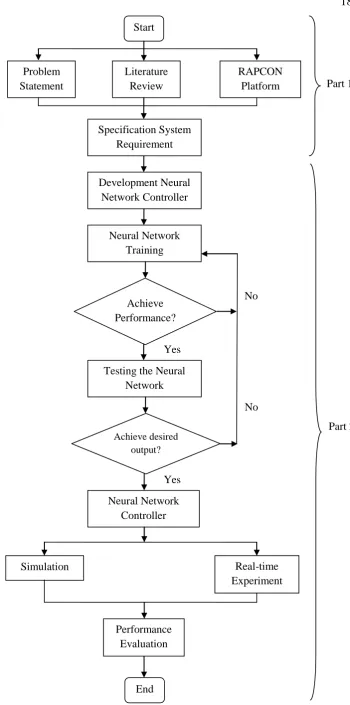
3.1 Flow chart for overall project activities 18
3.2 The interfacing DC motor with RAPCON platform 19 3.3 Connection between RAPCON hardware with DC motor 20
3.4 RAPCON hardware (board) 21
3.5 Library RAPCON software (Simulink) 22
3.6 DC motor with encoder 22
3.7 DC motor system modeling 23
3.8 Typical equivalent mechanical loading on a motor 24
3.9 DC motor block diagram 26
3.10 Typical components of a feedback control loop 26
3.11 Tuning PID controller in RAPCON Simulink 28
3.13 Input and output response PID controller 29
3.14 Neural network training block diagram 30
3.15 Neural network controller in DC motor system 31
3.16 Two-layer feedforward neural network 32
3.17 Input and output PID controller response data 33
3.18 block 34
3.19 in workspace 34
3.20 Time, input and output PID controller in variable editor 35
3.21 Creating a neural network ( ) 36
3.22 Initializing weights ( ) 36
3.23 Neural network training 37
3.24 Training tool window of the neural network 39
3.25 Performance plot of neural network 39
3.26 Regression plot of neural network 40
3.27 Simulate the neural network 41
3.28 Neural network input response 41
3.29 Neural network and PID output response 41
3.30 Neural network and PID output response (zoom) 42
3.31 Generate neural network block 42
3.32 Neural network controller 43
3.33 Internal neural network structure 43
3.34 Within the Layer 1 43
3.35 Within the Layer 2 43
3.36 Within the weight in Layer 1 44
3.37 Within the weight in Layer 2 44
4.1 RAPCON platform 45
4.2 A DC motor with open loop controller 46
4.3 A DC motor subsystem with open loop controller 47
4.4 A DC motor subsystem 47
4.5 A DC motor open loop response 47
4.7 PID controller for DC motor system (pulse waveforms) 49 4.8 Output system response based on PID controller (step input) 50 4.9 Output system response based on PID controller (pulse
waveforms)
51
4.10 PID controller for DC motor system using RAPCON Simulink
52
4.11 Output system response based on PID controller (pulse waveforms)
52
4.12 Neural network for DC motor system (step input) 54 4.13 Output system response based on neural network controller 54 4.14 Neural network controller for DC motor system (pulse
waveforms)
55
4.15 Output system response based on neural network controller 55 4.16 Neural network controller for DC motor system (real-time) 56 4.17 Output response based on neural network controller 57
4.18 Output responses system (zoom) 57
4.19 Comparison of output responses between neural network controller and PID controller for simulation experiments
58
4.20 Comparison of output responses between neural network controller and PID controller for real-time experiments
59
4.21 Comparison of output responses between neural network controller and PID controller for real-time experiments (zoom)
LIST OF ABBREVIATIONS
BP Backpropagation
DC Direct Current
FPGA Field-Programmable Gate Array MATLAB MATrix LABoratory
MSE Mean Square Error
NN Neural Network
PID Proportional-Integral-Derivative
RAPCON Real-time Rapid Control Prototyping Platform RBF Radial Basis Function
LIST OF APPENDICES
APPENDIX TITLE PAGE
A DC motor open loop response coding 66
B Neural network training coding 67
C PID controller coding 69
D Neural network controller coding 72
E Neural network and PID controller response comparison coding
CHAPTER 1
INTRODUCTION
1.1 Introduction
DC motors that are used in feedback controlled devices are called DC motors drivers [1,2,3,4]. Applications of DC motors abound, e.g., in robotics, computer disk drives, printers, aircraft flight control systems, machine tools, flexible manufacturing systems, automatic steering control, etc [5]. These applications need a position control for DC motors drivers.
A position controller commonly used is Proportional-Integral-Derivative (PID) controller [6]. A PID controller, which consists of proportional, integral and derivative element, is widely used in feedback control of industrial processes’ industry [7]. The PID controller has been implemented in position control system, but still suffers from poor performance because of non-linear parameters [8,9].
1.2 Problem statement
The main problem in controlling DC motor as a position control drive is to achieve the desired position, reduce the steady-state errors and oscillation problem. Most of position controllers present several problems because of the nonlinearities system. Moreover, these nonlinearities are often unknown. These nonlinearities system affect the performance of position control of the DC motor system. The commonly used Proportional-Integral-Derivative (PID) controller is simple and easy to practice, but this controller suffers from poor performance if it has nonlinearities and uncertainties issues. The PID controller is not able to work well for non-linear system, and particularly complex and vague system that has no precise mathematical models. To overcome these difficulties, the neural network controller is developed in this project to ensure the DC motor is operable in any circumstance of situations.
1.3 Aim and objectives
The aim of this project is to improve the performances of a position control by developing neural network controller that has ability to provide precise position control for the DC motor system. In order to achieve this aim, the objectives of this project are formulated as follows:
(i) To investigate the DC motor system model parameters measurement using a RAPCON platform.
(ii) To design the neural network controller with backpropagation training method for position control to control the DC motor system.
(iii) To observe the performances of neural network controller by simulation and real-time experiment in order to fulfill the design requirements.
The scopes and limitations of the project are given below:
(i) The control system used in this project was neural network controller (intelligent control).
(ii) Understand the background of DC motor system, and identify the system modeling.
(iii) RAPCON board with Simulink library was applied for interface between controller and DC motor.
(iv) 12V DC Motor permanent magnet with carbon brushes is applied as an object with size and weight approximately .
(v) The position control system is based on the attached optical incremental encoder position sensing 1024 ppr (2π / 4096 rad angular resolution) with index.
(vi) The communication between RAPCON boards with MATLAB Simulink is implemented using PCI card and crossover cable.
(vii) The testing of the DC motor system is done by implementing the neural network controller by using simulation and real-time experiment.
1.5 Thesis Outline
Thesis organization has shown the sequence and step to develop position controller for DC motor system. This thesis classified into five chapters as below:
First chapter describes the research introduction. It contains the project problem statement, aim, objectives and scopes for developing of the project.
Chapter II is about the literature review of the project. It describes the definition, concepts, ideas and principles used in this project. Literature review provides the background of this project and also gives guidelines and direction in this research.
Chapter III deals with a research methodology. This chapter describes the detailed method that has been used to conduct this research. There are also some explanations on how the position control has been measured and calculated.
hardware and RAPCON software throughout the project development. The test is divided into two parts which are testing via simulations and real time experiments. The results comprise graph of input/output data DC motor system and the input/output data from PID controller and the neural network controller are demonstrated in this chapter. The results and analysis about comparison between PID controllers and neural network controller have been shown in this chapter.
CHAPTER 2
LITERATURE REVIEW
2.1 Introduction
In order to design and develop a neural network controller for DC motor as position control, extensive research on position controller of the DC motor need to be investigated. This chapter will discuss previous studies that have been accomplished by other researchers in same area.
2.2 Related Work
Figure 2.1: Position controller for the system
Figure 2.2: Position control using an NN speed controller
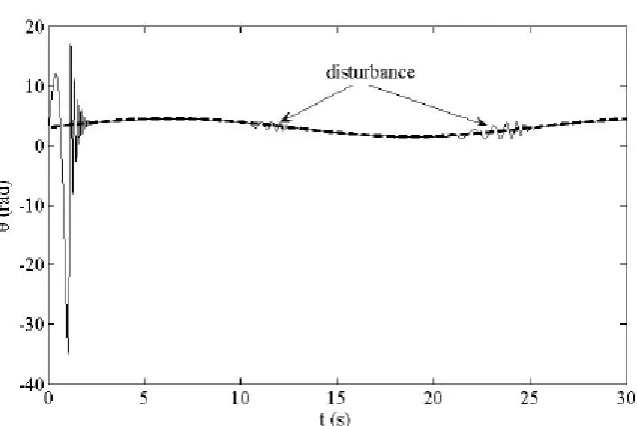
Figure 2.3: Angular position identification: (solid line), (dashed line)
Figure 2.4: Angular position tracking performance: (dashed line), (solid line)
[image:19.595.159.478.378.591.2]influence on the system from nonlinear factors. Thus the design improves the position accuracy of servomotor and position tracing, which guarantee the precision of three dimension laser processing system. After the transformation, laser sub-marker has overcome the noise caused by nonlinear factors such as mechanical elasticity, gap and friction. The system has good positioning accuracy, fast-tracking accuracy, strong robustness and interference immunity.
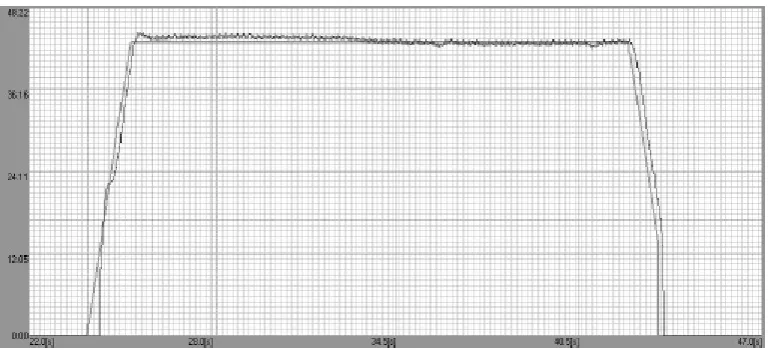
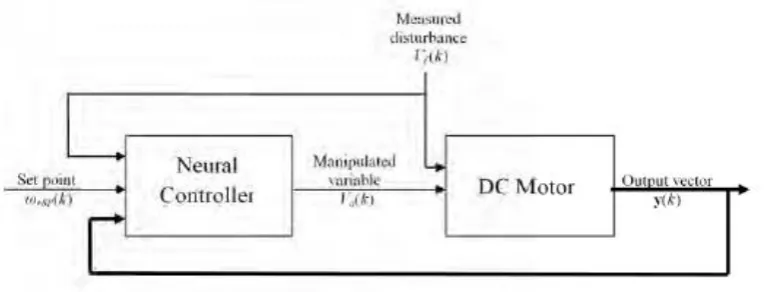
[image:20.595.119.504.466.612.2]Ninos, et al. [13] developed a non-linear controller based on an inverse neural network model of the system under control. The neural controller is implemented as a Radial Basis Function (RBF) network trained with the powerful fuzzy means algorithm. The resulting controller is tested on a non-linear DC motor control. The proposed control scheme is a discrete neural controller; it should receive feedback for the current values of the state variables and the disturbance henceforth produces the current value for the manipulated variable. The control configuration can be observed in Figure 2.5. The results of the set point tracking case are shown in Figure 2.6, where the responses of the two control scheme are shown, together with the set point changes. It is crystal clear that both controllers manage to track accurate changes. However, the neural controller is much faster compared to the PID response.
Figure 2.6: Set point responses of the control schemes
2.3 Literature Review Comparison
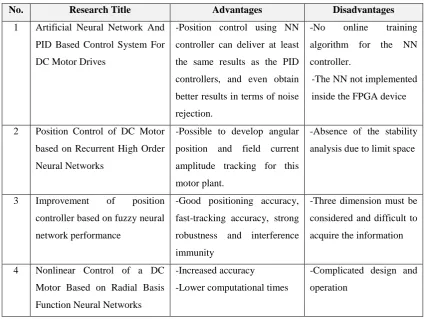
The comparison for each of the previous studies regarding position control is summarized in Table 2.1.
Table 2.1: Comparison between each research
No. Research Title Advantages Disadvantages
1 Artificial Neural Network And
PID Based Control System For
DC Motor Drives
-Position control using NN
controller can deliver at least
the same results as the PID
controllers, and even obtain
better results in terms of noise
rejection.
-No online training
algorithm for the NN
controller.
-The NN not implemented
inside the FPGA device
2 Position Control of DC Motor
based on Recurrent High Order
Neural Networks
-Possible to develop angular
position and field current
amplitude tracking for this
motor plant.
-Absence of the stability
analysis due to limit space
3 Improvement of position
controller based on fuzzy neural
network performance
-Good positioning accuracy,
fast-tracking accuracy, strong
robustness and interference
immunity
-Three dimension must be
considered and difficult to
acquire the information
4 Nonlinear Control of a DC
Motor Based on Radial Basis
Function Neural Networks
-Increased accuracy
-Lower computational times
-Complicated design and
[image:21.595.106.531.426.745.2]2.4 Control Requirement
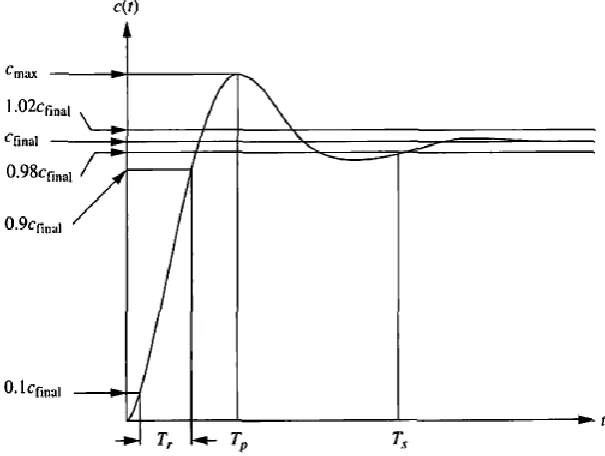
[image:22.595.165.468.199.427.2]The controller requirements are analyzed based on output response parameters. It will indicate the performance of the controller. The specifications of output response to fulfill the requirements are given below [4]:
Figure 2.7: Response specification
(i) Rise time,
The time required for the response to progress from 0.1 to 0.9 of the final value.
(ii) Peak time,
The time required to reach the first or maximum peak. (iii) Settling time,
The time required for the response taken to fall within and stay within of the steady-state value.
(iv) Percent overshoot,
2.5 PID controller
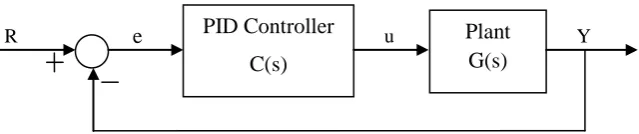
The PID controller has a simple three term controller [6]. The letter P, I and D stand for Proportional, Integral and Derivative. PID controllers are used in more than 95% of closed-loop industrial process [7]. It can be tuned by someone with no knowledge or background in control. Most of PID controllers are tuned on-site. The transfer function of PID controller is given in equation (2.2).
[image:23.595.176.496.542.609.2]
where is Proportional gain, is Integral gain and is Derivative gain. Figure 2.8 shows PID controller is used in a closed-loop unity feedback system. The variable, indicate the tracker error, which is sent to the PID controller. The signal, from the controller to the plant is equal to proportional gain ( ) multiply with magnitude of the error plus the integral gain ( ) multiply with integral of the error plus the derivative gain ( ) multiply with derivative of the error. The equation for signal is illustrated by equation (2.3).
Figure 2.8: PID controller with closed loop unity feedback system
∫
PID Controller
C(s)
Plant G(s)
R e u Y
(2.2) (2.1)
The effect of increasing each of the controller parameters , and are described in Table 2.2. Relationship between , and and output response characteristics, of which these three are most useful [15]:
(i) Use to decrease the rise time, .
[image:24.595.103.534.237.329.2](ii) Use to reduce the overshoot, and settling time, . (iii) Use to eliminate the steady-state error.
Table 2.2: The effect PID controller parameter
Response Rise Time, Overshoot,
Settling Time, Steady-state Error,
Decrease Increase No definite Decrease
Decrease Increase Increase Eliminate
No definite Decrease Decrease No definite
2.6 Neural Network Design
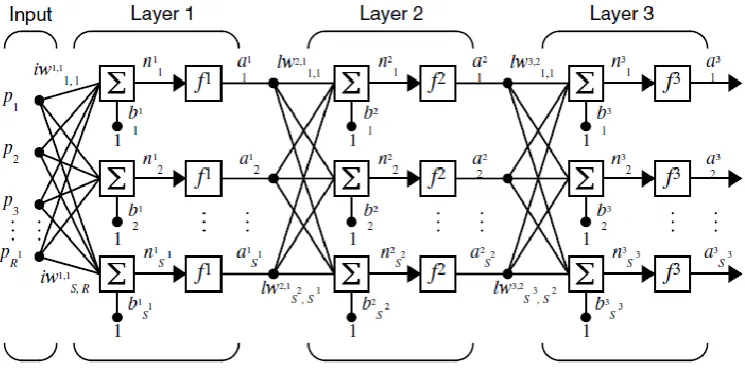
In the neural network, there is abundant of architecture can be used to perform a variety types of functions. There are kind of neural network with high efficiency and strong function generalizing in terms of learning speed and simplicity of the structure. Neural network mentioned is feedforward neural network. In this neural network, the data can only move in one direction which is forward. The route is from the input layer to the hidden layer proceed to the output layer, and ultimately to the final layer of network. In neural networks, there is no loop or cycle in the layer of network [16].
Figure 2.9: Three Layers Feed Forward Neural Network.
In the neural network, is the network output, is the transfer function used in each layer, is the weight. This can be simplified to equation (2.4) where in this equation there are three equations which represent the number of layers.
2.6.1 Backpropagation Training Method
In developing a neural network controller, training method is needed to train the neural network. One of the most popular training methods commonly used is the backpropagation algorithm. The backpropagation algorithm can be used to train feedforward neural network. Backpropagation algorithm is a supervised training method that uses a data set of input/target data pairs to train the network.
completion of training, the network has been trained to be able to deal with any new input data to find the correct output data. To calculate the error value, the equation (2.5) has been used. In equation (2.5), its shows that represents the activation of neurons in the output layer , and are the target value.
∑
Levenberg-Marquardt algorithm was designed to approach second-order training speed without having to compute the Hessian matrix [17]. When the performance function has the form of a sum of squares, then the Hessian matrix can be approximated as in equation (2.6):
and the gradient can be computed as in equation (2.7):
where is the Jacobian matrix that contains first derivatives of the network errors with respect to the weights and biases, and e is a vector of network errors. The Jacobian matrix can be computed through a backpropagation algorithm is much less complex than computing the Hessian matrix. The Levenberg-Marquardt algorithm uses this approximation to the Hessian matrix in equation (2.8)
[ ]
when the scalar is zero, this method is just using the approximate Hessian matrix. When is large, this becomes gradient descent with a small step size. This is faster and more accurate near an error minimum possible. Thus, is decreased after each successful step (reduction in performance function) and is increased only when a tentative step would increase the performance function. In this way, the performance function will always be reduced at each iteration of the algorithm.
(2.5)
(2.6)
reaches an acceptable error value. Error value let the network to achieve the optimum learning process. The more training is done and the more time is needed, hence the lower the error. Within the neural network, it may be consisting one or more hidden layers. The network will be more efficient if it has more hidden layers, but the structure will be more complex, and requires more processing time coupled with pricey to implement.
2.6.2 Neural Network Transfer Function
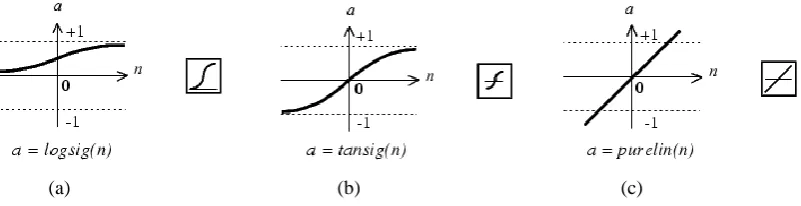
[image:27.595.125.526.556.659.2]To determine the multi-layer neural network output, three transfer functions are required, which are the log-sigmoid ( ) transfer function, tan-sigmoid ( ) transfer function and the linear ( ) transfer function [17,18]. The transfer function accepts any type of data between the range of ) and generates the output between . Alternatively, the transfer function accepts any type of data between the range of ) and generates the output between . The third transfer function is the linear transfer function. The linear transfer function is usually used after the transfer function to construct the output revert to the same range, rather than having the output between . As known, any neural network that has a transfer function in the hidden layers and linear transfer function in the output layer can generalize any type of non-linear functions. Both of transfer functions used in the training method is illustrate in Figure 2.10.
Figure 2.10: Transfer functions: (a) log-sigmoid, (b) tan-sigmoid and (c) linear
Mathematical equation for transfer function is shown as in equation (2.9):
Mathematical equation for transfer function is shown as in equation (2.10):
Mathematical equation for transfer function is shown as in equation (2.11):
(2.10)
CHAPTER 3
METHODOLOGY
3.1 Introduction
The development of this project is shown in Figure 3.1. It is divided into two parts namely Part 1 and Part 2. Each part represents the work to be done for Master Project 1 and Master Project 2 respectively. Part 1 starts with the understanding of DC motor modeling and identifying the problems that exist in its current control such as PID controller. Extensive literature reviews are done based on international publication, engineering-related websites, and engineering books. Detail research in the hardware and software are needed for real-time experimental the DC motor system. RAPCON platform has been proposed because it offers interfaces between the DC motor and MATLAB Simulink for implementation in real-time control system. RAPCON platform can be divided into RAPCON hardware (board) and RAPCON software (Simulink). The interface testing had been done to ensure the functionality of the RAPCON hardware and RAPCON software is compatible with MATLAB Simulink.
Figure 3.1: Flow chart for overall project activities Yes Part 1 Part 2 No No Yes Neural Network Controller Problem Statement Literature Review RAPCON Platform Specification System Requirement Simulation Development Neural NetworkController Neural Network Training Achieve Performance?
Figure 3.2 shows the RAPCON platform interface between the DC motor with encoder and MATLAB Simulink for implementation of real-time position control for the DC motor system [19,20]. RAPCON is acronym from Real-time Rapid Control Prototyping Platform for MATLAB Simulink. The RAPCON platform consists of the real-time control board (RAPCON hardware) and the associated MATLAB interface (RAPCON software). The connection between RAPCON software and RAPCON hardware is made by special crossover cable DB9F to DB9F. Table 3.1 summarizes the specification of the RAPCON platform. Figure 3.3 shows the connection between RAPCON hardware with DC motor.
PCI Card
RAPCON Software MATLAB Simulink
RAPCON Hardware
MATLAB Simulink
Crossover Cable
DB9F to DB9F
RAPCON Board
RAPCON Library
DC Motor with Encoder
[image:31.595.61.569.325.776.2]HOST DEVICE
Table 3.1: RAPCON platform specification Power supply 6 − 15 V, minimum 0.15 A, regulated
Interface 460800 baud, 8 bit data, no parity, 1 stop bit
Analog input A0 – A7, 0 − 5 V analog, 12 bit resolution
Capture input C0 – C1, 0 − 5 V digital, 16 bit resolution
Digital input D0_d0 – D0_d7, 0 − 5 V digital, 8 lines
Encoder input E0 – E1, 0 − 5 V digital, 16 bit resolution
Frequency output F0 – F1, 0 − 5 V digital, 16 bit resolution
Analog output B0 – B1, 0 − 5 V analog, 12 bit resolution
Digital output G0_g0 – G0_g7, 0 − 5 V digital, 8 lines
Pulse output H0 – H1, 0 − 5 V digital, 16 bit resolution
Filtered pulse output L0 – L1, 0 − 5 V analog
H-bridge output P0 – P1, 0 − (supply voltage) V digital, 5 A
Voltage regulator output VDD, 5 V, 0.25 A, regulated power supply
Sampling rate up to 15.2 kHz
Size 10.16 cm x 7.62 cm (4.0'' x 3.0'')
[image:32.595.148.490.432.691.2]Weight 43.9 g (1.55 oz)
The hardware of the RAPCON platform is shown in Figure 3.4 has 8 x 12 bit analog input, 2 x 16 bit capture input, 2 x 16 bit encoder input, 1 x 8 bit digital input, 2 x 12 bit analog output, 2 x 16 bit frequency output, 2 x 16 bit pulse output and 1 x 8 bit digital output [19]. The board also contains two H-bridges with 5 A capabilities to drive external heavy loads. Some input and output are multiplexed to simplify the hardware. The board is interfaced to the host computer that runs MATLAB through a serial port.
Figure 3.4: RAPCON Hardware (board)
3.4 RAPCON Software
Figure 3.5: Library RAPCON software (Simulink)
3.5 DC Motor with Encoder
DC motor is widely used to convert electrical energy into mechanical energy [2]. They are small, fast, efficient and cheap. DC motor is an important component in the control system. Some of the basic characteristics of the control system can be investigated by studying DC motor control. Figure 3.6 shows the DC motor has been developed with optical incremental encoder (position sensing) system [20]. It is very accurate and fully compatible with RAPCON platform.
[image:34.595.273.400.526.696.2]The DC motor system is basically made up of a permanent magnet DC motor and an incremental encoder. Figure 3.7 illustrate the DC motor system, where is the armature resistance, is the armature inductance, is the voltage apply to the motor, is the current through the motor, is the emf voltage, is the moment of inertia of the load, is viscous friction coefficient, is torque generated by the motor, is the angular position of the motor [2,4].
Figure 3.7: DC motor system modeling
Based on the DC motor system modeling, voltage is proportional to speed [14]. Thus,
From equation (3.1), is the back electromotive force (back emf), is constant proportionality called the back emf constant, ⁄ is the angular velocity of the motor. In the Laplace transform, equation (3.1) becomes:
The relationship between the armature current, , the applied armature voltage, , and the back emf, was found using a loop equation around the Laplace transform armature circuit and can be obtained as shown in equation (3.3):
(3.1)
(3.2)
The torque developed by the motor is proportional to the armature current:
where is the torque developed by the motor, and is a constant of proportionality, called as the motor torque constant. Rearranging equation (3.4) will give equation (3.5):
The transfer function of the motor is investigated, equation (3.2) and (3.5) are substituted into equation (3.3):
[image:36.595.196.436.544.604.2]
Figure 3.8 demonstrate that a typical equivalent mechanical loading on a motor. is the equivalent inertia at to the armature and includes both the armature inertia and the load inertia reflected to the armature. is the equivalent viscous damping at the armature and includes both the armature viscous damping and the load viscous damping reflected to the armature.
Figure 3.8: Typical equivalent mechanical loading on a motor
From Figure 3.8, typical equivalent mechanical loading on a motor is determined using equation (3.7):
(3.4)
(3.5)
(3.6)
REFERENCE
1. R. C. Dorf and R. H. Bishop. Modern Control System. Addison Wesley, Menlo Park, CA. 2010.
2. B. Kuo. Automatic Control Systems. Englewood Cliffs, NJ.: Prentice-Hall. 2010.
3. K. Ogata. Modern Control Engineering. Upper Saddle River, NJ.: Prentice-Hall. 2010.
4. N. S. Nise. Control System Engineering. 6th edition, John Wiley and sons Pte Ltd., 2010.
5. J. M. Zurada. Introduction to artificial neural system. ST Paul, MN.: West Publishing Company. 1992.
6. J. Tang. PID Controller using the TMS320C31 DSK with Online Parameter Adjustment for Real-time DC Motor Speed and Position Control. IEEE International Symposium on Industrial Electronics. 2001. vol 2, 786-791. 7. Araki M. PID Control. Control System, Robotic, and Automation,
Encyclopedia of Life Support Systems (EOLSS). vol 2.
8. M. Karadeniz, I. Iskender, and S. Yuncu. Adaptive neural network control of a DC motor. Gazi University, Faculty of Engineering, Turkiye.
9. Guoqiang Zhao. Design Nerve Network Controller of DC Motor Without Brush. Journal of Liaoning Technical University Publisher. 2004. 76-78. 10. A. Cozma and D. Pitica. Artificial Neural Network and PID Based Control
System for DC Motor Drives. International Conference on Optimization of Electrical and Electronic Equipment. May 2008. OPTIM 2008: 11th, 161 – 166.
11. C.E. Castañeda. Position control of DC motor based on recurrent high order neural networks. IEEE International Symposium on Intelligent Control
12. J. Weihua and W. Hao. Improvement of Position Controller Based on Fuzzy Neural Network Performance. International Conference on Electrical and Control Engineering (ICECE). June 2010. 1180 – 1182.
13. K. Ninos, C.Giannakakis, I. Kompogiannis, I. Stavrakas, and A. Alexandridis. Nonlinear control of a DC-motor based on radial basis function neural networks. International Symposium on Innovations in Intelligent Systems and Applications (INISTA). June 2011. 611 – 615.
14. Karl Johan. Control System Design. 2002.
15. Jinghua Zhong. PID Controller Tuning. Purdue University, Mechanical Engineering. 2006.
16. S. Haykin. An Introduction to Feed Forward Networks. 1999.
17. H. Demuth and M. Beale. MATLAB Neural Network Toolbox. Retrieved on 5 April 2013, from http://www.varpa.org/Docencia/ Files/nnet.pdf
18. S. Weereasooriya and M. A. El-Sharkawi. Identification and Control of a DC Motor Using Backpropagation Neural Networks. IEEE Transaction on Energy Conversion. , December 1991. Vol 6, No. 4.
19. Zeltom LLC. RAPCON: Real-time Rapid Control Prototyping Platform for Matlab/Simulink. Retrieved on March 28, 2013, from http://zeltom.com/products/rapcon
20. Zeltom LLC. DC Motor System User Manual 1.3. Retrieved on March 28, 2013, from http://zeltom.com/documents/dcms_um_13.pdf
21. Antonio Visioli. Practical PID Control. London.:Springer. 2006.
22. M. Shahrokhi and A. Zomorrodi. Comparison of PID Controller Tuning Methods. Retrieved on 4 April 2013, from http://www.personal.psu.edu/ auz107/Publications_files/Zomorrodi_Shahrokhi_PID_Tunning_Comparison. pdf