Journal of Chemical and Pharmaceutical Research, 2014, 6(4):46-51
Research Article
CODEN(USA) : JCPRC5
ISSN : 0975-7384
Development of the function-driven automatic redesign system
of cylindrical helical spring
Du Jiang and Cao Yan
School of Mechatronic Engineering, Xi’an Technological University, Xi’an, China
____________________________________________________________________________________________
ABSTRACT
Aim at the inefficient redesign problem of the Cylindrical Helical Spring, the conception of the Function -driven Automatic Redesign System of the Cylindrical Helical Spring is proposed at first with the target to design the Cylindrical Helical Spring automatically by reuse its design data and knowledge. Then, the key issues such as the content and storage method of the reusable Spring Part data, the function driven redesign process to develop this Automatic Redesign System is analyzed according to the real design process of the Cylindrical Helical Spring. At last, the corresponding automatic redesign program is developed based on Pro/E and ACCESS with Protoolkit. Based on this redesign program, the 3D Part model of the Cylindrical Helical Spring can be created automatically by designer according to real usage requirement. The methods discussed in the paper bring a new idea to develop the automatic design system of the Mechanical and electrical Products through the effective reuse of the design data and knowledge.
Key words: Design Reuse; Design Automation; Automatic Modeling; Function-driven
____________________________________________________________________________________________
INTRODUCTION
Now, The Cylindrical Helical Spring (hereinafter referred to as CHS) has been widely use in the mechanical and electrical products as a kind of standard part. In practice, the design and modeling active of the CHS need to be done by designer repeatedly. It has become inefficient design active and wasted much time which can originally be used by designer to do more valuable work.
Aim at this problem, if the reusable 2D or 3D Part data of CHS can be firstly defined based on the function of the each type Spring Part data in the design Process of the CHS. Then, these defined reusable Spring Part data can be recorded with the relational database system or CAD system according to their character and their function. In the new design process of CHS, These recorded reusable Spring Part data can be reused easily by designer, so the designer’s work quality and efficiency can be improved.
As a kind of standard part, because the design and usage requirements of the CHS are clearly in practice, so the design steps and the corresponding work contents are stable in the real design process of the CHS. According to this character shows in the real design process of the CHS, in the real redesign process of CHS, if an automatic Redesign Program can be developed based on the 3D CAD system such as Pro/E, through the better reuse of the 2D, 3D Spring Part data and the corresponding design knowledge behind them. Then, based on this automatic Redesign Program, all the repetitive design and modeling actives in the redesign process of CHS can be done au tomatically, and the required Spring Part 3D model can be quickly designed according to the current design object and usage requirements [1] [2]. So the inefficient redesign problem of the CHS can be resolved.
It is also a valuable exploration for the development of the automatic design system of the mechanical and electrical products from a design reuse perspectives.
1. THE CONCEPTION OF THE FUNCTION-DRIVEN AUTOMATIC REDESIGN SYSTEM OF CHS
Now, for the Part with the characters like standardization and serialization, the 3D Standard Part library which developed based on 3D CAD system such as Pro/E has get a good effects in practice. Based on the 3D Standard Part library, the required 3D Standard Part model can be created and reused easily.
But, for the Part like CHS, it is obvious that the 3D Spring Part model can not be better reu sed only by the development of the 3D Spring Part library like the Standard Part. Because the real dimension of the CHS can not be selected by designer like the Standard Part.
In practice, because the structure and dimension of the Standard Part are all c learly defined in national standards, so based on the experience of the designer, the dimension of the Standard Part can be selected only according to its structure and work space. But, for CHS, although its structure and dimension are also clearly defined in national standards, but after its type and structure is selected by designer according to its current working condition, its dimensions can not be selected by designer based on his experience. The dimension of Spring Part needs to be redesigned by designer according to its current usage requirements such as load and deformation. So, the 3D Part model of CHS can not be simply reused only based on its structure and dimension data like the Standard Part.
Although the 3D Part model of CHS can not be reused directly only based on its structure and dimension, But, through the analysis of the design process of the CHS, the design process of the CHS is essentially a variant design. In practice, after the design objects and the usage requirement of CHS are conformed, the design actives to calculate the dimensions of the CHS are stable.
Based on the above cognition, in the redesign process of the CHS, if the dimensions calculation method of each kind of CHS can be realized by the development of the corresponding design program, then based on the 3D Spring Part model of each type CHS, the required 3D Spring Part model can be created easily by update the dimension value of the corresponding type of 3D Spring Part model with the dimensions calculated by the design program. So the redesign process of the CHS can realize automation.
The conception of the Function-driven automatic Redesign System of CHS (hereinafter referred to as FDARS) is provided just base on this idea. Its object is to design the CHS automatically by reuse its design data and knowledge.
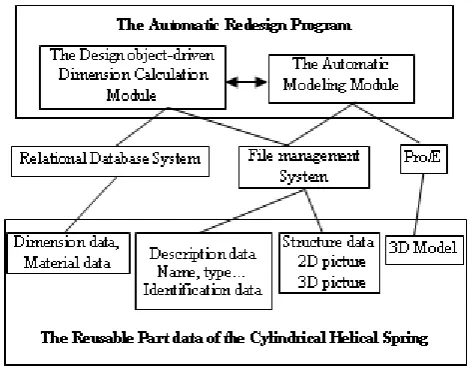
[image:2.595.186.421.476.665.2]Based on this conception, the basic system structure of the FDARS shows in figure 1[3] [4].
Fig. 1: the System Structure of FDARS
three levels structure, the reusable Part data of the CHS can be managed consistently by the corresponding systems in the middle level at first. So the accessing steps of them are stable [5], and they can be accurately reused by the top level redesign program according the current design objects and requirements.
2. THE KEY ISSUE AND METHOD TO DEVELOP THE FDARS
Based on the conception and structure of the FDARS discussed above, the method to realize the function driven redesign process of the CHS and the corresponding Part data reuse method is the core question to develop the FDARS. It needs to resolve the following problems [6] [7].
1) The content of the reusable Part data of CHS and its storage method
2) The function driven redesign process based on the reuse of the CHS Part data
3) The Automatic Redesign program that can realize the function driven design process of the CHS
Based on the Structure of the FDARS shown in figure 1, by the resolving of problem 1, the reusable Part data of CHS can be recorded classifiably according to its function in the redesign process of CHS, so the calling and the retrieve step of these data are stable, and then the redesign process of the CHS can be defined based on these reusable Part data by resolving of problem 2. Based on the resolve of problem 3, the corresponding automatic redesign program can be developed, and the required Spring Part model can be built dynamically according to the real usage requirements.
[image:3.595.117.496.352.465.2]For the above question 1, through the analysis of the real design process of the CHS, the type of the reusable Part data of the CHS are shown in table 1 [8].
Table 1 The Reusable Part Data of the CHS
Data Type Data Content Data Function in Redesign Process
2D or 3D Structure figure Chose the structure of spring part
3D Part model Automatic Modeling
Dimension Data Mean Diameter data
Spring Wire data Dimension Retrieval and Calculation
Identification data name, type, GB code Descript and Distinguish each type Part data of CHS
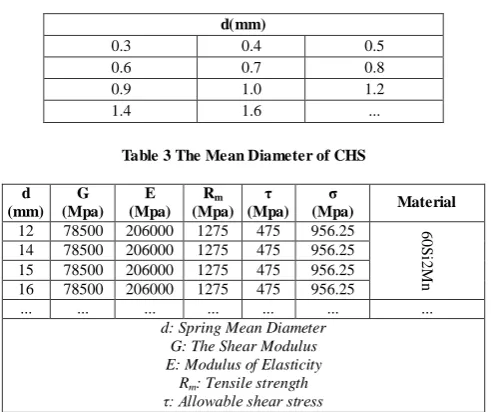
[image:3.595.184.430.558.764.2]As shows in table 1, for some kind of CHS, there is a one to one relationship among its first three types of reusable Part data. For these three types of the reusable Spring Part data, the 2D or 3D Structure figure can be recorded with jpg file. The 3D Part model can be recorded by the 3D CAD system as the model file. Because the reusable dimension data such as the Mean Diameter and the Spring Wire Diameter are common to all type of CHS, so they can be recorded by the Relational Database System with the Data Sheet shown in table 2 and table 3[9].
Table 2 The Spring Wire data of CHS
Table 3 The Mean Diameter of CHS
d (mm)
G (Mpa)
E (Mpa)
Rm (Mpa)
τ (Mpa)
σ
(Mpa) Material
12 78500 206000 1275 475 956.25 60S
i2M
n
14 78500 206000 1275 475 956.25
15 78500 206000 1275 475 956.25
16 78500 206000 1275 475 956.25
... ... ... ... ... ... ...
d: Spring Mean Diameter G: The Shear Modulus E: Modulus of Elasticity
Rm: Tensile strength
τ: Allowable shear stress
d(mm)
0.3 0.4 0.5
0.6 0.7 0.8
0.9 1.0 1.2
With the above method, the first two types of reusable Spring Part data such as the Structure figure, and the 3D Part model can be recorded by the corresponding data file such as the jpg file and 3D model file. The reusable dimension data can be recorded by the Relational Database System as the Common Dimension Database file of CHS.
Based on these data file of the reusable Spring Part data, the all kinds of the reusable Spring Part data can be described consistently through the Identification data of the CHS with the XML file defined below [10].
<xmlRoot>
< the reusable Part data of CHS>
<node data=" " name="Cold compression spring ", GB Code ="gbt1239.3-2009"> <node data="gbt1239_3-2009NI" 2Dfigure="jpg" 3D model="prt" subtype="NI"/> </node>
</node> </the reusable Part data of CHS> </xmlRoot>
Based on this XML file, the each type recorded reusable Part data of certain CHS can be described correlatively by its identification data such as the GB Code. So, these reusable Part data can be accessed automatically by the program according to the real design require in practice.
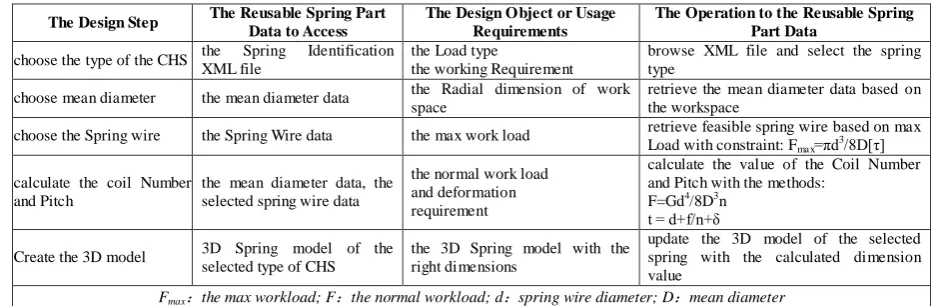
[image:4.595.70.537.374.527.2]For the above question 2, according to the real design process of the CHS in practice, after the basic type of the CHS is defined by its working condition, based on the recorded reusable Part data of the CHS, the Function-Driven Redesign Process under the static load condition is illustrated in table 4 with the Helical tension spring [11]. The redesign process of the other type CHS is similar, here does not descript any more.
Table 4. The Function-Driven Redesign Process of CHS
The Design Step The Reusable Spring Part
Data to Access
The Design Object or Usage Requirements
The Operation to the Reusable Spring Part Data
choose the type of the CHS the XML file Spring Identification the Load type the working Requirement browse XML file and select the spring type
choose mean diameter the mean diameter data the Radial dimension of work
space
retrieve the mean diameter data based on the workspace
choose the Spring wire the Spring Wire data the max work load retrieve feasible spring wire based on max
Load with constraint: Fma x=πd3/8D[τ]
calculate the coil Number and Pitch
the mean diameter data, the selected spring wire data
the normal work load and deformation requirement
calculate the value of the Coil Number and Pitch with the methods:
F=Gd4/8D3n
t = d+f/n+δ
Create the 3D model 3D Spring model of the
selected type of CHS
the 3D Spring model with the right dimensions
update the 3D model of the selected spring with the calculated dimension value
Fmax:the max workload; F:the normal workload; d:spring wire diameter; D:mean diameter
G:Shear modulus; n:coil Number; f: deformation; δ:the mini gap; [τ]: Allowable shear stress; t: Pitch
According to the steps shown in table 4, through reuse the Spring Part data and the design knowledge associated with them, the dimensions of the CHS can be designed based on the real design objects and usage requirements such as the max workload, the normal work load, the deformation etc. Then, the requirement 3D spring model can be designed efficiently by update the dimensions [12].
3. THE DEVELOPMENT OF THE AUTOMATIC REDESIGN PROGRAM OF FDARS
According to the structure of the FDARS shown in figure 1 and the Function-Driven Redesign Process shown in table 4, the Automatic Redesign Program of FDARS includes two function modules. The one is the Design object-driven Dimension Calculation Module; the other is the Automatic Modeling Module. The Design object-driven Dimension Calculation Module can run the first four redesign steps of the Function-Driven Redesign Process shown in table4. The dimension data of the CHS can be calculated by it according to the current design objects and usage requirements.
The Automatic Modeling Module can run the last redesign step of the Function-Driven Redesign Process, and the corresponding 3D Spring Part model can be created by it with the dimensions calculated the Design object-driven Dimension Calculation Module.
Class or the Protoolkit functions to realize these operations are shown in table5.
Table 5. The Operations to the Reusable Spring Part Data and the corresponding VC++ Class or Protoolkit function
The Operation to Reusable Spring Part Data The Operation VC++ Class or ProToolkit Function
read the Spring identification data from XML file MSXML2
display the identification data for browse and selection CPersistentTreeCtrl
display the 2D structural picture of the selected type of Spring CBitmapContrl
Retrieve the mean diameter data based on workspace
Retrieve the Spring Wire data according to the max load CDatabase , CRecordset
Display the mean diameter data for designer to select CComboBox
Display the Material of Spring Wire for designer to choose CListCtrl
input the design and usage requirement data of the Spring CEdit
Record the calculated dimension data CFile
call the 3D Spring part model of the chosen type of Spring ProMdlRetrieve()
Update dimension value of chosen 3D Spring Part model ProParameterValueSet()
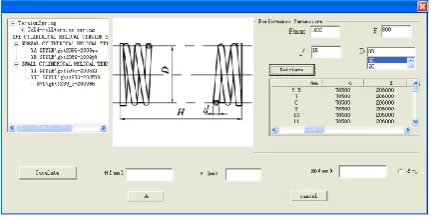
Based on the VC++ Class and the ProToolkit function shown in table 5, the Automatic Redesign Program of the FDARS is developed based on the Pro/E and ACCESS in the paper, and the running interface of this Automatic Redesign Program shows in figure 2.
Fig. 2. The Interface of the Automatic Redesign Program
As shown in figure2, it is the running interface of the Design object-driven Dimension Calculation Module of the Automatic Redesign Program. The interface is a dialog window. It includes four regions. The region in left is the Tree View Window of the CPersistentTreeCtrl. The CPersistentTreeCtrl is a VC++ Class defined to access the XML file. It derives from the CTreeCtrl. The MFC Class CXMLFile which is defined as a simple C++ XML Parser is packaged in it. The function of the CPersistentTreeCtrl is to read and show the content of the XML file with a tree view. Base on its member function Load( ), the reusable identification data of CHS which recorded in the XML file can be read at first, then these Spring Identification data can be shown as a tree view, so the designer can browse and select the type of the CHS from it.
The region in middle is a Picture Window of the CBitmap, it can show the 2D picture of the CHS according the Spring type selected in the tree view window of the CPersistentTreeCtrl by the designer.
The region in right is the interface to get the initial design and usage requirements data from the designer. It developed with VC++ Class such as the CEdit, ComboBox, CList and CButton. After the spring type is selected by designer, Based on the window of CEdit, the initial design and usage requirements data such as the max load, the normal working load and the deformation can be inputted by designer at first. Then, the reusable Mean Diameter data can be retrieved from the Common Dimension Database file by the class CDatabase and CRecordset. And all the retrieved Mean Diameter data can be displayed in a drop down list window through the ComboBox. So the value of the Mean Diameter can be selected by the designer according to the real workspace of CHS. After the dimension of the Mean Diameter is selected by designer, based on the other inputted design and usage requirements data such as the max load and the deformation, the reusable Spring Wire Data can be synchronously retrieved from the Common Dimension Database file also through the class CDatabase and CRecordset according to the max load constraint shown in table 4. And the retrieved feasible Spring Wire data can be displayed as a list window through the CList. Then, the feasible spring wire data can be further selected by designer. Thus, the all initial design and usage requirements data have been inputted by the designer.
Program with step and method shown in table4.
After the calculation is finish, the dimension data such as the spring wire diameter, the mean diameter, the Coil Number and the Pitch can be write into a dimension data file with the VC++ Class CFile at first, then, these Spring dimension data can be read by the Automatic Modeling Program Module to create the final 3D Spring Part model.
The Automatic Modeling Program Module is developed with protookit, it run in backstage. After the Design object-driven Dimension Calculation Module run over, it begin to run. It can open the 3d Spring Part model corresponding to the type selected by the designer with the Protoolkit function ProMdlRetrieve( ) at first. Then, the dimensions which are used to build the 3D Spring Part model can be read from the dimension data file. Based on the each reading dimension data, The value of the corresponding model parameter can be updated with the protookit function ProParameterValueSet( ). After all parameters value is updated, the final required Spring 3D Part model can be created automatically with the Protoolkit function ProSolidRegenerate( ).
CONCLUSION
Aim at the inefficient Re-design problem occurred in the design process of the CHS, the conception and realization method of the Function-driven Automatic Redesign System of the CHS is researched based on Pro/E system with the target to design the CHS automatically by reuse Spring Part data and design knowledge hided in them. The methods provided in this paper bring a new way to develop the automatic design system of the Mechanical and electrical Products through the effective reusing of the part data and design knowledge.
Acknowledgments
The paper is supported by
1) Shaanxi 13115 Scientific and Technological Innovation Engineering Project (2010FWPT-05) 2) Special Scientific Research Project of Shaanxi Provincial Department of Education (09JK475) 3) Shaanxi Major Subject Construction Project
4) 2011 Key Education Innovation Research Project of Xi'an Technological University (11JGZ02) 5) President Scientific Research Fund of Xi'an Technological University. (XAGDXJJ0608)
REFERENCES
[1].CAI Zhao-quan, LU Qing-wu, ZHENG Zong-hui, LUO Wei, Computer Engineering,2009,9(5):60 [2].Chen Zhang. Computer Engineering and Application,2005,18(9):39
[3].ZHU Ju, WANG Zhi2jian, YANG Xue. Computer Technology and Development, 2006,5(5):38 [4].Yao Chao. Journal of Southwest Forestry College,2005,2(6):73
[5].Gruber TR, Russell DM, Generative Design Rationale: Beyond the Record and Replay Paradigm[R], Knowledge Systems Laboratory Technical Report KSL92-59, 1991.
[6].Gruber TR, Russell DM, Design Knowledge and Design Rationale: A Framework for Representation, Capture, and Use[R], Knowledge Systems Laboratory Technical Report KSL 90-45,1991.
[7].Gruber TR, Russell DM, Derivation and Use of Design Rationale Information as Expressed by Designers[R], Knowledge Systems Laboratory Technical Report KSL92-64,1991.
[8].Xue D, Yadav S, Norrie DH, Computer-Aided Design,1999,31:131-145.
[9].Szykman S, Sriram RD, Regli WC, ASME Journal of Computation and Information Science in Engineering ,2001,01(01):59-68.
[10].JIANG Hua; WANG Tao; CAO Qing; XIONG Guang leng. Methodology of Design History Modeling [J].2000,19(2):197-200