Balancing workloads: a timely issue
Barrett, PS and Barrett, LC
Title
Balancing workloads: a timely issue
Authors
Barrett, PS and Barrett, LC
Type
Article
URL
This version is available at: http://usir.salford.ac.uk/19513/
Published Date
2006
USIR is a digital collection of the research output of the University of Salford. Where copyright
permits, full text material held in the repository is made freely available online and can be read,
downloaded and copied for noncommercial private study or research purposes. Please check the
manuscript for any further copyright restrictions.
IN
PRACTICE
1
ISSUE TEN
|
2006
ENGAGING WITH LEADERS IN HIGHER EDUCATION
www.lfhe.ac.uk
INTRODUCTION
Over the last decade the pressures in higher education in the UK have become greater than ever and this includes growth in student numbers, severe regulatory demands, and, more recently, explicit competition. The corollary of this has been a steady increase in the measures within universities to actively manage finances and quality. It could be anticipated that the above pressures will have had impacts on staff working within HE and, indeed, a recent large survey of the sector has shown that almost half of the respondents found their workloads unmanageable (Kinman and Jones, 2004). Against this background it would seem logical that the emphasis on finance and quality would be matched by similar attention to the allocation of workloads to staff, ie the issue of how best to utilise people's time, the single biggest resource available within universities.
Thus the aim of the research reported here was to focus on the processes and practices surrounding the allocation of workloads to academics. The term ‘workload allocation’ (WLA) has been used for the policy and modelling aspects of the process of dividing up work, however, ‘workload balancing/tuning’ relates to the more individualised/negotiated dimensions of the process, the importance of which clearly emerges in this study.
An initial literature synthesis looked at a variety of issues, including large surveys of academics’ work done on behalf of unions, both in the UK (Kinman and Jones, 2004) and Australia (Winefield et al., 2002) and studies on behalf of government (McInnis, 1999) and employers (UUK, 2003). The UK union survey showed that 69% of staff found their work stressful, with 42% regularly undertaking work in the evenings and at weekends. This obviously raises concerns about work-life balance, especially the ease with which IT extends the office into the home.
Their study also showed that sheer time worked does not correlate simply with measures of psychological wellbeing. As well as models on resource allocation, other areas covered within the literature were: the higher education context and leadership issues within it; research on work-related stress; communication and trust. These areas revealed interconnected aspects, such as the importance for staff of feeling in control of their work, the part consultation plays in decision-making processes and the positive effects that good communication has on trust levels operating across all levels in universities. Heads of departments were felt to be pivotal to this process, linking lecturers to university policy-makers, so making their developmental support a key issue.
So, ten diverse organisations were studied: six universities in the UK, two overseas universities and two non-HE, but knowledge-intensive, organisations. In each case a cross-section of staff was taken including two lecturers and their heads of department as well as a senior university staff member, and representatives from human resources and the union body, resulting in 59 in-depth interviews. By identifying typical workload allocation practices, in addition to interesting alternatives, it was possible to collate views on their various strengths and weaknesses, as well as clarifying the associated variable factors that might need attention. Through the study potential approaches were identified to promote more equitable loads for individuals as well as providing synergies for institutions.
FINDINGS
The findings reveal that most universities have policy guidelines on workload allocation practices, but that they are often limited and not at all well known by heads of department or staff. Generally they included some advice on transparency and equity, but within an overall stance of allowing each department or school to determine their own approach. None of the universities studied had a ‘university’ system. It was universally felt that disciplinary differences rendered this impossible, although research findings showed that different models in fact operated across the full range of disciplines.
BALANCING WORKLOADS IN
DEPARTMENTS
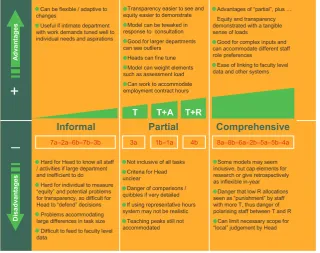
Across departments a wide variety of approaches was found, in three broad categories:
Informal approaches where the head collected background information, consulted and then divided the work. These approaches could work effectively if the head knew staff well and created a positive consensus, however, the trend to larger departments is making this ‘traditional’ approach harder to sustain.
Partial approaches where there is a move to combine the data formally or numerically to give an output in terms of points or hours. Sometimes only teaching is covered, as this has to be timetabled and contact hours are fairly easily defined. In other cases administration might be included, but typically the research aspect was left out, partly because it was felt that it was harder to quantify, but also there was a sense that academics were motivated to do this work anyway. These approaches allowed for easier comparisons, but by being incomplete could not fully support achieving equity.
BALANCING WORKLOADS: A TIMELY ISSUE
2
interviewees was that it was the thinking or criteria behind decisions and not just the decisions themselves that academics wanted to be more transparent. Generally, it was believed that transparent systems would counter claims of unfair treatment, discrimination and favouritism for the benefit of both heads of departments and lecturing staff. Openness could lead to discussion and development of a mutually agreed idea of a ‘reasonable load’. It may also allow staff with different role emphases, (teaching or research) to have greater awareness of, and respect for, the different contributions to the overall good. Conversely, it was felt that care was needed to ensure that such openness would not lead to staff bickering and comparing workloads. Interestingly, there was wide agreement that transparency was most
helpful in identifying overloaded staff and those shirking their responsibilities.
Although workload allocation was felt to rely to a large extent on the head’s judgment, many also felt that a good model could support a better match between people and resources. This might help resolve the frequently mentioned problem that there is a definite tendency for staff who are cooperative, capable and calm to be asked to undertake extra tasks, even if they are overburdened, precisely because of those very qualities.
THE ROLE OF HEADS
OF DEPARTMENT
For heads of department/school the problems involved in workload allocation have become more complex as the size of units has increased, making it harder for them to have a feel for how people are loaded and to subsequently fine-tune the process. However, heads generally seemed to enjoy their role, although many had found it difficult at the start and felt that more support prior to appointment would have been useful. The role of more experienced heads was felt to be very helpful in providing advice and reducing feelings of isolation. Some universities have developed informal groupings for this purpose.
In developing new work allocation models heads often found staff fairly resistant to change, but where staff were consulted and involved in the development, processes seemed to operate more smoothly. Although the question was not asked directly, implicitly lecturers seemed to trust their heads of department and feel that they were trying to operate fairly. Heads themselves were keen to avoid disputes and often spoke of their role not only in representing their
department, but also in relaying information back to colleagues, keeping them involved as a way to build confidence and trust in organisational decisions. This is arguably essential, given the often expressed cynicism about managerial practices. However, some staff did say that they often felt unclear about the overall direction of their own department.
BALANCING WORKLOADS: A TIMELY ISSUE
Comprehensive approaches where teaching, administration and research were all factored in with various weightings and multipliers to reflect the different loads involved. This could support equity in principle, but many approaches were actually limited in some way with capped items. They could also create problems if they became too detailed and undermined the head’s ability to tune allocations to individual circumstances.
Figure 1.shows a summary of the results, including the distribution of the universities studied indicated by the numbers (plus a or b for different departments) and some of the advantages and
disadvantages of each approach.
Findings subsequently indicate a huge variety of different practices surrounding workload allocation, with no one approach solving all problems. It is particularly difficult, for example, for any model to demonstrate equity in terms of loads when certain elements, such as research, are excluded. There is, however, agreement on ideal principles for procedure in relation to approaches, particularly in relation to equity and transparency. But without any consistent measures, equity is hard to evidence and not just within a devolved unit. For example, deans spoke of the difficulties involved in looking across their faculty trying to equate different measures. Staff working across departments also had problems working through two models.
TRANSPARENCY AND EQUITY
[image:3.595.28.349.272.525.2]The idea of transparent systems is that they allow the often hazy belief in equity in departments/schools to be evidenced. However the definition of transparency is open to interpretation, ranging from views of it as meaning named workers’ loads to general summaries of work distribution. One frequent comment from
3
TIME AND TASKS: RESEARCH
AND TEACHING
Other findings related to staff working hours, with the majority of individuals reporting working in the evenings and at weekends. Some heads saw this as part of a personality issue and spoke of the need for individual members of staff to take responsibility for monitoring their own workloads. However, some lecturers took exception to this call for efficiency and felt that it was a glib response to a real problem. Junior staff, especially, had anxieties about the quality of their work in these situations and often reported how just a little reassurance from their head had made a significant impact on how they felt they were coping.
Other factors discussed were the almost universally disliked administrative tasks, and the emphasis placed on research and the RAE, even for those universities with little background in this area. Research itself creates work patterns that are constant over the year, meaning that the vacation period is often lost. The ‘open-endedness’ of research was felt by many to be problematic and some staff cited this work as the element that most differentiated loads, thus making its exclusion from some allocation models both understandable, but problematic.
In teaching, other problems surface. Peaks, for example, occur at examination marking periods and for some staff the workload was truly disturbing. In one case, even if the lecturer had marked 24 hours a day he could not have completed student assessments in the time between the end of the examinations and exam boards! Generally, heads had found this issue to be problematic and some had liaised with their university centrally over the timetabling of schedules and questioned semester timings. In other peak periods staff on fractional employment contracts and PhD students had been employed to try to temporarily redistribute loads.
Other problems included: the upturn in popularity of particular subjects (psychology was often cited); high student intake not matched by staff recruitment - sometimes felt to be because of sluggish HR responses; and difficulties in finding suitably qualified staff, especially in more rural areas.
FRACTIONAL CONTRACTS
Fractional or sessional workers were frequently women with childcare responsibilities. They generally felt that academic working practices were fairly flexible and were positive about the way they were allowed to negotiate their way around their responsibilities. This positive disposition reflects the high regard for autonomy felt by many academics. However, one university studied had undertaken a study of fractional workers and found that the hours actually worked often far exceeded the hours for which staff were contracted.
RECOMMENDATIONS
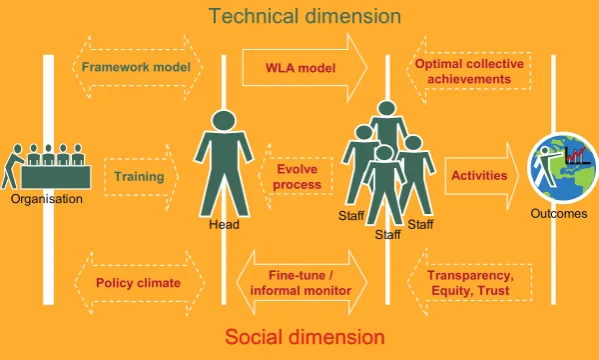
The results show that a broad, neutral framework is feasible. There is a need to explicitly identify at university level the essential elements that must be included within the process, such as equity, transparency and consultation and to provide a framework
model. Departmental factors can then inform the variable features, such as particular teaching delivery methods. The WLA model itself can be usefully viewed as part of a dynamic process rather than a fixed feature. This would allow for incremental improvement that would help staff to feel involved in the process and reduce negative thoughts on managerialist interventions.
After accommodating staff views, implementation should involve a balance between the ‘model’ and discretionary inputs from heads to fine-tune to individuals. Case studies that operated with a strong imbalance between these two elements (technical and social) seemed to have more problems. Further, staff themselves have a responsibility to actively engage with the processes. Such an approach would then form the basis of a strong socio-temporal contract, drawing from Agyris’(1960) notion of the ‘psychological contract’, that looks beyond just tight issues of time or units and considers a richer network of influences, such as work distribution patterns. Finally, attention needs to be given to the informal bonds that support collegiality within the department, so that drives for efficiency do not leave overworked staff feeling inadequate, isolated and underperforming.
At its simplest, it is suggested that the following are needed to achieve effective workload allocation practice in the HE sector:
a university-wide policy and general framework model to meet agreed WLA criteria
consultative local tuning of general framework model to fit departments/schools (loop process)
integration of all work areas in models - including research linkage of model to other systems, such as appraisal
potential for feedback from staff to university model (loop process) fine-tuning by heads to fit individuals
informal regular monitoring of loads - and individual response to stress
training of heads to support these systems
refinement of existing teaching allocations - management of peak periods, role stability
encouragement of staff to think about/negotiate the balance of their activities
IN
PRACTICE
Social dimension
[image:4.595.267.567.362.542.2]Technical dimension
Most universities will be taking some of these actions, but to achieve the full effect demands action on all fronts. In this way equitable workloads can be achieved, the fit between organisational needs and staff interests can be improved, synergies with other university performance management systems can be facilitated, and the university’s capabilities to dynamically achieve strategic alignment in a turbulent environment can be enhanced.
SUMMARY
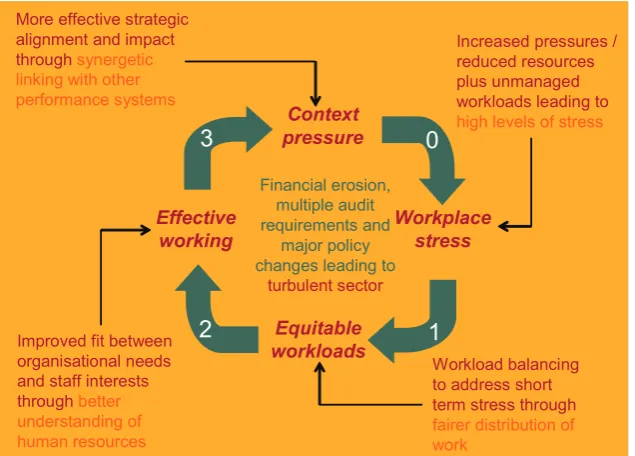
[image:5.595.31.349.509.737.2]Against a background of workplace stress, a first step is for universities to display transformational leadership by creating broad frameworks to support workload allocation between staff leading to more equitable workloads. Secondly, through this process and the associated interactive, individualised actions described above, this should provide the basis for achieving a better fit between organisational needs and staff interests /capabilities. This will demand transactional leadership at a department level. Then, thirdly, from this basis of sound information within a broad, but consistent framework it should be possible to link the staff workload data to other performance systems, such as activity costing. This will then enable better strategic choices to be made, so alleviating some of the tensions flowing from the turbulent HE environment. This progression in levels of impact that can be achieved is illustrated in
Figure 3below.
IN
PRACTICE
4
www.lfhe.ac.uk
Workload allocation could be seen as a low-level operational issue, but given the centrality of staff to the success of universities, it is in fact a major strategic process, which if not done well can disable the organisation. If effectively and authentically handled, universities can create strong socio-temporal contracts with their staff that embody the vision of the university.
We hope that this work will provide a way forward to the benefit of university staff individually and universities in general. In fact the Leadership Foundation would be interested in supporting universities on the issue of managing academic workloads, perhaps by creating a network for the exchange of good practice. If you would be interested in being involved in such an initiative please let Helen Goreham ([email protected]) at the Leadership Foundation know.
For correspondence on this project contact: Professor Peter Barrett, Pro-Vice-Chancellor for Research and Graduate Studies, The Old Fire Station University of Salford, Salford, UK
T:+44 (0) 161 295 5588
FIG 3: Progressive Levels of Impact Possible
REFERENCES
Argyris, C (1960). Understanding Organisational Behaviour. Doresy.
Gillespie, N and Mann, L (2004). Transformational Leadership and Shared Values: the Building Blocks of Trust. Journal of Managerial Psychology. 19(6): 588-607.
Kinman, G and Jones, F (2004). Working to the Limit. London. Association of University Teachers: 1-64.
McInnis, C (1999). The Work Roles of Academics in Australian Universities. Evaluations and Investigations programme. Department of Education, Training and Youth Affairs. UUK (2003). Patterns of Higher Education Institutions in the UK: Third Report. Universities UK.