Journal of Chemical and Pharmaceutical Research, 2014, 6(7):1974-1980
Research Article
CODEN(USA) : JCPRC5
ISSN : 0975-7384
Research on performance of environment-friendly
fume-suppression asphalt and optimization design for road
Lan Ouyang
Changsha University of Science and Technology, Chiling Road No.45 in Tianxin District, Changsha,
Hunan, China
____________________________________________________________________________________________
ABSTRACT.
Based on the analysis of the mechanism and hazards of asphalt fume, by adding two fume suppressant Mg(OH)2
and Al(OH)3 and two viscosity reducers Sasobit and ROADBIT-BPL, the paper optimized the mixture ratio for
road use, and prepared the environment-friendly fume-suppression asphalt, and then conducted the performance tests to identify the optimum dosage. The results show that: the fume amount caused by the 10.0% dosage of Al(OH)3 will be reduced by 7.6% than the matrix asphalt; the admixture of the above two agents has negative
effects on the asphalt anti-crack performance in low temperature. The anti deformation ability and high temperature stability of fume-suppression asphalt are relatively good in the optimized scheme 3.0%Sasobit+10.0% Al(OH)3.
Key words: Environmental friendly asphalt; fume suppressant; viscosity reducer; optimization design
____________________________________________________________________________________________
INTRODUCTION
The asphalt mixing and paving process for road use often accompanies with large amount of fume which brings great harm to human health and pollutes the environment [1-2]. Therefore, it is necessary to control the asphalt fume to minimize the harm for human health and environment. The paper adopted two fume suppressants and viscosity reducers respectively to optimized the design mix, and evaluate the asphalt performance to obtain the less harmful environment-friendly fume-suppression asphalt.
2 The hazards of asphalt fume
The refined asphalt and tar asphalt used for constructions contain various hazardous substances. The refined asphalt is the combination of hydrocarbon and its derivative with few volatile substances such as Phenanthrene, Naphthalene and Anthracene. While the tar asphalt is the byproduct in tar production which includes Phenanthrene, Naphthalene and Pyrene[3]. Under high temperature, the hazardous substances volatile in forms of fume which can damage the ecological environment and has negative effects on human health to some extent.
The major hazardous substances in the asphalt that can harm to human health and environment include the following several types:
1)Acridine:After being inhaled by human, the blood pressure will raise and breathing will become rapid. It may
even lead to DNA distortion and frame shift destruction and cause transcription disorder. Certain mucosa inflammation will appear after being absorbed by skin.
2)Phenols:The main composition of Phenols is the strong corrosive chemical poison -carbolic acid. When entered
3)Benzene:It’s one of the main compositions in tar asphalt. When Benzene entered into human body, the phenol
will be produced and the nervous system will be hurt. In short term, it will cause dizziness and convulsion while for long-term it will damage the bone marrow and cause chromosomal aberrations.
4)Pyridine:It has a strong irritant to respiratory and eyes. When a high concentration of Pyridine is inhaled, it may
cause the sense of suffocation, muscle weakness, loss of consciousness, digestive disorders, etc.
5)Anthracene:Although being classified into slight toxic substances, the Anthracene is notorious for its
carcinogenic performance. It has strong irritation to mucosal and skin. When ignited in high temperature or decomposed, it will produce large amount of CO.
6)Naphthalene:It mainly exists in tar asphalt and volatiles via asphalt fume. It may cause dermatitis to sensitive
skin. When a high concentration of Naphthalene is inhaled, it may cause nausea, headache or even damage to liver and kidney [2].
3 Performance analysis of asphalt fume 3.1 Mechanism of asphalt fume
A series of complex chemical reactions will happened in stages among most of the hydrocarbons contained in asphalt. From the dynamic point of view, these reactions mainly include the thermal polymerization reaction and thermal decomposition reaction. During the process of reaction, the total energy before reaction is always higher than those after reaction. The energy consumption always accompanies with additional generated products [4]. This paper mainly focuses on the generating mechanism of asphalt fume: the asphalt is always brown in color with high viscosity at room temperature. Before mixing, the asphalt needed to be heated from room temperature to the temperature over 160℃in a short time. Fume will appear in pace with increasing temperature. The higher the
heating temperature is, the greater the amount of fume will be generated, the fundamental reason for which is that during the heating process, part of the volatile substances as Anthracene, Benzene, Phenanthrene, Naphthalene, Pyridine, Carbazole, Acridine and Phenols can emission in form of colored fume, generating the poisonous asphalt fume with a variety of harmful substances.
3.2 Asphalt fume testing method
Currently the testing methods include ultroaviolet ray spectrophotometry, fluorescence method, gravimetric method and fume tester method, etc. The common practice is to adopt the ultroaviolet ray spctrophotometry method using the Benzene as absorbing liquid. The Benzene has the best absorption effect when the asphalt fume is dissolved in Benzene solution with the wavelength 268mm. Meanwhile, this method matches with Braun-Beer's law when both of the extinction value and the asphalt content are 0~500µg [5]. Therefore, this paper simplifies the testing method by using KC-6D air sampler, triangular flask. Heated by electronic furnace, the asphalt fume and volatile substances pass through two U-shaped series-connected porous pipes and absorbed by the air sampler to carry out the asphalt fume test. The device installation is shown in Fig.1.
Fig.1 Detection device for asphalt smoke
After fume absorption, all of the Benzene solution (washing solution included) was poured into the evaporating dish, heated at 80℃ constant temperature and then weighted. The difference of the mass before and after heating is
the mass of asphalt fume. Then according to atmospheric sampling test principle, the concentration of the asphalt fume can be calculated by formula (1).
3
1 0
3
(
) 10
=
0.5
10
m
m
t
β
−
×
−where β is the concentration of asphalt fume, mg/m3; t is the sampling duration, min; m0、m 1 are respectively the
mass before and after heating, g.
4 Raw material performance 4.1 Matrix asphalt
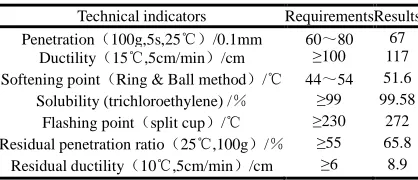
[image:3.595.201.410.182.272.2]The basic properties of 70#A class matrix asphalt were evaluated in accordance with testing specifications, the results of which can meet the requirements, as shown in Table 1.
Table 1 Performance indicators of 70# matrix asphalt
Technical indicators RequirementsResults Penetration(100g,5s,25℃)/0.1mm 60~80 67
Ductility(15℃,5cm/min)/cm ≥100 117
Softening point(Ring & Ball method)/℃ 44~54 51.6
Solubility (trichloroethylene) /% ≥99 99.58
Flashing point(split cup)/℃ ≥230 272
Residual penetration ratio(25℃,100g)/% ≥55 65.8
Residual ductility(10℃,5cm/min)/cm ≥6 8.9
4.2 Fume suppressant
Fume suppressant is one of the important raw materials used in project research. According to the principle of good performance of anti-flaming, anti-fume and thermal stability, the two suppressants Mg(OH)2 and Al(OH)3 are
adopted for indoor tests, Both of which are non-halogen inorganic materials which do not produce toxic gas while in use and are abundant in supply with affordable price. The fume suppressant can reduce the hazardous substances volatile into the air by fume suppression.
4.3 Viscosity reducer
Viscosity reducer is another indispensible agent mixed in fume-suppression asphalt. The two viscosity reducers Sasobit and ROADBIT-BPL were adopted for comparison analysis. The former is a high molecular weight synthetic aliphatic hydrocarbons which can be melt during the asphalt heating and reduces the asphalt viscosity the technical indicators for which is shown in Table 2[6]. While the latter agent is mainly composed of saturated hydrocarbon which has synthetic long chains with 120℃ melting point. It can reduce the asphalt viscosity, and
improve the temperature sensitivity and the anti-deformation ability. While in construction, it can protect the environment and health of the workers by means of reducing the emission of fume and other hazardous substances.
Table 2 Technical indicators of viscosity reducer Sasobit
25℃density/(g·cm-3)Melting point/℃Flash point/℃Molecular weight/g/mol
0.92 110~120 285 ≈1000 5 Optimized design scheme for environment-friendly fume-suppression asphalt 5.1 Design scheme for the materials of fume-suppression asphalt
The asphalt fume is mainly suppressed by two methods: one is adding viscosity agent to lower down mixing temperature and reduce the fume emission and volatile; the other is adding inorganic fume suppression agent to effectively absorb and dilute the fume, which can be decomposed into porous oxide and vapor and the fume content will be reduced after being heated [7-9]. The basic test scheme is listed in Table 3.
Table 3 Admixtures dosage design
Admixtures Dosage/% Viscosity reducer - Sasobit,ROADBIT-BPL 1.0,2.0,3.0,4.0
Fume suppressant - Al(OH)3,Mg(OH)2 5.0,10.0,15.0,20.0
5.2 Fume-suppression asphalt preparation
Considering the material compatibility during the modified asphalt preparation, according to the material dissolution effect to ensure no segregation or separated layers in order to form a relative stable unified system, the high temperature swelling and shear dispersing methods can achieve good effect. The mix shall be a relative stabled unified system in view of dissolve effects of each substance. To ensure the stable mixing of matrix asphalt, fume suppressant and viscosity, the high speed shear apparatus was adopted to blend the material and prepare the fume-suppression asphalt in accordance with mechanics principle. The shearing speed was controlled at 4500r/min and the temperature for adding viscosity reducer and fume suppressant was controlled at 140℃. The mixing
5.3 Asphalt fume test
With reference to the testing method as listed in section 2.2, proper amount of 70#matrix asphalt was heated on the triangular flask. The temperature shall be heated from room temperature to 200℃ and the tests were carried out at
120℃ with the temperature intervals of 20℃. The test results are shown in Fig.2.
4.23
5.97
7.18
9.34
15.64
0 3 6 9 12 15 18 21
120 140 160 180 200
Temperature/℃
C
o
n
ce
n
tr
at
io
n
o
f
as
p
h
al
t
fu
m
e
/m
g
/m
³
Fig.2 Detection results of 70 # A asphalt fume
From Fig.2, when the temperature changes from 120℃ to 180℃, the density of asphalt fume shows a steep raising
trend. There is abrupt value when the temperature rises from 180℃ to 200℃ because the majority of substances in
the asphalt can volatize. According to the test phenomenon, the whole test was coupled with strong pungent smell and apparent yellow smoke was produced and testers can feel the strong irritation to their respiratory and eyes. The test results of asphalt fume density at 180℃ after adding the fume suppressants Mg(OH)2 and Al(OH)3 are shown
in Fig.3.
8.0 8.2 8.4 8.6 8.8 9.0 9.2 9.4 9.6 9.8
0.0 5.0 10.0 15.0 20
Fume-suppression dosage/%
C
o
n
ce
n
tr
at
io
n
o
f
as
p
h
al
t
fu
m
e
/m
g
/m
³
Al(OH)3 M g(OH)2
Fig.3 Asphalt fume concentration with different dosage of fume suppressants
As can be seen in Fig.3, under the same test condition, the asphalt fume can be reduced after adding fume suppressants Mg(OH)2 and Al(OH)3. The fume-suppression effect is much more obvious when the input amount
increases from 0.0% to 10.0%. However, when the mixing amount is more than 10.0%, no apparent change is observed on fume suppression in spite of continuously adding the agents. The curve reveals that Al (OH)3 has
better smoke suppression effect. When the dosage of the two agents is 10.0%, the fume density of Mg(OH)2 is
0.16mg/m3 higher than that of Al(OH)3 with the proportion of 1.85%. The optimum amount for fume suppressant
6 The performance of fume-suppression asphalt 6.1 Penetration test
Penetration is an indicator for asphalt anti-deformation ability and its essence is the shear creep theory. Under 25℃,
the penetration test results of various fume suppressants and viscosity reducers are shown in Fig.4.
0 10 20 30 40 50 60 70 80
0 1 2 3 4
Dosage of viscosity reducers/%
P en et ra ti o n /0 .1 m m Sasobit ROADBIT-BPL 54 56 58 60 62 64 66 68
0 5 10 15 20
Dosage of fume-suppression agents/%
P en et ra ti o n /0 .1 m m
Al(OH)3 M g(OH)2
Fig.4 Penetration of asphalt fume with different dosage of modifiers
From Fig.4, the admixture of viscosity reducer can reduce the asphalt penetration to some extent. With the amount of Mg(OH)2and Al(OH)3 increasing, the penetration declines and the anti-deformation ability is gradually
strengthened. Both of the two agents can enhance the anti-deformation performance and the optimum mixing amount for the fume suppressant and the viscosity reducer is 10% and 3.0%.
6.2 Softening point test
Softening point test is an indicator for asphalt thermal stability and viscosity. The softening point test of various amounted viscosity reducers and fume suppressant was conducted by the ball and ring method. The test results are shown in Fig.5.
0 20 40 60 80 100
0 1 2 3 4
Dosage of viscosity reducers/%
S o ft en in g p o in t/ ℃ Sasobit ROADBIT-BPL 48 50 52 54 56 58
0 5 10 15 20
Dosage of fume-suppression agents/%
S o ft en in g p o in t/ ℃
Al(OH)3 M g(OH)2
Fig.5 Softening point of asphalt fume with different dosage of modifiers
From Fig.5, the softening point increased dramatically after adding the viscosity reducer, and the admixture of fume suppressants can also increase the softening point, which indicates that both the fume suppressants and the viscosity reducers can improve the high-temperature stability, and the optimum mixing amount for the viscosity reducer and the fume suppressant is identified as 3% and 10% respectively.
6.3 Ductility test
Ductility is an indicator to evaluate the asphalt low-temperature ductility and anti-cracking performance. This paper used the 15 ℃ ductility to evaluate the ductility performance of various amounted viscosity reducers and
0 20 40 60 80 100 120 140
0 1 2 3 4
Dosage of viscosity reducers/%
D
u
ct
il
it
y
/c
m
Sasobit ROADBIT-BPL
0 20 40 60 80 100 120 140
0 5 10 15 20
Dosage of fume-suppression agents/%
D
u
ct
il
it
y
/c
m
Al(OH)3 M g(OH)2
Fig.6 Ductility of asphalt fume with different dosage of modifiers
From Fig.6, both the viscosity reducers Sasobit and ROADBIT-BPL and the fume suppressants Al(OH)3 and
Mg(OH)2 can reduce the low-temperature ductility. Thus, the anti-crack ability will be worse. Furthermore, the
more amounts are added, the worse the asphalt low-temperature performance is. Therefore, the two agents should not be excessively added.
6.4 Viscosity-temperature characteristic analysis
The viscosity-temperature performance of asphalt is mainly characterized as the high-temperature rheology. According to the mixing amount of the agents mentioned above, the viscosity of optimized asphalt was tested under varied temperatures. The test results are shown in Fig.7.
0 3 6 9 12 15 18 21 24
90 110 135 150 165
Temperature/℃
A
sp
h
al
t
v
is
co
si
ty
/P
a·
s
3%Sasobit+10%Al(OH)3 3%ROADBIT-BPL+10%Al(OH)3 70#A Matrix asphalt
Fig.7 Viscosity results of environment-friendly fume suppressant
As shown in Fig.7, as the temperature increases, the asphalt viscosity decreases gradually. After mixing the viscosity reducers,the fume-suppression asphalt has a stronger viscosity and anti-deformation performance than
the matrix asphalt below 120℃, while the viscosity is lower and the workability of is relatively better above 120℃.
Compared with the viscosity reducers, the improving effect of Sasobit is better.
CONCLUSION
By analyzing the formation mechanism and hazards of the asphalt fume, this paper prepared and evaluated the performance of various schemed environment-friendly fume-suppression asphalt by mixing fume suppressants and viscosity reducers.The results shows that the fume suppressant applied in 70#A matrix asphalt can greatly reduce the fume emission; the optimum mixing amount for viscosity reducer Sasobit and fume suppressants Al(OH)3 are
3.0% and 10% respectively, which has better anti-deformation ability and high-temperature stability.
REFERENCES
Chongqing: Chongqing Jiaotong University, 2010.
[2]Li Y R, Luo Q Q, Li Q R. Effects of asphalt fume on liver function and blood routine of operational staff [J].
Journal of Occupational and Health, 2012, 28 (9): 1066-1067.
[3]Liu X, Deng X. Pretreatment method for asphalt fume [J]. Journal of World Nonferrous Metals, 2013 (5): 46-47.
[4]Yang X W, Peng X Y, Qian S L. Experimental study on asphalt fume inhibitor in pavement construction and field application [J]. Journal of Huazhong University of Science and Technology, 2012, 40 (6): 122-127.
[5]Liu J, He Z Y, Huang G. The development and application of asphalt fume measurement system [J]. Journal of
Petroleum Pitch, 2013, 27 (6): 50-53.
[6]Wang X L, Liu Y C. Solutions to problems of flyash and asphalt fume from asphalt concrete mixing plant [J].
Journal of Engineering Machinery, 2012 (8): 63-65.
[7]Quan R J. Design and performance study on fume-suppression asphalt OGFC-13 mixture [J]. Transportation
Standardization, 2011, (19): 63-65.
[8]Zhang H Z, Fan W Q. Experimental study on fume inhibitors of asphalt pavement [J]. Journal of Western
Traffic Science and Technology, 2013 (4): 5-9.