Learners of English as a Second Language in Australia:
Their Perceptions of Learning Environment and Factors
Affecting Their Motivation
Masanori Matsumoto
Faculty of Society and Design, Bond University, Australia
Copyright©2018 by authors, all rights reserved. Authors agree that this article remains permanently open access under the terms of the Creative Commons Attribution License 4.0 International License
Abstract
This is a preliminary case study on students from a university in Japan learning English as a second language (L2). Three students volunteered to report weekly their motivational changes through a four-week English course provided by a language institute in Australia and to be interviewed twice at the beginning and the end of the course. The results show that learning experience in a new environment could help them develop the "L2 Selves"; however, the same factor they experience both inside and outside the classroom class could affect either positively or negatively their motivation. Also, their motivational intensity does not exhibit a significant change through the course. The study discusses the participants’ actual experience of the primary difference in the contents of the English class between Japan and Australia may work positively their learning due to their desire to develop the English proficiency. However, the relationship between their perceptions of environmental factors reflected on their prior learning experiences and their motivational intensity could be more complex than we imagine. There may be a gap between learners’ general perception of motivational factors and its influence on the deterioration and the development of motivation to learn.Keywords
Second Language Motivation, Learner’s Perceptions, Learning Experiences, Motivational Changes, Contextual Factors1. Introduction
Learners’ motivation to acquire second language (L2) has long been regarded as one of the key elements that could have a strong impact on the learners’ success (or failure) in the target language learning among not only practitioners but researchers in psychology and applied linguistics. Since the early stage of its study in 1950s to 60s
on social-psychology based research, the study of motivation has been developing and especially since the beginning of this century, various researchers diversified their research interests, and cognitive and educational psychology-based theories have been implemented to account for the role that motivation should play. Dörnyei and Otto [1] made one of the most prominent claims in their Process Model of Motivation, in which the fluctuating nature of motivation was first shed light on along with three distinctive stages in the long process of L2 learning. As motivation is likely to change, factors that affect the changes of motivation, then, have been one of the primary targets to explore and what affects motivation in what way has been studied in various research and educational contexts (e.g. Busse & Walter [2]; Campbell & Storch [3]; Kaboody [4]; Kikuchi [5]; Koizumi & Matsuo [6]; Kozaki & Ross [7]; Negueruela-Azarola [8]; Sakai & Kikuchi [9]; Waninge, De Bot, & Dörnyei [10]).
The current study has attempted to respond the demand and investigated Japanese university students participating in an English-study-abroad program at an institute that provided them with four-week intensive course. The study aims to find how the learners’ motivation changes and the factors that influenced the motivational fluctuations. The study also targets how learners’ image of “self” as L2 learning goal claimed by Dörnyei in his L2 Motivational Self System (Dörnyei [11]) develops along with the learning experiences in the given learning context by analyzing both quantitative and qualitative data collected by weekly questionnaire and interviews on the volunteered participants from the program.
2. Research Background
Gardner’s associates (e.g. Gardner & MacIntyre, [14]) based on social-psychology paradigm, then the study was extended to more process-oriented approach focusing on the dynamic nature of motivation in classroom learning context since the turn of the century (Ellis [15], p. 677). One of the most prominent and recent developments in accounting for the motivational role in L2 acquisition should be Zoltan Dörnyei’s [11] L2 Motivational Self System. In this model of L2 motivation, Dörnyei emphasized the learners’ possession of vivid and elaborated image of ‘self’ that has a strong association with the use of target language. Then, the ‘gap’ between one’s future self that may have a high proficiency in the L2 and the current real self that may lack the needed knowledge and skills could be the motivational force as learners narrowing the distance between the two selves (Dörnyei [11]. p. 29).
The model’s central framework consists of three components, the Ideal L2 Self, Ought-to L2 Self, and L2 Learning Experiences (Dörnyei [11]). The model notes that one’s future self can be either ‘Ideal’ or ‘Ought-to’ one. The former is based on the learner’s desire to achieve in the future, and the latter, on the external pressure that necessitates the learner to become because failing to achieve the ‘out-to self’ may result in the embarrassment or severe disadvantages so she needs to avoid such a negative outcome. The ideal L2 self, according to Dörnyei, is closely associated with integrative and/or internalized instrumental motives, while ought-to L2 self is more related to less internalized instrumental motives. The third component, L2 learning experiences, influences “the executive motives that are linked to the immediate learning environment and actual learning experiences” (p. 29) that L2 learners are involved. Dörnyei [11] emphasized that the L2 learners’ selves would not impact on motivational behavior properly unless several conditions are met, such as the availability of elaborate and vivid future self-image and perceived plausibility of the future selves (p. 18). It is also noted that more elaboration is required to the third component particularly and further research may need to focus on how the learning experiences in certain learning context affect the elaboration or possession of either ‘self’ among particular L2 learners.
Recent studies also strongly emphasize the fluctuation of motivation while L2 learners are engaged in a long process of L2 acquisition (see Busse & Walter [2]; Campbell & Storch [3]; Dörnyei [16]; Dörnyei & Ushioda [17]; Kozaki & Ross [7]; Waninge, et al. [10]). When L2 learners participate in a language program, they are exposed to various micro and macro environmental factors, such as teachers, peer learners, classroom tasks, and materials to be used as micro factors, and learning contexts as macro factor. These factors seem to affect the learners’ motivation in a complex way, cause the up-and-downs of motivational intensity and result in different learning behaviors (Dörnyei [11]; Kozaki & Ross [7]). Nakata [18] noted the
cause of motivational fluctuation as below:
…motivation is not a matter exclusively pertaining to learner’s mind, but rather is inextricably linked with a number of other factors such as the curriculum, the course of study, exam, textbook, limited class hours and the teacher (p. 316).
Julkunen [19] also emphasized that L2 learners’ motivation and attitudes should be best affected in the language classroom (p. 29), and in the classroom context, motivation can be regarded as the continuous interaction process between the learner and the environment, which then plays a role to control and direct the learning performances.
learners’ motivational changes. That is, learners’ perception of little progress in target language proficiency could be attributed to the improper transition of the levels of tasks from high-schools to university and the provision of low-level of intellectual challenge in the tasks, which, then, instigated their deterioration of intrinsic motivation and resulted in less learning effort.
Studies were also extended to examine how L2 context affects the motivational changes. Kormos, Csizér and Iwaniec [21] investigated the change of motivation among the learners in a study-abroad program in the L2 learning environment. They studied 70 international students from a variety of ethnic backgrounds participated in a British international study program and attempted to identify the participants’ motivational changes and the frequency and type of contact experiences with local native speakers over a period of one academic year. The age of the participants was ranging between 17 and 24, and their English proficiency was from 4.5 to 7.5 in IELTS. The results indicated that the participants had instrumental language learning goals and valued the experience of international study opportunity, which, they believed, could help them obtain a better job. However, the strong instrumental goals did not result in a high level of effort in language learning and frequent contact with native and international speakers of English due to a lack of favorable self-efficacy beliefs and a high level of anxiety that they experienced when interacting with speakers from outside the participants’ own L1 group (p. 159). This seems to suggest that learners’ expression of motivational intensity may not be directly related to their actual learning performances and behaviors. As the number of previous studies revealed, classroom learning experiences and learning environments do have some impact on the learners’ change of motivation; however, every learner in the same language program taught from the same teacher does not seem to change their motivation in the same way. In other words, each learner’s individual perception of various environmental variables, especially contextual factors and the learner’s social and cultural backgrounds, seem to be required to investigate, and researchers have embarked on this relatively new issue regarding the motivation research. Kozaki and Ross [7] noted that “individual learner is the epicenter of cognitive and affective processes that drive successful language learning” (p. 1), and environmental factors impact and mediate language learners’ motivational state. They claimed that “individual differences in motivation are dynamic and malleable and can be either enhanced or diminished, depending on the immediate context of the foreign language classroom” (p. 21). Coleman [22] noted the complexity of the interpretation of individual difference in motivational characteristics and the influence of study abroad learning environment as below:
In each individual case, biographical, affective, cognitive and circumstantial variables come into play, with students’ previous language learning and
aptitude impacted upon by their motivation, attitudes, anxiety, learning style, and strategies, as well as by unpredictable elements such as location, type of accommodation, and degree of contacts with native speakers. (p. 583)
In response to this current view of motivational fluctuation and the approach towards the issue, Dörnyei and Ushioda [17] stressed the needs of introducing “relational rather than linear view of the multiple contextual elements, and also viewing motivation as an organic process emerges through the complex system of interrelations” (p. 220), because L2 learners are those who are necessarily located in a particular cultural and historical context, and whose motivation and identities interact with these contexts (p. 78). That is, each L2 learner views their own learning experiences and environmental elements in their own ways, interprets them based on their personal value system associated with their cultural backgrounds, and then, attributes them to their motivational and attitudinal forces for current and future L2 learning. Given this, the research should take more personal perceptions of various learning contextual factors into consideration and carefully examine each learner’s reflected intentions and motivational changes longitudinally.
In consideration of the above development of recent studies in L2 motivation, the present research aims to find answers to the following research questions:
(1) How does motivation of Japanese learners in study abroad program change, and what do they perceive as the factor affecting the change of motivation? (2) How do the study abroad context and the learners’
learning experiences affect the development of their ‘ideal’ and ‘ought-to’ selves?
3. Methodology of the Research
The present article is about a preliminary pilot study for a future research on a larger number of participants with more extended period of longitudinal study. Participants of the current paper are Japanese learners of English who are visiting a language institute belonging to a university in Australia for an intensive study of English within four weeks from the 13th of February to 10th of March 2017. In
total 12 students volunteered to participate in the current research; however, only three of them who are all females at age 19 completed weekly learning log for four weeks and attended two interviews at the beginning and the end of the program.
participants’ own perceptions of the change of motivation and the reasons for the changes, the environmental/contextual factors affecting the motivation, English-learning orientations, and any perceptions of the change of orientations for learning English after experiencing the study abroad program. Each participant’s level of motivational intensity each week is specified by seven-point Liker scale with which participants choose appropriate number in the learning log, and other motivational and attitudinal changes were detected by answering questions in the learning log provided. In order to reduce the annoyance of filling the log every week, the participants were allowed to answer the questions in their first language (L1) Japanese.
The participants were also required to sit for the interview twice in week 1 and after they finished the program, and answer the structured questions (see Appendix 2). The interviews were conducted in Japanese,
which were recorded and transcribed into English by the researcher. Depending on the development of the answers, extended questions were asked to further clarify what the participants’ perceived and considered their experiences of learning English in the given educational and cultural context. The development or possession of ‘self’ image in terms of learning English was attempted to be detected through the answers provided in the interviews with regard to the reasons for learning English and any changes of their future goals since the beginning of the study abroad program.
4. Results
The three participants are identified as student 1 to 3 in the current article in order to keep the data anonymous. Their personal backgrounds and level of English study are indicated in Table 1 below.
Table 1. Description of the participants
Age Gender Major Times in Australia Level of the class
Student 1 19 Female English 1st time CEFR B1
Student 2 19 Female English/I.R. 1st time CEFR B2
Student 3 19 Female English 1st time CEFR B2
I.R. = International Relations
CEFR = Common European Framework of Reference B1 = Lower intermediate level B2 = Upper intermediate level
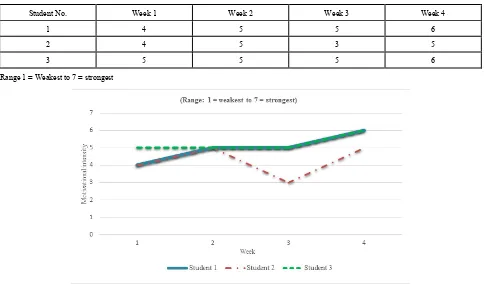
The level of motivational intensity each week is indicated in Table 2 and Figure 1 below.
Table 2. Weekly changes of motivational intensity
Student No. Week 1 Week 2 Week 3 Week 4
1 4 5 5 6
2 4 5 3 5
3 5 5 5 6
Range 1 = Weakest to 7 = strongest
[image:4.595.57.542.451.740.2]As the Table 2 and Figure 1 show, all three participants’ motivational intensity went higher towards the end of the program; student 1 and 2 started from the moderate level of four and ended with six and five respectively, while student 3 started with the strong level of five and finished with very strong level of six. They seem to designate that all the participants viewed generally the experience of the program positively, which enhanced their motivation. However, when you examine what the participants expressed verbally in the submitted learning logs, the change of motivation took place in a little more complex way. Table 3 below displays the actual indication of the change of their motivation written in the logs.
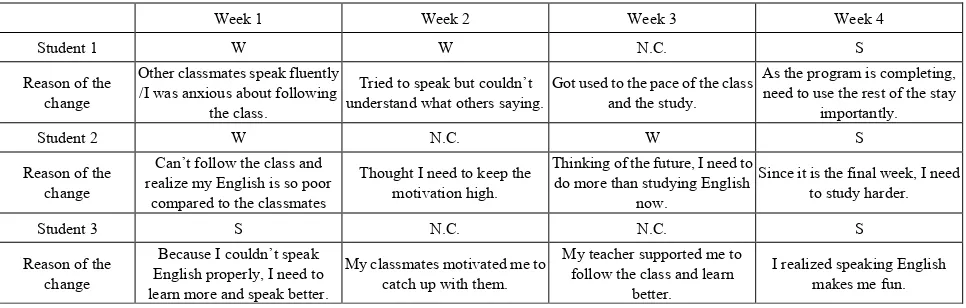
Table 3. Verbal indication of the change of motivation
Week 1 Week 2 Week 3 Week 4
Student 1 W W N.C. S
Reason of the change
Other classmates speak fluently /I was anxious about following
the class.
Tried to speak but couldn’t
understand what others saying. Got used to the pace of the class and the study.
As the program is completing, need to use the rest of the stay
importantly.
Student 2 W N.C. W S
Reason of the change
Can’t follow the class and realize my English is so poor
compared to the classmates
Thought I need to keep the motivation high.
Thinking of the future, I need to do more than studying English
now.
Since it is the final week, I need to study harder.
Student 3 S N.C. N.C. S
Reason of the change
Because I couldn’t speak English properly, I need to learn more and speak better.
My classmates motivated me to catch up with them.
My teacher supported me to follow the class and learn
better.
I realized speaking English makes me fun.
W = Weakened, N.C. = Not changed, S = Strengthened
Beside the level of motivation by Liker scale, the participants’ verbal indications of the change of attitudes and motivation by individually perceiving the learning context and environmental variables seem to demonstrate more precisely how each learner reacts to the environmental elements and determine their intentions and behaviors reflected upon them. In week 1, for example, student 1 and 2 wrote their motivation was weakened compared to before coming to Australia because they found peer learners’ level of English was far better than theirs and developed anxiety about participating in the lessons. This result coincides with the previous studies by Gardner et al., [20] and Busse and Walter [2]. Student 3, on the other hand, experienced similarly that her English did not work properly to communicate with other classmates or host family members, but the unsuccessful communication in English rather worked positively to enhance her motivation to study English. In week 2, the three participants reacted to the learning environment differently. Student 1 continued to take the learning experience negatively and further weakened her motivation, student 2 might have experienced the same as week 1 but determined to keep her motivation high deliberately, and student 3 took the difficult learning environment with better speakers of English positively and sought help from them to improve her English to catch them up. And in the final week log, the fact that the end of the program was approaching was perceived slightly differently among the participants. Students 1 and 2 determined to study harder because of the limited time remained, whereas student 3 started enjoying the lessons in the class where she needs to speak English more, which can be regarded as the elaboration and development of intrinsic motivation.
The verbal indication of the classroom factors that influenced their motivation exhibited quite similar results. All the three participants mentioned classmates and teachers influenced their motivation most strongly as the program proceeded. What needs to attract attention seems to be the participants’ different perceptions and their change of views on those peer students and teachers. The learners first found the different learning environment demotivating them because they learn with many other students from diversified cultural and L1 backgrounds with better fluency. They developed rather negative attitudes towards the better and more talkative classmates that caused their weakened motivation. As they spent more time in the learning context, however, they started accepting the different environment as a stimulus to learn English more with some help from supportive students and teachers as student 1 wrote below.
Student 1 Week 1 log:
Other Japanese students can speak English much better than me, which made me so worried.
Week 2 log;
When I find some students, who could communicate with others and teachers without hesitation, I feel so discouraged. But a teacher kindly paid more attention on me and encouraged me to speak up, I felt OK.
Week 3 log:
Some Argentinian students joined the class that made the class-level even higher, I felt, but I could develop an active attitude to converse with them.
Week 4 log:
[image:5.595.57.540.185.339.2]pair-works and discussions. The lessons are very different from that in Japan and I found them so fun. At the same time, I thought English study doesn’t have an end and it is not easy to acquire a language other than my mother tongue because it is related to my personality and living environment.
The participants’ reasons for learning English seem to be also elaborated and more internalized. Student 1’s original reason for learning English in Japan is compulsory subject in junior high school, and student 2 and 3’s reason is less elaborated intrinsic one such as “want to speak it fluently”. Student 1 developed more concrete intentions and autonomous attitude towards the future study of English, which can be more internalized ‘ought-to’ self as below.
Student 1 (Week 4 log):
I think I was good at grammar, but I found my speaking was so poor. In order to improve the speaking skill, I thought I needed more practical lessons for actual communication. I will try to speak more in English based on the learnt grammar in the class.
Student 3 elaborated her ‘ideal” self by having experienced the communication-oriented activities with other learners of different backgrounds as below.
Student 3 (Week 4 log):
My reason for learning English didn’t change (want to speak fluently) but as I experienced more communications in English with so many people from different backgrounds, I have a strong desire to improve my English now, so I can converse with them more naturally.
The above findings in the weekly learning logs are verified in the interviews. To the questions regarding the change of motivational intensity and the reasons for the change, all the three participants first mentioned that the factor most strongly affected their motivation was superior peer learners in the class. Their fluent speech in the lessons discouraged them first and weakened their motivation to learn; however, with some help from the students and teachers, they would gradually regard the situation as a challenge and aimed to catch up with the better classmates who might have been established as their temporal ‘ideal self’. The change in the perceptions of the same environmental factor is found in the comments made in the interviews by student 3.
Student 3 (1st interview):
Many Argentinian classmates are very good at English and can speak very fluently. I didn’t like them because they are too good to compete, but one Argentinian student who I made a pair with was very kind to help me, so I thought I should study harder.
Student 3 (2nd interview):
Well, I enjoyed having much conversation with classmates, I guess.
There are two other factors that affected positively their motivation mentioned in the interviews by the participants.
They are the differences in English lessons between Japan and Australia, and the Australian ‘must-use-English’ L2 learning environment. They described the difference of English lessons between the university in Japan and the study abroad program.
Student 1 (1st interview):
I think the distance between teachers and students is smaller in here than in Japan. I think it works positively.
Student 2 (2nd interview):
Well, the English class in Japan, as far as I experienced myself, is characterized as students being more receptive. Students are just in the class listening to teachers’ talk, I think, whereas classes here in Australia require us to have more conversations and group works that encourage us to speak more spontaneously. Activities, such as pair-works, I mean. I could be more active in the class, because I had never experienced them before.
Student 3 (1st interview):
We are inactive in the class in Japan, as we sit quietly, but here we have many chances to speak. I feel we definitely need to develop more English communication skills.
They also valued the L2 learning environment where they have to speak English to live, which encouraged them to learn and use English more. They mentioned the change of their views on L2 context in the interview.
Student 1 (2nd interview):
I think being here in Australia where I have to speak English everyday affected positively my motivation.
Student 2 (2nd interview):
[How do you evaluate this learning environment (must-use-English)?]
I think it was good to me. First, I couldn’t understand anything what people say, so I lost all my confidence (in English).
[Then, as you spent time in here, do you feel you have come to understand them better?]
Yes.
[Do you think that feeling, what you experienced here, leads your motivation to study English more?]
Yes.
with some additional factor, such as supports gained from teachers or kind peer students. Next section will discuss these findings based on the research questions.
5. Discussion
Research question 1: How does motivation of Japanese learners in study abroad program change, and what do they perceive as the factor affecting the change of motivation?
Despite that the quantitative data collected by Liker scale showed an upward trend of motivational intensity among the three participants, the up-and-downs of motivation did not display much variation within the four-week study abroad program. It seems to explain that the study abroad program positively affected the learners’ motivation and successfully developed their intentions to study English more. The detailed examination of the simultaneously collected qualitative data, however, indicated more motivational complications in each learner.
L2 learners in a study abroad program go through various psychological interactions within themselves and with environmental factors along with learning experiences inside and outside the classroom. Within these interactions, the learners’ expectations, perceptions, prior learning experiences and their L1 culture seem to work on their motivation in a complex way (Dörnyei & Ushioda [17]; Yu [23]). When the learners are in the study abroad program, they may well be excited with the target language environment, which enhances their motivation, due to in many cases the learners’ “overly positive expectations about the host country members at the beginning” (Kormos et al. [21]). However, this expectation can be easily overturned when they perceive the new learning context as overwhelming based on their realization of the much higher-level of proficiency required in and out of the classroom (Yu [23]). Probably because of a lack of concrete knowledge about their own level of verbal communication skills, they can be easily discouraged by the fact that there are students and native speakers whom they have to speak English all the time to communicate with. This negative perception of new learning environment generally results in a deterioration of motivation and infrequent contacts with native speakers or students with higher proficiency as Kormos et al. [21] noted. However, by perceiving the same environmental factor in a different way, a learner can challenge the strong demand from the context and develop motivation to learn English harder. She can take the required higher level of proficiency as a target to achieve and determine to cope with the learning situation more positively. Given this, there should not be a universally categorized factor that always affects typically in negative (or positive). Learning experience can have either positive or negative influence depending on each learner’s own perception of a particular
factor as Gu, Schweisfurth, & Day [24] stated that “the process through which learners change to fit in with the host culture differ depending on personal and situational factor” (p. 11).
Then, the perception seems to be partly related to the learner’s prior learning experiences. The gap between what learners experienced prior to the L2 learning environment could affect their motivation in either positive or negative way depending on how they perceive the current one in contrast with the one before. In the present study, the difference in the English classes between Japan and Australia seems to be prominent and they viewed what they experienced in the study-abroad program as an important requisite they missed in Japan and thus being necessary to develop their communication skill in English. By experiencing the novel lesson that they observed as the ‘missing link’ of the acquisition of speech fluency they desire, they perceived the current learning context positively which could enhance their motivation to learn English for future purpose. This may be supported by Negueruela-Azarole’s [8] claim that “learner’s reasoning explains their past as history from the present perspective to make sense of their future” (p. 198), and by Ushioda [25] who stated that learners are human beings and their motivation should be viewed “as an organic process that emerges through the complex system of interrelations” (p. 220).
Research question 2: How do the study abroad context and the learners’ learning experiences affect the development of their Ideal and Ought-to selves?
and job hunting. This seems to reflect on the participants’ English learning purpose and the lack of elaborated ‘self’ image.
Then, the experiences in the new learning environment in Australia could provide them with clearer views of their own level of English and exactly what more is needed to be advantageous as an English as L2 speaker. In other words, the learning experience helped them acquire the real image of future self as either ‘ideal’ or ‘ought-to’. The L2 selves should be an important motivational force once learners possess them as a real image as actually living human in the present world and society. In order to make this happen, L2 learners may require the learning experiences that help them realize the real present and future ‘self. The learning experiences, therefore, is a ‘cradle’ of developing a real and elaborated ‘selves’ by perceiving and interacting with contextual and educational elements reflected upon their preceding learning experiences and L1 cultural values attached to the target L2.
6. Conclusions
The present article investigated Japanese learners of English as L2 in a study-abroad program in Australia. The findings revealed that individual learner perceives the same learning contextual and environmental factors in their own way, interprets them to reflect on their current and future learning intentions and performances differently. Furthermore, the perceptions of the same learner on the
same contextual factors may change by some additional elements, such as supportive staff and peer learners. That is, there may not be a universally applicable classification that can clarify which contextual factor should work positively and which, negatively. Each learner is a living entity carrying their personal and cultural history, which should interact with current learning environment and affect the future behavior and performances. So is the development of ‘self’ by contextual interactions. Learners of English as a foreign language with only learning experience in their own countries may be more likely to fail in the development of ‘ideal’ or even elaborated ‘ought-to’ self, probably because of a lack of opportunities to communicate with speakers of English from different L1 backgrounds. The learners can neither possess a concrete target to achieve that should be a basis of ‘ought-to’ self or image a desired ‘ideal’ self. Learning experiences in diverse contexts, therefore, should be a needed element for the elaboration and acquisition of a vivid ‘self’ and as well as the exact and accurate image of real self.
The above discussion, however, is solely based on the current preliminary study on only limited number of participants in a short period of observation for four weeks. Further research on learners with multiple L1 backgrounds in different ages and gender is needed to examine the claims made in the present article, and understand better how L2 learners’ motivation can interact with other individual factors and contribute to each learner’s successful target language learning.
Appendix 1
Weekly Learning Log
1. What is your current level of motivation? Indicate the level by number 1 to 7 with 1 as the weakest to 7 as the strongest.
Extremely Very Very Extremely
Weak Weak Weak Moderate Strong Strong Strong
1 2 3 4 5 6 7
2. Compared to the previous experience of learning English in Japan, did you find your motivation was strengthened, weakened or not changed?
3. What do you think is the reason why your motivation was changed or not changed?
4. In the current study of English in Australia, what do you think influences most your motivation to study English? (e.g. class atmosphere, teachers, class mates, teaching materials, learning tasks, learning environment such as campus or chances to use English for communication with local people).
5. What was your primary reason why you learned English in Japan? (e.g. compulsory subject, required for entrance examination, wanted to speak English fluently).
Appendix 2
Interview Questions Interview No. ___
1. Is there anything that affected your motivation to study English since the beginning of the course/the last interview? Yes? – Did it affect positively or negatively?
2. If your motivation was affected either positively or negatively, what do you think affected your motivation in that way?
3. Compared to the beginning of the course, has your motivation been strengthened, weakened or not changed much? Why so?
4. What do you think now is the major difference in learning English in Japan compared to learning English in Australia?
5. As you learn (have studied) English in Australia, what do you think is most motivating you now to study English? That could include teachers, class mates, class atmosphere, language program, materials used, support from school, pressure to use English for communication with other people, encouragement from family or friends in Japan.
6. Do you think your reason for learning English has changed since you started the study in Australia? How did it change?
REFERENCES
[1] Dörnyei, Z., & Otto, I. (1998). Motivation in Action: A Process Model of L2 Motivation. Working Paper in Applied Linguistics. London: Thames Valley University.
[2] Busse, V., & Walter, C. (2013). Foreign Language Learning Motivation in Higher Education: A Longitudinal Study of Motivational Changes and Their Causes. The Modern Language Journal, 97, 2, 435-456.
[3] Campbell, E., & Storch, N. (2011). The Changing Face of Motivation: A Study of Second Language Learners’ Motivation over Time. Australian Review of Applied Linguistics, 34, 166-192.
[4] Kaboody, M, A. (2013). Second Language Motivation; The Role of Teachers in Learners’ Motivation. Journal of Academic and Applied Studies, 3 (4), 45-54.
[5] Kikuchi, K. (2009). Listening to our Learners’ Voices: What Demotivates Japanese High School Students? Language Teaching Research, 13, 4, 453-471.
[6] Koizumu, R., & Matsumo, K. (1993). A longitudinal study of attitudes and motivation in learning English among Japanese seventh-grade students. Japanese Psychology Research, 35, 1, 1-11
[7] Kozaki, Y., & Ross, S. J. (2011). Contextual Dynamics in Foreign Language Learning Motivation. Language Learning,
20:10, 40, 1-27.
[8] Negueruela-Azarola, E. (2011). Changing reasons as reasoning changes: a narrative interview on second language classroom motivation, tele-collaboration, and the learning of foreign languages. Language Awareness. 20, 3, 183-201. [9] Sakai, H., & Kikuchi, K. (2009). An Analysis of
Demotivation in the EFL Classroom. System. 37, 57-69. [10]Waninge, F., De Bot, K., & Dörnyei, Z. (2014). Motivational
Dynamics in Language Learning: Change, Stability, and Context. The Modern Language Journal, 98, 3, 764-723. [11]Dörnyei, Z. (2009). The L2 Motivational Self System. In Z.
Dörnyei, & E. Ushioda (eds.), Motivation, Language Identity and the L2 Self (pp. 1-42). Bristol: Multilingual Matters. [12]Gardner, R. C. & W. E. Lambert. 1959. Motivational
variables in second language acquisition. Canadian Journal of Psychology13: 266-272.
[13]Gardner, R. C. & W. E. Lambert. 1972. Attitudes and Motivation in Second Language Learning. Massachusetts: Newbury House Publishers Inc.
[14]Gardner, R. C. & P. D. MacIntyre. 1991. An instrumental motivation in language study: Who says it isn’t effective?
Studies in Second Language Acquisition,13: 57-72. [15]Ellis, R. (2008). The study of second language acquisition
2nd edition. Oxford: Oxford University Press.
[16]Dörnyei, Z. (2000). Motivation in Action: Towards a Process Oriented Conceptualization of Student Motivation.
British Journal of Educational Psychology, 70, 519-538. [17]Dörnyei, Z., & Ushioda, E. (2011). Teaching and
researching motivation. Harlow, UK: Pearson Education Ltd.
[18]Nakata, Y. (2013). Perspectives on L2 Motivation: Bridging the Gaps between Teachers, SLA Researchers and Teacher Educators. In M. T. Apple, D. D. Silva, & T. Fellner (Eds.),
Language learning motivation in Japan (pp. 309-325). Bristol: Multilingual Matters.
[19]Julkunen, K. (2001). Situation-and Task-specific motivation in foreign language learning. In Z. Dörnyei, & R. Schmidt (eds.), Motivation and second language acquisition (pp. 29-41). Honolulu: Second Language Teaching & Curriculum Centre University of Hawaii at Manoa.
1-34.
[21]Kormos, J., Csizér, K., & Iwaniec, J. (2014). A mixed-method study of language-learning motivation and intercultural contact of international students. Journal of
Multilingual and Multicultural Development. 35, 2,
151-166.
[22]Coleman, J. A. (2004). Study abroad. In M. Byram (Ed.),
Routledge encyclopaedia of language teaching and learning
(pp. 582-4). London: Routledge.
[23]Yu, B. (2013). Asian international students at an Australian University: mapping the paths between integrative
motivation, competence in L2 communication, cross-cultural adaptation, and persistence with structural equation modally, Journal of Multilingual and Multicultural Development, 34, 7, 727-742.
[24]Gu, Q., Schweisfurth, M., & Day, C. (2010). Learning and growing in a foreign context: intercultural experiences of international students. Compare. 40, 1, 7-23.