Journal of Chemical and Pharmaceutical Research, 2016, 8(7):273-279
Research Article
CODEN(USA) : JCPRC5
ISSN : 0975-7384
Examining the Relation Between Information Technology and
Promoting Services Quality in Shiraz Shahid Rajaie
Bahram Younesinia
1, Somayeh Hessam
2* and Abbas Yazdanpanah
31Department of Healthcare Management, Fars Science and Research Branch, Islamic Azad University, Marvdasht
Iran
Department of Healthcare Management, Marvdasht Branch, Islamic Azad University, Marvdasht Iran
2Assistant Professor, Department of Health Services Administration, Shiraz Branch, Islamic Azad
University, Shiraz, Iran
3Assistant professor, Department of Healthcare Management, Marvdasht Branch, Islamic Azad University,
Marvdasht Iran
_____________________________________________________________________________________________
ABSTRACT
The present study has been conducted in 1395 and with the aim of examining the relation between information technology and promoting services quality in Shiraz Shahid Rajaie hospital. This research statistical population was constituted from departmental managers and personnel of Shahid Rajaie hospital in Shiraz city whose number was equal to 138 and according to Cochran formula; the sample content was calculated 102 persons who were selected by simple sampling method and participated in the study. The questionnaire reliability was confirmed by Cronbach alpha coefficient. Modeling of structural equations was used for testing hypothesis and responding to the study questions. In this study, a main hypothesis and 6 secondary hypotheses were considered that after statistical analysis, the results showed that all the study hypotheses have been confirmed and there is a significant relation between information technology and promoting services quality.
Keywords: information technology, services quality, Shahid Rajaie hospital
_____________________________________________________________________________________________
INTRODUCTION
In the present organizations in which information technology and communications are completely dominant, the performance issue has undergone change and evolution. Each organization performance is dependent to that organization human sources performance and their interaction with available resources, facilities and technology in the organization (Jamaliat.al, 1392). On the other hand, human resources performance is dependent to their motivation and ability. Their human resources ability is dependent to occupational knowledge and skill in using the mentioned knowledge in performing occupational duties and activities. Human resources motivation is dependent to their attitude, condition and situation in which they are working. Today, the organizations consider information technology a tool by which aid improve the people performance and adjust to changes (Azhar, 2015). But, for these organizations to make their personnel performance more effective and efficient in respect of training and expert level, they should encourage their personnel to use technology in level with technology changes speed, on the other hand, information technology facilities managers' roles and duties. Access to required information for decision making, control and supervising on the organizations and processes, the possibility of analyzing conditions and analysis in acquiring decisions planning and simulation may have considerable impacts on information technology existence in the organization (TavasoliShakib, 1379).
2- Topical literature 1-2. What is technology?
Different definitions are provided for technology, some of which are mentioned in this section:
* Technology is a series of processes, methods, techniques, tools, equipment, machineries and skills by which stuff is made or provided.
* Technologyincludes sciences utilization in industries using oriented and regular studies and procedures.
* Science examines physical and natural behaviors by nature study and seeks to discover phenomena, while technology provides man required services and stuff using scientific ideas and achievements.
* Technology is the operant of turning natural resources, asset and human resources to stuff and services whose pillars or constituting elements include: hardware, human-ware or specialized human force , technology crystalized in documents or information and organizations or org-ware (Acar&Uzunlar, 2014).
2-2 What is information?
There are several definitions from information, some of which are based on meaning (semantic) and some are based on quantity. Some of these definitions include:
According to the definition of ELE lexicon, information includes all ideas, realities and mind creative works which are recorded, published or distributed formally or informally and in each state and they may be documentary or unofficial (Alraja&Alomian, 2013). Based on Mark standard, documentary information is in one of the following forms:
* Books: text materials which are as single mapping.
* Consequences: text materials which are repeated regularly like periodical publications * Maps: geographical cases like flat maps or spheres.
* Computer files: are used in various computers and software.
* Audio and visual cases: includes audio information, audio cassette and images * Combined states: is a combination of the above cases.
In definition based on information theory, information is a quantity which is measured by bits and then is defined based on possibilities of symbols emerging. In informatics dictionary, information includes a series of letter or symbol digital elements which has an evident and distinct notion and could be exposed to automatic process (Ajami& Arab-Chadegani, 2014).
3-2 Information technology concept
Regarding the definitions of technology and information several definitions have been provided for information technology, among which we can say that information technology:
* Is an incorporation of transmission achievements, methods and approaches of problem solving and leadership ability using computer knowledge (Malekiat.al, 1392)
* Contains issues relating to advanced subjects of computer science and technology, computer designing, information systems implementing and its application (Malekiat.al, 1392).
* Is an incorporation of traditional computer knowledge and information technology for storing, processing and exchanging any type of data ( including text, sound, image and so on) ( Fazlzadehat.al, 1393).
* Is a general word which is used for extending electronic services and products resulting from transmission and computer renovations ( GholipourKananiat.al, 1392).
* Includes all technology forms which are used for creating, storing and using different forms if information including commercial information, vocal conversations, moving images and multimedia data ( Javidi&Esmaielpour , 1393).
Information technology is a branch of technology which makes possible the studying and using data and its process in fields of storing, manipulating, transferring, managing, controlling and data preparation automatically using hardware, software and net-ware. The term information technology is repeatedly used in new and modern fields in different meanings. Maybe it could be said that the only agreement which exist on its meaning is that information technology is a hot issue (Chugh et.al, 2013).
4-2 Quality concept
Services quality is a relatively young scientific course and about two decades is passing from research in this context (Ajer, 2015). This word has different meanings for various people, then in the first step of improving services quality, we should have a clear perception of quality concept. Moreover, quality definition is not only significant in semantic respect but more importantly it will be director of personnel efforts for reaching higher quality services.
* Quality includes readiness of service or stuff for user which in itself requires designing quality, adaption, accessibility and appropriateness of service provision location.
* Quality doesn't have any meaning except what the customer really wants. In other words, a high quality product should be defined as the product adaption with the customer demand.
* International standards organization defines quality as follows: all features and specifications of the product or service which have the ability to meet the customer's needs (Alhawari&Alryalat, 2015).
5-2 Quality concept
This word has different meanings and includes a range of personal services as a product. This word even contains a wider domain. Due to this same span and complexity, during 60s to 80s a wide range of definitions has been provided relating to service, yet no universal definition was provided from service. By this description, here some definitions are pointed:
* Service: an activity or profit which is offered by one part to the other and is mainly inappreciable and doesn't include the possession of nothing, the result maybe a physical or non-financial product ( Katler, 1389).
* Service is the result which is demanding by customers (Katler, 1389).
* Service is profit production mainly intangible or automatically as an individual product or important element of tangible product which is meets the customer identified need trough a form of exchange (Tseng &Wu, 2014).
3- Research method
This study is enumerated among descriptive – survey studies in respect of data collecting method. In descriptive studies, the scholar is seeking the quality of the issue which includes collecting information for testing the hypothesis or answering questions relating the present status of studied issue (Sarmad et.al, 1385). This research statistical population includes managers and departmental personnel of ShahidRajaie Hospital in Shiraz city who were 138 persons that according to Cochran formula the research sample number was considered 102. For data collecting a questionnaire was used. The respective questionnaire was constituted from 42 questions and two parts. Services quality was assessed by 6 criteria of services physical quality, services warranty, communion, reliability and access and information technology variable was analyzed by 6 questions. And finally, for this research data analysis, first data were arranged and classified using Excel software and then they were analyzed using Lisrel software.
It should be mentioned that the questionnaire reliability has been assessed by advisor professor and its validity was evaluated by Cronbach alpha and its results are stated in table 1. Regarding the following results, the questionnaire questions have required validity.
Table 1. The questionnaire validity
Cronbach alpha components
0.793 total questionnaire
4- The research data analysis 4-1. Fitness test of conceptual model
In this section, the research conceptual model is mapped in the mould of diagram route and its fitness is assessed using various methods. A complete model of structural equations in fact indicates a mixture of route diagram and confirmatory factor analysis (CFA).
[image:4.595.145.472.114.308.2]Figure 1. significance numbers of the research structural model
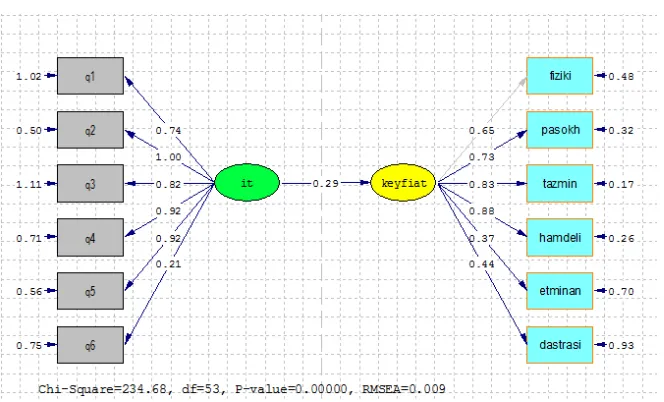
Figure 2. Standard estimation factors of the research structural model
Regarding to figure 1, it is distinctive that the effects of independent variables on dependent variables are significant (due to significance rates being more than 1.96) and based on figure 2, it is clearly observed that the relation between all model components is significant. Therefore, this model is confirmed.
2-4 Examining the research hypotheses
The research main hypothesis: there is a significant relation between information technology and services quality in Shiraz ShahidRajaie hospital.
Table 2- The relation output
route factor (β) significance number ( t-value)
route
to the variable from the variable
0.29 4.22
services quality information technology
[image:4.595.142.474.330.531.2]main hypothesis is confirmed and this result is obtained that information technology has a significant effect on services quality.
The research secondary hypotheses:
In this section, the research secondary hypotheses accuracy is examined using Pierson correlation test. Regarding to this test results, if significance level less than 0.05 is obtained, this result is acquired that there is a significant relation between two variables and the hypothesis is confirmed. This test result is observable in table 3.
1- There is a significant relation between information technology and services physical quality.
Regarding to the table, it is distinctive that the significance level between two variables has been obtained less than 0.05, then this result is obtained that there is a significant relation between two variables. The rate of this relation is 52.9%. So, this hypothesis is confirmed.
2- There is a significant relation between information technology and replication
Regarding the table, it is distinctive that between two variables a significance level less that 0.05 has been obtained. So, this result is obtained that there is a significant relation between two variables. This relation rate is 43.4%. Then, this hypothesis is confirmed.
3- There is a significant relation between information technology and warranty.
Regarding the table, it is clear that between two variables a significant level less that 0.05 has been obtained. So, this result is acquired that there is a significant relation between two variables. This relation rate is 48%. So, this hypothesis is confirmed.
4- There is a significant relation between information technology and communion.
Reading the table, it is specified that between two variables a significant level less that 0.05 has been obtained, then this result is acquired that there is a significant relation between two variables. So, this hypothesis is confirmed.
5- There is a significant relation between information technology and certainty.
Regarding the table, it is clear that between two variables, significance level less than 0.05 has been obtained, then this result is acquired that there is a significant relation between two variables. This relation rate is 25.9%. So, this hypothesis is confirmed.
6- There is a significant relation between information technology and accessibility.
Regarding the table, it is clear that between two variables a significant level less than 0.05 has been obtained, then this result is acquired that there is a significant relation between two variables. This relation rate is 27.5%. So, this hypothesis is confirmed.
information technology 0.529** Pierson correlation
physical quality significance level 0.000
102 number
0.434** Pierson correlation
replication significance level 0.000
102 number
0.480 Pierson correlation
warranty significance level 0.000
102 number
0.328** Pierson correlation
communion significance level 0.000
102 number
0.259** Pierson correlation
security significance level 0.000
102 number
0.275 Pierson correlation
accessibility significance level 0.000
102 number
5- Research findings:
study. In this study, services quality was assessed using 6 criteria of services physical quality, replication, services warranty, communion, reliability and accessibility.
The questionnaire reliability was confirmed using Cronbach alpha technique and combined validity. The relations between information technology and services quality were examined using modeling technique of structural equations (Lisrel software). The results showed that all relations are significant.
6- Suggestions for activists in the industry
* Based on the results obtained from research questionnaire analysis, there is a significant relation between information technology and services quality. Then, regarding the obtained results, it is suggested that the managers of Shiraz Rajaie hospital to increase the promotion level of using information technology in this hospital with more attention to information technology concepts and its applications. Today, providing suitable and appropriate services is considered among the most important concerns of service organizations. It should be noticed that one of important components about increasing the customers' satisfaction level to service providers' organizations like hospital is speed in receiving services form the organization. In this regard, today, most service provider organizations are moving towards becoming electronic and more usage of information technology in various dimensions. In the next part, some suggestions are provided with the aim of improving conditions of using information technology in Shiraz ShahidRajaie hospital.
* Notice to this point is necessary that information technology increases the quality of providing physical services provision in the hospital. In this respect, we can point to establishing electronic round in the hospital clinic, determining future rounds, referring the physicians non- personally.
* Among other advantages of information technology, we can point to increasing the reliability of services providers systems. By extension of using information technology, human mistakes are reduced and besides increasing services provision speed, the possibility of mistake error is decreased to great extent.
* Today, the rate of access to services is one of effective factors in increasing clients' satisfaction level from service provider organizations. Utilizing systems based on information technology and increasing non-personal services provision, besides increasing clients' access level to presentable services, will result in their satisfaction.
REFERENCES
[1]Ahmadabadi, S, Abbasi, M, AbbasiTalaie, A, ( 1392), the role of information technology on indicators of performance improvement in supply continuum management , the first national congress of business management, Hamedan, TolouaFarzin Industry and Science company, BoualiSina University
[2]Fazlzadeh, A, AsiabanRezaie, M, Tahooni, M, Tajvidi, M, (1393), examining the impact of implementing information technology on coherence and performance of supply continuum, national conference of modern approaches in business management, Tabriz, Tabriz University and industrial management organization
[3]Tavasoli, Shakib, M (1379), examining the impacts of data electronic exchange on increasing efficiency and facilitating international exchanges in Iran, M.A thesis, Mashhad, Mashhad Ferdosi University, faculty of economy and departmental sciences
[4]Javidi, A, Esmaielpour, M, (1393), the impact of using information technology and communications on occupational enabling of Boushehr city teachers, behavioral sceinces seasonal, 41-45
[5]Habibi, S, Saiedipour, B, (1391), examining the impact of information technology on the organization supply continuum, accounting national conference, financial management and investment, Gorgan: universal university of applied sciences, Golestan Province
[6]Haghshenas, Kashani, F, Ramezani, K, JamshidiAvaneki, M, (1393), the relation between using information and communications and the university personnel enabling, seasonal of information technology and communaications in educational sceinces, 3,65-68
[7]Sarmad, Z, Bazargan, A, W Hejazi, A, (1390), Research method in behavioral sceinces, Tehran, Nashragah publications (without history)
[8]GholipourKanani, Y, Atf, Z, Ardin, N, (1392), the role of information technology on performance of supply continuum (casestudy: a car manufacturer company), the second national conference of accounting, financial management and investment, Gorgan, Golestan managers and accountants vocational and scientific association [9]Katler, F (1389), marketing management, translated by Bahman Forouzandeh, Tehran, Rasa
[10]Maleki, R,Beig, M, Ghorbanzadeh, Y, (1392), the role of information technology and management of relation with customer in supply continuum, the second international conference of management, entrepreneurship , and economic development, p 12-23, Ghom, Payame Noor University
[12]Ajami, S., & Arab-Chadegani, R, (2014),the effects of applying information technology on jobempowerment dimensions, Journal of Eduacation and Health Promotion, 3.
[13]ALHawari, H., &Alryalat, L. (2015), THE RELATIONSHIP OF CUSTOMER KNOWLEDGE ,
KNOWLEDGE MANAGEMENT AND SERVICE QUALITY ON CUSTOMERSATISFACTION: A STUDY OF RETAIL ISLAMIC BANKING. E Proceeding of theInternational Conference on Social Science Research. Meliá Hotel Kuala Lumpur ,MalaysiaAlraja, M., &Alomiam, N. (2013). The Effect Of Information Technology In Empowerment
[14]Public Sector Employees: A Field Study., Interdisciplinary Journal Of Contemporary Research In Business, 5(1), 805-815.
[15]Azhar , S. (2015). The Relationship between Customer Knowledge and Customer RelationshipManagement Towards Service Quality in Malaysia. SSRN.
[16]Barros, A., Ishikiriyama, C., Peres, R., & Gomes, C. (2015). Processes and Benefits of theApplication of Information Technology in Supply Chain Management: An Analysis ofthe Literature. Procedia Computer Science, 55, pp. 698-705.
[17]Chugh, M.C. 2013.THE ROLE OF INFORMATION TECHNOLOGY IN KNOWLEDGE MANAGEMENT .Conference on Advances in Communication and Control Systems p . 688 - 693 . Atlantis Press.