Journal of Chemical and Pharmaceutical Research, 2016, 8(7):249-255
Research Article
CODEN(USA) : JCPRC5
ISSN : 0975-7384
Development and Evaluation of Polyherbal Tablet Formulation with Potent
Anti-Inflammatory and COX-2 Inhibitory Activity
Nasreen Begum
1*, Srisailam K.
1and Uma Maheshwararao V.
21Department of Pharmacognosy, University College of Pharmaceutical Sciences, Satavahana University,
Karimnagar, Telangana, 505001, India
2Department of Pharmacognosy, CMR College of Pharmacy, Kandlakoya (V), Medchal Road, Ranga Reddy,
Telangana, 501401, India
_____________________________________________________________________________________________
ABSTRACT
The main objective of the present study was to develop a polyherbal solid dosage formulation and to evaluate anti-inflammatory activity with specific COX-2 inhibitory activity. Based on the available traditional and scientific literature, plants that possess anti-inflammatory activity were selected. The extracts were prepared by successive soxhlation using solvents like petroleum ether, chloroform, ethyl acetate, methanol and water. In vitro evaluation of the extracts was done by HRBC membrane stabilisation method using diclofenac sodium as standard to study the anti-inflammatory activity. In vitroCOX-2 inhibitory activity of the same extracts was evaluated by enzyme immunoassay method. Herbal tablets were prepared by direct compression method by using the fractions with potential COX-2 inhibitory activity obtained by fractionation of the active extracts by column chromatography. Five tablet formulations with varying concentration of the active fractions of various herbs were prepared and standardised. All the formulations were further studied for specific COX-2 inhibitory activity among which, Polyherbal formulation IV proved to show pronounced invitro COX-2 inhibitory activity.
Keywords: Polyherbal tablet, COX-2 inhibitory activity, HRBC membrane stabilisation, enzyme immunoassay
_____________________________________________________________________________________________
INTRODUCTION
Since the evolution of mankind plants have played an important role. They have been used as important sources in treatment of various ailments. Plants serve as an important source of chemicals for development of novel drugs. Throughout the world, many traditional systems of medicines have been formed based on the medicinal properties of plants thus, providing natural remedies for treatment of various diseases. A path has been laid for novel drug discovery depending on the Plant based medicines, which are being dispensed in the form of crude drug. Plants serve as an important source in providing basic chemical moieties in development of modern drugs and till date many active compounds isolated from plants are being used in modern medicine. From vast diversity of plant kingdom many active compounds of pharmacological importance can be isolated. Many herbs possess anti-inflammatory activity. For the present study plants like, Zingiber officinale(rhizomes), Curcuma longa(rhizomes),
Rosmarinus officinalis(leaves), Matricaria recutita(flowers), Berberi saristata(roots), Origanum vulgare(leaves),
rheumatic complaints [7]. For thousands of years oregano has been used for it's effective culinary, cosmetic and folklore medicine. It has been reported that oregano has a property to neutralise the COX-2 enzyme which is associated with tissue inflammation [8]. Gaultheria commonly called as wintergreen contains active constituent methyl salicylate which inhibits the release of COX enzyme affecting the release of prostaglandins, PGF2a and PGE2 and thromboxanes [9]. Tulsi has a long history of medicinal value. It is a natural modulator of COX-2 enzyme. Like many modern pain killers, it may act by inhibiting COX-2 enzyme. This may be due to it's high eugenol concentration [10]. It acts by blocking both cyclooxygenase and lipooxygenase pathway or metabolism of arachidonic acid [11]. Today’s modern anti-inflammatory drugs are either steroidal or non-steroidal and have been reported to show undesirable side effects ranging from gastrointestinal irritation to cardiovascular effects [12]. In view of this,plant derived compounds or other naturally derived sources are especially important to be developed into anti-inflammatory drugs. Moreover, considering the resulting side effects of COX-1 inhibitors, herbs selectively inhibiting COX-2 enzyme need to be studied. Hence, in the present study an attempt was made to formulate a polyherbal tablet with specific COX-2 inhibitory activity in order to prevent or reduce the side effects caused by modern COX-2 inhibitors.
EXPERIMENTAL SECTION
Plants
For the present investigation, Ginger , Turmeric rhizomes, Chamomile Flowers were obtained from local market, Holy basil leaves were collected from the local surrounding areas, Rosemary leaves, Barberry Root were obtained from Yucca Enterprises, Mumbai, Oregano leaves, Gaultheria leaves, were obtained from Munnalaldawasaz, Hyderabad.
Chemical and reagents
Diclofenac sodium was obtained from Mangalam Drugs and Pharmaceuticals Ltd, Wapi, Gujarat. Starch, talc, magnesium stearate and lactose were procured from Colorcon Asia Pvt. Ltd – Mumbai, India,All the solvents were procured from E. Merck, Mumbai. The colorimetric human COX-2 inhibitor screening kit (Item No. 560131) used for in vitroCOX-2 inhibitory activity was manufactured by Cayman Chemical, USA. The contents of the kit includes, PG screening EIA antiserum, PG screening AChE tracer, PG screening EIA standard, EIA buffer concentrate,wash buffer concentrate, polysorbate 20, mouse antirabbitIgG coated plate, 96 – well cover sheet, Ellman’s reagent, reaction buffer, COX – 1 (ovine), COX – 2 (human recombinant), heme, arachidonic acid (substrate), potassium hydroxide, hydrochloric acid, stannous chloride.
Preparation of extracts
Required plant material was carefully separated and checked for foreign matter and shade dried. The drug was powdered by using a laboratory grinder and sieved after complete drying.50 g of powdered drug of each plant was subjected to successive soxhlation by using solvents, petroleum ether (60 - 80 o C), chloroform, ethyl acetate, methanol and water for 8 hours. The solvent extracts obtained were further concentrated in vacuo by using rotary vacuum evaporator and then, dried in a desiccator.
Evaluation of In Vitro Anti-inflammatory activity
In vitro anti-inflammatory activity of the extracts was performed stabilisation of human red blood cells[13].HRBCs (human red blood cells)were prepared by centrifugation of 5ml of blood from healthy donors from which supernatant was separated and the packed cells resuspended in an equal volume of isosaline and centrifuged. Centrifugation was repeated until a clear supernatant was observed and a 10% HRBC suspension was then prepared with normal saline and stored at 4 0 C until use. The reaction mixture (4.5 ml) was prepared by mixing 2ml hyposaline (0.25% w/v NaCl), 1 ml of isosaline buffer solution, pH 7.4 (6.0 g TRIS, 5.8g NaCl, HCl to regulate the pH and water to make 1000 ml) and varying volumes of the extract solution in isotonic buffer (concentration, 10mg/ ml) to make the volume to 4.0 ml. Then 0.5 ml of 10% HRBC in normal saline was added. Two controls were performed. One with 1.0 ml of isosaline buffer instead of extract (control 1) and another with 1 ml of extract solution and without red blood cells (control 2). The contents were incubated at 560C for 30 min. The tubes were cooled under running water for 20 min. The mixture was centrifuged, and the absorbance of the supernatant was read at 560 nm. Diclofenac sodium was usedas standard. The percentage of membrane stabilization was determined using the formula
(Extract absorbance value – control 1 absorbance value) 100 – --- × 100
Control 2 absorbance value
Evaluation of in vitro COX-2 inhibitory activity
In vitroCOX-2 inhibition was evaluated by enzyme immunoassay [14]. For this, enzyme immunoassay (EIA) kit
(Catalogue No.560131, Cayman Chemical, Ann Arbor, MI, USA) was used according the Manufacturer’s instructions. The ability of the test compound to inhibit COX-2 (human recombinant) was determined. The test compound was dissolved in DMSO, and the solution was made at the final concentration of 10 µM. A reaction buffer solution (960µl, 0.1M Tris-HCL, pH-8 containing 5 mM EDTA and 2 mM phenol) containing COX-2 enzyme (10 µl) in the presence of heme (10 µl) was added with 10 µl of 10 µM test drug solution. These solutions were incubated for a period of 10 min at 37
o
C after then 10 µl of AA solution was added followed by stopping the COX reaction by addition of 50 µl of 1 M HCL. Prostaglandins are one of the active mediators of inflammation formed by biosynthesis arachidonic acid (AA) to PGH
2 catalysed by cyclooxygenase enzyme catalyses the first step in the biosynthesis of the arachidonic acid (AA). PGH
2 by reduction with stannous chloride (100 µl) forms PGF2α ,
which is measured by enzyme immunoassay. The amount of PG tracer is kept constant and varying amount of PGs is added to the well which already contains PG antiserum. PGs and PG-acetyl cholinesterase conjugation (PG tracer) compete for the limited amount of PG antiserum. The amount of PG tracer that is able to bind to the PG antiserum is inversely proportional to the concentration of PGs in the well.Ellman’s reagent, which contains substrate to acetylcholine esterase, is added after washing the plate to remove any unbound reagents. This enzymatic reaction gives a distinct yellow colour, which is determined by spectrophotometerically (Micro titre Plate reader) at 412 nm, Absorbance is directly proportional to the amount of PG tracer bound to the well and inversely proportional to the amount of free PGs present in the well during the incubation:
Absorbance α [Bound PG tracer] α 1/PGs.
Percentage inhibition was calculated by the comparison of compound treated by control incubations.
Fractionation of active extracts
The active extracts showing good COX-2 inhibitory activity were subjected to column chromatography using silica gel glass column(60-120 mesh)[15].The active crude extracts were placed on the top of the column and various fractions of the active extracts were eluted by passing the suitable mobile phase through the packed column in different ratios. The COX-2 inhibitory activity of the various fractions isolated by column chromatography was observed by in vitro enzyme immunoassay and the fractions with potential COX-2 inhibitory activity were used for the preparation of herbal formulation.
Development of formulation
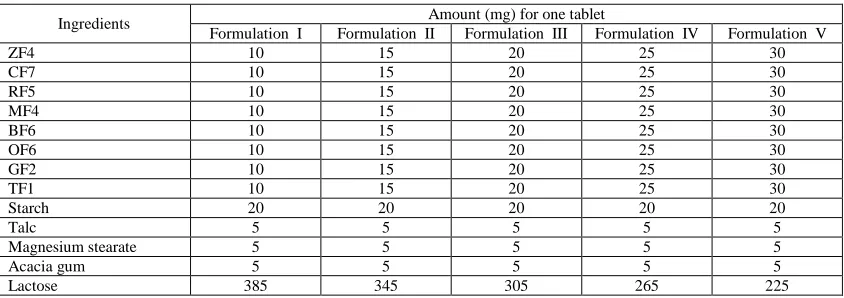
[image:3.595.96.518.598.747.2]Five formulations namely formulation I, formulation II, formulation III, formulation IV and formulationVwith varying concentrations of the active fractions were developed. According to the formulation, required quantity of each isolated fractions with potential COX-2 inhibitory activity and other ingredients were weighed, ground separately. Then the ingredients were screened through sieve number 80. All the ingredients except talc and magnesium stearate were mixed together and milled in a mortar pestle. The milled mixture was passed through sieve number 80. Then acacia gum solution, was slowly added to the milled mixture. This powder mass was screened through sieve number 18to obtain granules. The granules were dried at 35°C in vacuum dryer. The dried granules were passed through sieve no. 18 in order to remove bigger granules and stored in desiccators [16].The formulation details are mentioned in table no 1.
Table 1: formulation details of polyherbal tablet”
Ingredients Amount (mg) for one tablet
Formulation I Formulation II Formulation III Formulation IV Formulation V
ZF4 10 15 20 25 30
CF7 10 15 20 25 30
RF5 10 15 20 25 30
MF4 10 15 20 25 30
BF6 10 15 20 25 30
OF6 10 15 20 25 30
GF2 10 15 20 25 30
TF1 10 15 20 25 30
Starch 20 20 20 20 20
Talc 5 5 5 5 5
Magnesium stearate 5 5 5 5 5
Acacia gum 5 5 5 5 5
Preparation of polyherbal tablets
Power blends according to each formulation, were compressed to 500 mg tablet by using hand rotating single punch tablet presses with appropriate compression pressure. The granules were mixed with talc which acts as lubricant, and magnesium stearate which acts as glidant, before punching. The die cavity was adjusted for required weight and the Preformulation studies [17]for various parameters were conducted before compression of the powder blend to tablets.
Evaluation of Polyherbal Tablets
The following post-compression parameters were employed for evaluation standardisation of tablets[18, 19].
General appearance: The physical appearance of the tablet involving colour, odour and texture were observed.
Percentage Weight variation: 20 tablets were randomly selected and average weight was noted. Then each tablet was weighed individually. The deviation of each tablet from the average weight was then observed and expressed as percentage deviation from the average weight.
Hardness test: In order to resist the mechanical shocks during handling processes a certain amount of strength or hardness is required for the tablet. Monsanto hardness tester was used to determine the hardness of randomly selected 20 tablets.
Percentage friability test: The percentage of weight loss of randomly selected 20 tablets was observed after tumbling them into Roche friabilator at a speed of 25 rpm for 4 minutes Disintegration test: Digital microprocessor based disintegration test apparatus (basket rack assembly, Lab India) was used to determine the disintegration of the tablets. One tablet was introduced into each tube and a disc was added. The total assembly was suspended in a 1000 ml beaker filled in with water. The volume of water was such that the wires mesh at its highest point (at least 25 mm) below the surface of the water, and at its lower point (at least 25 mm) above the bottom of the beaker. The apparatus was operated and maintained at 37±2°C. The time required for disintegration of all the tablets was noted.
Statistical analysis
Data were expressed as mean ± SEM, where, n = 3, p ≤ 0.05 was considered to be statistically significant.
RESULTS AND DISCUSSION
From the investigations it has been revealed that various herbal preparations have capability of stabilizing red blood cell membrane leading to anti-inflammatory effect. Percentage of membrane stabilisation is directly correlated to anti-inflammatory response since, HRBC membrane is similar to that of lysosomal membrane[20] and thus, stabilisation of lysosomal membrane prevents the release of lysosomal enzymes responsible for inflammation. The test extracts were studied by in vitro method using COX catalysed prostaglandin biosynthesis assay to evaluate the COX-2 inhibitory capacity. Fromthe in vitro studies it is evident that methanolic extracts of Ginger, Rosemary,
Oregano, Gaultheria, Holybasil and aqueous extracts of Turmeric, Chamomile, Barberry were found to have
"Table 2: Percentage of membrane stabilization of various extracts"
PEE – petroleum ether extract. CE – chloroform extract, EAE – ethyl acetate extract, ME – methanolic extract, AE – aqueous extract.
"Table 3: Percentage COX-2 inhibition of various extracts"
Extract PEE CE EAE ME AE
Concentration (µg/ml)
Herb 300 500 300 500 300 500 300 500 300 500
Percentage COX-2 inhibition of various extracts
Ginger 30.12 ±0.01 36.42 ±0.02 52.43 ±0.05 59.13 ±0.01 63.14 ±0.01 69.56 ±0.04 73.62 ±0.01 79.55 ±0.02 42.31 ±0.02 51.42 ±0.02
Rosemary 40.26 ±0.02 42.9 ±0.02 55.82 ±0.02 57.32 ±0.05 51.44 ±0.04 53.53 ±0.03 68.49 ±0.01 74.59 ±0.03 56.26 ±0.02 61.33 ±0.04
Turmeric 51.12 ±0.02 ±0.03 56.36 52.16 ±0.04 59.07 ±0.02 ±0.02 55.26 66.12 ±0.03 ±0.01 61.67 67.41 ±0.02 ±0.02 78.26 85.21 ±0.03
Chamomile 35.21 ±0.01 42.9 ±0.03 45.82 ±0.04 47.32 ±0.04 38.59 ±0.05 41.43 ±0.02 35.44 ±0.05 39.68 ±0.03 60.46 ±0.01 68.62 ±0.03
Barberry 56.11 ±0.03 60.43 ±0.02 36.38 ±0.02 40.42 ±0.04 44.65 ±0.03 50.28 ±0.02 55.66 ±0.04 61.62 ±0.03 73.66 ±0.02 78.12 ±0.01
Oregano 45.62 ±0.01 ±0.02 49.93 35.68 ±0.03 39.62 ±0.04 ±0.01 48.65 54.79 ±0.02 ±0.01 68.86 74.52 ±0.03 ±0.05 50.36 52.72 ±0.05
Gaultheria 36.52 ±0.02 43.82 ±0.04 47.16 ±0.03 52.23 ±0.34 44.69 ±0.01 50.31 ±0.02 70.32 ±0.01 78.19 ±0.02 50.23 ±0.05 54.46 ±0.03
Holy basil 42.34 ±0.01 48.12 ±0.03 38.69 ±0.02 42.59 ±0.02 46.42 ±0.01 50.32 ±0.03 62.42 ±0.02 69.46 ±0.01 52.34 ±0.05 56.24 ±0.04
“Table 4: column chromatography studies”
Plant
Extract used for column chromatography Mobile phase No of fractions isolated
Name of the fractions fraction Active
Zingiberofficinale Methanolic Pet. ether: CHCl3 in
the ratio of 9:1, 7:4, 5:5 6 ZF1,ZF2,ZF3,ZF4,ZF5,ZF6 ZF4
Curcuma longa Aqueous CHCl3:CH3OH in the
ratio of 9:1, 7:4, 5:5 8 CF1,CF2,CF3,CF4,CF5,CF6,CF7,CF8 CF7
Rosmarinusofficinalis Methanolic the ratio of 9:1, 7:4, 5:5 Pet. ether: CHCl3 in 7 RF1,RF2,RF3,RF4,RF5,RF6,RF7 RF5
Matricariarecutita Aqueous CHCl3:CH3OH in the
ratio of 9:1, 7:4, 5:5 7 MF1,MF2,MF3,MF4,MF5,MF6,MF7 MF4
Berberisaristata Aqueous CHCl3:CH3OH in the
ratio of 9:1, 7:4, 5:5 8 BF1,BF2,BF3,BF4,BF5,BF6,BF7,BF8 BF6
Origanumvulgare Methanolic Pet. ether: CHCl3 in
the ratio of 9:1, 7:4, 5:5 7 OF1,OF2,OF3,OF4,OF5,OF6,OF7 OF6 Gaultheria
Procumbens Methanolic
Pet. ether: CHCl3 in
the ratio of 9:1, 7:4, 5:5 5 GF1,GF2,GF3,GF4,GF5 GF2
Ocimumsanctum Methanolic Pet. ether: CHCl3 in
the ratio of 9:1, 7:4, 5:5 4 TF1,TF2,TF3,TF4 TF1
Extract PEE CE EAE ME AE
Concentration (µg/ml)
Herb 300 500 300 500 300 500 300 500 300 500
Percentage inhibition of various extracts
Ginger 36.43 ±0.02 44.38 ±0.01 52.42 ±0.05 59.23 ±0.01 62.64 ±0.02 66.43 ±0.05 71.93 ±0.03 78.64 ±0.04 49.64 ±0.02 55.29 ±0.02
Rosemary 44.31 ±0.04 47.57 ±0.01 51.26 ±0.03 53.56 ±0.02 59.14 ±0.02 62.52 ±0.02 81.56 ±0.01 84.27 ±0.02 52.75 ±0.05 56.43 ±0.03
Turmeric 49.52 ±0.03 53.46 ±0.03 56.23 ±0.05 60.40 ±0.01 61.48 ±0.03 64.69 ±0.04 66.36 ±0.04 72.62 ±0.03 80.92 ±0.03 85.66 ±0.04
Chamomile 48.51 ±0.01 ±0.03 53.72 43.34 ±0.04 51.75 ±0.02 ±0.02 65.24 69.68 ±0.03 ±0.01 56.67 61.37 ±0.03 ±0.02 72.25 82.43 ±0.01
Barberry 46.26 ±0.02 51.12 ±0.04 35.56 ±0.03 39.48 ±0.04 49.54 ±0.01 54.52 ±0.03 59.91 ±0.02 62.56 ±0.02 79.24 ±0.01 83.67 ±0.01
Oregano 20.80 ±0.01 23.90 ±0.03 30.75 ±0.04 34.95 ±0.02 45.44 ±0.02 46.05 ±0.03 79.44 ±0.01 84.34 ±0.01 49.26 ±0.02 52.43 ±0.01
Gaultheria 38.45 ±0.01 ±0.02 43.07 46.94 ±0.03 52.23 ±0.04 ±0.01 58.89 60.02 ±0.03 ±0.03 65.62 68.69 ±0.03 ±0.05 30.92 34.69 ±0.03
Holy basil 38.64 ±0.02 44.92 ±0.05 46.69 ±0.01 51.09 ±0.02 55.33 ±0.03 58.49 ±0.04 78.22 ±0.01 86.14 ±0.04 50.69 ±0.05 53.08 ±0.03 Diclofenac 84.73±0.01 88.45±0.01
“Table 5: Pre-formulation studies of powder blend”
Parameters Powder blend of
Formulation I Formulation II Formulation III Formulation IV Formulation V Angle of repose 28.2±1.32° 28.1±1.51° 26.3±1.15° 30.2±1.41° 28.3±1.31° Loose bulk
density (g/cm3) 0.334±0.016 0.325±0.015 0.319±0.025 0.354±0.023 0.342±0.019 Tapped bulk
density (g/cm3) 0.556±0.005 0.522±0.016 0.532±0.008 0.552±0.017 0.561±0.015 Hausner ratio 1.39±0.018 1.34±0.016 1.44±0.024 1.46±0.015 1.38±0.039 Compressibility
index (%) 25.23±1.32 23.72±1.28 29.52±1.18 31.31±1.36 32.24±1.15 Loss on drying
(%) 0.95±0.009 0.98±0.011 0.97±0.019 0.96±0.009 0.97±0.006
“Table 6: Evaluation of formulated herbal tablets”
Parameters Formulation I Formulation II Formulation III Formulation IV Formulation V Colour Brownish Green Brownish Green Brownish Green Brownish Green Brownish Green Odour Characteristic Characteristic Characteristic Characteristic Characteristic
Texture Smooth Smooth Smooth Smooth Smooth
%WeightVariation(±5%) 2.11±0.017 1.26±0.012 2.12±0.008 1.07±0.003 1.61±0.006
Hardness(Kg/cm2) 7.5±0.25 6.7±0.36 6.5±0.31 7.3±0.52 7.1±0.42
% Friability(NMT 1%) 0.57±0.012 0.68±0.024 0.65±0.0032 0.54±0.0016 0.44±0.015
Disintegration (minutes) 14±1.12 13±1.24 11±1.76 11±1.03 12±1.12
"Table7: Percentage COX-2 inhibition of various formulations"
Tablet formulation % COX-2 inhibition Formulation I 62.49±0.02 Formulation II 70.24±0.01 Formulation III 74.54±0.01 Formulation IV 86.21±0.03 Formulation V 82.62±0.02
The percentage friability studies indicated that the tablets are mechanically stable. The acceptable range of weight variation is ±5%and all the tablet formulations passed the weight variation test. An ideal tablet should disintegrate within 15min. All the tablet formulation disintegrated within 13 minutes. The post formulation results mentioned in table no 6.In view of the positive standardisation results of the herbal tablets all the five formulations were assessed for in vitro COX-2 anti-inflammatory activity among which, formulation IV showed significant COX-2 inhibition in comparative to other formulations (table 7). This showed the possible anti-inflammatory mechanism of the formulation is by COX-2 inhibition.
CONCLUSION
From the pharmaceutical and pharmacological evaluation of this study it can be envisaged thatplants form a better source for anti-inflammatory as well as COX-2 inhibitory drugs from which more potent drugs with lesser side effects can be prepared by isolating active constituents from the crude active fractions which holds a great promise in competing with the modern COX-2 inhibitors.
Acknowledgements
The first author is thankful to Department of Science and Technology (DST), Government of India, New Delhi for sanctioning INSPIRE fellowship.
REFERENCES
[1] KC Srivastava; T Mustafa,Medical Hypotheses, 1989, 29, 25-28.
[2] MT Huang;T Lysz;T Ferrara;AH Conney. In: Cancer Chemoprevention, L Wattenberg;M Lipkin;CW Boone;Kelloff (eds).CRC press, 1992;375-391.
[3] JR Chi Pault;GR Mizuno;JM Hawkins; WO Lundberg, Food Res., 1952, 17, 46-55. [4] R Inatanietal,AgriBiol Chem.,1983, 47, 521-528.
[5] DL Mckay; JB Blumberg,Phytotheraphy Research, 2006, 20 (7), 519-530.
[6] JK Srivastava; S Gupta. Health promotion benefits of chamomile in the elderly population. In: R Watson Ronald, editor. Complementary and Alternative Therapies in the Aging Population, Elsevier Inc, Academic Press, 2009. [7] N Ivanovska; S Philipov,Int J Immunopharmacol., 1996, 18, 553-561.
[10] P Prakash;N Gupta,Indian Journal of Physiology and Pharmacology, April 2005, 49 (2), 125-131. [11] S Singh;DK Majumdar;HM Rehan, J of Ethnopharmacol., Oct 1996, 54 (1), 19-26.
[12] PN Praveen rao; EK Edward,J Pharm Pharmaceut Sci., 2008,11(2), 81S-110S.
[13] E Mongeli;C Desmarchelier;J Coussio;G Ciccia,Journal of Ethnopharmacology,1997,56, 117-121. [14] P Pradelles;J Grassi; JA Maclouf,Annal. Chem., 1985, 57, 1170-1173.
[15] S.Revathy; S. Elumalai;Merina Benny; Benny Antony,Journal of Experimetal Sciences,2011, 2, 21-25. [16] NB Ghiware;SG Gattani;SS Chalikwar,Int J Pharm Tech Res., 2010, 2(1),171-176.
[17] ME Aulton. Pharmaceutics: The science of Dosageform. Churchill Livingstone, 1996; 304.
[18] L Lachman;HA Lieberman;JL Kanig.The theoryand practice of industrial pharmacy, 3rd edition.Varghese Publishing House, New Delhi, 1987;293-639.
[19] Anonymous.Indian Pharmacopoeia.Governmentof India, Ministry of Health and Family Welfare Controller of Publication, New Delhi, 2007.