Reviewing the Grades, Activities and Assessment in an Engineering
Technology Course with relation to the Learning Styles
Chee-Ming Chan
Centre for Graduate Studies
Universiti Tun Hussein Onn Malaysia
Johor, Malaysia
[email protected]
Alina Shamsuddin
Centre for Academic Development and Training
Universiti Tun Hussein Onn Malaysia
Johor, Malaysia
[email protected]
Azeanita Suratkon
Faculty of Civil and Environmental Engineering
Universiti Tun Hussein Onn Malaysia
Johor, Malaysia
[email protected]
Abstract
There are generally eight (8) main categories of learning styles, namely sensing, intuitive, visual, verbal, active, reflective, sequential and global. However it remains uncertain which combination is most effective in the teaching and learning of an engineering technology course. Considering that the preference of learning style and technique could be dependent on individual temperament as well as the course contents and nature, it is not an easily resolved matter. The paper examines the activities and assessment conducted for the engineering technology undergraduate course of Soil Mechanics and Foundations with relation to the learning styles. Students were asked to complete an online evaluation exercise (“Index of Learning Styles Questionnaire” by Solomon and Felder, based on the Felder-Silverman model (Felder and Silverman, 1988) to determine their preferred ways of learning. Analysis was then performed to determine the match or mismatch between the most favoured learning approach and the activities / assessment embedded in the course. The results indicate certain levels of hit on the mark, though much room for improvement was also identified to make the course more deliverable in terms of effective learning. As the course was essentially a technical subject with emphasis on technology adoption and applicability for practical solutions, conventional lectures were found to be the least desirable by students. Problem-based learning with exposure to actual field conditions and challenges appeared to draw greater enthusiasm and interest among the students, leading to better delivery of the course contents where students were able to relate theoretical knowledge with field applications.
Keywords
soil mechanics and foundations, undergraduate, learning styles and activities, effective learning, assessment
1. Introduction
The styles and approaches of learning vary, but they can be broadly characterized as deep or surface learning (Marton and Booth, 1997). Both approaches disregard the contents of learning, but attribute the outcomes of the learning process as consequences of the engagement adopted. In general, deep learning involves active engagement
while surface learning uses routine memorization, leading to personal understanding and mimicry or reproduction respectively. It was also reported that the intentions and motives associated with assigned tasks within an overall learning context have significant impact on the effectiveness of learning (Biggs, 1993; Marton et al., 1997 and Tait and Entwistle, 1996). Educators need to be consciously aware of the subject matter, as well as the way the materials may be received by the students, i.e. understood, misunderstood or experienced (Laurillard , 1993). To assume that a single mode of delivery could cater for the needs of all students is unrealistic and doomed to fail, resulting in ineffective and counter-productive learning (Watson and Hardaker, 2005 and Wall et al., 2006).
Recognizing the strong influence of learning styles on the students’ learning experience, a small study of a class of 31 students in a core course of the Bachelor of Civil Engineering Technology programme was conducted, with the primary aim of ascertaining the congruence of the prescribed tasks / activities, assessment method and learning styles of the students. An examination of the students’ preferred learning styles in relation to the overall course and programme was also conducted. The survey was carried out using the Felder-Silverman online questionnaire and evaluation template (Felder and Silverman, 1988). Based on the post-mortem findings, some recommendations are included at the end of the paper for improving the overall learning experience of the course for future students.
2. Learning Outcomes, Activities and Assessment
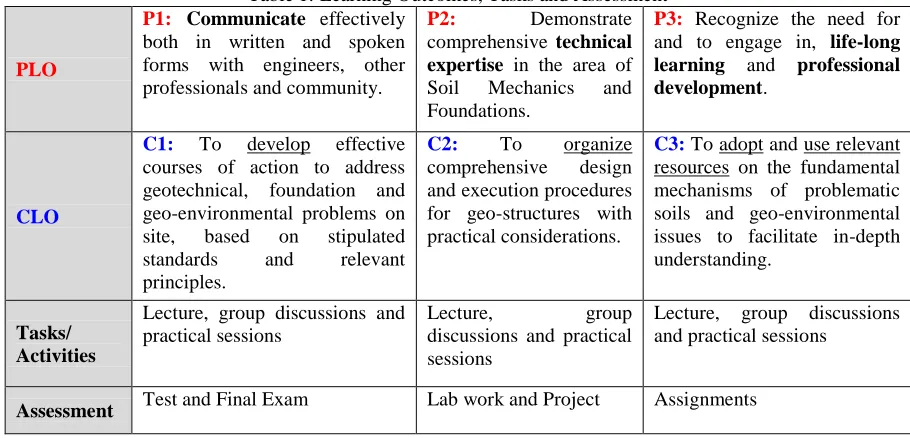
[image:2.612.80.537.337.557.2] [image:2.612.77.532.340.559.2]Soil Mechanics and Foundations is a core course in the undergraduate Civil Engineering Technology programme. The Course Learning Outcomes (CLOs) are outlined in tandem with the Programme Learning Outcomes (PLOs), as summarized in Table 1. Note that the activities and assessment methods are also included for ease of reference. It is apparent that the course activities were designed to meet the learning outcomes intended, with assessment methods tailored to suit the particular tasks assigned. While the mapping appears to be feasible and realistic on paper, it remained uncertain to what extent the prescribed tasks actually led students towards achieving the outcomes.
Table 1: Learning Outcomes, Tasks and Assessment
PLO
P1: Communicate effectively both in written and spoken forms with engineers, other professionals and community.
P2: Demonstrate
comprehensive technical expertise in the area of Soil Mechanics and Foundations.
P3: Recognize the need for and to engage in, life-long learning and professional development.
CLO
C1: To develop effective courses of action to address geotechnical, foundation and geo-environmental problems on site, based on stipulated standards and relevant principles.
C2: To organize comprehensive design and execution procedures for geo-structures with practical considerations.
C3: To adopt and use relevant resources on the fundamental mechanisms of problematic soils and geo-environmental issues to facilitate in-depth understanding.
Tasks/ Activities
Lecture, group discussions and practical sessions
Lecture, group
discussions and practical sessions
Lecture, group discussions and practical sessions
Assessment Test and Final Exam Lab work and Project Assignments
PLOs-wise, P1 emphasizes on communication skills, P2 highlights the importance of technical competence and P3 engages students in conscious continuous learning. The corresponding CLOs are: C1 addresses the problem-solving skills, C2 instills in-depth technical knowhow while C3 targets resourcefulness. There is no difference in the tasks or activities undergone by the students to attain the learning outcomes, which mainly revolve around lecture, discussions and practical. The assessment, however, is varied to gauge the effectiveness of learning via the CLOs, i.e. close-book individual test and examination for C1, topical lab work and a project (by group) for C2 and topical group assignments for C3. In summary, C1 is an assessment of the students’ ability to convey what he or she has learned at individual level; C2 measures the students’ ability to assemble complex ideas in solving a given problem via teamwork; C3 gauges the students’ ability to search and review information for a given task in a group setting.
3. Evaluation of Learning Styles
The online survey was developed based on the learning style model in a structured educational setting involving 2 key processes: reception and processing (Felder and Silverman, 1988). Accessed through http://www.engr.ncsu.edu/learningstyles/ilsweb.html, students are essentially classified according to their preferred manner of receiving and processing taught materials and other related information. A number of scales, ranging from 1-11, was used to define and classify the respondent’s choice of receiving and processing information, hence learning style. The model consists of 4 pairs of opposing learning dimensions encompassing the key learning styles: 1. Preference of information perception: sensory [SEN] (sights, sounds, physical sensations) vs. intuitive [INT]
(possibilities, insights, hunches)
2. Preference of sensory channel to receive information: visual [VIS] (pictures, diagrams, graphs, demonstrations) vs. verbal [VRB] (words, sounds, music)
3. Preference of information processing method: active [ACT] (through physical activities or discourses) vs. reflective [REF] (through introspection)
4. Progress towards understanding: sequential [SEQ] (in steps) vs. global [GLO] (in leaps, holistically)
It is perhaps heartening to know that conventional engineering technology education, not dissimilar to engineering education (though with more hands-on and practical emphasis), has quite adequately addressed the categories of intuitive, auditory, deductive, reflective and sequential (Felder and Silverman, 1988). The remaining dimensions are also well covered by other effective teaching techniques. Therefore it follows that a well-trained lecturer should be able to accommodate the learning styles of every student in class. The question remains if the activities / tasks and assessment adopted in a course delivery correspond with the overall learning styles of the students.
Considering that a mismatch could lead to overall boredom, short attention span and poor grades in class, or worse, disillusionment with the course and programme as a whole, it is crucial to address the matter and fine tune the course delivery to ensure effective learning among the students. This is notwithstanding the negativity that may arise and aggravate the situation, as the lecturer grows increasingly critical of students with subpar performance due to seemingly unacceptable excuses. These are as elaborated by Felder and Silverman (Felder and Silverman, 1988) in developing the model presently used. In a nutshsell, matching the learning styles of students with the assessed tasks in the course would not only make learning effective and fun, but help in nurturing the love for knowledge, building self confidence and honing students’ ability to formulate innovative technological solutions.
4. Results and Discussions
Figure 1 summarizes the individual response of the students, and the ensuing discussion follows the survey results in the descending order. It is apparent that most of the students (almost 75 %) learned well with visual inputs, suggesting the effective capture of lecture contents via pictorial-based materials. Verbal input, on the other hand, scored the lowest in the survey, with only a single student showing the particular preference. This combined observation cautions against excessive one-way lecture sessions with limited visual aids to guide the students through the lessons. It is also evident that demonstrations in the laboratory are better perceived by the students compared to auditory delivery alone. Consequentially, it is not surprising that sensory input is more favourable than learning by intuition through abstract ideas. Students most probably found it onerous to have to grasp new concepts in class, where learning related facts, examples and case studies made better channels to understand the underlying principles. Besides, a step-by-step approach was found more favoured by the students. In fact few actually had the tendency to learn effectively via a holistic view of the subject matter, which requires a good foothold in the basics of the topic concerned. This could be trying when encountering a new topic for the first time, with minimal existing knowledge to facilitate the assemblage of information. Finally, active learning was slightly more popular than the reflective learning style. Considering that this is an engineering technology course with emphasis on practical problem-solving skills in innovative ways, engagement in group activities involving lab work or topical discourses was probably more compatible with the students’ learning temperament moulded by preconception of the programme and profession in general.
suggesting a portion of the students to be more inclined for creativity and innovation, with an inherent curiosity for new discovery and may appear to lack patience with routine work.
This preference, though exhibited by only 25 % of the students, is an encouraging finding. Different from traditional engineering students, these students are to be trained as technologists, and expected to be on the ground engaged in troubleshooting tasks. A learner with strong inclination for route learning, fact memorization and standard procedural work would be ill suited to the job. Coupled with the tendency to learn by following logical, linear steps (i.e. sequential learners, which registered 40 % students in the balanced zone), the course seemed to have a healthy 65 % of students with learning styles which could potentially make them high achievers in class, and high performers in their respective profession in future.
[image:4.612.312.529.186.367.2]
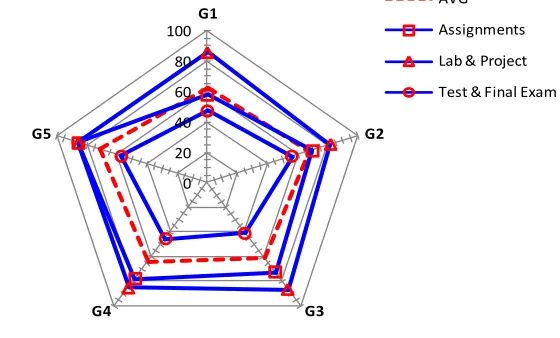
Figure 1: Learning style: preference of students Figure 2: Learning style preference: scaled projection Figure 3 summarizes the marks for all the assessed activities, both completed by group and individually. It is immediately apparent that students fared well in the group activities of assignments, lab work and project, but far less satisfactorily in the individual tasks of test and final examination. The resulting average marks were clearly affected by the relatively poor individual performance (i.e. test and final examination) to a significant extent. Indeed, it would appear that achievement of the students by group is far better than their individual grades in the test and final examination. In terms of group tasks, students generally did better in the lab work and project compared to the assignments, though only one group managed to score similarly well in both activities. Nonetheless the poor individual performance in the test and final examination is evident in every group, highlighting a possible common problem shared by all students in learning the course.
Figure 3: Marks for all activies (by group and individuals)
0 20 40 60 80 100
G1
G2
G3 G4
G5
AVG
Assignments
Lab & Project
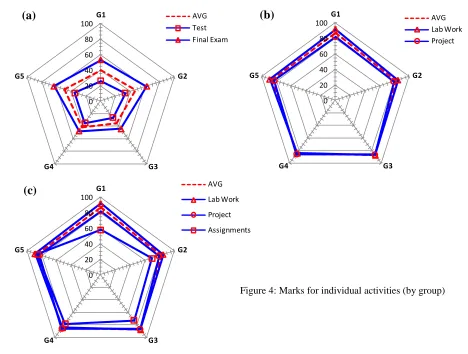
[image:4.612.166.446.513.682.2]Figure 4 presents the achievement breakdown of the activities. In Figure 4(a), the individual tasks of test and final examination were graded with the average marks included in the plot. Note that the test results were more disappointing than the final examination, leading to the low average grades. Considering that the test was conducted in the mid-semester, the poor performance could be attributed to the students’ unfamiliarity and lack of confidence in answering the questions then. With subsequent review of the test questions, and discourse on the tips of answering similar technical questions, students apparently fared better in the final examination. The improvement is most heartening, taking into account the fact that the test only covered questions from 2 topics, whereas the final examination encompassed questions from the entire syllabus of 5 topics (students were required to answer any 4 questions in 3 hours). Figure 4(b) shows the marks for lab work and project. The good performance is obvious, and very like the main components which boosted the students’ overall grades by the end of the semester. In comparison, students did not seem to score as well in the topical group activity of assignments, as can be seen in the combined plots of Figure 4 (c). Apart from Group 4(G4) and Group 5 (G5) with fairly well-rounded achievements in all group tasks, the other groups were found to be lagging behind in terms of marks obtained for the assignments. This is unexpected as the topical assignments were of a much smaller scope and presumed to be far less difficult compared to the semester-long lab work and project. In addition, in view of the fact that students were asked to write out a1-page mind map for each assignment as the outcome of an intensive literature search, review and compilation exercise, the marks almost suggest the inadequacy of the 1 week period given for the task. This could be due to unsatisfactory organizational skills within the group, causing last minute completion of the assignments with subpar quality.
0 20 40 60 80 100
G1
G2
G3 G4
G5
AVG Test Final Exam
0 20 40 60 80 100
G1
G2
G3 G4
G5
AVG Lab Work Project
0 20 40 60 80 100
G1
G2
G3 G4
G5
AVG
Lab Work
Project
[image:5.612.74.542.317.671.2]Assignments
Figure 4: Marks for individual activities (by group)
(a)
(b)
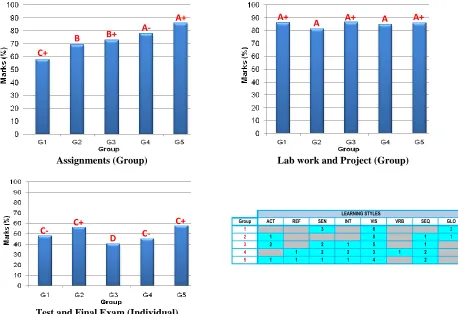
Figure 5 shows the grades analysis of the students based on assessment of the activities in Table 1. As most of the tasks were performed in groups, the grades and marks (as per 100 %) were derived for each group to give an overall view of the students’ achievement. Note too that significant influence of the learning styles was taken at scale 5 and above (see inset table). The discourse first addresses the group effort for assignments and lab work as well as project. For the assignments, the grades ranged from A+ to C+; while the laboratory work and project showed better performance with most groups achieving A+. Group 1 (G1), which did poorly in this category had 6 VIS, 3 SEN and 2 GLO learners. In comparison, Group 5 (G1) with the best grade had 4 VIS, 2 SEQ, and 1 each for ACT, REF, SEN and INT learners. It could be argued that a wider spectrum learning styles among the group members led to more significant contribution to the overall completion of the task. Seeing that the assignments involved calculations (concrete content) and case studies (abstract contents), groups with a good mix of learners could outperform the groups with members within a narrow band of learning preference.
Figure 5: Grades attained for each task: by group or individual
On the other hand, all groups scored excellent grades for the lab work and project, which were assessed based on experimental work and report in the laboratory as well as a problem-based project which spanned over the 14-week semester. In this particular task, students seemed to do well despite the variety of combined learning styles of the respective group members. It is worth noting that for G2 and G4 which scored A for this task, their combination of learners consisted of 3 and 6 styles respectively. As such, a wider spectrum of learners in a group did not seem to influence the assessed group task. Of course, a more thorough review of the individual task assessment and learning style is necessary for a more accurate evaluation.
The outcome of the individually conducted test and final examination grades was more dismal, with the best grade being a lowly C+. Considering that most of the students were VIS learners, this could imply a lack of visual aids during lectures to facilitate in-depth understanding of the course contents. The students’ poor test and final examination results were indeed a reflection of the unsound learning in class. Different from group tasks where peer support was at hand, individual tests like these could be stressful and disastrous for students with inadequate understanding of the fundamental knowledge, failed to be acquired in class or with revision.
A+
C+
B
A+ A+
Assignments (Group)
Test and Final Exam (Individual)
Lab work and Project (Group)
Group ACT REF SEN INT VIS VRB SEQ GLO
1 3 6 2
2 1 5 1 1
3 2 2 1 5 1
4 1 2 2 3 1 2
5 1 1 1 1 4 2
LEARNING STYLES
C+
B+ B
A- A+
A+ A+
A A A+
C- C+ C-
D
5. Conclusions
Overall the task-assessment and learning styles were fairly well matched. Students who participated in the survey were mainly found to be strong visual and sensory learners, though well balanced intuitive learners often associated with creativity and innovation also recorded a quarter of the total respondents. Preference for sequential learning, which could also aid in effective learning of the course, comprised of 40 % of the total students. Some recommendations to enhance the learning experience in this particular course include: (1) more visual aids should be incorporated in the lecture, e.g. diagrams, videos and photographs; (2) more interactive sessions should be introduced, such as impromptu verbal quizzes and short group discussions; (3) a learning style profiling could be conducted before group formation to enrich the students’ learning experience and effectiveness. In short, fine-tuning the course activities and assessment to suit students’ preferred style of learning is in-line with the philosophy of outcome-based education, centred on how much students have learnt, and not how much teachers have taught.
Acknowledgements
The study was funded by the Contract Research Grant, UTHM. The authors would also like to thank the students who completed the online survey and the indomitable Suzana Ojudah who compiled the survey data.
References
Biggs, J.B., What do inventories of students’ learning processes really measure A theoretical review and
clarification, Educational Psychology, vol. 63, pp. 3-19, 1993.
Felder, R.M. and Silverman, L.K., Learning and teaching styles in engineering education, Engr. Education, vol. 78, no. 7, pp. 674-681, 1988.
Laurillard, D., Rethinking university teaching, London: Routledge, 1993.
Marton, F. and Booth, S., Learning and awareness, Mahwah, NJ: Lawrence Erlbaum, 1997.
Marton, F., Hounsell, D.J. and Entwistle, N.J., The experience of learning, 2nd ed., Edinburgh: Scottish Acadmic Press, 1997.
Tait, H. and Entwistle, N.J., Identifying students at risk through effective study strategies, Higher Education, vol. 31, pp. 99-118, 1996.
Wall, J., Ahmed, V. and Smith, D., Addressing the lifelong learning needs of construction professionals using technology facilitated learning, J. Education in the Built Environment, vol. 1, no. 2, pp. 57-69, 2006.
Watson, J. and Hardaker, G., Steps towards personalised learner management system (LMS): SCORM implementation, Campus-Wide Information Systems, vol. 22, no. 2, pp. 56-70, 2005.
Biography
Chee-Ming Chan is an Associate Professor with the Civil Engineering Technology Department, Faculty of Engineering Technology, Universiti Tun Hussein Onn Malaysia. She is presently holding the office of Deputy Dean in Academic and Research at the Centre for Graduate Studies in the University. Her area of expertise includes geo-materials, engineering education and higher education improvement. More recently, Dr. Chan’s current work on dredged materials from Malaysian waters has gained momentum and support from the Ministry of Science, Technology and Innovation and Department of Marine, Malaysia. She is also involved in professional bodies, including the Society for Engineering Education Malaysia (SEEM), Malaysian Geosynthetics Society (MyIGS), Institution of Engineers Malaysia (IEM), Board of Engineers Malaysia (BEM), and is an education quality auditor for the Malaysian Qualification Agency (MQA). From 2009-2011, Dr. Chan served as a Postdoctoral Research Fellow at the Port and Airport Research Institute (PARI), Japan.