Journal of Chemical and Pharmaceutical Research, 2015, 7(3):579-587
Research Article
CODEN(USA) : JCPRC5ISSN : 0975-7384Study on the four kinds of "non mainstream"-oriented design knowledge
system of book binding and layout guide
Zhiliang Xia
Wenzhou Vocational & Technical College, Wenzhou, China
_____________________________________________________________________________________________
ABSTRACT
This paper analyzes the characteristics and limitations of the visual effect in the book binding and layout, introduces the necessity of the other four “non mainstream" design means for book binding and layout: hearing, taste, smell and touch and advocates to increase the personalized books so as to meet the different sensory needs of the audience and produce the effect of psychological experience with a variety of perception.
Key words: Book binding and layout; Orientation; Design; Non mainstream
_____________________________________________________________________________________________
INTRODUCTION
With the improvement of Internet technology, the digital media is providing quantitative information in a convenient and quick way. The audience are finding their eyes always fully occupied, many of whom even surf the Internet all day and become real Internet users. The demand of paper media will be gradually reduced. According to statistics, the average reading volume for people in our country every year is about two to three books per person, while the South Korea is six to seven. In addition to improving the content quality of the books, the personalized book binding and layout is another way that has been put on the agenda to elevate people's reading volume so as to stimulate people's demand and desire for books, especially the personalized books. Therefore, the "non-mainstream"-oriented design of book binding and layout arises at the historic moment. Apart from the visual sense as the guidance, attention should also be paid to other perception information representation forms, such as touch, taste, smell and hearing. The psychological research of different senses makes the book binding and layout more universal and communicative. Through the new conceptual thinking, new conceptual design products are worked out to cater to the personalized sensory and thinking demand of the audience.
CHARACTERISTICS AND LIMITATIONS OF THE VISUAL SENSE ORIENTED
Since ancient times, the visual elements in the book binding and layout are the basic elements of records of human civilization. The designers show their concepts and ideas by the use of visual design methods including text design, color design, image design and material design,etc., striving to perfectly present the true contents of books. In this way, the author and readers can have visual resonance through visual elements, and thus achieve the spiritual resonance, which is the work mission of designers. Although the book content the audience acquire through visual sense accounts for eighty percent, the visual sense has become the most important sensory organ of humans. A lot of books are designed by visual elements whose functions are beyond doubt. The famous design expert Lv Jingren thinks that the book binding and layout cannot just focus on the book cover to attract eyeballs. To evaluate whether a book is good or bad, the novel design is not the only way. The key lies in the contents which must be appropriate in the arrangement and the whole. Therefore, the visual elements of book binding and layout have their limitations, and the details are as follows:
1. Mainly pay attention to the universal design, but lack concern of the audience’s personalized needs.
even if the books are avant-garde in thinking and content.
3. The books are placed in an improper position, such as superposition or overlap, resulting in the dull in the visual perception of readers, and a good book might slip away from the eyes.
4. If the designer fails to pay attention to the change effect of the font, language, and culture of book cover, then readers ‘visual abilities will be misguided and they will miss a good book.
5. Even on holidays, the large numbers of readers will result in the hindrance in people’s visual recognition ability and they can't judge a book’s quality.
THE SUPPLEMENTARY ROLE OF NON-MAINSTREAM BOOK BINDING AND LAYOUT
When readers are reading a book, they first feel the appearance of the book, the touch of the paper and the weight of the book, then is the fragrance when turning over the pages. Sugiura Yasuhira, a Japanese famous book design master, thinks that the books have "five senses", namely, the weight of the book, the hand touch, the nasal smell, the ear hearing and the mouth taste. This is the process of physiological and psychological experience when readers pick up a book. Through the visual guidance, tactile experience, auditory rhythm and olfactory stimulus, readers can concentrate their attention when reading, even forget all about eating and sleeping to enter the atmosphere of the book, this is the so-called "bookworm". The argument of five sense, in fact, is the full-range interaction of sensory organs between people and books. They experience the life of books, the law of books and the true meaning of scrolls in the quiet meditation, which makes people realize the words uttered by Lao Zi: "although tasteless, invisible and inaudible, the function is inexhaustible and unlimited.”
The touch sense oriented book binding and layout: The structure and properties of book materials exert influence on
human touch sense related to the people's aesthetic psychology, so the different book materials result in different psychological reactions. For example, the cotton cloth will make people feel warm, the silk will make people feel smooth, and the wood will make people feel decorous. Different book materials will also bring about different understandings of readers on the books. Rudolf Arnheim once said that the art starts from the physical experience responses at any time and any place. The interaction between the reader and the book designer is the reader's true feelings when he gets the book. The touch sense, compared with the visual experience, will bring about more subtle and delicate psychology for readers who will be easier to be moved. Therefore, the touchalibity of books decides the materials and technology selected for the book binding and layout, and at the same time affects the artistic conception and psychology embodied. This is the culture atmosphere and style of the beauty of art and books as commodities in order to attract the corresponding consumer groups, induce the tactile sense, sense of taste and sense of smell of consumers and stimulate the readers’ reading interest and desire to buy, rendering it possible for books to embody the humanistic value and commercial value.
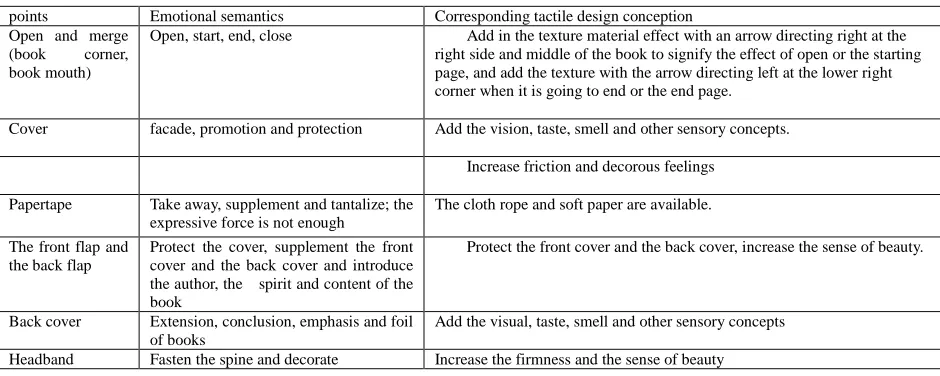
[image:2.595.73.543.575.763.2]Adopt different materials, shapes, colors, texts, graphics and design ideas as well as different visual elements to convey and present the information and characteristics of different goods. The material texture is the important principle of design structure. The rational use of art skills of material texture in the graphic design can fully embody the beauty and attraction of books. You can touch the roughness and feel the existence on some material textures, this is a kind of tactile preferred texture; you can only see the existence of some material textures, but cannot touch, then this is the visual preferred texture. The tactile orientation and application form of key points of book binding and layout are shown in Table 1.
Table 1 The tactile orientation and application form of key points of book binding and layout
points Emotional semantics Corresponding tactile design conception Open and merge
(book corner, book mouth)
Open, start, end, close Add in the texture material effect with an arrow directing right at the right side and middle of the book to signify the effect of open or the starting page, and add the texture with the arrow directing left at the lower right corner when it is going to end or the end page.
Cover facade, promotion and protection Add the vision, taste, smell and other sensory concepts.
Increase friction and decorous feelings
Papertape Take away, supplement and tantalize; the expressive force is not enough
The cloth rope and soft paper are available.
The front flap and the back flap
Protect the cover, supplement the front cover and the back cover and introduce the author, the spirit and content of the book
Protect the front cover and the back cover, increase the sense of beauty.
Back cover Extension, conclusion, emphasis and foil of books
Add the visual, taste, smell and other sensory concepts
Books are the tool of knowledge transmission and the medium of cultural accumulation. If a book wants to win the favor of people, its binding and layout must be pleasing to the eye in addition to the novel content. According to Professor Lv Jingren, although the e-book has developed rapidly, the book binding and layout plays an irreplaceable role with its unique art and technology. "Book design is a kind of tectonics and a complex integrating the external forms, internal information communication and rational thinking. The proper use of design techniques, the proper combination of materials and the innovation of processes all can play the role of strengthening or extending the connotation of books and enhancing the readability and interest." With the arrival of the experience economy, the tactile design of book binding and layout has been receiving more and more attention. The three-dimensional space of books, the intimate contact between books and readers as well as the lubrication degree of materials and textural touch the skin of readers, stimulate their mind and continue their reading experience. The famous Japanese design expert Sugiura Yasuhira said: "Through regarding the modelling containing sense of life as the breakthrough point, search for the source from the vast, redundant and fascinating images and differentiate and decipher from the modelling with layers of inclusive and boundless connotation to find the all-inclusive emotional stage universe with the commonality of everything." In his opinion, once a book is in hand, the hand turns over the page and the mind reads the book, then five senses will follow. He even claimed that the five senses of books are the beginning of design and thinking. Books convey all kinds of texture. Touch has the shock effect on the heart, soft, warm and cold. The sense of touch is very direct. It carries character and expression. The natural texture and the expression sense conferred by designers both can convey a tactile sense. With the development of science and art, the application of tactile design becomes more and more worthy of study.
TACTILE DESIGN ANALYSIS
[image:3.595.137.475.469.704.2]Based on the human physiological analysis, human skin is very sensitive. Its changes with the external humidity, temperature, roughness and lubrication will send the information sensed to the brain. The readers’ tactile organ will play its function during their close contact with books to readers. The design workers must recognize the physiological reaction features of humans and the material choice of books. Aristotle once said: "If there is no sense of touch, then there can be any other senses." Therefore, the tactile experience is the strongest in all senses, which can ensure people’s contact on things to get the most straightforward experience. It is said by Professor Lv Jingren that if a designer has no consciousness relevant to five senses, so he can only be a simple planar decorator." Books deliver different textural senses to people. The soft, warm and cold tactile sense is loaded with its own character and expressions. The emotions conferred by different materials and book designers can transfer different tactile reactions. For example, the book binding and layout of Dream of Red Mansions by Wu Yong conveys the modern concepts featured by simplified but rather complicated, refinedly expressing the theme of the books. The dim feelings of the books and smooth texture make readers unconsciously fall into the theme artistic conception of books, as shown in figure 1.
Figure 1 Dream of Red Mansions
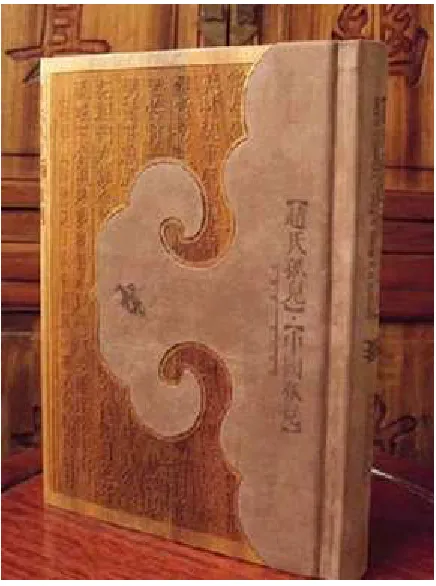
books affect the readers’ feelings. It is recorded in Artificers’ Record that: The weather is limited by season, the land is restricted by the climate, the craftsmen are clever and foolish, materials are good and bad, to put the four together is the best.” In other words, the goods artificially produced are closely related with nature, material and artisan skills. The formation of artistic works must go through the ingenious and superb skills. The technology here rises to the aesthetic height, becoming a language of form creative for book binding and layout, extending the design ideas and aesthetic taste of book designers, which helps to achieve the empathy between the designers and the author and enhance the connotation and taste of books. For the materials, the texture, weight, printing effect also play a decisive role in the design. The material selection affects the creation intent of designers. In the book China Colleges design by Professor Lv Jingren, the material selection and convex and concave effect fully embody the connotation of books, as shown in figure 2.
Figure 2 China Colleges by Lv Jingren
In Chinese ancient works, Hsun Tzu has it that “The standard of mould and its casting method is that the qualities of metal materials are assured, the smelting techniques should be elaborate, the heating and time should be appropriate.” “The qualities of metal materials are assured” refers to the quality of chosen materials, telling the designers to constantly strive for perfection in choosing materials and inspire them to fully fulfill and make use of the materials’ nature characters to serve for the works. With the development of science and technology, apart from the natural materials, the artificial materials emerge consistently, providing convenience for the designers responsible for the binding and layout. The reason why studying on The Artificers’ Record consist in its design achievement, fabrication technology, specifications, design philosophy and design ideas: “The weather should be limited by season, the land should be restricted by the climate, the materials should be of high quality, and the craftsmanship should be delicate, combining the four conditions together is the best artifacts can be made. If the quality cannot be assured is because of the failure to comply with the climate and failure to take the land into consideration”. The conceptions of systematic perspective and universe outlook indeed bring a profound revelation for designers nowadays. For example, the value and design principle of“objects are people-oriented and are used by people” and other Chinese philosophic thinking support the view of people first and artifacts second, emphasizing the order between human beings and objects. The books’ tactile design emphasizes this ideology of material making. In the book binding and layout domain, the purpose of design is to create exquisite books and meet the readers' spiritual needs, namely, to put people first and make things adopted, created, controlled and protected. The process design idea and practice after the spring and Autumn period demonstrate that the design and idea of ancient traditional handicraft objects long-term inherited in China continue to inspire the contemporary tactile design workers.
Readers receive the feedback of emotional information from the book they contact, and they can get a spiritual feelings. For example, when the audience hear the cheerful rhythm and passionate music, they will have access to feelings of happiness; when they hear the sad music, they will feel depressed, which is resonance of the audience through the feel of music. Different sensory stimulation will have different feedback results, so the designers have to work on this aspect and research on readers’ various tactile senses. Wang Shaoqiang designs the book Asia Pacific Design,
More consistent with the connotation of the book in color, material and other aspects and are widely acclaimed, as shown in figure 3.
Figure3 Asia-Pacific Design by Wang Shaoqiang
Figure 4 Zhu Xi’s Thousand Character Text
China Memory designed by Lv Jingren has been awarded "The Most Beautiful Book in the World" award, mainly attributed to the outstanding culture and art of Chinese 5000 years; then is the careful shooting and edit effect, coupled with the high printing quality, which is the perfect creation process. Therefore, the design of China Memory is an exquisite combination of books design, a systematic engineering, the updating of design idea and the crystallization of the collective. The accurate material selection and real feelings conferred by design workers transfer ingenious tactile experience to readers.
China Memory provides the essence of Chinese thousands years’ culture through the architectures and put the connotation elements of the original works throughout the whole process of book design, which fully embodies the oriental aesthetics and values and integrates the Chinese traditional culture of Taoism, Confucianism and Zen. This is embodied in the chapter division, editing, illustration, rough binding double-leaved design, paper touch texture set, cover sewing morphology and girdle dynamic images, etc.. The design process is the embodiment of ordered design concept. The famous book designer Mr. Lv Jingren said: "the book is a relatively static carrier, but it is also a dynamic media", as shown in figure 5.
[image:6.595.160.454.567.751.2]TACTILE DESIGN IS THE INEVITABLE OUTCOME OF EXPERIENCE ECONOMY
The experience economy regards the situation and life as the background and pays attention to people's sensory experience and thinking identity. It changes the audience’s consumer behavior through grabbing the attention of the audience, discovering the new existence value and space for the commodities. Alvin Toffler pointed out in his book Future Shock that the experience economy will be the brand new wave after the agricultural economy, industrial economy and service economy. Under the experience economy, the main consuming propensity of customers is their ever-prominent personalized demand. Consumers enjoy more discourse right and decision right than the past. This feature indicates the arrival of the era of experience economy and shows that the experiential products are increasingly popular, which requires the books to change the form of information transmission and pay attention to the reader's psychological feelings. Contact the reader and the book through actions to provide a chance for the reader to personally participate in the reading process. During the interactions with books, readers obtain the "five senses" and other sensory experience, enhancing their cognitive ability of the book's content and giving full play to the initiative and creativity of readers.
Tactile experience is an important means to understand the world, especially for children. Studies have shown that, the importance of touch for children in the learning process is higher than that for adults. In terms of the children’ s book binding and layout design, the tactile design must be emphasized by the designers. The experience effect of tactile design is based and produced by the choices of different materials, eg, the choices of papers, fabrics, plastic. And the natural materials also can be inserted in the books, eg, tree leaves, feathers, and decorations, you can touch the materials inserted in the pages, through touching feel the contents. The binding and layout of Little Tadpoles Looking for Mummy is a good example. With the advancement of scientific technology, the works of binding and layout based on the levels of sensation and experience will be continuously created.
The famous designer Patrick W. Jordan has gained some grounds on the research of factors arousing the audiences’ psychologically delight. He concludes that the factors causing users’ delightful experience include: safety, trustworthy, pride, excitement, satisfaction, entertainment, pleasure and reminiscence; the factors causing the users' antipathy towards the experience are: aggressiveness, cheat, forced compliance, frustration, anxiety and annoyance. Therefore, in terms of the design for children’s books, the influencing factors produced by the overall situation of sensory experience on the feelings must be taken into consideration. Eg, feeling a texture of being decorous, concrete, and close can make children produce a dependence feeling and participate in the activities in a harmonious atmosphere. More importantly, in terms of the recognition for the outside world, the children are commonly oriented by perceptual knowledge. With a lively personality, if they themselves participate in the book’s context, then their reading interests will be aroused, providing them with a feeling of excitement and satisfaction. No Teddy , No sleep is a children’s book designed by British designer Nicholasmi, with a delicate design of page structure. Many items such as drawers, sofas and windows can be touched. Through appealing indicators, children are led to get involved taking the forms of pushing and pulling, turning and doubling up, look for a different scene fitting with children’s nature, showing the important role of children reader’s behavioral experience. The design of picture book of Playtime possesses a distinctive style.Its three-dimensional design is highly creative. When opening the pages, the illustrations can stand up, and the whole book is like a stage where readers take advantage of tailor-made considerately plotted context to play a part in it. Various engaging pictures attract readers to personally act, and the combination of beautiful copywriting and three-dimensional animation stimulate the readers to read, touch, explore and experiment. This book has the functions of readability, interest and toy-playing, cultivating children’s intellect and establishing the examples in the childrens’s prestage education. Other cases in point include the Where Is Deng Deng? In the book design, every page is foldable. Readers are leafing through the books with an anticipating mood, surprised at every page and will continuously read through, which has aroused readers’interests. The pages inside have been designed into foldable ones and when opening every page, the anticipation and surprise will arise. As the pages are continuously opened and enlarged, the readers’ heart also becomes plentiful. Readers can look for their own countries, continents, even the positions of celestial bodies, and the sizes of pages give a picture of the varying spaces and continuously touch readers heart deep inside, arousing readers’ inspiration to sprout.
Therefore, from the above analysis, it can be concluded that the tactile experience is a comprehensive practice, containing both the direct tactile sense generated from the direct perception of tactile organs and the indirect tactile sense, namely, "the visual sense of touch". The visual sense of touch can make readers generate the psychological experience, transmit visual information and form the cognitive ability, which plays a guiding role in the impending tactile experience. The research on the readers’ tactile sense has a guiding role on the book binding and layout, especially the children's books, further stimulating children's brain development and improving their understanding ability toward the outside world.
Chinese ancient people, and is the most basic idea of creation philosophy. The book binding and layout must take the reader as the center, then the life of books can last for a long time. Tactile design is an important component part of the "five senses" design of books. The tactile design and other design means including the visual sense supplement each other, constituting the unity of book binding and layout design. The book design has been evolving from the plane to stereoscopic, from one-dimensional to three-dimensional. Only through constant innovation research and practice of different forms of design demand can the book binding and layout become mature, create more humane works for readers and enhance the reader's thirst for knowledge and learning ability.
TASTE SENSE ORIENTED BOOK BINDING AND LAYOUT
Taste sense element is also an important link in the book binding and layout design. It not only means tasting the book pages, but also takes advantage of the interaction between visual sense, smell sense, auditory sense and other organs to stimulate the taste buds and the appetite, namely, the reading desire. When we flip through the pages, the noise can make the person think of the corresponding food, and the saliva will be secreted in the oral cavity. Such psychological reaction can cause the reaction of the brain, and thus the desire for reading comes. For example, writers will create a certain scene and artistic conception when depicting things; designers always put advertisements with pictures of delicious food when advertising for restaurants or hotels; cooks always pay attention to the perfect combination of color, aroma and taste while putting the color at the first place, which can explain the importance of color in inducing appetite; People often use the phrase “ be beautiful enough to feast the eyes”to describe women; they describe underage girls to be the green apple; the red cheeks of girls are like red apples, the mature female friend said to be confidante. Song Dynasty poet Li Qingzhao also used the green color in the description of immature girls, that is:In order to cover up her gaffe, she smells the green plum, watching while smelling, shy and cowardly. The mystery of color is remarkable. Therefore, the designers should have a good grasp of the readers' psychology, which is valuable and necessary for the study of color.
SMELL SENSE ORIENTED BOOK BINDING AND LAYOUT
There are a large number of olfactory sensory cells have in people’s nasal cavity, and there are 1000 genes in the human body to encode the different gas receptors on the gas receptor cell membrane, accounting for 3% of the total number of human genes.
The concept of smell sense is the sensory reaction caused by the smell’s stimulation on nasal organ. The olfactory nerve in nasal cavity can stimulate the brain and leave a memory in it. The brain will re issue different instructions when receiving different information. Therefore, the interaction between smell sense and other sensory organs of the body will cause the emotional and psychological change of audience. The studies carried out by psychologists shows that the smell sense can arouse the memories of mammals. The experiments on police dogs illustrate this point. The sense of smell is essential for a qualified investigators. Similarly, the sense of smell can also cause different emotional characteristics of audience. Smells can recall a person the places where he has been or experienced, and in the course of time,people will form a habit and have the emotional dependence function. We can see the process of criminals’opium smoking. Such feeling of walking on the clouds makes people feel celestial. Therefore, some designers put some cards with special odor in the books to induce readers. The scholarly atmosphere has long been existing in the history of our country. In the past, those knowledgeable families with etiquette were called “scholar-gentry families". Of course,this saying is grounded. Because people like reading, so they like the odor of books, just as the saying goes, He that loves the tree loves the branch. In a word,the use of smell to design books is an effective way.
HEARING SENSE ORIENTED BOOK BINDING AND LAYOUT
The application of the hearing sense in the book binding and layout design means that the ear receives the external information and sends the sounds to the brain so that the brain produces memory, which is the same as the principle of smell sense. Different things produce different sounds, so the sounds produced by different papers are also not the same. Japanese scholar Sugiura Yasuhira conducted a special study in this respect. He detailedly introduced the different sounds produced by different materials of the paper in his monograph From the Book Binding and Layout to the Book Design. These sounds are like jumping notes and played music that are a feast for the eyes and the ears.
CONCLUSION
mobilize the initiative of the readers’ visual psychology, but also to meet the readers' psychological needs in sense of touch, hearing, smell, taste and other sensory organs, which is referred to as “non mainstream binding layout” in professional terms. Through the five senses experience, more readers can form the habit of active reading and meet their own psychological needs in the reading process. Putting people first and strengthening the humanities concern are the important starting point and mission of designers who realize their own aesthetic appeal and accomplish the information sharing and soul communication with readers while satisfying the needs of readers.
Acknowledgements
2012 Professional Development Project for Visiting Scholars or Teachers in Institution of Higher Learning (FX2012125) ; Ministry of Education’s subproject of the key project in the national educational science’s Twelve-Five planning (DCA110195-11001);2011 Zhejiang planning project on educational technology research (JB078)
REFERENCES
[1]Wang Mingdao, Yuan Hua. How to Construct the Beauty of Book Volume for the Traditional Book Binding and Layout [J]. Beijing: China Publishing Journal, January, 2010
[2] Deng Zhonghe; Creative Design of Book Binding and Layout [M]. China Youth Press, January, 2004.
[3](Switzerland) Nig g Li; The Composition of Layout Design Network[M]. China Youth Press, January,2005.
[4]Wang Mei. On the Design of Book Spine [J]. Beijing: China Publishing Journal, September, 2010. [5]Xia Zhi-Liang. Information Technology Journal,2013,12(20);5935-5940
[6]
Zhiliang
Xia. International Journal of Multimedia and Ubiquitous Engineering,2014,9(4);209-220[7]
Zhiliang
Xia. International Journal of Multimedia and Ubiquitous Engineering,2014,9(5); 343-354[8]Wang Kaiqing, The Book Binding and Layout of Contemporary China [J]. Chongqing: Packaging Engineering, April, 2006.
[9]Jiang Zhongzhi, The Artistic and Commercial Features of Book Cover Design [J]. Chongqing: Packaging Engineering, October, 2010.