Effects of Vibration on Dynamic and Stabiliser Muscle
Activities During the Press Up
Dan Robbins
1,2,*, Shane Bone
1, Mark Chapman
1, Mark Goss-Sampson
11Centre for Sports Science, University of Greenwich, Medway, Kent, ME4 6AZ, UK 2Division of Sports Therapy, University of Bedfordshire, Luton, LU1 3JU
*Corresponding Author: [email protected]
Copyright © 2014 Horizon Research Publishing All rights reserved.
Abstract
A pilot study investigating the influence of vibration during press ups on myoelectrical activity of both dynamic and stabiliser muscles. Nine male participants (21.1 ± 3.4 years, 1.68 ± 0.03 m, 72.3 ± 9.5 kg), performed press ups under 3 conditions: without vibration, low amplitude and frequency vibration (30L; 1.2 mm, 30 Hz) high amplitude and frequency vibration (40H; 1.9 mm, 40 Hz). Press ups were completed in a randomised order for a period of 15 s with 3 min rest. 3D motion capture with synchronous surface electromyography (EMG) of dynamic muscles (triceps, pectoralis major) and stabiliser muscles (serratus anterior, lower trapezius muscles). The introduction of vibration to press ups did not result in kinematic changes to exercises. No muscles analysed displayed significant increases in mean EMG amplitude in response to 30L VIB in the eccentric or the concentric phase of the exercise. 40H Vibration significantly increased EMG amplitudes of all muscles (p < 0.05) except the lower trapezius. Greater increases were observed during the concentric phase of movement. These results indicate that vibration influences muscle activity during press up exercises. However, further studies are required including additional information such as the transmission of vibration to the neck and head, should be completed.Keywords
Vibration, EMG, Kinematics, Push Up1. Introduction
To date there have been many studies considering the effect of whole body vibration (WBV) on the lower body, as reviewed by Rehn et al.[1], however yet there have been few investigations on the effects of WBV platforms on the upper body. Hazell et al. [2]considered the effect of WBV during static and dynamic squats and bicep curls on EMG of both the upper and lower body, with results indicating significant increases in signal RMS, yet this was not a consequence of direct vibration of the upper body. In a similar study Marin et al. [3] also reported significant increases in EMG activity of
activity (EMG). The hypothesis of the investigation is that press ups with vibration will increase the muscular activation of dynamic and stabiliser muscles detected by EMG.
2. Materials and Methods
2.1. Participants
Nine healthy male participants (21.1 ± 3.4 years, 1.68 ± 0.03 m, 72.3 ± 9.5 kg), experienced in recreational training and without any history of recent illness or injury volunteered for the study and provided informed consent in accordance with University Ethics Committee and the Declaration of Helsinki.
2.2. Study Design
Three press up conditions were tested on the WBV platform in a randomised cross over study design: press up in the absence of vibration (NVIB), low amplitude and frequency vertical vibration (30L; 1.2 mm, 30 Hz) high amplitude and frequency vertical vibration (40H; 1.9 mm, 40 Hz). Press ups were completed in a randomised order at a self-selected pace by participants for a period of 15 s with 3 min rest between each set. Participants were assessed for press up ability and familiarisation at least 24 hours before data collection. All press ups were completed in one testing session and all press ups were completed on the platform with feet resting on a bench of equal height to the platform.
2.3. Data Collection and Processing
Prior to testing participants completed 4 min arm crank ergometery (Lode Angio, Groningen The Netherlands) as a warm up activity. Press ups were performed with the hands consistently placed at a distance 1.2 times the distance between the acromioclavicular joints. Press ups on a Power Plate Pro 6 whole body vibration platform (Power Plate Ltd). During press ups on the Power Plate the participant’s feet were placed on a small bench to replicate the press up position of that on the floor. 3D motion capture was acquired using 16 mm retroreflective markers on the spine at C7 and S1, and acromion processes bilaterally. The sampling frequency of the motion capture was 500 Hz using 10 Oqus cameras (Qualisys, AB, Sweden). Maximal vertical displacements of the C7 and S1 were used to define cervical and pelvic vertical movements, the displacements between the C7 and S1 markers were used as a measure of postural changes i.e. kyphotic or lordotic postures. Synchronous to motion capture data surface EMG (DelsysBagnoli system, Boston, USA) was obtained via differential bipolar Ag-AgCl electrodes placed on the triceps (TR), pectoralis major (PM), serratus anterior (SA) and lower trapezius (LT) muscles in accordance with SENIAM recommendations [13]. Signal impedance and noise artefacts were minimised by skin preparation and taping of wires to prevent excessive
movement during press ups. EMG signals were amplified (1 k gain) with a bandwidth of 20-450 Hz and a sampling frequency of 2000 Hz. A single reference electrode was placed on the skin level with the C7 vertebrae. All synchronous data was acquired using Qualisys track manager software (Qualisys, AB, Sweden) and exported in .c3d format for post processing in Visual3Dtm (C-Motion, Inc. Germantown, USA). EMG signals were corrected for zero offset by subtracting the signal mean, fully rectified and smoothed using a 6th order Butterworth low pass filter with a cut-off frequency of 2 Hz. For direct comparison of averaged results between subjects, signals were time normalised from the start to the end of each press up based on the vertical position of the C7 marker. The mean signal amplitude for both the concentric and eccentric phase was calculated using the vertical displacement of C7 marker to identify the timing of each phase of the movement. The time normalised signal and mean values were then exported to MatLab (MathWorks, USA) for statistical analysis.
2.4. Statistical Analysis
The Anderson-Darling test showed that the kinematic data was not normally distributed, the mean EMG data, with the exception of the lower trapezius during the concentric phase and pectoralis major for the eccentric phase were all normally distributed. Therefore, median values were reported in place of means for the kinematic data [14], with statistical dispersion represented as + one median absolute deviation (MAD) for kinematic data and standard error of the means (SEM) were used for mean EMG data. Friedman’s test was used to test non-normally distributed conditions and repeated measures ANOVA was used for normally distributed data. The locations of significant differences were identified with Tukey’s honest significant difference test to account for repeated measures analysis. In all analyses significance was set at alpha = 0.05.
For data that was normally distributed the effect size was calculated using Omega2 (𝜔𝜔�2), data that was not normally
distributed the effect size was calculated using the coefficient of concordance (W). The calculations for effect sizes are described in detail in Kinnear and Gray [15].
3. Results
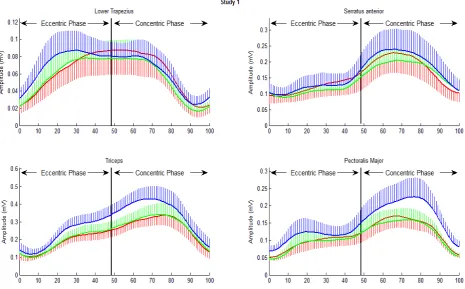
differences from NVIB. The LT and PM muscle activation during 40H displays a new peak emerging in the eccentric phase occurring at approximately halfway through the eccentric phase. The concentric phase of LT 40H is similar to 30L. In addition to the eccentric phase increase of PM during 40H VIB, the concentric phase also displays a new peak, again occurring around halfway through the phase.
Table 1. Kinematic parameters for press ups, values are presented as medians ± 1 MAD.
Variable NVIB 30L 40H
Duration (s) 1.76 + 0.38 1.69 + 0.34 1.76 + 0.38
C7 vertical
displacement (m) 0.37 + 0.05 0.35 + 0.07 0.34 + 0.04
S1 vertical
displacement (m) 0.24 + 0.02 0.24 + 0.03 0.24 + 0.02
Spinal posture (m) 0.51 + 0.03 0.51 + 0.03 0.52 + 0.03
None of the muscles analysed displayed significant increases in mean EMG amplitude in response to 30L VIB in
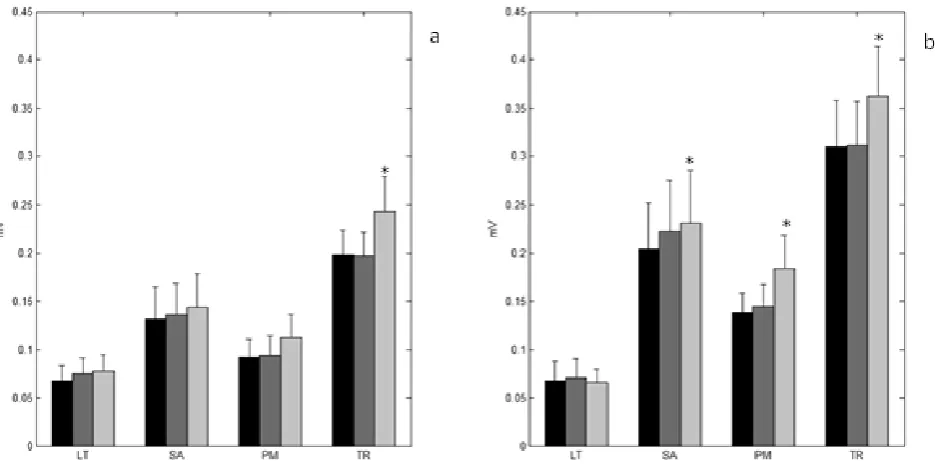
the eccentric or the concentric phase of the exercise. During the eccentric phase the TR muscles displayed a significant increase from NVIB but not from 30L. PM was the only muscle in the eccentric phase with data that was not normally distributed, therefore was analysed with Friedman’s test rather than repeated measures ANOVA. The effect size for all muscles was small (0.2), except TR which was medium (0.3).
The mean amplitude of the EMG signals during the concentric phase of the press up exercises displayed significant increases from NVIB in response to 40H VIB in all muscles except the lower trapezius, where 40H resulted in a slight decrease in amplitude. LT was the only muscle with data that was not normally distributed and therefore analysed with Friedman’s test rather than repeated measures ANOVA. The mean EMG amplitudes for the eccentric and concentric phases are displayed in Figure 2. The effect size for all muscles was small (0.2), except TR which was medium (0.4).
[image:3.595.77.543.329.618.2]Figure 2. Eccentric phase mean EMG amplitude (a) and Concentric phase mean EMG amplitude (b). The black bars = NVIB, the dark grey bars = 30L and the light grey bars = 40H. The error bars = 1 SEM, * = significantly different from NVIB (p < 0.05).
4. Discussion
The lack of significant difference between the timing to complete press ups, vertical displacements of cervical spine (C7) and pelvis (S1) and the distance between C7 and S1 indicate that the participants performed each press up in the same pace, range of motion and did not change posture i.e. develop kyphotic or lordotic postures during the press ups in any condition. This consistency of movements is important for two reasons, firstly vibration has previously been shown to reduce postural stability [16] and secondly the consistency in movement removes the variable of changing exercise performance when considering changes in EMG. Care was taken during the initial set up of NVIB, 30L and 40H to ensure all participants were positioned with hands and feet level, as changing the relative position of height and hands and feet has been shown to influence EMG activity of shoulder musculature, particularly that of the serratus anterior [11,17]. In addition, hand position was standardised as the distance equivalent to that between the acromioclavicular distance with avoidance of movement in a caudad and cephalad direction, as this has been shown to influence the EMG activity of the shoulder and upper arms agonist muscles [9,18]. During a standard press up it has previously been reported that the forces experienced are typically around two thirds of body weight [9,19]. Although it has been shown that narrow base press ups, i.e. with the hands closer together, have an elbow torque which is 71% of maximal torque, compared to wide base press ups which are only 29% [20] which likely explains the reported increase in EMG activity during press ups with altered hand positions [9,18]. Considering the adherence to specific participant positional set up, combined with the lack of significant
displayed a change in the pattern of activation, with a new peak becoming apparent at approximately halfway through the eccentric phase (see Figure 1). An increase in LT activation was also noted at this approximate time point, suggesting potential for increased muscular demand at this point of the movement. To the best of the authors knowledge there is no data on transmission of vibration through the human body in this position; yet it has previously been shown that when standing with increased knee flexion reduces vertical transmission of vibration [26]. It is therefore a reasonable assumption that whilst the elbows are flexed there is increased demand for damping of vibration transmission via the shoulder girdle, though further studies should be completed to confirm this. While patterns of EMG activity in LT did occur it should be noted that the increases in mean amplitude were not significant. The LT is the furthest analysed muscle from the WBV platform surface and is the only muscle to not display any significant increases in mean EMG amplitude. This observation can potentially be explained by the postulation that increased distance from the platform decreases muscle activity [27] indicating the role of the muscle and the location of the muscle are the key factors in the influence of vibration on muscle activity. This theory is given further credence by previously reported values of EMG during standard press ups to fatigue, where the SA displayed changes 3.5 times the level of the lower trapezius [28]. These differences in activation level are also potentially explained by the fact that the SA has previously been reported to be both the prime mover of the scapula [29] and a stabiliser muscle, particularly in prevention of conditions such as scapula winging [30].
One final area worthy of note is that it has previously been reported that large differences have been observed between skilled and unskilled performers of press up exercises [12]. Though unfortunately while the timing of EMG activity was also reported, a single pass Butterworth filter was applied to the signals. Single pass filters cause phase distortions resulting in time lags within the signal [31] and are therefore not comparable to the data obtained within this investigation.
5. Conclusion
The introduction of vibration to press up exercises does not result in kinematic changes to exercise performance. Duration, posture and range of motion did not change in any tested condition, indicating the actual exercise performance did not change in any condition. In contrast EMG activity displayed highly significant differences, particularly in the shoulder stabiliser muscles which displayed increases of 3.5 times the activity in a standard press up. In addition, the pattern of EMG activity in both pectoralis major, serratus anterior and lower traps displayed significant changes. These results suggest that vibration has significant influence on both dynamic and stabilising muscles of the shoulder; these changes are potentially influenced by the changing the force
moment arm during the movement. Use of the information in this pilot study can be used to determine the statistical power of sample sizes of future investigations in to the effect of vibration on press up exercises. Prior to recommendations being made for the application of vibration in press up exercises further studies should also be completed on the transmission of vibration through the upper body and the potential safety implications of transmission of vibration to the neck and head.
REFERENCES
[1] Rehn B, Lidström J, Skoglund J, et al. Effects on leg muscular performance from whole-body vibration exercise: a systematic review. Scandinavian journal of medicine &
science in sports 2007;17:2–11.
doi:10.1111/j.1600-0838.2006.00578.x
[2] Hazell TJ, Jakobi JM, Kenno KA. The effects of whole-body vibration on upper- and lower-body EMG during static and dynamic contractions. Applied physiology, nutrition, and
metabolism 2007;32:1156–63. doi:10.1139/H07-116
[3] Marín PJ, Santos-Lozano A, Santin-Medeiros F, et al.
Whole-body vibration increases upper and lower body muscle activity in older adults: potential use of vibration accessories.
Journal of electromyography and kinesiology
2012;22:456–62. doi:10.1016/j.jelekin.2012.02.003
[4] Gómez-Cabello A, González-Agüero A, Ara I, et al. Effects of a short-term whole body vibration intervention on physical fitness in elderly people. Maturitas 2013;74:276–8. doi:10.1016/j.maturitas.2012.12.008
[5] McBride J, Porcari J, Scheunke M. Effect of vibration during fatiguing resistance exercise on subsequent muscle activity during maximal voluntary isometric contractions. The Journal of Strength & Conditioning Research
2004;18:777–81.
[6] Mischi M, Cardinale M. The effects of a 28-Hz vibration on arm muscle activity during isometric exercise. Medicine and
science in sports and exercise 2009;41:645–53.
doi:10.1249/MSS.0b013e31818a8a69
[7] Tripp B, Faust D, Jacobs P. Elbow joint position sense after neuromuscular training with handheld vibration. Journal of
athletic training 2009;44:617–23.
doi:10.4085/1062-6050-44.6.617
[8] Contreras B, Schoenfeld B, Mike J, et al. The Biomechanics of the Push-up: Implications for Resistance Training Programs. Strength and Conditioning Journal 2012;34:41–6. [9] Gouvali M, Boudolos K. Dynamic and electromyographical
analysis in variants of push-up exercise. J Strength Cond Res
2005;19:146–51.
[10] Lehman GJ, MacMillan B, MacIntyre I, et al. Shoulder muscle EMG activity during push up variations on and off a Swiss ball. Dynamic medicine : DM 2006;5:7. doi:10.1186/1476-5918-5-7
during push up and push up plus exercises. Manual therapy
2008;13:500–6. doi:10.1016/j.math.2007.05.016
[12] Freeman S, Karpowicz A, Gray J, et al. Quantifying muscle patterns and spine load during various forms of the push-up.
Medicine and science in sports and exercise 2006;38:570–7.
doi:10.1249/01.mss.0000189317.08635.1b
[13] Hermens HJ, Freriks B, Disselhorst-Klug C, et al.
Development of recommendations for SEMG sensors and sensor placement procedures. Journal of electromyography
and kinesiology 2000;10:361–74.
[14] Lang T, Secic M. How to Report Statistics in Medicine:
Annotated Guidelines for Authors, Editors and Reviewers.
Second Edi. American College of Physicians 2006. [15] Kinnear PR, Gray CD. PASW 17 Statistics made simple.
2010.
[16] Lee B-C, Martin BJ, Sienko KH. Directional postural responses induced by vibrotactile stimulations applied to the torso. Experimental brain research ExperimentelleHirnforschungExpérimentationcérébrale
2012;222:471–82. doi:10.1007/s00221-012-3233-2
[17] Lear LJ, Gross MT. An electromyographical analysis of the scapular stabilizing synergists during a push-up progression.
The Journal of orthopaedic and sports physical therapy
1998;28:146–57.
[18] Cogley R, Archambault T, Fibeger J, et al. Comparison of Muscle Activation Using Various Hand Positions During the Push-Up. The Journal of Strength and Conditioning Research
2005;19:628–33.
[19] Blackard D, Jensen R, Ebben W. Use of EMG analysis in challenging kinetic chain terminology. Medicine & Science in
Sports & Exercise 1999;31:443–8.
doi:10.1097/00005768-199903000-00014
[20] Donkers MJ, An K-N, Chao EYS, et al. Hand position affects elbow joint load during push-up exercise. Journal of
Biomechanics 1993;26:625–32.
doi:10.1016/0021-9290(93)90026-B
[21] Eckhardt H, Wollny R, Müller H, et al. Enhanced myofiber recruitment during exhaustive squatting performed as whole-body vibration exercise. The Journal of Strength &
Conditioning Research 2011;25:1120–5.
[22] Ritzmann R, Gollhofer A, Kramer A. The influence of vibration type, frequency, body position and additional load on the neuromuscular activity during whole body vibration.
European journal of applied physiology 2013;113:1–11.
[23] Hazell T, Kenno K, Jakobi J. Evaluation of muscle activity for loaded and unloaded dynamic squats during vertical whole-body vibration. The Journal of Strength &
Conditioning Research 2010;24:1860–5.
[24] Marín PJ, Santos-Lozano A, Santin-Medeiros F, et al. A comparison of training intensity between whole-body vibration and conventional squat exercise. Journal of
electromyography and kinesiology 2011;21:616–21.
doi:10.1016/j.jelekin.2010.12.008
[25] Marin PJ, Azael h, Nuria S, et al. Effects of Different Magnitudes of Whole-Body Vibration on Arm Muscular Performance. Journal of Strength & Conditioning Research
2010;24:2506–11.
[26] Abercromby A, Amonette W, Layne C, et al. Vibration exposure and biodynamic responses during whole-body vibration training. Medicine and science in sports and
exercise 2007;39:1794–800.
doi:10.1249/mss.0b013e3181238a0f
[27] Wirth B, Zurfluh S, Müller R. Acute effects of whole-body vibration on trunk muscles in young healthy adults. Journal of
electromyography and kinesiology : official journal of the
International Society of Electrophysiological Kinesiology
2011;21:450–7. doi:10.1016/j.jelekin.2010.12.007
[28] Borstad JD, Szucs K, Navalgund A. Scapula kinematic alterations following a modified push-up plus task. Human
movement science 2009;28:738–51.
doi:10.1016/j.humov.2009.05.002
[29] Dvir Z, Berme N. The shoulder complex in elevation of the arm: A mechanism approach. Journal of Biomechanics
1978;11:219–25. doi:10.1016/0021-9290(78)90047-7 [30] Kendall F, McCreary E, Provance P. Muscles Testing and
Function, with Posture and Pain. Fourth Edi. Lippincott
Williams and Wilkins 1993.
[31] Winter D. Biomechanics and Motor Control of Human