Citation:
Jones, O and Gorra, A (2013) Assessment feedback only on demand: Supporting the few not
supplying the many. ACTIVE LEARNING IN HIGHER EDUCATION, 14 (2). pp. 149-161. ISSN
1469-7874 DOI: https://doi.org/10.1177/1469787413481131
Link to Leeds Beckett Repository record:
http://eprints.leedsbeckett.ac.uk/4380/
Document Version:
Article
The aim of the Leeds Beckett Repository is to provide open access to our research, as required by
funder policies and permitted by publishers and copyright law.
The Leeds Beckett repository holds a wide range of publications, each of which has been
checked for copyright and the relevant embargo period has been applied by the Research Services
team.
We operate on a standard take-down policy.
If you are the author or publisher of an output
and you would like it removed from the repository, please
contact us
and we will investigate on a
case-by-case basis.
Assessment feedback only on demand: supporting the few not supplying the many
Abstract
There are many pressures on academics to ‘satisfy’ students’ needs for feedback, not least the inclusion of questions about feedback in the National Student Survey. Many authors have commentated on the lack of student engagement with summative feedback while most believe that feedback is necessary to improve individual student performance.
Several authors have looked at a range of reasons why students do not collect their feedback but this paper investigates how many students collected
summative feedback and why they did so. This paper outlines an action research based intervention which involved offering feedback ‘on demand’ to
undergraduate students and utilises access statistics data from the Virtual Learning Environment to identify the actual rate of feedback collection by students. We found a discernible preference for seeking feedback where the difference between the expected grade and the actual grade was greater. A student survey and the VLE access data both indicated that students were satisfied with a few short comments and a marking grid, if the mark was similar to their expectations.
We argue that it is not resource efficient or effective for academic staff to provide detailed individual feedback to all students. Students should be offered a
hierarchy of feedback on demand which would allow some of the effort to be reallocated from summative feedback to formative assessment and feedback.
Keywords
Feedback
Some academics, such as Sadler (2010), bring into question the efficacy of providing large scale feedback on summative work to students, because the feedback loop is not acted on by many students. Weaver (2006) infers that this effect can be magnified due to the typical modularised curriculum which often involves end-loaded assessments, where feedback only reaches the students after the final assessment and modules have been completed. Gibbs and Simpson (2004) also stress the importance of 'timeliness' of feedback in order to enable feedback to be relevant and Higgins, et al. (2002, p. 55) state "if feedback is not 'timely' students might not make the effort to go back to the assignment". Rae and Cochrane (2008) found that students taking part in their study were split in their views of when to receive feedback on their assessment - most were keen to receive feedback soon after hand-in
whereas others were not. Rae and Cochrane (2008) refer to Yorke (2003) and also highlight the fact that feedback should be timely and, of course, acted upon by students. The increasingly common use of Virtual Learning Environments VLEs and information technology can allow the fast and convenient communication to individual and groups of students. There have been many studies, as outlined by Hepplestone et al. (2009), that use different technologies and methods in an attempt to increase efficiency of providing feedback to large numbers of students. However, unless the student is engaged with the feedback (Mutch, 2003; Rae and Cochrane, 2008) and understands it (Chanock, 2000; Rowe and Wood, 2008) these efforts can be in vain. Rae and Cochrane (2008) appear to identify a tension between students’ comments on the lack of consistency in how tutors provided feedback, against the students’ own differing views on the feedback process and outcome.
Several studies about feedback in British higher education (HE) institutions lament that
- students don't collect work (Winter and Dye, 2005),
- students are not interested in collecting feedback and
- students are only interested in their mark (Murtagh and Baker, 2009)
Many authors have identified possible reasons for students’ dissatisfaction and lack of engagement with feedback, such as lack of specific advice on how to improve (Higgins et al., 2001), feedback being difficult to interpret (Chanock, 2000) and having potentially negative impact on student ego (Carless, 2006). Higgins et al. (2002) provide the following reasons for which students perceived feedback negatively such as not containing enough information to be helpful, too impersonal, too general or too vague to be useful. Particularly at larger HE
Several authors have attempted to 'categorise' students according to their feedback preferences and behaviour. Rae and Cochrane (2008) identify in their research data the existence of two different student groups regarding their level of engagement with written assessment feedback. According to these authors, student groups consist of 'active' and 'passive' students. The latter group appears to have the main goal to achieve a pass mark, whereas the other group of 'active' students seems to be keen to learn from feedback in essence to feed-forward to the next module. McDowell and Sambell (1999) echo this idea when they refer to Entwistle’s (1998) concept of extrinsic or intrinsically motivated students. Weaver (2006) cites Wojtas (1998) who laments that students are ‘only interested in the mark’, but Higgins et al. (2002) identify a tension between being 'grade-sensitive' and being motivated by desire of achieving deep learning. Their study found that students are at university because they enjoy learning, and they are not "instrumental and mechanistic" (Higgins et al., 2002, p. 59). Their students not merely wanted feedback to indicate to them what to do to improve their mark. Winter and Dye’s (2004) data indicates that if a student is aware of their grade then they are less likely to read the feedback comments. This has lead other authors such as Hepplestone et al. (2009) to use technology to control access to the mark until the feedback comment has been read and reflected upon, which is known as ‘adaptive release’. While this has had some success, it appears not to significantly deter instrumental and superficial student behaviour and creates additional work for both staff and students.
A number of authors, such as Taras (2003), Bevan et al. (2008) and Rowe and Wood (2008) have some student comments that indicate that their students’ rates of access and feedback collection are possibly related to the final assessment result versus students’ expectations. Bevan et al.’s student quote (2008, p. 7) illustrates this:
“If I expect a mark, low or high and it’s that, I don’t really read the comments. If I get a mark that’s really different from what I expected then I’ll really read the comments”
However it is not clear in any of these studies how important and significant a factor the difference between expected and actual received grade is. None of the studies attempted to explore whether students might change their feedback behaviour based on the context and circumstances, or based on their received mark in relation to the expected mark.
Our study seeks to provide some quantitative data to provide evidence of the actual rate of feedback collection in direct response to Weaver (2006), and to further explore the validity of the statement by Taras (2003), Bevan et al. (2008) and Rowe and Wood (2008) that “Students are most likely to seek feedback where the student’s final grade is much less than their
expected grade”. In addition we wanted to build on Higgins et al. (2002) to further explore why students do access their feedback, not why they don’t, which has already been investigated by e.g. Murtagh and Baker (2009), as well as Winter and Dye (2005). Finally, we wanted to establish whether offering feedback on demand would be an appropriate mechanism for staff and students.
Hence this paper seeks to answer the following questions;
d) Can offering feedback on demand be suitable for students and academics?
At this stage this research project did not attempt to identify the level of engagement with the feedback, or the efficacy of the feedback loop on students learning and future performance.
Methodology
The study used predominately an action research based approach which is focused on the typology indicated by Norton (2009, p. 69) of “research which is carried out to test a particular intervention “. We utilise Norton’s (2009) preferred research cycle
1) Observe – Local problem with no evidence for rate of feedback collection and amount of resource required to produce feedback
2) Plan – Devise Intervention of feedback on demand, including identification and comparison with the mark expected by the student.
3) Act (Evaluate) – Use a ‘natural experiment’ (Cohen et al., 2007) and measure the outcomes using predominantly quantitative data.
4) Reflect – Use a combination of gathered data with the experimental data to evaluate possibilities to explain the results, and to consider implications for future practice and identify future research aims.
The cyclical nature of an action research project was satisfied in our case by repeating the intervention of feedback on demand the following year, without the additional data collection but only tracking the percentage of demand.
Plan of Intervention
Tracking Students’ Grade Expectations and Feedback Preferences
At the point of submission students were required to complete a small survey which then allowed them access to submit their assignment, hence 94% of students completed the survey. A small number did not due to technical issues. The survey asked the following two questions;
1. What is your expected grade for the assignment? (enter as a percentage score) 2. How likely are you to seek additional individual [audio] feedback on your assignment?
Students were informed they would be provided with a hierarchy of feedback which consisted of the following three levels
Firstly, written generic feedback on the assignment was offered from each of the four module tutors. Secondly as well as the mark, each report had a marking grid, indicating how each student performed against the assessment criteria using a marking scheme for each of the four questions. In addition each marking tutor provided a limited general commentary (50 -100 words) on the report as a whole. These two levels of feedback could be accessed by students by returning to the point at which they submitted their assignment in the VLE. Finally if students wanted more detailed individual feedback then they had to request it via the VLE. This
comprised the third level of feedback, which was in the form of an audio podcast recorded by the marking tutor. If students wanted to request this additional feedback they had a week in which to make the request via the VLE. Tutors then had a week to construct and record their audio feedback and post a controlled released mp3 file in the VLE for just the relevant student to access. As part of the process the students could request feedback on a particular aspect of their report or question if they wished.
Data Collection Method
VLE Tracking data: Using the systems embedded within the VLE we could track which students accessed the different levels of feedback, which ones requested additional feedback and compare to both their marks and their expected marks, and their initial desire for summative feedback at the point of assessment.
Online Survey: The students that requested feedback were asked to complete an online survey within the VLE after listening to their feedback. The sample size of the group was 18, from 24 students who accessed their audio feedback file. The survey asked students to identify whether they had accessed other forms of feedback, and to rate how valuable they found them in this context. They were asked about the value of the audio feedback and to indicate why they had sought additional feedback.
Study data nomenclature
N = Students in the cohort
n1= Students who accessed marking grid feedback n2= Students who requested additional audio feedback n3 = Students who accessed their additional audio feedback n4 = students who completed the online survey
Nx = Students in the larger mixed cohort for the general survey nx = Students who completed the general survey
Limitations
There a number of limitations to the methods of intervantion and evaluation. One signifigicant possibiltiy of skewed results is the students’ honesty in both filling out the mini-survey at the point of assessment about both their grade expectations and the likelyhood of seeking
feedback. Secondly, the fact that the additional feedback was only offered in one mode, that of audio feedback, although the repeat the following year did offer feedback in three different modes, as a development of the original intervention. The sample is only based on second year students, where their grade has less impact on their final degree classification, and they may be less interested in feedback in general. Although the offer of additional feedback was well communicated via a number of channels, some students may not of been aware of the process. In addition, the time delay between submission and feedback access was significant and most students will have begun the next semester’s modules. The study also focuses on one subject and the results may not comparable with other subjects or levels of study. The level of
granulation we have does not allow us to review indiviudal student behaviour, for example tracking which students accessed which type of feedback first and how that impacted whether they sought additonal feedback, whether the grade or the grade differential impacted on their reasons for seeking additional feedback.
Results
Tracking Access with VLE Statistics
The 254 students were asked at the point of submission about how likely they would seek additional feedback (in the form of an audio file) above and beyond the basic feedback. 65% of students indicated that they would be ‘very likely’ to seek additional feedback, and 21%
indicated ‘quite likely’. 10% were unsure and the remaining 4% indicated unlikely or very unlikely. Because more than one marking tutors posted generic feedback, and the constraints of the VLE tracking systems we could only determine that the number of students accessing the generic feedback was an average of 22%. 45% of students accessed their marking grid. In the week after the marks were issued, which was 3.5 weeks after submission, only 57 students (or 22% of the cohort) requested additional feedback. The number of students who actually accessed their audio feedback was 24 which was only 42% of those who requested it. The students’ access to the audio files was checked 1, 2, 3, 4 and 8 weeks after issuing of marks, and we found that 100% of the files that were listened to were downloaded by students were within the first week of issue. The access of feedback elements was neither homogenous nor hierarchical. Some students who requested individual feedback had not looked at either generic or formulaic feedback, whilst others did. Some students only accessed the generic feedback and/or the marking grid and comments.
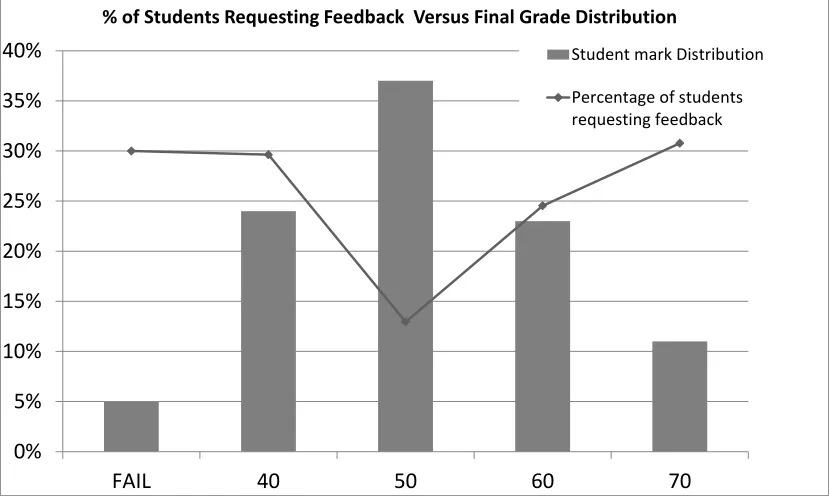
Using the VLE data we have reviewed which students requested feedback versus which marking band the students’ final grade fell into.
Figure 1: Feedback request vs. final grade N=254
As previously mentioned, the students were asked at the point of assessment submission their likely projected mark. We reviewed this against their actual mark and this showed a general trend to pessimistic forecasts at the higher mark bands, and a highly optimistic view of the student’s own performance at the lower end of assessment marks.
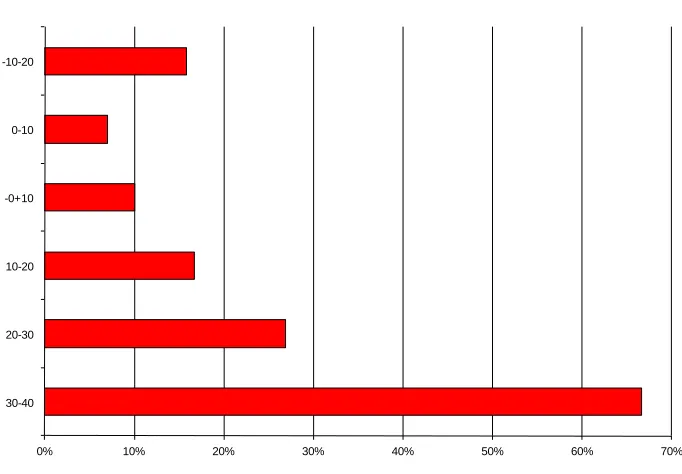
We then compared the requests for additional individual feedback to the difference between expected and actual marks awarded (Figure 2). The individual student differentials were placed into bands, based on how optimistic or pessimistic the students were in relation to their final actual grade. For example if a student or scored 15% less than they expected was placed in the 1-20 optimistic band. We then compared the number of students in each band to the
percentage of students’ requests for feedback.
Figure 2: Comparison of detailed feedback requests with actual and expected grade differential (n2=57)
n2= Students who requested additional audio feedback
The data for individual feedback requests shows the strongest indication that at higher negative differentials (pessimistic) between expected and actual marks more students are actively seeking additional feedback. For example, students who fell into the 30 to 40 Optimistic band (Figure 2, above) received an assignment mark that was 30 to 40% less than their expected mark. This was the largest group of students who requested detailed audio feedback. The one exception to this is where students received a significantly higher grade than they expected, in this case 10 to 20% higher (10 to 20 pessimistic).
Online Survey data
18 of the 24 students who accessed additional feedback completed the online survey of their experience of the feedback process of the module. 61% of the students who requested additional feedback had looked at the marking grid with simple comments, but 39% did not. 78% of these 24 students did look at the generic written feedback.
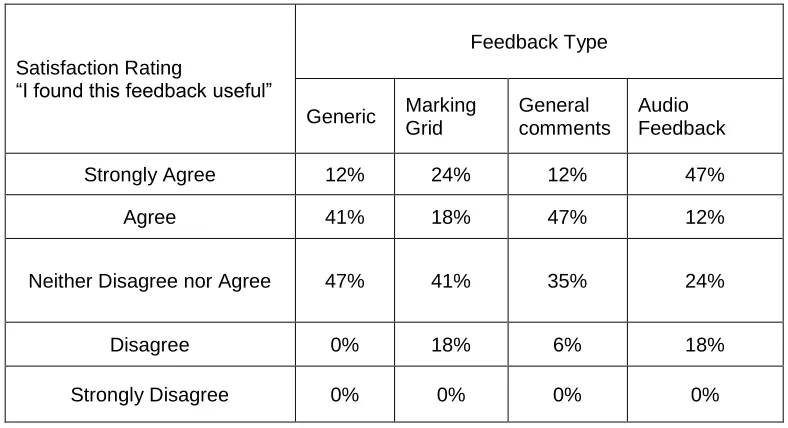
Overall satisfaction of this set of students with the different feedback channels is shown below (Table 1).
As can be seen from the last column in Table 1, audio feedback scores higher than the other aspects of the feedback received, although it is not a universally popular mechanism. At an individual student level there appears to be no correlation between students’ views of the different mechanisms, i.e. of the students who found audio feedback useful, some found the marking grid and generic feedback useful, whilst others did not.
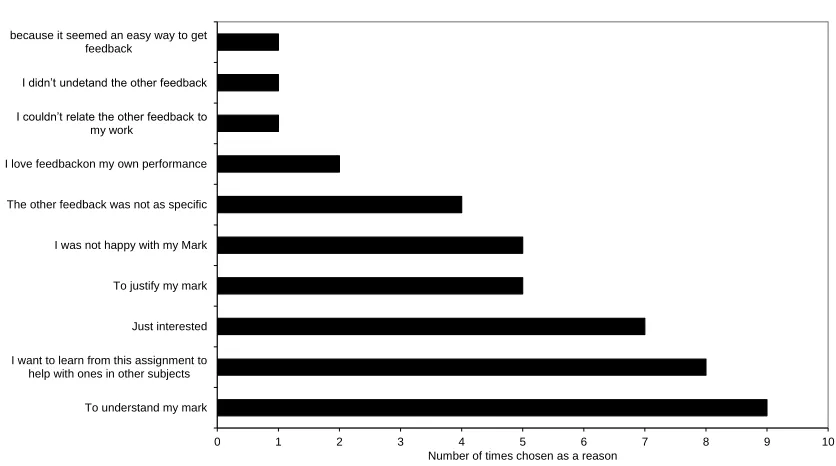
Those 57 students who requested individual additional feedback, i.e. made use of the third level of feedback of the ‘feedback on demand hierarchy’, were asked why they wanted additional feedback and given a set of 11 responses to choose from. Students could pick as many reasons as they wanted and these ranged from one reason to five, with an average number being 3.5, showing that the rationale for seeking feedback is not always simplistic or singular. The total scores for each reason are shown below in Figure 3.
Figure 3: Reasons for seeking additional feedback (n4 = 18)
General Survey data
The students from the larger survey (Nx = 404, nx =53) in semester 2 were asked whether seeking feedback was dependant on the difference between the grade they expected (higher or lower) and the one awarded asking responses to the statement; ‘I am more interested in the mark than feedback for the final assignment’
Strongly Disagree 18%
Disagree 26%
Neither Disagree nor Agree 15%
Agree 33%
Strongly Agree 8 %
These findings show that the student cohort appears to be clearly split in their preferences to this statement. However, this was explored further by asking whether the students would be satisfied with a simple marking grid feedback if their received assessment mark corresponded to their expectations. The results showed that students’ satisfaction levels with the marking grid type of feedback were very high at 72% if the received grade was as expected, as 58% agreed and 14% strongly agreed with this statement. A very low number of students disagreed (0% ‘Strongly disagreed’, 15% ‘Disagreed’). 13% felt ambivalent (‘Neither Agree nor disagree’) about being satisfied with marking grid feedback if the mark was as expected.
Additionally, the students were asked to rate different types of feedback. The results for the marking grid showed that most students perceived feedback in form of a marking grid to be useful, with 10% indicating ‘Great value’ and 47% stating ‘Significant value’. Only about a third of students surveyed (35%) found a marking grid to be of limited value, and very few students perceived a marking grid to be of ‘No value’ (6%) or ‘Unhelpful’ (2%).
These survey results suggest that our students felt that additional feedback provided was most useful when the actual grade differed from the expected grade (see Figures 3 and 5) but also that they perceived a simple scored feedback matrix to be of good value, particularly if the mark received was within their expectations.
Repeat of Intervention
Conclusions and implications for practice
We conclude by returning to the four questions of our paper
a) How many students actually access the feedback elements from an assessment?
Our findings indicate that only a small percentage of our student cohort actually accessed the feedback on their written assignment. The number of students accessing the generic feedback was an average of 22%.Only less than half (45%) of the 254 students accessed their simple scored feedback matrix. At the point of assessment submission, our students overwhelming believed that they would want additional feedback on their work with the vast majority of students stating this. However, once the mark had been released and time had passed the number actually seeking feedback was dramatically different, dropping from 86% to below 10%. These findings provide evidence to support authors, such as Murtagh and Baker (2009) that students are not interested in collecting feedback on summative work. This is important as these findings come not from student (Murtagh and Baker ,2009) or staff questionnaires (Winter and Dye, 2005),which have some limitations, but from collected data from actual student behaviour. With our next objective, we tried to investigate this further.
b) How does the differential between grade expectation and result affect feedback behaviour?
We found a definite bias of our students to seek feedback where the grade was different from their expectations. This increased as the difference between grade and expectation increased and especially where this expectation was higher than the mark allocated (see Figure 2). The data from the general survey indicates that the student population was split on whether this behaviour is their general preference. However, as this data has been collected by survey we cannot ascertain whether this is how they would like to act, or actually do act. The students’ satisfaction levels with the marking grid type of feedback were very high if the received grade was as expected. There is possibility a difference between satisfaction and preference, which may be linked to their current overall satisfaction with their module mark and overall mark profile. The online survey section that focused on reasons for seeking feedback provides some limited evidence that the above results could represent a population of students that desired to seek feedback regardless of the grade (see Figure 3). This is similar to Rae and Cochrane’s (2008) suggestion of active and passive students.
c) What are the main reasons students appear to seek additional detailed feedback?
Our findings are similar to those by Rae and Cochrane (2008) who postulated the two categories of active and passive students. Our research further supports their view that the passive students could become ‘feedback active’ students dependent on the differential between expected and actual grades. This substantiates some of the comments made about this type of behaviour in from students in studies by Taras (2003), Bevan et al. (2008) and Rowe and Wood (2008).
Although it is explicitly stated in the literature that students will often only seek feedback if the mark is lower than their expectation, our data also indicates that some students will also feedback where the mark is higher than expected. Therefore our main conclusion is that students will have a higher preference to seek feedback where it differs from their expectations, not just if it is lower than expected.
d) Can offering feedback on demand be suitable for students and academics?
Data from the general survey and the online survey of students who actually accessed additional feedback supports the view that the substantial majority of students would be
satisfied with offering additional feedback only when requested whilst utilising a simple marking grid approach, particularly in the context of where their mark is similar to expectations. Students did not appear to feel disempowered by the lack of universal detailed feedback, and we
received no complaints either to the module or the course based on this intervention.
Whilst no formal data gathering was undertaken to elicit academic staff opinions regarding this approach to providing feedback two themes emerged from module team discussions. The first was a concern that the numbers of students requesting feedback would be high, and the second the unfamiliar nature and time required to learn how to produce and deliver audio feedback. However the combination of low numbers of students requesting feedback, and the simplicity and efficiency of using the marking grid was generally felt to be beneficial by staff, and whilst adequate support was provided to support tutors in providing audio feedback, the
following year different modes were allowed within the feedback process. The following year indicated that feedback mode has limited influence on the feedback behaviour for these students in this context, and hence feedback modes could be tailored to staff preference taking into account teaching and learning contexts and personal and institutional efficiencies.
To conclude, we suggest that offering all students’ detailed feedback on summative work is not resource efficient for academic staff and institutions, based on the low ratio of students
requesting and actually accessing detailed individual feedback. Students could be offered a hierarchy of feedback with the feedback modes requiring the most resource, such as individual feedback, being offered ‘on request’ rather than universally supplied.
We believe that the further exploration of feedback on request would have significant
We call on others to further explore and evaluate feedback on request in order to address some of limitations, especially the applicability of this approach to other subjects, levels and contexts. We need more evidence of the difference between student behaviour versus their stated
References
Bevan, R., Badge, J., Cann, A., Willmott, C. and Scott J. (2008) Seeing Eye-to-Eye? Staff and Student Views on Feedback.Bioscience Education E-journal,12-1 [Online]. Last accessed 01/10/2010 at: http://www.bioscience.heacademy.ac.uk/journal/vol12/beej-12-1.pdf
Carless, D. (2006). Differing perceptions in the feedback process. Studies in Higher
Education, 31(2), 219-233.
Chanock, K. (2000) 'Comments on Essays: Do students understand what tutors write?',
Teaching in Higher Education, 5: 1, 95 - 105.
Cohen L., Manion L., Morrison K. (2007) Research Methods in Education 6th Edition, Abingdon, Oxon: Routledge
Ding, L. (1998) Revisiting assessment and learning: implications of students’
perspectives on assessment feedback, paper presented to Scottish Educational Research
Association Annual Conference, University of Dundee, 25–26 September.
Duncan, N., Prowse, S., Wakeman, C., Harrison, R. (2003) ‘Feed-forward’: improving
students’ use of tutors’ comments. Learning and Teaching Projects, University of
Wolverhampton.
Duncan, N. (2007) ''Feed-forward': improving students' use of tutors' comments', Assessment
& Evaluation in Higher Education, 32: 3, 271 – 283.
Entwistle, N. (1998) 'Motivation and approaches to learning: motivating and conceptions of teaching', in: S. Brown, S. Armstrong and G. Thompson (Eds) Motivating Students (London, Kogan Page), pp. 59-72. Cited in: Mcdowell, L. and Sambell, K. (1999) 'Fitness for Purpose in the Assessment of Learning: students as stakeholders', Quality in Higher Education, 5: 2, 107 — 123.
Gibbs, G., Simpson, C. (2004) Conditions Under Which Assessment Supports Students’ Learning. Learning and Teaching in Higher Education, Issue 1, 2004-05
Hepplestone, S., Parkin, H., Holden, G., Irwin, B., Thorpe, L. (2009) Technology, Feedback, Action!: The impact of learning technology upon students' engagement with their
feedback. Enhancing Learning Through Technology Research Project Report 08/09. [Online].
Last accessed 20/05/2011 at: http://evidencenet.pbworks.com/Technology,-Feedback,-Action!%3A-Impact-of-Learning-Technology-on-Students%27-Engagement-with-Feedback
Higgins, R. , Hartley, P. and Skelton, A. (2001) 'Getting the Message Across: the problem of communicating assessment feedback', Teaching in Higher Education, 6: 2, 269 — 274
Hyland, P. (2000) Learning from feedback on assessment, in: P. Hyland and A. Booth (Eds) The Practice of University History Teaching (Manchester, Manchester University Press). Mcdowell, L. and Sambell, K. (1999) 'Fitness for Purpose in the Assessment of Learning: students as stakeholders', Quality in Higher Education, 5: 2, 107 — 123.
Murtagh, L., Baker, N. (2009) Feedback to Feed Forward: student response to tutors’
written comments on assignments Vol 3, No 1 (2009): Practitioner Research in Higher
Education http://194.81.189.19/ojs/index.php/prhe/issue/view/10.
Mutch, A. (2003) Exploring the practice of feedback to students. Active Learning in Higher Education, 4 (1), 24-38.
Nicol, D. J., Milligan, C. (2006) Rethinking technology-supported assessment in terms of
the seven principles of good feedback practice. In: Bryan, C. and Clegg, K. (eds) Innovative
Assessment in Higher Education. London: Taylor and Francis Group Ltd.
McNiff J, Whitehead J. (2006) All you need to know about Action Research. London Thousand Oaks, New Delhi: Sage Publications.
McNiff J, Whitehead J. (2009) Doing and Writing Action research London Thousand Oaks, New Delhi: Sage Publications
Norton L.S, (2009) Action Research in Teaching and Learning: A practical guide to
conducting pedagogical research in Universities Abingdon, Oxon: Routledge
NSS (2011) [Online]. Last accessed 09/05/2011 at:
http://www.thestudentsurvey.com/content/nss2011_questionnaire_english.pdf
https://outlook.leedsmet.ac.uk/owa/redir.aspx?C=9fb222b8791449e695f9fd3d3c0524e8&URL= http%3a%2f%2fwww.thestudentsurvey.com%2fcontent%2fnss2011_questionnaire_english.pdf
Rae, A., Cochrane, D. (2008) Listening to students: How to make written assessment feedback useful. Active Learning in Higher Education. Last accessed 09/05/2011 at:
http://alh.sagepub.com/cgi/content/abstract/9/3/217
Ramaprasad, A. (1983) On the definition of feedback, Behavioural Science, 28, 4–13. Quoted in: Taras, M. (2005) Assessment – summative and formative – some theoretical reflections.
British Journal of Educational Studies, 53(4), 466-478.
Rowe, A., Wood, L. (2008) “What Feedback do Students Want?” Australian Association for Research in Education (AARE) International Education Research Conference. Fremantle, Australia. 2008 Last accessed 09/05/2011 at: http://www.aare.edu.au/07pap/row07086.pdf
Sadler, D. R. (2010) 'Beyond feedback: developing student capability in complex appraisal',
Assessment & Evaluation in Higher Education, 35: 5, 535 - 550.
Quoted in: Taras, M. (2005) Assessment – summative and formative – some theoretical reflections. British Journal of Educational Studies, 53(4), 466-478.
Taras, M. (2005) Assessment – summative and formative – some theoretical reflections. British
Journal of Educational Studies, 53(4), 466-478.
Taras, M. (2006) Do unto others or not: equity in feedback for undergraduates. Assessment &
Evaluation in Higher Education, 31(3), 365-377.
Weaver, M. (2006) "Do students value feedback? Student perceptions of tutors' written responses." Assessment and Evaluation in Higher Education 31.3 (June 2006): 379-94.
Winter, C. and Dye, V. L. (2004). 'An investigation into the reasons why students do not collect marked assignments and the accompanying feedback'. [Online]. Last accessed 21/10/2009 at: http://wlv.openrepository.com/wlv/bitstream/2436/3780/1/An%20investigation%20pgs%20133-141.pdf
Wojtas, O. (1998, September 25) Feedback? No, just give us the answers, Times Higher Education Supplement. Cited in: Weaver, M. (2006) "Do students value feedback? Student perceptions of tutors' written responses." Assessment and Evaluation in Higher Education
31.3 (June 2006): 379-94.
Yorke, M. (2003) ‘Formative Assessment in Higher Education: Moves Towards
Theory and the Enhancement of Pedagogic Practice’, Higher Education 45: 477–501. Cited in: Rae, A., Cochrane, D. (2008) Listening to students: How to make written assessment feedback useful. Active Learning in Higher Education. Last accessed 09/05/2011 at:
Figure 1: Feedback request vs. final grade N=254
0%
5%
10%
15%
20%
25%
30%
35%
40%
FAIL
40
50
60
70
% of Students Requesting Feedback Versus Final Grade Distribution
Student mark Distribution
Figure 2: Comparison of detailed feedback requests with actual and expected grade differential (n2=57)
n2= Students who requested additional audio feedback
0% 10% 20% 30% 40% 50% 60% 70%
Table 1: Student satisfaction with feedback type n4 = 18 n4 = students who completed the online survey
Satisfaction Rating
“I found this feedback useful”
Feedback Type
Generic Marking Grid
General comments
Audio Feedback
Strongly Agree 12% 24% 12% 47%
Agree 41% 18% 47% 12%
Neither Disagree nor Agree 47% 41% 35% 24%
Disagree 0% 18% 6% 18%
Figure 3: Reasons for seeking additional feedback (n4 = 18)
0 1 2 3 4 5 6 7 8 9 10
To understand my mark I want to learn from this assignment to
help with ones in other subjects Just interested To justify my mark I was not happy with my Mark The other feedback was not as specific I love feedbackon my own performance I couldn’t relate the other feedback to
my work
I didn’t undetand the other feedback because it seemed an easy way to get
feedback