Citation:
Ajayi, SO and Oyedele, LO (2018) Waste-Efficient Materials Procurement for Construction Projects: A Structural Equation Modelling of Critical Success Factors. Waste Management. ISSN 0956-053X DOI: https://doi.org/10.1016/j.wasman.2018.01.025
Link to Leeds Beckett Repository record: http://eprints.leedsbeckett.ac.uk/4663/ Document Version:
Article
The aim of the Leeds Beckett Repository is to provide open access to our research, as required by funder policies and permitted by publishers and copyright law.
The Leeds Beckett repository holds a wide range of publications, each of which has been checked for copyright and the relevant embargo period has been applied by the Research Services team.
We operate on a standard take-down policy. If you are the author or publisher of an output and you would like it removed from the repository, please contact us and we will investigate on a case-by-case basis.
1 Waste-Efficient Materials Procurement for Construction Projects: A
Structural Equation Modelling of Critical Success Factors
Abstract
Albeit the understanding that construction waste is caused by activities ranging from all stages of project delivery process, research efforts have been concentrated on design and construction stages, while the possibility of reducing waste through materials procurement process is widely neglected. This study aims at exploring and confirming strategies for achieving waste-efficient materials procurement in construction activities. The study employs sequential exploratory mixed method approach as its methodological framework, using focus group discussion, statistical analysis and structural equation modelling.
The study suggests that for materials procurement to enhance waste minimisation in construction projects, the procurement process would be characterised by four features. These include suppliers’ commitment to low waste measures, low waste purchase management, effective materials delivery management and waste-efficient Bill of Quantity, all of which have significant impacts on waste minimisation. This implies that commitment of materials suppliers to such measures as take back scheme and flexibility in supplying small materials quantity, among others, are expected of materials procurement. While low waste purchase management stipulates the need for such measures as reduced packaging and consideration of pre-assembled/pre-cut materials, efficient delivery management entails effective delivery and storage system as well as adequate protection of materials during the delivery process, among others. Waste-efficient specification and bill of quantity, on the other hand, requires accurate materials take-off and ordering of materials based on accurately prepared design documents and bill of quantity.
Findings of this study could assist in understanding a set of measures that should be taken during materials procurement process, thereby corroborating waste management practices at other stages of project delivery process.
2 1.0. Introduction
The construction industry accounts for about 13% of the global economy and serves as a key driver for other industries as a result of its infrastructural and facilities development (HM Government, 2008). Despite its significance to the global economy (Ajayi et al., 2015), it has remained a major target for environmental sustainability (Anderson and Thornback, 2002). This is due to its consumption of the largest portion of materials resources, water and energy, while also contributing largest waste to landfill sites (Edwards, 2014). It has also been argued that continuous sustainability of the industry depends on how well it manages waste generation (Udawatta et al., 2015); especially as waste minimisation is requisite to preventing materials depletion (Oyedele et al., 2014; Akinade et al., 2015). Although the waste generated by the construction industry is contributed by both construction and demolition activities, reducing waste during the construction process is not only good for environmental reasons, it could also reduce the overall cost of projects. This is especially as a substantial proportion of construction cost overrun is due to waste generation (Ameh and Itodo, 2013). Due to an understanding of the needs to minimise waste generated by construction activities, various studies have been carried out to determine both causative factors and preventive measures. This has led to an understanding that construction waste is caused by various activities at design, procurement and construction stages of project lifecycle (Faniran and Caban, 1998, Ekanayake and Ofori, 2004; Dainty and Brookes, 2004).
3 Notwithstanding the knowledge that wasted materials are purchased through the procurement process, the relevance of the process in reducing construction waste has not been adequately considered. Few procurement strategies that have been identified are subjects of studies that specifically focussed on design or construction activities. This is albeit the fact that substantial percentages of waste generated in construction activities have been traced to ineffective coordination of materials procurement activities (Faniran and Caban, 1998). Thus, it is important that waste-effective measures be taken while purchasing materials for construction activities. This has the tendency of reducing waste as well as the cost of construction materials, which is about 50% of total project cost (Kong et al., 2001).
Based on the paucity of literature that specifically focussed on materials procurement measures for waste mitigation, this study aims at investigating the waste preventive measures that should be taken during the construction materials procurement process. The study explores a set of requisite measures capable of minimising waste generated as of result of ineffective materials purchase, delivery, handling and storage. In order to achieve this goal, the study fulfils the following research objectives:
1. To explore waste-efficient measures that could be taken during procurement of construction materials.
2. To confirm key strategies for engendering construction waste minimisation through materials procurement process
4 The paper offers insights into factors and strategies to be considered during materials schedule, purchase and delivery process so as to achieve effective waste management. The relationship between various measured and latent factors are also presented. The study would assist construction professionals, materials suppliers and other stakeholders in understanding how well the procurement processes could be coordinated for construction waste mitigation. It also offers new theoretical insights into the importance of materials procurement in construction waste management.
2.0. Construction Materials Logistics and Supply Chain Management
The construction industry is arguably one of the least integrated sectors of the global economy, notwithstanding its significance in driving other sectors (Fulford and Standing, 2014). Due to the project-based nature of the industry and the transient nature of the project team, long-term relationship between the parties is often non-existent. This affects the multi-dimensional relationships that exist between various parties involved in project delivery process. While many industries have adopted various innovative concepts such as the Lean approach and assemble to order, among others, in their materials supply process, there has been little success in integrating these sets of concepts in the construction industry. This is notwithstanding the existence of strong relationships between supply chain management and organisational performance (Tan et al., 1998). According to Vrijhoef and Koskela (2000), the fragmented nature of the construction activities, as well as unique nature of every project, is partly responsible for the one-off approach to materials procurement, with the repeated reconfiguration of materials supply team and project organisation. This has resulted in a large quantity of waste, and several other problems, that characterised the materials supply chain in the construction industry (Vrijhoef and Koskela, 2000).
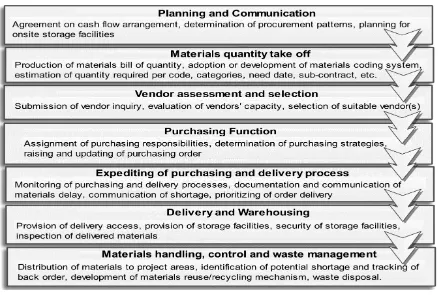
5 usually involves a number of stages including materials take-off, bill of materials, warehousing and the actual use of the materials. At the early stage, an effort is required to ensure that the materials take-off is accurately made from project specification in order to prevent error in ordering (Bell and Stukhart, 1986). The increasing use of Computer Aided Design (CAD), and specifically the use of BIM tools for materials take-off, is continuously facilitating efficient estimation of materials required for building activities. Nonetheless, this largely depends on the accuracy of the drawing documents and adequate coordination of drawings between various professional parties involved in modern-day designs (Monteiro and Martins, 2014).
Figure 1: Key stages of materials logistics management in construction projects
6 types of project procurement routes, which determines whether the role is played by the owner’s team, contractor, sub-contractor or other delegated team (Bell and Stukhart, 1986). This function includes raising of a purchase order, which incorporates item stock number, quantity, date needed, status and remarks, among other information that largely relies on the bill of quantity. Expediting is further required of the project team and vendors, who receive, manage and communicate information on anticipated delivery, likely delay, material shortage and shipping plans, all of which are required for updating purchase order and adequate planning of construction activities. On delivering materials, inspection, warehousing and material handling and control become essential roles of site management team. Balance is to be made between excessive material stocking and materials delay, as the former results in breakage and waste, while the latter results in costly labour delay and subsequent time overrun (Bell and Stukhart, 1986).
There has been increasing use of materials logistics planning as a strategic tool for efficient planning and management of materials in construction projects. It is a term that encompasses materials ordering and purchase management, storage management, planning of inbound and outbound materials or waste, variation control and delivery management, among others (Sobotka et al., 2005). It has been viewed as a proactive management of the quantities and type of materials needed, its supply routes, security, storage and handling, use, reuse and recycling, as well as disposal of excess materials (WRAP, 2007). Apart from the cost saving potentials of these sets of materials logistics management, they are essential requisites for achieving sustainability of the built environment (Yate, 2015). In addition, increasing awareness of the environmental impacts of materials logistics management has re-energised the concepts of whole lifecycle assessment, performance in use, innovative materials and responsible sourcing. All of these are significant areas that are gaining increasing importance in sustainable design appraisal systems (Yate, 2015).
7 confirming critical measures for engendering construction waste mitigation through the material procurement process.
3.0. Research Methods
Due to lack of literature on procurement measures for waste minimisation, qualitative research method is employed at the first stage of the study. At the later stage of the study, a structural equation model was developed to test the initial relationship established through the use of qualitative study. As such, the study was carried out in two stages in line with exploratory sequential mixed method approach.
3.1. Qualitative Sampling and Data Collection
While carrying out data collection in a qualitative research, in-depth interview with the individual participant or interview with multiple participants (focus group discussions) could be employed (Creswell, 2013). Focus group discussion was selected in this study, as it allows exploration of inter-subjective opinion among the research participant in order to arrive at a common understanding of the research participants.
As recommended by Creswell (2013), purposive sampling was used in determining information-rich participants whose understanding is important for the study. As such, architects, civil/structural engineers, project managers, construction materials suppliers and supply chain managers of construction firms were involved in the focus group discussions. This is to ensure logical applicability of the findings to other cases. In order to reach out to the participants, the researchers’ network of contact within the UK construction industry was used to select the participants, who were invited through a written invitation. In line with Creswell’s (1989) recommendation that five to 25 information-rich participants are expected to participate in qualitative research, a total of 24 participants were involved in this study. In addition to two members of the research team that moderated each of the focus group discussions, Table 1 shows the number of participants in each of the discussions.
8 mitigation through procurement and (ii) understanding of measures for reducing waste through materials purchase strategies. Each of the discussions lasted between 75 and 90minutes and the discussions were recorded for the ease of transcription and analysis.
Table 1: Overview of the focus group discussions and the participants Focus
Groups Categories of the Participants
Total No of experts
Years of experience
1
Architects and Design Managers
2 design architects
3 site architects
2 design managers
7 7 – 18
2
Materials Suppliers and Supply Chain Managers
4 materials suppliers
2 supply chain managers
6 11 – 21
3 Construction Project Managers 6 10 – 19
4
Civil and Structural Engineers
1 design engineer
4 site based engineers
5 9 – 21
Total 24
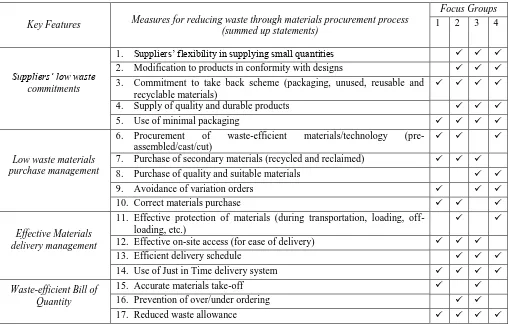
9 Table 2: Materials procurement measure for reducing construction waste
Key Features Measures for reducing waste through materials procurement process (summed up statements)
Focus Groups
1 2 3 4
Suppliers’ low waste commitments
1. Suppliers’ flexibility in supplying small quantities
2. Modification to products in conformity with designs
3. Commitment to take back scheme (packaging, unused, reusable and
recyclable materials)
4. Supply of quality and durable products
5. Use of minimal packaging
Low waste materials purchase management
6. Procurement of waste-efficient materials/technology
(pre-assembled/cast/cut)
7. Purchase of secondary materials (recycled and reclaimed)
8. Purchase of quality and suitable materials
9. Avoidance of variation orders
10. Correct materials purchase
Effective Materials delivery management
11. Effective protection of materials (during transportation, loading, off-loading, etc.)
12. Effective on-site access (for ease of delivery)
13. Efficient delivery schedule
14. Use of Just in Time delivery system
Waste-efficient Bill of Quantity
15. Accurate materials take-off
16. Prevention of over/under ordering
17. Reduced waste allowance
In line with established strategies for validating qualitative data (Long and Johnson, 2000), a combination of inter-rater reliability test and participants’ validation process were used in the study. These helped in the refinement of the themes and holistic re-alignment of the identified themes with the four key categories of waste-efficient procurement strategies.
3.2. Use of Structural Equation Modelling
10 relationships between constructs (Chen et al., 2012). Due to many benefits of SEM, it has been widely used in construction-related studies. For instance, Xiong et al. (2014) examine the influence of participant performance factors on contractors’ satisfaction, using structural equation modelling. Mainul Islam and Faniran (2005) construct an SEM to investigate factors influencing project planning effectiveness, while Chen et al. (2012) employed SEM to investigate interrelationships among critical success factors of construction projects. More recently, Xiong et al. (2015) carried out a review of 84 construction-related studies that employed SEM between 1998 and 2012.
To understand the key procurement measures with significant impacts on waste minimisation, SEM is used in the study. A key benefit of using SEM in this study is that its Confirmatory Factor Analysis (CFA) helps in confirming the relationship between the established factors and waste-efficient materials procurement. It also helped in establishing the magnitude and significance of the relationship between the main strategies.
3.3. Development of Hypothetical Model
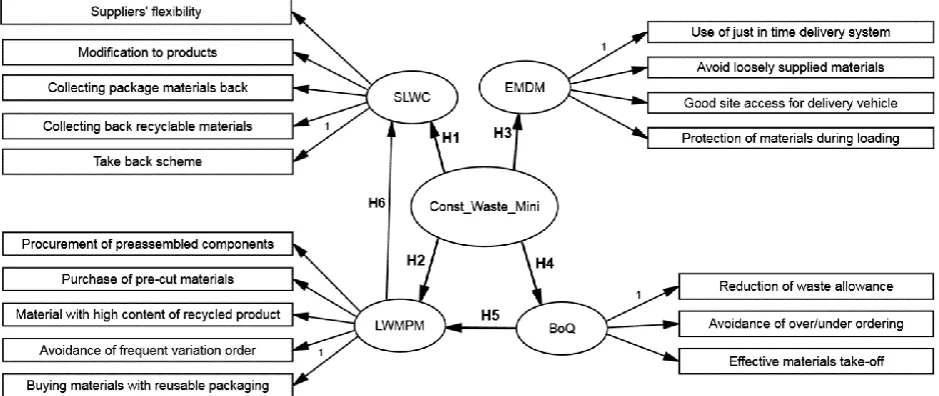
In order to develop a hypothetical model for the structural equation model, this study selected the 17 sub-factors established in Table 2 as measured variables and the four-key group as the latent variables. Figure 2 shows the hypothetical structural model for the study. In line with recommendations of Hoyle (1995), the directions of arrows represented the 6 hypothetical influences that the structural equation model was set to test. The 6 hypotheses are:
H1: Materials suppliers’ commitment is requisite to reducing waste in construction projects H2: Low waste materials purchase management is requisite to reducing construction waste H3: Effectiveness of materials delivery system is requisite to minimising construction waste H4: Waste consideration in Bill of Quantity determines overall waste output of projects H5: Waste consideration in Bill of Quantity has positive impacts on the waste effectiveness of materials purchase management.
11 Figure 2: Hypothetical model of procurement measures for mitigating construction waste
3.4. Quantitative Data Collection
In order to test the established hypothesis and confirm the factors contributing to each of the main strategies, a questionnaire was designed to incorporate all the measurement variables established from the first phase of the study. As a part of larger waste management research questionnaire, the measures were put on a five-point Likert scale, where 1 represents most important and 5 represents not important. In order to prevent ambiguity in the research instrument, a pilot study was carried out with seven experts, including 2 architects, 2 civil/structural engineers, and 3 project managers. The purpose of the pilot study was to test the clarity of language, layout, the degree of depth, the logic of the questions, and to perform a preliminary check of the proposed analysis.
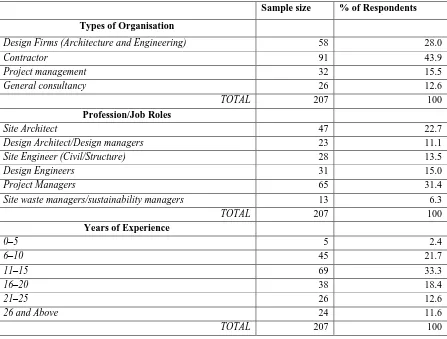
12 threshold for good response rate of 65% according to Fincham (2008), appropriateness of the data for structural equation modelling is also confirmed. The total sample size is above the N=200 threshold recommended by Kline (2010) for SEM.
Table 3: Demography of the research participants
Sample size % of Respondents
Types of Organisation
Design Firms (Architecture and Engineering) 58 28.0
Contractor 91 43.9
Project management 32 15.5
General consultancy 26 12.6
TOTAL 207 100 Profession/Job Roles
Site Architect 47 22.7
Design Architect/Design managers 23 11.1
Site Engineer (Civil/Structure) 28 13.5
Design Engineers 31 15.0
Project Managers 65 31.4
Site waste managers/sustainability managers 13 6.3
TOTAL 207 100 Years of Experience
0–5 5 2.4
6–10 45 21.7
11–15 69 33.3
16–20 38 18.4
21–25 26 12.6
26 and Above 24 11.6
TOTAL 207 100
3.5. Data Screening and Reliability Analysis
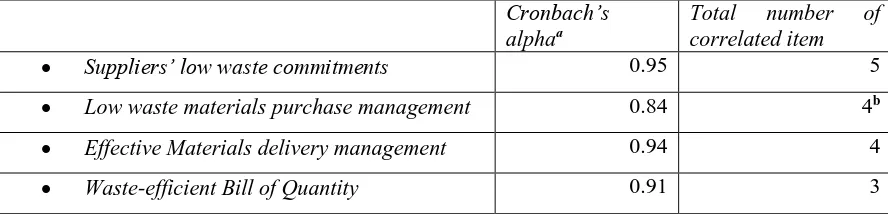
13 With the aid of SPSS Version 22, Cronbach Alpha analysis was used to test if all the measured variables are contributing to their corresponding latent variables and to confirm the appropriateness of the groupings. This is in line with the recommendation that the Cronbach’s alpha coefficient be determined, especially when using the Likert scale on a questionnaire (Nunnally and Bernstein, 2007). With Cronbach’s alpha ranging from 0 to 1, a value of 0.7 represents an acceptable consistency, while 0.8 indicates a good internal consistency according to Nunnally and Bernstein (2007). As shown in Table 4, the overall Cronbach alpha coefficient for the variables is 0.91, with none of the grouping having a Cronbach alpha value below 0.79. In order to confirm whether all items on the questionnaire are contributing to the good internal consistency, “Cronbach’s alpha if item deleted” were evaluated as suggested by Field (2009). In this case, any item with Cronbach’s alpha above the overall coefficient means that such item is not a good construct and should be deleted from the list of variables. This analysis suggests that one variable from group 2, “avoidance of variation order”, is affecting the group’s reliability and the overall reliability of the data. On deleting the variable, the overall Cronbach’s Alpha increased to 0.94, with none of the group having its Cronbach alpha below 0.84. This thus suggests an excellent internal consistency and reliability of the hypothetical model. Table 4 shows the results of the reliability analysis.
Table 4: Results of the Reliability test Cronbach’s alphaa
Total number of correlated item
Suppliers’ low waste commitments 0.95 5
Low waste materials purchase management 0.84 4b
Effective Materials delivery management 0.94 4
Waste-efficient Bill of Quantity 0.91 3
a: Overall Cronbach’s Alpha = 0.94; b: Item remains four after one of the five items was deleted.
3.6. Model Development and Verification
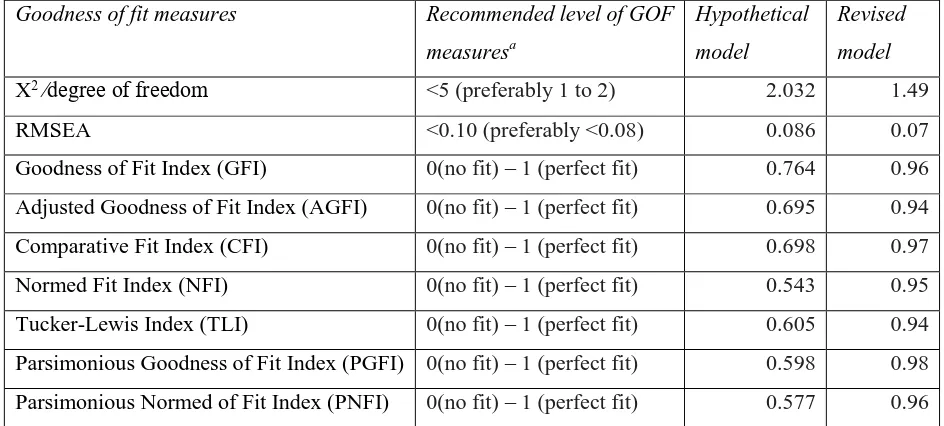
14 appropriateness of the initial model, using a number of Fit Indices as suggested by Kline (2010). As such, the model was assessed for Absolute Fit, which includes Root Mean Square Error of Approximation (RMSEA) and Goodness of Fit Index (GFI). It was also assessed for Incremental Fit, which includes Adjusted Goodness of Fit Index (AGFI), Comparative Fit Index (CFI), Normed Fit Index (NFI) and Tucker-Lewis Index (TLI). The parsimonious fit of the model was also evaluated. Based on the initial value of the model fit indices (as shown in Table 5), the improvement was required to ensure an adequate fitness of the model with the data.
Table 5: Result of GOF measures Goodness of fit measures Recommended level of GOF
measuresa
Hypothetical
model
Revised
model
X2 ∕degree of freedom <5 (preferably 1 to 2) 2.032 1.49
RMSEA <0.10 (preferably <0.08) 0.086 0.07
Goodness of Fit Index (GFI) 0(no fit) – 1 (perfect fit) 0.764 0.96
Adjusted Goodness of Fit Index (AGFI) 0(no fit) – 1 (perfect fit) 0.695 0.94
Comparative Fit Index (CFI) 0(no fit) – 1 (perfect fit) 0.698 0.97
Normed Fit Index (NFI) 0(no fit) – 1 (perfect fit) 0.543 0.95
Tucker-Lewis Index (TLI) 0(no fit) – 1 (perfect fit) 0.605 0.94
Parsimonious Goodness of Fit Index (PGFI) 0(no fit) – 1 (perfect fit) 0.598 0.98
Parsimonious Normed of Fit Index (PNFI) 0(no fit) – 1 (perfect fit) 0.577 0.96
a: Thresholds adapted from Doloi et al. (2011); Qureshi and Kang (2015) and Chen et al.
(2012).
15 that show no significant correlation with latent factor and to check for significant variables with low correlation coefficient. The hypothetical model went through a number of refinement before the desired model fit was achieved. Table 5 shows the results of the initial and final model fit indices.
3.7. Results of the SEM and Hypothesis Testing
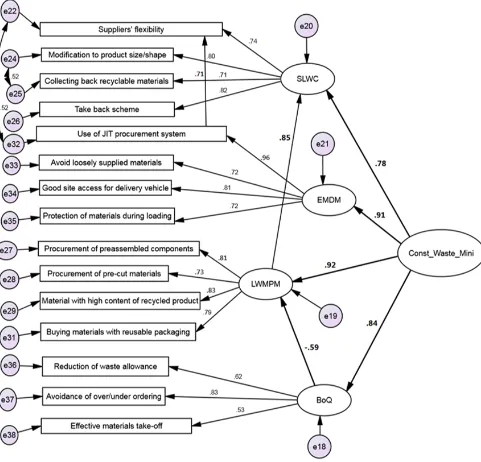
16 Figure 3: Final revised model of the relationship between the variables
Table 6: Standardized coefficient estimates of the final structural equation model
Hypothetical path Standardized
coefficient
Standard error
Sig. (p) Interpretation
H1: SLWC <--- Const_Waste_Mini +0.78 0.021 0.019 Supported
H2: LWMPM <--- Const_Waste_Mini +0.92 0.002 0.002 Supported
H3: EMDM<--- Const_Waste_Mini +0.91 0.036 0.007 Supported
[image:17.595.54.546.668.768.2]17
H5 LWMPM <--- BoQ -0.59 0.120 0.062 Rejected
H6 SLWC <--- LWMPM +0.85 0.027 0.046 Supported
4.0. Discussion
The structural component of the model suggests that the four key categories of measures are requisite to reducing waste generated by construction activities. They are as discussed in this section.
4.1. Low waste materials purchase management
With a β value of 0.92 at two-tailed significance level (See Table 6), low waste materials purchase management have the highest positive impact on construction waste mitigation through materials procurement. As materials could contribute up to 50% of project cost (Kong et al., 2001), success and profitability of a construction project largely depend on the extent to which its materials purchase is effectively managed. This finding is corroborated by Tam (2008) who identified purchase management as an effective measure for reducing waste in construction projects. The key measures that determine the waste effectiveness of materials purchase include procurement of pre-cut or preassembled materials, reusability of materials packaging and purchase of materials with a high content of recycled materials, all of which have a significant relationship with their latent factor. This was also echoed by Formoso et al. (2002) who argued that materials procurement that supports pre-cut and precast materials is indispensable to waste effectiveness of the construction industry. According to Tam et al. (2007), the use of precast materials is capable of reducing waste generated by construction activities by up to 84.7%.
4.2. Materials Delivery Planning and Schedule
18 ordered as at when needed during the construction process. This ensures that the materials are only taken to the site when they are needed, thereby preventing excessive storage of the materials (Al-Hajj and Hamani, 2011). It would as well prevent waste that could be due to stockpiling, inefficient handling and materials leftover. Other significant strategies include materials padding during transportation as well as adequate site access for materials delivery.
4.3. Suppliers’ Alliance and Commitment
With a β value of 0.78 at 95% confidence level (See Table 6), alliance with materials suppliers and their commitment is a key driver of construction waste minimisation. As further confirmed by the measurement components, suppliers’ commitment to take back scheme, flexibility in supplying lower quantity, support of JIT procurement system, and modification to materials’ size and shape in conformity with projects’ needs are significant measures of suppliers’ commitment to waste mitigation in projects. This is in line with the earlier finding that flexibility of materials suppliers in providing small quantities is requisite to reducing waste generated by construction activities (Dainty and Brooke, 2004).
Materials suppliers could actively support waste minimisation efforts by modifying materials in conformity with design, as it is capable of reducing offcut, which is a major source of waste landfilled by the industry (Formoso et al., 2002). In line with the significant measurement component of the suppliers’ commitment, literature has suggested take back scheme as a means of reducing waste due to materials leftover (Osmani et al., 2008; Oyedele et al., 2013; Al-Hajj and Hamani, 2011). Thus, the flexibility of suppliers in taking back unused materials (Dainty and Brooke, 2004), recyclable materials and packaging materials from construction sites are significant measures of the extent to which the suppliers support waste reduction.
4.4. Materials Specification and Bill of Quantity
19 volume of materials, which are added as likely waste proportion of the materials purchased. As pointed out, materials procurement in defiance of design, or what could be generally termed as inaccurate ordering (Faniran and Caban, 1998), is a major cause of construction waste. It usually results in additional materials that are more than needed, thereby resulting in excess order. It is therefore important that materials take-off is accurately done in preparation for actual materials purchase.
The relationship between suppliers’ commitment and low waste materials purchase suggests that decision of project team to reduce project waste output will result into the commitment of materials suppliers, suggesting that the suppliers will readily support waste management initiatives rather than initiate such move. As such, contractors and other construction team have key roles to play in driving waste efficiency of materials procurement process, as they determine the nature of materials to be purchased as well as the suppliers to engage. This relationship is further confirmed by the significant relationship between Just in Time (JIT) procurement and flexibility of suppliers, where JIT showed significant and strong causal influence on suppliers’ flexibility. Thus, the decision of project team to mitigate waste will readily influence suppliers’ readiness for take back scheme, modification to products, facilitation of recycling and other waste-effective practices.
4.5. Implication of the Findings for the Global Construction Industry
Construction waste minimisation has attracted significant research efforts aiming at reducing waste landfilled by the construction industry. These have resulted in an understanding that waste is caused by activities ranging from pre-design to construction stage of building delivery process. Albeit this understanding, waste preventive efforts have concentrated on other stages of the process than the procurement activities. Based on its exploration into the widely neglected opportunity for waste-effective procurement strategies, this study has implication for both construction practices and research into construction waste management.
20 materials purchase as well as during its purchase and delivery process. This could be achieved through the measures categorised as waste-efficient purchase management, design compliant procurement, and waste-efficient delivery management. The readiness of materials’ suppliers for collaborative waste mitigation could be evaluated through their commitment to such arrangement as take back scheme, flexibility in supplying small quantities of materials and proportion of secondary materials in their products. These set of measures could, therefore, be used in benchmarking the suppliers for waste minimisation capability. Albeit the need to select supportive materials suppliers in waste minimisation efforts, this study suggests that construction teams’ readiness for waste-efficient procurement would readily engender flexibility in materials suppliers.
Similarly, preparation for waste-efficient procurement is expected to commence as soon as the point of preparing materials take-off and bill of quantity, whose accuracy and low waste allowance are requisite to waste effectiveness of the procurement process. At this stage, it is important that materials take-off and specification be carefully prepared to avoid the error that could lead to materials over-ordering, leftover and waste, all of which could have impacts on project costs. With the way the industry is known to be requisite to the global sustainability agenda (Anderson and Thornhill, 2002), there is a need for the global construction industry to have a rethink on the concept of waste allowance.
In concurrence with earlier studies (Tam et al., 2007), this study implies that materials procurement process could significantly support waste minimisation by adopting the use of the modern methods of construction such as prefabrication, modular construction and ordering of pre-cut materials. This is not only capable of reducing waste; it could reduce the time required for construction activities while also freeing up site spaces in the case of confined sites. With the SEM showing a strong relationship between recycled content and low waste material purchase management, increasing use of materials with high-recycled content or secondary materials is requisite to the effective diversion of construction waste from landfill sites.
5.0. Conclusion
21 environmental impacts as it consumes a large proportion of materials resources and contributes the largest portion of landfill waste. In a bid to tackle this conundrum, research into construction waste is rife. This has led to the understanding that although construction waste occurs during the actual construction activities, waste is caused by activities and actions at design, materials procurement and construction stages of project delivery processes. Albeit this understanding, research efforts have been concentrated on design and construction stages, while the possibility of reducing waste through materials procurement process is widely neglected. As such, this study explored and confirmed strategies for achieving waste-efficient procurement in construction projects. The study employs sequential exploratory approach for its methodological framework, using focus group discussions, statistical analysis and structural equation modelling.
The study suggests that waste-efficient procurement requires dedication and commitment from the materials suppliers/manufacturers who are expected to subscribe to various waste preventive measures, such as take back scheme, less packaging and modification of materials to conform to projects’ requirement. Similarly, waste-efficient specification and bill of quantity are found to be a key requisite for achieving waste efficiency in construction projects. This requires accurate materials take-off and ordering of materials based on accurately prepared design documents, thereby preventing over-ordering and its subsequent waste generation. In order to reduce construction waste through materials procurement process, purchase and delivery processes are expected to be waste-efficient. While waste-efficient purchase management stipulates the need for such measures as reduced packaging and consideration of pre-assembled/pre-cut materials, waste-efficient delivery management entails effective delivery system and adequate protection of materials during the delivery process. The study further suggests that in as much as the project teams show commitment to waste mitigation, materials suppliers will readily support their plan.
22 implementing the strategies suggested in this study, and other similar studies, are possible areas for further investigation. Studies could as well be carried out to evaluate the combined and individual effects of design, materials procurement and onsite construction processes on construction waste minimisation.
Acknowledgement
The authors would like to acknowledge and express their sincere gratitude to the Engineering and Physical Sciences Research Council (EPSRC) and Innovate UK (grant applications No. 54832-413479/File No. 102473) for providing the financial support for this study.
References
Ajayi, S.O., Oyedele, L.O., Bilal, M., Akinade, O.O., Alaka H.A., Owolabi, H.A., and Kadiri, K.O. (2015). Waste effectiveness of the Construction Industry: Understanding the Impediments and Requisites for Improvements. Resources, Conservation and Recycling. 102, pp.101-112.
Ajayi, S.O., Oyedele, L.O., Akinade, O.O., Bilal, M., Owolabi, H.A., Alaka, H.A. and Kadiri, K.O., 2016. Reducing waste to landfill: A need for cultural change in the UK construction industry. Journal of Building Engineering, 5, pp.185-193.
Akinade, O.O., Oyedele, L.O., Bilal, M., Ajayi, S.O., Owolabi, H.A., Alaka, H.A. and Bello, S.A., 2015. Waste minimisation through deconstruction: A BIM based Deconstructability Assessment Score (BIM-DAS). Resources, Conservation and Recycling, 105, pp.167-176. Akinade, O.O., Oyedele, L.O., Munir, K., Bilal, M., Ajayi, S.O., Owolabi, H.A., Alaka, H.A.
and Bello, S.A., 2016. Evaluation criteria for construction waste management tools: towards a holistic BIM framework. International Journal of Sustainable Building Technology and Urban Development, pp.1-19.
Al-Hajj, A., & Hamani, K. (2011). Material Waste in the UAE Construction Industry: Main Causes and Minimisation Practices. Architectural Engineering and Design Management, 7(4), pp. 221 – 235.
Ameh, O.J., & Itodo, E.D. (2013). Professionals’ views of material wastage on construction sites and cost overruns. Organization, Technology & Management in Construction: An International Journal, 5(1), 747-757.
23 Aretoulis, G.N., Kalfakakou, G.P. & Striagka, F.Z., 2010. Construction material supplier
selection under multiple criteria. Operational Research, 10(2), pp.209-230.
Bell, L.C. and Stukhart, G., 1986. Attributes of materials management systems. Journal of Construction Engineering and Management, 112(1), pp.14-21.
Bilal, M., Oyedele, L.O., Qadir, J., Munir, K., Akinade, O.O., Ajayi, S.O., Alaka, H.A. and Owolabi, H.A., 2016a. Analysis of critical features and evaluation of BIM software: towards a plug-in for construction waste minimisation using big data. International Journal of Sustainable Building Technology and Urban Development, pp.1-18.
Bilal, M., Oyedele, L.O., Akinade, O.O., Ajayi, S.O., Alaka, H.A., Owolabi, H.A., Qadir, J., Pasha, M. and Bello, S.A., 2016b. Big data architecture for construction waste analytics (CWA): A conceptual framework. Journal of Building Engineering.
Buchan, R. D., Fleming, F. W., & Kelly, J. R. (1991). Estimating for builders and quantity surveyors. Oxford: Newnes.
Chen, Y.Q., Zhang, Y.B., Liu, J.Y. and Mo, P., 2012. Interrelationships among critical success factors of construction projects based on the structural equation model. Journal of Management in Engineering, 28(3), pp. 243-251.
Creswell, J. W. (2013). Qualitative inquiry and research design: Choosing among five approaches, 3rd edition. Thousand Oaks: Sage.
Dainty, A.R.J., & Brooke, R.J. (2004). Towards improved construction waste minimisation: A need for improved supply chain integration? Structural Survey, 22(1), pp. 20–29.
Edwards, B., 2014. Rough guide to sustainability: A design primer, 4th edition. London: RIBA Publishing.
Ekanayake, L.L., & Ofori, G. (2004) Building waste assessment score: Design-based tool. Building and Environment, 39(7), pp. 851–861.
Faniran O.O, & Caban G. (1998). Minimising waste on construction project sites. Engineering, Construction and Architectural Management, 5(2), pp. 182–188.
Field, A. (2013). Discovering statistics using IBM SPSS statistics, 3rd edition. London: SAGE. Fincham, J. E. 2008. Response rates and responsiveness for surveys, standards, and the
Journal. American Journal of Pharmaceutical Education, 72(2), p. 43.
Formoso, C.T., Soibelman, L., De Cesare, C., & Isatto, E.L. (2002). Material Waste in Building Industry: Main Causes and Prevention. Journal of Construction Engineering and Management, 128(4), pp. 316 – 325.
24 HM Government (2008). Strategy for sustainable construction. London: Department of
Business, Enterprise and Regulatory Reform
Hoyle, R.H. (ed.), 1995. Structural equation modeling: Concepts, issues, and applications. Sage Publications.
Kline, R.B., 2010. Principles and practice of structural equation modelling, 3rd edition. New York: Guilford publications.
Kong, C. W., Li, H., & Love, P. E. D. (2001). An e-commerce system for construction material procurement. Construction Innovation, 1(1), pp. 43-54.
Long, T., & Johnson, M. (2000). Rigour, reliability and validity in qualitative research. Clinical Effectiveness in Nursing, 4(1), 30-37.
Monteiro, A. and Martins, J.P., 2013. A survey on modeling guidelines for quantity takeoff-oriented BIM-based design. Automation in Construction,35, pp.238-253.
Nunnally, J.C., & Bernstein, I. H. 2007. Psychometric Theory, 3rd edition. New York: McGraw-Hill.
Osmani, M., Glass, J. & Price, A.D.F. (2008). Architects’ perspectives on construction waste reduction by design. Waste Management, 28(7), pp. 1147–1158.
Oyedele, L. O., Ajayi, S. O., & Kadiri, K. O. (2014). Use of recycled products in UK construction industry: An empirical investigation into critical impediments and strategies for improvement. Resources, Conservation and Recycling, 93(2014), pp. 23-31.
Oyedele, L.O., Regan, M., Meding, J.V., Ahmed, A., Ebohon, O.J., and Elnokaly, A., 2013. Reducing waste to landfill in the UK: identifying impediments and critical solutions. World Journal of Sci., Technology and Sustainable Development, 10(2), pp. 131 – 142.
Schreiber, J.B., Nora, A., Stage, F.K., Barlow, E.A. and King, J., 2006. Reporting structural equation modeling and confirmatory factor analysis results: A review. The Journal of educational research, 99(6), pp. 323 – 338.
Sobotka, A., Czarnigowska, A. and Stefaniak, K., 2005. Logistics of construction projects. Foundations of civil and environmental engineering, 6, pp.203-216.
Tam, V.W.Y., Tam, C.M., Zeng, S.X., & Ng, C.Y. (2007). Towards adoption of prefabrication in construction. Building and Environment, 42(10), pp. 3642–3654.
Tan, K.C., Kannan, V.R. and Handfield, R.B., 1998. Supply chain management: supplier performance and firm performance. Journal of Supply Chain Management, 34(3), p.2. Thomas, H.R., Sanvido, V.E. and Sanders, S.R., 1989. Impact of material management on
25 Udawatta, N., Zuo, J., Chiveralls, K., & Zillante, G. (2015). Improving waste management in construction projects: An Australian study. Resources, Conservation and Recycling, 101 (2015), pp. 73-83.
Ullman, J.B. 2001. Structural equation modelling. In: Tabachnick, B.G. and Fidell, L.S. (Eds), Using Multivariate Statistics. Needham Heights, MA: Allyn & Bacon, pp. 68-91.
Vrijhoef, R. and Koskela, L., 2000. The four roles of supply chain management in
construction. European journal of purchasing & supply management, 6(3), pp.169-178. Wang, J., Li, Z., & Tam, V. W. (2015). Identifying best design strategies for construction waste
minimisation. Journal of Cleaner Production, 92, 237-247.
WRAP (2007). Material Logistics Plan Good Practice Guidance: Guidance for Clients, Design Teams, Construction Contractors and Sub-contractors on developing and implementing an effective Material Logistics Plan. Oxon: Waste & Resources Action Plan (WRAP).