of retrospective session-rating of perceived exertion to quantify training load in youth athletes. Journal of Strength and Conditioning Research, 32 (7). pp. 1975-1980. ISSN 1064-8011 DOI: https://doi.org/10.1519/JSC.0000000000002099
Link to Leeds Beckett Repository record: http://eprints.leedsbeckett.ac.uk/3865/
Document Version: Article
The aim of the Leeds Beckett Repository is to provide open access to our research, as required by funder policies and permitted by publishers and copyright law.
The Leeds Beckett repository holds a wide range of publications, each of which has been checked for copyright and the relevant embargo period has been applied by the Research Services team.
We operate on a standard take-down policy. If you are the author or publisher of an output and you would like it removed from the repository, please contact us and we will investigate on a case-by-case basis.
1 Institute for Sport, Physical Activity and Leisure, Leeds Beckett University, UK 2 Queen Ethelburgas Collegiate, York, UK
3 Rugby Football League, Red Hall, Leeds, United Kingdom
Corresponding Author:
Sean Scantlebury, Institute for Sport, Physical Activity and Leisure,
G03 Macauley, Headingley Campus, Leeds Beckett University, LS63QS, UK
Email: [email protected]
ABSTRACT
Youth athletes frequently participate in multiple sports or for multiple teams within
the same sport. To optimise player development and minimise undesirable training outcomes
(e.g., overuse injuries), practitioners must be cognizant of an athlete’s training load within
and outside of their practice. The present study aimed to establish the validity of a 24-hour
(s-RPE24) and 72-hour (s-RPE72) recall of session rating of perceived exertion (s-RPE)
against the criterion measure of s-RPE collected 30 minutes’ post training (s-RPE30).
Thirty-eight adolescent athletes provided a s-RPE30 following the first field based training session of
The validity of retrospective session-rating of perceived exertion to quantify training load in
youth athletes.
the week. Approximately 24 hours later subjects were asked to recall the intensity and
duration of the previous days training. The following week subjects once again provided a
s-RPE30 measure post training before recalling the intensity and duration of the session
approximately 72 hours later. A nearly perfect correlation (0.98 [0.97 – 0.99]) was found
between s-RPE30 and s-RPE24, with a small typical error of estimate (TEE; 8.3% [6.9 – 10.5])
and trivial mean bias (-1.1% [-2.8 – 0.6]). Despite a large correlation between s-RPE30 and
s-RPE72 (0.73 [0.59 – 0.82]) and a trivial mean bias (-0.2% [-6.8 – 6.8]) there was a large
typical error of estimate (TEE; 35.3% [29.6 – 43.9]). s-RPE24 provides a valid measure of
retrospectively quantifying s-RPE, however the large error associated with s-RPE72 suggests
it is not a suitable method for monitoring training load in youth athletes.
Keywords: adolescent, soccer, rugby, hockey
INTRODUCTION
Training load comprises of the stress placed on an athlete from a single or multiple sessions
over a training block (16). The quantification of load can be considered from both an
external and internal load perspective. External load is represented by the work performed
by the athlete (e.g. actions, distance covered, high speed running) (9) whilst internal load
identifies the physiological stress experienced by the athlete in response to the external load
duration is important to optimise athletic development, whilst also minimising the risk of
non-functional overreaching and overuse injury (15).
Youth athletes are at risk of maladaptive training exposures as they frequently
participate in multiple sports (2) or in multiple teams or age categories within the same sport
(Phibbs et al., 2016), often under numerous coaches. Subsequently, each coach must be
cognizant of the entire training load encountered by the athlete to allow sufficient recovery
between training sessions and to minimise the risk of overuse injuries (4). Additionally,
previous research has discovered 20% of children who play at school or regional level
experience non-functional overreaching at some point in their careers (15). A potential
mechanism for the development of non-functional overreaching is the additional stress
placed on the youth athlete through external sources such as schoolwork, relationship
stresses and pressure from parents/coaches alongside the fatigue derived from sports training
(15). Therefore, non-functional overreaching should be as much of a consideration for the
schoolteacher or local club coach as for those coaches involved with higher level youth
athletes. The adverse outcomes associated with overuse injuries and non-functional
overreaching include sporting burnout (4) and the athletes’ withdrawal from sport.
Withdrawal from sport, sacrifices the potential benefits of sporting participation including
improvements in physical fitness, reduced metabolic disease risk and developments of
self-esteem (5). Such negative consequences further highlight the importance of training load
monitoring and the minimisation of undesirable training responses.
One such method of monitoring an individual’s training load is through the session
rating of perceived exertion (s-RPE). Although the reliability of s-RPE has yet to be
established due to the difficulty in determining the reliability of ordinal scales (19), s-RPE
team sports (3,13,14), offering a cost-effective and simple alternative to heart rate based
methods. Following a training session, individuals are required to provide a measure of
intensity based on how hard they thought the session was which is then multiplied by the
perceived duration of the session to establish a measure of training load in arbitrary units.
Previous research (7,20) has suggested the ideal time for RPE collection is between 10 and
30 minutes following the cessation of exercise to prevent bias towards activities completed
at the end of the training session.
Although guidelines as to the most appropriate time to acquire an RPE have been
established, the time at which s-RPE ceases to accurately represent the session load remains
unclear. Weekly recall diaries are often used within practice but are suggested to have
limitations in terms of accuracy (1). Recent research (18) within adolescent rugby players
advocated the use of s-RPE up to 24 hours’ post training however suggested that a 7-day
recall diary may not be suitable due to the substantial typical error associated with the longer
time lapse. Despite this, the suitability of s-RPE appears to sustain beyond 24 hours, with
research (6) in youth football finding 48-hour s-RPE recall to be an appropriate measure of
training load quantification.
As previously mentioned, the participation in multiple sports or at multiple levels
within the same sport makes it extremely difficult for coaches and schoolteachers to monitor
an athletes training load 10-30 minutes’ post training for every session. Existing literature is
ambiguous as to the time frame in which retrospective s-RPE ceases to accurately represent
the training load experienced by an athlete. Consequently, there is a clear need to identify a
window of recall whereby the individual can accurately identify the intensity and duration of
training exposures coaches or practitioners were not present at. Such findings would
individual’s training dose. On the other hand, failure to correctly account for an individual’s
training load will leave that individual susceptible to a maladaptive training response
predisposing the athlete to overtraining, injury and potential sporting burnout. Therefore, the
aim of the present study was to provide practitioners with a greater clarity regarding the
timeframe in which the validity of retrospective s-RPE begins to diminish by assessing 24
(s-RPE24) and 72 (s-RPE72) hour recall against the criterion measure of s-RPE taken 30
minutes following training (s-RPE30).
METHODS
EXPERIMENTAL APPROACH TO THE PROBLEM
The present study sought to determine the validity of 24-hour and 72-hour recall of
s-RPE (and its constructs, intensity and duration) by assessing their level of agreement to the
criterion measure of s-RPE given 30 minutes’ post training. The study was completed in the
month of April over a two week in-season period with coaches instructed to carry out their
training session as normal and in keeping with their periodised training plan. The lead
researcher offered no instruction to coaches as to how training sessions should be structured.
The criterion measure of s-RPE30 was obtained 30 minutes following the first school training
session of week one. The validity of s-RPE24 was investigated by asking subjects to recall the
intensity and duration of the first school training session of week one approximately 24
hours after providing s-RPE30. At the start of week two, the criterion measure of s-RPE30 was
once again obtained following the first school training session of the week. The validity of
s-RPE72 was assessed by asking subjects to recall the intensity and duration of the first school
training session of week two approximately 72 hours after providing s-RPE30. Both s-RPE24
s-RPE30 to establish the accuracy of both recall timeframes. All subjects were familiar with the
s-RPE30 method as it was a frequently used method of training load quantification prior to the
commencement of the study. All subjects were advised to keep their dietary and sleeping
patterns consistent throughout the experimental period.
SUBJECTS
Thirty-eight adolescent athletes (mean ± standard deviation (SD); age 17.8 ± 0.6
years; height 173.6 ± 9.7 cm; body mass 74.6 ± 14.4 kg) representing three different sports
(hockey, rugby and football) were recruited from an independent school in the United
Kingdom. All athletes had at least 3 years’ experience of playing their sport (8.6 ± 3.6
years). Ethics approval was granted by the University Human Research Ethics Committee
and all participants and parents were provided with a plain language statement outlining the
procedures and potential benefits and risks of participation. Following an opportunity to ask
any questions regarding the study to the lead researcher, all participants and parents provided
written informed consent prior to participation.
PROCEDURES
S-RPE30
Following the first school training session of both week one and week two, subjects
provided a RPE measure as well as a session duration to the nearest minute to the lead
researcher. The RPE selection was made non-verbally, by pointing to the desired text
descriptor on a modified Borg category ratio-10 (CR-10) scale, in isolation from other
following each training session to avoid any influence the activities completed towards the
end of each training session may have had on RPE. The time at which each subject provided
their session duration and intensity was recorded to ensure recall times were kept as close to
24 and 72 hours as possible. The RPE anchor was then multiplied by the previously
ascertained session duration to calculate a load measure in arbitrary units.
S-RPE24
To establish s-RPE24, subjects were asked to provide a session duration and intensity
measure for the first school training session of week one approximately 24 hours later
(matched against the time their s-RPE30 was provided) using the same CR-10 scale to the
lead researcher. Session durations and intensities were collected in isolation to prevent
subjects conferring with regards to the previous day’s session. The intensity measure was
once again multiplied by the session duration to provide a load measure in arbitrary units.
S-RPE72
On the subsequent training week, another s-RPE30 measure was attained after the
first school training session of the week, using the same protocol as the previous week.
Approximately 72 hours later subjects provided the lead researcher with a session duration
and intensity measure for the first school training session of week two in isolation, again
using the same CR-10 scale. The recalled intensity and duration were multiplied together to
give a load measure in arbitrary units.
STATISTICAL ANALYSES
intensity and duration at each time point were assessed using an excel spreadsheet designed
to calculate the mean bias (!̅"#$$/!̅%&#'(&#)*)x100), typical error of the estimate (TEE;
+, /√2) and Pearson correlation coefficient (10). Confidence intervals were set at 90%. All
diff
data were log-transformed for analyses to reduce bias as a result of non-uniformity error
(100 x log(raw value)), excluding the regression analysis (10). Raw data were presented to
report the regression equations, mean and SD of the criterion and practical measures.
Standardised measures were calculated using back-transformed data based on the Cohen’s d
effect size principle using the following equation; (!̅practical - !̅criterion)/SDcriterion) (10).
Standardised mean bias was rated as trivial (<0.2), small (0.2-0.59), medium (0.6-1.19) or
large (1.2-1.99) (11). Standardised TEE was rated as trivial (<0.1), small (0.1-0.29)
moderate (0.3-0.49), large (0.5-0.69) very large (0.7-0.89) or nearly perfect (0.9-0.99) (10).
The magnitude of the correlations was assessed using the following boundaries; r= 0.1-0.29
is small, 0.3-0.49 = moderate, 0.5-0.69 = large, 0.7-0.89 = very large, 0.9-0.99 = nearly
perfect, 1 = perfect (11).
RESULTS
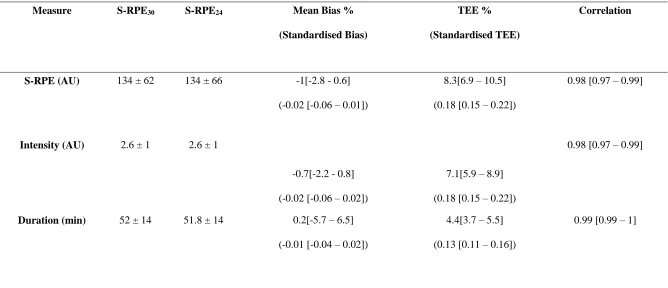
Table 1 displays the agreement between s-RPE30 and s-RPE24 for s-RPE, perceived
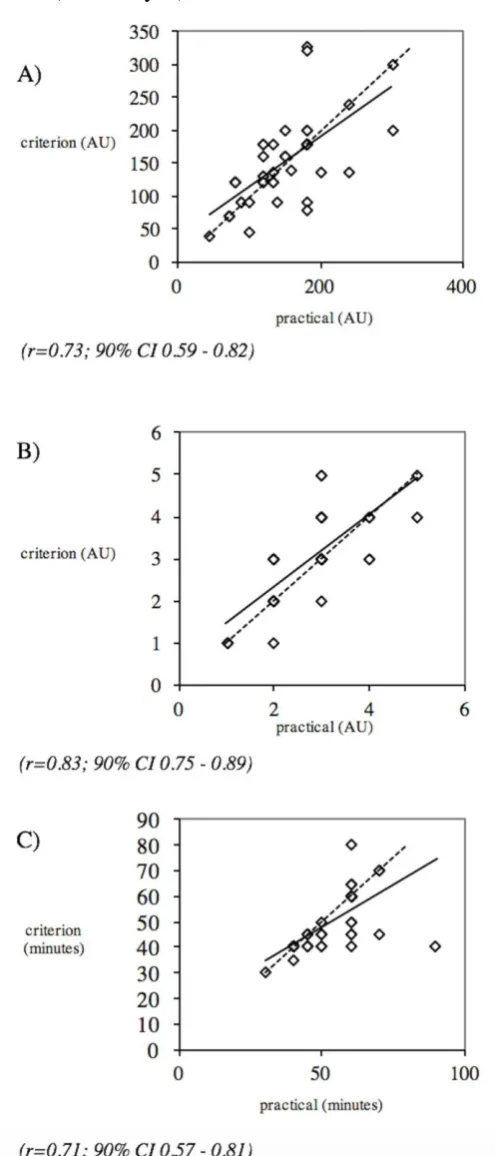
duration and intensity. Table 2 displays the agreement between s-RPE30 and s-RPE72 for
s-RPE, perceived duration and intensity. The regression plots for the agreement between the
criterion s-RPE30 and practical measure s-RPE24 for s-RPE, intensity and perceived duration
are presented in figure 1, whilst figure 2 displays the regression plots for the agreement
Nearly perfect correlations were found between s-RPE30 and s-RPE24 for s-RPE,
intensity and duration. The standardised TEE was small between s-RPE30 and s-RPE24 for
s-RPE, intensity and duration whilst standardised biases were trivial for s-s-RPE, intensity and
duration.
Although very large correlations were found between s-RPE30 and s-RPE72 for
s-RPE, intensity and duration, the standardised TEE was large for s-s-RPE, moderate for
intensity and very large for duration. The standardised mean bias was trivial for s-RPE and
intensity but small for duration.
***INSERT TABLE 1 NEAR HERE***
***INSERT TABLE 2 NEAR HERE***
***INSERT FIGURE 1 NEAR HERE***
***INSERT FIGURE 2 NEAR HERE***
DISCUSSION
To optimise training periodisation practitioners must be cognizant of an athletes’
training load within and outside of their practice. As it is not always possible for the coach to
obtain a s-RPE 30 minutes’ post training, a reliable window of recall must be established.
Such findings would provide practitioners with a timeframe in which they can confidently
10
training session. Therefore, the purpose of the current study was to assess the validity of
s-RPE24 and s-RPE72 against the criterion measure of s-RPE30. The study found that s-RPE24
showed high levels of agreement with s-RPE30 however there was a large amount of error
when subjects were asked to recall training from 72 hours prior.
In line with previous research in youth athletes (18), s-RPE24 and its constructs of
intensity and time had a nearly perfect correlation with s-RPE30, a trivial mean bias and a
small TEE. Subsequently, s-RPE24 can be considered a valid method of monitoring internal
training load providing coaches and practitioners with a simple, quick and cost-efficient
method of retrospectively quantifying load.
On the other hand, despite a very large correlation with s-RPE30, the large TEE
associated with session-RPE72 restricts its application to practice. Recent research (12) has
identified week to week spikes in training load to be associated with injury and illness. A
>15% increase on the previous weeks training can escalate injury risk to between 21% and
49% with an increase of <10% recommended to minimise injury risk (8). The present study
found the error associated with s-RPE72 to be 35.5% meaning s-RPE72 would not be sensitive
enough to detect small and potentially crucial changes in training load, leaving the individual
susceptible to injury. A potential explanation for the error associated with s-RPE72 is that the
sessions subjects were attempting to recall were perceived, on average, to be moderate. Had
the sessions been of a higher intensity, the stress placed on the individual may have led to a
stronger anchoring of intensity as suggested to occur during match play (6).
Previous literature (6) has demonstrated the validity of 48 hour RPE recall in youth
footballers, whilst weekly training diaries have been found to contain too much error to be
11
by establishing the timeline whereby the validity of s-RPE recall appears to diminish.
Subsequently, coaches and practitioners must establish a method of quantifying an
individual’s training load within 72 hours of the training activity occurring to be confident
the load measure obtained accurately reflects the load experienced by the individual.
LIMITATIONS
Subjects were individually reminded that it was not a memory test and that the RPE
and duration given should represent their perceptions at that time rather than their response
given 30 minutes’ post training. Prior research (6) has demonstrated that the ability to
remember a previously given RPE does not influence response shift when recalling RPE.
However, this does not entirely eradicate the possibility of subjects remembering and
reporting values given at s-RPE30 when asked to recall at s-RPE24 and s-RPE72. Additionally,
all s-RPE measures in the present study were taken following training sessions. Recall
accuracy has been found to improve following match play in comparison to training (6),
therefore the validity of s-RPE24 and s-RPE72 may need to be examined following a
competitive fixture to further understand recall precision.
PRACTICAL APPLICATIONS
Training load manipulation is required to elicit improvements in performance whilst
minimising the risk of non-functional overreaching and overuse injury (4). To attain a
holistic quantification of an individual’s training load, coaches & practitioners require an
accurate method of collecting retrospective perceptions of intensity and duration from
12
of internal training load quantification. Despite this, the precision of recall does not extend to
72 hours with the large error associated at s-RPE72 meaning small and meaningful changes in
training load would be missed, predisposing to errors in training load management.
Therefore, coaches and practitioners should seek to implement a method of monitoring
training load which establishes the athletes s-RPE within 72 hours of the training activity
taking place.
REFERENCES:
1. Borresen, J and Lambert, M. Quantifying training load: A comparison of subjective
and objective methods. Int J Sports Physiol Perform 3: 16–30, 2008.
2. Brenner, J. Overuse injuries, overtraining, and burnout in child and adolescent
athletes. Pediatrics 119: 1242–1245, 2007.
3. Clarke, N, Farthing, JOPF, Sorris, SS, and Arnold, BEA. Quantification of training
load in Canadian Football: Application of Session-RPE in collision-based team sports.
J Strength Cond Res 27: 2198–2205, 2013.
4. Difiori, JP, Benjamin, HJ, Brenner, J, Gregory, A, Jayanthi, N, Landry, GL, et al.
Overuse Injuries and Burnout in Youth Sports: A Position Statement from the
American Medical Society for Sports Medicine. Clin J Sport Med 24: 3–20, 2014.
5. Eime, RM, Young, JA, Harvey, JT, Charity, MJ, and Payne, WR. A systematic review
of the psychological and social benefits of participation in sport for children and
13
Int J Behav Nutr Phys Act 10: 98, 2013.
6. Fanchini, M, Ferraresi, I, Petruolo, A, Azzalin, A, Schena, F, Impellizzeri, FM, et al.
Is a retrospective RPE appropriate in soccer ? Response shift and recall bias. Sci Med
Footb 1: 1–7, 2017.
7. Foster, C, Florhaug, JA, Franklin, J, Gottschall, L, Hrovatin, LA, Parker, S, et al. A
new approach to monitoring exercise training. J strength Cond Res 15: 109–15, 2001.
8. Gabbett, TJ. The training-injury prevention paradox: should athletes be training
smarter and harder? Br J Sports Med 50: 1–9, 2016.
9. Halson, SL. Monitoring Training Load to Understand Fatigue in Athletes. Sport Med
44: 139–147, 2014.
10. Hopkins, WG. Spreadsheets for analysis of validity and reliability. in, Sport 36–42,
2015.
11. Hopkins, WG, Marshall, SW, Batterham, AM, and Hanin, J. Progressive statistics for
studies in sports medicine and exercise science. Med Sci Sports Exerc 41: 3–12, 2009.
12. Hulin, BT, Gabbett, TJ, Blanch, P, Chapman, P, Bailey, D, and Orchard, JW. Spikes
in acute workload are associated with increased injury risk in elite cricket fast
bowlers. Br J Sports Med 48: 708–12, 2014.
13. Impellizeri, FM, Rampinini, E, Coutts, AJ, Sassi, A, and Marcora, SM. Use of
RPE-based training load in soccer. Med Sci Sport Exerc 36: 1042–1047, 2004.
14. Kelly, DM, Strudwick, AJ, Atkinson, G, Drust, B, and Gregson, W. The
14
of training load in elite soccer players. J Sports Sci 34: 1–5, 2016.
15. Matos, NF, Winsley, RJ, and Williams, CA. Prevalence of nonfunctional
overreaching/overtraining in young english athletes. Med Sci Sports Exerc 43: 1287–
1294, 2011.
16. Murray, A. Managing the training load in adolescent athletes. Int J Sports Physiol
Perform 1–24, 2017.
17. Phibbs, P, Jones, B, Roe, G, Read, D, Darrall-Jones, J, Weakley, J., et al. We know
they train, but what do they do? Implications for coaches working with adolescent
rugby union players. Int J Sport Sci Coach 1–23, 2016.
18. Phibbs, P, Roe, G, Jones, B, Read, D, Weakley, J, Darrall-Jones, J, et al. Validity of
daily and weekly self-reported training load measures in adolescent athletes. J
Strength Cond Res 31: 1121–1126, 2017.
19. Scott, T, Black, C, Quinn, J, and Coutts, AJ. Validity and reliability of the
session-RPE method for quantifying training in Australian football: a comparison of the CR10
and CR100 scales. J Strength Cond Res 27: 270–276, 2013.
20. Uchida, MC, Teixeira, LFM, Godoi, VJ, Marchetti, PH, Conte, M, Coutts, AJ, et al.
Does the timing of measurement alter session-RPE in boxers? J Sport Sci Med 13:
Table 1. The level of agreement between s-RPE30 and s-RPE24 for s-RPE, intensity and duration. Data are mean ± standard deviation,
log-transformed mean bias (Mean bias %), standardised mean bias (Standardised bias), percentage typical error of the estimate (TEE%),
standardised typical error of estimate (Standardised TEE) and Pearson correlation coefficient (Correlation), all with 90% confidence limits.
Measure S-RPE30 S-RPE24 Mean Bias %
(Standardised Bias)
TEE %
(Standardised TEE)
Correlation
S-RPE (AU) 134 ± 62 134 ± 66 -1[-2.8 - 0.6]
(-0.02 [-0.06 – 0.01])
8.3[6.9 – 10.5]
(0.18 [0.15 – 0.22])
0.98 [0.97 – 0.99]
Intensity (AU) 2.6 ± 1 2.6 ± 1
-0.7[-2.2 - 0.8]
(-0.02 [-0.06 – 0.02])
7.1[5.9 – 8.9]
(0.18 [0.15 – 0.22])
0.98 [0.97 – 0.99]
Duration (min) 52 ± 14 51.8 ± 14 0.2[-5.7 – 6.5]
(-0.01 [-0.04 – 0.02])
4.4[3.7 – 5.5]
(0.13 [0.11 – 0.16])
0.99 [0.99 – 1]
transformed mean bias (Mean bias %), standardised mean bias (Standardised bias), percentage typical error of the estimate (TEE%),
standardised typical error of estimate (Standardised TEE) and Pearson correlation coefficient (Correlation), all with 90% confidence limits.
Measure S-RPE30 S-RPE72 Mean Bias %
(Standardised Bias)
TEE %
(Standardised TEE)
Correlation
S-RPE (AU) 148 ± 62 145 ± 55 -0.2[-6.8 – 6.8]
(-0.01 [-0.16 – 0.15])
35.3[29.6 – 43.9]
(0.69 [0.59 – 0.83])
0.73 [0.59 – 0.82]
Intensity (AU) 3 ± 1 2.7 ± 1
-5.8[-10.7 - -1.0]
(-0.15 [-0.27 – 0.02])
26.6[22.4 – 32.8]
(0.56 [0.48 – 0.67])
0.83 [0.75 – 0.89]
Duration (min) 50.6 ± 12 54 ± 11 6.3[2.3 – 10.1]
(0.27 [0.10 – 0.43])
17.1[14.5 – 21]
(0.71 [0.61 – 0.85])
Figure 1. Regression plots for agreement between criterion (s-RPE30) and practical measure
Figure 2. Regression plots for agreement between criterion (s-RPE30) and practical measure