Wu, J and Liao, F and Deng, J (2016) Optimal Preview Control for a Class of Linear Continuous
Stochastic Control Systems in the Infinite Horizon. Mathematical Problems in Engineering, 2016.
ISSN 1024-123X DOI: https://doi.org/10.1155/2016/7679165
Link to Leeds Beckett Repository record:
http://eprints.leedsbeckett.ac.uk/3326/
Document Version:
Article
Creative Commons: Attribution 4.0
The aim of the Leeds Beckett Repository is to provide open access to our research, as required by
funder policies and permitted by publishers and copyright law.
The Leeds Beckett repository holds a wide range of publications, each of which has been
checked for copyright and the relevant embargo period has been applied by the Research Services
team.
We operate on a standard take-down policy.
If you are the author or publisher of an output
and you would like it removed from the repository, please
contact us
and we will investigate on a
case-by-case basis.
Research Article
Optimal Preview Control for a Class of Linear Continuous
Stochastic Control Systems in the Infinite Horizon
Jiang Wu,
1Fucheng Liao,
1and Jiamei Deng
21School of Mathematics and Physics, University of Science and Technology Beijing, Beijing 100083, China 2Leeds Sustainability Institute, Leeds Beckett University, Leeds LS2 9EN, UK
Correspondence should be addressed to Fucheng Liao; [email protected]
Received 1 July 2016; Accepted 26 September 2016
Academic Editor: Andrzej Swierniak
Copyright © 2016 Jiang Wu et al. This is an open access article distributed under the Creative Commons Attribution License, which permits unrestricted use, distribution, and reproduction in any medium, provided the original work is properly cited.
This paper discusses the optimal preview control problem for a class of linear continuous stochastic control systems in the infinite horizon, based on the augmented error system method. Firstly, an assistant system is designed and the state equation is translated to the assistant system. Then, an integrator is introduced to construct a stochastic augmented error system. As a result, the tracking problem is converted to a regulation problem. Secondly, the optimal regulator is solved based on dynamic programming principle for the stochastic system, and the optimal preview controller of the original system is obtained. Compared with the finite horizon, we simplify the performance index. We also study the stability of the stochastic augmented error system and design the observer for the original stochastic system. Finally, the simulation example shows the effectiveness of the conclusion in this paper.
1. Introduction
Future reference signals or disturbance signals are known in certain circumstances. All the known future information can be utilized by preview control theory to improve the performance of the dynamic system. The original idea of preview control theory is that in order to minimize the error between the reference signals and the controlled terms, not only the past and present information but also the future information should be concentrated on [1–5]. An augmented error system is constructed while designing the optimal preview controller for the discrete system. And also a group of identical equations of future reference signals is added to the augmented error system [6–9]. Since the continuous system is of infinite dimensions, the method in dealing with the discrete condition is no longer useful. In [10], the augmented error system was constructed by differentiating the state equation on both sides, combining with the error equation. According to the maximum principle, the optimal preview controller was obtained by solving a differential equation on reference signals backward in time. This method was extended to systems with previewable disturbance signals in [11] and to singular continuous systems in [12]. The
application of preview control method to continuous systems with time delay is studied in [13].
According to automatic control system theory, the con-trolled systems can be regarded as falling into two categories: deterministic systems and stochastic systems. Stochastic sys-tems are a collection of dynamic syssys-tems that contain internal stochastic parameters, external stochastic disturbances, or observation noises [14]. A typical stochastic system is the stochastic differential equation. It is a class of differential equations driven by one or more stochastic processes. There-fore, the solution of a stochastic differential equation is also a stochastic process. Up to the present, a phenomenon such as stock market volatility or thermal motion in a physical system is usually described by a stochastic differential equation. Typically, a white noise stochastic variable represented by the differential form of Brownian motion or Weiner process is contained in a stochastic differential equation.
In this paper, preview control theory is applied to a class of linear continuous stochastic control systems in the infinite horizon. In the finite horizon [15], an assistant system is designed, and the state equation is translated to the assistant system. Then an integrator is introduced to construct a stochastic augmented error system. As a result, the tracking Hindawi Publishing Corporation
problem is converted to a regulation problem. The optimal regulator is obtained based on the dynamic programming principle for stochastic systems, which means the optimal preview controller of the original stochastic system is gained. For such a system, when the integrator approaches zero at infinity, the error also approaches zero. Therefore, this property can be utilized to simplify the performance index in the infinite horizon. Due to the fact that the relative terms of reference signals are included in the stochastic augmented error system, the conclusion in the infinite horizon cannot be directly employed when solving the optimal regulation problem in this paper. Firstly, the corresponding optimal regulation problem is solved in the finite horizon with the new performance index and then the time was set to approach infinity. The stability of the stochastic augmented error system is studied and the sufficient and necessary criteria which guarantee that there exists a unique semipos-itive definite solution to the corresponding Riccati equation have been met. Also an observer for the original stochastic system is designed. The introduction of the integrator can eliminate the static error and the simulation example shows the effectiveness of the conclusion in this paper [16].
Notation. The notations are standard.(Ω, 𝐹, 𝑃)is a complete
probability space. Adaptive procedure𝐹𝑡is𝜎algebra
gener-ated by{𝐵𝑠 : 𝑠 ≤ 𝑡}, and𝐵𝑠denotes Brownian motion of𝑚
dimensions.𝐴 ∈ 𝑅𝑚×𝑛denotes𝑚 × 𝑛matrix.𝑃 > 0 (𝑃 ≥ 0)
denotes a positive definite (semidefinite) matrix.𝐼 denotes
the unit matrix. The symbol∗denotes the symmetric terms in
a symmetric matrix.𝐸𝑡0,𝑥0denotes the expectation of process
(𝑡, 𝑥)with initial time𝑡0and state𝑥0. tr(⋅)denotes the trace of a matrix.
2. Problem Statement
Consider the following stochastic control system:
𝑑𝑥 (𝑡) = [𝑀𝑥 (𝑡) + 𝑁𝑢 (𝑡)] 𝑑𝑡 + 𝜔 (𝑡) 𝑑𝐵𝑡,
𝑦 (𝑡) = 𝐶𝑥 (𝑡) ,
𝑥 (𝑡0) = 𝑥0, 𝑡 ∈ [𝑡0, ∞) ,
(1)
where 𝑥(𝑡)is the state vector of𝑚dimensions, 𝑦(𝑡)is the
output vector of𝑝dimensions,𝑢(𝑡)is the𝐹𝑡adaptive input of
𝑛dimensions, and𝐵𝑡is the Brownian motion of𝐹𝑡adaptive
of𝑚dimensions.𝑀 ∈ 𝑅𝑚×𝑚,𝑁 ∈ 𝑅𝑚×𝑛, and𝐶 ∈ 𝑅𝑝×𝑚are
constant matrices.𝜔(𝑡) ∈ 𝑅𝑚×𝑚.
First of all, the following assumptions are introduced.
Assumption 1. Suppose the matrices pair(𝑀, 𝑁)is stabiliz-able.
Assumption 2. Suppose the matrices pair(𝐶, 𝑀)is detectable
and the matrix𝐶is of full row rank.
By denoting the reference signals of𝑝dimensions with
𝑟(𝑡), another assumption about𝑟(𝑡)is needed.
Assumption 3. Suppose the reference signal𝑟(𝑡)is a piecewise
continuously differentiable function defined on (𝑡 ≥ 𝑡0).
Moreover,𝑟(𝜌)(𝑡 ≤ 𝜌 ≤ 𝑡 + 𝑙𝑟) is available at any moment
𝑡and when𝜌 > 𝑡 + 𝑙𝑟,𝑟(𝜌) = 𝑟(𝑡 + 𝑙𝑟); that is, ̇𝑟(𝜌) = 0.𝑙𝑟is
the preview length of the reference signal.
Remark 4. Since there are few effects on the system when the reference signals exceed the previewable range, it is always assumed that the signals are usually constant [11].
The tracking error signal𝑒(𝑡)is defined as the difference
between the output vector𝑦(𝑡)and the reference signal𝑟(𝑡);
that is,
𝑒 (𝑡) = 𝑦 (𝑡) − 𝑟 (𝑡) . (2)
In this paper, an optimal controller will be designed to
make the output𝑦(𝑡)in (1) tracking the reference signal𝑟(𝑡)
as accurately as possible without static error.
Then, an assistant system is defined. The following assumption is needed.
Assumption 5. Suppose
rank[𝑀 𝑁
𝐶 0] = 𝑚 + 𝑝 , (full row rank) . (3)
With Assumption 5, the following lemma holds.
Lemma 6(see [15]). There exist matrices pairs(Γ, 𝛾) which solve the following:
𝑀Γ + 𝑁𝛾 = 0,
𝐶Γ = 𝐼, (4)
if and only if Assumption 5 holds, whereΓ ∈ 𝑅𝑚×𝑝and𝛾 ∈
𝑅𝑛×𝑝.
Definition 7(see [17]). If matrix𝐴 ∈ 𝑅𝑚×𝑛 and the rank of
𝐴is equal to𝑛, then𝐴has a left inverse:𝐵 ∈ 𝑅𝑛×𝑚such that
𝐵𝐴 = 𝐼.
Remark 8. If𝑝 = 𝑛, there exists unique solution of matrices pair(Γ, 𝛾), while if𝑝 < 𝑛, according to Definition 7, any
left inverse of matrix[𝑀 𝑁𝐶 0]can be applied to calculate the
solution of (4) and the solutions are infinite. In this paper only the square full-rank case is used.
Let the state vector and input vector be denoted by𝑥∗(𝑡)
and𝑢∗(𝑡), respectively. Let𝑥∗(𝑡) = Γ𝑟(𝑡 + 𝑙𝑟)and 𝑢∗(𝑡) =
𝛾𝑟(𝑡 + 𝑙𝑟). According to Lemma 6, at the moment𝑠, for any time𝑡 (𝑠 ≤ 𝑡 ≤ 𝑡𝜏),𝑥∗(𝑡)meets
𝑑𝑥∗(𝑡) = Γ ̇𝑟 (𝑡 + 𝑙𝑟) 𝑑𝑡,
𝐶𝑥∗(𝑡) = 𝐶Γ𝑟 (𝑡 + 𝑙𝑟) . (5)
Since[𝑀Γ + 𝑁𝛾]𝑟(𝑡 + 𝑙𝑟) = 0and𝐶Γ𝑟(𝑡 + 𝑙𝑟) = 𝑟(𝑡 + 𝑙𝑟)
according to (4), substituting these two equations into (5) yields
Mathematical Problems in Engineering 3
that is,
𝑑𝑥∗(𝑡) = {[𝑀𝑥∗(𝑡) + 𝑁𝑢∗(𝑡)] + Γ ̇𝑟 (𝑡 + 𝑙𝑟)} 𝑑𝑡, 𝑟 (𝑡 + 𝑙𝑟) = 𝐶𝑥∗(𝑡) . (7)
Define
̃𝑥 (𝑡) = 𝑥 (𝑡) − 𝑥∗(𝑡) ,
̃𝑢 (𝑡) = 𝑢 (𝑡) − 𝑢∗(𝑡) , ̃𝑦 (𝑡) = 𝑦 (𝑡) − 𝐶𝑥∗(𝑡) , ̃𝑟 (𝑡) = 𝑟 (𝑡) − 𝑟 (𝑡 + 𝑙𝑟) .
(8)
Subtracting (7) by (1) from both sides, the following could be obtained:
𝑑̃𝑥 (𝑡) = [𝑀̃𝑥 (𝑡) + 𝑁̃𝑢 (𝑡) + (−Γ) ̇𝑟 (𝑡 + 𝑙𝑟)] 𝑑𝑡
+ 𝜔 (𝑡) 𝑑𝐵𝑡,
̃𝑦 (𝑡) = 𝐶̃𝑥 (𝑡) ,
̃𝑥 (𝑡0) = 𝑥0− 𝑥∗(𝑡0) , 𝑡 ∈ [𝑡0, ∞) .
(9)
Now an integrator is introduced. Integrating the tracking
error signal𝑒(𝑡)in the interval of𝑡0to𝑡yields
𝑞 (𝑡) = ∫𝑡
𝑡0
𝑒 (𝑠) 𝑑𝑠 = ∫𝑡
𝑡0
[𝑦 (𝑠) − 𝑟 (𝑠)] 𝑑𝑠. (10)
Obviously𝑞(𝑡0) = 0. Let𝑞∗(𝑡) = ∫𝑡𝑡
0[𝐶𝑥
∗(𝑠) − 𝑟(𝑠 + 𝑙
𝑟)]𝑑𝑠, and
then𝑞∗(𝑡) = 0holds. Definẽ𝑞(𝑡) = 𝑞(𝑡)−𝑞∗(𝑡)and the
differ-ential form of̃𝑞(𝑡)becomes
𝑑̃𝑞 (𝑡) = 𝑒 (𝑡) 𝑑𝑡 = [𝐶̃𝑥 (𝑡) − ̃𝑟 (𝑡)] 𝑑𝑡. (11)
Remark 9. According to Assumption 3, the term̃𝑟(𝑡)in (11)
is also previewable whilẽ𝑟(𝜌) (𝑡 ≤ 𝜌 ≤ 𝑡 + 𝑙𝑟). In particular,
while𝜌 ≥ 𝑡 + 𝑙𝑟,̃𝑟(𝜌) = 0.
In order to make the output𝑦(𝑡)tracking the reference
signal𝑟(𝑡)as accurately as possible, the performance index𝐽
is designed as
𝐽 (𝑡0, 𝑥0; ̃𝑢 (⋅))
= 𝐸𝑡0,𝑥0{1
2∫
∞
𝑡0
[̃𝑞𝑇(𝑡) 𝑄̃𝑞̃𝑞 (𝑡) + ̃𝑢𝑇(𝑡) 𝑅̃𝑢 (𝑡)] 𝑑𝑡} , (12)
where𝑄̃𝑞 = 𝑄𝑇̃𝑞 > 0and𝑅 = 𝑅𝑇 > 0are matrices of proper
dimensions.
Remark 10. Compared with the finite horizon, lim𝑡→∞𝑒(𝑡) =
0 can also be obtained in the infinite horizon while
lim𝑡→∞𝑞(𝑡) = 0. Therefore, the term 𝑒𝑇(𝑡)𝑄𝑒𝑒(𝑡) in the
performance index of [15] can be replaced bỹ𝑞𝑇(𝑡)𝑄̃𝑞̃𝑞(𝑡)
in (12). Furthermore, since there exists unique semipositive definite solution of the corresponding Riccati equation when
𝑄̃𝑞 > 0, no other terms need to be included in the perform-ance index, which simplifies the calculation.
To solve the optimal control problem of (9) with the per-formance index (12), the augmented error system method can be employed.
3. Construction of the Stochastic Augmented
Error System
Combining (9) and (11), the following holds:
𝑑𝑧 (𝑡) = [̃𝑀𝑧 (𝑡) + ̃𝑁̃𝑢 (𝑡) + ̃𝐷̃𝑟 (𝑡) + ̃Γ ̇𝑟 (𝑡 + 𝑙𝑟)] 𝑑𝑡
+ 𝜔 (𝑡) 𝑑𝐵𝑡,
(13)
where
𝑧 (𝑡) = [̃𝑞 (𝑡) ̃𝑥 (𝑡)] ,
̃
𝑀 = [0 𝐶 0 𝑀] ,
̃ 𝑁 = [0
𝑁] ,
̃ 𝐷 = [−𝐼
0] ,
̃Γ = [0 −Γ] .
(14)
Referring to the output equation of (9) and the reference signal, the output of (13) can be defined as
̃𝑞 (𝑡) = ̃𝐶𝑧 (𝑡) , (15)
wherẽ𝐶 = [𝐼 0]. Joining (13) and (15) together, the following
hold:
𝑑𝑧 (𝑡) = [̃𝑀𝑧 (𝑡) + ̃𝑁̃𝑢 (𝑡) + ̃𝐷̃𝑟 (𝑡) + ̃Γ ̇𝑟 (𝑡 + 𝑙𝑟)] 𝑑𝑡
+ 𝜔 (𝑡) 𝑑𝐵𝑡,
̃𝑞 (𝑡) = ̃𝐶𝑧 (𝑡) ,
𝑧 (𝑡0) = [̃𝑞 (𝑡0) ̃𝑥0(𝑡0)
] = 𝑧0.
(16)
Equation (16) is the needed stochastic augmented error system.
4. Design of the Optimal Controller for
the Stochastic System
Denoting the performance index (12) with the related vari-ables in (16) yields
̃𝐽 (𝑡0, 𝑧0; ̃𝑢 (⋅)) = 𝐸𝑡0,𝑧0{12
⋅ ∫∞
𝑡0
[𝑧𝑇(𝑡) (̃𝐶𝑇𝑄̃𝑞̃𝐶) 𝑧 (𝑡) + ̃𝑢𝑇(𝑡) 𝑅̃𝑢 (𝑡)] 𝑑𝑡} .
(17)
Due to the existence of the term ̃𝐷̃𝑟(𝑡) + ̃Γ ̇𝑟(𝑡 + 𝑙𝑟) in
dealing with the infinite horizon cannot be directly employed. Therefore, similar to the condition in deterministic systems [11], the optimal regulator of the stochastic augmented error system (16) can be obtained through the following three steps.
Firstly, (17) is revised to
̃𝐽 = lim
𝑡𝜏→∞𝐸 𝑡0,𝑧0{1
2
⋅ ∫𝑡𝜏
𝑡0
[𝑧𝑇(𝑡) ̃𝐶𝑇𝑄̃𝑞̃𝐶𝑧 (𝑡) + ̃𝑢𝑇(𝑡) 𝑅̃𝑢 (𝑡)] 𝑑𝑡} .
(18)
Secondly, the finite-time horizon optimal regulation problem with the performance index
̃̃𝐽 = 𝐸𝑡0,𝑧0{1
2
⋅ ∫𝑡𝜏
𝑡0
[𝑧𝑇(𝑡) ̃𝐶𝑇𝑄̃𝑞̃𝐶𝑧 (𝑡) + ̃𝑢𝑇(𝑡) 𝑅̃𝑢 (𝑡)] 𝑑𝑡}
(19)
is solved, where𝑡𝜏is the terminal time.
Compared with the performance index in [15], the two
terms𝑒𝑇(𝑡)𝑄𝑒𝑒(𝑡)and 𝑒𝑇(𝑡𝜏)𝑄𝑒(𝑡𝜏)𝑒(𝑡𝜏)are removed in (19).
Therefore, according to the dynamic programming principle for stochastic systems [16, 18], the following lemma about the finite horizon optimal control problem with the terminal time
𝑡𝜏can be obtained by letting𝑄𝑒 = 𝑄𝑒(𝑡𝜏)= 0in Theorem 1 in
[15].
Lemma 11(see [15]). If Assumptions 3 and 5 hold, the optimal controller of (16), with the performance index (19), is
̃𝑢 (𝑡) = −𝑅−1𝑁̃𝑇1{𝑃 (𝑡) 𝑧 (𝑡) + 𝜃 (𝑡)} , (20)
where𝑃(𝑡) ≥ 0 ∈ 𝑅(𝑚+𝑝)×(𝑚+𝑝)satisfies the Riccati differential equation
− ̇𝑃 (𝑡) = ̃𝑀𝑇𝑃 (𝑡) + 𝑃 (𝑡) ̃𝑀 − 𝑃 (𝑡) ̃𝑁𝑅−1𝑁̃𝑇𝑃𝑇(𝑡)
+ ̃𝐶𝑇𝑄̃𝑞̃𝐶.
(21)
With the terminal condition𝑃(𝑡𝜏) = 0and𝜃(𝑡)the differential equation is obtained:
̇𝜃 (𝑡) + (̃𝑀𝑇− 𝑃 (𝑡) ̃𝑁𝑅−1𝑁̃𝑇) 𝜃 (𝑡)
+ (𝑃 (𝑡) ̃𝐷̃𝑟 (𝑡) + 𝑃 (𝑡) ̃Γ ̇𝑟 (𝑡 + 𝑙𝑟)) = 0,
(22)
with the terminal condition𝜃(𝑡𝜏) = 0.
Thirdly, Theorem 12 is received by letting𝑡𝜏 → ∞.
Theorem 12. If Assumptions 1 to 5 hold, the optimal controller
̃𝑢(𝑡)of (16) with the performance index (17) can be expressed as
̃𝑢 (𝑡) = −𝑅−1𝑁̃𝑇𝑃𝑧 (𝑡)
− 𝑅−1𝑁̃𝑇∫𝑡+𝑙𝑟
𝑡 exp[(𝑡0− 𝑡) (̃𝑀 − ̃𝑁𝑅
−1𝑁̃𝑇𝑃)𝑇]
⋅ (𝑃̃𝐷̃𝑟 (𝑠) + 𝑃̃Γ ̇𝑟 (𝑠 + 𝑙𝑟)) 𝑑𝑠,
(23)
where𝑃 ∈ 𝑅𝑚×̃̃ 𝑚is the unique semipositive definite solution of Riccati differential equation
̃
𝑀𝑇𝑃 + 𝑃̃𝑀 − 𝑃̃𝑁𝑅−1𝑁̃𝑇𝑃 + ̃𝐶𝑇𝑄̃𝑞̃𝐶 = 0. (24)
Proof. In terms of the performance index (17), if(̃𝑀, ̃𝑁)is
stabilizable and(𝑄1/2̃𝑞 ̃𝐶, ̃𝑀)is detectable, according to the
known conclusion, there exists a unique semipositive definite
solution𝑃of Riccati algebra equation
̃
𝑀𝑇𝑃 + 𝑃̃𝑀 − 𝑃̃𝑁𝑅−1𝑁̃𝑇𝑃 + ̃𝐶𝑇𝑄̃𝑞̃𝐶 = 0. (25)
And when𝑡 → ∞,
lim
𝑡→∞𝑃 (𝑡) = 𝑃. (26)
As a result, the solving of𝜃(𝑡)in (22) is also simplified.
Denote𝑀𝑐= ̃𝑀− ̃𝑁𝑅−1𝑁̃𝑇𝑃. Equation (22) and its
term-inal condition can be expressed as
̇𝜃 (𝑡) + 𝑀𝑇
𝑐𝜃 (𝑡) + (𝑃̃𝐷̃𝑟 (𝑡) + 𝑃̃Γ ̇𝑟 (𝑡 + 𝑙𝑟)) = 0,
𝜃 (𝑡𝜏) = 0. (27)
Based on linear system theory [19], the fundamental solution matrix of the homogeneous system corresponding to (27) is
̃
Φ (𝑡, 𝑡0) =exp[− ∫
𝑡
𝑡0
𝑀𝑇𝑐𝑑𝑡] =exp[(𝑡0− 𝑡) 𝑀𝑇𝑐] , (28)
with the property
̃
Φ−1(𝑡0, 𝑡) = ̃Φ (𝑡, 𝑡0) , ̃
Φ (𝑡, 𝑡0) = ̃Φ (𝑡, 𝑡𝑠) ̃Φ (𝑡𝑠, 𝑡0) ,
𝑡0≤ 𝑠 ≤ 𝑡.
(29)
Therefore, the solution of (27) is
𝜃 (𝑡) = ̃Φ (𝑡, 𝑡0) 𝜃 (𝑡0)
− ∫𝑡
𝑡0
̃
Φ (𝑡, 𝑠) (𝑃̃𝐷̃𝑟 (𝑡) + 𝑃̃Γ ̇𝑟 (𝑡 + 𝑙𝑟)) 𝑑𝑠,
(30)
and the backward form is
𝜃 (𝑡𝜏) = ̃Φ (𝑡𝜏, 𝑡) 𝜃 (𝑡)
− ∫𝑡𝜏
𝑡
̃
Φ (𝑡𝜏, 𝑠) (𝑃̃𝐷̃𝑟 (𝑠) + 𝑃̃Γ ̇𝑟 (𝑠 + 𝑙𝑟)) 𝑑𝑠.
(31)
With the terminal condition𝜃(𝑡𝜏) = 0, the following will be
obtained:
𝜃 (𝑡)
= ̃Φ−1(𝑡𝜏, 𝑡) ∫𝑡𝜏
𝑡
̃
Φ (𝑡𝜏, 𝑠) (𝑃̃𝐷̃𝑟 (𝑠) + 𝑃̃Γ ̇𝑟 (𝑠 + 𝑙𝑟)) 𝑑𝑠.
Mathematical Problems in Engineering 5
According to the property of the reference signals in
Assump-tion 3,𝜃(𝑡)can be expressed as
𝜃 (𝑡) = ̃Φ−1(𝑡𝜏, 𝑡)
⋅ ∫𝑡𝜏∧(𝑡+𝑙𝑟)
𝑡
̃
Φ (𝑡𝜏, 𝑠) (𝑃̃𝐷̃𝑟 (𝑠) + 𝑃̃Γ ̇𝑟 (𝑠 + 𝑙𝑟)) 𝑑𝑠
= ̃Φ (𝑡, 𝑡𝜏)
⋅ ∫𝑡𝜏∧(𝑡+𝑙𝑟)
𝑡 Φ (𝑡̃ 𝜏, 𝑠) (𝑃̃𝐷̃𝑟 (𝑠) + 𝑃̃Γ ̇𝑟 (𝑠 + 𝑙𝑟)) 𝑑𝑠
= ∫𝑡𝜏∧(𝑡+𝑙𝑟)
𝑡
̃
Φ (𝑡, 𝑠) (𝑃̃𝐷̃𝑟 (𝑠) + 𝑃̃Γ ̇𝑟 (𝑠 + 𝑙𝑟)) 𝑑𝑠.
(33)
Substituting (33) into (20) yields
̃𝑢 (𝑡) = −𝑅−1𝑁̃𝑇𝑃𝑧 (𝑡) − 𝑅−1𝑁̃𝑇1∫𝑡𝜏∧(𝑡+𝑙𝑟)
𝑡 Φ (𝑡, 𝑠)̃
⋅ (𝑃̃𝐷̃𝑟 (𝑠) + 𝑃̃Γ ̇𝑟 (𝑠 + 𝑙𝑟)) 𝑑𝑠,
(34)
where𝑡𝜏∧ (𝑡 + 𝑙𝑟) =min{𝑡𝜏, 𝑡 + 𝑙𝑟}.
The conclusion is that when𝑡𝜏→ ∞, the following
theo-rem can be obtained.
Theorem 13. If Assumptions 1 to 5 hold, the optimal controller
̃𝑢(𝑡)of (16) with the performance index (17) can be expressed as
̃𝑢 (𝑡)
= −𝑅−1𝑁̃𝑇𝑃𝑧 (𝑡)
− 𝑅−1𝑁̃𝑇∫𝑡+𝑙𝑟
𝑡 Φ (𝑡, 𝑠) (𝑃̃̃ 𝐷̃𝑟 (𝑠) + 𝑃̃Γ ̇𝑟 (𝑠 + 𝑙𝑟)) 𝑑𝑠,
(35)
where𝑃 ∈ 𝑅𝑚×̃̃ 𝑚is the unique semipositive definite solution of Riccati differential equation
̃
𝑀𝑇𝑃 + 𝑃̃𝑀 − 𝑃̃𝑁𝑅−1𝑁̃𝑇𝑃 + ̃𝐶𝑇𝑄̃𝑞̃𝐶 = 0. (36)
Then, let the matrix𝑃be separated into
𝑃 = [𝑃1 𝑃2] , (37)
where𝑃1and𝑃2are matrices of𝑚 × 𝑝̃ and𝑚 × 𝑚̃ . According to (8), (35),𝑧(𝑡) = [̃𝑞(𝑡)̃𝑥(𝑡)], and∫𝑡𝑡+𝑙𝑟Φ(𝑡, 𝑠)𝑃̃Γ ̇𝑟(𝑠 + 𝑙̃ 𝑟)𝑑𝑠 = 0, the following will be obtained:
𝑢 (𝑡) = −𝑅−1𝑁̃𝑇𝑃1𝑞 (𝑡) − 𝑅−1𝑁̃𝑇𝑃2𝑥 (𝑡)
− 𝑅−1𝑁̃𝑇∫𝑡+𝑙𝑟 𝑡
̃
Φ (𝑡, 𝑠) 𝑃̃𝐷̃𝑟 (𝑠) 𝑑𝑠 + 𝑢∗(𝑡)
+ 𝑅−1𝑁̃𝑇𝑃2𝑞∗(𝑡) + 𝑅−1𝑁̃𝑇𝑃2𝑥∗(𝑡) ,
(38)
where𝑃 ≥ 0 ∈ 𝑅𝑚×̃̃ 𝑚satisfies Riccati differential equation (24).
Due to the fact that𝑥∗(𝑡) = Γ𝑟∗(𝑡+𝑙𝑟),𝑢∗(𝑡) = 𝛾𝑟∗(𝑡+𝑙𝑟),
and𝑞∗(𝑡) = 0, the following corollary is obtained.
Corollary 14. If Assumptions 1 to 5 hold, the optimal preview controller𝑢(𝑡) of (1) with the performance index (12) can be expressed as
𝑢 (𝑡) = −𝑅−1𝑁̃𝑇𝑃1𝑞 (𝑡) − 𝑅−1𝑁̃𝑇𝑃2𝑥 (𝑡)
− 𝑅−1𝑁̃𝑇∫𝑡+𝑙𝑟
𝑡
̃
Φ (𝑡, 𝑠) 𝑃̃𝐷̃𝑟 (𝑠) 𝑑𝑠
+ [𝛾 + 𝑅−1𝑁̃𝑇𝑃2Γ] 𝑟 (𝑡 + 𝑙𝑟) .
(39)
From (39) it can be seen that there are four parts con-tained in the preview controller of (1): the first part is the
inte-gral of tracking error term−𝑅−1𝑁̃𝑇𝑃1𝑞(𝑡), stemmed from the
inducing of the integrator. The second part is the state
feed-back −𝑅−1𝑁̃𝑇𝑃2𝑥(𝑡). The third one −𝑅−1𝑁̃𝑇∫𝑡𝑡+𝑙𝑟Φ(𝑡,̃
𝑠)𝑃̃𝐷̃𝑟(𝑠)𝑑𝑠is the reference preview compensation. The last one[𝛾 + 𝑅−1𝑁̃𝑇𝑃2Γ]𝑟(𝑡 + 𝑙𝑟)is the previewable complement of the assistant system.
5. Stability of Closed-Loop System
With𝜔(𝑡)𝑑𝐵𝑡being an external disturbance, the stability and
detectability of system (16) are studied only when𝜔(𝑡) = 0.
Here, (16) becomes the deterministic system
𝑑𝑧 (𝑡) = [̃𝑀𝑧 (𝑡) + ̃𝑁̃𝑢 (𝑡) + ̃𝐷̃𝑟 (𝑡) + ̃Γ ̇𝑟 (𝑡 + 𝑙𝑟)] 𝑑𝑡. (40)
As a result, the sufficient and necessary criteria which guar-antee that there exists a unique semipositive definite solution to the Riccati equation (24) can be gained by the known con-clusion, as follows.
Lemma 15 (see [11]). Suppose the following conditions are satisfied:
(1)The matrices𝑄̃𝑞and𝑅are both positive definite.
(2)The matrix
Π = [ [
𝑀 𝑁
𝐶 0]] (41)
is of full row rank.
(3)The matrices pair(𝑀, 𝑁)is stabilizable.
(4)The matrices pair(𝐶, 𝑀)is detectable.
Then there exists unique semipositive definite solution in the Riccati equation (24), and there exists the asymptotically stable coefficient matrix𝑀𝑐in the closed-loop system (27).
Theorem 16. If𝑄̃𝑞 and𝑅are both positive definite matrices and Assumptions 1 to 5 hold, the full regulation is achieved in the closed-loop system:
𝑑𝑧 (𝑡)
= [̃𝑀𝑧 (𝑡) + ̃𝑁̃𝑢 (𝑡) + ̃𝐷̃𝑟 (𝑡) + ̃Γ ̇𝑟 (𝑡 + 𝑙𝑟)] 𝑑𝑡
+ 𝜔 (𝑡) 𝑑𝐵𝑡,
̃𝑢 (𝑡)
= −𝑅−1𝑁̃𝑇𝑃𝑧 (𝑡)
− 𝑅−1𝑁̃𝑇∫𝑡+𝑙𝑟
𝑡
̃
Φ (𝑡, 𝑠) (𝑃̃𝐷̃𝑟 (𝑠) + 𝑃̃Γ ̇𝑟 (𝑠 + 𝑙𝑟)) 𝑑𝑠,
̃𝑞 (𝑡) = ̃𝐶𝑧 (𝑡)
𝑧 (𝑡0) = [̃𝑞 (𝑡0) ̃𝑥0(𝑡0)
] = 𝑧0;
(42)
namely,
lim
𝑡→∞̃𝑞 (𝑡) = 0. (43)
Furthermore, the following will be obtained:
lim
𝑡→∞𝑒 (𝑡) = 0. (44)
6. State Observer
If the state vector𝑥(𝑡)in (1) cannot be measured directly, the
optimal preview controller (39) cannot be realized. In order to solve this problem, the state observer
𝑑̂𝑥 (𝑡) = [𝑀̂𝑥 (𝑡) + 𝑁𝑢 (𝑡) + 𝐿 (𝑦 (𝑡) − 𝐶̂𝑥 (𝑡))] 𝑑𝑡 + 𝜔 (𝑡) 𝑑𝐵𝑡, 𝑥 (𝑡0) = 𝑥0, 𝑡 ∈ [𝑡0, ∞)
(45)
could be designed.
Subtracting (45) from (1) on both sides yields
𝑑𝑥 (𝑡) = [(𝑀 − 𝐿𝐶) 𝑥 (𝑡)] 𝑑𝑡, (46)
where𝑥(𝑡) = 𝑥(𝑡) − ̂𝑥(𝑡).
So, if(𝑀 − 𝐿𝐶)is stable, the following will hold:
lim
𝑡→∞𝑥 (𝑡) = 0, (47)
which means that the state vector ̂𝑥(𝑡) in the observer
equation (45) approximates the state vector𝑥(𝑡)in (1) when
𝑡 → ∞. Based on linear system theory [19], it is known that if(𝐶, 𝐴)is detectable,(𝑀 − 𝐿𝐶)is stable. Then the following will be obtained.
Theorem 17. If the conditions in Theorem 16 hold, the closed-loop system can be received:
𝑑𝑥 (𝑡) = [𝑀𝑥 (𝑡) + 𝑁𝑢 (𝑡)] 𝑑𝑡 + 𝜔 (𝑡) 𝑑𝐵𝑡,
𝑑̂𝑥 (𝑡) = [𝑀̂𝑥 (𝑡) + 𝑁𝑢 (𝑡) + 𝐿 (𝑦 (𝑡) − 𝐶̂𝑥 (𝑡))] 𝑑𝑡 + 𝜔 (𝑡) 𝑑𝐵𝑡,
𝑦 (𝑡) = 𝐶𝑥 (𝑡) ,
𝑢 (𝑡) = −𝑅−1𝑁̃𝑇𝑃1∫𝑡
𝑡0
(𝐶̂𝑥 (𝑠) − 𝑟 (𝑠)) 𝑑𝑠
− 𝑅−1𝑁̃𝑇𝑃2̂𝑥 (𝑡)
− 𝑅−1𝑁̃𝑇∫𝑡+𝑙𝑟 𝑡
̃
Φ (𝑡, 𝑠) 𝑃̃𝐷̃𝑟 (𝑠) 𝑑𝑠
+ [𝛾 + 𝑅−1𝑁̃𝑇𝑃2Γ] 𝑟 (𝑡 + 𝑙𝑟) ,
(48)
where (𝑀 − 𝐿𝐶) is stable and (48) achieve the complete regulation.
7. Numerical Simulation
Example 1. Consider the stochastic control system
𝑑 [𝑥1(𝑡) 𝑥2(𝑡)] = [[
0 1 −1 −1] [
𝑥1(𝑡) 𝑥2(𝑡)] + [
0
1] 𝑢 (𝑡)] 𝑑𝑡 + 0.1 𝑑𝐵𝑡,
𝑦 (𝑡) = [1 0] [𝑥1(𝑡) 𝑥2(𝑡)] ,
(49)
where the coefficient matrices are
𝑀 = [0 1 −1 −1] ,
𝑁 = [0 1] , 𝐶 = [1 0] ,
𝜔 (𝑡) = [0.1 0.1] ,
(50)
respectively. Therefore, the coefficient matrices in (16) are
̃ 𝑀 = [[
[
0 1 0 0 0 1 0 −1 −1
] ] ] ,
̃ 𝑁 = [[
Mathematical Problems in Engineering 7
Reference signal: r(t)
lr= 0s, output: y(t)
−0.2
0 0.2 0.4 0.6 0.8 1 1.2
y
&
r
5 10 15 20 25 30 35 40
0
[image:8.600.314.543.70.283.2]t (s)
Figure 1: Closed-loop output response with nonpreview and refer-ence signal𝑟(𝑡).
̃ 𝐷 = [[
[ −1 0
0 −1 0 0
] ] ]
(51)
and Brownian motion𝐵𝑡satisfies
𝐵𝑡∼ 𝑁 (0, 0.01) . (52) Let the initial state of (1) be
𝑥 (0) = [00] , (53)
where 𝑥1 and 𝑥2 are mutually independent. The preview
lengths of the reference signals are 𝑙𝑖𝑟 = 0, 0.5, 0.75s (𝑖 =
1, 2, 3), respectively. The weight matrices of the performance index are
𝑄̃𝑞= 1,
𝑅 = 1, (54)
and the solution of Riccati equation
̃
𝑀𝑇𝑃 + 𝑃̃𝑀 − 𝑃̃𝑁𝑅−1𝑁̃𝑇𝑃 + ̃𝐶𝑇𝑄̃𝑞̃𝐶 = 0 (55) is
𝑃 = [[ [
2.1533 1.8184 1.000 1.8184 1.9157 1.153 1.000 1.153 0.818 ] ] ]
, (56)
which is a positive definite matrix. The coefficient matrix𝑀𝑐
in (25) is
𝑀𝑐= ̃𝑀 − ̃𝑁𝑅−1𝑁̃𝑇𝑃 = [[ [
0 1 0 0 0 1 −1 −2.153 −1.818
] ] ]
. (57)
Reference signal: r(t)
lr= 0.5s, output: y(t)
5 10 15 20 25 30 35 40
0
t (s)
−0.2
0 0.2 0.4 0.6 0.8 1 1.2
y
&
[image:8.600.55.290.72.282.2]r
Figure 2: Closed-loop output response with𝑙𝑟= 0.5s preview and reference signal.
Reference signal: r(t)
lr= 0.75s, output: y(t)
−0.2
0 0.2 0.4 0.6 0.8 1 1.2
y
&
r
5 10 15 20 25 30 35 40
0
t (s)
Figure 3: Closed-loop output response with𝑙𝑟= 0.75s preview and reference signal𝑟(𝑡).
When the reference signal is
𝑟 (𝑡) = { { { { { { { { {
0, 0 ≤ 𝑡 ≤ 5, 0.2 (𝑡 − 5) , 5 < 𝑡 ≤ 10, 1, 𝑡 > 10,
(58)
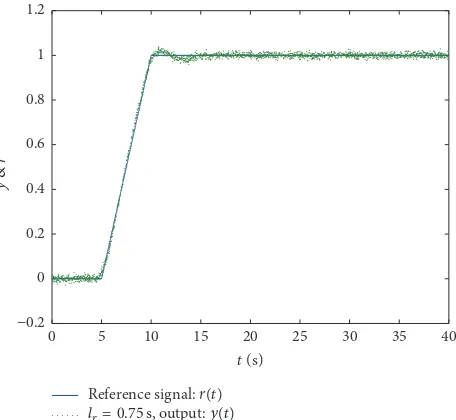
Figures 1–3 can be obtained.
Figure 1 shows the tracking controller with nonpreview.
Figure 2 shows the tracking controller with𝑙𝑟= 0.5s preview.
Figure 3 shows the tracking controller with𝑙𝑟 = 0.75s
[image:8.600.316.544.332.542.2]Reference signal: r(t)
lr= 0s, output: y(t)
5 10 15 20 25 30 35 40
0
t (s)
−0.2
−0.15
−0.1
−0.05
0 0.05 0.1 0.15 0.2
y
&
[image:9.600.53.290.70.283.2]r
Figure 4: Closed-loop output response with nonpreview and reference signal𝑟(𝑡).
5 10 15 20 25 30 35 40
0
t (s)
−0.15
−0.1
−0.05
0 0.05 0.1 0.15 0.2
y
&
r
Reference signal: r(t)
lr= 0.5s, output: y(t)
Figure 5: Closed-loop output response with𝑙𝑟= 0.5s preview and reference signal.
based on the preview controller, the output signals can track the reference signals much faster and with less tracking error.
When the reference signal is
𝑟 (𝑡) = { { { { { { { { {
0, 0 < 𝑡 ≤ 5, 0.1sin0.5 (𝑡 − 5) , 5 < 𝑡 ≤ 5 + 5𝜋,
0, 𝑡 > 5 + 5𝜋,
(59)
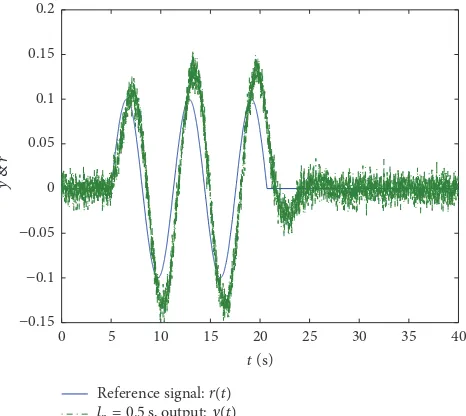
Figures 4–6 can be obtained.
Figure 4 shows the tracking controller with nonpreview.
Figure 5 shows the tracking controller with𝑙𝑟= 0.5s preview.
Reference signal: r(t)
lr= 0.75s, output: y(t)
5 10 15 20 25 30 35 40
0
t (s)
−0.2
−0.15
−0.1
−0.05
0 0.05 0.1 0.15
y
&
r
Figure 6: Closed-loop output response with𝑙𝑟= 0.75s preview and reference signal𝑟(𝑡).
Figure 6 shows the tracking controller with𝑙𝑟 = 0.75s
pre-view. Comparing the above three figures, it can be seen that based on the preview controller, the output signals can track the reference signals much faster and with less tracking error.
8. Conclusion
This paper has studied the optimal preview control problem for a class of continuous stochastic system in the infinite horizon. By introducing the integrator and the assistant system, the stochastic augmented error system is constructed. Compared with the finite horizon, the performance index is simplified. The stability of the stochastic augmented error system is also studied and the observer for the original stochastic system is designed. Finally, the simulation example shows the effectiveness of the conclusion in this paper.
Competing Interests
The authors declare that they have no competing interests.
Acknowledgments
This work was supported by the National Natural Science Foundation of China (Grant no. 61174209).
References
[1] M. Tomizuka, “Optimal continuous finite preview problem,”
IEEE Transactions on Automatic Control, vol. 20, no. 3, pp. 362– 365, 1975.
[2] Y. Xu, F. Liao, L. Cui, and J. Wu, “Preview control for a class of linear continuous time-varying systems,”International Journal of Wavelets, Multiresolution and Information Processing, vol. 11, no. 2, Article ID 1350018, 1350018, 14 pages, 2013.
[image:9.600.55.288.332.540.2]Mathematical Problems in Engineering 9
International Journal of Control, vol. 85, no. 10, pp. 1616–1624, 2012.
[4] F. Liao, K. Takaba, T. Katayama, and J. Katsuura, “Design of an optimal preview servomechanism for discrete-time systems in a multirate setting,”Dynamics of Continuous, Discrete & Impul-sive Systems. Series B. Applications & Algorithms, vol. 10, no. 5, pp. 727–744, 2003.
[5] T. Katayama, T. Ohki, T. Inoue, and T. Kato, “Design of an optimal controller for a discrete-time system subject to pre-viewable demand,”International Journal of Control, vol. 41, no. 3, pp. 677–699, 1985.
[6] F. Liao, Y. Guo, and Y. Y. Tang, “Design of an optimal preview controller for linear time-varying discrete systems in a multirate setting,”International Journal of Wavelets, Multiresolution and Information Processing, vol. 13, no. 6, Article ID 1550050, 1550050, 19 pages, 2015.
[7] T. Tsuchiya and T. Egami,Digital Preview and Predictive Control, Translated by Fucheng Liao, Beijing Science and Technology Press, Beijing, China, 1994.
[8] M. Cao and F. Liao, “Design of an optimal preview controller for linear discrete-time descriptor systems with state delay,” Inter-national Journal of Systems Science, vol. 46, no. 5, pp. 932–943, 2015.
[9] Z. Y. Zhen, Z. S. Wang, and D. B. Wang, “Information fusion estimation based preview control for a discrete linear system,”
Acta Automatica Sinica, vol. 36, no. 2, pp. 347–352, 2010. [10] T. Katayama and T. Hirono, “Design of an optimal
servomech-anism with preview action and its dual problem,”International Journal of Control, vol. 45, no. 2, pp. 407–420, 1987.
[11] F. Liao, Y. Y. Tang, H. Liu, and Y. Wang, “Design of an optimal preview controller for continuous-time systems,”International Journal of Wavelets, Multiresolution and Information Processing, vol. 9, no. 4, pp. 655–673, 2011.
[12] F. Liao, Z. Ren, M. Tomizuka, and J. Wu, “Preview control for impulse-free continuous-time descriptor systems,” Interna-tional Journal of Control, vol. 88, no. 6, pp. 1142–1149, 2015. [13] F. Liao and H. Xu, “Application of the preview control method to
the optimal tracking control problem for continuous-time sys-tems with time-delay,”Mathematical Problems in Engineering, vol. 2015, Article ID 423580, 8 pages, 2015.
[14] A. ˚Astr¨om,Introduction to Stochastic Control Theory, Translated by Yuhuan Pan, Science Press, Beijing, China, 1983.
[15] J. Wu, F. Liao, and M. Tomizuka, “Optimal preview control for a linear continuous-time stochastic control system in finite-time horizon,”International Journal of Systems Science, vol. 48, no. 1, pp. 129–137, 2017.
[16] B. Oksendal,Stochastic Differential Equations: An Introduction with Applications, Springer, New York, NY, USA, 6th edition, 2005.
[17] T. H. Cormen, C. E. Leiserson, R. Rivest, and C. Stein, Introduc-tion to Algorithms, MIT Press and McGraw-Hill, Boston, Mass, USA, 2nd edition, 2001.
[18] J. Yong and X. Y. Zhou,Stochastic Control: Hamiltonian Systems and HJB Equations, vol. 43, Springer, New York, NY, USA, 1999. [19] D. Zheng, Linear System Theory, Tsinghua University Press,
Submit your manuscripts at
http://www.hindawi.com
Hindawi Publishing Corporation
http://www.hindawi.com Volume 2014
Mathematics
Journal ofHindawi Publishing Corporation
http://www.hindawi.com Volume 2014
Mathematical Problems in Engineering
Hindawi Publishing Corporation http://www.hindawi.com
Differential Equations
International Journal of
Volume 2014 Hindawi Publishing Corporation
http://www.hindawi.com Volume 2014 Hindawi Publishing Corporationhttp://www.hindawi.com Volume 2014
Hindawi Publishing Corporation
http://www.hindawi.com Volume 2014
Mathematical PhysicsAdvances in
Complex Analysis
Journal ofHindawi Publishing Corporation
http://www.hindawi.com Volume 2014
Optimization
Journal ofHindawi Publishing Corporation
http://www.hindawi.com Volume 2014
Combinatorics
Hindawi Publishing Corporation
http://www.hindawi.com Volume 2014
International Journal of
Hindawi Publishing Corporation
http://www.hindawi.com Volume 2014
Journal of
Hindawi Publishing Corporation
http://www.hindawi.com Volume 2014
Function Spaces
Abstract and Applied Analysis
Hindawi Publishing Corporation
http://www.hindawi.com Volume 2014
International Journal of Mathematics and Mathematical Sciences
Hindawi Publishing Corporation http://www.hindawi.com Volume 2014
The Scientific
World Journal
Hindawi Publishing Corporationhttp://www.hindawi.com Volume 2014
Hindawi Publishing Corporation
http://www.hindawi.com Volume 2014
Discrete Dynamics in Nature and Society
Hindawi Publishing Corporation
http://www.hindawi.com Volume 2014
Hindawi Publishing Corporation
http://www.hindawi.com Volume 2014
Discrete Mathematics
Journal ofHindawi Publishing Corporation
http://www.hindawi.com Volume 2014 Hindawi Publishing Corporationhttp://www.hindawi.com Volume 2014