International Research Journal of Management and Commerce Vol. 4, Issue 2, February 2017 Impact Factor- 5.564 ISSN: (2348-9766)
© Associated Asia Research Foundation (AARF)
Website: www.aarf.asia Email : [email protected] , [email protected]DETERMINANTS OF REVERSE MORTGAGE USE INTENTION: A
THEORETICAL FRAMEWORK
Mohammed Ishaq Mohammed1, Noralfishah Sulaiman2
1,2
Department of Real Estate, Faculty of Technology Management and Business, UniversitiTun Hussein Onn Malaysia, Johor, Malaysia.
1
Department of Estate Management and Valuation, Faculty of Environmental Technology AbubakarTafawaBalewa University Bauchi, Nigeria.
ABSTRACT
Reverse mortgage is a relatively new financial product specially designed to enable the elderly
people convert the trapped equity in their homes into liquid cash in order to supplement their
existing income. This paper aims at proposing a model that can predicts potential consumers;
intention to use reverse mortgage as a source of supplementary income in old age by adopting
the original TPB and extending it with a view to identifying the behavioural factors likely to
influence reverse mortgage use. The methodology of the paper is based on review of relevant
literatures on reverse mortgage and behavioural change theories. The proposed model, Reverse
Mortgage Use Intention Model (ReMUIM), is expected to identify the underlying behavioural
factors that can influence potential reverse mortgage consumers’ willingness to use reverse
mortgage as a source of supplementary income in old age.
KEYWORDS: Ageing, Behaviour, Elderly, Financial insecurity, Intention, Reverse mortgage
1. Introduction
Ageing trend which started in developed countries has long surfaced in the developing
Globally, the population of the elderly people aged 60 years and above is expected to reach 2
billion by the year 2050[1]. Malaysia is not an exception to this demographic reality either. The
population of the elderly people in the age group 60 years and above is expected to reach 10%
of the country‘s total population in the year 2020[2]. This will enlist the country among the league of ageing nations based on the United Nations‘ benchmark.
One of the challenges facing the elderly people globally is lack of sufficient finances to
fund increased medical needs and other associated costs[3,4]. This problem is further
complicated given the fact that the sustainability of the social security systems such as pension
schemes and other welfare schemes that are meant to support the elderly after their active
working age is being doubted[5,6].The Malaysian elderly people are not exception to this
problem either because inadequacy of savings upon retirement has been identified as the main
challenge facing this group of individuals[7].Studies have shown that the elderly people in
Malaysia are facing challenges in terms of financial sustainability, adequacy of retirement
income and health care financing as a result of increasing life expectancy, changing family
structure and other socio-economic changes being witnessed in the country[8]. A report indicated
that retirees in Malaysia use up the average RM150, 000 ($ 37,000 approximately) of their
Employee Provident Fund (EPF) savings in the first three to five years of retirement[9]. This is
alarming because the EPF is the most popular retirement savings scheme in the country that
covers private sector employees and other public sector employees that are not eligible for the
public pension scheme.
Furthermore, an alternative means through which the elderly people could avoid the
effect of financial insecurity in later life is by savings during their youthful age. Lamentably,
however, Malaysians are not saving enough to enable them cushion the effect of income shocks
in later life[10]. This is further verified by recent report which indicated that 90% of the urban
households and 86% of the rural households in the country have zero savings[11]. Similarly,
while family traditionally serves as an important source for support to the elderly, recent
evidences point to the gradual decline of this long lasting Asian legacy among many as a result
of modernisation[12].
Even though the elderly are considered ―cash-poor‖, on the other hand, they are considered to be ―asset-rich‖ by virtue of the enormous housing wealth they own which, if turned
16]. In the case of Malaysia, for example, real estate has been established to constitute the largest
single asset for majority of household irrespective of financial status[17]. Malaysia‘s national
home ownership rate in 2012 is 74.5%, which surpasses the 66.9% national rate of the
US[18,19]. This scenario depicts the Malaysian elderly people to fall within the ―cash-poor‖ but
―asset-rich‖ classification.Thus, this paper propose a model that could be used to predict individual‘s willingness to use reverse mortgage as a source of supplementary income in old-age
with a view to identifying the behavioural factors that may likely affect reverse mortgage
demand in Malaysia.
2. Determinants of Reverse Mortgage Use
Reverse mortgage is one of the many financial products that enable consumption
smoothing over the life cycle. The general name for this product class is ―home equity release products‖. Home equity release products have generally been promoted as a means of tapping
the equity trapped in residential houses[20]. This is especially for retired elderly homeowners
whose debt-free properties form the major part of their net assets[21]. The continuous increase in
the cost of providing old age-related payments and services amidst persistent global economic
crisis is linked to the growing popularity of real estate asset as a potential source of income
capable of supplementing the dwindling pension fund and various social security funds in many
countries[22,23]. Being the most significant asset among majority of households, the primary
home is regarded as a store of wealth that can be used to augment the income needs of elderly
people after their retirement. This led to the emergence of a number of financial products that
make it possible for homeowners to access the illiquid wealth trapped in their residential real
estates. These financial products are generally termed ―home equity release products‖.
Home equity release products give home owners the flexibility of consuming their
accumulated housing wealth without necessarily moving out of the property. This can be done
through lease-back arrangement, where an owner sells his property to a buyer then rent the
property back and become a renter. It can also be in the form of physical subdivision of the
property to create two separate units which makes it possible for one of the units to be rented out
or even be sold. Similarly, other alternative products allow the homeowner to sell the property to
jurisdictions, banks and other financial institutions introduced some financial products that offer
homeowners access to housing equity while maintaining the ownership of their residential
properties, popular among which are equity withdrawal and reverse mortgage[24].
Reverse mortgage has been described as a form of annuity to the homeowner for the
length of time he/she remains in the home[20]. It is designed for elderly homeowners to enable
them access their accumulated home equity while continuing to live in their homes[19] . In
contrast to a conventional forward mortgage, where periodic payment is made to the lender, in
reverse mortgage contract, the payment is made by the lender to the homeowner. The loan
principal and the accumulated interest are repaid when the borrower sells the home, moves
permanently or dies[20,24]. The amount of money a borrower can access in reverse mortgage
contract is a function of borrower‘s age, value of the property and prevailing interest rate[25].
The product is designed to provide elderly people who are ―asset-rich‖ but ―cash-poor‖
and who require additional fund to finance their medical needs, children education, house
improvement, leisure, bills payments and other necessities that may arise during the remaining
years after their active working life. Unlike the conventional forward mortgage where the
borrower must surrender collateral to which recourse can be made upon default, a reverse
mortgage loan does not require any form of collateral to be surrendered by the borrower.
Repayment of the loan principal and the accumulated interest is made from the proceeds realized
from selling the home after the death of the borrower or when he/she decides to move out from
the home permanently to care facility. The loan can be accessed through receipt of regular
monthly payments, lump sum payment, or line of credit, or a combination of these options.
The growth and sustainability of reverse mortgage product market is linked to a set of
inter-related factors as evidenced in literature. Although no study specifically concentrated on
investigating the influence of behavioural factors on reverse mortgage use decision, some studies
hinted on the possible effect of behavioural factors on individual‘s decision to use or demand for
reverse mortgage. For instance, a study in Italy reported that risk/uncertainty-related elements
have significant correlation with people‘s interest in reverse mortgage[26]. This is buttressed by
another study where it was found that debt aversion, perception of home equity as savings for
high origination costs, and unexpected expenses as the reasons behind the slow growth of the
In a different study that analysed the demand factor of regional difference for reverse
mortgage in Beijing and Hangzhou, China, it was revealed that even though the respondents
owned their houses and have monthly income below the disposable income level they, however,
show weak interest in applying for reverse mortgage to supplement their monthly income[28].
The resultant weak demand willingness for reverse mortgage is attributed to the attitude of the
elderly towards the product where it is seen as a last resort means of finance only in emergency
situations. Respondents also show strong motive to leave houses to their children. It is further
found that in Beijing elderly people suffering from health problems are more likely to apply for
reverse mortgage than their healthy counterpart because of the increase in medical expenses.
Moreover, result of a simulation study on reverse mortgage choice shows that elderly people
who are mainly concerned with the impact of unavoidable expenditure shocks on their standard
of living, shows higher probability of using line of credit plan than either tenure or term plans.
The choice of the line of credit plan is based on the fact that it gives the borrower access to a
large sum of money, rather than adding an additional fixed component to an existing income[29].
Individuals‘ decision to consider applying for reverse mortgage has also been found to be influenced by the level of individual‘s financial awareness and involvement, which describes the
general financial behaviour of individuals. A recent study discovered that lack of product
knowledge significantly affect the demand for reverse mortgage[30]. They pointed that demand
for reverse mortgage product can reasonably be increased by reducing the inherent complexity in
the product design.
Similarly, in China, a research that explored the feasibility of using reverse mortgage as
alternative option for generating retirement income for asset-rich-cash-poor elderly revealed that,
possession of stock, bond or fund were positively related to willingness to apply for reverse
mortgage[31]. This finding indicates the role of financial awareness as a determinant for reverse
mortgage demand since the respondents that showed strong willingness indicated that they
possess one or more financial product in their possession thus indicative of financial market
awareness. However, a more recent study found no significant relationship between financial
literacy and interest in reverse mortgage product among their respondents[26].
On the socio-cultural perspective, a number of studies on reverse mortgage market
attachment, ethnicity and/or race, intergenerational transfer and expectation from family
members have been found to influence individual‘s interest in applying for reverse mortgage
loan. For example, evidence have shown that young people‘s high expectation for inheritance
was found to negatively affects their willingness to approve of their parents‘ application for
reverse mortgage[32]. Moreover, in a study that investigate the feasibility of implementing
reverse mortgage for house-rich-cash-poor older adults in Hong Kong, it was found that living
arrangement, desire to leave ones property to descendants and intergenerational transfers
received from children and grandchildren are barriers to interest in reverse mortgage[33].
In another study that explored the relationship between family and community ties and
demand for reverse mortgage in the USA, a fairly strong relationship between family and
community ties and interest in reverse mortgage was established. It was discovered that higher
incidence of out-migration tends to increase demand for reverse mortgage while
old-out-migration tends to reduce demand for reverse mortgage[34].Similarly, evidence was found that
homeowners who are less attached to their home and have no fear of liquidating it are more
likely to be interested in reverse mortgage[26].
Interest in reverse mortgage was also found to differ among ethnic and/or racial enclaves.
It was found that communities with higher percentage of Whites and individuals with higher
educational attainment are found to be more interested in reverse mortgage[34]. The result also
revealed that demand for reverse mortgage is also influenced by race, educational achievement
and the extent of market penetration.
In discussing the reasons for the small sized nature of the reverse mortgage product
market in some European countries, cultural suspicion arising from the perception that reverse
mortgage promotes personal consumption against intergenerational transfers has been identified
as one of the barriers preventing its wider acceptance among the elderly in the region[23].
Corroboratively,debt consolidation, altruistic motives and the attitude to offer financial
assistance to younger generations have also been identified as factors capable of influencing
demand for equity release products[35].
The aforementioned studies highlighted the role of behavioural factors such as attitude,
bequest motive, social influence, financial behaviour, and place attachment as possible
determinants of reverse mortgage use. However, in almost all the previous studies, these factors
worthwhile to combine these factors in a single model to determine their interaction effect on
individuals‘ intention to use reverse mortgage.
3. Overview on the Theory of Planned Behaviour (TPB)
The Theory of Planned Behaviour (TPB) (originally Theory of Reasoned Action, TRA) is
identified as one of the most widely referred and used behaviour theory[36]. The theory is based
on cognitive approach to explaining individual‘s attitudes and beliefs. The theory sets to predicts
and understand individual behaviour based on some antecedents. According to the theory,
individual‘s behaviour is predictable by intention. In turn, intention is predicted by attitude,
subjective norms, and perceived behavioural controls[37,38]. Attitude toward behaviour means
the positive or negative evaluation of a particular behaviour based on individual‘s beliefs.
Subjective norm is individual perceptions of whether significant referents approve or disapprove
of the behaviour. It is the social pressures exerted on an individual resulting to the perceptions of
what others think they should do and their inclination to comply with these[36]. Perceived
behavioural control described the perceived difficulty of performing the behaviour. It reflects
past experience as well as anticipated barriers and the perceived control over the opportunities,
resources, and skills necessary to perform a behaviour[39–41]. In essence, the more favourable
the attitude toward performing a behaviour, the greater the perceived social approval; the easier
the performance of the behaviour is perceived to be, the stronger the behavioural intention41. The
main idea behind TPB is to predict actual behaviour from behavioural intention by three
independent constructs: attitude, subjective norm and perceived behavioural control[43]. The
Figure 1: Theory of Planned Behaviour[37]
3.1The TPB constructs
The TPB is an improvement on a previous theory, Theory of Reasoned Action (TRA),
which was criticized for ignoring the effect of individual‘s control belief on behaviour. The
inclusion of perceived behavioural control as a construct in the TPB was to deal with conditions
in which individuals have incomplete volition control over behaviour[44]. TPB assumes that
human action is guided by three kinds of considerations: beliefs about the likely outcomes of the
behaviour and the evaluations of these outcomes (behavioural beliefs), beliefs about the
normative expectations of others and motivation to comply with these expectations (normative
beliefs), and beliefs about the presence of factors that may facilitate or impede performance of
the behaviour and the perceived power of these factors (control beliefs). In their respective
aggregates, behavioural beliefs produce a favourable or unfavourable ‗attitude toward the
behaviour‘; normative beliefs result in perceived social pressure or ‗subjective norm‘; and
control beliefs give rise to ‗perceived behavioural control‘. In combination, attitude toward the
behaviour, subjective norm, and perception of behavioural control lead to the formation of a
‗behavioural intention‘[37]. The main constructs in the TPB are explained in the following
3.1.1Intention
The central factor in the TPB is the individual‘s intention to perform a given behaviour.
Intention is described as indications of how hard people are willing to try and the amount of
effort they are planning to exert in order to perform a particular behaviour. In essence, intentions
are assumed to capture the motivational factors that influence behaviour[37]. Generally, the
stronger the intention to engage or perform behaviour, the more likely should be its
performance[37].
3.1.2Attitude (ATT)
Attitude has been defined as an individual's positive or negative feelings (evaluative
affect) about performing the target behaviour[45]. They posit that individuals form attitudes
toward behaviour by evaluating their beliefs through an expectancy-value model. For each
attitude toward behaviour, individuals multiply the belief strength by the outcome evaluation and
then sum the entire set of resulting weights to form the attitude.
3.1.3 Subjective norm (SN)
Subjective norm has been defined as the person‘s perception that most people who are
important to him think he should or should not perform the behaviour in question[45].
Individuals multiply the normative belief strength by the motivation to comply with that referent,
and sum the entire set of resulting weights to determine their behavioural intention.
3.1.4 Perceived behavioural control (PBC)
Individual‘s volitional control in the context of TPB was conceptualized as perceived
behavioural control[38]. Perceived behavioural control is the individual‘s belief of how easy or
difficult it is to perform the behaviour in question[46]. The extent of one‘s control to perform a
given behaviour is determined by presence or absence of requisite resources and opportunities.
The more resources and opportunities is possessed, and the fewer barriers is anticipated, the
greater the perceived behavioural control over the behaviour[47]. Moreover, individual‘s belief
about behavioural control is partially affected by past experience with the behaviour and by
and by other factors that increase or reduce the perceived difficulty of performing the behaviour
in question[47].
4. APPLICATION OF TPB IN INVESTMENT AND FINANCIAL DECISIONS
TPB is widely used in varied fields to study individuals‘ behavioural intention towards a
particular event, service, or product. Its application is found in the field of technology adoption
such as e-commerce, internet banking, credit card use, computer usage. It is also applied to study
customers‘ behaviour in the hospitality and tourism industry; health sector, and financial and
investment decision. In all these studies, the original TPB model or modified models were used
to investigate individuals‘ behavioural intention with regard to the specific subject of interest.
The current study falls within the general financial decision parlance. In order to appreciate the
extent of use of TPB to study individuals‘ financial decision, a review of some selected studies is
given. This is to help contextualized the present study in line with the previous studies in the
finance and investment fields that adopted the TPB as a theoretical model.
In a study that aimed at determining the acceptance of diminishing partnership home
financing in Malaysia, attitude and subjective norm were discovered to be the main determinants
of intention[48]. In another study that explored the individual factors that are likely to influence
the investment decisions of potential investors in Barbados, attitude, subjective norm, perceived
behavioural control, and risk propensity were identified as the most significant predictors of
investment decision[49].
Similarly, a research conducted in Malaysia that aimed at investigating the effect of
attitude, social influence, religious obligation, government support and pricing on the intention to
use Islamic personal financing revealed that attitude, social influence and pricing significantly
predict intention[50]. Subsequently, the TPB model was adopted to investigate whether
religiosity influence customers‘ intention to undertake Islamic home financing in Malaysia. The
findings shows that attitude, perceived behavioural control and religiosity explains 50.5%
variance in the intention to undertake Islamic home financing among the respondents[51].
Similarly, attitude and knowledge were found to have positive and significant influence on
intention while social influence was reported as insignificant factor in determining Muslim
Furthermore, a study in the United States that examined the link between TPB and
financial literacy by developing a predictive model for credit card debt among college students, it
was found that attitude, subjective norm and perceived behavioural control predicts
intention[53]. However, financial literacy was found to be statistically insignificant predictor of
intention to use credit card while positive correlation was established between attitude and
amount of credit card debt.
In a study that investigates the effects of subjective norm, relative advantage, simplicity,
compatibility and perceived behavioural control on Islamic home financing adoption, it was
discovered that subjective norm, relative advantage and simplicity are significant determinants of
attitude to adopting Islamic home financing. In addition, it was found that attitude, subjective
norm, relative advantage, simplicity, compatibility and perceived behavioural control are
statistically significant predictors of Islamic home finance adoption[54]. A different study by the
same authors that explored the willingness of bank customers in Malaysia to participate as
partner in MusharakahMutanaqisahrevealed that about 55% variation in intention was explained
by attitude, subjective norm and perceived behavioural control. The relationship between attitude
and subjective norm was also found to be statistically significant[55].On the other hand, a study
in the Islamic insurance sector test the effect of attitude, subjective norm and quality of
information about Islamic insurance on demand using Theory of Reasoned Action (TRA). The
result shows that attitude and quality of information positively affect the demand for Islamic
insurance while subjective norm affects it negatively[56]. Similarly, another study that
investigates the determinants of customers‘ intention to use Islamic personal finance confirmed
that attitude, social influence and religious obligation significantly influence intention to use
Islamic personal finance[57]. Moreover, religiosity and product knowledge were found to
significantly influence customers‘ attitude toward halal credit card service while attitude has
significant influence on customers‘ intention to accept halal financial credit card services[58].In
the annuity market, attitude, and subjective norm were also found to significantly determine
longevity annuity purchase intention among Italian younger adults. similarly, gender, household
annual income and educational attainment are significant moderators to intention[59].
The foregoing literatures indicate the applicability of TPB in determining the behavioural
next section discusses the justification for adopting TPB to investigate the intention to use
reverse mortgage among Malaysians.
4.1Rationale for Adopting TPB in the study
Decision to use reverse mortgage falls within the general financial decision making
process. Economic based theories such as utility theory have been used by previous researchers
to evaluate the behaviour of individuals when making financial decisions. Similarly, other
behavioural theories such as Prospect Theory, Image Theory, and Mental Accounting have
emerged to deal with the phenomena. However, the theory of planned behaviour only received
limited attention in this area[60].
The TPB is adjudged the most widely used intention model. The strength of the model in
predicting behaviour and intention were confirmed in a meta-analysis of a data base of 185
independent studies where TPB was found to account for 27% and 39% of variance in behaviour
and intention respectively[61]. Therefore the universality of TPB and the corresponding recorded
success of its use in predicting behavioural intention in different aspect of human
undertakings[62,63] explain one of the justifications for its adoption in the present study.
Previous studies on reverse mortgage give hints on the role of some behavioural factors
that are capable of influencing the use of reverse mortgage. However, little or no effort has been
made to investigate the interaction of these factors holistically. For instance, evidence have
shown that reverse mortgage is attractive to some individuals because it gives them more
perceived control on their spending decisions[64]. The influence of psychological and
behavioural factors on willingness to use reverse mortgage have been documented[13,65–67].
Similarly, several other studies pointed to cultural and social factors as potential factors likely to
influence the willingness to use or the actual use of reverse mortgage[28,31,32,68]. Other likely
factors are bequest motive and sense of community/place attachment[23,32–35,69,70]. Some of
these factors reflect the main constructs of the TPB. It is therefore anticipated that applying TPB
to investigate the influence of these factors on the willingness to use reverse mortgage would
help in predicting reverse mortgage use in Malaysia. Similarly, the adoption of TPB in the study
would provide a framework that can best explain the interaction of the determining factors of
willingness for reverse mortgage use in the context of the TPB, thereby extending the application
4.2 The proposed reverse mortgage use intention model (ReMUIM)
The intention of individuals to take up reverse mortgage is expected to be determined by
many psychological and behavioural factors such as attitude, societal expectation, self-control,
bequest motive, sense of place/neighbourhood attachment and financial behaviour. The proposed
reverse mortgage use model (ReMUIM) is meant to predict the use of reverse mortgage by
adopting the original TPB constructs and additional three constructs that are deemed necessary in
predicting the use of reverse mortgage. The justification for including the three new constructs is
based on the facts that the TPB is open to the inclusion of additional predictors if it is evident
that such predictors have significant contribution in predicting intention[63]. The proposed
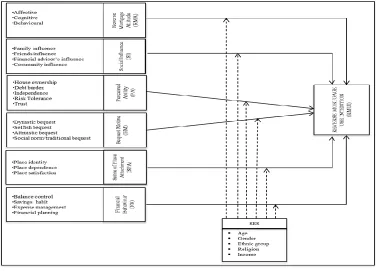
model constitutes of eight (8) constructs. Four of the constructs, Perceived Ability (PA); Social
Influence (SI); Reverse Mortgage Attitude (RMA) and Reverse Mortgage Use Intention (RMUI)
convey the same meaning applied to the original TPB constructs. On the other hand, the
remaining four constructs, Bequest Motive (BM), Sense of Place Attachment (SPA), Financial
Behaviour (FB) and Socio-Economic Status (SES) are additional constructs identified in the
literature as potential predictors of willingness for reverse mortgage use.
In the next section, a detailed explanation of the constructs and their relationships as
depicted in the proposed model (Figure 2) is presented. The purpose of the explanation is to offer
a much clearer view on the proposed model by contextualizing the constructs in line with the
peculiarity of the current study and develop working hypotheses for further empirical
Figure 2: Reverse Mortgage Use Intention Model (ReMUIM)
Source: Authors (2017)
4.2.1 Reverse mortgage use intention (RMUI)
Although there is not a perfect relationship between behavioural intention and actual
behaviour, intention can be used as a proxy measure of behaviour. Behavioural intention is a
good predictor of actual usage of an application or system[71]. It may be a natural conclusion
then, that any factors influencing behaviour can indirectly influence intention[72]. In this study,
the degree of willingness to use reverse mortgage is examined in association with the other
constructs. It is expected that higher willingness will translate to higher actual use and lower
willingness will result to low or non-use.
4.2.2 Reverse mortgage attitude (RMA)
The attitude-behavioural intention relationship implies that people form intentions to
perform behaviour toward which they have positive effect. Perceived usefulness is the
consumer‘s perceptions regarding the outcome of an experience[73]. Therefore, it is expected
for money etc they are more likely to accept its use. On the other hand, if they perceived that
reverse mortgage is not useful, risky, complex, etc there could be higher likelihood of not
accepting or using the product. Therefore, the inter-relationship between perceived usefulness
and the intentions to use reverse mortgage are important to examine. In view of the
aforementioned, it is hypothesized that:
H1: Attitude significantly predict reverse mortgage use intention
4.2.3 Perceived Ability (PA)
Perceived ability reflects the perceived belief of performing the behaviour in question. In
the context of this research, the likelihood of individuals applying for reverse mortgage in the
future depends on their belief about the opportunities (availability of reverse mortgage products,
desire to age-in-place), resources (home ownership, information and knowledge), and barriers
(risk averseness, debt averseness), associated with their action. Similarly, as mentioned earlier
that individual perceived control is partially affected by past experience and second hand
information about the behaviour. It is assume that previous experience on financial and
investment decision such as buying annuity product, taking up mortgage, investing in shares will
influence the willingness to use reverse mortgage. Evidence in the reverse mortgage literature
indicate that low income, attachment to home, house ownership, previous investment decision,
risk averseness, and counselling influences interest in reverse mortgage. Therefore, it is
hypothesized that:
H2: Perceived ability significantly predict reverse mortgage use intention
4.2.4 Social Influence (SI)
Social influence is used in this context to convey the socio-cultural expectations that
could affect individual‘s willingness to use reverse mortgage. According to the TPB other people‘s expectations about individual‘s performance of an action influence intentions both
positively and negatively. Previous studies on reverse mortgage indicate that the decision to
apply or use reverse mortgage could probably be influenced by family members, community and
financial advisers[32]. It is anticipated that when family members support individual‘s decision
system such as bequest and intergenerational practices could influence one‘s willingness to use
reverse mortgage. Expectations to adhere to certain led down rules in administering one‘s
property could affect the intention to use reverse mortgage. Community and family expectations
to bequeath one‘s property to his offspring in line with the concept of reciprocity[74,75] could
influence decision to use reverse mortgage. Based on the aforesaid, this study hypothesized that:
H3: Social influence significantly predicts reverse mortgage use intention
4.2.5 Bequest motive (BM)
Bequest motive is an additional construct introduced in the original TPB. Its inclusion as
a construct in this study is based on the expectation that it will influence individual‘s willingness
on using reverse mortgage product. Literature on reverse mortgage demand indicated that
individual‘s desire to leave behind assets to heirs on the occasion of death might influence peoples‘ willingness to apply for reverse mortgage products[65,76,77]. Studies on bequest and
inheritance in Malaysia revealed that people hold different bequest motives with regards to the
sharing of their assets. Studies have revealed evidences of selfish life-cycle, altruistic, dynastic,
social norm and traditional bequest motives among Malaysians[11,78,79]. It is therefore
worthwhile to include bequest motive as additional construct in the TPB in order to investigate
its influence on the willingness of Malaysians to use reverse mortgage product. It is therefore
hypothesized that:
H4: Bequest motive significantly predict reverse mortgage use intention
4.2.6 Sense of place attachment (SPA)
One of the conditions in reverse mortgage contract is that the borrower ought to leave in
the house permanently until death. Findings from reverse mortgage studies implied that those
individuals who are highly attached to their environment are the most attracted to reverse
mortgage while those who anticipated moving out showed less interest in reverse mortgage[32].
In consideration of the aforementioned, addition of a construct that measures the degree of place
attachment to the original TPB is important because it is expected that individuals‘ willingness to
use reverse mortgage will be affected by the degree to which he plan to remain in the house or
community. Thus, it is hypothesized that:
4.2.7 Financial behaviour (FB)
In the financial behaviour literature, four major domains of financial behaviourwere
identified to include managing money, planning ahead, choosing products and staying
informed[80]. Effective engagement in these behaviours to improve one‘s financial well-being
leads to positive or desirable financial behaviour while their ineffective use translates to negative
or undesirable financial behaviour[81]. Thus it is expected that individual‘s financial behaviour
will influence decision to apply for reverse mortgage. It is expected that those individuals who
interact with other forms of financial products will be more likely to enter into reverse mortgage
transaction than those who do not involve in such, as such it is hypothesized that:
H6: Financial behaviour significantly predicts reverse mortgage use intention
4.2.8 Socio-Economic Status
Generally, socio-economic statuss have been established to influence people‘s decision in
many aspects of human activities[82–84]. Previous studies on reverse mortgage product market
highlighted the role of age, race, income level, gender, marital status, health status and place of
residence in determining the level of reverse mortgage usage among individuals[24,28,32,84]. It
is therefore suitable to include socio-economic characteristics as a possible predictor of reverse
mortgage use intention. Similarly, this study considered socio-economic characteristics as a
moderating variable between the identified six constructs and reverse mortgage use intention.
Therefore, the following hypotheses are formulated:
H7a: Socio-economic status moderates the relationship between reverse mortgage attitude and
reverse mortgage use intention
H7b: Socio-economic status moderates the relationship between perceived ability and reverse
mortgage use intention
H7c: Socio-economic status moderates the relationship between social influence and reverse
mortgage use intention
H7d: Socio-economic status moderates the relationship between place attachment and reverse
H7e: Socio-economic status moderates the relationship between bequest motive and reverse
mortgage use intention
H7f: Socio-economic status moderates the relationship between financial behaviour and reverse
mortgage use intention
5 CONCLUSION
The reverse mortgage product is a relatively new financial product specifically designed
to enable the elderly people avoid the risk of financial insecurity in old-age. Evidence has shown
that elderly people in Malaysia are facing the risk of financial insecurity in old-age. On the other
hand, they are considered to possess substantial illiquid wealth in the form of accumulated home
equity which is trapped in their homes. One of the cardinal points of the Malaysia‘s New
Economic Model (NEM) as a roadmap to the actualisation of the country‘s vision of becoming a
high income country is to ensure inclusiveness in all aspect of human activities in the country.
Institutions in the country are encouraged to ensure inclusiveness in their service and product
delivery as well. Therefore, by understanding the extent of potential customers‘ willingness to
use reverse mortgage and the respective factors that predict such behaviour, the financial
institutions will have clue on the future acceptability and marketability of reverse mortgage
product in the country, thus helping the financial institutions contribute to the government‘s
inclusiveness agenda as enshrined in the 10th Malaysia Plan.
REFERENCES
[1] United Nations Department of Economic and Social Affairs Population Division. World
Population Ageing 2013. New York: 2013. doi:ST/ESA/SER.A/348.
[2] Department of Statistics Malaysia. Population Projections in Malaysia 2010 - 2040. Kuala
Lumpur: 2012.
[3] Kumar PM, Divakaruni RK, Sri Venkata M. Reverse Mortgages - Features & Risks.
Mumbai: Institute of Actuaries of India; 2008.
[4] Hoe NK. The prospects for old-age income security in Hong Kong and Singapore. London
[5] Cocco JF, Lopes P. Reverse Mortgage Design. 2015.
[6] Zin RHM, Lee HA, Abdul-Rahman S. Social Protection in Malaysia. In: Adam E, Hauff
M von, John M, editors. Soc. Prot. Southeast East Asia, Singapore: Friedrich Ebert
Stiftung; 2002, p. 119–69.
[7] Abd Samad S, Awang H, Mansor N. Population ageing and social protection in malaysia.
Malaysian J Econ Stud 2013;50:139–56.
[8] Help Age International, UNFPA. Ageing in the Twenty-First Century: A Celebration and
a Challenge. Fundo Popul Das Nações Unidas 2012:12. doi:978-0-89714-981-5.
[9] Employee Provident Fund. EPF savings and your retirement 2015:6–7.
[10] Loke YJ. Household‘s Preparedness for Income Shock. Singapore Econ. Rev. Conf. 2013,
2013, p. 1–25.
[11] Alavi K. Intergenerational Relationships Between Aging Parents and Their Adult Children
in Malaysia. 20th Assoc Asian Soc Sci Res Counc Bienn Gen Conf 2013:1–19.
[12] Hanewald K, Post T, Sherris M. Portfolio Choice in Retirement What Is the Optimal
Home Equity Release Product ? 2014.
[13] Shan H. Reversing the trend: The recent expansion of the reverse mortgage market. Real
Estate Econ 2011;39:743–68. doi:10.1111/j.1540-6229.2011.00310.x.
[14] Ong R. Unlocking Housing Equity Through Reverse Mortgages: The Case of Elderly
Homeowners in Australia. Eur J Hous Policy 2008;8:61–79.
doi:10.1080/14616710701817166.
[15] Rasmussen DW, Megbolugbe IF, Morgan BA. Using the 1990 Public Use Microdata
Sample to Estimate Potential Demand for Reverse Mortgage Products. J Hous Res
1995;6:1–23.
Malaysia 2011:77. doi:10.1007/s13398-014-0173-7.2.
[18] Wang P. Feasibility Study of Reverse Mortgages for Pension —— A Case of Hangzhou ,
China 2011.
[19] Reed R, Gibler K. The case for reverse mortgages in Australia–Applying the USA
experience. Real Estate Soc Conf Brisbane, Aust 2003:19–22.
[20] Kumar M. Reverse mortgage as a retirement planning tool: an evaluation. punjabi
University, 2013.
[21] Ong R, Haffner M, Wood G, Jefferson T, Austen S. Assets, debt and the drawdown of
housing equity by an ageing population. vol. 153. 2013.
[22] Haffner MEA, Ong R, Wood GA. Mortgage equity withdrawal in Australia: Recent
trends, institutional settings and perspectives. Delft, The Netherlands: 2015.
[23] Doling J. Releasing Housing Equity. Socio-Economic Sci 2010:1–5.
[24] Mayer CJ, Simons K V. Reverse mortgages and the liquidity of housing wealth. Real
Estate Econ 1994;22:235–55. doi:10.1111/1540-6229.00634.
[25] Redfoot DL, Scholen K, Brown SK. Reverse mortgages: Niche product or mainstream
solution? Washington D.C.: 2007.
[26] Fornero E, Rossi MC, Brancati MCU. Explaining why, right or wrong,(Italian) households
do not like reverse mortgages. J Pension 2011:1–23. doi:10.1017/S1474747215000013.
[27] Lee C-C, Chen K-S, So-De Shyu D. Credit , Equity Conversion , and Housing
Endowment : Analysis of Reverse Mortgage Markets 2015;5:63–80.
[28] Zhou H. Analysis on demand factor of regional difference for reverse mortgage-based on
survey data in Beijing & Hangzhou. J Chem Pharm Res 2014;6:232–8.
[29] Fratantoni M. Reverse mortgage choices: A theoretical and empirical analysis of the
[30] Davidoff T, Gerhard P, Post T. Reverse Mortgages: What Homeowners (Don‘ t) Know
and How it Matters. JpwiwiRwth-AachenDe 2014:1–34.
[31] Chou KL, Chow NWS, Chi I. Willingness to consider applying for reverse mortgage in
Hong Kong Chinese middle-aged homeowners. Habitat Int 2006;30:716–27.
doi:10.1016/j.habitatint.2005.04.008.
[32] Yoo I, Koo I. Do Children Support Their Parents ‘ Application for the Reverse
Mortgage ?: A Korean Case. Seoul: 2008.
[33] Sau Po Centre on Ageing. Report on A Study on Reverse Mortgage Commissioned by the
The Hong Kong Mortgage Corporation Limited. Hong Kong: 2010.
[34] Knapp K. The Influence of Family and Community Ties on the Demand for Reverse
Mortgages. New York: 2001.
[35] Luiz JM, Stobie G. The market for equity release products : lessons from the international
experience. South African Bus Rev 2010;14:24–45.
[36] Morris J, Marzano M, Dandy N, O‘Brien L. Theories and models of behaviour and
behaviour change. For Sustain Behav Behav Chang Theor 2012:1–27.
[37] Ajzen I. Perceived Behavioral Control, Self-Efficacy, Locus of Control, and the Theory of
Planned Behavior1. J Appl Soc Psychol 1985;80:11–39.
doi:10.1111/j.1559-1816.2002.tb00236.x.
[38] Ajzen I, Fishbein M. Understanding attitudes and predicting social behavior. vol. 278.
1980. doi:Z.
[39] Ozmete E, Hira T. Conceptual Analysis of Behavioral Theories / Models : Application to
Financial Behavior. Eur J Soc Sci 2011;18:386–404.
[40] Rutherford LG, Devaney SA. Utilizing the Theory of Planned Behavior to Understand
Convenience Use of Credit Cards. J Financ Couns Plan Educ 2009;20:48–63.
college students. Soc Indic Res 2009;92:53–68. doi:10.1007/s11205-008-9288-6.
[42] Xiao J, Wu J. Applying the theory of planned behavior to retain credit counseling clients.
Arizona: 2006.
[43] Barua P. The Moderating Role of Perceived Behavioral Control : The Literature Criticism.
Int J Bus Soc Sci 2013;4:57–9.
[44] Aubele T. Investigation of consumer over- indebtedness within the German mail ‐ order
industry using the Theory of Planned Behaviour ‖. University of Gloucestershire, 2014.
[45] Fishbein M, Ajzen I. Belief, Attitude, Intention, and Behavior, An Introduction to Theory
and Research. 1975. doi:10.1016/B978-0-12-375000-6.00041-0.
[46] Ajzen I, Madden TJ. Prediction of goal-directed behavior: Attitudes, intentions, and
perceived behavioral control. J Exp Soc Psychol 1986;22:453–74.
doi:10.1016/0022-1031(86)90045-4.
[47] Taib FM, Ramayah T, Razak DA. Factors influencing intention to use diminishing
partnership home financing. Int J Islam Middle East Financ Manag 2008;1:235–48.
doi:10.1108/17538390810901168.
[48] Alleyne P, Broome T. An exploratory study of factors influencing investment decisions of
potential investors. Barbados: 2010.
[49] Hanudin A, Abdul Rahim AR, Stephen LSJ, Ang Magdalene CH, Amin H, Rahman ARA,
et al. Determinants of customers‘ intention to use Islamic personal financing: The case of
Malaysian Islamic banks. J Islam Account Bus Res 2011;2:22–42.
doi:10.1108/17590811111129490.
[50] Alam SS, Janor H, Aniza C, Wel C. Is Religiosity an Important Factor in Influencing the
Intention to Undertake Islamic Home Financing in Klang Valley ? 2012;19:1030–41.
doi:10.5829/idosi.wasj.2012.19.07.392.
[51] Wahyuni S. Moslem Community Behavior in The Conduct of Islamic Bank: The
doi:10.1016/j.sbspro.2012.09.1188.
[52] Kennedy BP. The Theory of Planned Behavior and Financial Literacy: A Predictive
Model for Credit Card Debt? Marshall University, 2013. doi:Paper 480.
[53] Amin H, Rahman ARA, Jr SLS, Hwa AMC. Determinants of customers‘ intention to use
Islamic personal financing: The case of Malaysian Islamic banks. J Islam Account Bus
Res 2011;2:22–42. doi:10.1108/17590811111129490.
[54] Amin H, Abdul Rahman AR, Abdul Razak D. Willingness to be a partner in musharakah
mutanaqisah home financing: Empirical investigation of psychological factors. J Pengur
2014;40:69–81.
[55] Gouider JJ, Gafsi N. Islamic insurance in Tunisia: fiction or reality? J Soc Sci Res
2014:639–48.
[56] Ahmad NHB. Determinants of Customers‘ Intention to Use Islamic Personal Finance.
University Utara Malaysia, 2014.
[57] Putit L, Johan ZJ. C onsumers‘ Acceptance of ―Halal‖ Credit Card Services : An
Empirical Analysis. J Emerg Econ Islam Res 2015;3:1–9.
[58] Nosi C, D‘Agostino A, Maria Pagliuca M, Alberto Pratesi C. Saving for old age:
Longevity annuity buying intention of Italian young adults. J Behav Exp Econ
2014;51:85–98. doi:10.1016/j.socec.2014.05.001.
[59] Southey G. The Theories of Reasoned Action and Planned Behaviour Applied to Business
Decisions : A Selective Annotated Bibliography. J New Bus Ideas Trends 2011;9:43–50.
[60] Cruz JN. Is white-collar crime a form of entrepreneurship? 2013.
[61] Armitage CJ, Conner M. Efficacy of the Theory of Planned Behaviour: a meta-analytic
review. Br J Soc Psychol 2001;40:471–99. doi:10.1348/014466601164939.
[62] Ajzen I. The theory of planned behavior. Orgnizational Behav Hum Decis Process
[63] Williams FL, Kao YE. Value of Home Equity Used in Reverse Mortgages as a Potential
Source of Income for Elderly Americans. Financ Couns Plan 1997;8:57–64.
[64] Leviton R. Reverse Mortgage Decision-Making. J Aging Soc Policy 2002;13:1–16.
doi:10.1300/J031v13n04_01.
[65] Dillingh R, Prast H, Rossi M, Brancati C. The psychology and economics of reverse
mortgage attitudes: evidence from the Netherlands. 2013.
[66] Andersson KC, Sandstrom J. Investigating a Psychological Perspective of Reverse
Mortgage - How is Reverse Mortgage Perceived by Potential Borrowers in Sweden?
Umeå University, 2013.
[67] Chen A, Jensen HH. Home Equity Use and the Life Cycle Hypothesis. J Consum Aff
1985;19:37–56. doi:10.1300/J081V04N01.
[68] Nakajima M, Telyukova IA. Reverse Mortgage Loans : A Quantitative Analysis. 2014.
[69] Chinloy P, Megbolugbe IF. Reverse Mortgages - Contracting and Crossover Risk. J Am
Real Estate Urban Econ Assoc 1994;22:367–86. doi:10.1111/1540-6229.00638.
[70] Venkatesh V, Davis FD. A Theoretical Extension of the Technology Acceptance Model:
Four Longitudinal Field Studies. Manage Sci 2000;46:186–204.
[71] Slatten LAD. An Application and Extension of the Technology Acceptance Model to
Nonprofit Certification. J NONPROFIT Manag 2010;14:47–55.
[72] Davis FD, Bagozzi RP, Warshaw PR. Extrinsic and intrinsic motivation to use computers
in the workplace. J Appl Soc Psychol 1992;22:1111–32.
doi:10.1111/j.1559-1816.1992.tb00945.x.
[73] Nicińska A. WHY DO PEOPLE BEQUEATH? ARGUMENTA OECONOMICA
2013;2:75–95.
[74] Kolm SC. Introduction to the Economics of Giving, Altruism and Reciprocity. In:
North-Holland: 2006, p. 1–122. doi:10.1016/S1574-0714(06)01001-3.
[75] Gotman A. Towards the end of bequest ? The life cycle hypothesis sold to seniors: Critical
reflections on the reverse mortgage financial fashion. Civ - J Soc Sci 2011;11:93–114.
[76] Caplin A. The Reverse Mortgage Market: Problems and Prospects. In: Mitchell OS, Bodie
Z, Hammond B, Zeldes S, editors. Innov. Retire. Financ., Pension Research Council;
2001.
[77] Chuan CS, Seong LC, Chau WH. Financial Satisfaction , Resource Transfers and Bequest
Motives A mong Malaysia ‘ s Urban Older Adults. Proc. B. ICETSR, Handb. Emerg.
Trends Sci. Res., vol. 8, PAK Publishing Group; 2014, p. 106–29.
[78] Alma‘amun S. Searching for bequest motives and attitudes to leaving a bequest among
Malaysian muslims. J Ekon Malaysia 2012;46:73–84.
[79] Kempson E, Collard S, Moore N. Measuring financial capability: an exploratory study.
London: 2005.
[80] Xiao JJ, Sorhaindo B, Garman ET. Financial behaviours of consumers in credit
counselling. Int J Consum Stud 2006;30:108–21. doi:10.1111/j.1470-6431.2005.00455.x.
[81] Dunlop S, Coyte PC, McIsaac W. Socio-economic status and the utilisation of physicians‘
services: results from the Canadian National Population Health Survey. Soc Sci Med
2000;51:123–33. doi:10.1016/S0277-9536(99)00424-4.
[82] Clark GL, Strauss K. Individual pension-related risk propensities: the effects of
socio-demographic characteristics and a spousal pension entitlement on risk attitudes. Ageing
Soc 2008;28:847–74. doi:10.1017/S0144686X08007083.
[83] Morgan BA, Megbolugbe IF, Rasmussen DW. Reverse Mortgages and the Economic
Status of Elderly Women 1 1990;36:400–5.
[84] Hancock R. Can Housing Wealth Alleviate Poverty among Britain‘s Older Population?
[85] Willis RM, Stewart RA, Giurco DP, Talebpour MR, Mousavinejad A. End use water
consumption in households: Impact of socio-demographic factors and efficient devices. J
![Figure 1: Theory of Planned Behaviour[37]](https://thumb-us.123doks.com/thumbv2/123dok_us/54247.1009037/8.612.155.457.49.254/figure-theory-of-planned-behaviour.webp)