© Hindawi Publishing Corp.
CONVEX ISOMETRIC FOLDING
E. M. ELKHOLY
(Received 27 September 1993 and in revised form 5 June 1996)
Abstract.We introduce a new type of isometric folding called “convex isometric folding.” We prove that the infimum of the ratio VolN/Volϕ(N)over all convex isometric foldings ϕ:N→N, whereNis a compact 2-manifold (orientable or not), is 1/4.
Keywords and phrases. Isometric and convex foldings, regular and universal covering spaces, manifolds, group of covering transformations, fundamental regions.
2000 Mathematics Subject Classification. Primary 51H10, 57N10.
1. Introduction. A mapϕ:M→N, whereMandNareC∞Riemannian manifolds of dimensionsmandn, respectively, is said to be an isometric folding ofMintoNif and only if for any piecewise geodesic pathγ:J→M, the induced pathϕ◦γ:J→Nis a piecewise geodesic and of the same length. The definition is given by Robertson [4]. The set of all isometric foldingsϕ:M→Nis denoted by(M,N).
Letp :M→N be a regular locally isometric covering and let G be the group of covering transformations ofp. An isometric foldingφ∈(M)is said to bep-invariant if and only if for allg∈Gand allx∈X,p(ϕ(x))=p(ϕ(g,x)). See Robertson and Elkholy [5]. The set ofp-invariant isometric foldings is denoted byi(M,p).
Definition1.1. Letϕ∈(M,N), whereMandNareC∞Riemannian manifolds of dimensionsmandn, respectively. We say thatϕis a convex isometric folding if and only ifϕ(M)can be embedded as a convex set inRn.
We denote the set of all convex isometric foldings ofMintoNbyC(M,N), and if C(M,N)≠, then it forms a subsemigroup of(M,N).
Definition1.2. We say thatϕ∈i(M,p)is ap-invariant convex isometric folding
if and only ifϕ(M)can be embedded as a convex set inRm.
We denote the set ofp-invariant convex isometric foldings of M byCi(M,p). If
Ci(M,p)≠ , then for any covering map, p :M →N, Ci(M,p) is a subsemigroup
ofC(M).
To solve our main problem we need the following:
(1) Robertson and Elkholy [5] proved that ifNis ann-smooth Riemannian manifold, p:M→Nis its universal covering, andGis the group of covering transformations of p, then(N)is isomorphic as a semigroup toi(M,p)/G.
corresponding foldingψ∈i(M,p)maps each fiber ofpto a single point.
(3) Elkholy and Al-Ahmady [3] proved that under the same conditions of (2), ifNis a compact 2-manifold, then
VolN Volϕ(N)=
VolF
Volψ(F), (1.1)
whereF is a fundamental region ofGinM.
2. Convex isometric folding and covering spaces. The next theorem establishes the relation between the set of convex isometric folding of a manifold,C(N), and the set ofp-invariant convex isometric folding of its universal covering space,Ci(M,p).
Theorem2.1. LetNbe a manifold andp:M→Nits universal covering. LetGbe the group of covering transformations ofp. IfC(N)≠, thenC(N)is isometric as a semigroup toCi(M,p)/G.
Proof. Let C(N)≠ϕ. Then by using (1), there exists an isomorphism f from i(M,p)/Ginto(N). SinceCi(M,p)is a subsemigroup ofi(M,p),Ci(M,p)/Gis a
subsemigroup ofi(M,p)/G.
Leth=f|(Ci(M,P)/G). SinceCi(M,p)/Gis a semigroup,his a homeomorphism
and also it is one-one. To show thath is an onto map, we suppose thatϕ∈C(N). Hence,ϕ∈(N) and, consequently, there existsψ∈i(M,p)/G. Sinceϕ∈C(N),
ϕ∗is trivial and hence for allx∈M,ψ(G,x)=ψ(x), and thereforeψ∈Ci(M,p)/G.
Theorem2.2. LetNbe a compact orientable 2-manifold and consider the universal covering space(R2,P)ofN. Letϕ∈C(N)andψ∈C
i(R2,p). Then for allx,y∈R2,
d(ψ(x),ψ(y))≤∆, where∆is the radius of a fundamental region for the covering space.
Proof. Elkholy [1] proved the truth of the theorem forN=S2. So, we have to prove it for the connected sum ofn-tori. First, letN=T be a torus homomorphic to the quotient space obtained by identifying opposite sides of a square of length “a” as shown in Figure 1(a)
T
a a
b b
(a) (b)
g1·x g2·x g3·x
g4·x α1 α2 α3
α4 y
Suppose thatϕ:T→T is a convex isometric folding. Thenϕ∗(π1(T ))is trivial. By Theorem 2.1, there exists a convex isometric foldingψ:R2→R2such that for allx, y∈R2and for allg∈G,pψ(x)=pψ(g,x). Equivalently, for all(P,Q)∈R2and for allg∈Z×Z, there exists a uniqueh∈Z×Zsuch thath◦ψ(P,Q)=ψg(P,Q), i.e.,
ψP,Q+2∆m,2∆n=ψP+2∆m,Q+2∆n, wherem,n,m,n∈Z. (2.1)
Consider any fundamental regionF of the covering space(R2,p)ofT, i.e., a closed square of length “a” with sides identified as shown in Figure 1(b). Sinceϕ∗is trivial, by (2), for allx∈R2,ψ(G,x)=ψ(x). Now, letxandybe distinct points ofR2such thatx=g·yfor allg∈Gand letd(x,y)=α1. Then there exists a pointx∗=g·x such that
dy,x∗=min(α
i), αi=dy,gi,x, i=1,...,4. (2.2)
Thus, there are always four equivalent pointsgi·x, i=1,...,4 which form the
ver-tices of a square of length “a” and such that d(gi·x,y)≤2∆. From Figure 1(b), it
is clear that maxd(x∗,y)≤∆and sinceψis an isometric folding, by Robertson [4], d(ψ(x),ψ(y))≤d(x,y), i.e.,
dψ(x),ψy=dψgi·x,ψy≤dgi·x,y=dx,y≤∆, (2.3)
and this proves the theorem forN=T.
Now, consider the connected sum of two tori, obtained as a quotient space of an octagon with sides identified as shown in Figure 2(a). The group of covering transfor-mationsG is isometric toZ×Z×Z×Z. Using the same previous technique, we can
(a) T#T
(b) g1·x g2·x g3·x
g4·x
y a1 a2 a3
a4
Figure2.
Theorem2.3. LetNbe a compact nonorientable 2-manifold and consider the uni-versal covering space (M,p) of N. Let φ ∈ C(N)and ψ ∈Ci(M,p). Then for all
x,y∈M,dψ(x),ψ(y)≤∆, where∆is the radius of a fundamental region for the covering space.
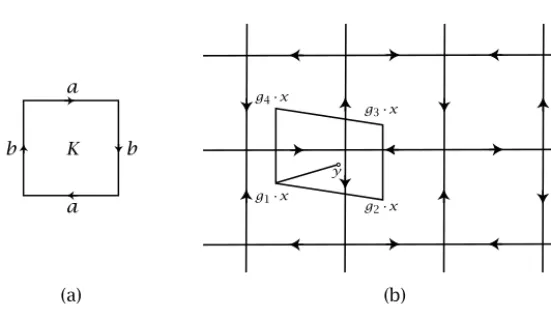
Proof. By Elkholy [2], the theorem is true forN=p2andM=S2. Now, consider the connected sum of two projective planes, the Klein bottleK, homeomorphic to the quotient space obtained by identifying the opposite sides of a square as shown in Figure 3(a).
b b
a
a
(a) K
(b)
g1·x
g2·x g3·x g4·x
y
Figure3.
Suppose thatϕ:K→K is a convex isometric folding. Then there exists a convex isometric foldingψ:R2→R2such that for allx∈R2andg∈G,p(ψ(x))=p(ψ(g· x)). Equivalently, for all(P,Q)∈R2 and for all g∈Z×Z2, there exists a unique h∈Z×Z2such thath◦ψ(P,Q)=ψ(g(P,Q)), i.e.,
ψP,Q+2∆m,2∆n
=ψP+2∆m,2∆n+(−)mQ, wherem,n,m,n∈Z. (2.4)
Any fundamental regionF of the covering space(R2,p)ofKis a closed square of diameter 2∆with the boundary identified as shown in Figure 3(b). Sinceϕ∗is trivial, for allx∈R2,ψ(G·x)=ψ(x).
Now, letxandy be distinct points ofR2such thaty≠g·xfor allg∈G, and let d(x,y)=α1. Thus, there exists a pointx∗=g·xsuch that
dy,x∗=min(α
i), αi=dy,gi·x, i=1,...,4. (2.5)
Thus, there are always four equivalent pointsgi·xwhich form the vertices of a
par-allelogram such that the shortest diameter is of length less than 2∆.
Now, the pointyis either inside or on the boundary of a triangle of verticesg1·x=
x,g2·x,g3·x. Letybe a point equidistant from the vertices of this triangle, i.e.,
[image:4.516.114.390.200.360.2]From Figure 3(b), it is clear thatd(y,x) <∆and, hence,d(x∗,y) <∆. Therefore,
dψ(x),ψy=dψgi·x,ψy≤dg·xi,y=dx∗,y<∆ (2.7)
and the result follows.
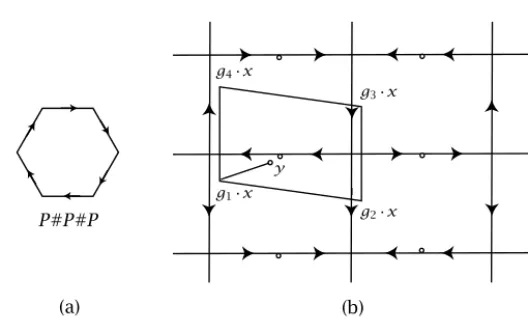
Now, letNbe the connected sum of three projective planes obtained as the quotient space of a hexagon with the sides identified in pairs as indicated in Figure 4(a). In this case,(R2,p)is the universal cover ofNandGZ×Z×Z2. Using the same method as that used above, we can always have equivalent pointsgi·x,i=1,...,4 which form
the vertices of a parallelogram whose shortest diameter is of length less than 2∆. From Figure 4(b), we can see that maxd(y,x∗) <∆and the theorem is proved.
In general and by using the same technique, the theorem is also true for the con-nected sum ofn-projective planes.
P#P#P
(a)
g1·x
g2·x g3·x g4·x
y
(b) Figure4.
3. Volume and convex folding. The following theorem succeeds in estimating the maximum volume we may have if we convexly folded a compact 2-manifold into itself.
Theorem3.1. The infimum of the ratio
eN=Volϕ(N)VolN , (3.1)
whereNis a compact 2-manifold over all convex isometric foldingsϕ∈C(N)of degree zero, is4.
Proof. Robertson [4] has shown that ifNis a compact 2-manifold, andϕ:N→N is a convex isometric folding, any convex isometric folding is an isometric folding, then degϕis±1 or 0. We consider only the case for which degϕis zero otherwise ϕ(N)cannot be embedded as a convex subset ofR2unlessNis. In this case, the set of singularities ofϕdecomposesNinto an even number of strata, sayk, each of which is homeomorphic toϕ(N)and, hence,
[image:5.516.118.382.250.416.2]that is,eNshould be an even number. To calculate the exact value ofeN, consider first
an orientable 2-compact manifoldN. By using (1.1)
eN=Volϕ(F)VolF (3.3)
and this means thateN can be calculated by calculating the volume ofF and of its
imageϕ(F), butF is a closed square of diameter 2∆andϕ(F)is a closed subset of F such that the distanced(x,x)between any two pointsx,x∈ϕ(F)is at most∆. The supremum of 2-dimensional volume of such set isφ(∆/2)2and, hence, 2< e
N.
ButeN is an even number. Hence,eN=4.
Now, let N be a nonorientable 2-compact manifold, i.e., a connected sum of n-projective planes. Elkholy [2] proved the theorem forn=1.
The fundamental region in this case is a square or a rectangle of diameter 2∆ ac-cording to whethernis even or odd. Ifnis an even number, then
VolF=2∆2 (3.4)
and the result follows. Now, letnbe an odd number. ThenFis a rectangle of lengths ((n+1)/2)a,((n−1)/2)aand hence
VolF=4∆2sinθcosθ=4∆2 a(n+1)/2 a(n2+1)/2
a(n−1)/2 a(n2+1)/2=
n2−1
n2+12∆2. (3.5) Therefore,eN>2 for alln >1. SinceeN is an even number,eN=4.
References
[1] E. M. Elkholy,Isometric and topological folding of manifolds, Ph.D. thesis, Southampton University, England, 1982.
[2] , Maximum isometric folding of the real projective plane, J. Natur. Sci. Math. 25 (1985), no. 1, 25–30. MR 87d:53081. Zbl 589.53052.
[3] E. M. Elkholy and A. E. Al-Ahmady,Maximum volume of isometric foldings of compact2 -Riemannian manifolds, Proc. Conf. Oper. Res. and Math. Methods Bull. Fac. Sc. Alex. 26 A(1977), no. 1, 54–66.
[4] S. A. Robertson,Isometric folding of Riemannian manifolds, Proc. Roy. Soc. Edinburgh Sect. A79(1977), no. 3–4, 275–284. MR 58 7486. Zbl 418.53016.
[5] S. A. Robertson and E. M. Elkholy,Invariant and equivariant isometric folding, Delta J. Sci. 8(1984), no. 2, 374–385.