COMPARATIVE ANALYSIS OF THE TRAINING PROGRAMMES BETWEEN GOVERNMENT SECTOR AND PRIVATE SECTOR.
Dr. G. Kanaka Mahalakshmi. M.Com.,Mba.,Mhrm,Ph.D. Principal, Visakha Institu For Professional Studies, Visakhapatnm
ABSTRACT
Newly recruited employees require training so as to perform their tasks effectively. Instruction,
guidance, coaching help them to handle jobs competently, without any wastage. Training is
necessary to prepare existing employees for higher level job promotion. Existing employees
require different types of trainings so as to keep of the latest developments in job operations. In
the face of rapid technological changes, this is an absolute necessity. Training is necessary when
a person is shifted from one job to another Training is necessary to make employees mobile and
versatile. They can be placed on various jobs depending on organizational needs. Training is
needed to bridge the gap between what the employees has and what the job demands. Training
is needed to make employees more productive and useful in the long run.
INTRODUCTION
The primary concern of an organization is its viability. There is continuous environmental
pressure for efficiency, and if the organization does not respond to this pressure, it may find itself
rapidly losing whatever share of the market it has. Employee training imparts specific skills and International Research Journal of Management and Commerce
ISSN: (2348-9766) Impact Factor- 5.564, Volume 4, Issue 8, August 2017 Website- www.aarf.asia, Email : [email protected] , [email protected]
knowledge to employees in order that they contribute to the organization’s efficiency, and be
able to cope with the pressures of a changing environment.
NEED FOR THE STUDY
Even though human resource plays a crucial role in toning up the efficiency and
performance especially in Government sector it did not receive the attention and weightage as on
the lines of other resources. It is observed that the HRD function in Government sector is not
effectively implemented in its various facets as implemented in private sector. The HRD policy
in Government sector demonstrated grave loopholes and failed to create desirable work
environment, organizational health and excellence. HRD Still appears to be tradition bound and
conservative and relegated to the last position among all other functions. In Government Sector
the required change is yet to take place in respect of HRD practices and also need a scientific
assessment.
In the light of the above an attempt has been made by the researcher to study the scope
of training one of the important HRD technique In Government sector and its comparison with
private sector.
OBJECTIVES OF THE STUDY
1. To know the policy, objectives, programmes towards Training in Government sector and
private sector.
2. To know the way in which the training programmes are organized and the relative
emphasis laid on training in respect to different categories of the employees in
Government sector and Private sector and also to know the opinions on the part of the
employees in respect to the measures taken by the organizations towards training
programmes.
METHODOLOGY OF THE STUDY
Primary Data: The primary data was collected through structured questionnaire on direct personal investigation method. The main source of primary data is the opinions of the employees
Information has been secured from the respondents of both Government and private sector. To
have a clear information and understanding about the units, the researcher made a number of
visits to both Industries Department and Biological Evans Limited and collected data through
designed questionnaires.
Secondary Data
The secondary data and information was collected from the annual reports, office records,
documents, action plans and booklets of both Industries Department and Biological Evans
Limited. Study relevant data was also procured from journals, periodicals, reference books,
reports, records and other useful published and unpublished reports. For survey of literature the
researcher visited various libraries in Andhra Pradesh, which include Andhra University Library,
Visakhapatnam, Osmania University Library and administrative staff college library in
Hyderabad.
Sample Units for the Study
In Government Sector the study covers the Industries Department Government of Andhra
Pradesh located at Hyderabad, which has been playing a major role in setting up of the industries
in Andhra Pradesh and its 10 District industries centers which are located at Mahaboobnagar,
Rangareddy, Medak, Nizamabad, KarimNagar, Adilabad, Warangal, Khammam, Nalgonda, and
Hyderabad. In private sector the study covers Biological Evans Limited, a pharmaceutical giant
in Andhra Pradesh located at Hyderabad and its branches at Gagan Pahad, Shameerpet and
Patancheru.
Sample Size of the study
There are 1252 employees working at operational and administrative level in the
head office of the Industries Department including its 10 selected District Industries Centers. Out
of this total number, the researcher has taken a sample of 10 percent of the employees based on
random sampling technique. Similarly a sample of 10 percent of the employees has been selected
randomly out of the 1260 employees working at operational and administrative level in
Biological Evans limited, including its branches. To make better comparison the researcher took
REVIEW OF LITERATURE
Fred Luthans : in his book “Organization behavior” pointed out that (1) the need for recognition, security and sense of belonging exert greater impact on workers’ productivity than
the physical working conditions. A manger can get good output in poor working conditions if the
human relationships are good, but he cannot get good output in good working conditions if the
human relations are bad: (2) informal groups operating within the organization exert strong
social controls over the work habits and performance of the individual workers: and (3)
supervision has a great impact on the behavior of the work groups in determining as to whether
they will react positively or negatively while working towards the organizational objectives.
Allen, A. Zallhas : emphasized in his book Human Resource Management, that concern on manpower planning and development of human resources is mainly due to socialization of the
individual to work in organization as well as an individual. Socialization involves change in the
persons: therefore, when we consider some of the techniques for developing human resources,
we should be clear about the changes we have in mind. He further mentions we are specifically
concerned with five kinds of changes, viz, changes in skills, changes in knowledge, changes in
attitude, changes in awareness, and changes in motivation are the important aspects to promote
human resource development. The techniques used for development should be compatible with
the type of change that is desired.
R.D. Agarwal : In his book Dynamics Of Personnel Management, complies the views of eminent foreign and Indian writers on Human Resource Management, exemplifies that the
vitality of any organization depends heavily upon the quality of its Human Resource
management. The book reveals that the field of Human Resource Management is assuming
increasing significance in India under the impact of change in production and distribution
technology, increasing the size and complexity of an organization and transition.
R.S. Dwivedi : In his book Man Power Management , contributed to the knowledge of HRM by adopting an integrated approach to personal management and labour relations. His study
referred to Dale Yoder, Henemann, Turnbull and stane who interpreted manpower management
as involving procedures through which human resources are organised and directed towards the
conceptual frame work of manpower management referring to the contributions made by K.K.
Mehra, P. Ghosh, S. Srinivasan, Nitish, R. Day, in the area of manpower planning, recruitment,
training and development, compensation and trade unionism, among several other aspects of
HRM. He also discussed the changing concept of HRM beginning with a scientific approach.
As the book is based on research and empirically verified hypothesis in the Indian context, it is
an addition to the existing knowledge on HRM.
S.K. Bhatia : discussed in his article of Trends in Training and Development , the main objectives of training and suggested a shift from knowledge to attitude while designing the
training programmes. He identifies three areas of training – technical skills, knowledge of
organisation and external systems, conceptual and inter-personnel skills. The emphasis on
different skills should vary with the type of employees.
M.K. Ghosh : In his article Balancing Of Training and inputs for The First line Supervisors ,he expressed the need for behavioral inputs in training programmes organised for supervisor and
for assessing the training needs of the managers.
P.C. Sethu : In his article Importance Of Training, ,he suggested that training for personnel manager should be directed towards attitudes and beliefs that underlined managerial philosophy
and their inter-relatedness.
L. Prasad and A.M. Benergee: In his book Management Of Human Resource, he extensively discussed the philosophy of management, types of organisation structure, manpower planning
and selection, training and development, promotion, wages, incentives, working conditions and
preparing people in industries for change, among other things, connected with HRM. The work
aims at presenting the concepts, principles and practices of organising work and employing
appraising, communicating, leading, motivating and developing people for better results.
COMPARATIVE ANALYSIS OF THE EMPLOYEES ON TRAINING IN GOVERNMENT SECTOR AND PRIVATE SECTOR
Level of Satisfaction (Government sector) sector) No. of
respondents
Percentage No. of
respondents
Percentage
Highly Satisfied 19 15.2 45 36.0
Satisfied 29 23.2 33 26.4
Dissatisfied 48 38.4 32 25.6
Highly dissatisfied 29 23.2 15 12.0
Total 125 100 125 100
Source: Survey
An attempt was made to compare the satisfaction levels of employees on Induction
training programmes between the employees of Industries Department (Government sector) and
Biological E. Limited (Private sector) to find out whether there is a difference in the
satisfaction/dissatisfaction level of employees in the two sectors. The data presented in Table 8.8
for this purpose reveals that with respect to the government sector, 15.2% were highly satisfied,
23.2% satisfied, 38.4% dissatisfied and 23.2% highly dissatisfied. In the private sector, 36%
were highly satisfied, 26.4% were satisfied, 25.6% were dissatisfied and 12 % were highly
dissatisfied. The analysis reveals that in the Industries Department, only 38.4% were satisfied
and the remaining majority i.e. 61.6% were dissatisfied. In contrast, in Biological E. Limited
about 62.4% were satisfied and only 37.6% were dissatisfied. Hence, it can be inferred that
though the level of satisfaction varied, satisfaction of employees on Induction training
programme was more in the private sector organisation whereas dissatisfaction was reported to
be more in the Government sector organisation. In order to find out the Statistical significance
about level of satisfaction of employees on Induction training programme in both Industries
Department and Biological E. limited, chi-square test has been applied to the data and the
following findings were observed.
STATISTICAL PACKAGE
Statistical Package for Social Sciences (SPSS)
Degree of Freedom df : 3
Chi-square value: 18.48
Inference: The calculated chi-square value for the above table is 18.48 found significant at 1% level because the degree of freedom is 3 and the tested chi-square value is higher than the table
value 11.3. Therefore, it shows that there is a significant difference between the level of
satisfaction of employees on Induction training programmes in Government and private sector
because the level of satisfaction of employees on induction training was more in private sector
whereas dissatisfaction was reported to be more in the Government sector.
The findings suggested that, response of the employees in respect of induction training
programmes from both Government and private sector is valid statistically.
It can be observed that, employees from both organisations have on-job training
programmes. All the respondents (100%) have attended on-job training programmes from both
Industries Department and Biological E. Limited. The researcher also compared the type of
[image:7.612.68.545.360.660.2]on-job training programmes attended by the employees from both sectors.
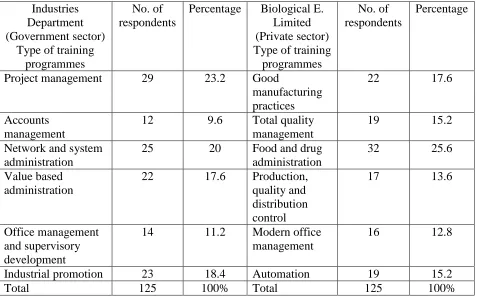
Table no.2: Different types of on-job training programmes attended by the employees Industries
Department (Government sector)
Type of training programmes
No. of respondents
Percentage Biological E. Limited (Private sector) Type of training
programmes
No. of respondents
Percentage
Project management 29 23.2 Good
manufacturing practices
22 17.6
Accounts management
12 9.6 Total quality
management
19 15.2
Network and system administration
25 20 Food and drug
administration
32 25.6
Value based administration
22 17.6 Production,
quality and distribution control
17 13.6
Office management and supervisory development
14 11.2 Modern office
management
16 12.8
Industrial promotion 23 18.4 Automation 19 15.2
Total 125 100% Total 125 100%
An attempt was made by the researcher to compare the different types of on-job training
programmes attended by the employees from both sectors.
From the above table it can be observed that, all the respondents have attended for
different types of on-job training programmes based upon the requirement from both
organizations and every employee is nominated for on-job training programmes in both sectors.
Both general and also practice oriented training programmes are conducted in both Industries
Department and Biological E. Limited.
Table no.3: Level of satisfaction of employees on On-job training programmes
Level of Satisfaction
Industries Department (Government sector)
Biological E. Limited (Private sector)
No. of respondents
Percentage No. of
respondents
Percentage
Highly Satisfied 27 21.6 24 19.2
Satisfied 43 34.4 46 36.8
Dissatisfied 23 18.4 33 26.4
Highly dissatisfied 32 25.6 22 17.6
Total 125 100 125 100
Source: Survey
An attempt was made to compare the satisfaction levels of employees on on-job training
programmes between the employees of Industries Department (Government sector) and
Biological E. Limited (Private sector) to find out whether there is a difference in the satisfaction/
dissatisfaction level of employees in the two sectors. The data presented in Table 8.11 for this
purpose reveals that with respect to the Government sector, 21.6% were highly satisfied. 34.4%
satisfied, 18.4% dissatisfied and 25.6% highly dissatisfied. In the private sector, 19.2% were
highly satisfied, 36.8% satisfied, 26.4% dissatisfied and 17.6% highly dissatisfied. The analysis
reveals that in the Industries Department, about 56% were satisfied and the remaining only i.e.
44% were dissatisfied. In Biological E. limited about the same 56% were satisfied and only 44%
were dissatisfied. Hence, it can be inferred that there is no significant difference between
Government and private sector with respect to level of satisfaction/ dissatisfaction of employees
on on-job training programmes. In order to find out the statistical significance about level of
Biological E. limited, chi-square test has been applied to the data and the following findings
were observed.
STATISTICAL PACKAGE
Statistical Package for Social Sciences (SPSS)
Degree of Freedom (df): 3 Chi-square value: 3.92 Table value: 7.81
Inference
The tested chi-square value for the above table is 3.92 shows no significance because the
degree of freedom is 3 and table value is 7.81, which is higher than the chi-square value.
Therefore, it infers that there is no significant difference between level of satisfaction of
employees with on-job training programmes in both Government and private sector. The
findings suggested that, response of the employees in respect of on-job training programmes in
[image:9.612.67.513.448.550.2]both Government and private sector is valid statistically.
Table no.4 : Number of employees attended External training programmes
Opinion
Industries Department (Government sector)
Biological E. Limited (Private sector)
No. of respondents
Percentage No. of
respondents
Percentage
Yes 79 63.2 112 89.6
No 46 36.8 13 10.4
Total 125 100% 125 100%
Source: Survey
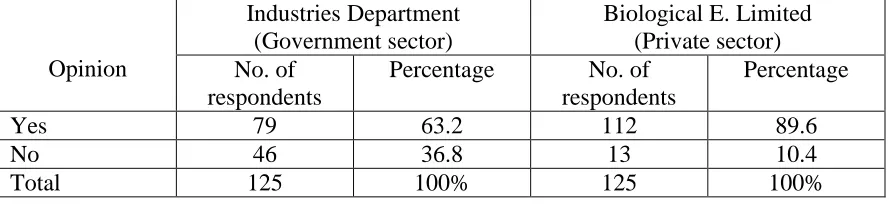
From the above table it can be observed that, external training programmes are conducted
in both Industries Department and Biological E. Limited. But In Biological E. Limited about
89.6% of the respondents attended external training programmes whereas only 63.2% of the
employees attended external training programmes in Industries Department. In order to find out
Department and Biological E. limited, Chi-square test has been applied to the data and the results
are shown below.
STATISTICAL PACKAGE
Statistical package for social sciences.
Degree of Freedom (DF)=1
Chi-square value at above DF =24.16
Table value at 1% confidence level at DF=6.63
Inference: The tested chi-square value for the above table is 24.16 is indicated significant at 1% level because of the degree of freedom is 1 and table value is 6.63 therefore it can be analyzed
that there is a significant difference in the response of employees from Government and private
sector organization on attending external training programmes conducted by the organizations,
because compared to private sector, in Government sector external training programmes were
conducted only to few employees, so most of the employees are not nominated for external
training which played vital role to give exposure and knowledge to the employees. Whereas in
private sector most of the employees are provided external training compared to government
sector.
The results suggested that, response of the employees from both Government and private sector
[image:10.612.20.599.530.698.2]valid statistically.
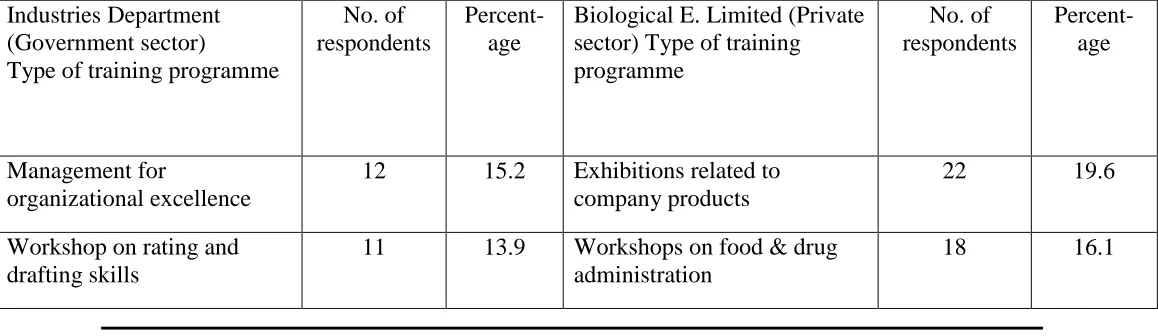
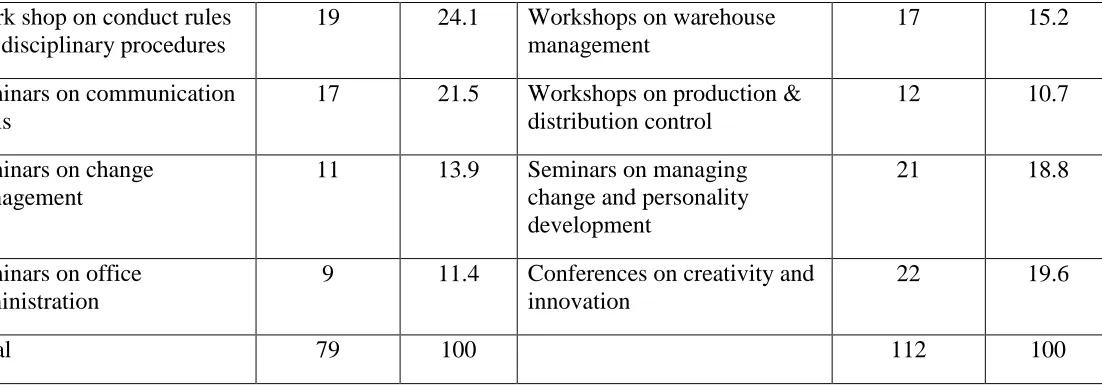
Table no.5 : Different types of external training programmes attended by the employees Industries Department
(Government sector) Type of training programme
No. of respondents
Percent-age
Biological E. Limited (Private sector) Type of training programme
No. of respondents
Percent-age
Management for
organizational excellence
12 15.2 Exhibitions related to
company products
22 19.6
Workshop on rating and drafting skills
11 13.9 Workshops on food & drug administration
Work shop on conduct rules and disciplinary procedures
19 24.1 Workshops on warehouse
management
17 15.2
Seminars on communication skills
17 21.5 Workshops on production & distribution control
12 10.7
Seminars on change management
11 13.9 Seminars on managing
change and personality development
21 18.8
Seminars on office administration
9 11.4 Conferences on creativity and
innovation
22 19.6
Total 79 100 112 100
Source: Survey
From the above comparative table it can be observed that, about 89.6% of the
respondents were nominated for external training programmes in Biological E. Limited but in
Industries Department only 63.2% of the respondents were nominated for external training
programmes. Most of the training programmes in Biological E. Limited are Innovative and
development oriented whereas in Industries Department most of the training programmes are
[image:11.612.43.594.35.229.2]general in nature.
Table no.6 : Level of satisfaction of employees on external training programmes
Level of Satisfaction
Industries Department (Government sector)
Biological E. Limited(Private sector)
No. of respondents
Percentage No. of
respondents
Percentage
Highly Satisfied 12 15.2 47 41.9
Satisfied 18 22.8 32 28.6
Dissatisfied 26 32.9 19 17.0
Highly dissatisfied 23 29.1 14 12.5
Total 79 100 112 100
Source: Survey
An attempt was made to compare the satisfaction levels of employees on external training
programmes between the employees of Industries Department (Government sector) and
satisfaction/dissatisfaction level of employees in the two sectors. The data presented in Table
8.15 for this purpose reveals that with respect to the Government sector, 15.2% were highly
satisfied, 22.8% satisfied, 32.9% dissatisfied and 29.1% highly dissatisfied. The analysis reveals
that in Industries Department, only 38% were satisfied and the remaining majority i.e. 62% were
dissatisfied. In contrast, in Biological E. limited about 70.5% were satisfied ad only 29.5% were
dissatisfied.
Hence, it can be inferred that though the level of satisfaction varied, satisfaction of
employees on External training programmes is more in the private sector organisation whereas
dissatisfaction was reported to be more in the Government sector organisation. In order to find
out the statistical significance about level of satisfaction of employees on external training
programmes in both Industries Department and Biological E. limited, chi-square test has been
applied to the data and the results are show below.
STATISTICAL PACKAGE= statistical package for social sciences. Degree of Freedom (DF)=3
Chi-square value at above DF=8.01
Table value at 1% of confidence level at DF=7.81
Inference:
The calculated chi-square value for the above table is 8.01 found significant at 5% level
because the degree of freedom is 3 and the tested chi-square value is higher than the table value
7.81. Therefore, it shows that there is a significant difference between the level of satisfaction of
employees on external training programmes in both Government and private sector because
satisfaction of employees on external training programmes was more the Government sector.
The findings suggested that, response of the employees in respect of external training
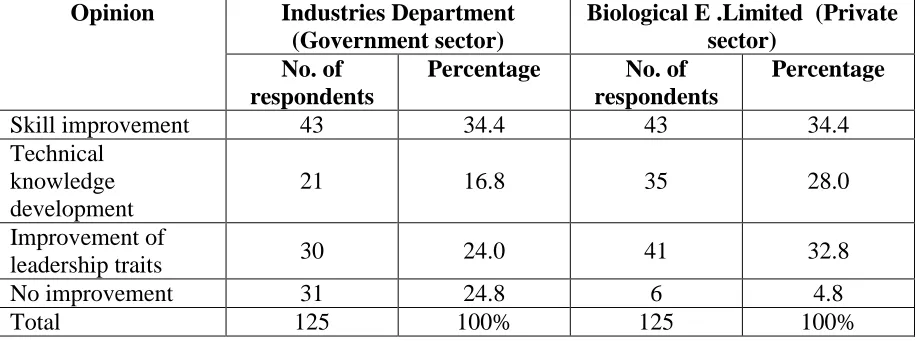
Table no. 7 : Opinion of the employees on perceived benefits from the training programmes Opinion Industries Department
(Government sector)
Biological E .Limited (Private sector)
No. of respondents
Percentage No. of respondents
Percentage
Skill improvement 43 34.4 43 34.4
Technical knowledge development
21 16.8 35 28.0
Improvement of
leadership traits 30 24.0 41 32.8
No improvement 31 24.8 6 4.8
Total 125 100% 125 100%
Source: Survey
From the above table it may be observed that, about 34.4% of the respondents have
opined that, the training has provided improvement of skills among the employees in both
Industries Department and Biological E. Limited. In Biological E. Limited about 28% of the
respondents have opined that, the training has provided technical knowledge development to the
employees whereas only 16.8% of the respondents in Industries Department have perceived
same benefit from training programmes. In Biological E. Limited about 32.8% of the
respondents whereas in Industries Department only 24% of the respondents have opined that the
training programmes provided improvement of leadership traits among the employees. In
Industries Department about 24.8%of the respondents have opined that there was no benefit from
the training programmes but in Biological E. Limited only 4.8% of the respondents have opined
with the same reason.
It may be observed that In Biological E. Limited majority of the employees perceived
benefits from the training programmes compared to the employees in Industries Department. In
Industries Department majority of the employees did not perceive benefits from the training
programmes.
In order to find out the statistical significance of the employees on perceived benefits
from the training programmes in both Industries Department and Biological E. Limited,
STATISTICAL PACKAGE: Statistical package for social science. Degree of Freedom (DF)=3
Chi-square value at above DF= 22.10
Table value at 1% confidence level at DF= 11.3
Inference:
The calculated Chi-square value for the above table is 22.10 is indicate significant at 1%
level because the degree of freedom is 3 and the calculated value shows higher than table value
11.3 therefore, the table analysis and the calculated statistics indicate that there is a significant
difference in the opinions of government and Private sector employees on perceived benefits
from training programmes, because in private sector majority of the employees perceived the
benefits from the training programmes compared to the employees in Government sector. In
Government sector majority of the employees did not perceive benefits from the training
programmes.
The results suggest that, response of the employees on perceived benefits from the
training programmes in both Government and private sector is valid statistically.
FINDINGS
Induction training programme: It is mandatory to newly recruited employees in both Government and Private sector. The duration of the programme was 2 to 3 weeks in Government
sector whereas the duration was 1 to 2 months in private sector. All the employees from both
Industries Department and Biological E. limited were nominated for induction training
programme out when it comes to level of satisfaction of the employees with Induction training,
satisfaction of the employees was more in private sector organisation whereas dissatisfaction was
reported to be more in the Government sector organisation.
On-job training programmes: In both Government and private sector on-job training programmes are conducted to the employees based upon the requirement and job description of
the employees. Both general as well as practice oriented training programmes were conducted
Government and private sector whereas the duration was 3weeks to 1 month in private sector.
When it comes level of satisfaction, there is no significant difference between Government sector
and Private sector with respect to level of satisfaction/dissatisfaction on on-job training
programmes.
External training programmes: Most of the external training programmes were general and theoretical in nature and the duration was 2 to 3 weeks in Government sector whereas in private
sector most of the training programmes were technical and practical oriented and the duration
was 1 month to 2 months. Majority of the employees 89.6% were nominated for external training
in private sector whereas only 63.2% were nominated for external training in Government sector.
When it comes to level of satisfaction, satisfaction of employees was more in the private sector
organisation whereas dissatisfaction was reported to be more in the Government sector
organisation.
Perceived benefits of the employees from the training programmes
About 34.4% of employees expressed that, training programes provided skill
improvement in both Government and private sector but in Government sector 24.8% of the
employees have chosen no improvement option whereas only 4.8% of the employees have
chosen no improvement option in private sector. Hence, it is found that in Government sector
majority employees were not getting any benefits from the training programmes whereas
majority employees were getting benefits from training programmes in private sector.
SUGGESTIONS
Induction programme which is vital and giving exposure and awareness about company
rules and regulations, culture and ethics and entry, exit procedures to the newly recruited
employees. It is not possible to gain full knowledge and awareness about induction
training in short duration of time. Hence, it is suggested that the duration of induction
training should be increased in Government sector.
It is suggested that, it is effective to enhance the time duration of on-job training
programmes to the employees in Government sector to have more knowledge about the
External training programmes helped employees to have exposure, to acquire new knowledge and specific skills on particular task. Hence, it is suggest that, in Government
sector practical, technical and creative training programmes should be conducted and
better to avoid general and theoretical programmes. The duration of the programmes
should be enhanced.
In Government sector in respect of training policy in all the parameters, the
dissatisfaction level of employees was more. Hence, it is suggested that, to increase
duration of the training programmes, to conduct skill oriented training programmes and
to design suitable training programmes as per requirements.
In private sector training policy in repeat of few parameters, the dissatisfaction level of employees was more. Hence, it is suggested to take effective steps in fair selection of the
employees for training programmes and also provide facilities for full time training.
CONCLUSION
It is believed that all the organisations in the world especially in any sector in order to long last
in operational service have to bestow attention and create opportunities for lifelong learning on
the part of the employees. Training needs have to be identified scientifically after prior
discussion with the employees so that the needs are identified aptly. The traditional training
programmes being used may be redesigned with new advantages and technically and process of
training be made more scientific with proper evaluation system in Government sector and also in
private . The HRD department should take sufficient care in the administration and content of the
HRD practices in both ssectors.
REFERENCES
Beardwell, Holden Len. : Human Resource Management, Macmillan India Ltd.,
New Delhi. (1996)
Bhagoliwal, T.N. : Personnel Management and Industrial Relations, Sahitya
Biswanth Ghosh. : Human Resource Development and Management, Vikas
Publishing House, New Delhi. (2009)
Chakraborthy S.K. : Human Resource Development (1995)
Chanra, S. : Human Resource Management Policy, Ramat
Publications. (1997)
Douglas Mc. Gregor : The Human side of Enterprise, Tata Mc. Graw Hill
Publishing Company, Bombay. (1971)
Durlabhiji, S. : HRD and the Systems, Concept, Oxford Publishers, New
Delhi. (1988)
Industries Department : Manual of Training in industries Department.
Industries Department : Mnaual of Industry Profile
Basha, M.M.A. : Training techniques in verying cultures, American
methods, integrated Management, Vol. 50. (1971)
Bhatia, S.K. : Trends in Training and Development, Indian Journal of
Training and Development, Vol.II, No.4 (1981).
Biological Evans Limited : Manuals of Training .