University of Pennsylvania
ScholarlyCommons
Finance Papers Wharton Faculty Research
1-2015
Measuring Marginal q
Vito D. Gala
University of Pennsylvania
Follow this and additional works at:http://repository.upenn.edu/fnce_papers
Part of theFinance and Financial Management Commons
This paper is posted at ScholarlyCommons.http://repository.upenn.edu/fnce_papers/54
For more information, please [email protected].
Recommended Citation
Gala, V. D. (2015). Measuring Marginal q.Allied Social Science Associations Program,Retrieved fromhttp://repository.upenn.edu/ fnce_papers/54
Measuring Marginal q
Abstract
Using asset prices I estimate the marginal value of capital in a dynamic stochastic economy under general assumptions about technology and preferences. The state-space measure of marginalqrelies on the joint measurability of the value function, i.e. firm market value, and its underlying firm state variables. Unlike existing methodologies, the state-space marginalqrequires only general restrictions on the stochastic discount factor and the firm investment technology, and it uses simple linear estimation methods. Consistently with a large class of neoclassical investment models, I construct the state-space marginalqusing the firm capital stock and profitability shocks. I show that this new measure of real investment opportunities is substantially
different from the conventional Tobin'sQ, it yields more plausible and robust estimates of capital adjustment costs, it increases the correlation with investment and the sensitivity of investment to fundamentals.
Disciplines
Measuring Marginal q
Vito D. Gala
December 2014
Abstract
Using asset prices I estimate the marginal value of capital in a dynamic sto-chastic economy under general assumptions about technology and preferences. The
state-spacemeasure of marginalqrelies on the joint measurability of the value func-tion, i.e. …rm market value, and its underlying …rm state variables. Unlike existing methodologies, thestate-space marginalq requires only general restrictions on the stochastic discount factor and the …rm investment technology, and it uses simple linear estimation methods. Consistently with a large class of neoclassical invest-ment models, I construct thestate-spacemarginalqusing the …rm capital stock and pro…tability shocks. I show that this new measure of real investment opportunities is substantially di¤erent from the conventional Tobin’s Q, it yields more plausible and robust estimates of capital adjustment costs, it increases the correlation with investment and the sensitivity of investment to fundamentals.
Visiting Assistant Professor of Finance. The Wharton School, University of Pennsylvania. [email protected]. I thank Andrew Abel, Hengjie Ai, Frederico Belo, Patrick Bolton, Maria Cecilia Bustamante, John Cochrane, Bob Goldstein, Francisco Gomes, Joao Gomes, Urban Jermann, Ralph Koijen, Boris Nikolov, Stavros Panageas, Nick Souleles, Martin Szydlowski, Neng Wang, Toni Whited, Amir Yaron, and seminar participants at The Wharton School, Columbia Business School, Uni-versity of Minnesota, London Business School, Federal Reserve Board of Governors, EPFL Lausanne, HEC Lausanne, CAPR Workshop 2013, CEPR ESSFM 2013, UBC Summer Finance Conference 2013, and EFA Meetings 2014 for valuable comments and suggestions.
Tobin’s Q-theory of investment emphasizes a fundamental connection between …nan-cial markets and the real economy: marginal q - i.e. marginal value of capital - is a su¢ cient statistic to describe investment behavior (Hayashi, 1982). As any other shadow value in economics, however, the marginal value of capital is not directly observable. To overcome such empirical limitation, researchers have thus mainly used the “observable” (average) Tobin’s Q - i.e. ratio of market value of capital to its replacement cost - in empirical studies. Such common practice, however, relies on a set of very restrictive underlying assumptions under which marginal q is equal or proportional to (average) Tobin’s Q.1 Despite the long-standing consensus that the restrictive underlying assump-tions of perfect competition and homogeneity are misspeci…ed, particularly at the …rm level, the use of (average) Tobin’s Q remains still predominant in the empirical litera-ture, primarily for lack of model-free and easy-to-compute alternatives.2 In this paper, I provide a new measure of marginal q to …ll this gap.
I propose a new methodology to measure marginal q under general assumptions re-garding the nature of technology, markets, and preferences. This general procedure is both theoretically justi…ed, and useful, empirically. Under general regularity conditions for the di¤erentiability of the value function and the measurement of its underlying …rm state variables, I show how marginalq can be easily estimated as market price elasticity of capital using a two-stage procedure, which I refer to as state-space approach. First, I project the observable market values - i.e. value function - onto the measurable …rm-level state-space, which includes also the …rm capital stock, and then I di¤erentiate the projected market values with respect to the …rm capital stock to obtain the marginal value of capital. The key insight underlying the state-space measure of marginal q rests on the joint measurability of the value function - i.e. market values - and its underly-ing set of …rm state variables. Unlike the demand side of the economy, where one get
1Hayashi (1982), and Abel and Eberly (1994) in a more general stochastic economy, showed that under the joint assumption of perfect competition and homogeneity of a …rm production and adjstment cost technologies in investment and capital, marginalqis equal or proportional to (average) Tobin’sQ. 2Possible departures from perfect competition and homogeneity include market power or decreasing returns to scale in production (Gomes, 2001; Cooper and Ejarque, 2003; Abel and Eberly, 2011), and inhomogeneous costs of investment (Abel and Eberly, 1994, 1997; Cooper and Haltiwanger, 2006).
to observe neither the value function - i.e. indirect utility - nor its underlying state variables including above all household’s wealth, in the production side of the economy one get to observe, or at least easily measure in most cases, both the value function -i.e. market values - and its underlying state variables including above all the stock of capital. Although some of the …rm’s state variables are not directly available, they can be readily constructed from observables in most cases.3
Consistently with a large class of neoclassical investment models a la’ Abel and Eberly (1994), I identify empirically the …rm capital stock and pro…tability shock as the key state variables for market values and investment. I construct the state-space measure of marginal q, which I then use to address several open questions in economics. In this paper, I focus on the empirical relationship between marginalq and (average) Tobin’sQ, the estimation of capital adjustment costs, and investment-q sensitivity.
I provide direct empirical evidence that marginal q is indeed statistically di¤erent from (average) Tobin’s Q, with marginalq being substantially lower on average and less volatile than Tobin’s Q. A statistical variance decomposition also shows that marginal q accounts only for about 25 percent of the variation in (average) Tobin’s Q. Therefore, using Tobin’s Q instead of marginalq may lead to incorrect inference.
Under the optimal investment policy, marginalqprovides an upper bound on the total capital adjustment costs paid by the …rm as a share of capital expenditure. Regardless of the speci…cation of capital adjustment costs, I then show that using the empirical estimates of marginal q rather than observed Tobin’sQprovides much tighter and more plausible bounds. If one were to use observed Tobin’sQ, or equivalently, were to estimate adjustment costs under the assumptions of perfect competition and linear homogeneity, one would have estimated on average an upper bound about four times higher than estimated with marginal q.
Lastly, I investigate empirically the shape of the investment policy function and the magnitude of the investment-q sensitivity using the new measure of marginal q. I found
3Gala (2013) provides a general treatment of the state-space methodology for the estimation of shadow values of any measurable input of the value function in dynamic stochastic production economies.
that investment is substantially more responsive to changes in marginalq than (average) Tobin’sQ. Speci…cally, the use of (average) Tobin’sQsystematically under-estimates the sensitivity of investment to fundamentals by several orders of magnitude, ranging from a factor of seven for low levels of investment up to a factor of seventeen for high levels of investment. Most importantly the use of marginal q increases the correlation with investment. Furthermore, convex adjustment costs as a share of investment expenditure range from 16 percent when using marginal q up to 117 percent when using (average) Tobin’s Q.
Abel and Blanchard (1986) and Gilchrist and Himmelberg (1995) o¤er an alternative methodology to estimate directly marginalq. They propose using VAR-based forecasts of the future expected marginal pro…t of capital. However, their approach requires explicit functional forms for the marginal revenue product of capital, the marginal adjustment cost, and the stochastic discount factor. Furthermore, their approach also imposes im-portant restrictions on the formation of expectations which are outside of the structural model. Di¤erently, thestate-space approach only requires standard regularity conditions for the di¤erentiability of the value function and for the measurement of the …rm-level state variables. These conditions are generally satis…ed in any well-behaved model of in-vestment. In addition, the state-space approach imposes more discipline over the choice of …rm-level state variables as implied by the structural model.
The Euler equation approach (e.g. Abel (1980), Shapiro (1986), and Whited (1992), among others) also provides an alternative methodology to estimate indirectly marginal q. Exploiting the …rst-order condition for investment, one can replace unobservable mar-ginal q with a parameterized marginal investment cost in the Euler equation, and then estimate it using structural GMM. However, also this approach requires speci…c func-tional forms for the marginal pro…t of capital and the stochastic discount factor. In contrast, the state-space approach requires signi…cantly fewer restrictions on the func-tional forms of technology and preferences, and can be implemented using fairly standard linear estimation methods rather than resorting to nonlinear GMM techniques.
in-vestment equations directly by approximating the optimal inin-vestment policy as function of a model’s underlying state variables. The policy function approximation is partic-ularly useful to describe …rm investment behavior and quantify, through a statistical variance decomposition, the importance of various state variables, and corresponding class of investment models. However, the policy function approximation does not use as-set prices and, while requiring fewer structural restrictions than thestate-spaceapproach, does not provide direct identi…cation of marginal q. The state-space approach, instead, provides direct identi…cation and estimates of marginal q imposing only additional stan-dard restrictions on the …rm production technologies, and almost no restrictions on the functional forms of the stochastic discount factor and …rm investment technologies.
Unlike these estimation methodologies, which do not rely on asset prices, the state-spacemeasure of marginalqmakes an e¢ cient use of market values. In the construction of marginalq, I only use market values, which are maximally correlated with the underlying fundamentals or “instrumented”market values. As such, thestate-space approach avoids measurement error problems induced, for instance, by potential stock market ine¢ ciencies (Blanchard, Rhee and Summers (1993), Erickson and Whited (2000)).
Most importantly, unlike previous methods, which cannot disentangle the estimation of marginalqfrom the functional forms of adjustment costs and stochastic discount factor, the state-space approach allows for such separation. Therefore, thestate-space measure of marginal q provides an estimate of the shadow value of capital robust to adjustment costs and stochastic discount factor misspeci…cation. Furthermore, this separation allows to estimate easily structural parameters of adjustment cost technologies even in highly nonlinear models without resorting to simulation-based indirect inference methods.
While the focus in this paper is mainly on investment models only with frictions to capital adjustment, it is easy to modify the state-space approach to accommodate labor market frictions and …nancial market imperfections. Intuitively, any deviations from frictionless labor markets and/or from the Modigliani-Miller theorem imply that the value function and the optimal investment policy now depend on an augmented set of measurable state variables, which also include labor and/or (net) …nancial liabilities.
Those additional state variables would indeed accommodate investment models with la-bor market frictions as in Hall (2004), Merz and Yashiv (2007), and Bazdresch, Belo, and Lin (2014), and …nancial frictions as in Hennessy, Levy, and Whited (2004), Busta-mante (2011), Bolton, Chen, and Wang (2011), Bolton, Schaller, and Wang (2013) and Hugonnier, Malamud, and Morellec (2014).
This paper contributes to the literature in three signi…cant ways. First, and foremost, it provides a new general methodology to estimate the shadow price of capital in pro-duction economies. Unlike existing methodologies, the state-space measure of marginalq makes an e¢ cient use of market values, and requires only standard regularity conditions for the di¤erentiability of the value function. Imposing almost no restrictions on the func-tional forms of the stochastic discount factor and …rm investment technologies makes the estimate of the shadow value of capital more robust to model misspeci…cation. Second, I provide direct empirical evidence on the existence of a signi…cant wedge between marginal and (average) Tobin’s Q, and I obtain model-free estimates of capital adjustment costs, which are both more plausible and more robust to model misspeci…cation than existing ones. Lastly, I show that investment is a convex function of fundamentals, and that the sensitivity of investment to fundamentals as measured by marginalq is substantially higher than estimated in conventional Tobin’s Qregressions.
The rest of our paper is organized as follows. The next section describes the general model, the implied value and optimal investment functions, and how to estimate empir-ically the marginal value of capital as function of the key state variables. In Section 3, I describe the data and the empirical implementations including the main …ndings. I conclude with a discussion of the potential extensions and generalization of the approach in Section 4. The Appendices contain additional estimation details, and a detailed review of the alternative methodologies available to estimate marginal q.
I.
A General Model of Investment
This section describes the general model of investment. I use a generalized version of the model in Abel and Eberly (1994), which allows for a weakly concave production technology and asymmetric, non-convex and possibly discontinuous capital adjustment costs. This model is ‡exible enough to include the large majority of investment models in the literature as special cases.
A.
Production and Investment Technologies
Consider a …rm that uses capital and a vector of costlessly adjustable inputs, such as la-bor, to produce a nonstorable output. At each point of time, the …rm chooses the amounts of costlessly adjustable inputs to maximize the value of its revenue minus expenditures on these inputs. Let (Kit; Ait)denote the maximized value of this instantaneous operating pro…t at time t, where Kit is …rm i’s capital stock at time t and Ait is a random vari-able representing uncertainty in technology, in the prices of costlessly adjustvari-able inputs, and/or in the demand facing the …rm.
Assumption 1. Pro…t. The function :K A !R satis…es: (i) K(K; A)>0 and A(K; A)>0; and (ii) KK(K; A) 0.
This formulation of the pro…t function allows the …rm to be either a price-taker or a price-setter. The random variable Ait evolves according to a di¤usion process:
dAit = A(Ait; t)dt+ A(Ait; t)dWitA (1) where dWA
it is standard Wiener process. The vector of aggregate random variables, t, summarizes the state of the economy and evolves as
d t= ( t)dt+ ( t)dWt (2)
withdWt being a vector of standard Wiener processes independent ofdWitA. The general formulation in (1) allows for common systematic variation in the shocks to technology, prices of costlessly adjustable inputs, and demand facing the …rm.
Capital is acquired by undertaking gross investment at rate I, and the capital stock depreciates at a …xed proportional rate 0, so that the capital stock evolves according to
dKit = (Iit Kit)dt: (3)
When the …rm undertakes gross investment, it incurs costs, which reduce operating prof-its. The adjustment costs are summarized by the function (I; K).
Assumption 2. Adjustment Costs. The function :I K !R+ satis…es: (i) twice
continuously di¤erentiable for I 6= 0; (ii) (0; K) = 0; (iii) I( ) I 0; (iv) K( ) 0; and (v) II( ) 0.
Conditions (ii) and (iii) imply that capital adjustment costs are non negative and minimized at I = 0. Assumption 2 allows for the possibility of very general non-convex and discontinuous adjustment costs. A general function satisfying all the conditions in Assumptions 2 is: (I; K) = 8 > > > < > > > : f+K+p+I+ '+ KI 'K if I >0 0 if I =0 f K+p I+ ' KI 'K if I <0 (4)
where the constants f+, f , p+, p , +, , and ' are all non-negative. The constant
f+ R f 0 denotes non-convex and discontinuous …xed cost of investment incurred whenever I 6= 0. The constant p+ p 0 denotes the purchase and sale price
per unit of capital, and + 0 allows for potentially asymmetric and convex (' 2) adjustment costs re‡ecting costly reversibility. The standard smooth quadratic adjustment costs are obtained as special case of (4) with'= 2,p+ =p >0, = +>
0, and f+ =f = 0:
B.
Optimal Investment Decisions
Each …rm chooses optimal investment by maximizing the expected present value of op-erating pro…t, (K; A) less total investment cost (I; K). The value of the …rm is
thus V (Kit; Ait; t) = max fIt+sg Et Z 1 0 t+s t [ (Kit+s; Ait+s) (Iit+s; Kit+s)]ds (5)
subject to the capital accumulation equation in (3), the …rm shock process in (1), the dynamics for the vector of aggregate random variables in (2), and the pricing-kernel dynamics
d t t
= r( t)dt ( t)dWt (6)
where rt denotes the instantaneous riskless rate, and ( t) denotes the market prices of risks associated with the vector of aggregate systematic shocks, t.4
The …rm value function V (K; A; ) satis…es the following Hamilton-Jacobi-Bellman (HJB):5
0 = max
I f [ (K; A) (I; K)] +D[ V]g (7) withD[ ]denoting the in…nitesimal generator of the Markov processesA and , and the process K D[M( )] = A( )MA+ 2 A( ) 2 MAA+ ( )M + 2 ( ) 2 M + (I K)MK
applied to the discounted …rm value V, along with the transversality (“no bubble”) condition:
lim
T!1Et[j t+TVit+Tj] = 0:
Substituting for D[ V] in (7), the optimal investment policy then satis…es
I (q; K) = arg max
I [qI (I; K)] (8)
where the marginal value of capital q VK, by the Fayman-Kac Theorem, is equal to q(Kit; Ait; t) =Et Z 1 0 e s t+s t K(Kit+s; Ait+s) K Iit+s; Kit+s ds: (9) 4The vector
tsummarizes the aggregate state of the economy, which potentially includes moments of
the cross-sectional …rm distribution, aggregate shocks to productivity, wages, relative price of investment goods, and household preferences.
As shown in Abel and Eberly (1994), the marginalqis the present value of the stream of expected marginal pro…t of capital which consists of two components: K is the marginal operating pro…t accruing to capital, and K is the reduction in the adjustment cost accruing to the marginal unit of capital.
C.
Measuring Marginal
q
Marginalq in (9) does not yield an explicit closed form solution under the general condi-tions under consideration. Hence, we cannot directly test the optimal investment policies in (8), unless we can measure the unobservable marginal q.
C.1 State-Space Approach
I propose a new methodology to measure marginalqthat rests on thejoint measurability
of the …rm value function, V ( ), and its underlying state variables, = fKit; Ait; tg. Speci…cally, I can measure marginal q according to its de…nition as partial derivative of theobservable value function - i.e. market value of the …rm - with respect to itsobservable
capital stock, q VK( ).6
First, I approximate the (scaled) market value of …rmiat timet,Qit Vit=Kit, using a tensor product polynomial in the state variables as
vit logQit= nk X jk=0 na X ja=0 n X j =0 cjk;ja;j [kit] jk [a it]ja [ t]j + it (10)
where kit logKit, ait logAit, and it captures measurement error in market values.7 Given the state-space variables kit,ait and t, the coe¢ cients cjk;ja;j are the subject of
6The identi…cation of marginalqrests on the ability to identify theexogenousstate variables,Aand . Therefore, the selection of the relevant state variables for the representation of the value function should always include theexogenous state variables implied by the model (or any one-to-one transformation).
7Under the null of the model, the value function, V, depends only on the set of state variables . Therefore, I estimate the value function under the standard assumption that …rm intrinsic values are observed only with error by the econometrician. The measurement error it (which can be serially
the estimation procedure. Then, I estimate the marginal q according to its de…nition of partial derivative of the value function as
b qit=Qbit 1 + @logQbit @logKit ! =Qbit 1 + nk X jk=0 na X ja=0 n X j =0 b cjk;ja;j jk [kit] jk 1 [a it]ja [ t]j ! (11) Rather than imposing additional restrictive conditions concerning the functional forms of the stochastic discount factor and adjustment cost functions, thestate-space approach only requires general regularity conditions for the existence and di¤erentiability of the value function as well as for the measurement of the …rm-level state variables.
C.1.1 Measuring the State Variables In order to estimate marginal q using the state-space approach, we need to measure the relevant state variables in . First, we focus on the …rm-level state variables K andA. The …rm capital stock,K, is directly observable. Di¤erently, the …rm shocks, A, are not directly observable, but can be easily estimated using the theoretical restrictions imposed by the model. As standard in the literature, and in accordance with Assumption 1, the operating pro…t evaluated at the optimal choice of the costlessly adjustable inputs of production can be represented as:
(K; A) =AK (12)
where denotes the share of capital in pro…ts. I estimate the …rm shocks, A, following the procedure in Cooper and Haltiwanger (2006) - see Appendix for more details. Having estimated a statistically signi…cantb= 0:51, I then recover A from equation (12).
Given a large panel of …rms, one can also account for unobserved time-invariant heterogeneity across …rms by allowing the constant termc0;0;0 in (10) to be …rm-speci…c.
The complete knowledge of the aggregate state variables in is not necessary for the purpose of estimating …rm level marginal q. In fact, one can capture the impact of all unobserved aggregate state variables by allowing for time-speci…c polynomial coe¢ cients in (10). Speci…cally, one can …t a separate cross-section of (scaled) …rm market values
for each year as vit logQit = nk X jk=0 na X ja=0 bjk;ja;t [kit] jk [ait] ja + it (13)
where I have suppressed the direct dependence on the aggregate state variables, , and I have allowed the polynomial coe¢ cients bjk;ja;t to vary over time. For easy of exposition
and comparison with the existing literature, I focus the empirical analysis on unobserved aggregate variation that a¤ects only linearly the value function.8
D.
Discussion
In general, we cannot directly observe shadow prices. Therefore, most of the literature follows Hayashi (1982) and assumes perfectly competitive …rms with homogeneous pro…t function, ( ), and investment cost function, ( ), to derive expression forq in terms of observable variables. Speci…cally, Abel and Eberly (1994) prove that if ( )and ( )are homogeneous of degree in both I and K, then marginal q is proportional to (average) Tobin’s Q: q= KV. Hayashi (1982) conditions of linear homogeneity follows as a special case with = 1: The theoretical appeal ofQ-theory lies on the fact that it is possible to summarize all relevant information about the state variables in a single (relative) market price. While this is often convenient and may well be a useful approximation in aggregate environments where homogeneity assumptions are more likely to hold, the identi…cation and measurement of marginal q with (average) Tobin’s Q under these restrictive homo-geneity assumptions o¤er a fairly poor …t to the data at the …rm level (e.g. Gala and Gomes (2013), among others).
I show instead how one can still use asset prices to estimate directly marginal qunder general assumptions concerning technology and preferences. The state-space measure of marginal q rests on the joint measurability of the value function - i.e. market values - and the underlying set of state variables. As long as the observable value function depends on a set of measurable …rm-level state variables, we can estimate marginal q
8Gala (2012) allows aggregate state variables to enter non-additively the value function and investi-gates empirically alternative state-space representations of asset prices.
by di¤erentiating the projection of market values onto the …rm level “state-space” with respect to the capital stock. The successful empirical identi…cation of the marginal value of capital does not require the complete identi…cation and measurement of all state variables a¤ecting the value function, but only the identi…cation of a subset a¤ecting its partial derivative with respect to capital. As such, the state-space estimate of the marginal q is robust to the omission of any state variable that is independent of the …rm capital stock. In addition, when using a large panel of …rms, it is possible to allow for …rm …xed e¤ects to account for unobserved time-invariant …rm heterogeneity. Similarly, one can allow for time-speci…c polynomial coe¢ cients to fully account for the impact of any aggregate state variable.
Abel and Blanchard (1986) and Gilchrist and Himmelberg (1995) o¤er an alterna-tive methodology to measure marginal q. They propose estimating marginal q using VAR-based forecasts of the future expected marginal pro…t of capital according to the de…nition in (9) - see Appendix for more details. However, their approach requires ex-plicit simplifying assumptions, suitable for linear VAR, concerning the functional forms for the marginal revenue product of capital, K, the marginal adjustment cost, K, and the stochastic discount factor, . Furthermore, their approach also imposes important restrictions on the formation of expectations which are outside of the structural model. In contrast, the state-space approach only requires standard regularity conditions for the di¤erentiability of the value function as well as for the identi…cation and measurement of the …rm-level state variables (indeed, it can accommodate a larger class of functional forms beyond those suitable for linear VARs). These conditions are generally satis…ed in any well-behaved model of investment. In addition, the state-space approach imposes more discipline over the choice of …rm-level state variables as implied by the structural model. Within a neoclassical model of investment, I focus on …rm size and pro…tability shocks.
The Euler equation approach (e.g. Abel (1980), Shapiro (1986), and Whited (1992), among others) also provides an alternative methodology to measure marginal q. Ex-ploiting the …rst-order condition for investment, which requires the marginal bene…t of
investment to equal its marginal cost, one can replace unobservable marginal q with a parameterized marginal investment cost in the Euler equation; and then use nonlinear GMM to estimate the underlying parameters of the model as well as marginal q - see Appendix for more details. However, also this approach requires speci…c functional forms for the marginal pro…t of capital and the stochastic discount factor. In addition, even though the estimation of the Euler equation allows to control for expectations without modelling them explicitly (under the assumption of rational expectations), in practice it still requires to make a (somewhat arbitrary) choice of variables among the set of valid instruments in the econometrician information set. In contrast, the state-space approach requires signi…cantly fewer restrictions on the functional forms of technology and pref-erences, and can be implemented using standard linear estimation methods rather than nonlinear GMM techniques. Furthermore, the state-space approach identi…es explicitly the set of relevant variables in the econometrician information set according to the struc-tural model. Finally, and unlike the state-space approach, the measurement of marginalq in the Euler equation approach is subject to the occurrence of investment activity. Thus, the Euler equation approach is less suitable for the estimation of models with non-convex adjustment costs where investment activity is infrequent.
Unlike the existing estimation methodologies, which do not rely on asset prices, the
state-spacemeasure of marginalqmakes an e¢ cient use of market values. In the construc-tion of marginal q, I only use the variation in market values driven by fundamental state variables, thus avoiding measurement error concerns induced, for instance, by potential stock market ine¢ ciencies (Blanchard, Rhee and Summers (1993)).
Finally, an important point of departure from existing methodologies is that the state-space approach allows to estimate marginal q separately from adjustment cost technolo-gies. This separation thus ensures a model-free estimate of the shadow value of capital. Importantly, given such a model-free estimate of marginal q one can then recover easily structural parameters of adjustment cost technologies, even in highly nonlinear and inho-mogeneous models, and without resorting to computationally intensive simulation-based estimation methods.
II.
Empirical Implementation
I now describe the data used in the empirical analysis and additional issues concerning the state-space representation of marginalq. I then use the state-space measure of marginal q to estimate capital adjustment costs and investigate the shape of the investment policy function.
A.
Data
Our data comes from the combined annual research, full coverage, and industrial COM-PUSTAT …les. To facilitate comparison with much of the literature our sample is made of an unbalanced panel of …rms for the years 1972 to 2010, that includes only manufacturing …rms (SIC 2000-3999).
I keep only …rm-years that have non-missing information required to construct the primary variables of interest, namely: investment, I, …rm size, K, Tobin’s Q, and sales revenues,Y. These variables are constructed as follows. Firm size, or the capital stock, is de…ned as gross property, plant and equipment. Investment is de…ned as capital expendi-tures in property, plant and equipment. Sales are measured by net sales revenues. These last two variables are scaled by the beginning-of-year capital stock. Finally, Tobin’sQis measured by the market value of capital (de…ned as market value of equity plus debt net of current assets) scaled by gross property, plant and equipment.9
The sample is …ltered to exclude observations where total capital, Tobin’s Q and sales are either zero or negative. To ensure that the measure of investment captures the purchase of property, plant and equipment, I eliminate any …rm-year observation in which a …rm made an acquisition. Finally, all variables are trimmed at the 1st and 99th percentiles of their distributions to reduce the in‡uence of any outliers, which are common in accounting ratios. This procedure yields a base sample of 29,564 …rm-years
9Erickson and Whited (2006) show that using a perpetual inventory algorithm to estimate the replace-ment cost of capital and/or a recursive algorithm to estimate the market value of debt barely improves the measurement quality of the various proxies for Q.
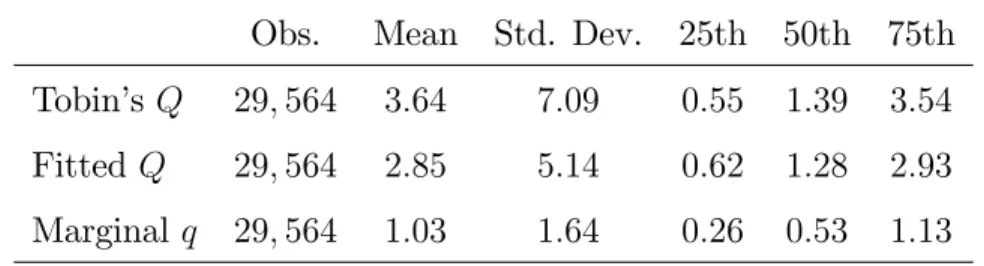
observations. Table I reports summary statistics including mean, standard deviation and main percentiles for the variables of interest.
B.
Findings
I now describe our main …ndings. I …rst examine the variation of market values and investment rates across portfolios sorted by …rm size, K, and pro…tability shock, A. I then proceed to estimate marginal q, and use it for the estimation of adjustment costs and investment-q sensitivity.
C.
Market Values and Investment by State-Variables Portfolios
To gain some insights about the role of size and pro…tability shock in spanning the true underlying state-space for market values and investment rates, I sort all …rms into 25 portfolios double-sorted on the empirical distribution of pro…tability shock conditional on …rm size. Speci…cally, each …rm is allocated annually …rst across …ve …rm size quintiles, and then, within each size quintile, to …ve pro…tability shock quintiles. Table II reports the equally-weighted average market values and investment rates across the resulting 25 conditionally double-sorted portfolios.Across all …rm size quintiles the pattern in average market values and investment rates shows a monotonic increasing relation with the productivity shock. This relation is statistically and economically signi…cant. In the smallest …rm size decile, the equal-weighted average market value increases from $0.02 billions for the lowest pro…tability shock quintile to $0.11 billions for the highest. Similarly, the average investment rates increases from 0.12 percent for the lowest pro…tability shock quintile to 0.32 percent for the highest. In the highest …rm size quintile, average market values and investment rates increase from $1.83 billions and 0.10 percent for the lowest pro…tability shock quintile to $23.11 billions and 0.14 percent for the highest, respectively. These relations are statistically and economically signi…cant across these portfolios.
Thus, the double-sort portfolio analysis con…rms that there is substantial variation in market values and investment rates as functions of the underlying state-variables. I now turn to estimate the marginal q using the state-space approach.
D.
Empirical Value Function
I now turn to formally estimate …rm market values (scaled by the capital stock) as function of the …rm-level state variables in (10). The goal is to …nd a parsimonious polynomial representation in terms of order of approximation that provides the best overall …t for market values empirically and can be used to evaluate marginal q.
Several practical questions arise when implementing these approximations in empiri-cal work. The …rst issue is whether to use natural or orthogonal terms in the estimation. In this paper, I opt for natural polynomials as they make easier the interpretation of the estimated coe¢ cients. The second issue concerns the order of the polynomial. The choice of the polynomial order can be made according to standard model selection tech-niques based on a measure of model …t such as Akaike information criterion (AIC). Using stepwise regression analysis, I …nd that a second order complete polynomial inkand ais often su¢ cient, and higher order terms are generally not necessary to improve the quality of the approximation.
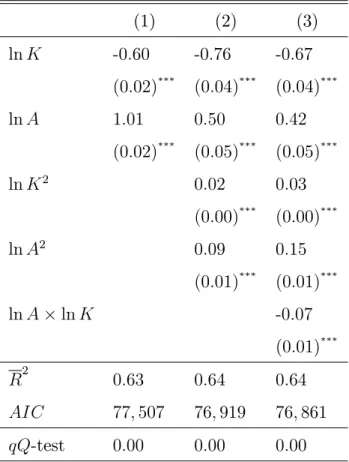
Table III reports the empirical estimates for various speci…cations of the value function polynomial regression: vit = nk X jk=0 na X ja=0 cjk;ja [kit] jk [a it] ja + i+ t+ it (14)
where the left-hand side is the log market value scaled by capital, lnV =K,k is …rm size,
lnK, a is pro…tability shock,lnA. As discussed above, all estimates use year- and …rm-…xed e¤ects to account for potential aggregate shocks and unobserved …rm heterogeneity. I …nd that …rst and second order terms are all strongly statistically signi…cant. The complete second order polynomial in k and a, which also includes the interaction term, explains up to 64% (including …xed e¤ects) of the total variation in log (scaled) market
values.10 Based on the Akaike information criteria, I then choose the complete second order polynomial in …rm size and productivity shock (column 3) as the best parsimonious state variable representation of market values empirically.11
D.1 Variance Decomposition of Value Function
To better understand the relative importance of various variables in capturing variation in log (scaled) market values, I perform the analysis of covariance (ANCOVA) to the empirical value function speci…cation in (14).
Table IV reports the results of this covariance decomposition for several polynomial speci…cations. Each column in the table corresponds to a di¤erent speci…cation for the (scaled) value function. The numbers reported in the table, excluding the adjusted R2 reported in the last row, correspond to the fraction of the total Type III partial sum of squares for a particular speci…cation.12 That is, I normalize the partial sum of squares for each e¤ect by the aggregate partial sum of squares across all e¤ects in the model, so that each column sums to one. Intuitively, each value in the table corresponds to the fraction of the model sum of squares attributable to a particular e¤ect - i.e. …rm, year, and state variable polynomial.
As shown in Table IV, …rm-…xed e¤ects account for most of the explained variation in log Tobin’s Q across all polynomial speci…cations, with values ranging from 76 to 78 percent. Such a large contribution of …rm-…xed e¤ects makes them good control variables to better identify empirically the partial derivative of the value function with respect to the capital stock, i.e. marginalq. Year-…xed e¤ects, which capture unobserved aggregate variation, account instead for, at most, only 7 percent of the total explained variation in log Tobin’s Q. Finally, the state variable polynomials in k and a provide sizable
10I omit higher order terms because they are mostly insigni…cant and do not improve the overall quality of the approximation.
11Even if the quadratic and interaction terms do not increase substantially the overall …t of the value function, they are statistically signi…cant and might be still important to explain variation in investment through marginalq.
contributions with values up to 18 percent of explained variation in log Tobin’s Q.
E.
Marginal and Average Tobin’s Qs
Given the estimates of the (scaled) value function in (14), I can then compute the Fitted Qand marginalq. The FittedQis computed from the …tted values of the speci…cation in (14), and it provides a measurement error-free measure of (average) Tobin’sQ, which is maximally correlated with fundamental state variables. The …rm marginalqis computed according to its de…nition as partial derivative of the value function with respect to the capital stock as in (11).
Table V reports summary statistics for the empirical distributions of estimated mar-ginal q, FittedQ, and observed (average) Tobin’sQ. Tobin’sQ is on average higher and more volatile than both Fitted Q and marginal q. Fitted Q is on average higher and more volatile than marginalq.
Figure 1 plots the empirical distributions of the logs of the ratio of (average) Tobin’sQ to marginalq (left panel), and FittedQ to marginalq (right panel). Marginalqcan take on values substantially higher than observed (average) Tobin’sQ. However, marginalqis always lower than FittedQ. This is indeed consistent with the model-implied concavity of the …rm value as a function of the …rm capital stock (Hayashi, 1982).
In order to better understand the di¤erences among these alternativeQmeasures and quantify the contribution of marginalq in explaining variation in both (average) Tobin’s Q and FittedQ, I perform the analysis of covariance.
Table VI reports the results of a variance decomposition of (average) Tobin’s Q and Fitted Q using …rm- and year-…xed e¤ects and marginal q as covariates. Marginal q accounts only for 25 percent (0:47 0:53) of total variation in (average) Tobin’s Q. Therefore, only this 25 percent of variation in Tobin’s Q as identi…ed by marginal q should be relevant in explaining variation in investment. Marginal q contributes for 67 percent (0:47 0:53) to the total variation in Fitted Q. As expected, marginal q has a
larger contribution in explaining variation in FittedQthan (average) Tobin’s Qbecause FittedQ is measurement error-free.
E.1 Equivalence Between Marginal and Average Q
For each state variable representation of the value function in terms of polynomials in k and a, I can test directly the equivalence between marginal q and average Q. Test-ing such an equivalence requires that @bvit=@kit = 0, or equivalently that all coe¢ cients corresponding to terms involving k are jointly equal to zero:
cjk;ja = 0 for jk = 1; :::; nk; and8ja. (15)
The null hypothesis in (15) corresponds to a test of linear restrictions on the coe¢ cient estimates. Such an hypothesis can be tested using a Wald statistic (“qQ-test”), which is distributed as 2r with degrees of freedom r equal to the number of restrictions.
The last row of Table III reports the p-values corresponding to the “qQ-test” for each polynomial speci…cation. In all cases, I can strongly reject the null hypothesis that marginal q is equal to average Q.
F.
Estimating Adjustment Costs
Under the optimal investment policy, the maximand in (8) - i.e. qI (I; K) - is nonnegative. As such, the estimate of marginal q provides an upper bound on the total capital adjustment costs paid by the …rm as a share of capital expenditure, ( )=I.
Therefore, one can use the empirical distribution of marginalqto draw inference about the upper bound on the total capital adjustment costs as a share of investment. As shown in Table V, marginalq is on average much lower and less volatile than both FittedQand (average) Tobin’s Q. As such, the total adjustment costs (including the purchase price) do not exceed on average 103 percent of the cost of investment for the average …rm in the sample. In contrast, under the Hayashi (1982)’s assumptions of homogeneity and perfect competition, one would have estimated on average an upper bound of 364 percent of the
cost of investment based on the implied equivalence between observed (average) Tobin’s Q and marginal q. A similar comparison holds true when considering the values for the median …rm in the sample. Tobin’s Q implies an upper bound of 139 percent for the total adjustment costs as share of investment expenditure, which is 2.6 times higher than the upper bound implied by marginal q.
Therefore, these estimates of marginal qprovide much tighter (and plausible) bounds on the total adjustment costs as a share of investment,regardless of the speci…c assump-tions concerning the investment technology.
F.1 Smooth Adjustment Costs
With smooth adjustment costs, the optimality condition for investment requires the marginal cost of investment to equal marginalq. As such, the distribution of marginal q corresponds exactly to the distribution of marginal adjustment costs.
Under smooth adjustment costs, the average of the …rm marginal adjustment cost of investment (including the purchase price) is only about1:03for each additional dollar of investment. This estimate is about 2:8 times smaller than the estimate under the Fitted Q. Thus, if I were to use the FittedQas a measurement error-free estimate of marginalq under the assumption of homogeneity, I would have substantially over-estimated the …rm marginal adjustment costs. Even more so, if I were to use the observed (average) Tobin’s Q. In such a case, I would have estimated the average marginal cost of investment at about3:64, which is 3:6times higher than under marginal q.
Therefore, while accounting for mismeasurement in marginalq- i.e. using FittedQ- is important, it is accounting for misspeci…cation - i.e. using marginalq - that substantially improves the estimates of …rm capital adjustment costs.
G.
Investment-q
Sensitivity
In this section I investigate the shape of the investment policy function. I provide struc-tural estimates of the investment-q sensitivity and capital adjustment costs using alter-native measures of Tobin’s Q including the new measure of marginal q.
In line with the existing literature, I focus on a generalized adjustment cost function,
( ), that is homogeneous of degree one in investment and capital. Speci…cally, I use the following polynomial speci…cation for the adjustment cost function:
(Iit; Kit; i; t) Kit = ( i+ t) Iit Kit + M X m=2 m m Iit Kit m (16) where the variables i and t allow for …rm- and year-speci…c elements to the investment price. For example, the price of capital may systematically vary across …rms due to tax considerations such as the value of investment tax credits and depreciation allowances. While this function is not restricted to be globally convex, I verify that the estimates imply convexity.
This functional form yields the following expression for the optimal investment policy in (8) and can be estimated as
qit = M X m=2 m Iit Kit m 1 + i+ t+"it (17)
where the error term " captures measurement or estimation error in the alternative measures of Q. I use the di¤erent measures of Q as dependent variables to mitigate concerns about attenuation bias due to measurement error in market values.
G.1 Quadratic Adjustment Costs
Table VII reports the estimates of the adjustment cost parameters m in (17) obtained with the widely used (average) Tobin’s Q, Fitted Q, and the state-space measure of marginal q. I concentrate …rst on the linear-quadratic adjustment costs speci…cation. Panel A of Table VII shows that the positive and signi…cant coe¢ cient on investment
when using marginal q in speci…cation (5) implies an adjustment cost parameter of only about 1:46. This is several orders of magnitude smaller than the value implied by the use of (average) Tobin’s Q in speci…cation (1), 12:18, and Fitted Q in speci…cation (3),
6:65.
Figure 2 shows that the sensitivity of investment to fundamentals implied by these estimates di¤ers substantially across alternative measures of Q.13 As shown in Panel A, the sensitivity of investment to fundamentals as measured by marginal q is more than eight times higher than estimated in conventional (average) Tobin’s Q regressions. Accounting for measurement error in (average) Tobin’sQ- i.e. using FittedQ- increases only slightly the investment sensitivity relative to observed Tobin’s Q.
Following Abel and Eberly (2002), one could also obtain an estimate of the quadratic adjustment costs as a share of investment expenditure by multiplying =2 by 0:15, the sample mean for the investment rate.14 The magnitudes of quadratic adjustment costs as a share of investment expenditure implied by these coe¢ cient estimates range on average from 11 percent of investment expenditure up to 91 percent.15 These numbers imply that estimated quadratic adjustment costs are nearly 4:6 times higher under the FittedQ speci…cation, and 8:3 times higher under the observed (average) Tobin’sQ. In light of the skewness in investment rates noted in Table 1, one could also evaluate the quadratic adjustment costs at the median investment rate, which is 0:10, rather than its sample mean. In such a case, the magnitudes of quadratic adjustment costs as a share
13The investment sensitivity to fundamentals is de…ned as
@ Iit Kit =@qit= 1= M X m=2 m(m 1) Iit Kit m 2! :
14The total amount of quadratic adjustment costs is given by
2
I K
2
K. Therefore, the ratio of total adjustment costs to investmentIis 2KI.
15Given the quadratic adjustment cost speci…cation, I can also compare these estimates with previous studies. For instance, Gilchrist and Himmelberg (1995) …nd estimates of = 20 when using (average) Tobin’sQand = 5:46when using the VAR-based measure of marginalq(i.e. FundamentalQ). These estimates, which correspond (' 2 I=K = 2 0:17) to170 percent and47 percent, respectively, are still an order of magnitude higher than the ones reported here.
of investment expenditure range from 7 percent of investment expenditure when using marginal q up to61percent when using observed (average) Tobin’sQ. This last value is comparable with the lower estimate of 59 percent in the linear investment speci…cation reported in Abel and Eberly (2002).
Importantly, investment is substantially more correlated with marginal q than with the measures of Tobin’s Qincluding the measurement error-free FittedQ.
Finally, as reported in Panel B of Table VII, I obtain similar results when I estimate the investment equation in (17) using …rst-di¤erences rather than using the within-groups estimator. In such instance, the estimates of quadratic adjustment costs are even lower across alternative Q measures. Figure 2 Panel C displays the corresponding higher in-vestment sensitivity to fundamentals.
While accounting for mismeasurement - i.e. using Fitted Q - helps to some extent, accounting for misspeci…cation - i.e. using marginal q - substantially improves both the correlation with investment and the structural estimates of investment sensitivity to fundamentals.
This evidence still rests on the strong (though common) assumption of a linear re-lationship between investment and marginal q. Given that the state-space estimation of marginal q is independent of the speci…c assumptions concerning adjustment costs, a further investigation of nonlinearities in the relation between investment and marginal value of capital may improve our understanding of the shape of the optimal investment policy function.
G.2 Polynomial Adjustment Costs
Previous work has shown that the relationship between …rms’investment and their (av-erage) Tobin’s Q is highly nonlinear (Barnett and Sakellaris, 1999; Abel and Eberly, 2002). This suggests that the responsiveness of investment to fundamentals may not be the same at all levels of the fundamentals as would be implied by the commonly used quadratic adjustment cost speci…cation. I now revisit this empirical relationship using
the new measure of marginal q.
Table VII reports the adjustment cost parameters for the polynomial speci…cation. The empirical results suggest to include only up to cubic terms (M = 3). At all in-stances, I estimated this polynomial adjustment cost function to be convex for the range of investment rates observed in the sample.
Figure 2 demonstrates that the sensitivity of investment to fundamentals implied by these estimates exhibits substantial variation over the di¤erent levels of investment. It ranges from 0.06 to 0.14 for (average) Tobin’sQ, from 0.12 to 0.22 for FittedQ, and from 0.44 to 2.40 for marginalq. At the average level of investment, the sensitivity is 0.07, 0.13, and 0.50, correspondingly. Similarly, the corresponding sensitivity at the median level of investment is 0.07, 0.13, and 0.48, respectively. These …gures show that the response of investment to marginalqis uniformly much higher than estimated in nonlinear (average) Tobin’s Q regressions. For instance, using (average) Tobin’s Q systematically under-estimates the sensitivity of investment to fundamentals by several orders of magnitude, ranging from a factor of seven for low levels of investment up to a factor of seventeen for high levels of investment.
From Figure 2, it is evident that …rm investment is more responsive to fundamentals as fundamentals improve - i.e. investment is a convex function of fundamentals. While this is true for all three alternative measures of Q, it is particularly pronounced when fundamentals are measured by marginal q.16 According to the standard neoclassical model of investment, this rising sensitivity to fundamentals is due to the curvature of the convex adjustment costs. The estimated marginal cost of adjusting capital is increasing in the investment rate at a decreasing rate. Thus, as marginal q rises, the …rm has to keep on increasing its investment rate at an ever-increasing rate in order to maintain equality between the marginal value and the marginal cost of investment.
16Although based on di¤erent time periods and data samples, Barnett and Sakellaris (1999) and Abel and Eberly (2002) also …nd evidence that investment is a convex function of fundamentals. However, their investigation of the relationships between investment and fundamentals is performed under the convetional homogeneity assumptions and therefore limited to the use of (average) Tobin’s Q.
Given the estimates in Table VII, one can also obtain structural estimates of the convex adjustment costs as share of investment expenditures.17 I discuss adjustment costs at the mean investment rate of 0:15. The magnitudes of convex adjustment costs as a share of investment expenditure implied by the coe¢ cient estimates range from16
percent when using marginalq up to117 percent when using (average) Tobin’sQ. These numbers imply that estimated convex adjustment costs are nearly 3:7 times higher for the FittedQspeci…cation, and7:0times higher for the (average) Tobin’sQ speci…cation relative to the marginalq speci…cation. In light of the skewness in investment rates, one could also evaluate the convex adjustment costs at the median investment rate, which is
0:10, rather than its sample mean. In such a case, the magnitudes of convex adjustment costs as a share of investment expenditure range from 11 percent when using marginal q up to 78 percent when using observed (average) Tobin’s Q.
As shown in Panel B of Table VII, I obtain similar results when I estimate the investment equation in (17) using …rst-di¤erences rather than using the within-groups estimator. In such instance, the estimates of convex adjustment costs are uniformly lower across alternative Qmeasures. Figure 2 Panel D displays the corresponding higher investment sensitivity to fundamentals.
Consistently with the empirical evidence based on quadratic adjustment costs, invest-ment is substantially more correlated with marginal q than with the observed (average) Tobin’s Q or the measurement error-free FittedQ.
Based on this empirical evidence, one can conclude that accounting for misspeci…ca-tion - i.e. using marginal q - increases substantially the correlation with investment, the investment sensitivity to fundamentals, and yields plausible estimates of capital adjust-ment costs.
17The total amount of convex adjustment costs is given by 2
2 I K 2 K+ 3 3 I K 3 K. Therefore, the ratio of total adjustment costs to investmentI is 2
2 I K + 33 I K 2 .
III.
Concluding Discussion and Extensions
A new measure of …rm marginal q - i.e. …rm real investment opportunities - is surely a basis for a better understanding of corporate policies. Unlike much of the existing empirical literature that relies on counterfactual assumptions to replace unobservable marginal q with observable (average) Tobin’s Q, I show instead how to estimate directly marginal qusing asset prices under general assumptions concerning technology and pref-erences. A general measure of marginal q can then ultimately be applied to address several open questions in economics without making conterfactual assumptions. In this paper, I investigate the empirical relationship between marginal and average Tobin’s Q, the estimation of capital adjustment costs, and investment-q sensitivity. I provide direct empirical evidence that marginal q di¤ers substantially from average Tobin’sQ. I show how the use of marginal q rather than (average) Tobin’s Q or Fitted Q (measurement error-free counterpart of observed Tobin’sQ) yields plausible estimates of capital adjust-ment costs, increases the correlation with investadjust-ment and the response of investadjust-ment to fundamentals.
In this paper, I focus only on two …rm-level state variables shared by a large class of neoclassical investment models: …rm capital and pro…tability shocks. While I show that these …rm-level state variables capture already substantial variation in market values, the overall empirical value function approximation can be further improved by augment-ing the …rm-level state space with additional measurable variables includaugment-ing labor and (net) …nancial liabilities. Those additional state variables would indeed accommodate in-vestment models with labor market frictions as in Hall (2004), Merz and Yashiv (2007), and Bazdresch, Belo, and Lin (2014), and …nancial frictions as in Bond and Meghir (1994), Hennessy, Levy, and Whited (2004), Bustamante (2011), Bolton, Chen, and Wang (2011), and Hugonnier, Malamud, and Morellec (2014). In such instances, the state-space methodology can be used not only to measure marginal q, but also to mea-sure the marginal value of labor (as partial derivative of value function w.r.t. labor) and the marginal value of cash/debt (as partial derivative of value function w.r.t. cash/debt) so as to assess the overall contribution of technological versus …nancial market frictions
on real investment. Furthermore, given any set of …rm-level state variables, the overall empirical value function approximation can also be improved by allowing for time-speci…c polynomial coe¢ cients so as to account for the full impact of any aggregate state variable. Unlike the existing methodologies, the state-space measure of marginal q is indepen-dent of the assumptions concerning capital adjustment costs. Therefore, it provides an ideal measure to investigate further the relationship between investment and the marginal value of capital in search of potential discontinuities to identify …xed costs of investment, …re sales, and investment irreversibility. In addition, this independence can also be exploited to validate empirically alternative class of adjustment costs including those de-pending on the growth rate of investment as in Eberly, Rebelo and Vincent (2012) rather than on its level. Even more so, the joint measurability requirement in the state-space methodology also allows for a fully nonparametric kernel density estimation of marginal q, which seems a new direction of promising research.
IV.
Appendix A: Estimating Pro…tability Shocks
I follow Cooper and Haltiwanger (2006) to measure pro…tability shocks. I assume that each …rm has a Cobb-Douglas revenue function F(Z; K; N) = ZK KN N, where Z
denotes the productivity shock, K is physical capital, N is the variable factor(s), and W is the price of the variable factor(s). The equations that follow are based on one variable factor for expositional purposes but extend easily to multiple variable fac-tors. Maximization of operating pro…t, (Z; K; N) = F (Z; K; N) W N, over the ‡exible factor, N, leads to a reduced form pro…t function, (K; A) = AK , where A = (1 N) [Z( N=W) N]
1
(1 N) includes shocks to productivity as well as variations
in factor prices and in demand. The exponent on capital is K=(1 N). Similarly, the revenue function evaluated at the optimal ‡exible factor takes the reduced form F (K; A) = A
(1 N)K .
The coe¢ cient on K measuring the degree of returns-to-scale in capital ( ) in both the revenue and pro…t functions is the same. Moreover, the properties of the shocks to revenue and pro…ts are the same up to a factor of proportionality. Thus, the estimation strategy is to estimate from either a quasi log-linear …rst-di¤erenced pro…t or revenue regression on the capital stock. The latter seems preferred since there is potentially less measurement error involved.
Let ait = ln (Ait)have the following structure ait= t+ it
where t is a common shock, and it is a …rm-speci…c shock, whose dynamics are given by
it = i+ it 1 +!it; !it M A(0)
where i is a …rm-speci…c time-invariant e¤ect capturing heterogeneity in the average …rm pro…tability shocks. Taking logs and quasi-di¤erencing yields
or
it= 1 it 1+ 2kit+ 3kit 1+ t + i+!it
where kit = ln (Kit) and it = ln ( it), 1 = , 2 = ; 3 = , t = t t 1.
Whenever, the standard assumption on the initial conditions hold (E[xi1!it] = 0 for t= 2; :::; T), then by …rst di¤erencing, we have
E[xit s !it] = 0 where xit = (kit; it)
for s 2 if !it M A(0). This allows the use of suitably lagged levels of the variables as instruments, after the equation has been …rst-di¤erenced to eliminate the …rm-speci…c e¤ects (cf. Arellano and Bond, 1991) as:
it = 1 it 1+ 2 kit+ 3 kit 1+ t + !it.
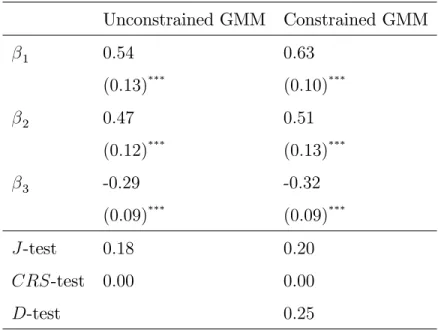
I estimate this equation via GMM using a complete set of time dummies to capture the aggregate shocks and using twice and lagged capital and twice and thrice-lagged revenue as instruments. Table A reports both the unconstrained and constrained GMM estimates. All coe¢ cient estimates are statistically signi…cant and the test of over-identifying restrictions (J-test) does not reject the model. In addition, the GMM distance test (D-test) also does not reject the nonlinear constraint on the coe¢ cient estimates (i.e.
3 = 1 2). Having estimated a statistically signi…cantb= 0:51(0:13), I then recover
ait from (Ait; Kit) = AitKit.18
18Although based on a di¤erent dataset - i.e. plant-level data - Cooper and Haltiwanger (2006) also obtain a similar estimate ( = 0:59).
V.
Appendix B: Alternative Methodologies
I now review the alternative existing methodologies available to estimate marginal q: (i) VAR approach; and (ii) Euler equation approach.
A.
VAR Approach
In their seminal work, Abel and Blanchard (1986) and Gilchrist and Himmelberg (1995) propose to estimate marginalqusing VAR-based approximations of marginalqcomputed according to its de…nition as the expected present value of the future marginal pro…t of capital: qit =E Z 1 0 e s t+s t DK(Kit+s; Ait+s)ds j it (18) whereDK K K denotes the marginal pro…t of capital, and it denotes the time t information set.
Estimation of marginal q then requires the speci…cation of functional forms for the marginal pro…t of capital (i.e. and ), the stochastic discount factor, , together with a method of evaluating the expected discounted stream of marginal pro…t of capital. To this end, one can assume that the marginal pro…t of capital and the stochastic discount factor are each generated as linear combinations of the elements of some observable vector which evolves according to a vector autoregressive process. The choice of some vector of fundamentals observable to the econometrician then identi…es the relevant variables in the timet information set it for the computation of expectations.
In summary, the VAR-based approximation of marginalq requires: 1) (usually linear) approximations of marginal q (as function of and DK) to facilitate the computation of expectations of long products of stochastic variables; 2) speci…c functional forms for , and (usually, K = =K; K = 0; and weighted average of equity and debt discount factors); 3) the speci…cation of the relevant observable variables (often not implied by the model) in the timet information set it; 4) assumptions on the dynamics of the relevant variables observable to the econometrician (usually linear VAR); 5) no
direct use of asset prices (unless potentially included in the time t information set it).
B.
Euler Equation Approach
An alternative methodology available to estimate structural investment equations is based on the Euler equation (e.g. Abel (1980), Shapiro (1986), Whited (1992), and Bond and Meghir (1994)). We can rewrite the equation de…ning marginal q in (18) as
qit =E Z 0 e s t+s t DK(Kit+s; Ait+s)ds+e t+ t qit+ j it (19)
for any time interval > 0. This is the standard (continuos-time) Euler equation for investment: the shadow value of capital at timet equals its discounted expected value at time t+ plus any marginal pro…t ‡ow generated over the time interval .
Since marginal q is unobservable, one can exploit the optimality condition for invest-ment in (8) - i.e. q = I at any times t and t+ when capital adjustment occurs - and substitute marginal q in the Euler equation (19) with the parameterized marginal cost of investment I:19 I(Iit; Kit) =E Z 0 e s t+s t DK(Kit+s; Ait+s)ds+e t+ t I Iit+ ; Kit+ j it : (20) Equation (20) is now only a function of “observables”and its estimation then follows the procedure introduced by Hansen and Singleton (1982). The expectation operator in (20) is replaced with an expectational error uncorrelated with any information known at time t.20 Ex-post errors based on speci…c functional forms for the marginal pro…t of capital (i.e. and ) and the stochastic discount factor, , are calculated using
19In models without non-convex adjustment costs, investment activity occurs each period. However, with non-convex adjustment costs, investment activity becomes infrequent, and the equivalence between marginalqand the marginal cost of investment holds only when investment activity takes place. Cooper, Haltiwanger, and Willis (2010) consider the Euler equation estimation in the presence of non-convex adjustment costs.
20If expectations are formed rationally, the di¤erence between the realized and expected value should be orthogonal to information available at timet.
observations on capital and pro…t ‡ows. Then structural parameters are estimated using Hansen’s (1982) GMM based on appropriate orthogonality conditions. The choice of some vector of fundamentals observable to the econometrician then identi…es the relevant variables in the time t information set it which can be used as instruments for the computation of orthogonality conditions.
In summary, the Euler equation approach requires: 1) speci…c functional forms for , and ; 2) the speci…cation of the relevant observable variables (often not implied by the model) in the time t information set it; 3) no direct use of asset prices (unless potentially included in the time t information set it); 4) (usually) nonlinear structural estimation methods.
Unlike the VAR-based approach, the Euler equation approach circumvents the di-rect estimation of marginal q by replacing it with the parameterized marginal cost of investment whenever investment activity takes place. One can then compute the implied marginal q from the optimality conditions for investment using the estimated structural parameters.
In models without non-convex adjustment costs, one can always compute the implied marginal qas investment activity takes place each period. However, in models with non-convex adjustment costs, where investment activity is infrequent, one can only recover marginal qfrom the optimality conditions for investment when investment activity takes place. As such the measurement of marginalq in the Euler equation approach is subject to the occurrence of investment activity.
References
Abel, Andrew B., “Empirical Investment Equations: An Integrative Framework”, Carnegie-Rochester Conferences on Economic Policy, vol 12, pp 29-91, 1980.
Abel, Andrew B. and Olivier Blanchard, “The Present Value of Pro…ts and Cyclical Movements in Investments”, Econometrica, vol 54, pp 249-273, 1986.
Abel, Andrew B. and Janice C. Eberly, “A Uni…ed Model of Investment Under Uncer-tainty”, American Economic Review, vol 84, pp 1369-1384, 1994.
Abel, Andrew B. and Eberly, Janice C., “An Exact Soultion for the Investment and Market Value of a Firm Facing Uncertainty, Adjustment Costs, and Irreversibility”,
Journal of Economic Dynamics and Control 21, 831-852, 1997.
Abel, Andrew B. and Janice C. Eberly, “Investment and q with Fixed Costs: An Em-pirical Investigation”, unpublished manuscript, University of Pennsylvania, 2002. Abel, Andrew B. and Janice C. Eberly, “How Q and Cash Flow A¤ect Investment
without Frictions: An Analytic Explanation”, The Review of Economic Studies, 78, 4, 1179-1200, 2011.
Barnett Steven A. and Plutarchos Sakellaris, “A New Look at Firm Market Value, In-vestment, and Adjustment Costs”,The Review of Economics and Statistics, 81(2), 250-260, 1999.
Blanchard, Olivier, Changyong Rhee, and Lawrence Summers, “The Stock Market, Pro…t and Investment”, Quarterly Journal of Economics 108, 261-288, 1993. Bazdresch, Santiago, Frederico Belo, and Xiaoji Lin, “Labor Hiring, Investment, and
Stock Return Predictability in the Cross Section”, Journal of Political Economy, 122(1), 129-177, 2014.
Bolton Patrick, Hui Chen, and Neng Wang, “A Uni…ed Theory of Tobin’s q, Corporate Investment, Financing, and Risk Management”, Journal of Finance, 66(5), 1545-1578, 2011.
Bolton Patrick, Huntley Schaller, and Neng Wang, “Financial Constraints, Corporate Savings, and the Value of Cash”, Working Paper, 2013.
Bond, Stephen and Costas Meghir, “Dynamic Investment Models and the Firms’ Fi-nancial Policy”, Review of Economic Studies 61, 197-222, 1994.
Bustamante, Maria Cecilia, “How do Frictions a¤ect Corporate Investment? A struc-tural approach”, Working Paper, 2011.
Cooper, Russell and Joao Ejarque, “Financial Frictions and Investment: A Requiem in Q”, Review of Economic Dynamics, 6, 710-728, 2003.
Cooper, Russell W. and John C. Haltiwanger, “On the nature of capital adjustment costs”, Review of Economic Studies 73, 611-633, 2006.
Eberly, Janice C., Sergio Rebelo, and Nicolas Vincent, “What explains the lagged in-vestment e¤ect?”, Journal of Monetary Economics, 59(4), pp 370-380, 2012. Erickson, Timothy and Toni Whited, “Measurement Error and the Relationship
Be-tween Investment and Q”,Journal of Political Economy, 108, 1027-57, 2000. Erickson, Timothy and Toni Whited, “On the Accuracy of Di¤erent Measures of Q”,
Financial Management, 35, 5-33, 2006.
Gala, Vito D., “A Fundamental Characterization of Asset Prices”, Working Paper, London Business School, 2012.
Gala, Vito D., “Estimating Shadow Values in Production Economies”, Working Paper, London Business School, 2013.
Gala, Vito D. and João F. Gomes, “Beyond Q: Investment without Asset Prices”, Working Paper, The Wharton School, 2013.
Gilchrist, Simon and Charles Himmelberg, “Evidence on the Role of Cash Flow in Investment”, Journal of Monetary Economics, vol 36, pp 541-572, 1995.