PERFORMANCE COMPARISON OF PARALLEL PROGRAMMING
PARADIGMS ON A MULTICORE CLUSTER
Enzo Rucci, Franco Chichizola, Marcelo Naiouf and Armando De Giusti∗ Institute of Research in Computer Science LIDI (III-LIDI)
National University of La Plata La Plata, Buenos Aires, Argentina
{erucci,francoch,mnaiouf,degiusti}@lidi.info.unlp.edu,ar
ABSTRACT
Currently, most supercomputers are multicore clusters. This type of architectures is said to be hybrid, because they combine distributed memory with shared memory. Tradi-tional parallel programming paradigms (message passing and shared memory) cannot be naturally adapted to the hardware features offered by these architectures. A par-allel paradigm that combines message passing with shared memory is expected to better exploit them. Therefore, in this paper the performance of two parallel programming paradigms (message passing and combination of message passing with shared memory) is analyzed for multicore clusters. The study case used is the construction of phy-logenetic trees by means of the Neighbor-Joining method. Finally, conclusions and future research lines are presented.
KEY WORDS
parallel programming, hybrid programming, multicore cluster, performance comparison, Neighbor-Joining method.
1
Introduction
The study of distributed and parallel systems is one of the most active research lines in computer science nowadays [1, 2]. In particular, the use of multiprocessor architectures configured in clusters, multiclusters, grids and clouds, sup-ported by networks with different characteristics and topo-logies, has become general, not only for the development of parallel algorithms but also for the execution of processes that require intensive computation and the provision of con-current web services [3, 4, 5, 6].
The energy consumption and heat generation prob-lems that appear when the speed of a processor is escalated are the reasons of the development of the multicores pro-cessors. This type of processor is formed by the integration of two or more computational cores within the same chip. Even though these cores are simpler and slower, when com-bined they allow enhancing the global performance of the processor while making an efficient use of energy [7, 8].
The incorporation of this type of processors to
con-∗CONICET Main Researcher
ventional clusters gives birth to an architecture that com-bines shared and distributed memory, known as multicore cluster [9, 10]. In this type of architectures, communic-ations between processing units are heterogeneous [11] and can be classified in two groups: inter-node and intra-node. Inter-node communications are between cores that are in different nodes and they communicate by exchanging messages through the interconnection network. Intra-node communications are between cores that are within the same node and they communicate through the different memory levels of the node.
Parallel programming paradigms differ in the way tasks communicate and synchronize. Traditionally, there were two main programming paradigms for parallel archi-tectures: shared memory and message passing. In shared memory architectures, such as multicores, the most widely used paradigm is shared memory. In it, tasks communic-ate and synchronize by reading and writing variables in a shared address space. OpenMP is the most widely used lib-rary to program shared memory [12]. Message passing is the most commonly chosen paradigm for distributed archi-tectures, such as traditional clusters. In it, each task has its own address space and task communication and synchron-ization is done by exchanging messages. MPI is the most widely used library to program under this paradigm [13].
Multicore clusters are hybrid architectures that com-bine distributed memory with shared memory, so neither of the previous paradigms naturally adapts to all hardware fea-tures in these architecfea-tures. For this reason, the scientific community has a great interest in analyzing hybrid parallel programming paradigms that allow communications both through message passing and shared memory. A parallel paradigm that uses shared memory for intra-node commu-nications and message passing for inter-node communic-ations would be expected to better leverage the features offered by multicore clusters [14].
In this paper, the performance of two parallel al-gorithms designed for the same application but using differ-ent programming paradigms is compared over a multicore cluster. The application selected as study case is the con-struction of phylogenetic trees by means of the Neighbor-Joining method, and it was selected based on its computa-tional complexity (O(n3)). The rest of the paper is
In Section 3, the Neighbour-Joining method is explained, together with sequential an the parallel algorithms used. In Section 4, the experimental work carried out is described, whereas in Section 5, the results obtained are presented and analyzed. Finally, in Section 6 the conclusions and future lines of work are presentend.
2
Related Works
There are numerous works that analyze and compare par-allel programming paradigms for multicore clusters. To mention but a few, in [15], [16] and [17] there are compar-isons between message passing and combinations of mes-sage passing with shared memory. Results vary depending on the characteristics of the problem solved, the algorithms used and the features of the hardware architecture used as support; which makes research in this area even more sig-nificant.
3
Neighbor-Joining Method
Studies carried out on molecular mechanisms of organisms suggest that all organisms in the planet have a common pre-decessor. Then, any set of species would be related, which is called Phylogeny. In general, this relation can be repres-ented by means of a phylogenetic tree. The task of Phylo-geny is to infer the previous tree based on observations of the existing organisms [18].
The Neighbor-Joining method (NJ) is based on dis-tance matrixes and is widely used by biotechnologists and molecular biologists due to its efficiency and temporal complexity order. In recent years, it has become very pop-ular through its use in the ClustalW algorithm [19], one of the most widely used tools for multiple sequence align-ment. The NJ algorithm was originally developed by Saitou and Nei in 1987 [20]. One year later, Studier and Kep-pler [21] would review the algorithm and incorporate an improvement that allows reducing the temporal complexity fromO(n5)toO(n3).
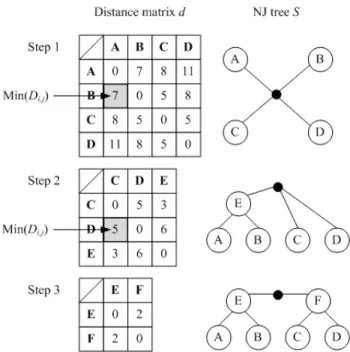
The Neighbor-Joining method starts with a star-shaped tree. In each step, the pair of nodes that is closest to each other are selected and connected through a new, inner node. Then, the distances from this new node to the rest of the nodes in the tree are calculated. The algorithm ends when there are only two nodes that are not connected [18]. Algorithm 1 details the pseudo-code of the Neighbor-Joining method and Figure 1 shows an example of the building process of a phylogenetic tree using the Neighbor-Joining method for a 4x4 distance matrix.
3.1 Sequential Neghbor-Joining Algorithm
The algorithm starts with a distance matrix between pairs of sequences ofN×N denotaded asd,Nbeing the number of sequences. Since this is a symmetric matrix, there is no need to store it in full, but only the lower triangular matrix
Algorithm 1 Pseudo-code of the Neighbor-Joining method.
Initialization:
L=S.
Iteration:
Pick the pairi,jfor which normalized distanceDi,jis min-imum, where
Di,j=di,j − (ri+rj)
andriis the divergence of nodei, where
ri= 1 [L]−2× X kL di,k
Define a new nodekand assigndk,s= ½(di,s+dj,s–di,j),
for allsinL.
AddktoSwith distance edgesdi,k = ½(di,j +ri –rj),
dj,k=di,j–di,k, connectingktoiandj, respectively.
RemoveiandjfromLand addk. Termination:
WhenLis formed by two leavesiandj, add the pending edge betweeniandjwith distancedi,j.
or the upper triangular matrix can be stored (in this case, the former is chosen).
In each iteration of the main loop, the pair i, j for whichDi,jis minimal has to be found. The normalized dis-tance matrixDis not stored, but the value of each position is calculated in each iteration. Node divergences are com-puted in a one-dimensional arrangement before starting the main loop, and are updated in each iteration of the loop, rather than calculating them every time they are required.
For the list of active nodesL, a one-dimensional flag arrangement is used; the flags indicate which nodes have been selected and which have not.
Algorithm 2 details the pseudo-code of the sequential algorithm.
3.2 Parallel Neighbor-Joining Algorithm
The algorithm was parallelized using different parallel pro-gramming paradigms (message passing and combination of message passing and shared memory). Before going into an in-depth review of the solution developed, certain aspects of the Neighbor-Joining algorithm should be ana-lyzed, since these might explain why an efficient parallel solution is difficult to obtain.
First, it should be noted that for each iteration of the main loop, a new node is added to the distance matrix, but those from the two originating nodes are removed. This means that, in a parallel solution, the work carried out by each task in each iteration decreases as the iterations of the main loop progress. Also, in distributed environments, the distances of the new nodes must be distributed among all processes forming the solution.
Figure 1. Building process of a phylogenetic tree using the Neighbor-Joining method for a 4x4 distance matrix.
The search for the pair of nodes whose distance is minimal represents the most expensive part of the main loop from a computational standpoint. Taking into account that the distance matrix is triangular, distributing the work required for the search process by assigning the same num-ber of rows to each task could result into idle time, since not all rows have the same number of cells. Since idle time negatively affects the performance of an algorithm, it must be removed or, if this is not possible, minimized. For this reason, the workload distribution strategy must be chosen trying to make it as equitable as possible for all tasks. 3.2.1 Message Passing as Parallel Programming
Paradigm
This solution uses a master-slave model ofPprocesses as parallelization strategy. The distances of each newly cre-ated node are distributed among all processes following a circular order (the node to which it is assigned is the
owner). Algorithm 3 details the pseudo-code of the
par-allel algorithm.
3.2.2 Combination of Message Passing and Shared Memory as Parallel Programming Paradigm
This solution is based on the one described in Section 3.2.1, but unlike it, each process generatesT threads when com-putation begins. Then, the iterations belonging to different process loops are distributed among the threads that have been generated.
Algorithm 2Pseudo-code of the sequential algorithm. 1. L=S. 2. foreachdi,jinddo 3. Updateri. 4. Updaterj. 5. end foreach 6. forhin 1 toN-2 7. foreachdi,jinddo 8. CalculateDi,j.
9. Calculate minimumDi,j. 10. end foreach
11. Create nodekconnecting nodesiandj. 12. S=S+ {k}.
13. Calculatedi,kanddj,k. 14. L=L– {i,j} + {k}. 15. foreachsinLdo 16. Calculatedk,s. 17. Updaterk. 18. Updaters. 19. end foreach 20. end for
21. Group both remaining nodes inL.
4
Experimental Work
4.1 Architecture Used
Tests were carried out on a cluster of Blade multicores with four blades and two quad core Intel Xeon e5405 2.0 GHz processors each[22, 23]. Each blade has 10 Gb RAM memory (shared between both processors) and 2 x 6Mb L2 cache for each pair of cores. The operating system is GNU/Linux Fedora 12 (64 bits).
4.2 Algorithms Used
The algorithms used in this work were developed using C language (gcc compiler version 4.4.2) with the OpenMPI (mpicc compiler version 1.4.3) library for message passing and OpenMP for thread management. The algorithms are detailed below:
Algorithm 3Pseudo-code of the parallel Neighbor-Joining algorithm.
1. The master process divides distance matrix d into
P portions and distributed P-1 among the slaves. Each process keeps approximately ((N)×(N-1)/2P) elements from distance matrixd.
2. Each process calculates the partial divergences of the nodes it has, broadcasts them to the other processes, and update its divergence vector based on the partial divergences received from the other processes. 3. forhin 1 toN-2 do
4. Each process calculates its local minimumDi,j.
5. The master process collects all local minimums, cal-culates the global minimumDi,j and broadcasts it to the other processes.
6. The master process creates a new nodekand adds it toS.
7. The owner process of nodekcalculatesdi,kanddj,k.
Each remaining process accumulates in a data struc-ture the distances to the pair of nodesi,j it has and then sends it to the owner of nodek.
8. The owner process of nodekcalculates the distances from it to the rest of the nodes and updates the diver-gence vector.
9. The owner process of nodekbroadcasts to the other processes the updated divergence vector.
10. Each process removes nodesiandjfrom their ownL
and addk. 11. end for
• MP: this algorithm is based on the solution described in Section 3.2.1, wherePis the number of cores used. • HY: this algorithm is based on the solution described in Section 3.2.2, wherePis the number of blades used andTis the number of cores in each blade.
4.3 Tests Carried Out
Based on the features of the architecture, both algorithms were tested using all the cores with different numbers of nodes: two, three and four; this means thatP= {16, 24, 32} forMP. In the case ofHY, one process per node was used; this means thatP= {2, 3, 4} andT = {8}. Various problem sizes were used: N = {4000, 6000, 8000, 10000, 12000, 14000, 16000}. Each particular test was run five times, and the average execution time was calculated for each of them.
5
Results
To assess the behavior of the algorithms developed when escalating the problem and/or the architecture, thespeedup
andefficiencyof the tests carried out are analyzed [1, 3, 24].
The speedup metric is used to analyze the algorithm performance in the parallel architecture as indicated in Equation (1).
Speedup=SequentialT ime
P arallelT ime (1) To assess how good the speedup obtained is, the effi-ciency metric is calculated. Equation (2) indicates how to calculate this metric, wherepis the total number of cores used.
Ef f iciency=Speedup
p (2)
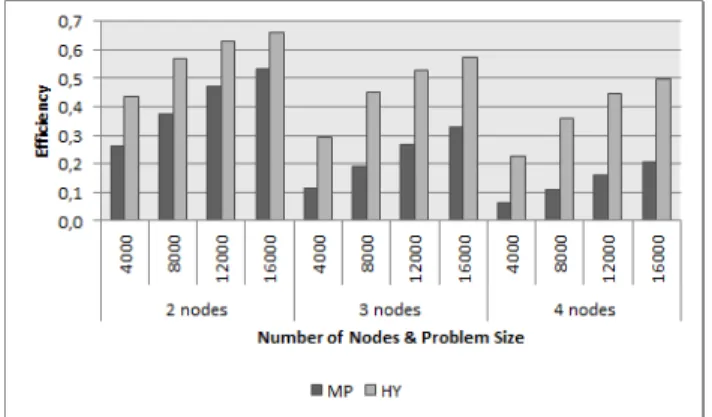
Figure 2 shows the efficiency achieved by the al-gorithmsMPandHYwhen using two, three and four blades of the architecture for different problem sizes (N). For read-ability, only the results forN= {4000, 8000, 12000, 16000} are shown.
Figure 2. Efficiency achieved by algorithmsMPandHY
when using two, three and four blades of the architecture for different problem sizes (N).
This chart shows that both algorithms increase their efficiency as the size of the problem increases and, on the other hand, as it is to be expected in most parallel systems, the efficiency decreases when the total number of nodes used increases. The efficiency levels obtained with both al-gorithms are low due to the number of communication and synchronization operations carried out and the idle time that processes and threads might have. Despite this, it can be seen that the best efficiency levels are obtained byHY.
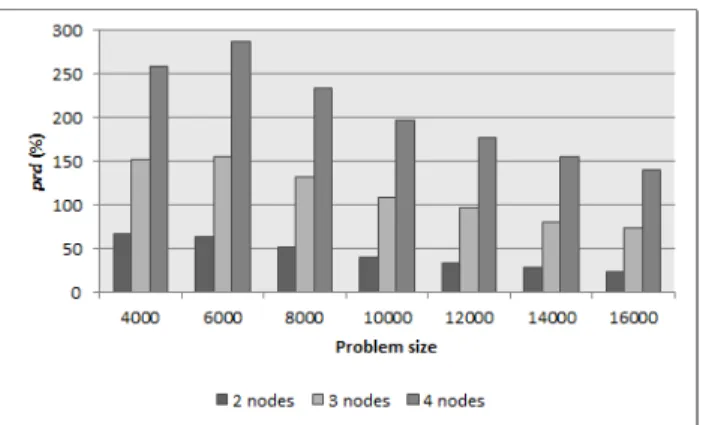
The superiority of HY over MPcan be analyzed in detail in Figure 3, which shows the percentage of the rel-ative difference between the efficiencies of both algorithms (prd), calculated by means of Equation (3).
prd= ef f iciency(HY)−ef f iciency(M P)
Figure 3. prdwith two, three and four blades of the archi-tecture for different problem sizes (N).
The chart in Figure 3 shows that HY is better than
MPin all cases, achieving improvement percentages higher than 250%. It can also be seen that the improvement in-creases with the number of nodes and that it dein-creases when the size if the problem increases. The difference in favor ofHYis due to several factors:
• First, HY reduces latency and maximizes the band-width of the interconnection network, since, by using a single, multi-threaded process instead of multiple processes for each node, it groups all task messages corresponding to a node in a single, larger message. It also removes competition for the network at node level.
• Finally, since the distance matrixdis divided in less parts and the work assigned to each of these portions is distributed dynamically among the threads in each process,HYachieves a more balanced work distribu-tion versus the fully static strategy used byMP.
6
Conclusions and Future Works
In this paper, the performance of two parallel programming paradigms (message passing and hybrid) was compared for current cluster architectures, taking as study case the con-struction of phylogenetic trees by means of the Neighbor-Joining method. The algorithms were tested using vari-ous work and architecture sizes. The results obtained show that the hybrid parallelization better leverages the hardware features offered by the support architecture, which in turn yields a better performance.
Future lines of work include the development and op-timization of hybrid solutions for other types of applica-tions and their comparison with soluapplica-tions based only on message passing or shared memory.
References
[1] A. Grama, G. Karypis, V. Kumar, and A. Gupta,An Introduction to Parallel Computing. Design and
Ana-lysis of Algorithms., 2nd ed. Addison Wesley, 2003.
[2] M. Ben-Ari,Principles of Concurrent and Distributed
Programming, 2nd ed. Addison Wesley, 2006.
[3] Z. Juhász, P. Kacsuk, and D. Kranzlmuller, Eds., Dis-tributed and Parallel Systems: Cluster and Grid
Com-puting. Springer Science + Business Media Inc.,
2005.
[4] J. Dongarra, I. Foster, G. Fox, W. Gropp, K. Kennedy, L. Torczon, and A. White,The Sourcebook of Parallel
Computing. Morgan Kauffman, 2003.
[5] M. D. Stefano,Distributed data management for Grid
Computing. John Wiley & Sons Inc, 2005.
[6] M. Miller, Web-Based applications that change the
way you work and collaborate online. Que, 2009.
[7] AMD. (2009) Evolución de la tecnolo-gía de múltiple núcleo. [Online]. Avail-able: http://multicore. amd.com/es-ES/AMD-Multi-Core/resources/Technology-Evolution
[8] T. Burger. Intel Multi-Core Processors: Quick Refer-ence Guide.
[9] L. Chai, Q. Gago, and D. K. Panda, “Understanding the impact of multi-core architecture in cluster com-puting: A case study with intel dual-core system,” in
Proceedings of the IEEE International Symposium on
Cluster Computing and the Grid., 2007.
[10] M. McCool, “Scalable programming models for massively multicore processors,” inProceeding of the IEEE, 2012.
[11] C. Zhang, X. Yuan, and A. Srinivasan, “Processor affinity and mpi performance on smp-cmp clusters,”
inIEEE International Symposium on Parallel &
Dis-tributed Processing, Workshops and Phd Forum
(IP-DPSW), 2010.
[12] (2012) OpenMP.org. [Online]. Available: http://openmp.org/wp/
[13] (2012) The Message Passing Inter-face (MPI) standard. [Online]. Available: http://www.mcs.anl.gov/research/projects/mpi/ [14] N. Drosinos and N. Koziris, “Performance
compar-ison of pure mpi vs hybrid mpi-openmp paralleliza-tion models on smp clusters,” in 18th International Parallel and Distributed Processing Symposium
(IP-DPS’04) - Papers, 2004.
[15] E. Rucci, A. De Giusti, F. Chichizola, M. Naiouf, and L. De Giusti, “DNA sequence alignment: hybrid parallel programming on a multicore cluster,” in Re-cent Advances in Computers, Communications,
Ap-plied Social Science and Mathematics, N.
C. G. Helmis, Eds., vol. 1, no. 1. WSEAS Press, September 2011, pp. 183–190.
[16] F. Leibovich, L. De Giusti, and M. Naiouf, “Paral-lel algorithms on clusters of multicores: Comparing message passing vs hybrid programming,” in Pro-ceedings of the 2011 International Conference on Parallel and Distributed processing Techniques and
Applications (PDPTA2011), 2011.
[17] X. Wu and V. Taylor, “Performance Characteristics of Hybrid MPI/OpenMP Implementations of NAS Par-allel Benchmarks SP and BT on Large-scale Mul-ticore Clusters,” The Computer Journal, vol. 55, pp. 154–167, 2012.
[18] R. Durbin, S. R. Eddy, A. Krogh, and G. Mitchinson,
Biological Sequence Analysis. Probabilistic models of
proteins and nucleic acids., 7th ed. Cambridge
Uni-versity Press, 2002.
[19] ClustalW and Clustal X Multiple Se-quence Alignment. [Online]. Available: http://www.clustal.org/clustal2/
[20] N. Saitou and M. Nei, “The neighbor-joining method: a new method for reconstructing phylogenetic trees,”
Mol. Biol. Evol., vol. 4, pp. 406–425, 1987.
[21] J. A. Studier and K. J. Keppler, “A note on the neighbour-joining algorithm of saitou and nei,”Mol.
Biol. Evol., vol. 5, pp. 729–731, 1988.
[22] HP. HP BladeSystem. [Online]. Available: http://h18004.www1.hp.com/products/blades/compon ents/c-class.html
[23] ——. HP BladeSystem c-Class
architecture. [Online]. Available: http://h20000.www2.hp.com/bc/docs/support/Support Manual/c00810839/c00810839.pdf
[24] B. Wilkinson and M. Allen, Parallel Programming. Techniques and Applications Using Networked
Work-stations and Parallel Computers., 2nd ed. Prentice