PESTICIDE APPLICATION TRAINING
Cooperative Extension Service Manhattan, Kansas
Category 7B
Stored Products
Pest Control
Table of Contents
Introduction
3
Stored-Product Insects
4
How Stored-Product Insects Multiply Internal Grain-Infesting Insects
Other Stored-Product (External) Insects
Monitoring for Stored-Product Insects 15
Monitoring Methods
Cockroaches
19
Biology and Behavior Common Species Cockroach Control
Food-Plant Pest Treatment Areas
24
Areas of Concern
Forms of Pesticide Chemicals
Grain Handling
28
Preharvest Preparation Harvest Operations Post-Harvest Operations Use of Sprays and Protectants
Fumigation of Stored Products
32
Fumigants
Preparation for Fumigation Respiratory Protection Devices Fumigant Application
Post Fumigation
Commodities/Pests to Consider for Fumigation
Fumigation Methods for Stored Grain 39
General
Fumigation of Structures, Facilities
and Other Enclosures
41
Types of Fumigants
45
Threshold Limit Values Safe Use of Fumigants Safety Precautions Fumigation References
Vertebrate Pests
51
Rodents
Control Techniques Bird Damage Control
Directions for Using this Manual
This is a self-teaching manual. At the end of each major section is a list of study questions to check your understanding of the subject matter. By each question in parenthesis is the page number on which the answer to that question can be found. This will help you in checking your answers.
These study questions are representative of the type which are on the certification examination. By reading this manual and answering the study questions, you should be able to gain sufficient knowledge to pass the Kansas Commercial Pesticide Applicators Certification and/or Recertification examination.
Introduction
The control of pests in commodity storage (farm and commercial) and food plants (food manufacturing, processing and warehousing) requires a high degree of professionalism combined with experience and knowledge.
Pest management programs must utilize combinations of techniques that are effective, economical and emphasize prevention of food product contamination. These programs must be directed at immediate pest prob-lems; at preventing future infestation problems; and must respond to routine daily needs, yet be flexible to meet emergency pest control situa-tions. Integrated pest management in stored-product pest control tends to emphasize the non-chemical aspects of pest control with the judicious use of pesticides.
Unsatisfactory control of pests results in contaminated products that can cause health, financial, legal and aesthetic problems. Financial losses can result from (a) presence of live or dead insects in products and con-tainers; (b) presence of odors, web-bing and frass in products and containers; (c) loss in faith in the company by the consumer because of these conditions; and (d) direct loss in weight resulting from insect feeding.
Persons applying pesticides (chemical control measures) must be knowledgeable about the chemicals, application technique and pesticide regulations to avoid contamination of foods and/or legal problems resulting from misuse.
A variety of pests may be found in stored commodities and food pro-cessing facilities, depending upon geographic location, physical nature of the facility, and the type of food being processed.
Pests contaminate, damage and/or destroy stored raw materials and processed foods and must be con-trolled to maintain the quality and quantity of products. The presence or evidence of pests may result in actions by federal and state agencies
includ-ing seizure of products, fines and/or imprisonment of responsible parties. A potential source of pests in food products is the raw material(s) from which the food is made. Not only may pests from this source be diffi-cult to remove from the raw material, but they also may infest the process-ing plant and equipment, as well as products in the plant, transportation vehicles or warehouse facilities. Contamination from pests in raw materials also may pass through the processing system into finished food products.
Why Control
Stored-Product Pests?
Control of stored-product pests is necessary to prevent contamination/ adulteration of human foods. Persons involved in commodity/food storage, handling and/or processing have the responsibility to prevent food adul-teration. Failure to do so can result in human illness and/or death, the violation of laws, loss of good will and resulting loss of revenue.
In recent years, regulations such as those of the Food and Drug Adminis-tration (FDA), the Environmental Protection Agency (EPA), and the Federal Grain Inspection Service (FGIS) of the U.S. Department of Agriculture (USDA) have been modified to reflect an increased emphasis on reducing the potential for pest adulteration of food products.
The Federal Food Drug and Cosmetic Act defines a food as adulterated “if it contains any filthy, putrid or decomposed substance, or if it is otherwise unfit for food (Sec. 402 (a) (3)), or if it has been prepared, packed, or held under unsanitary conditions whereby it may have been contaminated with filth or whereby it may have been rendered injurious to health (Sec 402 (a) (4)).” The filthy, putrid or decomposed material may be a result of insects, rodents, birds, or micro-organisms; otherwise unfit for food may be the result of con-tamination by physical or chemical contamination, such as glass, metal, pesticides, etc.
As indicated in this introduction, the control of pests in commodity storage and/or food processing facilities requires a high degree of professionalism combined with experience and knowledge. The following sections of this manual provide valuable information for applying various pest management practices.
4
Stored-Product
Insects
Insects are important pests of cereal grains and stored food. Under optimum conditions many of the species can complete their life cycles in less than 30 to 35 days and lay many eggs. This results in rapid build-up of populations that con-sume and contaminate various stored products.
Most stored product insects are either beetles or moths. Both have complete metamorphosis, i.e., they have four distinct developmental stages: egg, larva, pupa and adult. The larval stage is “worm-like” or “grub-like” and differs in appearance from the adults. Often, people do not associate the “worms” with the adults which produce them. Growth occurs in the larval stage and after transformation to the adult there is no further growth in size. (Figure 1).
Beetles are characterized by rather hard, shell-like bodies with the forewings modified into covers (elytra) which overlay the back of the insect and protect the thin membra-nous flight wings (if present) folded underneath. The adults of most of the stored-product beetles live and feed in the same food materials as the larvae. Both have chewing mouth-parts. A pictorial key (Figure 2) illustrates the differences in appear-ance of several species of stored-product beetles.
Moths that infest cereal grains and stored products are similar to
“millers” and have scales covering the wings and bodies. The larvae are caterpillars which do not resemble the adults—they have chewing mouthparts while adults may have coiled siphoning tubes suitable only for liquid food. Since liquids are usually not available to them, adults normally do not feed. Therefore, the moths usually only live long enough to mate and lay eggs.
How Stored-Product
Insects Multiply
Stored-product insects are small and often not noticed unless carefully looked for. Fifty rice weevils can be placed on the surface of a penny. Stored-product beetles can survive in any part of a grain mass, in small accumulations of grain or grain products in storage or processing facilities, and in “dead” areas in handling or processing equipment.
Temperature and moisture content of the food source play an important
Table 1. Number of offspring five months after 50 pairs of rice weevils were placed in wheat.
GRAIN GRAIN TEMPERATURE (˚F)
MOISTURE 60˚ 70˚ 80˚ 90˚ 9% 0 0 0 0 10% 0 0 326 413 11% 40 87 885 984 12% 58 4,827 9,661 2,223 13% 514 8,692 10,267 3,230 14% 951 10,745 13,551 3,934 Figure 1 PUPA Stage lasts 5 to 15 days.
Exit hole of adult from wheat kernel. Adults formed in 4 to 7 weeks after eggs are laid. May remain inside kernels for severl days after being formed. Adults may live 4 to 5 months.
3RD INSTAR LARVA 2ND INSTAR LARVA 1ST INSTAR LARVA LARVA
Usually only one larva per kernel. Two larvae may live in a single kernel separated by the crease.
EGG
Egg laid in small cavity cut into kernel. Cavity filled and concealed with gelatinous “egg-plug.” Eggs hatch 5 to 15 days. Each female may lay 300 to 400 eggs.
RICE WEEVIL Sitophilus oryza (L.)
Rice Weevils are reddish-brown to black. They are 1/8 inch long. Two light spots are on each front wing. Body is cylindrical. Head is prolonged into snout. Hind wings function as flight wings.
4TH INSTAR LARVA Larva develops inside kernel. Larva is white, wrinkled and legless. Requires four molts and growth periods
4TH INSTAR LARVA Larva develops inside kernel. Larva is white, wrinkled and legless. Requires four molts and growth periods before trans-forming to adult. Stage lasts 15 to 40 days. 3RD INSTAR LARVA 2ND INSTAR LARVA 1ST INSTAR LARVA LARVA
Usually only one larva per kernel. Two larvae may live in a single kernel separated by the crease.
EGG
Egg laid in small cavity cut into kernel. Cavity filled and concealed with gelatinous “egg-plug.” Eggs hatch 5 to 15 days. Each female may lay 300 to 400 eggs.
RICE WEEVIL Sitophilus oryza (L.)
Adults may live 4 to 5 months.
Adults formed in 4 to 7 weeks after eggs are laid. May remain inside kernels for several days after being formed.
Exit hole of adult from wheat kernel. PUPA Stage lasts 5 to 15 days.
Rice Weevils are reddish-brown to black. They are 1/8 inch long. Two light spots are on each front wing. Body is cylindrical. Head is prolonged into snout. Hind wings function as flight wings.
Pronotum with 6 teeth on each side. Beak absent. Species about 1/8 inch long.
Pronotum without teeth on each side. Beak absent.
Pronotum without teeth on each side. Beak is present. Species is about 1/8 inch long.
Head back of eye rounded. Head back of eye pointed.
Each fore wing with 2 pale spots. Pronotum with round punctures.
Each fore wing dark.Pronotum with elongate punctures.
Small brownish species. Less than 1/4 inch long.
Larger blackish species. 1/4 to 3/4 inch long.
Male genital structure not grooved.
Male genital structure grooved.
GRANARY WEEVIL
Sitophilus granarius
SAW-TOOTHED GRAIN
Oryzaephilus surinamensis
MERCHANT GRAIN BEETLE
Oryzaephilus mercator
Head visible from above 1/8 inch long or more.
Antennal segments gradually
enlarge towards tip. Antenna appears to beclubbed.
CONFUSED FLOUR
Tribolium confusum
RED FLOUR BEETLE
Tribolium castaneum
Fore wing with
roughened surface. Fore wing with lines.
Fore wing is smooth. Flattened beetles 1/4 to 1/2 inch long. Pronotum is separated by strong constriction from bases of wings.
Convex beetles 1/2 inch long or more. Pronotum not so strongly separated from bases of wings.
LESSER GRAIN BORER
Rhyzopertha dominica
DRUG-STORE BEETLE
Stegobium paniceum
CIGARETTE BEETLE
Lasioderma serricorne CADELLE
Tenebroideas mauritanicus
YELLOW MEAL WORM
Tenebrio molitor
RICE WEEVIL
Sitophilus oryzae
MAIZE WEEVIL
Sitophilus zeamais
Head not visible from above 1/8 inch long or more.
Flattened beetles 1/4 to 1/2 inch long. Pronotum is separated by strong constriction from bases of wings.
RICE WEEVIL Sitophilus oryzae
Stored-Product
Insects
part in the speed with which stored-product insect populations increase. Stored wheat frequently retains summer heat so that temperatures in some parts of the grain mass remains above 15˚C (60˚F) until October through January. In general, as grain mass temperatures increase above 15˚ C (60˚F), stored-product insects can survive and reproduce in grain of lower moisture contents. Similarly, high-moisture contents enable stored-product insects to survive at lower temperatures (See Tables 1 and 2). Similar temperatures and mois-ture contents are favorable for stored-product insects in food storage and processing facilities.
Over extended periods, the upper limits for survival and reproduction of stored-product insects, are approx-imately 38˚C (100˚F) and above
15 percent moisture content (mostly because molds and other micro-organisms take over at moisture levels above this point). Lower limits are 15˚C (60˚F) for reproduction and 9 percent moisture content. Stored-product insects may survive by acclimation below 15˚C (60˚F) but generally die without reproducing during extended periods below this temperature. Many of the stored-product insects produce a new generation every month when temperature and moisture conditions are favorable.
Stored-product insects may be found wherever there are grain or grain products. Sources of infestation on farms are seed grains, stored grains, animal feeds or feeders, grain handling equipment and small
accumulations at various locations. Figure 2
Pronotum with 6 teeth on each side. Beak absent. Species about 1/8 inch long.
Head back of eye rounded. Head back of eye pointed.
MERCHANT GRAIN BEETLE Oryzaephilus mercator SAW-TOOTHED GRAIN
Oryzaephilus surinamensis
Head visible from above 1/8 inch long or more
Antennal segments gradually enlarge towards tip.
Antenna appears to be clubbed.
Small brownish species. Less than 1/4 inch long.
Larger blackish species. 1/4 to 3/4 inch long. Pronotum without teeth on each side. Beak absent.
RED FLOUR BEETLE Tribolium castaneum CONFUSED FLOUR
Tribolium confusum
Fore wing with roughened surface.
Fore wing with lines. Fore wing is smooth.
LESSER GRAIN BORER Rhyzopertha dominica
CIGARETTE BEETLE Lasioderma serricorne
DRUG-STORE BEETLE Stegobium paniceum
Pronotum without teeth on each side. Beak is present. Species is about 1/8 inch long.
Each fore wing with 2 pale spots. Pronotum with round punctures.
Each fore wing dark. Pronotum with elongated punctures.
GRANARY WEEVIL Sitophilus granarius Male genital structure
not grooved
Male genital structure grooved
MAIZE WEEVIL Sitophilus zeamais
CADELLE Tenebroides mauritanicus
Convex beetles 1/2 inch long or more. Pronotum not so strongly separated from bases of wings.
YELLOW MEAL WORM Tenebrio molitor Head hidden under pronotum
6
In grain elevators, receiving pits, bucket elevator boots, and dead spaces in other grain handling equipment, as well as dust and spillage accumulations are common sources. Food processing facilities also provide a variety of potential sources of infestation, including dead
moisture conditions within the equipment providing an ideal environment for stored-product insect development.
Internal Grain
Infesting Insects
There are five species of insects that feed and develop internally in kernels of cereal grains. Because of the difficulty of removing these internal forms, they are responsible for most of the insect fragments found in finished cereal foods, e.g., flour, corn meal, etc. Remember, using fumigants to kill these internal forms will not eliminate the frag-ments in the processed product.
There are three species of weevils (insects with the head elongated into a snout). They are very similar in appearance, behavior and develop-ment, but have some differences as outlined in the following description (Figure 2):
Rice Weevil—Sitophilus oryzae (L.)
■ Head is elongated into a snout,
at the end of which are strong teeth-like mandibles.
■ Adults are about 3 millimeters
(1⁄8 inch) long, dark brown with
two rather large, yellowish spots on each wing cover.
■ Pits on the pronotum (top of
prothorax, just behind head) are nearly round and are close together.
■ Usually found only in whole
cereal grains (wheat, corn, sorghum, rice). Not a problem in flours, meals, etc.
■ Female chews a hole in the
kernel, deposits an egg in it and seals the hole with a gelatinous material.
■ The white, legless, grub-like
larva hatches from the egg after a few days, feeds and completes development to adult inside the kernel. The adult chews its way out of the kernel and continues to feed on the grain.
■ The rice weevil may fly and
infest grain maturing in the field in warmer areas of the U.S.
Stored-Product
Insects
spots in grain handling and process-ing equipment, screenprocess-ings from grain cleaning, and product accumulations in cracks and crevices in the facilities.
The presence of grain dust, fines, broken kernels and other dockage permits certain stored-product insects to survive adverse tempera-ture and moistempera-ture conditions. For instance, confused flour beetles were not able to maintain themselves in clean, low moisture (8 percent) wheat, but they at least maintained their populations when dockage was added to the same grain. Clean grain, therefore, is an important factor in controlling infestations.
Some stored-product insects, for example the cadelle, can become dormant and survive through periods of low temperatures and low moisture that exceed one year in length. For these, thorough cleaning of storage structures followed by residual insecticides is an important step in preventing infestation carry-over from one batch of grain to the succeeding batch.
Grain processing facilities are generally heated during cold periods of the year increasing the potential for stored-product insect develop-ment on a year-round basis. In addition, processing operations quite often generate heat and increased
Table 2. Effects of grain temperature on egg laying, development, and survivorship of the confused flour beetle.
Temperature(˚F) Eggs/Day Days to Hatch % Hatching
61 occasional — — 63–64 1.2 39 27 72 1.9 14 77 77 5.9 8.3 90 81 7.5 6.2 90 90 10.1 4.3 92
■ Uniformly dark brown, about 3 millimeters (1⁄8 inch) long.
■ Adults are strong fliers.
■ Usually only infests whole
cereal grains. Eggs are placed among the kernels (not inside). Newly hatched larvae burrow into the kernels where they develop to the adult stage. The adult chews its way out of the kernel, then continues to feed on grain.
■ During development the larvae
push “dust” out of the kernels. The dust has a sweetish, musty odor and is composed of fecal material and flour. Lesser grain borer infestations often can be identified by this odor in the grain storage.
■ Although usually found in
whole grain, they are capable of completing development in flours, meals or broken kernels.
Stored-Product
Insects
Figure 3
PUPA
Damages grain by hollowing out insides leaving only shells. Much loose flour produced.
Emerge as adults 35 to 110 days after eggs were laid.
Larva usually develop inside of kernel.
Young larva start feeding on flour and then bore into kernels where they complete their life cycle.
Eggs hatch 6 to 14 days.
Eggs dropped singly or in batches into loose grain.
LESSER GRAIN BORER
Rhyzopertha dominica (F.)
Body is black to brown and cylindrical. 1/8 inch long. Head turned down under thorax. Adult armed with powerful jaws that can cut into wood. Adult is a strong flier. Larvae and adults are both destructive.
GROWN LARVA
GROWN LARVA Larva usually develops inside of kernel.
Young larva start feeding on flour and then bore into kernels where they complete their life cycle.
Eggs hatch 6 to 14 days.
Eggs dropped singly or in batches into loose grain.
Emerge as adults 35 to 110 days after eggs were laid.
Damages grain by hollowing out insides leaving only shells. Much loose flour produced.
■ Adults live four to five months
and females lay 300 to 400 eggs. Complete life cycle may be as short as 27 days but averages about 35 under favorable conditions.
Maize Weevil—Sitophilus zeamais (Motsch)
■ Appearance and habits of the
maize weevil are so similar to those of the rice weevil that it is unnecessary for most people to distinguish them. This insect usually is larger than the rice weevil but coloration and pronotal pits are similar. The two species may be distin-guished by spatial arrangement of the pits and by differences in appearance of internal repro-ductive structures.
■ Although it can infest any of the
common stored cereal grains, it is a stronger flier than the rice weevil and is the weevil species most commonly found in corn in the field in the south. It continues infestation in storage.
Granary Weevil—Sitophilus granarius (L.)
■ Similar to the rice and maize
weevils but is a uniform color and somewhat more shiny. The pits on the pronotum are elliptical and not as closely spaced as those of the above two species. The adult is somewhat larger than the rice weevil usually, but similar in size to the maize weevil.
■ Does not fly so is dependent
upon man for its distribution.
■ Infests whole cereal grains, only
after harvest.
■ Life cycle averages about 40 days;
300 to 400 eggs per female.
■ Unlike the rice and maize
weevils, it has not been found in grain maturing in the field.
Lesser Grain Borer (Figure 3)
■ Small, cylindrical beetle with
the head pointed downward from under the prothorax. Head usually cannot be seen from above.
PUPA
LESSER GRAIN BORER Rhyzopertha dominica (F.)
Body is black to brown and cylindrical. 1/8 inch long. Head turned down under thorax. Adult armed with powerful jaws that can cut into wood. Adult is a strong flier. Larvae and adults are both destructive.
8
EGGS
te. Laid on food in 0. Hatch 2 to 14 days.
LARVA
Larvae (caterpillars usually yellowish, greenish or pinkish. Spin large amounts of silk over their food. Stage may last 2 weeks up to 2 years. Larvae is the destructive stage.
PUPA Larvae usually come to the food-mass to spin co pupate. Stage may last 4
Adults formed 4 to 6 w eggs laid. Adults die oviposition.
Angoumois Grain Moth
■ Adult is tan or buff color,
similar in appearance to clothes moths and about 6.5 millimeters
(1⁄4 inch) long. The hind wing
has a fringe of long hairs and the leading edge is extended at the tip to form a “pointing finger.”
■ Eggs are laid among kernels of
cereal grains. A few days later newly-hatched larvae enter the kernels where development to adults is completed.
■ The mature larva prepares a
thin escape “window” for the adult by chewing away all but a thin outer layer of the grain covering. These “windows” are more conspicuous on corn kernels than on wheat.
■ Usually infests only whole
cereal grains. In bulks of small grains and shelled corn, it infests only the top few inches. In ear corn it may infest the entire bulk. It is not a problem in flours, meals, etc.
■ Adults do not feed. They live
only a few days, lay 80 to 100 eggs per female, and complete their life cycle in 35 to 40 days.
Other Stored-Product
(External) Insects
Indian Meal Moth (Figure 4)
■ Adult moth is about 10
millime-ters (3⁄8 inch) long and dark,
except for a conspicuous light band across the base of the wings (usually folded longitudi-nally over the back). When at rest, a distinctive dark-light-dark sequence is visible. The distal portion of the wings is a dark “coppery” color.
■ Larvae are caterpillars that web
food particles together with silk and often wander out of the food materials in search of places to pupate.
■ Infest a variety of materials
including cereal products, meals, feed, dried fruit, nuts and whole cereal grains.
■ A common pest in grain bins. It
infests just the upper few inches of the grain mass but may be so numerous that surfaces may be covered by a mat of silk web-bing. Early infestations are evidenced by several kernels webbed together in clumps.
■ A common kitchen and
ware-house pest.
■ Adults do not feed and live
just a few days. Females lay 200 eggs each. Life cycle aver-ages 35 to 40 days.
Red Flour Beetle—Tribolium castaneum Herbst
■ Adults are uniform
reddish-brown, shiny, about 3 milli-meters (1⁄8 inch) long and
somewhat flattened.
■ Both adults and larvae feed in a
variety of materials: flour, meals, nuts, dried fruits and whole grain if moisture is sufficient and/or contains broken kernels.
■ Adults can fly.
Stored-Product
Insects
Figure 4
LARVA
Larvae (caterpillars usually yellowish, greenish or pinkish. Spin large amounts of silk over their food. Stage may last 2 weeks up to 2 years. Larvae is the destructive stage.
EGGS Whitish and ovate. Laid on food in
clusters of 12 to 30. Hatch 2 to 14 days. Larvae usually come to the outside ofPUPA the food-mass to spin cocoons and pupate. Stage may last 4 to 30 days.
Adults formed 4 to 6 weeks after eggs laid. Adults die after oviposition.
INDIAN-MEAL MOTH (Plodia interpunctella Hbn.)
Basal half of front wings light colored; distal half dark. Hind wings lack distinctive markings and are more or less uniformly gray. 1/2 to 3/4 inch wing spread.
PUPA
Naked. At first it is white, but it gradually changes to yellow, then brown. Shortly afterwards it transforms into an adult.
Stage lasts 1 to 2 weeks.
Change to adults 1 to 4 months after eggs are laid. When fully grown, they are
about 1/4 inch long. They are white, tinged with yellow. Stage lasts 2 weeks to 2 months.
Feed on flour or other material such as grain dust and the broken surfaces of grain kernels.
When hatched, larvae are worm-like, slender, cylindrical, and wiry in appearance.
EGGS Eggs hatch in 5 to 12 days.
Eggs are small, clear, and sticky. They are laid on sacks or food, or in cracks.
LARVA
CONFUSED FLOUR BEETLE Tribolium confusum (Duv.)
Beetles elongate. They are shiny, reddish-brown and about 1/7 inch long. Head and upper parts of thorax are densely covered with minute punctures and wing covers are ridged lenghtwise and sparsely punctured between the ridges. They resemble the Red Flour beetle.
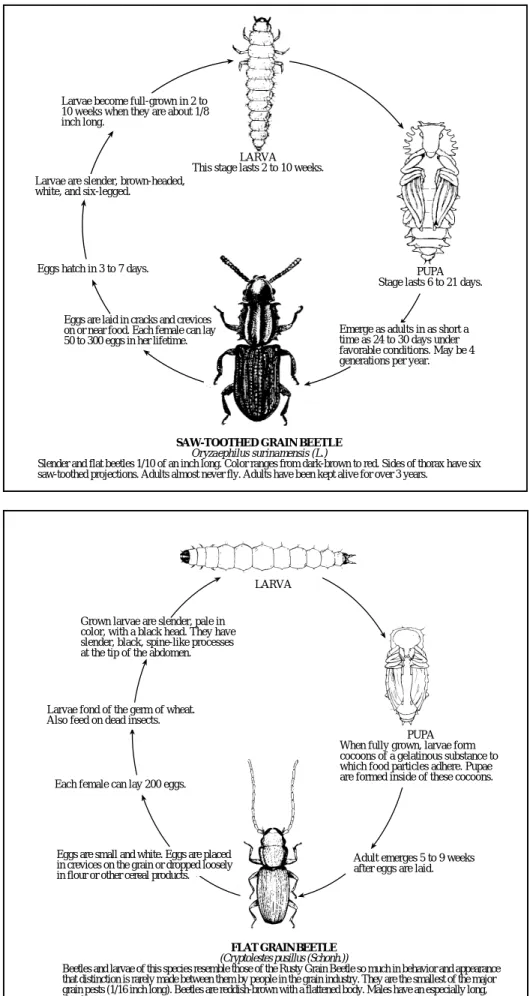
Flat Grain Beetle (Figure 7)
■ Adults are flat, reddish-brown
and among the smallest of the stored-grain insects (2 milli-meters or 1⁄12 inch long).
Anten-nae are long and slender—the female’s about half as long as the body and the male’s two-thirds as long. The prothorax of the female is nearly square; that of the male narrows slightly toward the posterior.
■ Both larvae and adults feed in
grain, cereal products, nuts and other stored products. They may infest deadstock in mills.
■ They are common in grain,
often abundant in grain infested with other insects such as the weevils. They cannot develop on completely sound kernels of grain, but nearly all masses of grain include damaged kernels.
Stored-Product
Insects
Figure 5
PUPA Naked. At first it is white, but it gradually changes to yellow, then brown. Shortly afterwards it transforms into an adult. LARVA
When fully grown, they are about 1/16 inch long. They are white, tinged with yellow. Stage lasts 2 weeks to 2 months.
Feed on flour or other material such as grain dust and the broken surfaces of grain kernels.
When hatched, larvae are worm-like, slender, cylindrical, and wiry in appearance.
EGGS Eggs hatch in 5 to 12 days.
■ Outer three antennal segments
of the adult are similar in size and distinctly larger than the adjacent ones.
■ Adults live several months and
lay 400 to 500 eggs per female. Complete life cycle averages 35 to 40 days.
Confused Flour Beetle (Figure 5)
■ Very similar in appearance and
behavior to red flour beetles.
■ Antennal segments enlarge
gradually toward the tip of the antenna.
■ Do not fly.
■ Probably the most common
flour mill insect, although it can infest the same foods as the red flour beetle.
Saw-toothed Grain Beetle (Figure 6)
■ Adults are slender, flat, dark
brown and about 2.5 milli-meters (1⁄10 inch) long. Each side
of the prothorax (just behind head) bears 6 pointed, saw-tooth-like projections.
■ Both larvae and adults feed in
cereal products, nuts, dried fruits, meals and whole cereal grains.
■ This species is a common
kitchen and warehouse pest and one of the most common insects in Kansas farm-stored grain (although not as damaging as internal feeders).
■ Small size, especially of
newly-hatched larvae, permits penetra-tion of all but the tightest food packages.
■ Adults live several months and
lay up to 300 eggs per female. The life cycle may be completed in 25 days but the average is longer.
Merchant Grain Beetle— Oryzaephilus mercator (Fauv.)
■ Almost identical in appearance
and habits to the saw-toothed grain beetle.
■ Infests the same foods as the
saw-toothed grain beetle, but is better adapted to oilseeds and oilseed products than the former.
Eggs are small, clear, and sticky. They are laid on sacks or food, or in cracks.
Stage lasts 1 to 2 weeks.
Change to adults 1 to 4 months after eggs are laid.
CONFUSED FLOUR BEETLE Tribolium confusum (Duv.)
Beetles elongate. They are shiny, reddish-brown and about 1/7 inch long. Head and upper parts of thorax are densely covered with minute punctures and wing covers are ridged lengthwise and sparsely punctured between the ridges. They resemble the Red Flour Beetle.
10
PUPA Stage lasts 6 to 21 day
Emerge as adults in as short a time as 24 to 30 days under favorable conditions. May be 4 generations per year.
Larvae become full-grown in 2 to 10 weeks when they are about 1/8 inch long.
e slender, brown-headed, six-legged.
h in 3 to 7 days.
gs are laid in cracks and crevices or near food. Each female can lay to 300 eggs in her lifetime.
LARVA This stage lasts 2 to 10 weeks.
SAW-TOOTHED GRAIN BEETLE Oryzaephilus surinamensis (L.)
Slender and flat beetles 1/10 of an inch long. Color ranges from dark-brown to red. Sides of thorax have six saw-toothed projections. Adults almost never fly. Adults have been kept alive for over 3 years.
PUPA Stage lasts 6 to 21 days.
Stored-Product
Insects
Figure 6 Figure 7
LARVA This stage lasts 2 to 10 weeks.
Emerge as adults in as short a time as 24 to 30 days under favorable conditions. May be 4 generations per year. Larvae become full-grown in 2 to
10 weeks when they are about 1/8 inch long.
Larvae are slender, brown-headed, white, and six-legged.
Eggs hatch in 3 to 7 days.
Eggs are laid in cracks and crevices on or near food. Each female can lay 50 to 300 eggs in her lifetime.
y 200 eggs.
LARVA
PUPA When fully grown, larvae fo of a gelatinous substance to particles adhere. Pupae are f of these cocoons.
Adult emerges 5 to 9 w after eggs are laid. white. Eggs are placed
rain or dropped loosely real products. m of wheat. Also
e are slender, pale in black head. They have k, spine-like processes at e abdomen.
PUPA When fully grown, larvae form cocoons of a gelatinous substance to which food particles adhere. Pupae are formed inside of these cocoons.
Adult emerges 5 to 9 weeks after eggs are laid. LARVA
Grown larvae are slender, pale in color, with a black head. They have slender, black, spine-like processes at the tip of the abdomen.
Larvae fond of the germ of wheat. Also feed on dead insects.
Each female can lay 200 eggs.
Eggs are small and white. Eggs are placed in crevices on the grain or dropped loosely in flour or other cereal products.
FLAT GRAIN BEETLE (Cryptolestes pusillus (Schonh.))
Beetles and larvae of this species resemble those of the Rusty Grain Beetle so much in behavior and appearance that distinction is rarely made between them by people in the grain industry. They are the smallest of the major grain pests (1/16 inch long). Beetles are reddish-brown with a flattened body. Males have an especially long, slender antennae.
PUPA Pupation usually occurs on the top of food material. Stays in pupal stag average of 6 days at 90°F.
Adults usually mate immediately o emergence. Egg laying starts several later. Adult has not been observed t
Adult may live only a few days or c live up to several days. Entire cycle to adult) varies from 4 to 6 weeks to several years.
rvae grow older, they feed on whole or seeds. Are very resistant to ation, may live for months or even
without food.
n damaged by Khapra beetles has the appearance as grain attacked by the r grain borer.
g larvae feed largely on damaged ls. They are about 1/16th inch long.
EGG
female lays up to 126 eggs. Eggs in 8 days at 90°F.
LARVA
Larvae are about 1/6th inch long. Have typical cream and tan coloring of Trogoderma larvae. Older larvae are repelled by light. A typical infestation is characterized by large numbers of larvae and their cast skins. Stage lasts 27 days at 90°F. (May stay in larval stage for years.)
Stored-Product
Insects
■ Larvae feed principally on the
germ of kernels.
■ Each female may lay 200 to
300 eggs.
■ Their life cycle may be
com-pleted in as few as 22 days, but is somewhat longer.
Rusty Grain Beetle—Cryptolestes ferrugineus (Steph.)
■ Similar to the flat grain beetle,
except that antennae of males and females are the same length, about half the length of the body.
■ The prothorax is slightly longer
than broad and tapers toward the posterior. This is more pronounced in the male.
■ Habitats and biology are similar
to those of the flat grain beetle.
■ Both species are common in
Kansas stored grain. No doubt rusty grain beetles have often been reported as “flat grain beetles.”
Dermestid Beetles
Grain Dermestids (Trogoderma species)
■ Dark, oval beetles, from 2 to
3 millimeters (1⁄12 to 1⁄8 inch) in
length, with hairs on the wing covers (may be rubbed off, then beetle appears shiny) and rather indistinct patterns of brown and black. Females are larger than males.
■ Larvae have long hairs and
thick tufts of smaller brown hairs on a few of the posterior segments and have a “ringed” appearance. The width of the body is nearly uniform through-out its length.
■ Infestations are revealed by cast
“skins” of the larvae, which are shed at each molt, and may be numerous on the surface of the food material, sacks and packages.
■ They infest many kinds of
cereal products, meals and sometimes grain.
■ Adults do not feed in the same
food materials as larvae and are short-lived, so are not as readily
observed in infested foods as larvae.
■ The life cycle may be completed
in 25 to 35 days, but often is longer.
■ Larvae are capable of living
more than a year without food.
■ Khapra beetle is illustrated
(Figure 8). Sporadic accidental importations into the U.S. have occurred in the past few years but vigorous inspections and quarantines have prevented long-term establishment of this serious pest.
Black Carpet Beetle—Attagenus piceus (Oliv.)
■ Adults are similar in
appear-ance to the Trogoderma species but usually larger and uni-formly black or dark brown. Length is about 3 to 5
milli-meters (1⁄8 to 3⁄16 inch). Figure 8
LARVA
Larvae are about 1/6th inch long. Have typical cream and tan coloring of Trogoderma larvae. Older larvae are repelled by light. A typical infestation is characterized by large numbers of larvae and their cast skins. Stage lasts 27 days at 90˚F (May stay in larval stage for years.) As larvae grow older, they feed on whole
grain or seeds. Are very resistant to starvation, may live for months or even years without food.
Grain damaged by Khapra beetles has the same appearance as grain attacked by the Lesser Grain Borer.
Young larvae feed largely on damaged kernels. They are about 1/16th inch long.
EGG
Adult female lays up to 126 eggs. Eggs hatch in 8 days at 90˚F.
PUPA
Pupation usually occurs on the top layer of food material. Stays in pupal stage an average of 6 days at 90˚F.
Adults usually mate immediately on emergence. Egg laying starts several days later. Adult has not been observed to fly.
Adult may live only a few days or can live up to several days. Entire cycle (egg to adult) varies from 4 to 6 weeks to several years.
KHAPRA BEETLE
Trogoderma granarium (Everts)
One of the most important cosmopolitan pests of stored grain. First discovered in the U.S. in Calif. in 1953. Thought to have been present since 1946. Adult is small (1/14th to 1/8th inch in length); females are often twice the size of the males. Beetle is pale red-brown to dark brown or black; wing covers unicolorous or with indistinct red-brown markings. Hairs on top often rubbed off, giving the beetle a slick appearance. Khapra beetle hard to distinguish from other species in its group.
12
Stored-Product
Insects
■ The larvae are darker thanTrogoderma larvae and have a particularly long tuft of hairs at the posterior end. The body narrows from front to back which gives it sort of a cigar shape. It has a “ringed” appear-ance, as do the cast “skins” which are found on the surface of the food medium or in folds, cracks or crevices in sacks, packages, walls, etc.■ Infestations may occur in many
of the cereal products and grain as well as in carpets, woolens, etc.
Cigarette Beetle (Figure 9)
■ Small, reddish brown, oval,
hump-backed beetle about 2.5 millimeters (1⁄10 inch) long. It
is covered with fine hairs and
the head points downward under the hood-like pronotum. There are no striations (grooves) on the wing covers. Antennae are rather long and slender with segments resembling saw teeth.
■ Larvae are white and grub-like
with long hairs.
■ Have been found infesting a
wide range of materials such as tobacco, spices, nuts, grain, dried fish and meatmeal.
■ Adults feed little, if at all, and
live only a few days. Females average 100 eggs each and complete life cycle in about 35 days.
Drugstore Beetle—Stegobrium paniceum (L.)
■ Similar to the cigarette beetle,
but less oval with striations on wing covers and with a less hump-backed appearance. The outer three segments of the antennae are distinctly enlarged.
■ Although there are minor
differences in larval appearance and habits, they are not consid-ered here.
■ This insect lays fewer eggs
(75 per female) and has a slightly longer life cycle (40 days) than the cigarette beetle.
Cadelle (Figure 10)
■ Adult is a flattened, black, shiny
beetle about 8 millimeters
(1⁄3 inch) in length. The head and
prothorax are closely joined but appear separate from the rest of the body giving the body a divided appearance.
■ The larva is white with black
head and conspicuous black plates on the first segment behind the head and at the tip of the abdomen, the latter bearing two horns.
■ In grain, especially in wooden
structures, both larvae and adults burrow into the wood to pupate in cold weather or when no grain is in the bin.
■ Both larvae and adults feed on
grain, flour and other grain products.
Figure 9
Full-grown larve about 3/16 inch long. Fine hairs on body appear light brown on mature larvae.
Pupal stage lasts 7 to 18 days depending on weather.
Total life cycle (egg to egg) takes 56 days in summer. arvae mature in 30 to 50 days.
hatched larvae are tiny. rayish white and covered h fine hairs.
in 6 to 10 days.
pearly white, elongate, t 1/50 inch in length. Have ells that are resistant to Are fragile.
During a 3 to 4 week lifetime, each female may lay 75 to 100 eggs. Most eggs laid during first 10 days.
Full-grown larvae about 3/16 inch long. Fine hairs on body appear light brown on mature larvae.
Larvae mature in 30 to 50 days.
The newly hatched larvae are tiny. They are grayish white and covered thinly with fine hairs.
Eggs hatch in 6 to 10 days.
Eggs are pearly white, elongate, and about 1/50 inch in length. Have waxy shells that are resistant to drying. Are fragile.
During a 3 to 4 week lifetime, each female may lay 75 to 100 eggs. Most eggs laid during first 10 days.
Pupal stage lasts 7 to 18 days depending on weather.
Total life cycle (egg to egg) takes 56 days in summer.
THE CIGARETTE BEETLE Lasioderma Serricorne (F.)
The adult cigarette beetle is brown and less than 1/8 inch long. It is cosmopolitan in distribution, having been carried around the world by commerce. Practically all injury to tobacco and many other stored products is caused by the feeding of the larvae. It is found occasionally attacking grains left long in storage in original sacks.
Prepupal stage lasts 7 to 17 days. stage lasts 8 to 25 days dependin conditions, especially temperatur
Adults may live up to 2 years. lete development in 2 to 14
ally molt 3 or 4 times; may if larval period is long.
days in warm weather.
id in clusters in the food
y about 1,000 eggs during
Grown larvae characterized by black heads and black forked tail pieces. Transform to pupae, usually in a chamber they have cut in the wooden surfaces of the storage structure.
Stored-Product
Insects
■ The female lays about 1,000
eggs and the life cycle is com-pleted in a minimum of 70 days.
Yellow Mealworm—Tenebrio molitor L.
■ Adults are shiny black or dark
brown and 14 to 20 millimeters (1⁄2 to 2⁄3 inch) in length. These
beetles are the largest found in stored products.
■ The larvae are honey-yellow
and attain a length of 26 to 30 millimeters (1 to 11⁄4 inches).
The body is heavily sclerotized and cylindrical and is similar in appearance to wireworms.
■ They feed on grain and grain
products, especially when it is out of condition. They may also infest meals, meatmeal, mill sweepings and other products.
Dark Mealworm—Tenebrio obscurus (F.)
■ Similar in size, appearance and
habits to the yellow mealworm, except the adults are dull and pitchy black, not shiny.
■ Larvae are much darker than
the larvae of the yellow mealworm.
Insects Associated With High Moisture Conditions
There are several other small beetles, i.e. the foreign grain beetle (Ahasverus advena Waltl), the hairy fungus beetle (Typhea stercorea (L.)), etc. which may be found in grain and grain products slightly high in moisture content. These insects primarily feed on fungi developing in these products and do not signifi-cantly damage the products.
Booklice (Liposceles spp.) and mites (Acarious spp.) (not true insects but close relatives) are microscopic in size and can be found under similar conditions (Figure 11).
Parasites and Predators
On occasion, very tiny insects (some wasp-like) may be found in large numbers associated with infested grains. These are natural enemies (parasites/predators) of the grain infesting insects. In some instances, application of ineffective chemical treatments may destroy the parasites/predators allowing the
damaging species to survive. Figure 10
Grown larvae characterized by black heads and black forked tail pieces. Transform to pupae, usually in a chamber they have cut in the wooden surfaces of the storage structure.
Larvae complete the development in 2 to 14 months. Usually molt 3 or 4 times; may have up to 7 if larval period is long.
Hatch 7 to 10 days in warm weather.
White eggs laid in clusters in the food material.
Females lay about 1,000 eggs during lifetime.
Prepupal stages lasts 7 to 17 days. Pupal stage lasts 8 to 25 days depending on conditions, especially temperature.
Adults may live up to 2 years.
CADELLE Tenebroides mauritanicus (L.)
An elongated, oblong, and flattened beetle with a shiny-black or dark-brown body. It is one of the best known, most destructive, largest (about 1/3 inch long), and longest lived insects that attack stored grain.
14
Stored-Product
Insects
Booklouse Liposceles Mite Acarious Figure 11Questions
1. (3) In recent years, regulations by what Federal government agency has increased emphasis on reducing pest adulteration of food products?
a. Health and Human Services (HHS)
b. Centers for Disease Control (CDC)
c. Food and Drug Administration (FDA) d. Bureau of Alcohol, Tobacco
and Firearms (BATF)
2. (4) Adult beetles infesting stored products are characterized by: a. rather hard shell-like bodies b. soft, very fragile bodies c. transparent body walls d. body covered with scales and
hairs
3. (5) In general, stored grain mass temperatures above ___ allow insects to survive in lower moisture content.
a. 30˚F b. 40˚F c. 50˚F d. 60˚F
4. (6) The cadelle can become dormant and survive low tem-perature and moisture conditions for over:
a. 6 months b. 12 months c. 18 months d. 24 months
5. (7) This stored grain infesting weevil does not fly.
a. Maize weevil b. Granary weevil c. Rice weevil
d. Lesser grain weevil
6. (8) Larvae of the ___ web food particles together.
a. Rice weevil
b. Angoumois grain moth c. Granary weevil
d. Indian meal moth 7. (9) One of the most common
insects in Kansas farm-stored grain is the ___.
a. Saw-toothed grain beetle b. Rice weevil
c. Angoumois grain moth d. Pea weevil
8. (11) Vigorous inspections and quarantines have prevented long-term infestations of this pest. a. Rusty grain beetle b. Merchant grain beetle c. Flat grain beetle d. Khapra beetle
9. (12) The Drugstore beetle is similar in appearance to: a. Yellow mealworm b. Cigarette beetle c. Dark mealworm d. Khapra beetle
10. (13) Ineffective chemical treat-ments may destroy these insects and thereby allow the damaging species to survive.
a. Syrphid flies b. Parasites
c. Indian meal moth d. Merchant grain beetle
Monitoring for
Stored-Product
Insects
Stored-product insects cause significant losses of stored grains, processed foods, fibers and animal products. In general, losses can be minimized when infestations are quickly identified and appropriate control measures implemented.
Numerous methods for detecting stored-product insects have been developed or are being investigated. The most promising technique that has been developed, and continues to be refined, is monitoring populations with insect pheromones and/or food attractants.
The incorporation of monitoring methods into existing stored-product pest management programs can lead to earlier detection of low level infestations and pinpointing location of infestations. Monitoring informa-tion can be used to justify reducinforma-tion in pesticide use or the need for intensified surveillance and pest management procedures. Monitoring results also can serve as an indicator of how well integrated pest manage-ment (IPM) program components are functioning.
Monitoring Methods
Current monitoring methods for insect infestation vary and depend on the type of insect, commodity and/or storage. They include:
Bulk Commodity Storage
■ Observation of the commodity
surface and overspace for insects and/or evidence of their presence, i.e. webbing,
castskins, dust, odor, etc.
■ Examination of commodity
samples obtained by various means, i.e. probe sampling, turning of the commodity, etc.
■ Probe (pitfall) traps inserted
into the surface of grain masses and left for varying lengths of time have proven useful as a means of early detection of live, free-living insects.
■ Temperature monitoring in
grain masses may detect
localized increases in tempera-ture which can indicate the presence of an insect infestation.
Warehouse Storage of
Processed Commodities
Pheromone/food attractant monitoring
Pheromones have been identified for many of the stored-product insects. Some synthesized lures have been commercially developed and a variety of trap designs are available. Traps have been very effective for monitoring commodities that have few species of stored-product pests, e.g., tobacco. Pheromone/food attractant monitoring has the advantage of:
■ continuous surveillance.
■ targeting a defined area of
facility.
■ identification of an infested area.
■ early detection of an infestation.
■ reduced need for time
consum-ing product inspection.
■ providing a basis for minimum
pesticide application. Some definitions:
■ Food attractant—A natural
food, food extract, or synthe-sized scent that will attract a select group of insects. In some cases it is impregnated into an artificial medium.
■ Lure—A small rubber or plastic
device impregnated with or retaining a pheromone or food attractant, designed to release the attractant gradually over a designated period of time, either passively or controlled.
■ Pheromone—A chemical
compound produced by an organism that initiates a behav-ioral activity in others of the same species. Such compounds are synthesized for attracting target insect species.
■ Aggregation pheromone—
A communication chemical predominantly produced by males that attracts both sexes. Effective compounds have been synthesized for stored-product
16
Monitoring for
Stored-Product
Insects
insect species with long-lived adults (e.g. Tribolium, Rhyzopertha) and species which need to feed to reproduce.
■ Sex attractant pheromone—
A communication chemical usually produced by females to attract the opposite sex. Effec-tive compounds have been synthesized for stored-product insect species with short-lived adults and adults that do not need to feed to reproduce (e.g., Plodia, Ephestia).
Pheromone and food
attractant lures (Table 3)
Pheromone lures have been developed for several stored-product insects. Lures developed for species with short-lived adults have proven more effective. The lure for the lesser grain borer (Rhyzopertha dominica) also has produced good results. Food attractant lures for stored-product insects (predominantly an oil lure consisting of oat oil, wheat germ oil extracts and mineral oil) are used for species having long-lived adults and some larvae. These lures may be used
Table 3. Status of pheromones for stored-product insects.
Codes: A = aggregation pheromone, F = food attractant, S = sex pheromone
Duration of Lure Comm. Duration
Genus Adult Stage Type Available of Lure Effectiveness
Anagasta1 1–2 wks S Y 6–20 wks2 moderate–good
(Mediterranean flour moth)
Anthrenus 2–4 wks S&F Y3 4–8 wks good
(carpet beetle)
Attagenus 2–9 wks S&F Y3 4–8 wks good
(black carpet beetle)
Cadra1 (Raisin moth) 1–2 wks S Y 6–16 wks2 moderate
Cryptolestes 3 mon–1 yr A N unknown N/A
(flat grain beetle)
Ephestia1 1–2 wks S Y 6–20 wks2 moderate–good
Almond/Tobacco moth)
Lasioderma 2–4 wks S Y 6–8 wks moderate–good
(Cigarette beetle)
Oryzaephilus 6 mon–3 yr A/F4 N/Y unknown poor5
(sawtoothed grain beetle)
Plodia1 1–3 wks S Y 6–20 wks2 good
(Indianmeal moth)
Rhyzopertha 6 mon A Y 8 wks good
(Lesser grain borer)
Stegobium 2–5 wks S Y 4 wks unknown
(Drugstore beetle)
Tribolium (flour beetle) 6 mon–3 yr A&F Y 7–16 wks variable (poor–good)
Trogoderma 2–4 wks S&F Y 6–26 wks good
(warehouse/Khapra beetle)
1 Same lure for all species, separate lure for Cadra under development.
2 May be effective for up to 40 weeks based on USDA studies.
3 Trogoderma traps utilizing food attractants will catch larvae of both Attagenus and Anthrenus. Commercial sex lures
have been marketed (1992) for carpet beetles, their effectiveness is not known.
4 Aggregation pheromone under development.
5 Food lure results have been erratic. Glue boards currently are almost as effective and more economical.
Used with permission: Stored-product Pest Monitoring Methods. Technical Information Memorandum No. 27 Armed
with or without pheromones. In general, food attractant lures have a smaller effective range than phero-mone lures. They can be used to enhance the effectiveness of phero-mone traps for flour beetles (Tribolium) and to attract Trogoderma, Attagenus, and Anthrenus larvae.
Pheromone and food
attractant traps
There are a variety of traps used to deploy pheromones and/or food attractants. Bulk grain is most
effectively monitored with perforated plastic probe (pitfall) traps. Traps are usually placed in the grain near the surface at cardinal points and in the center. They take advantage of the normal movement and activity of grain-infesting insects and may include a pheromone or food attrac-tant lure.
Traps for flying insects (wing-, delta-, and diamond-traps) sus-pended at various locations
through-out grain elevators or warehouses are an effective way to monitor for moth adults and certain beetles. Lures containing pheromones for either Indianmeal moth or lesser grain borer placed in the center of a glue coated surface within the trap attracts these species and traps them on the sticky surface.
Multi-layered, corrugated paper traps with pheromones and/or food attractants are used to monitor for beetles and some larvae in ware-house situations. The corrugations attract the insects by serving as harborage sites similar to crevices in floors and walls. Multiple entry points formed by the corrugations provide tactile stimuli and air cham-bers within the trap to provide circulation for the pheromones and/ or food attractants. Traps usually lie flat to prevent spillage of food attractant, however, some may be wall-mounted. A modified pitfall trap for floor or shelf placement also has been designed.
Monitoring for
Stored-Product
Insects
18
Monitoring for
Stored-Product
Insects
Questions
1. (15) One of the promising tech-niques for stored products insect pest management is:
a. Monitoring b. Poison baits c. Spraying bin walls d. Super cooling with CO2 2. (15) Monitoring of bulk
commod-ity storage for insects may include such techniques as: a. Observation of surface and
overspace
b. Probe traps inserted into the surface
c. Temperature read-outs in the grain mass
d. All the above
3. (15) These pheromones are used in warehouse storage of pro-cessed commodities and they attract both sexes of the species. a. Repelling
b. Sex
c. Aggregation d. Reproduction
4. (17) Pheromone and food attrac-tant traps may include:
a. Perforated plastic probes b. Multi-layered corrugated
paper
c. Wing-, delta-, and diamond traps
Cockroaches
Cockroaches are among the oldest of insects, as indicated by fossil remains, dating to 200 million years ago. This ability to survive the many changing environments through time illustrates the capability of these insects to adapt to wide ranges of habitats and living conditions.
Cockroaches may be direct carriers of disease. They also contaminate food and kitchen utensils with excrement and salivary secretions and leave an unpleasant odor. Cockroaches sometimes produce allergic reactions in humans. The allergy is due to cockroach parts (proteins), not the odor.
Biology and Behavior
Cockroaches develop by gradual metamorphosis through three life stages: egg, nymph and adult. Adult females produce small, bean-like capsules or oothecae which contain the eggs. These capsules usually are dropped at random near food or glued to some surface by the female soon after they are formed. (The female German cockroach carries the capsule protruding from her body until the eggs are ready to hatch.)
Nymphs which hatch from the eggs and emerge from the ootheca resemble adult cockroaches, except that they are smaller and do not have fully developed wings. Their flat-tened bodies allow them to squeeze into crevices and long, spiny legs enable them to run rapidly.
Nymphs molt several times before becoming mature males and females. As indicated in Table 4, the time required to complete the life cycle varies from about 2 months to nearly 3 years, depending on the species and environmental conditions. Most cockroaches are tropical or sub-tropical in origin and generally live outdoors. However, some species have become well-adapted to living with humans. Though it is true that cockroaches prefer poor housekeep-ing, they at times, infest even the
most sanitary and well-organized buildings.
Cockroaches can enter buildings in boxes and containers of all kinds. They also can enter around loose-fitting doors and windows, where electrical lines or water and stream pipes pass through walls, sometimes even in seasoned firewood and through sewer lines.
Most cockroaches are nocturnal and appear during daylight only when disturbed or where there is a large population. They prefer warm, dark, moist shelters and often are found around food-handling areas; where pipes or electrical wiring pass along or through a wall; behind window or door frames, loose baseboards or molding strips; or underside of tables, chairs and equipment.
Cockroaches feed on a variety of plant and animal products, including meat and grease, starchy foods, sweets, baked goods and other unprotected kitchen goods. They also feed on materials such as leather, wallpaper paste and book binding and sizing.
Common Species
There are about 55 species of cockroaches in the United States, but only five species are routine prob-lems in buildings. Most of the other species live outdoors and, therefore, escape notice; if brought into the building they either leave or die. Unfortunately, four species of cockroaches favor the buildings of people as a home—reflecting the close relationship humans have had with cockroaches since moving into the first cave (Figure 12).
German Cockroach—Blatta germanica (L.)
■ Light brown and 13 to 16
millimeters (1⁄2 to 5⁄8 inch) long.
■ The head shield is marked with
two dark stripes that run lengthwise.
■ Adults are fully winged but
rarely fly.
■ Immature German cockroaches
are smaller and darker than adults and are wingless.
Cockroaches
Figure 12 German Cockroach American Cockroach Brownbanded Cockroach Oriental Cockroach20
■ The most prevalent household
cockroach in Kansas and is more active than other domestic species.
■ Troublesome infestations can
develop rapidly after the intro-duction of a few individuals.
■ The only domestic species in
which adult females carry the egg capsules protruding from their abdomens until the eggs are ready to hatch.
■ These cockroaches thrive in all
types of buildings but are found most often in homes and
commercial food establishments.
■ Usually enter homes with
bottled drinks, potatoes, onions, dried pet food, grocery sacks, corrugated cartons and even furniture.
■ Usually seek dark shelters near
moisture and food. However, they may sometimes be found in other parts of the building.
American Cockroach—Periplaneta americana (L.)
■ Largest of the common species,
growing to a length of 38 to 51 millimeters (11⁄2 to 2 inches).
Reddish-brown with a light yellow band around the edge of the head shield.
■ Adults of both sexes have
well-developed wings but seldom fly. However, they are capable of gliding flights.
■ Nymphal cockroaches are
small, brown and not fully winged.
■ Female usually drops her egg
capsule within a day after it is formed. The capsule often is dropped near a food source or in locations where it can be covered with miscellaneous debris. Occasionally, the capsule is glued to some surface with secretions from the female’s mouth.
■ They thrive in commercial
establishments and other buildings which provide favorable shelter and an ample food supply. They live mainly in dark, moist sites in base-ments, steam tunnels and sewers.
Brownbanded Cockroach—Supella longipala (F.)
■ Light gold to glossy dark brown
and 13 to 16 millimeters (1⁄2 to
5⁄8 inch) long with transverse
yellow bands across the base of the wings and across the abdomen.
■ Wings of adult males cover the
abdomen while the female’s wings are shorter.
■ Yellow bands are more
pro-nounced on nymphs than on adults.
■ These cockroaches are quite
active. Adult males fly readily when disturbed.
■ Female carries her egg capsule
for only a day or two before gluing it to protected surfaces such as the undersides of furniture and equipment and
Cockroaches
Average number of eggs per capsule Average number of capsules produced per female Length of Life cycle (days) Average longevity of adults (days) Approximate number offspring possible per year beginning with one female
Table 4. Life-history of four common cockroaches in Kansas.
German 37 7 60–250 140 35,300
American 15 58 320–1070 440 810
Brownbanded 16 10 140–380 110 680
sometimes to ceilings in dark-ened rooms.
■ Egg capsule remains in place
until hatching which may require several weeks.
■ Brownbanded cockroaches are
more likely to be found in homes, apartments, hotels, motels, nursing homes and hospitals than in restaurants, grocery stores and other com-mercial establishments.
■ Prefer starchy foods and appear
to have lower water require-ments than other cockroaches.
■ Nymphs and adults are
fre-quently found on ceilings, behind picture frames, in light switches, in upper walls of cabinets and closets, on under-sides of furniture and inside upholstered furniture.
Oriental Cockroach—Blatta orientalus L.
■ Glossy dark brown to black.
■ Females are nearly 38
milli-meters (11⁄2 inches) long.
■ Male has wings which cover
part of the body. Female has rudimentary wings which are reduced to mere lobes.
■ Neither sex can fly; in fact, both
are rather sluggish.
■ Nymphs are dark brown to
black and have wing stubs which lack a definite venation.
■ Female usually carries egg
capsule for about a day, then it is dropped or attached to a protected surface near a food supply.
■ Adults are more abundant in
the spring.
■ Nymphs and adults usually
found near decaying organic matter.
■ During warm, humid weather
they inhabit lawns, compost piles, flower beds and dumps.
■ In periods of drought or cool
weather, there is mass move-ment into buildings.
■ In buildings, they inhabit high
moisture areas such as sewers, crawl spaces, drains, basements
and hollow spaces under concrete slabs.
■ Activities restricted to the
ground or below-ground levels in buildings.
Pennsylvania Wood Roach
■ Not a normal building dwelling
species; but males are attracted to lights and will invade build-ings in the spring.
■ In wooded areas, the
Pennsyl-vania wood roach is a definite, but usually seasonal problem.
Cockroach Control
The control of cockroaches requires much care and planning. Taking precautions to prevent the invasion of cockroaches into a building works better than applying insecticides to control an established population. Cleanliness and elimination of favorable breeding sites will greatly lessen the possibility of cockroach infestation, but these practices will not always prevent infestation from outside. Cockroaches can survive in even the most sanitary environment once an infestation is established.
Because various combinations of cockroaches can occur in the same building, it is essential to accurately identify the species present. This will permit use of control measures that take advantage of behavioral patterns and life requirements for the particu-lar species. For instance, for chemical control of the widely dispersed brownbanded cockroach, chemicals must be applied over greater areas of a building than for control of the more restricted oriental or American cockroaches.
Non-chemical Control
Non-chemical measures include: 1. Keeping tight-fitting windows
and doors; caulking cracks in outside walls, sills and foundations.
2. Sealing all openings where electrical lines or water, steam and cooling pipes pass through walls and floors to slow the movement of cockroaches into a building.
22
3. Inspecting boxes and other containers to avoid bringing cockroaches into the building. 4. Repairing plumbing leaks and
sealing other moisture sources. 5. Keeping the premises clean by
removing all food crumbs and placing garbage and trash into containers with tight-fitting lids. 6. Use roach traps (sticky traps) to
monitor for cockroach activity.
Chemical Control
To effectively control cockroaches with insecticides, it is necessary to inspect closely for their shelters and thoroughly treat these locations. Regardless of the insecticide or formulation chosen, chemicals placed in or near regular hiding places will provide much better control than those placed where cockroaches move only occasionally.
Present methods of insecticidal control generally provide temporary control within treated structures. Since some cockroach species invade buildings from outside, reinfestation can occur once the insecticide has dissipated. To solve this problem, outdoor populations also must be controlled. For example, when wood
roaches become numerous in the home, use of chemicals inside will provide short-term control. Locating, treating or removing outside shelters can provide effective long-term control.
To eliminate an established infestation from a building, first remove as many routes of reinfesta-tion as you can, then thoroughly clean the building and apply an approved chemical concentrating on cracks, crevices and hiding places. The type of chemical selected and the application method used will depend on the location and nature of the infestation. Chemicals have different capabilities and pesticide selection should be based on the species of the insect, application technique, surfaces to be treated and information on the label.
Each cockroach problem must be studied and control measures used in accordance with the location, extent and nature of the infestation. With a range of chemicals, formulations and application techniques available, it is important to select the appropriate combination to provide the desired control.
Cockroaches
Questions
1. (19) The ___ cockroach carries the egg capsule protruding from her body until the eggs are ready to hatch.
a. American b. German c. Brownbanded d. Oriental
2. (19) In the United States there are about ___ species of cockroaches. a. 28
b. 40 c. 55 d. 63
3. (20) The largest adult of the common cockroach species is the: a. German
b. American c. Brownbanded d. Oriental
4. (20) The ___ cockroach has yellow transverse bands across the base of the wings and abdomen.
a. German b. American c. Brownbanded d. Oriental
5. (21) The ___ cockroach appears to have lower water requirements than the other cockroaches. a. German
b. American c. Brownbanded d. Oriental
6. (21) Chemicals must be applied over a greater area of the build-ing to control the ___ cockroach. a. German
b. American c. Brownbanded d. Subslab dwelling
7. (22) Present methods of insecti-cidal control of cockroaches provide:
a. Temporary control b. Annual control c. Permanent control d. No control