A Distributed MAC Scheme Supporting Voice Services
in Mobile Ad Hoc Networks
1
Hai Jiang†, Ping Wang∗, H. Vincent Poor‡, and Weihua Zhuang§
†Department of Electrical & Computer Engineering, University of Alberta, Canada ∗School of Computer Engineering, Nanyang Technological University, Singapore
‡Department of Electrical Engineering, Princeton University, U.S.A.
§Department of Electrical & Computer Engineering, University of Waterloo, Canada
Email: [email protected], [email protected], [email protected], [email protected]
Abstract – Future mobile ad hoc networks are expected to support voice traffic. The requirement for small delay and jitter of voice traffic poses a significant challenge for medium access control (MAC) in such networks. User mobility presents particular difficulties in this context due to the associated dynamic path attenuation. In this paper, a MAC scheme for mobile ad hoc networks supporting voice traffic is proposed. With the aid of a low-power probe prior to DATA transmissions, resource reserva-tion is achieved in a distributed manner, thus leading to small delay and jitter. The proposed scheme can automatically adapt to dynamic path attenuation in a mobile environment. Statistical multiplex-ing ofon/offvoice traffic can also be achieved by partial resource reservation foroffvoice flows. Simulation results demonstrate the effectiveness of the proposed scheme.
Index Terms– medium access control, code-division multiple access, mobile ad hoc networks, statistical multiplexing.
I. INTRODUCTION
Mobile ad hoc networks are expected to support multimedia services such as voice and video with quality-of-service (QoS) requirements. This task is challenging because there is no central controller in such networks. User mobility makes the situation even worse because of the time-varying network
1Contact author: Dr. Hai Jiang, University of Alberta. Tel: 1-780-492-7702. Fax: 1-780-492-1811. Email: [email protected]. This paper was presented in part at IEEE GlOBECOM 2007. This work was supported by the U.S. National Science Foundation under Grants ANI-03-38807 and CNS-06-25637, a research grant from the Natural Science and Engineering Research Council (NSERC) of Canada, and a Postdoctoral Fellowship from NSERC of Canada.
topology and propagation loss between any two nodes. QoS support in mobile ad hoc networks in-cludes two approaches: routing at the network layer, or medium access control (MAC) at the link layer. The function of routing is to search for a network path (i.e., a route) from a traffic source node to its destination node, and to react (e.g., select a new route) to possible route failures and/or network congestion. On the other hand, the function of MAC is to coordinate the channel access in an orderly manner among the mobile nodes such that efficiency can be achieved. Here, we focus primarily on the MAC in a mobile ad hoc network supporting voice traffic. In such a network, a MAC scheme should be: 1) distributed (because of the scalability requirement); 2) tolerant to the hidden terminal problem; 3) ensuring of small delay/jitter (due to the real-time nature of voice traffic); and 4) adaptive to user mobility.
In this paper, we propose an effective MAC scheme with the above desired features. The scheme is fully distributed, thus scaling well to a large network. The hidden terminal problem does not exist in our scheme. Radio resource requirements are met by resource reservation, thus achieving small delay and jitter. Our scheme can also adapt to user mobility to a certain extent. The rest of this paper is organized as follows. Related work is discussed in Section II. The proposed MAC scheme is presented in Section III. Statistical multiplexing of voice traffic in our scheme is investigated in Section IV. Performance evaluation is given in Section V, followed by concluding remarks in Section VI.
II. RELATEDWORK ANDDISCUSSION
The most prevalent MAC schemes for ad hoc networks are carrier-sense multiple access (CSMA) and its variants, and busy-tone based schemes. The CSMA schemes are inherently distributed. How-ever, it is well accepted that CSMA schemes suffer from the hidden terminal problem. In addition, these schemes are based on an ideal assumption, i.e., that each transmitter has an interference range so that a receiver of another link outside the interference range does not receive any interference from that transmitter. However, in practical networks, the interference from a transmitter to any receiver depends on the transmission power, the distance between the two nodes, and the environment between
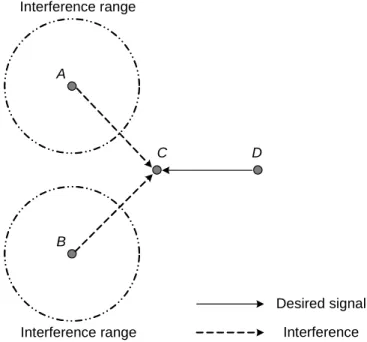
them. This means the interference level is continuous. So the principle behind the preceding ideal assumption is to quantize the continuous interference level to two discrete levels: full interference or no interference, thus making network analysis much easier. However, it may not reflect the reality in an actual network. For instance, consider the situation shown in Fig. 1. We have a transmission link from nodeDto nodeC. The receiver, i.e., nodeCis beyond the interference range of two interferers, nodes AandB. According to the ideal assumption, nodeC receives no interference from eitherAor B. However, in reality, although the interference from either node A or B is not significant enough to affect node C’s reception, the summation of interference received from A and B may make node C unable to receive its desired signal successfully. On the other hand, one motivation of busy-tone based schemes [1] is to better solve the hidden terminal problem. Each target receiver sends areceive busy-toneto notify the nearby hidden terminals not to transmit. However, the hidden terminal problem is not eliminated. For instance, collisions of request-to-send (RTS) frames can still occur due to the hidden terminal problem [2]. It is also challenging to determine the busy-tone coverage. Traditionally the busy-tone coverage is set to be the same as the interference range. However, similar to the case in CSMA, if there are multiple interferers beyond a target receiver’s busy-tone coverage, the aggre-gate interference from them can be strong enough to corrupt the target receiver’s desired reception, since the interferers cannot hear the busy-tone and thus start their transmissions. In a mobile envi-ronment, the multipath fading can cause the busy-tone coverage to vary with time. This can severely degrade the system performance because a strong interferer may not be notified by the busy-tone due to instantaneous deep fading of the busy-tone channel.
The contention-based nature of CSMA schemes and busy-tone based schemes makes it very diffi-cult to bound delay and jitter to small values for voice traffic. This observation implies that we should instead resort to reservation of channel resources. Resource reservation can avoid contentions, and voice traffic can be transmitted continuously on the reserved channel, thus bounding the transmission delay and jitter. Reservation based MAC schemes have been extensively studied in the literature [3]-[8]. In these schemes, each node first contends in a contention period to send a reservation request.
Once the reservation is granted, the node can transmit in the reserved time slot without contention. However, these schemes still suffer from the aforementioned “ideal assumption” problem. Thus in this research we consider a code-division multiple access (CDMA)-based mobile ad hoc network, in which the air interface supports multiple simultaneous transmissions in a neighborhood. In our previ-ous work [9], we have proposed a MAC scheme for a CDMA-based wireless mesh backbone, referred to as theMESHscheme here. Before DATA2transmissions, each potential sender first transmits a
low-power probe to the network. Upon reception of the probe, each active receiver estimates a potential interference increase due to the potential sender’s DATA transmission. The active receiver transmits a busy-tone signal in a separate busy-tone channel to notify the potential sender if the potential in-terference increase is intolerable. If the potential sender does not detect a busy-tone, it successfully reserves a code channel. However, targeted at a wireless mesh backbone with fixed topology and large traffic intensity, the MESH scheme is not effective or efficient in a mobile ad hoc network with time-varying network topology and time-time-varying channel gain between any two nodes. Accordingly, in the following we propose a MAC scheme for a mobile ad hoc network supporting voice traffic, based on a similar “probing” mechanism.
III. THEPROPOSEDMAC SCHEME
A. System Model
Consider a mobile ad hoc network having N mobile nodes. At the MAC layer, a source node can communicate with one or more of its neighbors, with a separate queue for each destination node. Each node is assigned a unique transmitting code and a unique receiving code [10]. The network topology changes as the mobile nodes move.
We use a time frame structure as shown in Fig. 2, in which time is partitioned into fixed-length frames. In each frame, there are M information slots (ISs), each followed by a short blocking slot
(BS). The ISs are used for information (i.e., DATA and ACK) and probe transmissions, while the BSs are used for transmitting blocking messages (to be discussed). Only constant rate voice traffic is considered3.
Each voice link requires a minimal transmission rate (e.g., voice packet generation rate from the codec) so that its delay and jitter can be kept at a very low level. To keep the transmission accuracy of the voice link, a signal to interference plus noise ratio (SINR) threshold is required for each link, i.e., for the link from senderito receiverj, the following inequality should hold:
GiPijtgij
Ij +ηj
≥Γd (1)
whereGiis the spreading gain,Pijt is the transmit power,gij is the path gain from nodeito nodej,Ij
is the interference (received at node j) from other links,ηj is the background noise power at nodej,
andΓdis the required SINR threshold for accurate information transmission.
Unlike the situation for the MESH scheme, all the transmissions are within a frequency band in our proposed scheme, using CDMA technology. Since RAKE reception can collect signal energy from different paths, we will assume that there is no fast (multipath) fading4, and the transmit power is
attenuated only due to path loss with exponentβ and shadowing. A node cannot transmit and receive at the same time, since each node’s transmission and reception are within the same frequency band.
B. Power Allocation for DATA and ACKs
Random access wireless networks usually use two power allocation strategies: common power al-location and linear power alal-location [11]. A common transmit power is used by all the nodes in the common power allocation strategy [12]. In the linear power allocation strategy [13][14], the transmit power is proportional to the path attenuation level from the sender to the receiver. In a mobile ad hoc
3Note that our scheme can still work in the case with other traffic types such as video and data. Each time frame can be (dynamically) divided into three portions, for voice, data, and video traffic, respectively. Then our scheme can be applied in the voice portion of each frame.
4For a non-ideal case where fast fading is not fully addressed by a RAKE receiver, the impact of the fluctuation due to fast fading can be represented by extra packet loss rate. The extra packet loss rate depends on the mobility environment, the RAKE receiver structure, the error-correction technology, and so on.
network, it is difficult to estimate the path attenuation in advance from a sender to a receiver due to user mobility. Here we consider a common power allocation strategy, in which each traffic source node uses a constant powerP to transmit its DATA frames to its destination, and the traffic destination uses the same power level to feed back ACKs.
C. Multiple Access Procedure
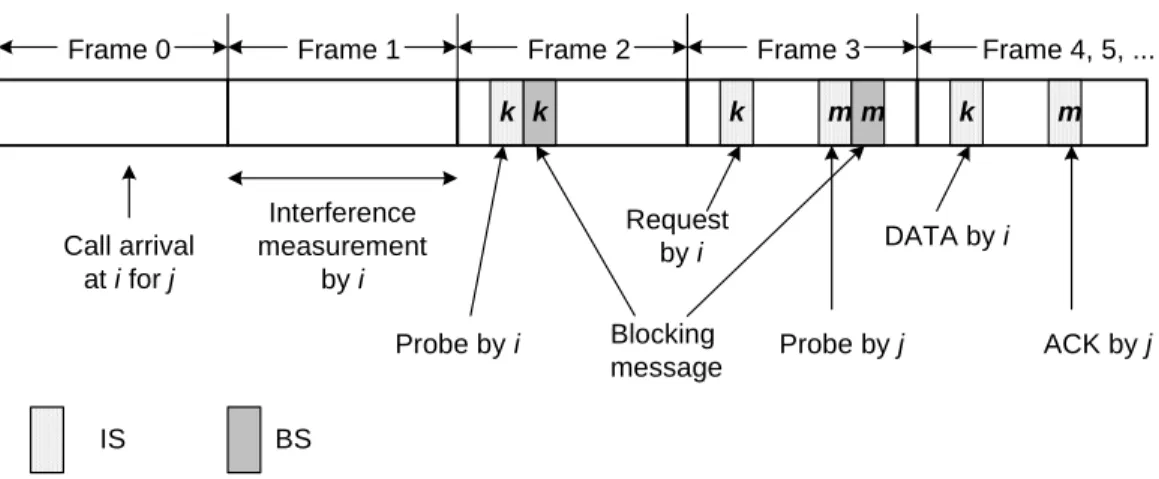
The multiple access capability of the network is based on resource reservation. Consider the case of a new call arrival at source node i in time frame 0 to destination node j5. The multiple access
procedure is illustrated in Fig. 3, while the finite state machine is demonstrated in Fig. 4.
C.1 Selection of DATA IS
Before the call arrival, node iis in stateIdle. Upon the new call arrival, nodeifirst selects an IS for DATA transmission, referred to as itsDATA IS, i.e., nodeitransits to stateDATA IS Sel. The ISs at which the destination nodej is sending traffic should be skipped, because nodej cannot send and receive at the same time at the same band. In frame 1, nodei measures its experienced interference, and monitors the transmitting code of nodej. Among the ISs over which nodej’s transmitting code is not detected, node iselects one with the minimum interference level, say IS k, as its DATA IS. If no IS is available, the call is dropped, i.e., nodeiproceeds to stateCall dropping.
C.2 Transmissions of Probe and Blocking Messages
Prior to DATA transmission in the selected DATA IS, nodeishould make sure its DATA transmission does not corrupt any existing reception at any active receiver6 in the IS. To achieve this goal, nodei
5Note that our MAC scheme only deals with unidirectional traffic (from nodeitoj) rather than bidirectional traffic (from nodeito
jand vice versa) for the following reason. In a mobile ad hoc network, it is likely that there is no direct link between a pair of users (say user A and user B). In this case, it is not necessary that traffic from user A to user B follows the same path as that in the reverse direction. Therefore, our scheme only reserves resources for unidirectional communications, and the routing protocol in the network layer will ensure that reservation is performed in both directions.
6Here an active receiver can be an existing traffic destination node for DATA reception, or an existing traffic source node for ACK reception.
first sends a low-power test signal into the network, i.e., in stateDATA Probe Tx. Specifically, at IS
k of frame 2, nodeisends a probe spread by a common probe code with a large spreading gain, and with transmit power levelα·P (α¿1). No data is carried in the probe. With its low power, the probe is very unlikely to corrupt any existing reception at the IS. Although the probe is sent with low power, we assume that it can be received by active receivers at the IS because of the large spreading gain.
At ISk, an active receiver, say nodel, first measures the received probe power level denoted byPlr,p
and its own interference level due to other existing transmissions. It estimates the potential interference increase due to DATA transmission of the probe sender asPlr,p/α, and determines whether the potential interference increase can corrupt its own reception. If so, it sends a blocking message at BS k. The blocking message is spread by a common blocking code7. No data is carried by the blocking message.
The power allocation for the blocking message will be discussed in Section III-D.
At BS k, node i monitors the blocking code. If the detected blocking message power is above a threshold Pthr,b, it gives up on IS k for DATA transmission and tries another IS until no blocking message is detected.
C.3 Selection of ACK IS
If no blocking message is detected, nodeisends a request message to destination nodej, at ISkin frame 3 spread by nodej’s receiving code, and sends its first DATA frame at ISkin frame 4 spread by nodei’s transmitting code, both with powerP. That is, the node proceeds to stateRQT.
Upon receiving the request message, node j selects an IS for its ACK, referred to as ACK IS, i.e., nodej proceeds toACK IS Sel. Generally it is desired that, at the ACK IS, the interference experi-enced by nodeiis small so that the ACK can be received correctly. So in the request message, nodei
indicates (among the ISs except IS k) the IS with minimal experienced interference, say ISm. After node j has selected IS m as the ACK IS, it proceeds to state ACK Probe Tx. That is, it sends an
7Unlike [9] where a busy-tone is used over a separate control channel, the blocking message in this research is sent in the data channel, thus avoiding the extra hardware cost to implement the busy-tone channel.
probe at IS min frame 38 in the same manner as nodeisending a probe for DATA IS. If no blocking
message is detected at BSm, nodejsends an ACK spread by its transmitting code at ISmin frame 4 for the DATA frame received9 in frame 4, i.e., nodejproceeds to stateInfo Rcv ACK.
If node i does not receive an ACK at IS m of frame 4, it goes back to state DATA IS Sel, i.e., selects another DATA IS, and repeats the preceding procedure with a maximal number of attempts. If an ACK is received, it proceeds to the next stateInfo Tx.
C.4 Continuous Transmissions at Reserved DATA and ACK ISs
At subsequent time frames from frame 5, node i in state Info Tx transmits its DATA frames spread by its transmitting code at IS k, and node j in state Info Rcv ACK transmits the ACKs spread by its transmitting code at IS m, until the completion of the call. It can be seen that call-level resource reservation is performed. Upon the call completion, no link termination procedure is necessary, because our scheme is based on real-time interference measurement, and other active receivers can measure the interference level reduction when the target link stops using the reserved resource.
D. Power Allocation for the Blocking Message
If an active receiver at an IS is to send a blocking message in response to a probe from a potential sender10, the transmit power of the blocking message should be designed carefully so that the potential
sender can be notified. The objective of blocking message power allocation is to ensure that the potential sender can detect a blocking message with power above thresholdPthr,b.
At an IS, it is possible that one or more potential senders may send probes for resource reservation. Since the resource reservation is performed at the call level, it is reasonable to assume that at an IS
8The probe is sent at ISmin frame 3 whenm > k, or in frame 4 whenm < k. For simplicity of presentation, we use the former case as an example in this paper.
9Since the request message and DATA are sent in the same way from nodei, DATA can also be received correctly if the request can be delivered successfully.
there are at most two potential probe senders in a neighborhood. This assumption is reasonable due to the fact that the duration of a frame (usually in the order of 10 ms) is much shorter than a call duration (usually in the order of minutes). Since each voice user may only need one request (and thus one probe) for its call duration, it is reasonable to have the above assumption.
We also assume channel reciprocity in terms of shadowing effect. Consider the case in which an active receiver, say nodel, detects the probe power levelPlr,p, and wants to send a blocking message. Nodelsends a blocking message with transmit power
Plt,b = max n2·Pr,b th ·αP Plr,p , Pthr,b·P Λl o (2)
whereΛlis theinterference margin[15][16] of nodel, defined as the maximum extra interference that
can be tolerated by nodel. From the interference margin definition, we have
GlP gl
Il+ηl+ Λl
= Γd (3)
whereGlandglare the spreading gain and path gain for the transmission to nodel, respectively. Then
Λlis given by
Λl =
GlP gl
Γd
−Il−ηl. (4)
We first consider the scenario in which only one potential sender, nodei, sends a probe at an IS. The path gain from nodeito nodelis
gil = Plr,p αP . (5) From (2) we have Plt,b ≥ 2·P r,b th ·αP Plr,p = 2·Pthr,b gil . (6)
Due to the reciprocity of the channel,gli =gil, and so we have
Plt,b≥ 2·P
r,b th
gli
. (7)
Then the received blocking message power at the potential senderiis
which is greater than the detection thresholdPthr,b. Hence the potential sender is notified to give up the IS.
Next, we consider the scenario in which two potential senders, nodei1 and nodei2, send probes at an IS. As a common probe code is used, and no data is carried by a probe, node l can collect energy from both probes via a RAKE receiver. The total received probe power at node l is also denoted by
Plr,p, and nodel wants to send a blocking message. Without loss of generality, assume the path gain from nodei1 tolis not less than that fromi2tol, i.e.,gi1l ≥gi2l. We have
Plr,p =αP ·gi1l+αP ·gi2l≤2αP ·gi1l. (9)
When nodelsends a blocking message with power given by (2), the received blocking message power at nodei1 is Plt,b·gli1 =P t,b l ·gi1l ≥ 2·Pthr,b·αP Plr,p ·gi1l ≥ 2·Pthr,b·αP 2αP·gi1l ·gi1l =Pthr,b. (10)
As a result, nodei1 will be notified to give up the IS.
In the following, we prove that, if nodei2’s potential information transmission (i.e., DATA or ACK) generates extra interference that is intolerable at node l, node l’s blocking message with power given by (2) can reach nodei2 with a power level above the thresholdPthr,b.
Proof: If nodei2’s information transmission can corrupt nodel’s reception, this means
P ·gi2l≥Λl. (11)
We have
gi2l ≥
Λl
P . (12)
at nodei2 is Plt,b·gli2 =P t,b l ·gi2l ≥ Pthr,b·P Λl ·gi2l ≥ Pthr,b·P Λl · Λl P =Pthr,b. (13)
As nodei2 detects blocking message power above the threshold, it gives up the IS.
In summary, when there are two probe senders in an IS, and the aggregate potential interference from their information transmissions is intolerable by an active receiver, the potential sender with stronger interference will be blocked. The potential sender with weaker interference will be blocked if its potential interference to the target active receiver is larger than the receiver’s interference margin.
E. Impact of User Mobility and Solutions
The impact of user mobility on each active link at the MAC layer is two-fold. One is due to the time-varying path attenuation of the desired signal, and the other is due to the varying interference level. The path attenuation consists of three components: path loss, shadowing, and fast (multipath) fading. Fast fading can be addressed by the RAKE receiver that collects signal energy from different paths. The time-varying path loss, shadowing, and interference level make the SINR of each link fluctuate with time. Generally our scheme can automatically adapt to the varying SINR of each link, because each receiver determines whether or not to admit new links into the network based on real-time measurement and estimation of its desired signal and interference levels. However, it is possible that the SINR of some ongoing links at an IS cannot remain above the threshold Γd (a condition referred
to as alink failure) because of the fluctuations. Although a new route searched by the routing scheme can help to solve the problem, it is desirable to deal with the problem at the MAC layer first before resorting to the routing scheme, considering the overhead and time needed for a new route search, and the duration needed to set up a new route.
To address the link failure problem, for each active link, the traffic destination node indicates in its ACK two candidate DATA ISs at which the destination node experiences the minimum interference
and does not transmit. The destination node also indicates a detected link failure (if any) in the ACK. If the traffic source node (say node i) does not receive correctly the ACK from its destination (say node j), this means the ACK is corrupted11. As node i does not have the information of whether
the DATA transmission is corrupted or not, we let the link be re-established in a new DATA IS and a new ACK IS. The main difference from the establishment procedure given in Section III-C is as follows. Node isends two probes in the two candidate DATA ISs indicated in the previous ACK. At each candidate IS, a request is sent if no blocking message is detected. The request also indicates two candidate ACK ISs in which node iexperiences the minimum interference and does not transmit. If at least one request is received at node j (which means a new DATA IS is established), nodej sends two probes at the candidate ACK ISs. If at least one probe at a candidate ACK IS is not blocked by active receivers at that IS, a new ACK IS is established. If the new DATA IS and ACK IS cannot be established simultaneously, the call is dropped.
On the other hand, if node isuccessfully receives an ACK which indicates that a failure of DATA transmission happens, a similar procedure is executed, except that only the establishment of a new DATA IS is needed.
Generally, if the link failure is due to large interference, it is likely that the call can be established successfully in other DATA and/or ACK ISs at which nodes generating large interference are not active. However, if the link failure is due to a large path loss of the desired signal (e.g., the traffic source and destination are separated by a large distance) or due to shadowing of the desired signal (e.g., the path between the traffic source and destination is blocked by a tall building), it is very likely that the link quality of the target call at other ISs is not good enough either, and thus the call will be dropped. In this case, a new route should be selected by the routing scheme.
11If an expected DATA frame is not received, the traffic destination node responds with a NACK. For presentation simplicity, we use “ACK” to represent both ACK and NACK in this paper.
F. Summary
The proposed MAC scheme has the desired features discussed in Section I. The scheme is per-formed in a distributed manner at the mobile nodes, and is thus scalable to large networks. The hidden terminal problem does not exist, since each active receiver makes an admission decision on a new call based on real-time measurement of its own desired signal and interference levels. The reservation nature of our scheme can guarantee small delay and jitter for voice traffic as long as the minimum required rate can be met. Our scheme can adapt automatically to user mobility to a certain extent, also benefiting from the fact that each active receiver makes real-time measurements of desired signal and interference levels. In addition, the “ideal assumption” required by CSMA and busy-tone based schemes (as discussed in Section II) is unnecessary for our scheme. Furthermore, although the block-ing message has similar functionality to the busy-tone in busy-tone based schemes, our scheme does not have the problem of different channel gains in the separate busy-tone and DATA frequency bands, because the blocking message and DATA are sent in the same band.
IV. STATISTICALMULTIPLEXING OF VOICE TRAFFIC
The resource reservation procedure in the preceding section is suitable for constant rate voice traffic, i.e., the sender generates packets at a constant rate during the call lifetime. However, voice traffic is normally characterized by an on/off nature. No information packets are generated in anoffstate, thus posing some challenges on the resource reservation procedure. When anonvoice flow turnsoff, other active receivers measure less interference. If subsequently one or more new calls are admitted at the serving ISs of the off voice flow, and later the off voice flow switches to the on state, it is likely that some active receivers at the voice flow’s serving ISs experience more interference than they can tolerate, thus leading to link corruption. This problem is due to the inaccurate interference estimation when a voice flow turns off. Furthermore, it is more desirable to achieve multiplexing gain ofon/offvoice traffic. To address these problems, the following solutions are proposed.
A. Solution to Inaccurate Interference Estimation
When a voice flow is in anoffstate, it uses a probe (referred to asoffprobe) with a different code from that in Section III-C to inform other links of the interference that will be generated when theoff
voice flow turnsonagain. Specifically, when a voice flow from nodeito nodej turnsoff, its source and destination nodes send anoffprobe on the DATA and ACK IS, respectively, with powerαP and a large spreading gain. Each active receiver keeps monitoring theoffprobe. At an active receiverlat the DATA or ACK IS, letPlr,p,offdenote the receivedoffprobe power. Then when a new call sender sends a probe (for admission) that arrives at nodelwith power levelPlr,p, nodel will send a blocking message if
Plr,p
α +
Plr,p,off
α >Λl. (14)
This means the potential interference of offvoice flow from nodeito nodej is counted in nodel’s current interference level, and thus the inaccurate interference estimation problem can be addressed. When the voice flow from nodeito nodej turnsonlater, nodesiandj can send the DATA and ACK frame at the DATA IS and ACK IS, respectively, without any re-admission procedure.
B. Solution for Statistical Multiplexing
In (14), each active receiver at an IS counts 100% of the potential interference from off voice flows, and thus there is no statistical multiplexing gain. However, if an active receiver counts only a portionξ(<1)of the potential interference fromoffvoice flows, only part of the reserved capacity foroffvoice flows is maintained. When a new call sender sends a probe (for admission) that arrives at an active receiver nodelwith power levelPlr,p, nodelwill send a blocking message if
Plr,p α +ξ·
Plr,p,off
α >Λl (15)
whereξis referred to asreservation factor. By this means, only a portionξof the capacity for theoff
On the other hand, when an offvoice flow turns onand its source and destination nodes start to transmit in its previous DATA and ACK ISs, respectively, it is possible that the transmission accuracy of other links at the ISs may be corrupted. So re-admission ofoff-to-onvoice flows is necessary as follows. When anoffvoice flow turnson, the voice source node sends a probe in its previous DATA IS and in another IS at which the voice destination node experiences the least interference (as indicated in the last ACK). At either IS, if no blocking message is detected, the voice source node sends a request which also indicates a candidate ACK IS (different from its previous ACK IS) at which it experiences the least interference and does not transmit. If the voice destination node receives at least one request, it sends a probe in its previous ACK IS and the candidate ACK IS. A new ACK IS is established if at least one probe is not blocked. The call will be dropped if a DATA IS and an ACK IS cannot be established simultaneously.
Note that the admission of anoff-to-onvoice request is different from that of a new call request. For a new call request, a certain portion of the capacity should be reserved for off voice flows, as shown in (15). On the other hand, for anoff-to-onvoice request, such reservation is not necessary, and thus we have the following criterion for blocking a request
Plr,p
α >Λl. (16)
Therefore, when an off voice flow turnson, the source or destination node should use a different probe from that used by the source or destination of a new voice call (i.e., different from that used in Section III-C). By this means, other active receivers can distinguishoff-to-onvoice requests from new voice call requests.
V. PERFORMANCEEVALUATION
We use computer simulation to evaluate the performance of the proposed scheme. Generally it is desired to compare our scheme with other MAC schemes. However, to the best of our knowledge, so far no MAC scheme is designed to address user mobility issue, and thus it is difficult to achieve a fair
comparison. Therefore, in the following we only demonstrate the effectiveness of our proposed scheme to support voice traffic with QoS provisioning. Traditional QoS metrics for voice traffic include delay, jitter, and packet loss rate. From Section III, it can be seen that, as long as a call is admitted into the network, the transmitter can send voice packets continuously in the reserved slot. So the voice delay is fixed, and is up to the duration of a time frame, and there is no jitter. Therefore, in the following, packet loss rate is used as the major QoS metric for voice in the simulation. The simulation is done using Matlab.
Consider an ad hoc network consisting of N nodes, with N/2 voice source nodes andN/2 voice destination nodes. The source nodes are randomly distributed in a 1000 meter ×1000 meter square, each associated with a destination node. All the source nodes are fixed, and all the destination nodes move with a speedvin a randomly selected direction. A destination node is assumed to move within a radius of 150 m of the associated source node12. Each time frame has a fixed duration of 20
millisec-onds (ms), and is further divided into 8 ISs and 8 BSs. The spreading gain is 32 for DATA and ACKs, and 3200 for the probe. The path loss attenuation exponentβis 2.4, and the shadowing is modeled by the first-order autoregressive process given in [17]. Voice call inter-arrival time at each source node is exponentially distributed with mean value 48 seconds, and the duration of a call is exponentially distributed with mean value 30 seconds. When a call is active, one DATA frame is generated over each time frame. The SINR requirement Γdis 10 dB. In the following, the simulation for each set of
parameters ends until on average each source node finishes 100 calls.
In the simulation, the numberN of nodes varies from 20 to 100, and the destination node velocityv
varies from 0 to 20 km/hour (kph). We first verify our assumption in Section III-D that the probability of more than two probe senders at an IS is negligible. Among the ISs with one or more probe senders, Table I lists the percentage of ISs that have one probe sender, two probe senders, and more than two probe senders, respectively. No more than two probes are observed at an IS, thus validating our assumption.
First we compare our scheme with the IEEE 802.11 medium access control scheme. In the simula-tion, N=100, no node is moving, and an active source node generates constant rate voice flows. It is observed that the 95% confidence interval of the mean packet delay in the IEEE 802.11 medium access control scheme is [1.302, 1.303] second. It is also observed that the jitter in the IEEE 802.11 medium access control scheme is 0.7 second. On the other hand, our scheme is reservation based. Thus, the packet delay is a frame duration, i.e., 20ms, and the jitter is zero. Apparently our scheme performs better in terms of timely delivery of voice packets.
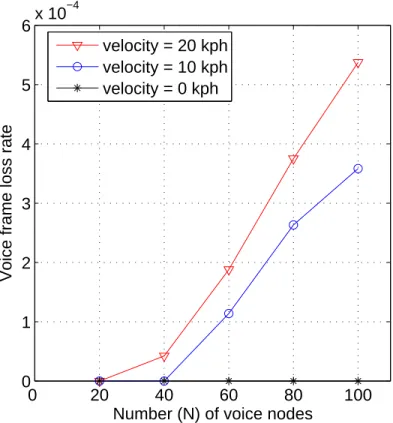
Next consider constant rate voice flows in our scheme. For an ongoing voice call, if its SINR requirement is not satisfied, it tries to switch from one IS to another. Some voice frames will be lost during the switching due to the switching processing time, and if the switching is not successful, call dropping occurs. Fig. 5 shows the voice frame loss rate with differentN andvvalues. A larger value of N and/orv tends to increase the frequency of switching among the ISs, thus increasing the frame loss rate. It can also be seen that all the frame loss rates are bounded by 0.1%, which is well within acceptable range for voice service. It is also observed that the ongoing call dropping probability is bounded by 1.2%, which happens when N = 100 andv = 20kph. So our scheme can maintain the frame loss rate and call dropping rate at low levels.
Then we consideron/off voice flows with statistical multiplexing in our scheme. The durations ofonandoffstates are independent and exponentially distributed with mean values 352 ms and 650 ms, respectively. For N = 100 case, Table II shows the ongoing call dropping probability and new call blocking probability. When the reservation factor increases, more capacity is reserved for off
voice flows, and thus the ongoing call dropping probability decreases. However, the new call blocking probability increases due to the reduced available capacity for new calls.
VI. CONCLUSIONS
It is challenging to support voice traffic over a mobile ad hoc network due to the delay-sensitive na-ture of such traffic and due to user mobility. In this paper we have proposed a MAC scheme to support voice traffic by the resource reservation mechanism. User mobility is addressed by real-time signal and interference measurement and estimation at the receivers. Statistical multiplexing is achieved by partial resource reservation foroffvoice flows. The results of this study provide some useful insight into the development and deployment of mobile ad hoc networks supporting multimedia services.
REFERENCES
[1] Z. J. Haas and J. Deng, “Dual busy tone multiple access (DBTMA) – a multiple access control scheme for ad hoc networks,”IEEE Trans. Commun., vol. 50, no. 6, pp. 975–985, June 2002. [2] P. Wang, H. Jiang, and W. Zhuang, “A dual busy-tone MAC scheme supporting voice/data traffic
in wireless ad hoc networks,” inProc. IEEE GLOBECOM’06, San Francisco, California, USA, Nov.–Dec. 2006.
[3] C. R. Lin and M. Geria, “Asynchronous multimedia multihop wireless network,” in Proc. IEEE INFOCOM’97, pp. 118–125, Kobe, Japan, Apr. 1997.
[4] A. Muir and J. J. Garcia-Luna-Aceves, “Group allocation multiple access with collision detec-tion,” inProc. IEEE INFOCOM’97, pp. 1182–1190, Kobe, Japan, Apr. 1997.
[5] S. Jiang, J. Rao, D. He, X. Ling, and C. C. Ko, “A simple distributed PRMA for MANETs,”IEEE Trans. Veh. Technol., vol. 51, no. 2, pp. 293–305, Mar. 2002.
[6] Z. Ying, A. L. Ananda, and L. Jacob, “A QoS enabled MAC protocol for multi-hop ad hoc wire-less networks,” inProc. 2003 IEEE International Performance, Computing, and Communications Conference (IPCCC’03), pp. 149–156, Phoenix, AZ, USA, Apr. 2003.
[7] S.-T. Sheu and T.-F. Sheu, “DBASE: A distributed bandwidth allocation/sharing/extension pro-tocol for multimedia over IEEE 802.11 ad hoc wireless LAN,” inProc. IEEE INFOCOM’01, pp. 1558–1567, Anchorage, Alaska, USA, Apr. 2001.
[8] C. W. Ahn, C. G. Kang, and Y. Z. Cho, “Soft reservation multiple access with priority assignment (SRMA/PA): a novel MAC protocol for QoS-guaranteed integrated services in mobile ad-hoc networks,” in Proc. IEEE Vehicular Technology Conference (VCT’00), pp. 942–947, Boston, MA, USA, Sept. 2000.
[9] H. Jiang, P. Wang, W. Zhuang, and X. Shen, “An interference aware distributed MAC scheme for CDMA-based wireless mesh backbone,” inProc. IEEE Consumer Communications and Net-working Conference (CCNC) 2007, pp. 59–63, Las Vegas, Nevada, USA, Jan. 2007.
[10] E. S. Sousa and J. A. Silvester, “Spreading code protocols for distributed spread-spectrum packet radio networks,”IEEE Trans. Commun., vol. 36, no. 3, pp. 272–281, Mar. 1988.
[11] T. Moscibroda and R. Wattenhofer, “The complexity of connectivity in wireless networks,” in Proc. IEEE INFOCOM’06, Barcelona, Spain, Apr. 2006.
[12] S. Narayanaswamy, V. Kawadia, R. S. Sreenivas, and P.R. Kumar, “Power control in ad hoc networks: theory, architecture, algorithm, and implementation of the COMPOW protocol,” in Proc. European Wireless’02, pp. 156–162, Florence, Italy, Feb. 2002.
[13] S. Banerjee and A. Misra, “Minimum energy paths for reliable communication in multi-hop wireless networks,” in Proc. 3rd ACM MOBIHOC, pp. 146–156, Lausanne, Switzerland, June 2002.
[14] J. E. Wieselthier, G. D. Nguyen, and A. Ephremides, “Energy-efficient broadcast and multicast trees in wireless networks,”Mobile Networks and Applications, vol. 7, no. 6 pp. 481–492, Dec. 2002.
[15] F. Cuomo, C. Martello, A. Baiocchi, and F. Capriotti, “Radio resource sharing for ad hoc net-working with UWB,”IEEE J. Select. Areas Commun., vol. 20, no. 9, pp. 1722–1732, Dec. 2002. [16] A. Muqattash and M. Krunz, “Power controlled dual channel (PCDC) medium access protocol for wireless ad hoc networks,” inProc. IEEE INFOCOM’03, pp. 470–480, San Francisco, California, USA, Mar.–Apr. 2003.
[17] G. L. Stuber,Principles of Mobile Communication. Kluwer Academic Publishers, Norwell, MA, USA, 1996, pp. 89-90.
TABLE I
THE PERCENTAGE OF THEISS WITH DIFFERENT NUMBER OF PROBES.
Number (N) of nodes 20 40 60 80 100 1 probe 1.000 1.000 0.998 0.996 0.997 v = 10 2 probes 0 0 0.002 0.004 0.003 kph ≥3probes 0 0 0 0 0 1 probe 1.000 0.996 1.000 0.995 0.996 v = 20 2 probes 0 0.004 0 0.005 0.004 kph ≥3probes 0 0 0 0 0 TABLE II
ONGOING CALL DROPPING PROBABILITY AND NEW CALL BLOCKING PROBABILITY FOR THE CASES WITHon/off
VOICE FLOWS. ξ 0 0.5 1 Dropping prob. (%) 0.6 0.3 0 v = 0kph Blocking prob. (%) 0 0 0.42 Dropping prob. (%) 4.7 4.3 0.9 v = 10kph Blocking prob. (%) 0.2 0.3 3.6 Dropping prob. (%) 5.1 4.9 1.2 v = 20kph Blocking prob. (%) 0.2 0.1 4.1
Interference range Interference range Desired signal Interference A B C D
Fig. 1. An example in which the ideal assumption is not valid.
IS 1 BS 1
. . .
Frame
IS 2 BS 2 IS M BS M
IS: information slot BS: blocking slot
Frame 0 Call arrival at i for j Interference measurement by i k k Probe by i Blocking message k Request by i m Probe by j k m DATA by i ACK by j m
Frame 1 Frame 2 Frame 3 Frame 4, 5, ...
IS BS
Fig. 3. The multiple access procedure.
Idle DATA_IS_ Sel DATA_Pro be_Tx RQT Info_Tx ACK_IS_ Sel ACK_Prob e_Tx Call arrival Success Call dropping Failure Blocking No blocking RQT received No blocking Blocking ACK received No ACK Info_Rcv_ ACK Info. completed
Frame 1 Frame 2 Frame 3 Frames 4, 5, ... For receiver
For transmitter
0 20 40 60 80 100 0 1 2 3 4 5 6x 10 −4
Voice frame loss rate
Number (N) of voice nodes velocity = 20 kph
velocity = 10 kph velocity = 0 kph