This thesis comprises 30 ECTS credits and is a compulsory part in the Master of Science with a Major in Industrial Management – Logistics, 120 ECTS credits
How Collaborative
Logistics Management
Increases Supply Chain
Efficiency
Nazila Kaveh
How Collaborative Logistics Management Increases Supply Chain Efficiency
Nazila Kaveh, [email protected]
Navid Khosravi Samani, [email protected]
Master thesis
Subject Category: Technology – Industrial Management
University College of Borås School of Engineering SE-501 90 BORÅS
Telephone +46 033 435 4640
Examiner: Håkan Torstensson
Supervisor, name: Håkan Torstensson Supervisor, address: University of Borås
Client: University of Borås
Date: June 2009
Acknowledgments
It is our pleasure to acknowledge all those who helped us during the writing of this thesis.First of all, we would like to express our appreciation to Professor Håkan Torstensson, our supervisor, for his continuous guidance and support during our research work. We also want to send our deepest thanks to Daniel Ekwall who has taken time to read the thesis and for his valuable opinions during the writing process.
We would also like to express our gratitude towards Abbas, Ali, and Arshuan for their great help on editing the thesis. Our appreciation also goes to Hans Karlsson, who has participated in the case study.
Finally we would like to dedicate this thesis to our parents, given that without their support, we would have never made it this far. They have always been a source of love and
encouragement. You showed us the real face of parenthood and your kindness and gentleness cannot be compensated by anything in the world.
Borås, June 2009
Nazila Kaveh Navid Samani
Abstract
Globalization, rapid technological change, shorter product life cycles, changing customer preferences, and hyper competition are just some characteristics of today’s business
environment. As a result, organizations have become aware of the fact that working alone is almost impossible. Therefore, they began to understand that building relationships are keys to a successful business. In fact, as the business processes become more specialized,
organizations prefer to focus on their core competencies and outsourcing becomes a relevant strategy. Consequently parts of the value adding processes are displaced outside the four walls of the firm which in turn, need a closer partnership (collaboration) between the partners. In today’s world logistics which includes transportation, inventory, order processing,
purchasing, warehousing, materials handling, packaging, and much more, must continuously be developed to meet those described challenges. In fact, an effective logistics system is a must in order to meet and satisfy the customer demand. These developments require a considerable effort and significant capital. Accordingly, outsourcing the logistics activities become common and many companies leave these tasks to those who have available resources and are competent to perform them. However, as mentioned, outsourcing without cooperation is inefficient.
The objective of this research project is to introduce and describe collaborative logistics management and investigate its consequence on the supply chain. This purpose necessitates a framework to support the collaboration between the entities in the chain especially in terms of logistics activities. Besides, the potential benefits (in terms of cost and services) in logistics collaboration are supported by a lot of literatures. Despite the identified needs and potential benefits, there are still barriers through which is not started or not successful enough. Therefore, while those barriers must be identified, possible enablers should be designed and implemented to attain desired benefits. This has been done through both a theoretical review and also a case study.
Keywords
Table of content
1 Introduction ………...1
1.1 Background ... 1
1.2 Purpose of the thesis ... 3
1.3 Research questions ... 3
1.4 Outline of the thesis ... 4
2 Research Methodology ……… 6
2.1 Type of research ... 6
2.1.1 Type of research for this thesis ... 6
2.2 Methods of data collection ... 6
2.2.2 Secondary data ... 7
2.2.3 Primary data ... 7
2.3 Validity ... 7
2.4 Reliability ... 8
3 Theoretical frame of reference ……….………...9
3.1 Supply chain management, history and definition ... 9
3.2 Why Supply Chain Management? ... 10
3.2.1 Concentrating in core business ... 10
3.2.2 National and international competition ... 11
3.2.3 Conflict in the different departments’ goals and performances ... 11
3.2.4 Minimizing the costs of production on a continuing basis ... 12
3.2.5 Introducing new technologies ... 13
3.2.6 Improving quality ... 13
3.3 Supply Chain Risk ... 14
3.3.1 Source of uncertainty ... 14
3.4 Logistics, history and definition ... 15
3.5 Why logistics management? ... 16
3.6 Collaboration ... 18
3.7 Collaborative planning, forecasting and replenishment (CPFR) ... 18
4 collaboration ………19
4.1 Definition ... 19
4.2 Form of collaboration ... 20
4.2.1 Vertical collaboration ... 20
4.3 Type of collaboration ... 21
4.3.1 Example of collaborative strategy ... 22
4.4 A framework for collaboration ... 23
4.5 Complexity ... 25
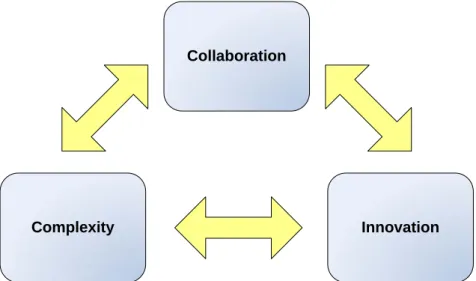
4.6 Supply chain complexity and collaboration ... 26
4.7 Collaboration and Innovation ... 28
4.7.1 On time introduction to the market... 31
4.7.2 Taking opportunities; sharing threats ... 31
4.8 Collaboration and competency ... 32
5 Collaborative Logistics Management ………33
5.1 Logistics excellence ... 33
5.2 Logistics fulfillment ... 34
5.3 Logistics management component ... 35
5.4 Flows in logistics ... 35
5.4.1 Material and resource flow ... 36
5.4.2 Information flow ... 39
5.4.3 Monetary flow ... 43
5.5 Collaborative logistics ... 43
5.5.1 Forms of logistics collaboration ... 44
5.5.2 Collaborative logistics intensity ... 44
6 Benefits, barriers, and bridges to effective collaboration ………47
6.1 Driving forces ... 47
6.2 Benefits of logistics collaboration ... 49
6.2.1 Risk sharing ... 49
6.3 Barriers ... 49
6.4 Bridge to effective collaborative logistics management ... 50
6.4.1 Value of information – Prisoner’s dilemma ... 51
6.5 Case study ……….. 52
6.5.1 Company’s history and business idea………...……….…....52
6.5.2 Business collaboration policy ………...……….…53
6.5.3 Information sharing policy ………...……….53
6.5.4 Logistics collaboration policy ………...………... 54
6.5.4.1 Driving forces and benefits of collaboration………. 54
7 Conclusions and Further Research ………...………55
7.1 Conclusion ... 55
7.2 Further research ... 57
List of References ………...58
1
1.1 Background
Today’s global business is becoming more fierce and unpredictable as a result of volatile variables in the market environment. It becomes a basic fact that a company’s responsiveness is essential to its success in today’s unpredictable business environment. This, together with an increase in number of companies that are working in the same area which act as
competitors and decrease the products’ life cycle, force companies to focus on their supply chain. These all emphasize that planning and working alone, no matter how sophisticated, are insufficient.
In the 1980’s companies discovered new manufacturing technologies and strategies that allowed them to reduce costs and better compete in different markets. Strategies such as just in time (JIT) manufacturing, kanban, lean manufacturing, total quality management (TQM), and others become very popular, and vast quantities of resources were invested in
implementing these strategies. In the last few years, however, it has become clear that many companies have reduced manufacturing costs as much as is practically possible. In their belief, the next step they need to take, in order to increase profit and market share, lie in their supply chain. Actors participating in the same supply chain identify tradeoffs with their adjacent customers and suppliers and have started to realize the importance of integration in the chain in order to focus on what is offered to the end customer in terms of cost and service. Internal excellence is not enough anymore; there is also a need for external excellence in the whole supply chain. This management philosophy is called supply chain management (SCM), and has received considerable attention in research journals as well as in industry and
consultancy firms (Christopher, 1998; Lambert & Cooper, 2000; Levi, 2003).
Keeping the importance of this trend “SCM” in mind, for a company to stay profitable as well as competitive in this kind of environment it has to focus on the drivers that help the specific company to be competitive. One major driver for most companies is cost. The cost reduction is overwhelming for the business’s competition. Christopher (2005), also introduces one more driver called value advantage which gives the product or offering a differential ‘plus’ over competitors and increasingly it is the case that markets are becoming more service sensitive. Successful companies either have a cost advantage or they have a value advantage, or a combination of both. It can be argued that these two factors are the most important drivers for being compatible. Therefore the challenge for a company is to seek the strategy that will take the business towards a secure position of strength in the market based upon differentiation and cost advantages. Similarly, by expanding this notion to the supply chain, the winning supply chains are those which are investigating the drivers more and try to acquire the cost and value advantage at the same time.
Introduction
This introduction includes a description of the background of the research project and the problem statement. Also, the objective and the research questions of the research are mentioned and described. The chapter ends with an outline of this thesis.
Within the supply chain, logistics has a profound impact both on cost and value drivers. That is, with effective logistics management a company and in general its supply chain could be able to gain cost and value advantage over the competitors. According to Lambert and Stock (2001), with rising interest rate, increasing fuel costs during the 1970’s, and globalization of industry, logistics received attention as a major cost driver. From the value advantage perspective, the shifting of channel power from manufacturer to retailers, wholesalers, and distributors, confirm the importance of effective logistics management. In fact, today’s sales are determined by what is in stock rather than by what particular brands are offered (ibid). This new trend shifts focus in the way that companies compete, from product to product’s availability.
As has already been mentioned, logistics has a key role in the supply chain. Its activities located everywhere in the chain, from the beginning, providing raw material, to the end, delivery of products to the final customer. Generally, the final goal of any logistics system is to satisfy the customer. In fact each component of the logistics system can effect whether a customer receives the right product, at the right place, in the right condition, for the right cost, at the right time (ibid). The term availability ‘right place at the right time’ is recently
considered important when it comes to customer service. The companies can not retain the customer any more if they have not got the products in their stock. Of course there are other factors that have impact on this matter, but among them logistics and its effective
management considered very important.
So far, supply chain and logistics are introduced as the two most important terms in today’s business world and importance of their effective management introduced. Simultaneously, tough competition is in place for any kind of trade and now customers have access to a verity of options both locally and internationally. Also new ways of commerce are started especially with the introduction of internet (e-commerce) as a quicker and simpler tool. These situations and so many others, which will be mentioned in the next chapters, can be summarized in a special term which is complexity. To challenge the complexity, companies do not rest and instead they seek new solutions (based on drivers) which then enable them to overcome that complexity. In fact, they should constantly redesign and restructure products (services) activities to increase their effectiveness and satisfy the final customer. Previously these developments are pursued in house, but as globalization, highly diverse workforces and new ways of competing reshape the business landscape it is become more obvious that using all available tangible and intangible resources through collaborative approaches is not just an advantage, it is a business imperative (Gadman et al., 2005).
According to Soosay et al. (2008), “Businesses with a supply chain strategy require
integration, cooperation and collaboration, which in turn demand aligned objectives, open communication, sharing of resources, risks and rewards”. As has already been mentioned, it has been widely believed today that collaboration among supply chain members will lead to competitive advantage for all. But what exactly is collaboration and what enables it to take place? What are the obstacles that must be overcome? Is achieving supply chain collaboration really worth the effort? And how much collaboration is actually taking place today?
Moreover, to have a successful collaborative network number of elements should be considered before companies in the chain enter to any kind of partnership (collaboration) strategy. Among them, questions on who to collaborate and where in the supply chain are the two most important factors which need to be thought.
1.2 Purpose of the thesis
In the context of logistics management, the main purpose of the research is to introduce and describe collaborative logistics management and investigate its consequence in the supply chain.
To attain this purpose, a number of matters should be considered. Initially, an introduction of the area where the study deals with “supply chain management and logistics” will be
performed. Then the content of collaboration including definition, form, types, etc. will be considered. Based on the purpose of the study, the thesis will then focus on logistics as a part of supply chain management and investigate the collaborative logistics management. Finally, driving forces, benefits, barriers, and bridges to effective logistics collaboration will be introduced.
This study has both theoretical and practical relevance. While most part of the thesis is written based on the theoretical perspective, the very final purpose of the research have been fulfilled practically through a case study and interviews with some experts in the area of logistics and supply chain management. This was implemented in order to experience how the theories work in practices.
1.3 Research questions
To answer the objective of this research project the following three questions will be investigated during the next chapters of this study.
In different literature of supply chain and logistics management, different terms with a variety of levels and strength have been used for describing relationships between companies in the chain. Based on Lambert and Stock (2001), relationships between organizations in the supply chain can range from arm’s length relationship to partnership and finally to vertical
integration. A partnership is not the same as a vertical integration, where a company owns all the operations in the chain, nor is it the same as arm’s length relationships, which involves a limited type of relationships. The term partnership is used when a closer, more integrated relationship is in place. The partnership itself has been divided to different types and levels. Here, in this thesis, we consider the classification state by Harrison et al. (2008). They use the term ‘strategic partner’ to refer to a supply partner with whom a focal firm has decided to develop a long term collaborative relationship. As it is represented in figure 1.1,
“Collaboration may be the ultimate objective of a number of phases through which a supply relationship may evolve” (ibid).
Figure 1.1 The transition from open market to collaboration.
Source: Harrison et al., 2008 Open market
negotiation Cooperation Coordination Collaboratio
Price-based negotiations arm’s length relationships
Fewer suppliers longer-term contracts Information links e-enablement, integration Joint SC strategies, technology sharing
Considering the discussion above and matters which will be mentioned in chapter 3 that identify logistics as a part of supply chain, a comprehensive study within the area of collaboration is required which will be investigated via the first research question: RQ1: What is collaboration and is this an issue in logistics activities?
Properly executed, collaborative logistics can significantly reduce costs, increase supply chain efficiency, and make trading partners more flexible in addressing shifts in consumer demand (Czaplewski et al., 2002). That is, both cost as well as service improvements are expected (drivers). While these expected effects could be considered as the strongest reason for why companies should collaborate, still a logical framework for collaboration is required to verify those expected effects.
Research has shown that surprisingly little SCM-based collaboration can be seen despite the many obvious advantages (Emmett, 2006; Mentzer et al., 2000; House et al., 2001; Min et al., 2005; Czaplewski et al., 2002). Each piece of literature in this area identifies several barriers. Although some of them are similar, a total number of these obstacles were not mentioned in a study. As a result it is of interest to investigate this issue as much as possible.
To explore the driving forces, benefits and barriers in collaboration research’s question number two was formulated as follows:
RQ2: What are the driving forces, benefits and barriers of collaboration in logistics management which companies have experienced through their supply chain?
Finally, as the barriers contributing to failed collaboration are identified, solutions can be developed and implemented to attain desired benefits. As driving forces and barriers, a number of solutions were presented in literature. A total list of these solutions will then be considered through the third question of this study:
RQ3: Which solution could be proposed for these barriers?
1.4 Outline of the thesis
Below an outline of the thesis will be described which clarifies a connection between the research questions and the following six chapters.
This thesis consists of seven chapters which are summarized as follows:
Chapter 1 describes the problem and the background of the research project. The objective of the research and the research questions are presented here.
Chapter 2 presents the methodology for this study. Methods in general, and then the chosen research methodology is presented and motivated. A discussion about validity and reliability is found in this chapter.
Chapter 3 presents the theoretical framework. Terminologies, definitions, themes and a brief history of the supply chain as well as logistics will be considered in this chapter. The purpose is to acquaint the reader with the research field; some relevant fields and notions are discussed here.
Chapter 4 introduces the concept of collaboration. Its forms and types will be mentioned and discussed. Based on the first research question, a framework for collaboration will be
developed in this chapter.
Chapter 5 focuses on collaborative logistics management. The main purpose of this chapter is to clarify the importance of collaboration in the logistics activities based on the 4 flows of operation. A definition, forms, and intensity of collaborative logistics will be given in this chapter. This chapter will mainly consider the first part of question number two, driving forces and benefits.
Chapter 6 presents an in depth record for driving forces, benefits, and barriers to
collaboration. Finally bridges to effective collaborative logistics management will be given which could be regarded as solutions on predefined barriers. Therefore this chapter will consider question number two and three of this research.
Chapter 7 is a conclusion and suggests further research. The discussions and conclusions from this research and the results of the three research questions are presented in this chapter. Future research is also discussed in this chapter.
2
Methodology refers to the overall approach to the research process, from the theoretical underpinning to the collection and analysis of data (Hussey et al., 1997). Therefore, it is essential to choose appropriate methodologies and data collection procedures when doing research to work out the answers from the formulated research questions.
2.1 Type of research
According to Hussey et al. (1997, pp 9-10), the many different type of research can be classified according to purpose, process, logic, and outcome of the research. The detailed classification is summarized in the table 1.
Type of research Basic of classification
Exploratory, descriptive, analytical or predictive Purpose of the research Quantitative or qualitative research Process of the research Deductive or inductive research Logic of the research
Applied or basic research Outcome of the research
Source: Hussey et al. (1997)
Table 2.1 Classification of main types of research
The important point is that one particular project may be described in number of ways as it will have purpose, process, logic and outcome (ibid).
2.1.1 Type of research for this thesis
The research carried out in this thesis can be characterized as deductive. Based on Hussey et al. (1997, pp 13-15) “deductive research is a study in which a conceptual and theoretical structure is developed and then tested by empirical observation; thus particular instances are deduced from general inferences. For this reason, the deductive method is referred to as moving from the general to the particular.” In the thesis we examined the theoretical and conceptual framework with a case study conducted during the project.
One case study was performed within this research project. The objective of the case study has been to answer the two last research questions within this project. The empirical data in the case study have mainly been collected by semi-structured interviews. Analysis has been performed after the case study. The base for the case study was literature reviews, which have been made continuously during the whole research project and also some findings during writing the reports.
2.2 Methods of data collection
In order to address the questions of the thesis related data need to be collected in a correct way. The data needed for the research can be collected either as secondary data or as primary data. Hussey et al. (1997), explain the difference between them as follows: primary data
Research Methodology
This chapter describes research methodology in general and the methodology that has been used in this research project. Methods of data collection, validity and reliability of data and information are also included in this chapter.which is data collected at source whereas secondary data is data which already exists. In this thesis both secondary and primary data were utilized.
2.2.2 Secondary data
Secondary data for our report are collected from literature (books, journals, articles,
magazines, thesis, and power points), Internet, and databases. Furthermore, participating in seminars, exhibition and lectures were other source of data for this thesis.
2.2.3 Primary data
Primary data can be both qualitative and quantitative, where interviews and some
observations fall under qualitative research methods, and other observations and surveys fall under quantitative research methods. In this thesis a suitable method to collect the primary data was interview. Since the purpose of this thesis is to describe logistics collaboration, i.e. to describe a situation, it is important that the chosen method can reach many potential
respondents. One good way to find the relevant information is interview which was the main source of primary data for our thesis. Interviews can be divided to different types like: face-to-face interview, group interview, telephone interview and so on. Interviews conducted in relationship with this thesis were face-to-face and through the telephone.
To summary, during the thesis we have used different techniques for data collection. Table 2 represents the methods which were used during each chapter.
Technique for data collection
Literature search Interviews Direct observation
Chapter 3 х
Chapter 4 х х
Chapter 5 х х
Chapter 6 х х х
Table2.2 Techniques used for data collection in the different chapters.
2.3 Validity
There are different tests of validity which are: construct validity, internal validity, and external validity (Yin, 1994). Construct validity is about establishing correct operational measures for the concepts being studied (ibid). As it was presented in table 2.2, construct validity in this thesis has been secured through using multiple sources of evidence and different methods of data collection. According to Yin (1994, p.35), “Internal validity is the extent to which we can establish a causal relationship; whereby certain conditions are shown to lead to other conditions, as distinguished from spurious relationships”. Since internal validity is a concern only for causal (or explanatory) case studies (ibid), and in this research no explanatory study has been performed, therefore internal validity is not of immediate interest in this research project. External validity deals with the problem of knowing whether a research’s findings can be generalized beyond that typical study. In this research, external validity has sought to be secured through the research questions being answered by several relevant and academic literatures and complementing case study.
2.4 Reliability
Reliability is the extent to which a study’s operations can be repeated, with the same results (Yin 1994, p.36). This study was performed more in theoretical perspective, whereas a single case study was conducted in order to observe the concepts realized in literature. As most of the literatures used for this study were published in the well known journals in area of the study, therefore an acceptable level of reliability could be verified. In addition, the result of the case study was reviewed by some experts with a relevant background which it increases the reliability of the project. Nevertheless, as it indicated in the last chapter, future research, the results of this study could be investigated in more detail for more practical observation.
3
3.1 Supply chain management, history and definition
The origin of the supply chain management (SCM) seems a mystery compared to logistics which has a long antecedent in business history. As we understand from the literature, there has been an attempt to distinguish between the SCM from logistics, while there are many authors who have argued about the similarity of both concepts. Some say that it is a
fulfillment of the activity integration promise implied in early definitions, while others think it is a new and bold concept (Ballou, 2007).
Considering the vast number of SCM and logistics management (LM) definitions, the ones made recently by the Council of Supply Chain Management Professionals (former Council of Logistics Management), are some of the most frequently cited sources. SCM is defined on their web sites as follows:
Supply Chain Management encompasses the planning and management of all activities involved in sourcing and procurement, conversion, and all Logistics Management activities. Importantly, it also includes coordination and
collaboration with channel partners, which can be suppliers, intermediaries, third-party service providers, and customers. In essence, Supply Chain Management integrates supply and demand management within and across companies.
Whereas, CSCMP defines logistics to be:
Logistics management is that part of SCM that plans, implements, and controls the efficient forward and reverse flow and storage of goods, services, and related information between the point of origin and point of consumption in order to meet customers’ requirements.
In these two definitions and from the SCM point of view, first note that procurement and conversion (i.e. production) are now clearly included in the definition. Second, emphasis is placed on coordination and collaboration among channel partners that are missing from logistics management. Furthermore, while the term supply chain management became common in the business area, several authors argued that it should be demand chain
management concerning the fact that the chain is driven by the market, not by the suppliers. Regardless of several discussions that could be found about the terms and their relationship, the important point is that effective logistics and supply chain management can provide a major source of competition. Martin Christopher (2005) points out that a position of enduring superiority over competitors in terms of customer preference may be achieved through better management of logistics and the supply chain.
Theoretical frame of
reference
The frame of reference in this thesis can be divided into two main parts. The first part deals with the term supply chain management, its history, and the importance of this concept in today’s business area. The second part handles about logistics management (a part of supply chain management as it will be explained), its history, and its contribution on customer satisfaction.
3.2 Why Supply Chain Management?
Demand uncertainty, shortened lead time, close competition, and so forth, are just some characteristics of today’s business environment. Working and competing alone does not make sense any more since the tasks are being specialized, and each company tries to focus more on its core competencies. Firms can no longer effectively compete in isolation of their suppliers and other entities in the supply chain. Interest in the concept of supply chain management has steadily increased since the 1980s when companies saw the benefits of collaborative
relationships within and beyond their own organization (Lummus, 1999).
In the 1980s companies discovered new manufacturing technologies and strategies that allowed them to reduce costs and better compete in different markets. Strategies such as just-in-time manufacturing, kanban, lean manufacturing, total quality management, and others become more popular, and vast quantities of resources were invested in implementing these strategies. In the last few years, however, it has become clear that many companies have reduced manufacturing costs as much as is practically possible (Levi et al., 2003). In order that manufacturing companies could increase their competitiveness and thus their market share and profitability, many of them are discovering that effective supply chain management is the next step they need to take in order to increase profit and market share.
Generally we can identify several logical motivations in order to illuminate the importance of the supply chain management. In the following subsection we will try to describe the most important one considered by the literatures and professionals in this area.
3.2.1 Concentrating in core business
Clearly companies have become more specialized and now search for suppliers who can provide low cost, quality materials rather than own their source of supply. In fact, SCM is not the same as vertical integration where the company possesses all of the operations in the chain. Previously, doing all the business from upstream suppliers to the very end downstream customers was done by one company; that is not an issue today. This idea that the relationship with the supplier, or even that the customer is risky is no longer admirable. On the contrary, the cooperation and collaboration with other companies in the chain, from the suppliers’ supplier to the customers’ customer is vital, and those who can create more value are the winners in the competition. In fact the most important concern in the business environment could be gathered in a word value. This is the exact philosophy of working; the effort of creating value for a product or service in the eyes of the customer.
Many professionals in the area of SCM expressed the idea of the value chain. Martin
Christopher (2006) states the concept of value chain from Michael Porter’s work, the Harward Business School professor, as follow:
Competitive advantage cannot be understood by looking at a firm as a whole. It stems from the many discrete activities a firm performs in designing, producing, marketing, delivering, and supporting its product. Each of these activities can contribute to a firm’s relative cost position and create a basis for differentiation. The value chain disaggregates a firm into its strategically relevant activities in order to understand the behavior of costs and the existing and potential sources of differentiation. A firm gains competitive advantage by performing these strategically important activities more cheaply or better than its competitors.
The implication of Michael Porter’s thesis is that organization should look at each activity in their value chain and assess whether they have a real competitive advantage in the activity. If they do not, the argument goes, so perhaps they should consider outsourcing that activity to a partner who can provide that cost or value advantage (ibid).
Significantly, it becomes clear that in order to optimize overall performance, companies need to consider the entire network of supply. These organizations have realized that whenever one company deals with another company that performs the next phase of the supply chain, both stand to benefit from the other’s success (Lummus, 1999).
3.2.2 National and international competition
Customers’ buying habits are constantly changing, and competitors are continually adding and removing products. Especially in some markets where demand changes periodically and the essentiality of lead time reduction makes a difficult situation for the durability of the firms. Previously, the firms coped with this situation by holding an inventory. But this idea was abolished due to a variety of drawbacks and problems.
Furthermore, there are numerous sources in the market, both national and international, which customers can access to satisfy their needs at a minimum cost and best quality. Globalization is the term that is noticed everywhere in the world today business. However it presents both opportunities and challenges. Cost reduction and expansion in new markets have become possible. On the other hand, increasing competition, local regulations, and cultural
adjustments cause additional difficulties. As a result the impact on many organizations has been predictable. They need to take the advantages of globalization and avoiding the existing risks if possible.
As a result, to cope with this fierce competition, firms need to consider their chain carefully. Every company has to clarify a variety of issues when entering a market, specially the international one, since the number of factors that should be considered is increasing. Based on Levi et al. (2003), there are many potential dangers that a firm must face as they expand their supply chain globally. Subjects such as exchange rate fluctuation, managing offshore facilities, government restrictions, and so forth may be harder to control as they appear. Availability of required resources such as skilled workers, efficient and compatible information systems, accessible and proper infrastructure, and so on, are other important matters that necessitate an efficient management of supply chain.
Thus the point is that companies should not only manage their supply chain carefully, they must also periodically reconsider their approach, based on changes caused by the
aforementioned factors. Even the competitor’s behavior in the market should be traced frequently as they are adjusting their strategy repeatedly.
3.2.3 Conflict in the different departments’ goals and performances
A third reason for the shift in emphasis to the supply chain is due to a realization by most companies that maximizing performance of one department or function may lead to less than optimal performance for the whole company. Purchasing may negotiate a lower price on a component and receive a favorable purchase price variance, but the cost to produce the finished product may go up due to inefficiencies in the plant. Companies must look across the entire supply chain to gauge the impact of decisions in any one area (Lummus, 1999).
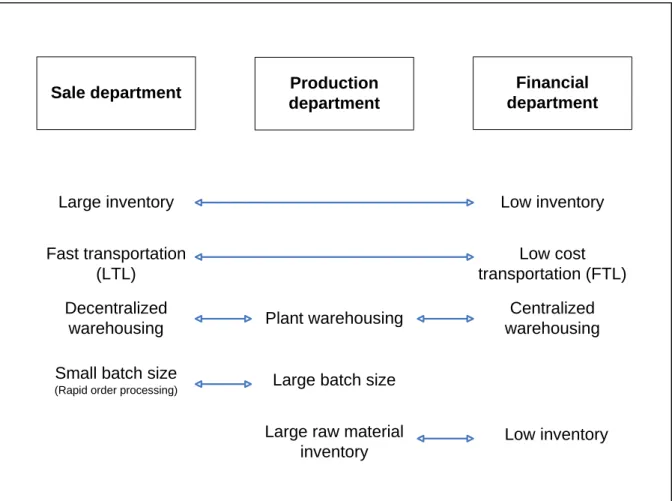
Furthermore, as it is described in figure 3.1, each department may desire to set up goals which are in direct conflict with other departments. For instance, when it comes to warehousing, sale
department’s goals which are more customers focused be quick to respond to a customer’s order. One quick decision would be to house the finished products as close as possible to the customer, which presents the decentralized warehousing method. Varieties of issues are playing a role in consideration of having centralized versus decentralized warehouse and each has its advantages and disadvantages. From the single company perspective, especially from the financial perspective, the decentralized method will need huge amounts of investment, and an increased level of inventory. The former, however, has its own downsides such as an increased risk of obsolescence, etc. Although this is difficult to implement, and risky for an individual firm, it might be seen as beneficial and efficient when it comes to the supply chain point of view.
Production department
Sale department Financial department
Large inventory Low inventory
Fast transportation (LTL)
Low cost transportation (FTL) Decentralized
warehousing Plant warehousing
Centralized warehousing Small batch size
(Rapid order processing) Large batch size
Large raw material inventory
Low inventory
Figure 3.1 Conflict between different departments’ goals
3.2.4 Minimizing the costs of production on a continuing basis
Consider a chain of companies working together for producing and selling some items. Typically each company thinks internally and tries to minimize its cost of production by shifting the costs to other parties in the chain. This is especially the situation where a firm forces its supplier to reduce the price of incoming material. But as it was examined in several case studies by some scholars and authors in this area (Levi et al., 2003; Vollmann et al., 2005) this kind and method of thinking while does not improve the company’s efficiency, may impose many additional costs both internally to the firm as well as externally to the other partners. According to Vollmann et al. (2005), supply chain management represents a major shift in classic manufacturing, planning and control (MPC) thinking. There has been a continuous evolution in MPC approaches, as a more integrated approach to company operations has developed. The shift from fairly simplified tools for inventory control to the
cross functional integration (ERP system), is an example for such these evaluations in MPC systems. But these evaluations primarily focused on improvements (and further integration) inside the firm.
In fact, now the major opportunity lies in more global improvements, that is, a system that achieve synergies through integration across business units from suppliers to customers. Examples include rationalization of the total company supplier base, reducing overall supply chain inventories, decreasing lead/response time, cutting chain obsolescence costs, reducing time to market, responding faster to marketplace realities, synchronizing cross firm
scheduling, and reducing the hidden factory of the chain by eliminating transactions between firms (ibid).
3.2.5 Introducing new technologies
This factor could be described from two different perspectives. First as mentioned previously, due to rapid transformation and changing of the technology in every area and strong
dependency of these days’ professions to particular tools, it is rather difficult to be an expert in various subjects since each expertise needs its typical technology. Both cost and quality of the work is important when a company wants to consider this issue. On the other hand this rapid shifting in the technology could be seen as a competitive advantage for firms if it was located at a correct supply chain. By effective managing the supply chain, all the entities can utilize one another capabilities in order to improve the over all system efficiency.
3.2.6 Improving quality
The term quality is always attached by the concept of customer satisfaction i.e., whenever we are talking about quality it is calculated or considered from the consumers’ point of view. This might be a product itself or other intangible features such as image or service. Martin Christopher (2006) states that: it has long been an axiom in marketing that ‘customers don’t by products, they buy benefits’. Put another way, the product is purchased not for itself but for the promise of what it will deliver.
This opening leads to this expression that how important customer satisfaction is for competitiveness. Also the fact that today consumers are more service sensitive rather than product sensitive in terms of quality. Furthermore, customers measuring this service by factors such as responsiveness i.e. responds better to customer expectation could lead to consumer satisfaction.
Indeed, in terms of product and process quality, several advantages can be gained from managing the whole flow of materials and information from suppliers' suppliers to customers' customers. Furthermore, the quality level delivered to the final customer is the result of the quality management practices of each link in the supply chain, thus each actor is responsible for the final result (Romano et al., 2001).
In an effective management of supply chain, the quality of the whole chain can improve since all the entity realize the customer order and could respond to that as effectively as possible. In the other hand, each partner in the chain knows what the final aims are in terms of the quality demanded by the final user. Moreover, feedback from the final customers increase and able to move far back in the chain. Therefore, this identical vision concerning the quality of the products leads to increase the overall quality of the product and the chain.
3.3 Supply Chain Risk
In recent decades, numerous events have shown the extent to which companies and subsequently their supply chains are open to attack to adverse events. Needless to say no supply chain or logistic system has resistance to any of these events that happen to them. In today’s international world of economy you can not find a firm that working alone without any connection to other companies. Furthermore the increasing complexity that characterizes the actual supply chains determines an always increasing number of sources of uncertainty inside a network (Coachella et al., 2006). Each firm is linked to others and this form a supply chain. As we see there is no escape from the supply chain disruption, every mistake in the each part of the chain embrace the other partners.
Supply chain disruptions can have significant physical costs (e.g., damage to facilities, inventory, and electronic networks) and subsequent losses due to downtime. Research in North America suggests that when companies experience disruptions to their supply chains the impact on their share price once the problems becomes public knowledge can be significant (Christopher, 2006). The research continues that companies experiencing these sorts of problems saw their average operating income drop 107 percent, return on sales fall 144 percent, and return on assets decrease by 93 percent (ibid). Another recent study estimates the cost of downtime (in terms of lost revenue) for several on-line industries that cannot function if their computers are down (Lawrence, 2006). For example, the cost of one hour of downtime for ebay.com is estimated at $225,000, for Amazon.com, $180,000, and for brokerage companies $6,450,000 (ibid). Note that these numbers do not include the cost of paying employees who cannot work because of an outage or the cost of losing customers’ goodwill. Moreover, a company that experiences a supply chain disruption can expect to face significant declines in sales growth, stock returns, and shareholder wealth for two years or more following the incident (ibid).
3.3.1 Source of uncertainty
To understand and succeed the supply chain risks first it is vital to identify and undertake the main sources of risks across the chain.
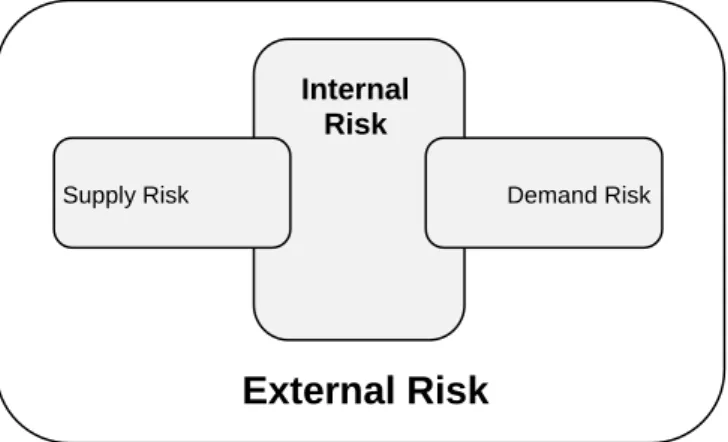
Figure 3.2 Source of risk in the supply chain.
Generally, there are two types of risks that a supply chain could be faced with. Those that are external to the supply chain and some are internal. Since consideration is being on supply
Internal Risk
Demand Risk Supply Risk
chain, two other categories could be added to this classification while included in the main classification. They are supply and demand risks which their importance and unintelligible boundary need separate consideration.
Demand risk could be described as the potential or actual vulnerability in flow of product, information, and cash between the focal company and the market. On the other hand the supply risk has the same description on the opposite way i.e. between the company and upstream. Therefore, it is risk associated with a company's suppliers. While demand and supply risk are naturally considered as an external risk and therefore cannot be influenced by the company’s action, it could be argued that a part of them actually are positioned inside, and the organization has the ability to control and react to them. Figure 3.2 shows the sources of risk and their relation.
Apart from the description above, external sources of uncertainty is constituted by competitors’ action, governmental restriction, natural disasters, wars, terrorism and
epidemics, etc. while those inside the company more relate to the internal process. However, despite the fact that there might be the same risk faced by the organization, each company has a unique risk profile.
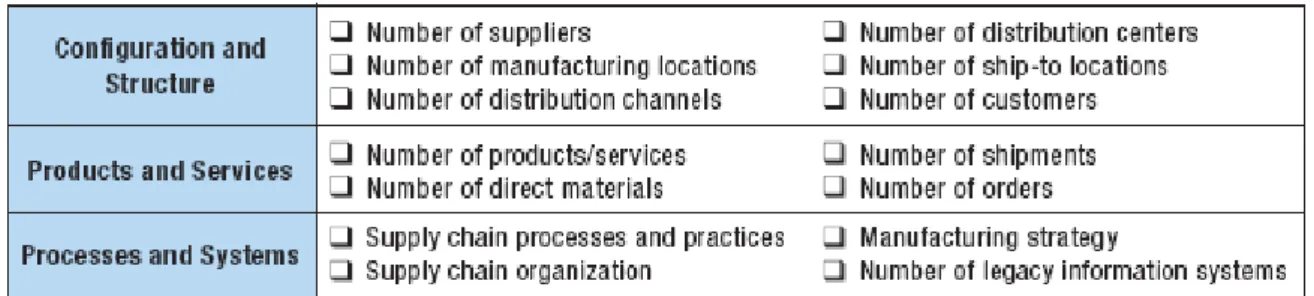
As it described earlier in this chapter companies need to move to the supply chain in order to increase their efficiency. This change in the strategy have several advantages such as utilizing the lean manufacturing concept and increase the level of customer satisfaction, but at the same time increase the complexity of the system. This complexity is due to several sources,
product/service complexity, e-business, outsourcing, globalization, etc (Cucchiella et al., 2006). Furthermore, the high number of sources of complexity exposes the network to an increasing level of uncertainty and the uncertainty level exposes the network at an increasing number of risks. To achieve elevated levels of performance it is necessary to proceed to the correct management of such risks (ibid).
Although we will not considering the managing supply chain risk in this context, the previous subsection seems vital since the overall goal of this thesis is to discuss the benefits, barriers and bridges to effective supply chain management from the logistics collaboration
perspective. These will be considered later in the chapter 6 of this text.
3.4 Logistics, history and definition
From the very beginning of the history of humanity to the building of today modern society, logistics is not a new idea. Procurement of raw materials and convert them to become
serviceable was discovered from the ancient areas all over the world, meaning they used some techniques to provide their necessaries. What is recognized by the profession today as
logistics was concerned with how to move materials to the required place, known as a point of consumption.
Early references to logistics are found primarily in military application (Lummus et al., 2001). Throughout the history of mankind wars have been won and lost through logistics strengths and capabilities or the lack of them (Christopher, 2005). Logistics received much attention from the military during both world wars specially the Second World War that necessitated greater movement of troops and supplies than any other period in history. Until World War II the term logistics began to be used pervasively to describe the support of military forces and their equipment. Beginning in the 1960s, logistical support of weapon systems became an integral part of the planning and design stages of these systems. Logistics was focused on
engineering issues, calculating initial support requirements, and programming resources to keep a system operational after introduction. The Persian Gulf War (Jan. 16, 1991–April 6, 1991) probably contributed to increased recognition because of the frequent mention by news commentators of the logistical challenges associated with the so called 7,000 mile “supply pipeline” to support the war effort in the Persian Gulf countries (Te, 2007). During that time the Defense Logistics Agency (DLA) ‘an agency in the United States Department of Defense’ provided more than $3 billion worth of food, clothing, medical supplies, and weapon system repair parts to the military services of the United States and several Allied nations
(globalsecurity.org). Later, DLA provided more than $69 million worth of food, clothing and medical supplies to the humanitarian relief efforts (ibid). In those first critical months, most of the supplies transported to Saudi Arabia from bread to boots, from nerve gas antidote to jet fuel came from DLA stock (ibid).
The facts described above emphasize the enormous activity being done from the logistics perspective during the gulf war. The exact situation could be generalized to the business area where the planning and management of supply sources, inventories, transportation,
distribution networks, and related activities as well as supporting information to meet
customer requirements is considered. In addition to the definition presented by the Council of Supply Chain Management Professionals mentioned in the previous subtitle, Martin
Christopher (2005) defines logistics as:
The process of strategically managing the procurement, movement and storage of materials, parts and finished inventory (and the related information flows) through the organization and its marketing channels in such a way that current and future profitability are maximized through the cost effective fulfillment of orders.
Besides both definitions it is important to say that Logistics management is vital not only to manufacturing and assembly industries, which are goods oriented, but also to retailing, transport and other distribution or service oriented industries (Huan, 1995). Both cost advantage and value advantage are the issues that can be achieved by effective
implementation of logistics management. Every company is able to utilize the strategy itself and even better the integrated one to overcome the fierce competition in the today world business.
3.5 Why logistics management?
The power of customer and customer requirement is increasing in every market. In other words, attention to these requirements becomes a means for differentiation for company in order to catch the market as the competition become more and more severe. Furthermore, some new requirements are added to the customer expectations that were not essential to consider before. In addition to the product requirements, customers request for a verity of services. Occasionally these services become more vital in the eyes of customers rather than product itself, i.e. it is harder to maintain a competitive edge through the product itself. In a situation like this it is customer service that can provide the distinctive difference between one company’s offer and that of its competitors (Christopher, 2005). Lambert and Stock (2001) define customer services as “a customer oriented philosophy that integrates and manages all elements of the customer interface within a predetermined optimum cost services mix.” Generally, the final goal of any logistics system is to satisfy the customer. In fact each
component of the logistics system can effect whether a customer receives the right product, at the right place, in the right condition, for the right cost, at the right time (Lambert and Stock
2001). The term availability ‘right place at the right time’ is recently considered very
important when it comes to customer service. The companies can not retain the customer any more if they don’t have the products in their stock. Nowadays no one can diminish the negative impact of out of stock. Several studies confirm the fact that the power of brand is decreasing compare to last years and will continue to do so. Also many of the shopping decisions are made at the point of purchase. All of these studies and observation verify the importance of having the product in stock, or availability. And as mentioned, many
companies nowadays apply logistics management in order to satisfy the customer and finally improve the customer service. This in addition to the value advantage acquired by the
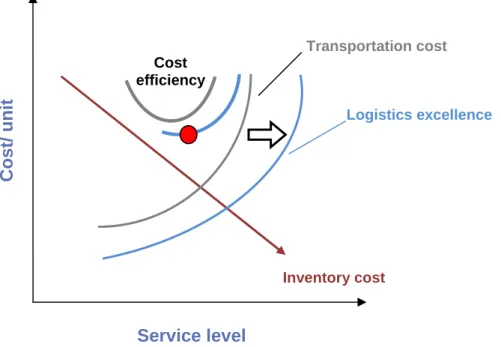
company when utilizing LM since it provides the required service with a minimum cost. As mentioned earlier the word logistics was first associated with the military. During World War II military forces made effective use of logistics models and form of systems analysis to ensure that materials were ate the proper place when needed. The term is still widely used in military and military type applications. The 1958 recession and profit squeeze created an environment in which business began searching for more effective cost control systems. Almost simultaneously, many firms realized that physical distribution and logistics were activities whose costs were neither carefully studied nor coordinated. A number of other trends were becoming apparent, and they made it necessary to focus attention on product distribution (Johnson, 1996). This concept is clearly described in figure 3.3. It shows the example of well-known trade-off analysis between inventory and transportation cost. Generally Logistics costs often shift in opposite directions or in other words are in conflict. As inventory is reduced transport costs rise because smaller quantities are shipped more frequently. On the other hand, as we reduce transport costs by shipping in larger quantities by less expensive modes, inventory levels in the system rise. However these conflicts would be alleviated through efficient logistics management which by improving the logistics and physical distribution, the transportation cost (or as a whole logistics cost) will be decreased while achieving the desired service level and at the same time cost efficiency for whole of the system.
Figure 3.3 Relationship between transportation and inventory costs through improving the
service level
Source: Efficient replenishment project, 1999 Cost efficiency Inventory cost Transportation cost Logistics excellence Cost/ unit Service level
3.6 Collaboration
The supply chain lies no longer with an individual company. Either it will not able to be managed separately. Professions became so specialized and time to market is one of the most important aspects of competitiveness. As it mentioned concentrating in core competencies is a dominant motivator for companies to enter in a partnership. Effective supply chain demands a kind of partnership where each individual in the chain adopt a standardized solution and stands on common goals. Every participant looks after the chain optimization rather than individual advantage. In fact a very immediate and available opportunity when two or more companies involve in a chain is the situation where parties would be able to recognize each other competencies and combine them in order to satisfy the customer requirements. Some other features which may participant anticipate when entering in a partnership are joint planning, management, and measurement; and sharing goals, objectives, benefits, resources, information, and risks with partners. Collaboration is a recognized term which may could explain and entail all of the above features. Based on Min et al. (2005), collaboration should be defined as a firm’s culture of working together with other firms toward a common set of goals that bring mutual benefits to a partnering relationship.
According to Bownan (2004), the best supply-chain performers are deeply involved in relationships that call for tight links between partners. It’s an environment where information flows freely in both directions, upstream to suppliers, or downstream to customers. The situation where manufacturers, distributors and retailers respond quickly to changing business conditions and customer service is paramount.
3.7 Collaborative planning, forecasting and replenishment
(CPFR)
Collaborative planning, forecasting and replenishment (CPFR) is aimed at improving collaboration between buyer and supplier so that customer service is improved while
inventory management is made more efficient (Harrison et al., 2008). According to Levi et al. (2003), forecasts are always wrong, thus it is impossible to predict the precise demand for a specific item, even with the most advanced forecasts techniques. While this expression is quite true, but a very effective method which company may able to alleviate inaccuracy in the forecasts is collaboration. It is quite obvious that each a company have more information available regarding the customer demand the better the forecast may be. Therefore in CPFR which was oriented first time in 1995 by Wal-Mart, it was seen that collaboration is used to solve the errors in forecasts. Based on Emmett and Crocker (2006), using CPFR means that the organization must:
• Develop collaborative agreements; • Create joint business plan;
• Create sales forecasts;
• Identify exceptions to the sales forecasts; • Collaborate/ Resolve these exceptions; • Create the order forecasts;
• Identify exceptions to the order forecasts; • Collaborate/ Resolve these exceptions; • Generate the order.
In summary, CPFR allows for planning rather than reacting, and uses internet technology to reduce inventory and expense, while increasing sales and improving customer service (ibid).
4
4.1 Definition
A supply chain is a network of suppliers, factories, warehouses, distribution centers and retailers, through which raw materials are acquired, transformed, produced and delivered to the customer. Being a complex network of suppliers, factories, warehouses, distribution centers and retailers, the success of any supply chain management system depends on how well these system components are managed and contributed. Levi et al. (2003) state that even if a firm has the available resources to perform a particular task, another firm in the supply chain may sometimes be better suited to perform that task simply because its relative location in the supply chain better positions it to do so.
As we have already mentioned, for organizations to compete in today’s business world which is characterized by globalization, increased customer responsiveness, channel integration and advances in information and communication technologies, they have no other alternative other than participating in a supply chain. Every successful supply chain strategy requires integration, cooperation and collaboration, which in turn demand aligned objectives, open communication, sharing of resources, risks and rewards (Soosay et al., 2008). Bring in mind the definition presented in chapter 3 by the council of supply chain management professional; the final part of the definition declares:
Importantly, it also includes coordination and collaboration with channel partners, which can be suppliers, intermediaries, third-party service providers, and customers. In essence, Supply Chain Management integrates supply and demand management within and across companies.
The definition clearly illustrates the importance of coordination and collaboration with channel partners. In fact in order to have an effective and resistant supply chain, all the entity inevitably should perform a least level of collaboration with other members in the chain. The fundamental rationale behind collaboration is that a single company cannot successfully compete by itself. Indeed no truly successful supply chain could be found where parties involved do not collaborate. Within this definition of supply chain management, collaboration could be defined as a means by which all companies in the supply chain are actively working together towards common objectives.
Actually the parties are collaborating to ensure that the end customer is satisfied. To do this companies involved must share information, knowledge, risk and profits. Sharing entails understanding how other companies operate and make decisions, and goes much deeper than cooperation. Collaboration is mutual goal setting that goes far beyond a normal written
Collaboration
The purpose of this chapter is to define and explain the context of collaboration in the supply chain. As the other kind of business relationship collaboration could be perform in several forms and types which try to be
identified. Finally, refer to the question number one of this research, a framework which could explain the why behind collaboration will be designed.
contract or partnership. According to Anthony (2000), Collaboration is defined as two or more companies sharing the responsibility of exchanging common planning, management, execution, and performance measurement information (Min et al., 2005).
In order to maximize the success of such collaboration there is a need for a deeper
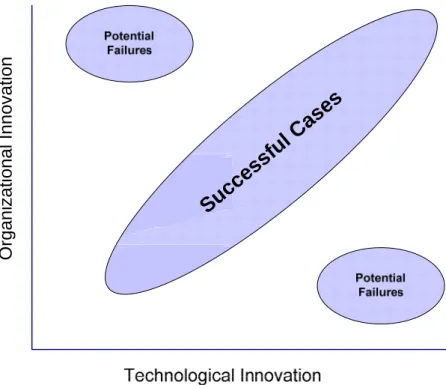
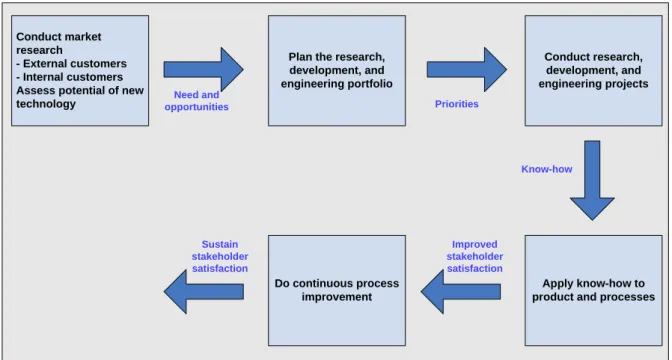
understanding of a number of issues, such as, the motivation to collaborate, where and with whom a firm can collaborate in the supply chain, type and scope of collaboration. These issues will be considered in detail through this chapter. Subsequently, a frame work which indicates the necessity of collaboration in today’s world of business will be described through its relation with complexity and innovation.
4.2 Form of collaboration
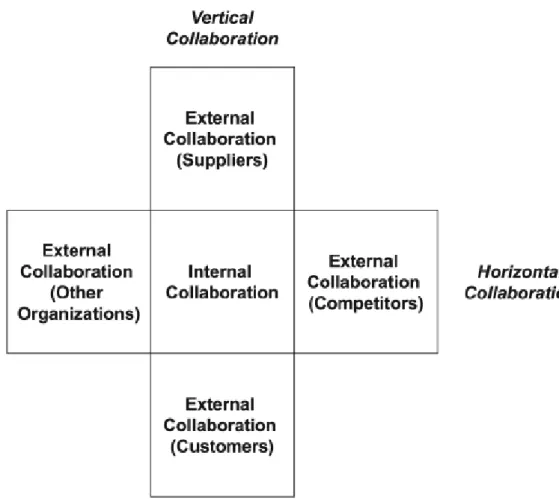
Collaboration in business can be found both in inter and intra organization and ranges from the simplicity of a partnership to the complexity of a multinational corporation. According to Barratt (2004), there are a variety of forms of potential supply chain collaboration, which can be divided into two main categories, vertical and horizontal collaboration (figure 4.1).
Furthermore, Soosay et al. (2008) states the third form of collaboration namely ‘lateral collaboration’, where it combines the benefits and sharing capabilities of both vertical and horizontal integration.
4.2.1 Vertical collaboration
This kind of collaboration would perform internally or along the supply chain. In the case of externally, along the supply chain, it means working more closely with trading partners to improve each other's efficiency for collective benefit. It is about giving and gaining visibility into each others processes so that each can do a better job. For instance manufacturer can directly access the stock holding figures of their retail client to know when replenishment will be needed, the warehouse operator can know when the manufacturer will be calling for a replenishment order from stock, or the raw material supplier can know that the manufacturer has depleted his stock by fulfilling an order and can carry out a delivery.
4.2.2 Horizontal collaboration
Horizontal collaboration requires cooperation between non-competing (or even competing) companies that would not otherwise engage in business, e.g. two manufacturers sharing a warehouse space enabling shared deliveries to retailers, or a number of small manufacturing firm joining their shipments together to buy full vehicle loads (FTL) instead of each paying higher part load rates (LTL).
Figure 4.1 The scope of collaboration Source: Barratt, 2004
4.3 Type of collaboration
Integration is understood to increase the organization’s efficiency both internally and
externally. According to Harrison et al. (2008), if significant improvements can be achieved by internal integration, potential for the benefits of external integration could be even higher. As shown in figure 4.2, relationship between organizations can rang from arm’s length relationships to partnership (collaboration) or even further to joint ventures and vertical integration. Based on Lambert and Stock (2001) normally a firm will have a wide range of relationships spanning the entire spectrum, the majority of which will not be partnerships but arm’s length association. Arm’s length relationships are more transactional in nature. In economics, a transaction cost is a cost incurred in making an economic exchange. Therefore relationship in this level is about to be like a simple contract. For instance a seller provides a product (service) for several buyers which it normally has in a standard format. While this kind of relationship might be proper in many cases, there are situations where parties need to work closer especially when they move towards their core competencies. Generally an organization is involved in several business areas like providing, manufacturing, marketing, distributing, etc. where some or at least one of them is its core competency. Depending on the company’s specific policy, some fields of its job are more important than other and in the case of outsourcing decisions it must be considered more carefully. Whereas some insignificant ones could be achieved through arm’s length relation, the one closer to the core competency of the company understood to be achieved with some kind of partnership where collaborative approach is considered as one of the best practice for this purpose.
Arm’s-length
relationships Type І Type ІІ Type ІІІ Joint Venture
Vertical integration
Partnerships
Source: Lambert and Stock (2001)
Figure 4.2 Types of relationships
However, in spite of its obvious advantages, each company must carefully study the area where integration may increase its efficiency. As specified before integration bring both benefit and risk. That is, while the overall system performance might be increased,
inefficiency in each section decreases the whole system presentation. Therefore understanding the type and level of integration before any action is vital. Many types of inter organizational relationships were introduced by several authors and scholars in the area of logistics and supply chain management (Levi et al., 2003; Lambert and Stock 2001; Harrison et al. 2008). Among them Lambert and Stock (2001) indicates three types of partnership (collaboration) as follows:
Type 1, the organizations involved recognize each other as partners and, on a
limited basis, coordinate activities and planning.
Type 2, the organizations involved progress beyond coordination of activities to
integration of activities.
Type 3, the organizations share a significant level of integration and each party
views the other as an extension of its own firm.
As it is clear, type 1 is handling in operational level while it is more strategic when it comes to type 3 of this classification.
4.3.1 Example of collaborative strategy
In terms of external collaboration, there are number of potential opportunities for vertical supply chain collaboration which include on the downstream side of the supply chain, methods such as customer relationship management (CRM), collaborative demand planning (which include collaborative forecasting and replenishment - CPFR), demand relationship, and shared distribution (Barratt, 2004). And on the upstream side of the supply chain: supplier relationship management (also referred to as supplier development, e.g. VMI), supplier
planning and production scheduling, collaborative design (which could include new product introduction), and collaborative transportation (ibid). Besides, strategic alliance (which could include third party logistics 3PL, retailer supplier partnership RSP, and distribution
integration DI, etc.) may possibly be performed on the both side of the supply chain (Soosay et al., 2008; Levi et al., 2003).
On the other hand horizontal integration occurs when two or more unrelated or competing organizations (at the same level of the supply chain) producing similar products or different components of one product, form a cooperative association to share resources such as warehouse space and manufacturing capacity (ibid).