Knowledge Sharing Plan – ERP Projects
Template
[Before you start:
Under the Australian Renewable Energy Agency Act 2011 (Cth), ARENA is required to promote the sharing of information and knowledge about renewable energy technologies where appropriate. As such, knowledge sharing is considered an integral element of the Project. It is important that the Knowledge Sharing Plan is aligned firmly with the rationale and purpose of the Project and that it reflects the specific aims and nature of the Project.
ARENA’s mandate covers the entire innovation chain and therefore the nature and size of the projects/activities which ARENA supports will vary.
Knowledge sharing obligations will, therefore, need to be suitably tailored to accommodate this diversity. However, it is important that this flexibility occurs within a consistent framework so that ARENA and the renewable energy sector are able to:
ensure that data/information being collected is of high quality;
aggregate and analyse data/information across different projects; and make use of the same data/information for different purposes.
This template is intended to guide and assist you in developing a Knowledge Sharing Plan for your Project. ARENA expects Knowledge Sharing Plans to generate and disseminate a substantial amount of high value data, information and lessons learned.
The specific items of data and information that will be covered by your Knowledge Sharing Plan will be subject to negotiation.
While the Knowledge Sharing Plan will be tailored to suit the scope and size of your Project, in developing the Plan, you should consider the following:
Objectives – It is important that your Knowledge Sharing Plan has well defined objectives. What critical question/s about renewable energy in Australia is the Project trying to answer? What critical knowledge gap/s is the Project aiming to address? These should be consistent with any Outcomes listed in item Error! Reference source not found. of Error! Reference source not found. of the Funding Agreement.
End users – To be of value, knowledge needs to be used by someone. Who are the intended end users of the knowledge that will be generated and disseminated under your Knowledge Sharing Plan? If organisations, who within the organisations – e.g. the CEO, technicians, financial officers, or somebody else?
Data and data methodology – the likely volume and complexity of the data and information that will be collected; whether and to what extent the data and information collected will require processing or analysis.
Implementation – whether knowledge sharing activities will require specialist personnel or IT support, including web-based platforms; whether you will need to use collaborative
arrangements with relevant partners.
Commercial sensitivities – mechanisms for sharing commercially sensitive information e.g. methods for redacting data, time delays for the release of data, aggregation of data, synthesis reports and small group discussions held under Chatham House rules.
Dissemination – a wide range of dissemination strategies beyond written documents; making use of existing opportunities to disseminate knowledge e.g. participation in industry forums,
conferences, webinars etc.
ARENA’s business development team and client managers will work with you in the finalisation of your Knowledge Sharing Plan.]
1.
Introduction
On [insert date] ARENA and [insert name of Recipient] (Recipient) entered into an Emerging Renewables Program Funding Agreement number [insert] (Funding Agreement), under which the Recipient has certain knowledge sharing obligations.
The Recipient has developed this Knowledge Sharing Plan in consultation with ARENA, and must comply with this Knowledge Sharing Plan for the term of the Funding Agreement.
Terms used in this Knowledge Sharing Plan which are defined in the Funding Agreement have the same meaning unless the context requires otherwise.
2.
Purpose
Under the Australian Renewable Energy Agency Act 2011 (Cth), ARENA is required to promote the sharing of information and knowledge about renewable energy technologies where appropriate. As such, knowledge sharing is considered an integral element of the Project. Effective knowledge sharing is central to ARENA achieving its twin objectives of improving the competitiveness and increasing the supply of renewable energy in Australia.
ARENA invests public money, and knowledge is one of the returns it expects from this investment. Effective knowledge sharing with key players in the Australian energy sector including EPC contractors, DNSPs, regulators, investors, researchers and planners helps to build a stronger, more resilient energy system with increasing levels of renewable energy.
This Knowledge Sharing Plan identifies the data, information and knowledge that will be generated and shared throughout the Project, along with how it will be shared, in accordance with an agreed timetable. In relation to data generated by the Project, it also outlines the methodology that will be used to capture, store, assess and report this data.
3.
Knowledge sharing objectives
The Recipient must use its best endeavours to contribute to the advancement of the [insert sector] sector’s knowledge in [insert number of, or name of, areas] areas.
The Outcomes for the Project are specified in Error! Reference source not found..
The objectives of the Knowledge Sharing Activities (Knowledge Sharing Objectives) support delivery of the Outcomes and are:
(a) improved understanding of the performance characteristics of [insert technology] deployed;
(b) timely data that is correct and of a sufficient quality to enable accurate calculation of the levelised cost of electricity in relation to [insert technology];
(c) more accurate technology readiness and commercialisation readiness levels for [insert technology], including [insert];
(d) improved understanding of the financing requirements for [insert technology] developments;
[Insert a list of project-specific knowledge objectives. Please be as specific as possible. Some examples might include:
(f) improved understanding of the costs of drilling and completing a geothermal well, including by increasing the publicly available data on specific cost elements including mobilisation/demobilisation, site preparation, EPC and associated costs;
(g) an improved understanding of the resource and its flow performance in particular the way in which heat is able to be transferred to the surface for use in either electricity
generation or, if appropriate, other uses such as direct heat;
(h) the actual cost of designing and constructing utility scale (>1MW) solar PV facilities in remote regions;
(i) improved understanding of the factors affecting economic viability of solar PV with storage integrated with existing diesel generation in [off grid/fringe of grid/grid constrained] areas;
(j) increased understanding of the performance characteristics of [insert technology] in [insert conditions, location and/or application];
(k) improved understanding of design and construction techniques for rooftop integrated photovoltaic systems;
(l) increased level of publically accessible online material or tools that inform the plant design of [insert biomass technology and feedstock];
(m) the optimal operations and maintenance program required to achieve financial and operational efficiencies for a [insert technology] plant of [insert size] in [insert region]; (n) improved understanding of supply chain systems including logistics and handling systems
for large quantities of agricultural by-products; and
(o) improved [insert data area e.g. resource data, generation data, grid constraint information] for [insert technology].]
The Project is to answer the following critical questions that need to be answered to improve the competitiveness and supply of renewable energy technology in Australia:
(a) [insert the critical questions the Project will answer]
4.
Key knowledge sharing audiences
In undertaking the Knowledge Sharing Activities, the Recipient must take into consideration the following audiences:
(a) ARENA, including the ARENA Executive and Board; (b) the Commonwealth;
(c) [insert sector] and allied services companies; (d) investors [delete if not applicable];
(e) researchers [delete if not applicable]; and
(f) [insert any other groups that would particularly benefit from this knowledge and the Recipient’s delivery of the Knowledge Sharing Objectives identified above].
[The audiences identified in this section should help you determine the most effective types of knowledge and knowledge sharing activities to use.]
5.
Confidentiality and dissemination of knowledge
In undertaking its legislated knowledge-sharing function, it is anticipated that ARENA may share information with other areas of government and with the public. The Recipient will provide information of varying levels of confidentiality, from little or none to highly valuable and confidential intellectual property.
To maximise the knowledge sharing benefit, the Recipient has established a level of confidentiality of information provided to ARENA. Accordingly, information the Recipient shares with ARENA is categorised according to those persons with whom it may be shared as follows:
(a) the public (unrestricted) – This information may be shared freely within ARENA, with industry participants, and with the public in general.
(b) the public (restricted) (Restricted Information) – Subject to any restrictions imposed by the Recipient, this information may be shared freely within ARENA, with industry participants, and with the public in general.
(c) ARENA only (Recipient Confidential Information) – this information may be shared freely within ARENA and with other areas of government with equivalent privacy management and control processes and in accordance with clause Error! Reference source not found..
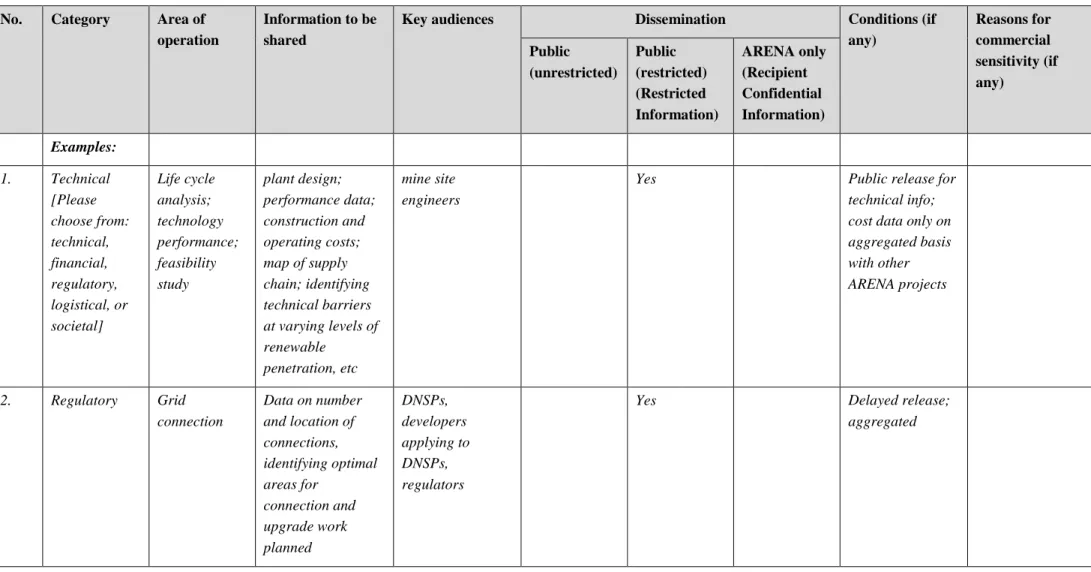
Table A identifies the knowledge that will be generated by the Project and those persons with whom it may be shared.
The Recipient must apply the dissemination levels in Table A to knowledge generated by the Project. The Funding Agreement determines the treatment of Intellectual Property Rights and Recipient Confidential Information.
It is the Recipient’s responsibility to ensure that any Project documentation (including Milestone Reports and other Reports) prepared for public release does not contain any Recipient Confidential Information.
Table A – List of high value knowledge to be generated by Project
[Table A should be as comprehensive as possible, clearly identifying the specific knowledge that the Project will generate that will help improve the competitiveness and supply of renewable energy technology. It should also be as specific as possible. It may help to order this knowledge according to the life-cycle stage (see below).]
No. Category Area of
operation
Information to be shared
Key audiences Dissemination Conditions (if
any) Reasons for commercial sensitivity (if any) Public (unrestricted) Public (restricted) (Restricted Information) ARENA only (Recipient Confidential Information) Examples: 1. Technical [Please choose from: technical, financial, regulatory, logistical, or societal] Life cycle analysis; technology performance; feasibility study plant design; performance data; construction and operating costs; map of supply chain; identifying technical barriers at varying levels of renewable penetration, etc mine site engineers
Yes Public release for
technical info; cost data only on aggregated basis with other ARENA projects 2. Regulatory Grid connection Data on number and location of connections, identifying optimal areas for connection and upgrade work planned DNSPs, developers applying to DNSPs, regulators
Yes Delayed release;
6.
Data
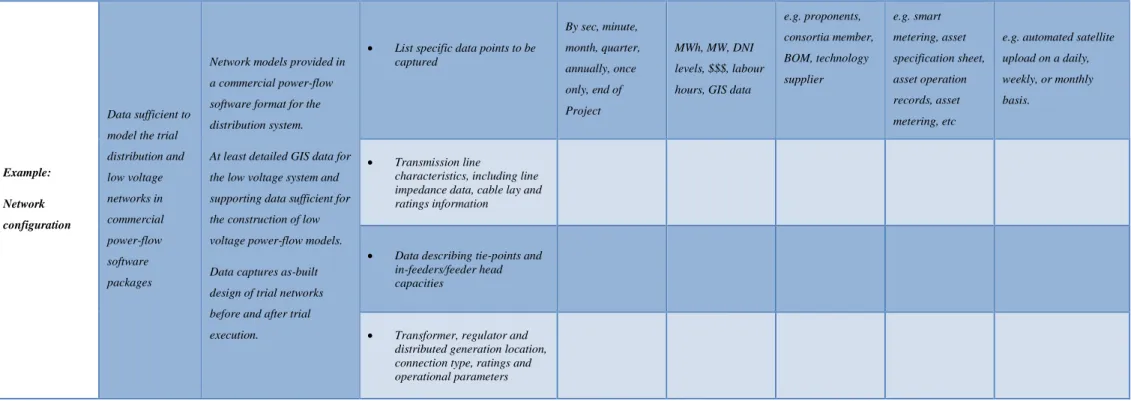
Table B sets out the data that must be generated, collected and stored from the Project to answer the critical questions identified in item 3 of this Knowledge Sharing Plan. [This table may be deleted in consultation with ARENA if your project will not be generating data.]
The Recipient must provide the data specified in Table B to ARENA on a [insert timeframe e.g. monthly/quarterly] basis as specified in Table B.
Table B – Data management and transfer
Overview (description of data)
Collection methodology considerations
Data categories Sampling frequency
Format (specific data units and components)
Data provider and owner
Data source Transfer process / how supplied to ARENA
[Insert first critical question as listed in item 3 of this Knowledge Sharing Plan. Each critical question should be listed as a sub-heading in this table with the relevant data points listed under each one.]
Example:
Network configuration
Data sufficient to model the trial distribution and low voltage networks in commercial power-flow software packages
Network models provided in a commercial power-flow software format for the distribution system. At least detailed GIS data for the low voltage system and supporting data sufficient for the construction of low voltage power-flow models. Data captures as-built design of trial networks before and after trial execution.
List specific data points to be captured By sec, minute, month, quarter, annually, once only, end of Project MWh, MW, DNI levels, $$$, labour hours, GIS data
e.g. proponents, consortia member, BOM, technology supplier e.g. smart metering, asset specification sheet, asset operation records, asset metering, etc
e.g. automated satellite upload on a daily, weekly, or monthly basis.
Transmission line
characteristics, including line impedance data, cable lay and ratings information
Data describing tie-points and in-feeders/feeder head capacities
Transformer, regulator and distributed generation location, connection type, ratings and operational parameters
Overview (description of data)
Collection methodology considerations
Data categories Sampling frequency
Format (specific data units and components)
Data provider and owner
Data source Transfer process / how supplied to ARENA
Load profile information derived from at least half-hourly load sampling and load connection points (including relevant phase information)
[As well as describing high value knowledge items (in Table A), you will need to clearly specify your methodology for capturing, storing and assessing data from your Project. This will include:
defining the form and metrics for collecting the data/information (using Table B above); describing whether the item requires any specific processing, or handling; and
ensuring data fields proposed to be collected can be accurately and reliably analysed to answer the critical questions identified in your Knowledge Sharing Plan. This may be supported by examples from previous work, the use of existing models or standards, or by demonstrating your approach with sample data. This is fundamental component of your Knowledge Sharing Plan. ARENA may seek expert advice to ensure the veracity of your proposed analysis. ARENA may also contract a third party to collect, store, analyse and report on data across its programs. This would be in addition to the Project-specific analysis and reporting set out in this Knowledge Sharing Plan.
Please also outline your arrangements for the proper storage and back-up of the data and information required for knowledge sharing purposes under this Agreement.
For further guidance in preparing a data methodology, please refer to the documents ‘Data and Information Methodology: Guidance for the Design Capture, Storage, Analysis and Reporting of Data and Information’ (parts one and two), which were prepared with input from the CSIRO to assist with the identification and collection of robust and consistent data from across the projects ARENA funds. Part two includes a detailed menu of possible data points that you can select from. Of course, there may be others that are relevant to your Project that you wish to add. The document is available on the ARENA website or by contacting ARENA.]
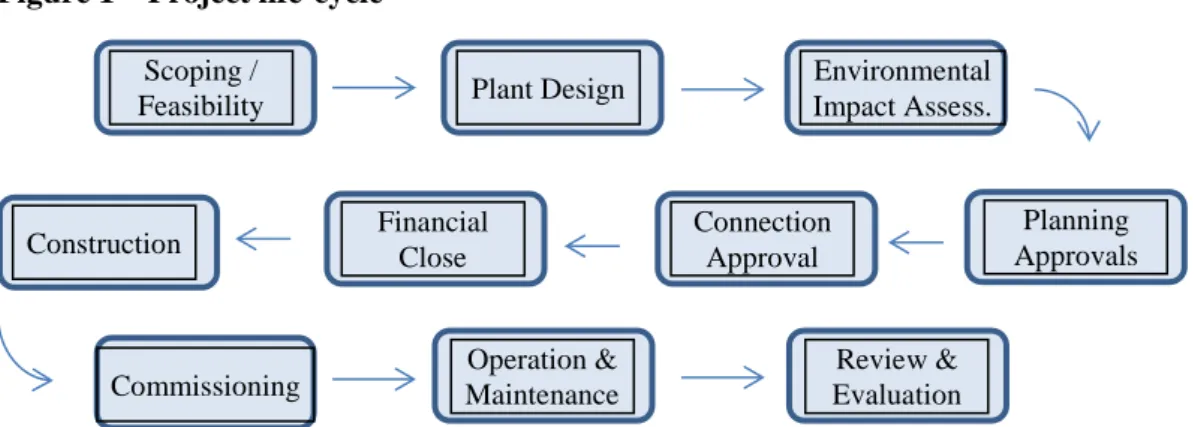
[The knowledge identified in Table A is to be shared throughout the Project’s life-cycle. Figure 1 provides an outline of a life-cycle for a typical large-scale renewable energy project.
Figure 1 – Project life-cycle
The purpose of this diagram is to identify the most relevant stages for knowledge sharing (both reports and activities) to assist completion of Table C.]
7.
Knowledge Sharing Activities
The Recipient must undertake Knowledge Sharing Activities as outlined in Table C below.
Table C – Detailed program of Knowledge Sharing Activities
Project stage and timeframe
Number and type of Knowledge Sharing Activity
High value knowledge to be shared and provided to ARENA Intended audience Further information (optional) Related No. in Table A Examples: (note not all examples may be relevant to your Project) Plant design (insert month)
Three roundtables Details of site operating plan including key design challenges overcome and an overview of the integration system
ARENA Government Regulators Feasibility study completed (insert month)
Two reports – one technical for engineers and developers; one higher level for senior managers
Details of the optimal plant design including the issues identified (supply chain, integration, etc) and the solutions proposed ARENA Developers Financiers Governments
Construction Webinar with other funding Logistical challenges encountered with Project managers Webinar to be hosted by
Plant Design Environmental
Impact Assess. Connection Approval Construction Commissioning Planning Approvals Financial Close Scoping / Feasibility Operation & Maintenance Review & Evaluation
Project stage and timeframe
Number and type of Knowledge Sharing Activity
High value knowledge to be shared and provided to ARENA Intended audience Further information (optional) Related No. in Table A
(insert month) recipients in the Emerging Renewables Program
remote installation and the solutions adopted within project developer and construction companies ARENA Operation and maintenance (insert month)
Two site visits – one for financiers and energy users; one for
Government, NSPs and regulators
Overview of the plant (design, construction) and technology performance Financers Regulators NSPs Energy users Government To be held once 6 months of performance data has been collected Plant performance (insert month) Two reports on first 12 months of operation – one at a higher level for managers; one at a more detailed technical level Performance of the plant against forecasts and correlated to seasons, temperature, rainfall, and atmospheric pressure records NSPs Energy users Government Project completion (insert month) Two presentations at industry conferences Details of experimental results including key design challenges overcome Researchers Research institutions Project completion (insert month) Public impact report
Potential market for technology, standard of research compared to international competitors, international collaboration and co-investment ARENA Government Early-stage investors Researchers General public
[Knowledge sharing activities may take a variety of forms. Some examples include expert roundtables or peer-assist workshops, public forums, presentations or participation in conferences, site visits, webinars, reports posted online or emailed to stakeholders, data sets, data visualisations and web-based tools, websites or social media platforms, journal articles or posters, models, and staff exchanges/secondments. If the same knowledge is being shared through several different activities (e.g. a report and a presentation) each activity should be listed separately. Table C should be
completed with the audience in mind – e.g. are they a senior executive, a technician, or member of the public.]
8.
Reporting
[Note: If progress reports are required under item Error! Reference source not found. of Error! Reference source not found., this section will be amended so that Milestone Report requirements also apply to progress reports.]
8.1
Reporting on Knowledge Sharing Activities
(a) Each Milestone Report must include a description of:
(i) the Knowledge Sharing Activities completed during the period to which the Milestone Report relates, including a list of any public reports or knowledge sharing reports;
(ii) the outcomes of those Knowledge Sharing Activities; and
(iii) any data or documentation developed from the Project during the period to which the Milestone Report relates.
(b) The Final Report must include details of:
(i) all of the Knowledge Sharing Activities completed as at the date of the Final Report;
(ii) analysis of the effectiveness of each of the Knowledge Sharing Activities so completed;
(iii) for any on-going Knowledge Sharing Activities, an update of progress in undertaking each Knowledge Sharing Activity; and
(iv) an assessment by the Recipient of its success in achieving the Knowledge Sharing Objectives.
8.2
Project failure report
In the event of Project failure, the Recipient must, within 20 Business Days after the Project failure, provide a report to ARENA for public release explaining the reasons for the failure and the Project Lessons Learnt.
8.3
Schedule of standard metrics (quantitative)
[Insert timeframe, eg in each Milestone Report or on a financial year basis] the Recipient must provide to ARENA a prescribed schedule of standard metrics that will:
(a) inform levelised cost of electricity (LCOE) calculations by ARENA and the Bureau of Resource and Energy Economics (BREE), noting that ARENA intends that the final calculation for each technology will be publicly available but not individual project data; and
(b) provide overall information on the performance of ARENA’s investment portfolio, (p) using the following template:
[At Project inception, this table should be completed using Project forecasts. Ongoing reporting should report actual recorded costs or performance data. This is a standard requirement across all ARENA-funded projects. The Project-specific data will be kept confidential, but may be used publicly in an aggregated form (e.g. total MWs generated by all ARENA-funded projects or by all projects within a particulartechnology category). In particular, information provided under 'Finance costs' will be for ARENA and Commonwealth use only, unless otherwise agreed in the Knowledge Sharing Plan.]
Input Unit Total value
Description of category source (i.e. estimated, references, based
on x analysis) Plant life and performance
Plant capacity (gross)
MW
Maximum or rated generation or energy supply from a plant without losses and auxiliary loads taken into account
Plant capacity (net) MW
Capacity factor %
Feedstock conversion efficiency % If applicable (e.g. biomass)
Generation MWh /year
- Gross MWh /year
- Net MWh /year
- Total onsite RE output
- Total non-RE output
Expected start of commercial
production Quarter and year
Estimated start date (quarter and year)
Plant lifetime
years
An estimate of the operating life of a particular technology prior to repowering or decommissioning
Annual tonnes CO2e emission intensity tCO2e/MWh
Total tCO2e and % of emissions
captured (if any) tCO2e and %
Total storage capacity MWh
Number of hours storage used Hours/year
Maximum rate of discharge
Life of storage system years If different from plant lifetime
Expenses prior to construction
Total expenses prior to construction $
- Studies and project development $
- Site acquisition $
- Project support team $
Input Unit Total value
Description of category source (i.e. estimated, references, based
on x analysis)
- Duties and taxes $
- Operator training $
- Commissioning fuel $
- Commissioning and testing $
Capital costs
Total capital cost (excluding
decommissioning) $
Major plant costs $
- Turbine $
- Inverter $
- Panels $
- Storage $
- Materials cost $
- Other major plant costs $
Minor equipment and labour work $
Electrical and site preparation costs
$
electrical upgrades, transmission to point of interconnection and other grid upgrade costs
Fuel and cooling costs $
Grid connection costs $
Additional break up of capital costs:
- Local equipment/ construction
costs %
These three should add up to 100%
- International equipment costs
% These three should add up to
100%
- Labour costs
% These three should add up to
100%
- EPC (engineering, procurement,
construction) costs %
These two should add up to 100%
- Owners’ costs % These two should add up to 100%
Fixed operating and maintenance costs
Input Unit Total value
Description of category source (i.e. estimated, references, based
on x analysis)
Total fixed annual operating and
maintenance costs $/year
- Direct labour and associated
support costs $/year
- Minor spares and fixed operating
consumables $/year
- Fixed service provider costs $/year
- Fixed inspection costs, diagnostic
and repair maintenance services $/year
- Insurance $/year
- Land leases $/year
Variable operating and maintenance costs
Total variable operating and
maintenance cost $
- Chemicals and operating
consumables that are generation dependent – e.g. raw water, and water treatment chemicals
$
- Feedstock cost $/GJfeed,HHV
- Scheduled maintenance for entire
plant including balance of plant $
- Unplanned maintenance $
Finance costs
Total finance costs $/year
Interest rate %
Assumed gearing level % Debt / total capital requirement
Equity internal rate of return
requirement %
Should be post-tax (deduct tax subsidies)
Term of debt Years
Construction
Input Unit Total value
Description of category source (i.e. estimated, references, based
on x analysis)
Construction profile
%/year
The percentage of expenditure of capital costs each year of construction period (for example, 100% in first year)
Other (ARENA portfolio reporting)
Diesel displacement estimation L
No. of direct employees (on project) FTE Across the whole project lifecycle
8.4
‘Lessons learnt’ (qualitative reporting)
Each Milestone Report must include 'lessons learnt' knowledge sharing reports which capture all Project Lessons Learnt since the previous Milestone. A separate 'lessons learnt' knowledge sharing report must be provided for each Project Lesson Learnt. Each 'lessons learnt'
knowledge sharing report must use the template provided by ARENA.
[These short one page reports are intended to capture the nuggets of knowledge that were learnt and perhaps were not a pre-determined learning of the Project. There may be only one key lesson learnt between Milestones or there may be multiple lessons to be captured. These are required in addition to pre-determined knowledge identified in Tables B and C.]
9.
Specified Personnel
[Insert name] occupying the position of [insert position] will be the central contact point for ARENA for the Knowledge Sharing Activities.
10. Knowledge Sharing Partner
[Applicants are to, in consultation with ARENA and to ARENA’s satisfaction, engage a third party to provide technical expertise and logistical support for the design and implementation of the
Knowledge Sharing Plan or specific Knowledge Sharing Activities, including processing, analysing and synthesising data and information. Alternatively, the Recipient may demonstrate the capacity to carry out the Knowledge Sharing Partner’s role in-house.
The Recipient must ensure that any arrangement or relationship with the Knowledge Sharing Partner includes requirements which enable the Knowledge Sharing Partner and its personnel to have access to the Recipient’s Personnel, the Project site and equipment, data, information and Project Lessons Learnt.]
[Insert organisation name] (Knowledge Sharing Partner) has been appointed as the Recipient's knowledge sharing partner for this Project to provide technical expertise and logistical support for the design and implementation of the Knowledge Sharing Plan and Knowledge Sharing Activities, including processing, analysing and synthesising data and information.
The Recipient must ensure the Knowledge Sharing Partner undertakes the following tasks: (a) [Insert a list of tasks]
The Recipient must ensure that the services or outputs which the Knowledge Sharing Partner is required to deliver are produced to at least the standard agreed by the parties in this Knowledge Sharing Plan.
11. Budget Estimate
The Recipient has allocated approximately ____ hours and $_____ (ex GST) from within the Project Budget towards implementing this Knowledge Sharing Plan.