Management Accounting in Small Construction
Companies – A comparative case study.
Pauliina Kolehmainen s144870
Department of Accounting
Hanken School of Economics
Helsinki
HANKEN SCHOOL OF ECONOMICS
Department of: Accounting Type of work: Master’s
Thesis
Author and Student number: Pauliina Kolehmainen s144870
Date: 21.9.2015 Title of thesis:
Management Accounting in Small Construction Companies - A comparative case study.
Abstract:
Historically, most management accounting research has focused on large corporations and the smaller companies have received increasing attention only during the past ten years. However, the small company research has mainly been conducted in high-tech and fast growing firms and therefore this thesis studies management accounting use in small, traditional business area companies.
Research method is a comparative case study and material was gathered from three construction companies by interviews. Theoretical framework consists of contingency theory, life cycle theory and management control systems as a package -approach. Additionally, entrepreneurship and growth factors are included in the analysis. The results show that management control systems are used even in these small companies. Mostly used systems are monthly income statement, cash flow statements, budgets, short-term planning and cultural controls. The results support findings from previous research and the approach of looking at management control systems as a package is found functional.
Keywords: Management accounting, management control systems, small business, micro companies, growth factors, construction, contingency theory
CONTENTS
1
INTRODUCTION... 1
1.1 Motivation ... 1
1.2 Problem area and research questions ... 2
1.3 Definitions ... 4
1.4 Structure of the thesis ... 5
2
THEORETICAL FRAMEWORK ... 6
2.1 Introduction ... 6
2.2 Management accounting ... 6
2.3 Management control systems ... 9
2.3.1 Contingency theory ... 13
2.3.2 Life cycle theory ... 16
2.3.3 Management control systems as a package ... 20
2.4 Management accounting in small business context ... 23
2.4.1 Previous research based on contingency theory ... 25
2.4.2 Previous research based on life cycle theory... 27
2.4.3 Previous research in high-tech firms ... 30
2.5 Small business and growth ... 33
2.6 Summary ... 37
3
METHODOLOGY ... 38
3.1 Research method ... 38
3.2 Data gathering and research process ... 38
3.3 Validity and reliability ... 40
4
CASE COMPANIES ... 42
4.1 Company A ... 43 4.2 Company B ... 44 4.3 Company C ... 465
RESULTS ... 48
5.1 Introduction ... 485.2 Management control systems in the case companies ... 48
5.2.1 Planning ... 49
5.2.3 Reward and compensation controls ... 55
5.2.4 Administrative controls ... 56
5.2.5 Cultural controls ... 57
5.3 Contingency theory ...58
5.4 Life cycle theory... 63
5.5 Entrepreneurship and growth ... 64
6
CONCLUSIONS ... 70
6.1 Conclusions ... 70 6.2 Discussion ... 73 6.3 Limitations ... 74 6.4 Further research ... 74SVENSK SAMMANFATTNING ... 76
REFERENCES ... 86
APPENDICES
Appendix 1 Interview form in English ... 90Appendix 2 Interview form in Finnish ... 94
TABLES
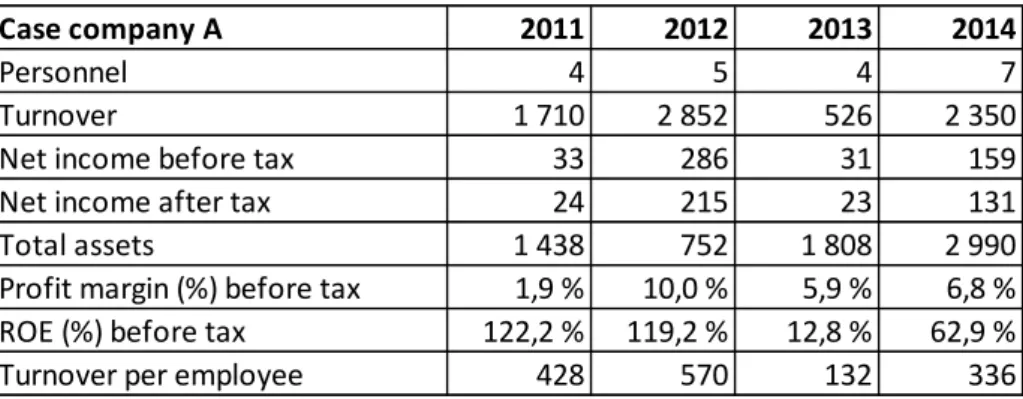
Table 1 Case company A: Key financial information. ... 44Table 2 Case company B: Key financial information. ... 45
Table 3 Case company C: Key financial information. ... 47
Table 4 Summary of results related to entrepreneurial attitudes ... 65
FIGURES
Figure 1 Life cycle stages and contextual variables in relation to MCS. ... 12Figure 3 Management Control Systems package (Malmi & Brown, 2008, p. 291). .... 20
Figure 4 MCS in the context of this study. Modified from Malmi and Brown (2008). ... 23
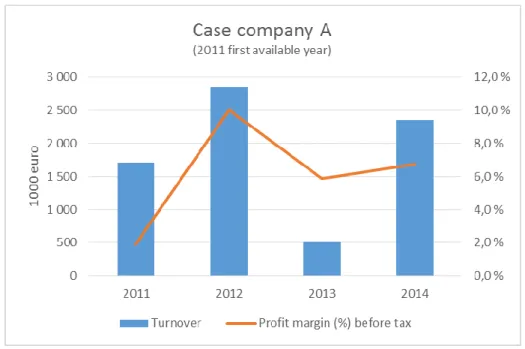
Figure 5 Case company A: Turnover and profit graph. ... 43
Figure 6 Case company B: Turnover and profit graph. ... 45
Figure 7 Case company C: Turnover and profit graph. ... 47
1
INTRODUCTION
1.1 Motivation
Increasing interest towards entrepreneurship has emerged both globally and in Finland during the recent years. Private companies are seen as the way to improve employment and growth of national economies. This is especially true in Finland, where the global financial crisis, the decline of the Nokia –cluster and the structural changes of other industries has lead to recession and in any case to a long period of modest growth possibilities.
However, research combining management accounting, small companies and growth is almost non-existent based on the initial literature review, especially in the Finnish context. Tornikoski, Saarakkala, Varamäki and Kohtamäki (2011) have conducted a research regarding small and medium sized companies, growth factors and controlling of growth. They report findings from the case companies that financial knowledge, profitability and funding are perceived important. The author of this thesis has over ten years of experience in management accounting in a large company and additionally from running a micro-sized family company, hence providing a personal interest in the topic. Why are small companies important? Because 96 % of new jobs are in fact created in companies employing less than 100 people (Räisänen & Koponen, 2013). The focus of this thesis to small companies can be justified with a few facts. According to The Federation of Finnish Enterprises (2012) 93,3 per cent (264 435 companies excluding primary production) of all Finnish companies employ less than 10 people. Out of these companies, about 64 per cent are so called self-employment-businesses, and if those are excluded it still leaves 94 435 micro companies who employ more than one person. If 50 per cent of these micro companies could employ one person more, it would create approximately 45 000 - 50 000 new jobs. Even though the high-growth firms have high potential to employ, it should be noted that The Enterprise Review reported only about 400 high-growth companies in Finland in 2008-2011 (The Ministry of Employment and the Economy, 2013). Furthermore, the Ministry notes that not all the entrepreneurship has the same value from the national economy’s perspective, referring to the so-called “forced-entrepreneurship”, where self-employment is the main reason for entrepreneurship, usually as a subcontractor to a large company. According to the same
report, Finland needs to improve the leverage between private sector jobs and the total population by 200 000 new jobs from year 2013 to 2020.
Change in the global economy during the past ten years has increased competition for example through internet trade. Thus, the expected uncertainty also for smaller companies has increased. This should lead to increased focus on profitability, ensuring competitiveness even in the changing circumstances. Kauppalehti reported 1st April
2015, that 50 % of small and medium sized companies in Finland currently have no debt at all and most of them are creating profits, but the very modest growth and investment rates are of concern. Therefore, it is fruitful to focus on the small companies, where it is both possible and necessary to create growth in the future.
Historically most academic research in management accounting has concentrated on large companies and only recently somewhat on small and medium sized companies, but still leaving the segment of specifically small and micro companies out of the loop. Furthermore, the focus of the scarce research so far has been mostly on the fast growing high-tech companies, not on traditional business areas. This study will provide insight to this segment. Practically this study aims to provide input firstly to the entrepreneurs themselves and secondly also to public actors. It is important to acknowledge this segment’s contribution for the national economy and provide an environment, where also these companies could grow. This study aims to provide further information to accountants as well, how could management accounting be promoted in small companies.
1.2 Problem area and research questions
Based on the initial literature review, this topic seems rather under-researched. Most of the management accounting research is conducted in large companies (see e.g. Mitchell & Reid, 2000; Jänkälä, 2007; Chapman, Hopwood, & Shields, 2009) and in the context of smaller companies, the focus has been mainly on the high-tech growth firms (see e.g. Granlund & Taipaleenmäki, 2005; Davila & Foster, 2007). Some master’s thesis have touched upon these topics as well, but none directly from the angle of combining management accounting and small companies (Forsberg, 2013; Janatuinen, 2013; Eklund, 2014). Additionally, the scarce research that exists in small business context suffers from unclear and varying definitions of small business, sometimes including also medium-sized companies (Jänkälä, 2007).
Thus, this thesis will focus on the small firms operating in the traditional business areas, such as construction and transportation. The reason is that there are some notable differences in the business models when comparing the traditional and the high-tech businesses; the business area itself is not necessarily growing rapidly, there is less focus on R&D, business model demands more tangible investments, products and services are not entirely scalable and cost structure is more complex. A specific aspect regarding many high-tech companies is also the presence of Venture Capital (VC) funding, which is usually not the case in the traditional businesses. To illustrate the differences, one can consider the case company from software industry in Janatuinen’s (2013) thesis, running 2-4 million-euro sales in an international setting without any formal management accounting in place. In comparison, the construction business case company in Forsberg’s (2013) thesis had a need to implement a management accounting system in order to handle and control the running of a 1 million euro turnover locally in Finland. The purpose of this study is to investigate how management accounting is used in the small companies operating in traditional business areas. The use can be informal or formal. The role of the growth literature is to provide additional dimension to the topic. This enables for example analysis of the results against the findings of management accounting use in high-tech growth firms. Possible similarities and differences can provide further insight to the research topic. The base assumption from the previous research is that management control systems are needed to support growth (Mitchell & Reid, 2000; Jänkälä, 2007; Sandino, 2007; Davila & Foster, 2007; Davila & Foster, 2009; Davila & Oyon, 2009; Davila, Foster, & Oyon, 2009).
Research questions
The problem area described above will be studied with three specific research questions 1) What management control systems are used in the case companies?
This question aims to cover the gap identified in the previous research (e.g. Mitchell & Reid, 2000; Jänkälä, 2007), concerning the management accounting and management control systems use in the smallest, traditional business area companies. To facilitate this, the case companies are chosen to represent the majority of the Finnish companies, which employ less than ten people.
2) How are the management control systems used?
After identifying which management control systems are implemented, the use of the systems will be studied. This question aims to deepen the understanding of whether the systems are used for decision-making, guiding the behaviour of others or for other purpose.
3) Is there a linkage between the use of management controls and growth ambitions? Thirdly, the study aims to investigate, if the management control systems used contribute to growth ambitions in the case companies. As noted above, the jobs created in the small companies are of great importance to the whole society, hence making the growth of these companies important. The use of management control systems has been identified to support growth and controlling for growth by the previous research (e.g. (Jänkälä, 2007; Davila & Foster, 2007; Davila & Foster, 2009).
Limitations
The purpose is not to study specifically factors that the entrepreneurs see as enabling or hindering growth, but to combine these in a meaningful way to the aspects of management accounting, which can be seen as enabling (profitable) growth. Furthermore, this thesis will not concentrate solely on any individual management control system, such as only budgets or performance measurement, but it will look upon the management control system as a package.
1.3 Definitions
Management accounting is used as the top-level definition. Within management accounting (MA) is included management control systems (MCS), management accounting systems (MAS) and for example profitability measurement.
Small and Medium sized Entrepreneurs (SME) = Employs > 250 people, annual turnover is > 50 million euros or total balance sheet value is less than 43 million euros and fulfils the European Commissions requirements for independence. (The Ministry of Employment and The Economy, 2015)
Small company = Employs less than 50 people, annual turnover or total balance sheet value is > 10 million euros and fulfils the European Commissions requirements for independence. (The Ministry of Employment and The Economy, 2015)
Micro company = Employs less than 10 people, annual turnover or total balance sheet value is > 2 million euros and fulfils the European Commissions requirements for independence. (The Ministry of Employment and The Economy, 2015)
Growth company = As defined by the Ministry of Employment and the Economy, EU and OECD: company employs 10 people at the starting point and is growing at least 20 % in amount of personnel for 3 following consecutive years. (The Ministry of Employment and the Economy, 2013)
Start-up company = No EU and OECD definition exists, but generally means young, under 5 years old growth companies. Also known as gazelles. (The Ministry of Employment and the Economy, 2013)
High-tech (growth firm) = Fast growing or targeting to fast growth, operating in the information and communications technology and biotech (life sciences) industry. Characteristics are R&D, knowledge intensity and venture capital finance. This does not mean only start-ups or dot.com firms, though those are often characterized by above-mentioned qualities. In this definition, these companies could be of any age or size. Also referred to as New Economy Firms (NEF). (Granlund & Taipaleenmäki, 2005)
Traditional business areas = Companies outside information and communications technology and biotech (life sciences) industry, electronic services, or internet trade.
1.4 Structure of the thesis
The first chapter has introduced the research topic, its relevance and specific research questions to the reader. The rest of the thesis is organized as follows: the second chapter will present the theoretical background, chosen framework and relevant previous research. Research design, methodology and data gathering will be covered in chapter three. Case companies will be briefly presented in chapter four and the actual results in chapter five. Last chapter provides conclusions and discussion and the abstract in Swedish is included after conclusions.
2
THEORETICAL FRAMEWORK
2.1 Introduction
This chapter presents the theoretical background and previous research relevant to the research topic and questions in this thesis. The purpose is to present justification for the chosen approach and typology, which will be used later in the study for the analysis of the results. Theoretical background consists mainly of scientific articles presented in academic journals, with ABS ranking of two or better. The sources were identified during the initial literature review and through search made in Google and Google Scholar with key words “management accounting in small business” and “obstacles for growth” both in English and with similar search terms in Finnish.
The research field of management accounting is wide and therefore the literature review mainly concentrates on the aspects related to small businesses. Thus, this chapter begins with a brief overview on management accounting, then moving on to management control systems and small business context. A brief review of entrepreneurship and growth literature is covered in the last part of this chapter.
2.2 Management accounting
As defined by Drury (2004), accounting can be divided to management accounting and financial accounting based on the users of the information. Management accounting is concerned to provide information to the internal users within the organization, enabling better decision-making and improvements in operational efficiency. Furthermore, the purpose of management accounting is to provide information to planning, control and performance measurement. Financial accounting’s main target groups are external users of information, such as shareholders, creditors and other stakeholders. Sometimes management accounting is referred to as external accounting and financial accounting as internal accounting.
The term management accounting is used in this study. It is understood as the overall, umbrella-like, main concept. Within the management accounting research are included several sub-fields, such as performance measurement systems, strategic management accounting and management control systems. Terminology used in previous research is sometimes mixed or not properly defined, which makes comparison and analysis of results difficult. As noted by Chenhall (2003) in his extensive review, the terms
management accounting, management accounting systems, management control systems and organizational controls (OC) are sometimes used interchangeably. He also points out that adoption of MCS and implementation of systems are two separate issues. As this study investigates small companies, which are not expected to have many formal systems implemented, it is logical not to focus on the systems. The MAS are therefore seen as part of the management control system, similarly as by for example Collier (2005).
Management accounting research has utilized theories from social and human sciences and various methodological approaches. This can be seen as a richness for the research field, but also as a necessity for capturing the complexity of design and operation of management accounting systems. (Chapman, Hopwood , & Shields, 2009; Scapens & Bromwich, 2010). Based on the literature review, two theoretical approaches are central: contingency theory and life cycle theory, which both origin from the organizational studies. From economics based theories, the research has used for example agency theory and resource based view.
On the other hand, even within the contingency-based research, as criticized by Chenhall (2003), there is a mixture of studies focusing on different questions. This variety can lead to a fragmented knowledge, as critical mass of evidence on the different topics is not achieved. Chenhall concludes though, that the variety is needed due to for example the novelty of some of the research topics, but still there is room for improvement when considering the modelling and definitions, replication and coherence of measurement. Davila, Foster and Oyon (2009) and Davila and Foster (2009) report similar richness of approaches in reviews of recent literature concerning management control systems in entrepreneurial companies. The methods commonly used in studies are: case (e.g. Granlund & Taipaleenmäki, 2005), survey (e.g. Sandino, 2007), and multi-method (e.g. Davila & Foster, 2007). The existing research mostly uses theoretical background from functional or economics perspective (information processing, lifecycle models, contingency theory, agency theory, psychology and signalling/legitimizing models). In the future, for example psychological and sociological perspectives could widen the knowledge, concerning for instance the entrepreneurial characteristics and mind set. (Davila, Foster, & Oyon, 2009). According to authors of these reviews, the research of MCS in small business context can be seen to be at crossroads with entrepreneurship literature. There are numerous rich research opportunities in this field, which will enable better understanding of the phenomenon and be useful to practitioners. The knowledge
for example about the evolution of informal controls as the companies grow, is just beginning to unfold. (Davila & Foster, 2009; Davila, Foster, & Oyon, 2009). Therefore, this thesis includes to a limited extent also previous research results about entrepreneurship and growth.
Jänkälä (2007) states that the past few decades of management accounting research has focused in finding and implementing ways to improve competitive advantage and hence organization’s performance. Jänkälä summarizes (p. 18) that the mainstream of the recent empirical research has dealt with current management accounting practices and techniques in different organizational and social contexts. Jänkälä (2007) describes the main research approaches:
New management accounting techniques implementation and adoption, including the pros and cons of outcomes. Jänkälä names new techniques such as activity-based calculations, the balanced scorecard, non-financial measures and economic value added.
The role of contemporary accounting practices in different managerial and changing settings, reliance on performance measures and the impacts on decision making.
Design and characteristics of management control systems. These studies have contributed to the understanding the relationships between different components and contextual factors. Usually the key variables have been based on the contingency theory of organizations: technology, strategy, size,
organizational structure, environment and culture.
This thesis study falls to the third category according to Jänkälä’s classification. The next section will present more thoroughly the contingency and life cycle approaches to MCS. As stated by Davila and Foster (2009), the developing nature of entrepreneurial companies makes life cycle models intuitively appealing. These authors continue that contingency theories have a long research tradition, but they can be seen to be static by nature. Still, there are studies in small business context successfully applying the contingency theory (see e.g. Gul, 1991; Reid & Smith, 2000, Jänkälä, 2007) as well.
2.3 Management control systems
This section will first discuss the definition of management control systems and establish how they are understood in this study. As already noted in the previous section, there is a variety of approaches and definitions used in the research of management accounting and the same is true for management control systems (Merchant & Otley , 2007). Thereafter, the contingency and life cycle approaches and the chosen typology for this study are presented.
Even though the concept of MCS has widened from the historical accounting-based controls (cybernetic) to today’s broader view, the contingency-based research still regards MCS in the conventional way, as a passive tool assisting manager’s decision-making (Chenhall, 2003, p. 129). This view is challenged by Simons’ definition (1995, p. 5) of MCS as “formal, information-based routines and procedures managers use to maintain or alter patterns in organizational activities”, and the levers of control-framework. Davila, Foster and Oyon (2009) claim that there is a change in paradigm starting notably from Simons’ work. The concept of interactive systems and levers of control, which can and should be adjusted by the management for different outcome objectives, is ground building also in relation to innovativeness. Simons’ framework is also intrinsically dynamic and hence fits the dynamic nature of entrepreneurship. Furthermore, the development of a more dynamic approach to MCS is understandable from the practical viewpoint of how the global business environment has changed during the past few decades.
However, Simons’ definition of MCS can be criticized for undermining the role of informal controls, which are central in small and entrepreneurial companies. In this type of a context, a large part of the possible control dimensions would be missed, unless cultural and administrative controls were included. Collier (2005) states that the research would benefit from a model, which includes both formal, system-based and the social and cultural controls. Collier also touches upon the problem of not producing enough repetitive evidence and accumulating results with comparable models and methods. Another issue with management control research is the studying of different controls separately. As none of the controls in real life function in isolation, it is difficult to assess, what is the outcome of a single control and how much the outcome may be affected by other factors. (Malmi & Brown, 2008; Fisher, 1998).
For further illustration of the richness of definitions in the field, Drury’s and Jänkälä’s definitions are presented here next. Drury’s (2004, p. 644) definition is “…management control systems which consist of a collection of control mechanisms that primarily have an internal focus. The aim of management control systems is to influence employee behaviours in desirable ways in order to increase the probability that an organization’s objectives will be achieved”. This definition can be seen to be quite well in line with the Malmi and Brown (2008) definition. On the other hand, Jänkälä (2007, p. 57) defines MCS in her study broadly “as a system conveying useful information to assist managers in their decision making to achieve desired organizational outcomes or goals efficiently”, explicitly mentioning decision making as a purpose.
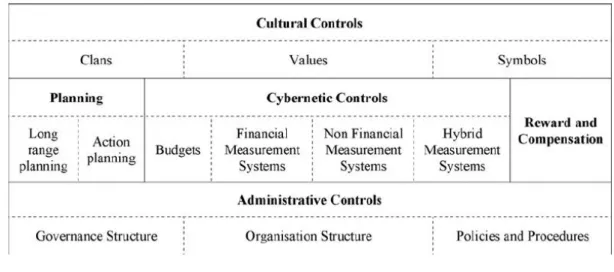
In an attempt to address both of the issues mentioned above, Malmi and Brown (2008) present a new typology for MCS. Their new model aims to synthesize nearly four decades of MCS research, providing a broad approach for empirical studies and to facilitate and stimulate the discussion and research within this research area. The authors willingly acknowledge that further research should refine the model. They state that studying MCS as a package can provide better understanding of how a range of controls can support organizational objectives, control activities and drive performance, including how the informal controls may substitute or complement the formal controls. Nevertheless, the authors state (p. 288) the three main challenges of studying MCS as a package: 1) The distinction between MCS and information/decision-support system, 2) What conceptually forms a MCS, what elements are included and excluded, and 3) Difficulties of conducting empirical research on these often very large and complex systems. In their definition, Malmi and Brown (2008, p. 290) state “Those systems, rules, practices, values and other activities management put in place in order to direct employee behaviour should be called management controls. If these are complete systems, as opposed to a simple rule (for example not to travel in business class), then they should be called MCSs.”
Malmi and Brown (2008) are very explicit about why accounting systems used for decision-making purposes should be named as MAS. Thekey should be in managerial problem of directing employee behaviour. Also mere target setting and performance measurement does not constitute a MCS; employee behaviour should be directed towards achieving organizational objectives and strategies. This definition raises an interesting question from small-business point of view: is the distinction between decision making and directing employee behaviour as significant? At least in the very
early-stage or otherwise small companies, everything is intertwined, interdependent and informal. The usage of certain controls might be today for decision making but tomorrow (with growth) towards directing others. Therefore, this study takes the view that a MCS in a small and micro company can include both decision making support for the owner-manager as well as tools to guide others. The second problem seems to be answered by the authors themselves (2008, p. 291) “The strength of the typology lies in the broad scope of controls in the MCS as a package, rather than the depth of its discussion of individual systems.” The third problem can in fact be addressed partly by MCS studies in small companies, as there the simpler structure provides possibility to observe the interaction of controls and their development from informal to formal (Mitchell & Reid, 2000; Jänkälä, 2007; Davila & Foster, 2009).
The Malmi and Brown typology for MCS will be used in this study. Its contents are more throughly presented in section 2.3.3. The main reasons for choosing this particular typology is that it is comprehensive, broad, contemporary and it addresses both informal and formal controls, which are specifically of interest in small business context. The use of this comprehensive typology then again enables possible further research even in larger entrepreneurial companies. Additionally, if the assumption is that more formal management controls become necessary when the company grows and direct monitoring is no longer sufficient, then it makes sense to use the same framework even in this small and micro company context. The only exception that is made to the original definition is to allow the purpose of MCS use to be both for decision making and directing others. Based on the literature review and the small business scope, the agent theory approach was not included in the theoretical framework applied in this thesis. Therefore, the key points of the agent theory in relation to MCS are briefly considered here. The agent problem exists in organizations due to the separation of ownership and management. Owner (principal) and manager (agent) do not necessarily have the same goals, hence forming a need for the owner to monitor the managers’ actions. This creates costs for the owner, known as the agency costs. (Scott, 2009). However, no agency problem exists in the very small companies, when the owner is the manager and he or she can monitor the personnel directly. In these case companies, the owner-manager is responsible for running the day-to-day operations. As stated by Davila and Foster (2009) MCS has a role to mitigate the agency costs in both cases, when 1) company grows and e.g. spreads geographically and direct monitoring is no longer possible and 2) outside investors are added.
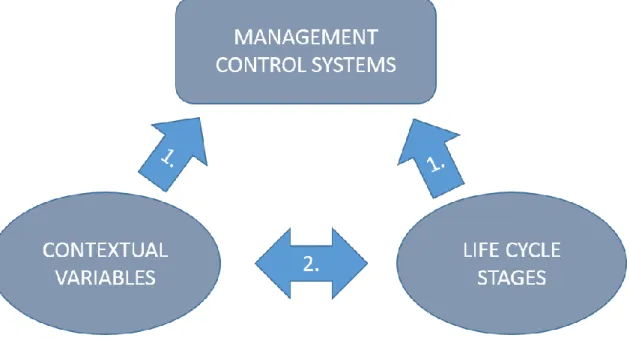
Before moving on to the presentation of contingency theory and life cycle theory separately, an attempt is made to explain how they can be seen in relation to one another.
Figure 1 Life cycle stages and contextual variables in relation to MCS.
Both theoretical approaches assume that there are specific factors (variables) which effect the design of management control system. In the picture above, number one (1.) illustrates the individual approach, when either life cycle stage or contingencies are considered to influence MCS. In contingency approach, this would mean that the contextual factors, such as external environment and technology, define how the specific MCS should be designed (see e.g. Drury, 2004). In life cycle approach the stage in which the company exists in, holds generic characteristics that would determine the suitable MCS design (Miller & Friesen, 1984).
In the above picture, number two (2.) illustrates the approach in which contingency and life cycle theories are not treated as mutually exclusive. This approach has been used by for example Moores and Yuen (2001) and Sandino (2007). In this approach, the idea is that the generic life cycle stage in fact constitutes of different contextual factors or the other way around, the life cycle stage of the company determines the relevant contingencies.
2.3.1 Contingency theory
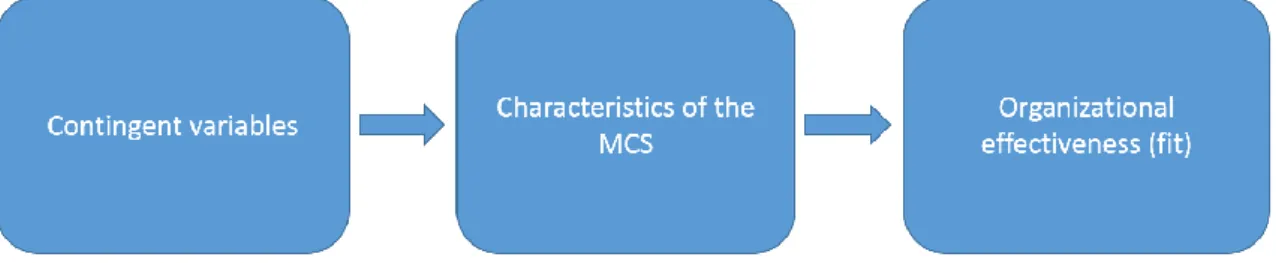
The contingency theory builds on organizational theory and is commonly known for the approach “it all depends” (Merchant & Otley , 2007). Contingency theory originally began as an opposite research stream to the universalistic control approach, which has its roots in the scientific management theory (Fisher, 1998). The universalistic theory assumed that there is one best MCS, which would fit any organization or situation. Fisher (1998) notes that contingency theory lies between the two extremes, the other one being situation-specific approach, which argues that each company and situation is so special that no generalizations about the control systems can be made. As Chenhall (2003, p. 157) states: “The term contingency means that something is true only under specified conditions”. Thus, according to contingency theory, the best MCS design depends on situational factors equalling contingencies (also called contextual factors, contingent variables and contingent factors). The contingency theory approach has produced a broad range of empirical studies since its emergence in the 1970s. (Drury, 2004)
Figure 2 Contingency theory framework. Modified from Drury (2004; p. 697).
According to Chenhall’s (2003) review, the contingency-based research can be classified to three main streams: 1) the meaning of MCS, 2) outcomes of MCS and 3) contextual variables and MCS. As the first topic relating to the definition problematics has already been discussed, the focus here is on points two and three.
Firstly, outcomes can be defined as use or usefulness of MCS and behavioural and organizational outcomes. This research includes the fundamental concept of “the good fit”, meaning that a fit between the management control system and the contextual variables leads to improved effectiveness. The evaluation of fit is done in relation to outcomes such as financial results, efficiency, and job satisfaction. However, research often uses self-assessment, which has validity problems. From a small company and entrepreneur perspective, it is reasonable to assume that an owner-manager does not adopt or implement a system without at least perceived usefulness. Again, terminology and definitions are by no means unproblematic or generic. Additionally, it has been
problematic, how to control for other possible variables and factors. Some researchers have solved this issue by simply leaving out the measurement of the organizational effectiveness. In the limited scope of this thesis, the evaluation of fit is excluded as well. Still, the fundamental purpose of a MCS quite directly links to organizational goals, thus it seems that the broader view of MCS facilitates also addressing more variables. (Chenhall, 2003; Drury, 2004)
Secondly, the third research stream regarding the contextual variables and MCS has been able to produce quite generally approved list of the key variables. The key variables are external environment, technology, organizational structure, size, strategy and culture. (Chenhall, 2003). Each variable and the main effects it may have on the design of the MCS are presented below.
External environment refers to the factors, which affect the company’s external functioning environment. The environmental uncertainty is the most researched variable in this category. Other elements could be for example: dynamic – static, simple – complex environment. (Fisher, 1998; Chenhall, 2003; Drury, 2004) Again, a note should be made about the proper definition of the different terms, such as uncertainty, hostility, turbulence, complexity. The research of environmental uncertainty has provided two major contributions to the small and entrepreneurial companies: 1) the more uncertain the external environment the more open and externally focused the MCS is needed (Chenhall, 2003) and 2) under higher uncertainty a more sophisticated MAS has a positive effect on performance and under lower uncertainty it can have a negative effect (Gul, 1991). Chenhall (2003) predicts that environment and uncertainty will continue to be a central variable in the future research, as the external environment is changing at increasing pace (globalization, networking, IT) and this prediction is also supported by Jänkälä (2007).
Generally, technology can be defined as the means of how inputs are transferred to outputs in an organization, including the resources used in the process. From MCS perspective three important aspects arise: complexity, task uncertainty and interdependence. For example high complexity, non-standard products would demand more flexible MCS. Based on prior research, high task uncertainty and high interdependence require more informal controls, such as personal and clan controls (broad definition of MCS). Due to historical reasons, most research has focused on traditional, manufacturing industries, in the future more research should be conducted in service industries, public sector and non-profit organizations. (Chenhall, 2003)
Previous research has focused on organizational structure mainly on aggregated level in large corporations. Not surprisingly, formal, traditional MCS (such as budgets) are commonly used in large companies with decentralized organization. Then again, R&D and marketing departments facing more task uncertainty seem to prefer for more flexible, informal controls. This remains an important research topic, considering the developments like empowering organization, flat organization, team-based organization and so forth. (Chenhall, 2003). This variable contains also compensational issues, which have been identified as future research area in entrepreneurial context as well (Davila, Foster, & Oyon, 2009).
A few studies have actually focused on size; it has been an underlying assumption that larger corporations use more formal MCS. Therefore, size has usually been used as a control variable. However, a little research has been conducted in the SMEs, which probably provide interesting research opportunities to be explored. (Chenhall, 2003). However, Davila (2005) has studied the development of HR related management control systems in high technology growth companies. The results of this quantitative analysis show that size has positive effect on the adoption of MCS. Size has an effect when the cost of governance by only informal means becomes too high and leads to a more formal approach. Personnel controls are informal in small companies, which allows also the new employees quickly to adopt the company culture. When company grows, this is no longer alone sufficient and for example a proper introduction procedure becomes necessary. Size also drives formalization in forms of rules and role descriptions. Additionally, for instance compensation and rewards are in the hands of the owner in a small company, but as the company grows, it becomes difficult to evaluate personally each person’s performance.
Chenhall (2003) notes that strategy is a bit different in comparison with the other variables, being something the management can change and influence. The choice of strategy can then in its turn help management to some extent influence the other contextual factors (environment, technologies and organizational structure). However, as pointed out by Porter (1996), it is important to understand the difference between operational effectiveness and strategy. Operational effectiveness should be seen as a necessity for any successful business, but not as the strategic goal itself. The original, generic strategies by Porter are cost leadership, differentiation and focus (Porter, 1996). Simons (1995) work regarding management control systems is central in this topic, how the controls can be used in relation to chosen strategy. If previously the research focused
on finding the MCS that best fits the chosen strategy (static approach), Simons’ levers of control framework brought dynamics into the equation. However, Chenhall (2003) notes that the main archetypes of strategy were developed during the 1970s and 1980s, which can lead to the question of their relevancy in today’s world. Still, Porter (1996) notes that even a consistent strategy does not need to be static, but it should be adjusted based on for example the environmental factors, to maintain its competitive advantages.
Chenhall (2003) notes that the variable culture has been so far quite under-researched. Culture can be defined as national culture or organizational culture. It should be noted that the Malmi and Brown (2008) MCS typology specifically includes cultural controls as well.
The main criticism of the contingency theory is pointed at the difficulty of defining the theoretical concepts, constructs and models and lack of repetitive, cumulative empirical research thereof (Drury, 2004). However, Chenhall (2003) summarizes his review, that although criticized, the contingency-based research has formed a basis for generalized propositions between elements of MCS and context and solid amount of empirical research. Additional criticism raises the question, whether any amount of empirical research will provide generalizable results across time and different cultures, when both the organizations evolve and contextual factors change continuously. In other words, the implication would be that the results from any given study would always be applicable only in that particular context and point in time. (Merchant & Otley , 2007)
2.3.2 Life cycle theory
Davila, Foster and Oyon (2009) note that the recent empirical findings challenge the traditional view of controls being in contradiction with new venture creation and innovativeness. Traditional view of controls emphasizes “command and control”, to eliminate “insecure and risky” innovativeness. This development in MCS research can be said to have taken more than 30 years, as Greiner (1998) actually challenged this view already in 1972 (his original 1972 article was republished in 1998). Greiner describes the life cycles, periods of stable evolution, interrupted with short crisis and revolution stages. Noteworthy from this study’s perspective is the first “crisis of leadership”, when the entrepreneur should change his or her mind set towards managerial duties, including a more formal management system and controls.
Greiner’s theory describes how evolution happens through crisis to the next level. His model includes five key dimensions, which affect the development: Age of the organization, size, stages of evolution, and stages of revolution and the growth rate of the industry. According to Greiner, revolution or crisis emerges once management practises become outdated for the organizations current needs. The key is then to find new set of organizational and managerial practices to use during the next period of evolutionary growth.
Growth rate of the industry is interesting, as it relates to differences between high-tech firms and traditional business areas. Quick growth in number of employees requires sooner suitable organizational structures, but “Evolution can be prolonged and revolutions delayed, when profits come easily” (1998, p. 57).
In Greiner’s (1998) five phases of growth-model each phase is characterized by management practice to achieve growth and crisis thereafter describe the problems that must be solved by the management in order to continue growth and move to next phase. From this thesis study’s perspective, mainly the two or three first ones are interesting, as Greiner’s model refers to a very large corporation structure, which does not directly transfer to an entrepreneurial company.
1. Creativity: Focuses on creativity, founders are usually technically or entrepreneurially oriented and not too keen on managerial or administrative duties. However, as the company grows, handling the growth demand also more formal procedures and knowledge / focus on administrative such as HR tasks. Growth may require e.g. external capital, which puts more pressure on the financial accounting information. The entrepreneurs may wish they could go back to the “good old times” and a crisis is under the way. Nevertheless, the individualism and idealism is essential in this phase for the new company to start flying. → Crisis of Leadership: Need for (usually external,
professional) new manager or at least management practises whom / which can lead the company out of the crisis. Greiner notes that the founding owner may not be suitable for this task and might have difficulties in giving the position to someone else.
2. Direction: Usually adopts a functional organization e.g. marketing is separated from the sales, accounting systems for inventory and purchasing, incentives, budgets, work standards, more formal communications. The lower lever managers have less influence on the central administration, which can lead to frustration. → Crisis of Autonomy: During this crisis, most companies seek for solution through delegation (in 1998 review, Greiner prefers to call this decentralization).
3. Delegation: Managers at different levels acquire more power and responsibility, and top management satisfices with
interest and top management feels that they lose control → Crisis of
Control: Top management tries to regain control, but this is difficult due to the now vast scale of operations.
4. Coordination: Top management introduces more sophisticated, formal systems for coordination. Decentralization is transferred to e.g. global product groups. Formal planning and follow up of activities. Headquarter staffing for corporate functions. Focus on invested capital, use of stock options and company wide incentives. Aims to achieve growth more profitably. Usually this leads to lack of trust between the line managers (“field”) and
headquarters. → Crisis of Red Tape
5. Collaboration: In essence, new ways of working, not only relying on formal procedures is needed for further development. Emphasizes
interpersonal collaboration, communication and more flexible approach to management. Typically HQ staff is reduced, more emphasis on e.g. matrix-type task forces and teams. → Crisis of ?
In small, entrepreneurial companies, the key is probably in the transition from the first to the second phase: unless the owner-manager wants to take this step and the “necessary” crisis and revolution, there is a little chance for the company to achieve substantial growth. As Greiner (1998, p. 67) puts it: “If they choose to grow, they may actually grow themselves out of a job and a way of life they enjoy”.
MCS research (see for example Moores & Yuen, 2001; Granlund & Taipaleenmäki, 2005) utilizing life cycle theory usually builds on Miller and Friesen (1984). In this longitudinal study, Miller and Friesen tested the life cycle model empirically with 161 periods from 36 firms. Based on the theoretical literature review, they present the five common life cycle stages: birth, growth, maturity, revival and decline. Variables associated with stages were environment, strategy, structure and decision-making. Miller and Friesen (1984) find support for the interaction of the variables within a stage and differences between stages. However, the results do not support the theory that organizations would move through the stages linearly.
The five life cycle stages are described briefly below (Miller & Friesen, 1984):
Birth: firms are young, dominated by their owners and have simple and informal structures.
Growth: Birth develops to growth once the company has found its competitive advantage and has had some initial product-market success. In this stage, the company then tries to scale its success and this leads to need to develop the organization (to handle the
growth). Miller and Friesen name for instance establishing functionally based organization with middle management. Procedures are formalized.
Maturity: The rapid growth levels out and organization becomes more stable. Emphasis is on smooth and efficient operations. Might also lead to an organization that is more bureaucratic.
Revival: According to Miller and Friesen, this phase is typically dominated by need to cope with more complex and heterogeneous markets. This is achieved by creating divisional organization and control and planning systems that are more sophisticated. Decline: Stagnation, as the markets dry-up and the company is not able to revive (lack of innovation). Sales and profitability decline.
Birth stage company was defined as less than 10 years old, informal structure and dominated by owner-manager. Growth company definition was sales growth by over 15 per cent, functionally organized structure and early formalization of policies.
The empirical findings show that the progress along the stages is not as straightforward as the theory suggests. The length of the periods can vary significantly. It should be seen more as a tendency, not an evolutionary imperative. For example, maturity can be followed by decline, revival or growth and growth can be followed by maturity or direct decline. The authors conclude that the key attributes (strategy, situation, structure, decision-making) seem to be able to define and predict the phases. Secondly, the phases seem to differ significantly more than earlier thought. The changes the organization goes through between the stages are various and many. The key attributes seem to be interdependent in many ways and are hardly changed independently of one another. It should be noted that age alone does not necessarily mean life cycle changes, in other words a firm can stay on some stage if its strategy and size becomes fixed. (Miller & Friesen, 1984)
Davila, Foster and Oyon (2009) note that the life cycle model is a common approach in organizational research. In MCS research there has been mixed findings though, namely regarding the claim of crisis-driven adoption of controls (Collier, 2005; Granlund & Taipaleenmäki, 2005). The evolutionary perspective of the life cycle models propose that MCS are adopted to address the challenges faced with the growth (controlling and managing growth). Further research should address this question, whether evolutionary
or crisis-driven approach better suits the research in entrepreneurial companies. (Davila, Foster, & Oyon, 2009).
2.3.3 Management control systems as a package
The Malmi and Brown (2008) conceptual framework is used in this thesis to analyse the management control systems as a package. From the small company perspective, it is meaningful to consider MCS as a package, as the informal controls are expected to play an important role and one does not expect to find many formal systems implemented (Collier, 2005; Sandelin, 2008; Davila & Foster, 2009).
Figure 2 illustrates the typology and its different elements are described below. Cultural controls are presented at the top, and broadly affecting the whole control system. Respectively administrative controls at the bottom create the foundation and structure, in which the other controls are executed. In other words, cultural and administrative controls can also be seen as the context, in which the other controls function. The planning, cybernetic and reward and compensation controls are assumed to be linked to each other and are presented in temporal order from left to right. (Malmi & Brown, 2008)
Figure 3 Management Control Systems package (Malmi & Brown, 2008, p. 291).
Planning provides goals to organization, which enables the directing of behaviour and co-ordination of activities. Short-term planning is done for the coming year and has tactical and operational focus. Long-term planning with more strategic focus is done for
time window more than 12 months ahead. Malmi and Brown compare their definition to Merchant and Van der Stede (2007), who include planning and budgeting together in their typology as financial control systems. Malmi and Brown argue that planning is not only tied to financial (budgetary) planning, as for example action planning. (Malmi & Brown, 2008). This view is supported by Davila and Foster (2007), who use classification to financial planning, human resource planning and strategic planning. Nevertheless, planning often forms the basis for financial control.
Cybernetic controls include budgeting and measurement systems. According to Malmi and Brown, in this category the difference between decision-making and control tool is distinctive. If for example an accounting-based system is used by a manager to detect and correct a variance, it is used as a decision making tool. On the other hand, if the information is used to effect someone else’s behaviour and actions, perhaps holding subordinate accountable for a certain outcome, then the use complies with the control tool definition. (Malmi & Brown, 2008)
Budgeting is one of the corner stones of any MCS and is widely used by organisations. In addition, the smaller and growth businesses commonly utilize budgeting (see e.g. Sandino, 2007). Its purpose is to set target levels and enable evaluation of outcomes against those plans. The outcomes to be evaluated are received from measurements. Financial measures (such as operating margin, return on investment) are traditionally used widely, and these may be called key performance indicators (KPI). Non- financial measures (for example customer satisfaction, market share) have become increasingly important, as they are seen as drivers of the financial performance. The combination of the two first mentioned are called hybrid measures, the balanced scorecard (BCS) by Kaplan and Norton (1992) being to most widely known hybrid system. (Malmi & Brown, 2008)
Reward and compensation controls are used for motivating and increasing performance. However, these can be linked also to other targets than financial and can have other purposes as well (e.g. retaining employees). (Malmi & Brown, 2008) In the entrepreneurial context, the non-financial rewards play a significant role (Jänkälä, 2007).
Administrative controls include organization design and structure, governance structures, and the procedures and policies. At first glance, one might think that these
controls do not exist in small companies. However, if we consider the growth perspective, they become central when the personal way of working (direct monitoring and communication) is no longer sufficient. Governance includes for example meeting structure and formality of minutes and the board structure. Procedures and policies include controls such as pre-action reviews. Some research has defined organizational structure as contingent variable, but here it is seen as something the managers can use and change. (Malmi & Brown, 2008)
Cultural controls include value-based controls (Simons, 1995), system-based controls (Schein, 1997 cited in Malmi & Brown, 2008) and clan controls (Ouchi, 1979 cited in Malmi & Brown, 2008). Simons (1995) presented the concept of belief systems, which provide values, purpose and direction for the organization. In entrepreneurial companies, the culture has been found to form a significant control mechanism (Collier, 2005). The values impact behaviour in three ways: 1) when particular values are used in recruitment, 2) when individuals adapt their values to the organizational values and 3) when individuals act according to the organizational values even though they do not comply with their personal values (Malmi & Brown, 2008). Symbol-based controls are visible expressions of the culture by for example workspace design and work uniforms (Schein, 1997 cited in Malmi & Brown, 2008). Clan controls are formed by subcultures or individual groups (such as department or organizational unit) in the workplace. Clan controls work by establishing common values through ceremonies and rituals. (Ouchi, 1979 cited in Malmi & Brown, 2008).
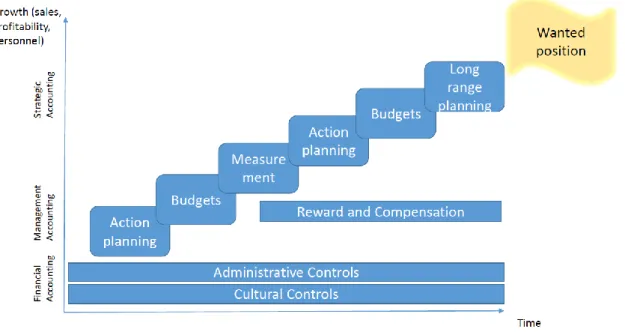
In figure 3 below the purpose is to illustrate, how management control systems and growth are combined in this study. The starting point is the long term planning, setting a strategic target or wanted position, usually in 3-5 years time. The roadmap to the wanted position is built through shorter term planning (here called action planning) and through annual budgeting. The follow up of progress is made through measuring the actuals towards set short-term targets. The underlying assumption in this study is that
management controls are indeed necessary for achieving any growth targets.
Figure 4 MCS in the context of this study. Modified from Malmi and Brown (2008).
2.4 Management accounting in small business context
This study uses the terms small company (or business or firm), micro company and entrepreneurial company in principal interchangeably. The difference between small and micro company is the size and when referring to small companies it automatically includes micro companies. However, Davila, Foster and Oyon (2009, p. 290) define entrepreneurial companies “Entrepreneurship is a process of growth from the founding of the company until it reaches the behaviour of a large company with its structures, processes and systems.” Thus, there is by definition the target of growing the company, to become a large company. In this thesis, this definition is relaxed and entrepreneurial company is understood as being an independent company controlled by the owner-manager, which may or may not have growth ambitions.
The sector of small business and entrepreneurial activities have had difficulties to attract the attention of academics within management accounting research (Mitchell & Reid, 2000; Chapman;Hopwood ;& Shields, 2009). Nevertheless, Mitchell and Reid (2000) argue that management accounting is equally important for any small firm, if not to be successful, but at least to avoid failure. Additionally, small firms provide many research opportunities, to study evolution and development of management accounting practices (Mitchell & Reid, 2000). The small entrepreneurial company provides an ideal setting to
investigate, when and how the informal controls evolve to a set of more formal procedures and system adaptation. This stage is noted to be often difficult and thus challenging the management and its capabilities. Therefore, it might even form a material obstacle for growth (Davila, Foster, & Oyon, 2009).
Perhaps it could even be assumed that in many small companies management accounting and accounting in general is commonly seen as the necessary evil, not a success factor. It is only something that is handled on the side. Based on research this is a faulted view and better understanding might help more businesses to grow (Jänkälä, 2007; Davila & Foster, 2009). Hence, when a company grows, MCS can provide the basis for the needed managerial infrastructure. An early adoption of MCS has been found to correlate with venture capital involvement, but as that relates usually to NEFs, the VC aspect is not included in this study. (Davila & Oyon , 2009)
Davila and his research teams (Davila & Foster, 2007; Davila & Oyon, 2009; Davila T., 2005) have published many papers on the subject of MCS in entrepreneurial companies, and found support for originally Greiner’s (1998) notion that the earlier adaptation of formal systems is linked with the number of employees. Davila, Foster and Oyon (2009, p. 291) report that besides crisis, there are several factors which seem to effect the adoption of systems: 1) the “import in” concept, 2) codifying learning, 3) managers’ perceived need, 4) contract with external parties, 5) legitimizing the company vis-à-vis external partners. Davila, Foster and Oyon (2009) conclude that the new more dynamic approach to MCS has proven that controls are a key element in contemporary, dynamic organization and in fact a necessity for growth. They support Malmi and Brown (2008) notion of need for more research for understanding the relationship between formal and informal controls, how the transition happens, how they are balanced and whether they are substitutes or complementary. The aim of this thesis is to gain understanding about these elements by studying the small companies where the observation should be doable. All in all, during the 2000’s the research of MCS in small business environment has clearly proven that there, first of all, are MCS in use in these companies and secondly that MCS can be seen as necessity for the growth or handling the growth of a company. The next sections will present some of the key studies in more detail.
2.4.1 Previous research based on contingency theory
Jänkälä’s (2007) doctoral dissertation is the most comprehensive MCS study that has been conducted in the Finnish small business context. Jänkälä’s study is very wide and only the most relevant parts concerning the thesis topic will be covered here.
Jänkälä investigates the use of MCS practices and the role of those in a contingency theoretical framework. The data includes both rapidly growing and more stable traditional firms, employing 10 – 49 persons. Due to the novelty of topic, this is an exploratory study, conducted in two phases: first, a qualitative pilot study and second, a survey analysed with quantitative methods. Survey data covers responses from 183 managing directors. The MCS and contextual factors effect on financial performance is investigated (fit approach).
Survey results suggest that firms use a wide range of MCS. Jänkälä reports that it seems that the strategy is positively associated with both growth and profitability. On the other hand, the use of a comprehensive MCS is not related to neither growth nor increased profitability. This can be interpreted that the decisive factor is the long-term target setting, which may lead to adoption of a more sophisticated MCS, which in its turn supports the target achievement. Firms, which have been profitable or had lower growth rate in sales use more advanced MCS practices. Nevertheless, use of more advanced dimensions of MCS seems to predict significant improvements for longer-term growth in net sales. One can ponder whether the results have been affected by the general economic situation as the base data was gathered 2001. Jänkälä compares the performance and net sales three years before (1997-2000) and two years after (2002-2003) the base year. There had been a strong growth in the GDP in Finland up to 2000, then significantly slower growth during 2002-2003.
The pilot study (2009) was qualitative, conducted with face-to-face semi-structured interviews and short questionnaire. Pilot companies were at least 5 years old (start-ups were excluded), 12 owner-managers were interviewed, six from stable companies and six from growing. Seven of the companies were micro companies. The companies were located in northern Finland and represented different industries and services, varying in sales, average was 0,3 million euros and on average 5,5 persons. Eight of the interviewees had vocational education, and three had university degree (out of which one in economics and business administration).
Common conclusions of the pilot study are that entrepreneurs deem net income and liquidity follow up important. Planning and budgeting was done once a year, investments should be profitable (but no specific method was used), the possible selling of the business was not considered important. The entrepreneur is the main capital investor and possible external financing is received from bank. Findings suggest existence of non-financial objectives in small business: respect, reputation, success. Generally the entrepreneurs enjoy their work, independence and being in control of things. Family entrepreneurship background seems to be an influential factor: entrepreneurship is considered as one alternative among many.
The growth firms in the study consider the developing of the business and liquidity important and investments are carefully estimated. “Grow or Die” mentality. Growth is gained through networking and geographical spread. Profitability is first and foremost seen as enabling the development of the business. Second priority is own earnings and benefits, which entrepreneurs benchmark with the level one could earn in a larger firm as a manager.
Attitudes are cautious against new shareholders or venture capitalists. Informality of organization and free information flow are perceived important (note, these are also characteristics for innovation). Growth firms seemed to have or aim for a more structured way of running the business. Companies strive for healthy and controlled growth. Non-financial returns are valued less than in the over all sample.
The owners of the traditional businesses in the study are modest in their expectation for earnings: “minimum standard of living”. Budgets are usually done once a year. Companies do not expect growth; they are rather fighting against decline. They see expansion a risk and being too dependent on the one owner-manager. More importance is put on the non-financial rewards. Owner has the role of a manager not a leader. Less emphasis on openness in communication or discussing financials with employees. Entrepreneurship has become a life style and the owners would not work for another anymore.
These results from Jänkälä’s pilot study offer a valuable background information for this thesis as well. The owners’ characteristics seem to differ quite notably between the growth companies and stable companies and it will be interesting to see how the results of this study comply with Jänkälä’s findings.
Sandino (2007) studied the choice of MCS adoption by 131 start-up companies (32 public) in the retail industry in the United States. The retail industry makes Sandino’s study specifically interesting, as the growth usually comes with opening of new branches, meaning geographical spread and therefore, controls that are more formal are needed relatively early. Study was conducted in two stages: first exploratory interviews (40), then survey (97) to a larger sample of 2-10 years old companies, which were analysed with quantitative methods.
Sandino considers both the life-cycle models and contingency theory. Based on the life cycle literature, Sandino suggests that an early-stage company first implements only the formal controls that are seen to liberate managers’ time to focus informally on firm’s strategy. The interviews conducted in the first research phase revealed that managers describe the implemented controls by their purpose, not so in direct concepts as for instance “budgets”.
The key findings from Sandino’s study are that all the sample companies adopt the same set of “basic MCS” (budgets, pricing and inventory control) first. The basic MCS seem to represent a “hygiene” factor in the industry. This could be relevant also in this thesis study, when the case companies are all from construction industry (for example time keeping needed already in the very beginning as a prerequisite for invoicing). Sandino’s concept of “additional MCS” includes the chosen strategy. Third finding is that the contingency model holds: MCS fit improves performance.
Limitations of Sandino’s study are generalizability outside retail sector, possible survivorship bias, not using data triangulation, memory and interpretation bias (answers are based on the respondent’s recollection). Relatively small sample size. Possible self-selection bias, but that was mitigated with efforts to maximize the rate of response. All in all, Sandino (2007, p. 268) states, “the real question is not whether MCS are needed, but which MCS are best suited to the contingencies of each firm.”
2.4.2 Previous research based on life cycle theory
Moores and Yuen (2001) apply the Miller and Friesen (1984) life cycle model in their explorative study. This study has configurational approach, examining the relationship of variables strategy, structure, leadership and decision-making styles to MAS. Although this study does not focus on small companies, it provides fundamental insights to the life