Enterprise Services
Page 1 of 5
IM 1.4.02 Incident Audit Process
IM 1.4.02 Incident Audit Process
Document Review
Version
1.0
Effective Date
04/01/13
Last Revised
03/06/13
Annual Review
October 15
Ad-Hoc Review
Change
CRQ
Document Owner
Prepared by
Name
Darren Undershultz
Name
Taras Z. Saranchuk
Role
Director, ICT Processes
Role
Business Analyst
Document Location
http://imtdocs.alberta.ca/operations/585.aspx
Document Sensitivity
Unrestricted
Document Number
C000017
Purpose:
The purpose of this document is to define the process and tasks associated with the audit of
Incidents.
Scope:
User Service Restorations and Infrastructure Restorations
Priority 1-4 Incidents
Out-of-Scope:
Scope does not include any associated Change Management or Problem Management processes.
Exceptions:
Exceptions to this process must be approved by the GOA Director, ICT Processes and follow
formal Change Management Processes.
Enterprise Services
Page 2 of 5
IM 1.4.02 Incident Audit Process
Process Map:
Incident Audit Process
S e rv ic e P ro v id e r In c id e n t M a n a g e r C o rp o ra te I n c id e n t M a n a g e m e n t Generate Selection Criteria Report IAP 1.8 Follow-up With Appropriate Individual or Group IAP 1.1 Use Selection Criteria Reports IAP 1.2 Input Incident Number into ITSM
End IAP 1.7 Pass/Fail? IAP 1.3 Enter Incident Information into Form IAP 1.4 Open Incident Work Info IAP 1.5 Gather Audit Information IAP 1.6 Enter Audit Information into Form Fail Pass
Page 3 of 5
IM 1.4.02 Incident Audit Process
Business Rules:
CIM will generate and distribute the Selection Criteria report to Service Provider Incident
Managers
Terms of Reference:
Activities:
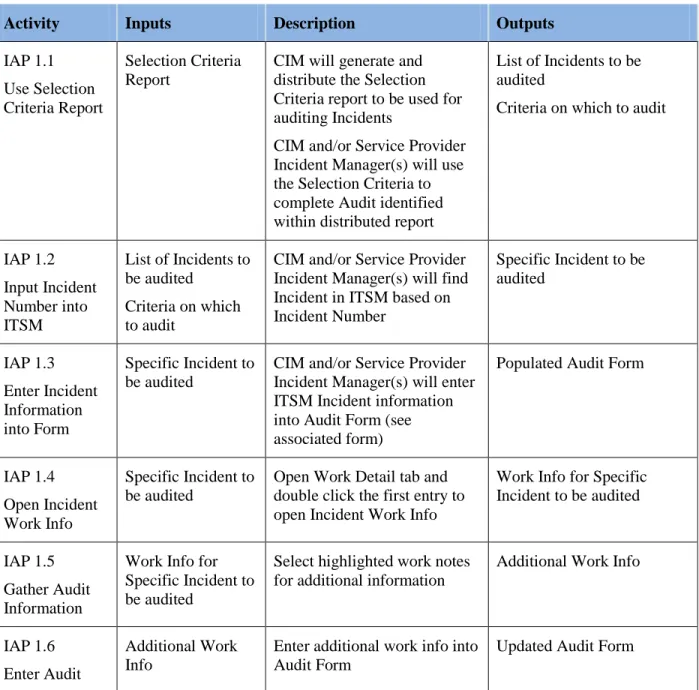
Table 1: Incident Audit Process Activity Matrix
Activity Inputs Description Outputs
IAP 1.1 Use Selection Criteria Report
Selection Criteria Report
CIM will generate and distribute the Selection Criteria report to be used for auditing Incidents
CIM and/or Service Provider Incident Manager(s) will use the Selection Criteria to complete Audit identified within distributed report
List of Incidents to be audited
Criteria on which to audit
IAP 1.2 Input Incident Number into ITSM List of Incidents to be audited Criteria on which to audit
CIM and/or Service Provider Incident Manager(s) will find Incident in ITSM based on Incident Number Specific Incident to be audited IAP 1.3 Enter Incident Information into Form Specific Incident to be audited
CIM and/or Service Provider Incident Manager(s) will enter ITSM Incident information into Audit Form (see associated form)
Populated Audit Form
IAP 1.4 Open Incident Work Info
Specific Incident to be audited
Open Work Detail tab and double click the first entry to open Incident Work Info
Work Info for Specific Incident to be audited
IAP 1.5 Gather Audit Information
Work Info for Specific Incident to be audited
Select highlighted work notes for additional information
Additional Work Info
IAP 1.6 Enter Audit
Additional Work Info
Enter additional work info into Audit Form
Page 4 of 5
IM 1.4.02 Incident Audit Process
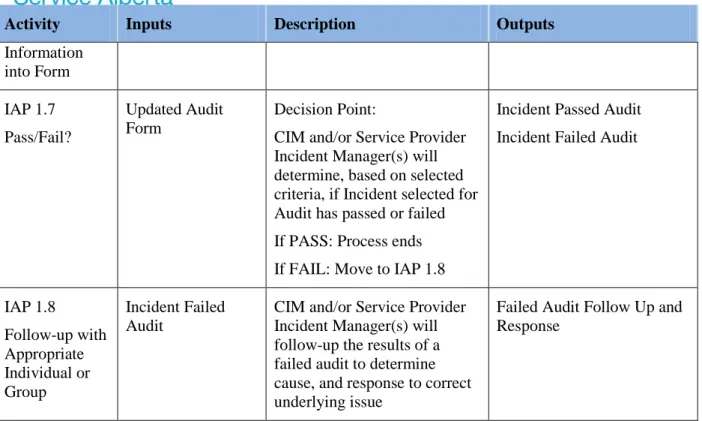
Activity Inputs Description Outputs
Information into Form IAP 1.7 Pass/Fail? Updated Audit Form Decision Point:
CIM and/or Service Provider Incident Manager(s) will determine, based on selected criteria, if Incident selected for Audit has passed or failed If PASS: Process ends If FAIL: Move to IAP 1.8
Incident Passed Audit Incident Failed Audit
IAP 1.8 Follow-up with Appropriate Individual or Group Incident Failed Audit
CIM and/or Service Provider Incident Manager(s) will follow-up the results of a failed audit to determine cause, and response to correct underlying issue
Failed Audit Follow Up and Response
Roles and Responsibilities:
Table 2: Incident Audit Process RACI Matrix
Incident Audit Process RACI Matrix
R = Responsible, A = Accountable, C = Consulted, I = Informed
Activity C li en t Servi ce D es k A ss igned Serv ic e Prov ide r Su pp ort T ea m Servi ce Pr ovi d er Su pp or t T eam In ci d ent Manage r C orporat e I nc iden t Manage m en t Servi ce D el iv er y Manag er A ff ec ted S er v ice P rovi d er Manage r G O A Fu n ct ional D ir ec to r
IAP 1.1 Use Selection Criteria Reports R,A R,A
IAP 1.2 Input Incident Number into ITSM R,A R,A
IAP 1.3 Enter Incident Information into Form R,A R,A
IAP 1.4 Open Incident Work Info R,A R,A
IAP 1.5 Gather Audit Information R,A R,A
IAP 1.6 Enter Audit Information into Form R,A R,A
IAP 1.7 Pass/Fail? R,A R,A
IAP 1.8 Follow-up with Appropriate Individual or Group
Page 5 of 5
IM 1.4.02 Incident Audit Process
Measurements:
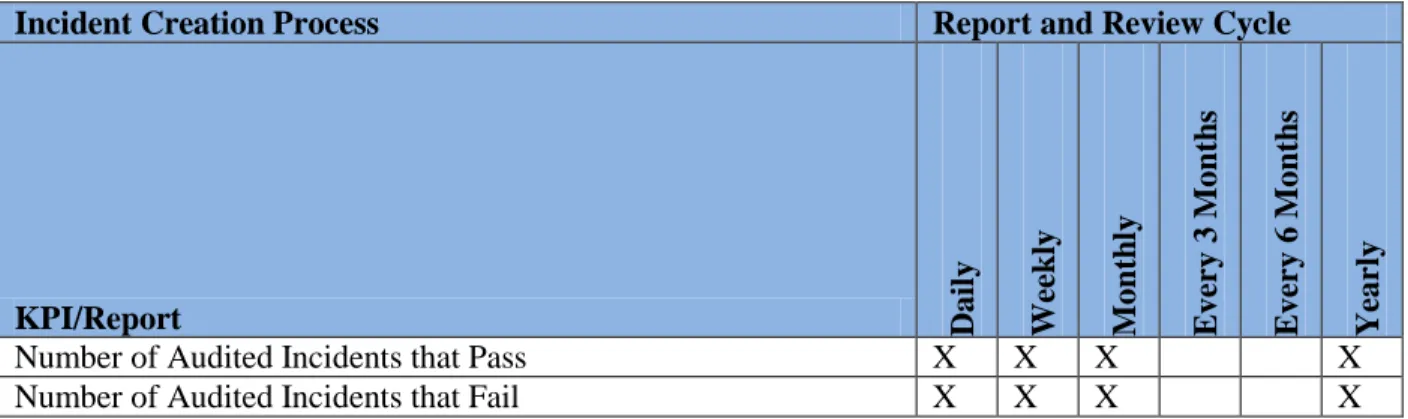
Every Process will have a balanced set of measurements (Key Performance Indicators) against
which its performance can be tracked, communicated and improved. As the process matures,
the KPI’s and review cycle may be modified based on the Process Owner’s discretion. The
tables below identify the KPI/report and the measurement criteria.
Table 3: Incident Creation Process Measurements
Incident Creation Process Report and Review Cycle
KPI/Report Dai ly Wee kl y Mont h ly E ver y 3 Mont h s E ver y 6 Mont h s Y ear ly
Number of Audited Incidents that Pass X X X X
Number of Audited Incidents that Fail X X X X