Working Paper 09-15
Statistics and Econometrics Series 05 March 2009
Departamento de Estadística Universidad Carlos III de Madrid
Calle Madrid, 126 28903 Getafe (Spain) Fax (34) 91 624-98-49
SMALL AREA ESTIMATION OF POVERTY INDICATORS
Molina, Isabel1 and Rao, J. N. K.2
Abstract
We propose to estimate non-linear small area population quantities by using Empirical Best (EB) estimators based on a nested error model. EB estimators are obtained by Monte Carlo approximation. We focus on poverty indicators as particular non-linear quantities of interest, but the proposed methodology is applicable to general non-linear quantities. Small sample properties of EB estimators are analyzed by model-based and design-based simulation studies. Results show large reductions in mean squared error relative to direct estimators and estimators obtained by simulated censuses. An application is also given to estimate poverty incidences and poverty gaps in Spanish provinces by sex with mean squared errors estimated by parametric bootstrap. In the Spanish data, results show a significant reduction in coefficient of variation of the proposed EB estimators over direct estimators for most domains.
Keywords: Empirical best estimator; Parametric bootstrap; Poverty mapping; Small area estimation.
1
Departamento de Estadística, Universidad Carlos III de Madrid, C/ Madrid 126, 28903 Getafe (Madrid), Spain. E-mail: [email protected]
2
Small Area Estimation of Poverty Indicators
∗
Isabel Molina
†and J. N. K. Rao
‡Abstract
We propose to estimate non-linear small area population quantities by using Empirical Best (EB) estimators based on a nested error model. EB estimators are obtained by Monte Carlo approximation. We focus on poverty indicators as particular non-linear quantities of interest, but the proposed methodology is applicable to general non-linear quantities. Small sample properties of EB estimators are analyzed by model-based and design-based simulation studies. Results show large reductions in mean squared error relative to direct estimators and estimators obtained by simulated censuses. An application is also given to estimate poverty incidences and poverty gaps in Spanish provinces by sex with mean squared errors estimated by parametric bootstrap. In the Spanish data, results show a significant reduction in coefficient of variation of the proposed EB estimators over direct estimators for most domains.
Key words: Empirical best estimator; Parametric bootstrap; Poverty mapping; Small area estimation.
1
Introduction
The first of the Millennium Development Goals established by the United Na-tions is the eradication of extreme poverty and hunger. The availability of the most possible accurate information concerning the living conditions of people is a basic instrument for targeting policies and programs aiming at the reduction of poverty. Thus, there are no doubts about the importance of the estimation of poverty measures. In many cases the information collected from national surveys is limited and allows estimation only for larger regions or larger population sub-groups. Therefore, small area estimation techniques are required that “borrow strength” across areas through linking models and auxiliary information such as
∗Supported by the Spanish grants MTM2006-05693 and SEJ2007-64500, and by the
Euro-pean project num. 217565-FP7-SSH-2007-1.
†Department of Statistics, Universidad Carlos III de Madrid. Address: C/Madrid 126,
28903 Getafe (Madrid), Spain, Tf: +34 916249887, Fax: +34 916249849, E-mail: [email protected]
censuses and administrative data; see Rao (2003) for a comprehensive account of these techniques.
Many measures of poverty and inequality are non-linear functions of a welfare variable for the population units. This makes many of the current small area estimation methods, typically developed for the estimation of linear characteris-tics, such as means, not applicable. Here we propose the use of empirical best predictors (EBPs) obtained through Monte Carlo approximation. This method provides estimators that are “best” in the sense of minimizing the mean squared error (MSE) under assumed small area models. It is useful for the estimation of any function of a welfare variable, when this variable or some transforma-tion of it follows a linear model. We show by simulatransforma-tions that empirical best predictors behave good in terms of bias and mean squared error. We also pro-pose a parametric bootstrap method for MSE estimation and study its bias in simulations.
In the U.S. the need for small area poverty estimates has given rise to the SAIPE program (Small Area Income & Poverty Estimates) of the U.S. Census Bureau; for further details see http://www.census.gov/hhes/www/saipe. The main objective of this program is to provide updated estimates of income and poverty statistics for the administration of federal programs and the allocation of federal funds to local jurisdictions. The county level methodology, summarized by Bell (1997), basically uses a Fay-Herriot area level model (Fay & Herriot, 1979) to produce model-based county estimates of school-age children under poverty.
The World Bank (WB) has been releasing small area poverty and income inequality estimates for some countries, using the methodology of Elbers et al. (2003). This methodology is currently widely used, see e.g. Neri et al. (2005), Ballini et al. (2006), Tarozzi and Deaton (2007) and Haslett and Jones (2005). Elbers et al. (2003) assumed a unit level model that combines both census and survey data. Using that model, they produce disaggregated maps that describe the spatial distribution of poverty and inequality. Section 7 shows that this method, when used to estimate small area means, is basically equal to a synthetic regression estimator.
Measures of inequality include the Gini coefficient, the Sen index, the general entropy and the Theil index (see e.g. Neri et al., 2005). Although the method developed in this paper allows the estimation of these inequality measures as well, for the sake of brevity we will focus on the estimation of a class of poverty measures called FGT poverty measures due to Foster et al (1984), see Section 2, and used in the WB method.
A common definition of poverty classifies a person as “under poverty” when the selected welfare variable for this person is below a threshold called poverty line, which is usually a given percentage of the median welfare for the population. For instance, the Spanish National Statistical Institute (INE) established the poverty line at 60% of the median per capita income. Here we assume that the poverty line is fixed at some quantity established by the corresponding authority and we avoid discussions concerning the definition of this threshold.
The paper is organized as follows. Section 2 defines the family of FGT poverty measures and Section 3 introduces two basic types of direct estimators, which make use only of the sample data from the target area. Section 4 describes the best prediction methodology for finite populations and Section 5 applies this methodology to the estimation of FGT poverty measures through the use of a nested error linear regression model. Section 6 describes a parametric bootstrap method for MSE estimation. Section 7 makes a theoretical comparison of the different methods in the context of estimating small area means. Sections 8 and 9 present the results of simulation studies on the performance of the proposed method relative to the WB method and direct estimation, in terms of bias and MSE. Performance of bootstrap MSE estimator is also studied. Finally, in Sec-tion 10, the proposed method is applied to Spanish data to estimate poverty incidences and poverty gaps in Spanish provinces by gender.
2
FGT poverty measures for small areas
Consider a finite population of size N that is partitioned into D small areas of sizes N1, . . . , ND. Let Edj be a suitable quantitative measure of welfare for individualj in small aread, such as income or expenditure, and letzbe the given poverty line; that is, the threshold for Edj under which a person is considered as “under poverty”. The family of poverty measures introduced by Foster et al. (1984) and called throughout the paper as FGT poverty measures, for each small area d, is defined as Fαd = 1 Nd Nd X j=1 z−Edj z α I(Edj < z), α= 0,1,2, d= 1, . . . , D,
where I(Edj < z) = 1 if Edj < z (person under poverty) and I(Edj < z) = 0 if Edj ≥ z (person not under poverty). For α = 0 we get the proportion of individuals under poverty in small area d, also called poverty incidence or head count ratio. The FGT measure for α = 1 is called poverty gap, and measures the area mean of the relative distance to non-poverty (the poverty gap) of each individual. For α = 2 the measure is called poverty severity. This measure squares the poverty gaps, and thus emphasizes extreme poverty.
3
Direct estimators of poverty measures
In the inference process, a random sample of size n < N is drawn from the population according to a specified sampling design. Let Ω denote the set of indexes of the population units. Let s be the set of units selected in the sample and r the set of indexes of the units that are not selected (with size N −n). The restrictions of Ω, s, N and n to area d are denoted by Ωd, sd, Nd and nd respectively, where n = n1 +· · ·+nD. The unweighted sample FGT poverty
measures are given by fαd = 1 nd X j∈sd z−Edj z α I(Edj < z), α= 0,1,2, d= 1, . . . , D. (1)
A direct estimator for a small area, as a sample estimator, uses only the sample data from the target small area and it is usually design-based. Let wdj be the sampling weight (inverse of the probability of inclusion) of individual j
from area d. Direct estimators of the FGT measures are given by
fαdw = 1 ˆ Nd X j∈sd wdj z−Edj z α I(Edj < z), α = 0,1,2, d= 1, . . . , D, (2) where ˆNd = P
j∈sdwdj is the direct estimator of the population size of small area
d, Nd. If the sampling weights wdj do not depend on the unit j, for example
wdj = nd/Nd under simple random sampling within areas, then (2) reduces to the unweighted mean (1).
The limited sample sizes nd within some of the areas prevent the use of es-timators such as (1) or (2). Indeed, a common definition of poverty classifies a person as “under poverty” when the selected welfare variable for this person is below 60% of the median. Under this definition the outcome of being un-der poverty is likely to have low frequency. Then, to obtain reliable estimators for small domains or geographical areas it is necessary to appeal to small area techniques (Rao, 2003). These techniques improve the estimation procedures by using models that establish some relationships between the areas, based on aux-iliary information (census and/or administrative variables) related to the welfare variables of interest. These models provide “indirect” estimators that make use of related data from other areas, and which might reduce drastically the esti-mation errors as long as model assumptions hold. Model checking should be an integral part of indirect estimation methods.
4
Best prediction under a finite population
Section 4 introduces the best predictor (BP) of a function of a random vector in a finite population. Application of the BP methodology for estimating FGT poverty measures in small areas is described in Section 5.
Consider a random vectory= (Y1, . . . , YN)′containing the values of a random variable associated withN units of a finite population. Let ys be the sub-vector of y corresponding to sample elements and yr the sub-vector of out-of-sample elements; that is, y = (ys′,yr′)′. The target is to predict the value of a
real-valued function δ =h(y) of the random vector y using the sample data ys. For a particular predictor ˆδ, the mean squared error is defined as
MSE(ˆδ) =Ey{(ˆδ−δ)
where Ey denotes expectation with respect to the joint distribution of the pop-ulation vector y. The BP of δ is the function ofys that minimizes (3). Consider the conditional expectation δ0 =E
yr(δ|ys), where the expectation is taken with
respect to the conditional distribution of yr givenys and the result is a function of sample data ys. Subtracting and adding δ0 in the mean squared error, we
obtain MSE(ˆδ) =Ey{(ˆδ−δ 0)2}+ 2E y{(ˆδ−δ 0)(δ0−δ)}+E y{δ 0−δ)2}.
In this expression, the last term does not depend on ˆδ. For the second term, observe that Ey{(ˆδ−δ 0)(δ0−δ)} = E ys h Eyr n (ˆδ−δ0)(δ0−δ)|ys oi = Eys h (ˆδ−δ0) δ0−Eyr(δ|ys) i = 0.
Thus, the BP is the value ˆδ that minimizesEy{(ˆδ−δ
0)2}. Since this quantity is
non-negative and its minimum value is zero, the BP is ˆ
δB =δ0 =Eyr(δ|ys). (4)
Typically, the joint distribution of y depends on some unknown model pa-rameters. Then an empirical BP (EBP) of δ can be obtained by replacing all unknown parameters by suitable estimators and then evaluating the expectation (4) from the estimated distribution.
Remark 1. Suppose that yfollows a Normal distribution with mean vector µ=
Xβ, for a known matrix X, and positive definite covariance matrix V. Let the
target quantity δ be a linear function of y, δ =a′y. In this case, the best linear
unbiased predictor (BLUP) of δ, obtained by Royall (1976), is equal to the BP
when the true β is replaced by the generalized least squares estimator.
5
Empirical best prediction of FGT poverty
mea-sures
In this section we describe how to obtain BPs of FGT poverty measures for small areas. For a given α∈ {0,1,2}, let us define the random variables
Fαdj = z−Edj z α I(Edj < z), j = 1, . . . , Nd, d= 1, . . . , D.
Then the FGT poverty measure for area d is the mean
Fαd = 1 Nd Nd X j=1 Fαdj, d= 1, . . . , D. (5)
Suppose that there is a one-to-one transformationYdj =T(Edj) of the welfare variables, Edj, such that the vector y containing the values of the transformed variables Ydj for all the population units satisfies y ∼ N(µ,V). Then we can express the random variables Fαdj in terms ofYdj as
Fαdj = z−T−1(Y dj) z α I{T−1(Ydj)< z}=hα(Ydj), j = 1, . . . , Nd.
Thus, the FGT poverty measure (5) is a non-linear function of the vector y. By the results of Section 4, taking δ =Fαd the BP of Fαd is
ˆ
FB
αd=Eyr(Fαd|ys). (6)
Using the decomposition of the mean (5) in terms of sample and out-of-sample elements, we have Fαd= 1 Nd ( X j∈sd Fαdj + X j∈rd Fαdj ) , (7)
where rd denotes the set of out-of-sample elements belonging to area d. Now taking conditional expectation of (7) and introducing the conditional expectation inside the sum, the BP becomes
ˆ FB αd= 1 Nd ( X j∈sd Fαdj + X j∈rd ˆ FB αdj ) , (8) where ˆFB
αdj =Eyr(Fαdj|ys) is the BP of the out-of-sample variableFαdj =hα(Ydj),
which is defined as ˆ FB αdj =Eyr[hα(Ydj)|ys] = Z IR hα(Ydj)f(Ydj|ys)dYdj, j ∈rd, (9)
where f(Ydj|ys) is the conditional density of Ydj given the data vector ys. The expectation in (9) cannot be calculated explicitly due to the complexity of hα. However, since y = (y′s,y′r)′ is Normally distributed with mean vector µ =
(µ′
s,µ′r)′ and covariance matrix partitioned conformably as
V= Vs Vsr Vrs Vr ,
the conditional distribution of yr given ys is
yr|ys ∼N(µr|s,Vr|s), (10)
where
µr|s=µr+VrsVs−1(ys−µs), Vr|s =Vr−VrsVs−1Vsr. (11) Then, we propose to use an empirical approximation by Monte Carlo simulation of a large number L of vectors yr generated from (10). Let Y(
ℓ)
of the out-of-sample observation Ydj, j ∈ rd, obtained in the ℓ-th simulation,
ℓ = 1, . . . , L. A Monte Carlo approximation to the best predictor ofYdj is then given by ˆ FB αdj =Eyr[hα(Ydj)|ys]≈ 1 L L X ℓ=1 hα(Ydj(ℓ)), j ∈rd. (12)
In practice, the mean vectorµ and the covariance matrix V usually depend on an unknown vector of parameters θ. Thus the conditional density f(Ydj|ys) depends on θ and we make this explicit in the notation using f(Ydj|ys,θ). We can take an estimator ˆθ of θ such as the maximum likelihood (ML) estimator or the residual ML (REML) estimator. Then the expectation can be approximated by generating values Ydj(ℓ) from the estimated density f(Ydj|ys,θˆ). The resulting predictor, denoted ˆFEB
αdj , is called the empirical best predictor (EBP). Finally, the EBP of the poverty measure Fαd is given by
ˆ FEB αd = 1 Nd " X j∈sd Fαdj + X j∈rd ˆ FEB αdj # .
In this paper, we consider the nested error linear regression model for the
Ydj (Battese et al., 1988). This model relates the transformed variablesYdj (e.g., log-earnings) to a vector of pexplanatory variablesxdj for all areas, and includes a random area-specific effect ud along with the usual residual errorsedj:
Ydj =x′djβ+ud+edj, ud ∼iidN(0, σu2),
edj ∼iidN(0, σe2), j = 1, . . . , Nd, d= 1, . . . , D, (13)
where the area effects ud and the errors edj are independent. Defining vectors and matrices obtained by stacking the elements for area d as
yd= col 1≤j≤Nd (Ydj), ed= col 1≤j≤Nd (edj), Xd= col 1≤j≤Nd (x′dj),
the vectors yd, d= 1, . . . , D, under model (13), are independent with
yd∼N(µd,Vd), where µd=Xdβ and Vd=σu21Nd1 ′ Nd+σ 2 eINd.
We assume that the population model (13) holds for the sample, i.e., sample selection bias is absent (Pfeffermann et al. 1998).
Consider the decomposition of yd into sample and out-of-sample elements
yd = (y′dr,y′ds)′, and the corresponding decomposition of µd=E(yd) and Vd = Var(yd). Then the distribution of the out-of-sample vector ydr given the sample data yds is
where the conditional mean vector and covariance matrix are given by µdr|s =Xdrβ+σ2u1Nd−nd1 ′ ndV −1 ds(ys−Xsβ) (15) Vdr|s =σ2u(1−γd)1Nd−nd1 ′ Nd−nd +σ 2 eINd−nd. (16)
Note that ydr|yds and ydr|ys have the same distribution (14) due to the inde-pendence of the vectors yd.
Observe that the application of the Monte Carlo approximation (12) involves simulation ofD multivariate Normal vectors of sizesNd−nd,d= 1, . . . , D, from (14). Then this process has to be repeated L times, something computationally very intensive. This can be avoided in the following way. Observe that the matrix Vdr|s corresponds to the covariance matrix of a vector ydr generated by the model
ydr =µdr|s+vd1Nd−nd+ǫdr, (17)
with new random effects vd and errors ǫdr that are independent and satisfy
vd∼N(0, σu2(1−γd)) and ǫdr ∼N(0Nd−nd, σ
2
eINd−nd).
Using these relations, instead of generating a multivariate normal vector of size
Nd−nd, we just need to generate univariate normal variablesvd∼N(0, σ2u(1−γd)) and ǫdj ∼ N(0, σ2e) independently, for j ∈rd, and then obtain the responses Ydj from (17) using the known value ofµdr|s. As mentioned before, in practice all the
unknown model parametersβ,σ2
uandσe2are replaced by suitable estimators, and then the variables Ydj are generated from the corresponding estimated normal distributions.
Summarizing, the proposed EBP method to estimate poverty measures works in the following way:
(a) Fit model (13) to the initial (transformed) data ys.
(b) Draw L out-of-sample vectorsy(rℓ), ℓ = 1, . . . , L from (14), or equivalently from (17), but with the unknown parameters replaced by the estimators obtained in (a).
(c) With theL generated vectorsy(rℓ),ℓ= 1, . . . , L, and using the sample data
ys, compute EBPs of the poverty measures from (8) using the Monte Carlo
approximation (12).
Instead of introducing the expectation inside the sum as in (8), we can approx-imate by Monte Carlo directly the expectation of the poverty measure (6). In this way, the proposed procedure can be used to predict any other function h(y) and it requires only the assumption of a model for some transformation of the welfare variable Edj.
6
Parametric bootstrap for MSE estimation
Here we propose to use an extension of the parametric bootstrap method for finite populations (Gonz´alez-Manteiga et al., 2008) to estimate the MSE of the empirical best predictors ˆFEB
αd , d = 1, . . . , D. For a given α, this method works as follows:
1. Fit model (13) to sample data ys and obtain model parameter estimates ˆ
β, ˆσ2
u and ˆσe2.
2. Generate bootstrap random area effects asu∗
d∼iidN(0,σˆ2u),d= 1, . . . , D. 3. Generate, independently of the random effectsu∗
d, bootstrap random errors
e∗
dj ∼iidN(0,σˆe2), j = 1, . . . , Nd, d= 1, . . . , D.
4. Construct a bootstrap population using the estimated model,
Ydj∗ =x′djβˆ+u∗d+e∗dj, j = 1, . . . , Nd, d = 1, . . . , D, (18) and calculate the FGT measures for this population, that is, calculate first
F∗
αdj =hα(Ydj∗),j = 1, . . . , Nd, and then take the small area means as
Fαd∗ = 1 Nd Nd X j=1 Fαdj∗ , d= 1, . . . , D.
5. Take the elements Y∗
dj with indices contained in the sample s, denoted ys∗. Fit the model again to y∗
s obtaining new model parameter estimates ˆβ∗, ˆ
σ2∗
u and ˆσe2∗.
6. Using the bootstrap sample datays∗and the known matrixX, apply the EB method as described in Section 5 and calculate bootstrap EBPs, ˆFEBP∗
αd ,
d= 1, . . . , D.
Observe that the bootstrap elements, given the original sample data, preserve properties of the original population model. Random effects and errors are iid with
E∗(u∗d) = 0, V ar∗(u∗d) = ˆσ2u, E∗(e∗dj) = 0, V ar∗(e∗dj) = ˆσe2, (19) where E∗ and V ar∗ denote expectation and variance with respect to the
distri-bution defined by the bootstrap model (18) given sample data ys. Consider the vector y∗ with all the population bootstrap elements defined analogously to y
for the original population. Then the mean vector and covariance matrix of this bootstrap vector are
Thus, the distribution of the bootstrap population y∗ (given sample data ys) imitates that of the original population y. Then an estimator of MSE( ˆFEB
αd ) is the bootstrap MSE of the bootstrap EBP, defined as
MSE∗( ˆFαdEBP∗) =E∗{( ˆF EBP∗ αd −F ∗ αd) 2}.
In practice, this quantity can be approximated through a Monte Carlo procedure, by repeating steps 2–6 a large number of times,B, and then taking the mean over the B replicates. More specifically, let Fαd∗(b) and ˆFαdEB∗(b) be the poverty measure and its corresponding EBP for the bootstrap replicate b, for b= 1, . . . , B. Then, the estimator of the MSE is calculated as
mse( ˆFEB αd ) = 1 B B X b=1 ( ˆFαdEB∗(b)−Fαd∗(b))2. (20)
It is possible to obtain a better MSE estimator, in terms of relative bias, by using a double bootstrap method (Hall and Maiti, 2006) applied to the trans-formed sample data.
7
Estimation of small area means
In this section we restrict ourselves to the estimation of the small area means ¯ Yd= 1 Nd Nd X j=1 Ydj, d= 1, . . . , D,
since means are common target quantities which also deserve attention; more-over, means allow for the study of some theoretical properties of estimators.
Consider first the case of population elements Ydj following a linear model without area effects,
Ydj =x′djβ+edj, edj ∼iid N(0, σe2), j = 1, . . . , Nd, d= 1, . . . , D. (21) Let us assume for simplicity of exposition that all model parameters are known. Taking the average of (21) over the elements in area d, we can express the true mean as ¯ Yd= ¯x′dβ+ ¯ed, where ¯xd = Nd−1 PNd j=1x′dj and ¯ed = Nd−1 PNd
j=1edj. Common small area es-timators derived under model (21) are the synthetic eses-timators, obtained by predicting all the Ydj and then taking the area mean, that is, taking
ˆ¯ YSY N d = 1 Nd Nd X j=1 ˆ Ydj,
as the synthetic estimator, where ˆYdj = x′djβ is the predictor of Ydj for j = 1, . . . , Nd. However, under model (21), the BP of ¯Yd is obtained by predicting only the out-of-sample observations and keeping the sample data, i.e.,
ˆ¯ YB d = 1 Nd ( X j∈sd Ydj + X j∈rd ˆ Ydj ) .
Let us compare the MSEs of the synthetic and the BP estimators. Writing the synthetic estimator as ˆ¯YSY N
d = ¯x′dβ, we obtain ˆ¯ YSY N d −Y¯d= ¯x′dβ−(¯x ′ dβ+ ¯ed) = ¯ed, and then the MSE becomes
MSE( ˆ¯YdSY N) = E{( ˆ¯Y SY N d −Y¯d)2}=E(¯e2d) = V ar(edj) Nd = σ 2 e Nd .
However, observe that the difference between the BP and the true mean is equal to ˆ¯ YB d −Y¯d = 1 Nd X j∈rd edj,
which implies that the MSE of ˆ¯YB
d is given by MSE( ˆ¯YB d ) = E{( ˆ¯YdB−Y¯d)2}= σ2 e Nd 1− nd Nd < σ 2 e Nd = MSE( ˆ¯YSY N d ).
Thus, under model (21) with known parameters, the BP has always smaller MSE due to the more efficient use of available information, namely the sample data. When the sampling fraction nd/Nd is negligible both estimators have a similar MSE.
Now consider the case of extra area variation not explained by the auxiliary variables; that is, the true model is (13), but we fit the model (21). The true mean for area d is then given by
¯
Yd = ¯x′dβ+ud+ ¯ed.
Then the MSE of the synthetic estimator under the true model is MSE( ˆ¯YdSY N) =E[(ud+ ¯ed)2] =σ2u+
σ2
e
Nd
. (22)
For the BP, the MSE under the true model is MSE( ˆ¯YB d ) = σ 2 u+ σ2 e Nd 1− nd Nd ,
which is again smaller than MSE( ˆ¯YSY N
The method of Elbers et al. (2003), henceforth called the ELL method, assumes a linear model with random cluster effects, where clusters may be dif-ferent from the areas. They computed small area estimators by (a) fitting a linear model with cluster random effects, (b) generating bootstrap random clus-ter effects, (c) generating bootstrap random errors, (d) constructing a population from the bootstrap model
Ydj∗ =x′djβ+u∗c +e∗dj, j = 1, . . . , Nd, d = 1, . . . , D, (23) where u∗
c is the bootstrap random effect of cluster c and (e) calculating the average of the bootstrap elements from area d:
¯ Y∗ d =N −1 d Nd X j=1 Y∗ dj. (24)
The ELL estimator of the small area mean ¯Yd is then the bootstrap mean ˆ¯
YELL
d =E∗( ¯Yd∗),
which, in practice, is obtained from a Monte Carlo approximation by generating a large number, L, of populations, calculating the area means (24) for each population and later averaging over the L populations. The bootstrap variance is used as the mean squared error of the ELL estimator; that is, the ELL method uses
MSE( ˆ¯YdELL) =V ar∗( ¯Yd∗), which again is approximated by Monte Carlo simulations.
In the case of no clusters (as in some establishment surveys), the ELL method fits the linear model (21) and uses this model to construct bootstrap populations. Then the bootstrap mean for area d becomes
¯ Yd∗ =Nd−1 Nd X j=1 Ydj∗ = 1 Nd Nd X j=1 (x′djβ+e∗dj) = ˆ¯Y SY N d + ¯e∗d,
and the ELL estimator is given by ˆ¯ YdELL =E∗( ¯Yd∗) = E∗( ˆ¯YdSY N+ ¯e∗d) = ˆ¯Y SY N d +E∗(¯e∗d) = ˆ¯Y SY N d ,
due to property (19) of the bootstrap method and the fact that the expectation
E∗ is conditional on the sample. The ELL estimator of the MSE is
MSE( ˆ¯YELL d ) =V ar∗( ¯Yd∗) =E∗[( ¯Yd∗−E∗( ¯Yd∗))2] =E∗[(¯e∗d)2] = V ar∗(e∗dj) Nd = σ 2 e Nd .
Thus, when fitting a model without cluster effects, the ELL estimator of a small area mean is essentially the synthetic estimator, which is a good estimator when the true model is (21). When the true model is (13), the ELL method is not
accounting for the area effects and the MSE estimator has a bias equal to σ2
u, see (22). Thus, the ELL estimator of MSE can lead to serious underestimation of MSE when the area effects have a substantial variance σ2
u.
Now consider the ideal case for ELL, in which clusters are the same as the small areas. In this case we use the ELL method by fitting the correct model (13). Then the ELL estimator is again
ˆ¯
YELL
d =E∗( ˆ¯YdSY N +u∗d+ ¯e∗d) = ˆ¯YdSY N, and the ELL estimator of the MSE becomes
MSE( ˆ¯YELL d ) =V ar∗( ¯Y ∗ d) =E∗[( ¯Y ∗ d −E∗( ¯Y ∗ d)) 2] =E ∗[(u∗d+ ¯e ∗ d) 2] =σ2 u+ σ2 e Nd ,
which is the MSE of the synthetic estimator under model (13). Thus, when the clusters are equal to the small areas, the ELL estimator remains essentially equal to the synthetic estimator, but in this case the ELL variance estimator is unbiased. Actually, under model (13), the difference between the ELL and EB methods is that the target quantities are not the same. EB method tries to estimate (or better predict) the actual area means ¯Yd, while the ELL method is estimating instead the marginal expectations E( ¯Yd).
8
Model-based simulation experiment
A model-based simulation study has been carried out to study the performance of the proposed EB predictors of small area FGT poverty measures with α = 0 (proportion of people under poverty) andα = 1 (poverty gap). For this, we sim-ulated populations of size N = 20000, composed of D= 80 areas withNd = 250 elements in each area d = 1, . . . , D. The response variables for the population units Ydj were generated from model (13) taking as auxiliary variables two dum-mies X1 ∈ {0,1} and X2 ∈ {0,1} plus an intercept. The values of these two
dummies for the population units were generated from Bernouilli distributions with success probabilities increasing with the area index for X1 and constant for
X2; that is,
p1d= 0.3 + 0.5d/20; p2d = 0.2, d= 1, . . . , D,
respectively. Here the welfare variables Edj are the exponential of the responses
Ydj; that is, the transformationT(·) defined in Section 5 isT(x) = log(x). A set of sample indicesswas drawn from the population indices{1, . . . , N}, by a stratified design with areas as strata and simple random sampling without replacement within each area. The values of the auxiliary variables for the population units and the sample indices were kept fixed over all Monte Carlo simulations.
The intercept and the regression coefficients associated with the two auxiliary variables used to generate populations were β = (3,0.03,−0.04)′. In this way,
the mean welfare increases when moving from the case (X1 = 0, X2 = 0) to
(X1 = 1, X2 = 0), but decreases when moving from (X1 = 0, X2 = 0) to (X1 =
0, X2 = 1). This implies that the “richest” individuals are those with values
X1 = 1 and X2 = 0. Since the probability p1d of X1 = 1 increases with the
area index but that of X2 = 1 is constant, then the last areas will have more
individuals with larger Ydj and then the FGT poverty measures will decrease with the area index. The random area effects variance was taken as σ2
u = (0.15)2 and the error variance as σ2
e = (0.5)2. The poverty line z was fixed as z = 12, which is roughly equal to 0.6 times the median of the welfare variables Edj for a population generated as mentioned above. In this way, the poverty incidence for the simulated populations is approximately 16%.
Under this setup, I = 1000 populations y(i) were generated from the true
model. For each population i, we carried out the following tasks:
(a) The true area poverty incidences and gaps (FGT measures for α = 0 and
α= 1 respectively) were obtained for each population as
Fαd(i)= 1 Nd Nd X j=1 z−Edj(i) z !α I(Edj(i) < z), α= 0,1, d= 1, . . . , D, where Edj(i) = exp(Ydj(i)) , j = 1, . . . , Nd.
(b) Sample estimators of the same quantities were also calculated as
fαd(i)= 1 nd X j∈sd z−Edj(i) z !α I(Edj(i) < z), α = 0,1, d= 1, . . . , D.
In this simulation study sample estimators are equal to direct estimators. (c) Model (13) was fitted to the sample data. Then, substituting the estimated
model parameters in (15) and (16), L = 50 out-of-sample vectors yr(iℓ),
ℓ = 1, . . . , L were generated from the conditional distribution (14) using (17). Then using the sample datay(si)and the generated out-of-sample data
y(riℓ), EB predictors of the area poverty incidences and gaps were calculated. For this, first, for each sample unit j we considered the sample values
Fαdj(i) = z−E (i) dj z !α I(Edj(i) < z), j ∈sd, d= 1, . . . , D,
while for each out-of-sample unitj, we computed the EB predictors ofFαdj(i)
using the L simulated vectors,
ˆ FαdjEB(i) = 1 L L X ℓ=1 z−Edj(iℓ) z !α I(Edj(iℓ) < z), j ∈rd, d= 1, . . . , D,
for α= 0,1. Then the EB predictor of the FGT measure of order α = 0,1 was obtained as ˆ FαdEB(i) = 1 Nd " X j∈sd Fαdj(i) +X j∈rd ˆ FαdjEB(i) # , d= 1, . . . , D.
(d) The ELL estimators of the poverty measures were calculated. For this, first the model (13) was fitted to the sample data and then L = 50 populations were generated using the parametric bootstrap described in Section 6. For each population, the poverty measures were obtained and finally, the results were averaged over the L= 50 populations.
Means over Monte Carlo populations i = 1, . . . , I of the true values of the FGT measures of order α= 0,1 were computed as
E(Fαd) = 1 I I X i=1 Fαd(i), d= 1, . . . , D.
These means are the reference values for comparison. Finally, for all estimators, namely, EBP, sample and ELL, the mean, variance and mean squared error over Monte Carlo populations i= 1, . . . , I were obtained for each area d= 1, . . . , D.
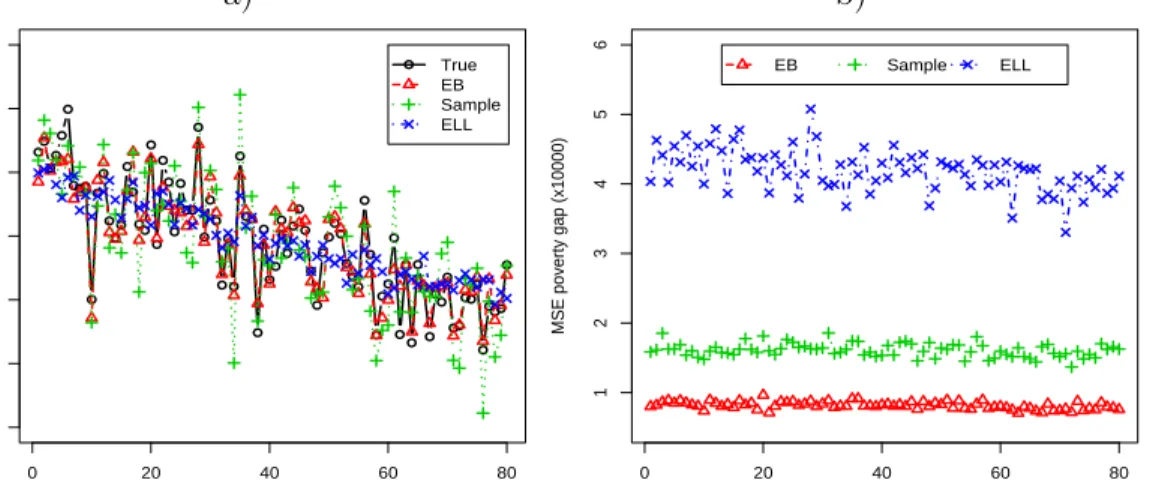
Figure 1 a) plots the means of the true poverty incidences F0(di), EB esti-mates ˆF0EBd (i), direct estimates f0(di) and ELL estimates ˆF0ELLd (i) for each area
d = 1, . . . , D. Figure 1 b) plots the MSEs of EB, direct and ELL estimators. Similarly, Figures 2 a) and 2 b) plot the analogous quantities for the poverty gap F1d. Observe that the means of EB estimates are for most areas close to the
mean true values. On the other hand, the direct estimates seem to be too unsta-ble (due to small sample sizes) and the ELL estimators seem too staunsta-ble, that is, they do not seem to reproduce the between area variation. In terms of MSE, EB estimators are clearly much better than the other two estimators. Surprisingly, the MSEs of ELL estimators are larger than those of direct estimators.
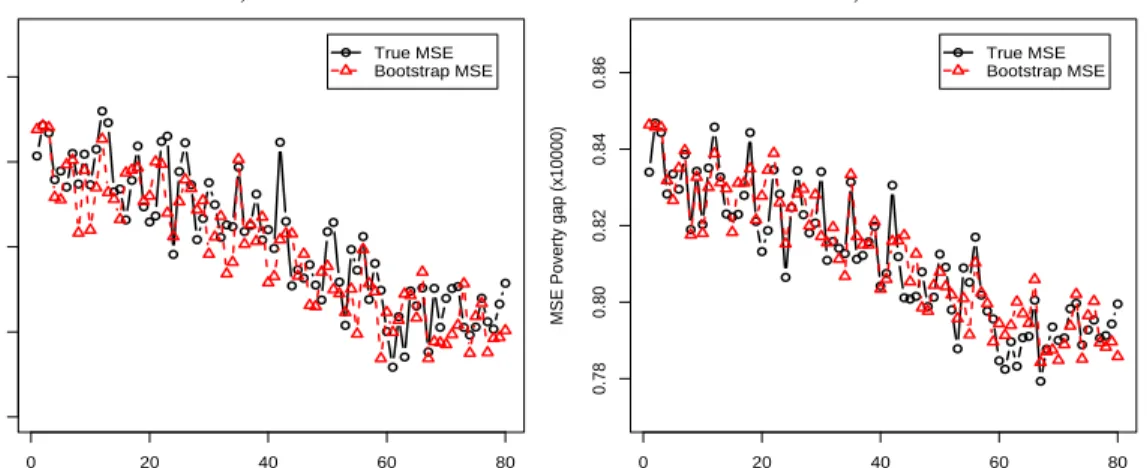
Turning to MSE estimation, the parametric bootstrap procedure described in Section 6 was implemented with B = 500 replicates and the results are plotted in Figure 3. The number of Monte Carlo simulations was I = 500 and the true values of MSE were independently computed with I = 50000 Monte Carlo simulations. Observe that the bootstrap MSE estimator seems to track the pattern of the true MSE values.
9
Design-based simulation experiment
A design-based simulation experiment was also carried out to study the perfor-mance of estimators over repeated samples drawn from a fixed population. Only one population was generated as described in Section 8, with the same popula-tion and sample sizes, and using the same values of model parameters. Then,
a) 0 20 40 60 80 15.0 15.5 16.0 16.5 Area Poverty incidence (x100) True EB Sample ELL b) 0 20 40 60 80 10 20 30 40 50 60 70 Area
MSE poverty incidence (x10000)
EB Sample ELL
Figure 1: a) Means (×100) and b) MSEs (×104) over simulated populations of
true values, EB, sample and ELL estimators of the poverty incidenceF0dfor each area d.
in each replication out of I = 1000, a new sample was drawn from this fixed population according to SRS without replacement within each area. From each sample, the three types of estimators of poverty measures, namely EBP, direct and ELL were obtained.
Results for the poverty incidence are displayed in Figures 4 and 5. Figure 4 shows the true values and the means over the Monte Carlo samples of the EB, direct and ELL estimators. Observe that the ELL estimators remain practically constant across the areas. On the other hand, EB estimators track the true values well, even though these estimators are supposed to have good theoretical properties with respect to the model. Of course, direct estimators perform better because they are design-unbiased. In terms of MSE, Figure 5 shows that ELL estimators have small MSEs for some of the areas and large for the other areas, while the MSE of EB and direct estimators remain small for all areas. For most areas, the MSE of EB estimators is smaller than that of the direct estimators.
10
Application
The EB method was applied to compute poverty incidences and poverty gaps in Spanish provinces crossed with gender. For this, data from the European Survey on Income and Living Conditions (EUSILC) from the year 2006 has been used. The welfare variable for the individuals is the normalized annual income calculated following the standard procedure of the Spanish Statistical Institute (INE). This variable has been transformed by adding a fixed quantity to make it always positive and then taking logarithm. This transformed variable acts as the response in the nested-error regression model. As auxiliary variables we have considered the indicators of the 5 quinquennial groupings of the variable age,
a) 0 20 40 60 80 3.2 3.3 3.4 3.5 3.6 3.7 3.8 Area Poverty gap (x100) True EB Sample ELL b) 0 20 40 60 80 1 2 3 4 5 6 Area
MSE poverty gap (x10000)
EB Sample ELL
Figure 2: a) Means (×100) and b) MSEs (×104) over simulated populations of
true values, EB, sample and ELL estimators of the poverty gaps ˆFE
1d for each area d.
the indicator of having Spanish nationality, the indicators of the 3 levels of the variable education level, and the indicators of the 3 categories of the variable employment, with categories “unemployed”, “employed” and “inactive”. From each variable, one of the categories was considered as base reference, omitting the corresponding indicator and then including an intercept in the model.
The values of the dummy indicators are not known for the out-of-sample units, but the EB method requires only the knowledge of the total number of people with the same x-values. These totals were estimated using the sampling weights attached to the sample units in the EUSILC.
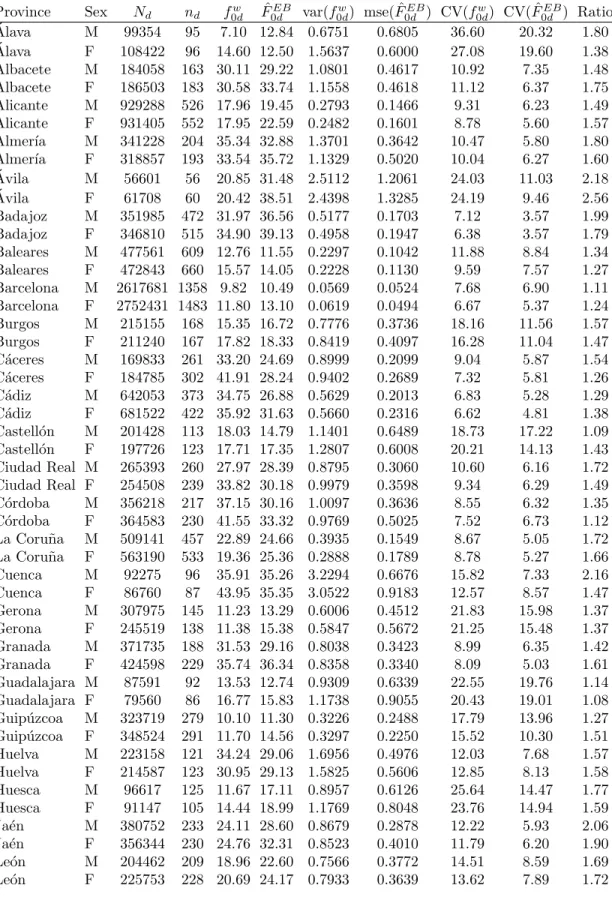
The MSEs of the poverty measures were estimated by using the bootstrap procedure described in Section 6. Values of EB estimates and coefficients of variation (CVs) for the poverty incidence and the poverty gap are listed in Tables 1 and 2 respectively. In these tables we show also the direct estimates (2) and their estimated variances following standard formulas in sampling theory, but taking as observations the quantitiesFαdj,j ∈sdand using the EUSILC sampling weights. Observe that the CVs of EB estimates are much smaller than those of direct estimators for all except few domains, in which the CVs are similar for both estimators. This improvement in efficiency is even more dramatic for the poverty gap than for the poverty incidence. Moreover, the reduction in CV tends to be greater for domains with small sample sizes. National statistical offices usually establish a maximum publishable CV. For these data, the estimated CVs of direct estimators of poverty incidences exceeded the level of 10% for 78 (out of the 104) domains while those of the EB estimators exceeded this level for only 28 domains. If we increase the level to 20%, then the direct estimators have greater CV for 17 domains but the CV of EB estimators exceeded 20% only for the first domain.
Span-a) 0 20 40 60 80 10.0 10.2 10.4 10.6 10.8 Area
MSE Poverty incidence (x10000)
True MSE Bootstrap MSE b) 0 20 40 60 80 0.78 0.80 0.82 0.84 0.86 Area
MSE Poverty gap (x10000)
True MSE Bootstrap MSE
Figure 3: True MSEs (×104) of EB predictors and bootstrap MSE estimates
with B = 500 for each area d: a) Poverty incidence, b) Poverty gap.
ish provinces for males and females have been constructed using the EB esti-mates, see Figures 6 and 7. In these maps we can see that the poorer provinces concentrate mainly in the south and west parts of Spain. Provinces with critical poverty incidences (over 30%) for men are, in the south: Almer´ıa and C´ordoba; west: Badajoz, ´Avila, Salamanza and Zamora and then Cuenca, situated east of Madrid. For women the poverty incidences increase in most provinces, becoming critical also, in the south: Granada, Ja´en, Albacete and Ciudad Real, and in the north: Palencia and Soria. The poverty level for L´erida (north-east) seems unexpected considering that this province belongs to the region of Catalonia, which is commonly considered as a rich region.
The poverty gap measures the degree of poverty instead of the quantity of people under poverty. For a region with many people whose income is under the poverty line but very close to it, the poverty gap will be close to zero. Observe that the provinces with an income of over 12.5% under the poverty line are also among those provinces with critical values of poverty incidence, except for the northern provinces such as L´erida, which do not have significant gaps in comparison with the rest of the provinces.
11
Conclusions
In this paper Empirical Best (EB) methodology to estimate poverty measures is proposed. Parametric bootstrap is used for mean squared error (MSE) es-timation. Simulation results show the good performance of EB estimators in comparison with the direct and the ELL estimators. Simulation results confirm the discussion that the ELL estimator is basically a synthetic-type estimator derived from a linear regression model.
0 20 40 60 80 5 10 15 20 25 30 35 Area Poverty incidence (x100) True EB Sample ELL
Figure 4: Means (×100) over Monte Carlo samples of true values, EB, sample and ELL estimators of the poverty incidence F0d for each aread.
0 20 40 60 80 0 50 100 150 200 250 300 Area
MSE poverty incidence (x10000)
EB Sample ELL
Figure 5: MSEs (×104) over Monte Carlo samples of EB, sample and ELL
−15 −10 −5 0 5
30
35
40
45
Poverty incidence − Men
under 15 15 − 20 20 − 25 25 − 30 over 30 −15 −10 −5 0 5 30 35 40 45
Poverty incidence − Women
under 15 15 − 20 20 − 25 25 − 30 over 30
Figure 6: Cartograms of estimated percent poverty incidences in Spanish provinces for Men and Women.
−15 −10 −5 0 5
30
35
40
45
Poverty gap − Men
under 5 5 − 7.5 7.5 − 10 10 − 12.5 over 12.5 −15 −10 −5 0 5 30 35 40 45
Poverty gap − Women
under 5 5 − 7.5 7.5 − 10 10 − 12.5 over 12.5
Figure 7: Cartograms of estimated percent poverty gaps in Spanish provinces for Men and Women.
the clusters in the ELL method are taken to be equal to the small areas, the ELL method generates a full population or census file of responses Ydj from the bootstrap model (23) withv∗
c =vd∗. Then the poverty measure is calculated from this census file. The procedure is repeated a large number of times and finally the computed poverty measures are averaged over bootstrap replications. The EB method also creates a new census file, but first plugging in the observed sample elements Ydj in their corresponding place, and then generating only the non-sample values from the conditional model (17). The main difference between model (17) and bootstrap model (23) used for the ELL method is the term
σ2
u1Nd−nd1
′
ndV
−1
ds(ys−Xsβ) appearing in the conditional mean given in (16). The rest of the procedure is the same as in the ELL method. Thus, this term makes an improvement for areas that are not fully explained by auxiliary variables and therefore reduces the MSE of estimators significantly.
We remark that EB is a model-based method that relies on the validity of the model. Thus, model selection procedures and model diagnostics are essential in the practical application of this methodology.
References
Ballini, F., Betti, G. and Neri, L. (2006). Poverty and inequality mapping in the Commonwealth of Dominica. Preprint.
Battese, G. E., Harter, R. M. and Fuller, W. A. (1988). An Error-Components Model for Prediction of County Crop Areas Using Survey and Satellite Data. Journal of the American Statistical Association, 83, 28–36.
Bell, W. (1997). Models for county and state poverty estimates. Preprint, Census Statistical Research Division.
Elbers, C., Lanjouw, J. O. and Lanjouw, P. (2003). Micro-level estimation of poverty and inequality. Econometrica,71, 355–364.
Fay, R. E. and Herriot, R. A. (1979). Estimation of income from small places: An application of James-Stein procedures to census data. Journal of the
American Statistical Association, 74, 269–277.
Foster, J., Greer, J. and Thorbecke, E. (1984). A class of decomposable poverty measures, Econometrica, 52, 761–766.
Gonz´alez-Manteiga, W., Lombard´ıa, M. J., Molina, I., Morales, D. and Santa-mar´ıa, L. (2008). Journal of Statistical Computation and Simulation, 75, 443–462.
Hall, P. and Maiti, T. (2006). On Parametric Bootstrap Methods for Small Area Prediction. Journal Royal Statistical Society, Series B, 68, 221–238.
Haslett, S. and Jones, G. (2005). Small area estimation using surveys and some practical and statistical issues. Statistics in Transition, 7, 541–555.
Neri, L., Ballini, F. and Betti, G. (2005). Poverty and inequality in transition countries. Statistics in Transition, 7, 135–157.
Pfeffermann, D., Skinner, C. J., Holmes, D. J., Goldstein, H. and Rasbash, J. (1998). Weighting in Unequal Probabilities in Multilevel Models. Journal
of the Royal Statistical Society B,60, 23–40.
Rao, J. N. K. (2003). Small Area Estimation. London: Wiley.
Royall, R. M. (1976). The Linear Least Squares Prediction Approach to Two-Stage Sampling, Journal of the American Statistical Association, 71, 657– 664.
Tarozzi, A. and Deaton, A. (2007). Using census and survey data to estimate poverty and inequality for small areas. Preprint.
Application results
Table 1.
Results on poverty incidence: Spanish SILC data.
Province Sex Nd nd f w 0d Fˆ EB 0d var(f w 0d) mse( ˆF EB 0d ) CV(f w 0d) CV( ˆF EB 0d ) Ratio ´ Alava M 99354 95 7.10 12.84 0.6751 0.6805 36.60 20.32 1.80 ´ Alava F 108422 96 14.60 12.50 1.5637 0.6000 27.08 19.60 1.38 Albacete M 184058 163 30.11 29.22 1.0801 0.4617 10.92 7.35 1.48 Albacete F 186503 183 30.58 33.74 1.1558 0.4618 11.12 6.37 1.75 Alicante M 929288 526 17.96 19.45 0.2793 0.1466 9.31 6.23 1.49 Alicante F 931405 552 17.95 22.59 0.2482 0.1601 8.78 5.60 1.57 Almer´ıa M 341228 204 35.34 32.88 1.3701 0.3642 10.47 5.80 1.80 Almer´ıa F 318857 193 33.54 35.72 1.1329 0.5020 10.04 6.27 1.60 ´ Avila M 56601 56 20.85 31.48 2.5112 1.2061 24.03 11.03 2.18 ´ Avila F 61708 60 20.42 38.51 2.4398 1.3285 24.19 9.46 2.56 Badajoz M 351985 472 31.97 36.56 0.5177 0.1703 7.12 3.57 1.99 Badajoz F 346810 515 34.90 39.13 0.4958 0.1947 6.38 3.57 1.79 Baleares M 477561 609 12.76 11.55 0.2297 0.1042 11.88 8.84 1.34 Baleares F 472843 660 15.57 14.05 0.2228 0.1130 9.59 7.57 1.27 Barcelona M 2617681 1358 9.82 10.49 0.0569 0.0524 7.68 6.90 1.11 Barcelona F 2752431 1483 11.80 13.10 0.0619 0.0494 6.67 5.37 1.24 Burgos M 215155 168 15.35 16.72 0.7776 0.3736 18.16 11.56 1.57 Burgos F 211240 167 17.82 18.33 0.8419 0.4097 16.28 11.04 1.47 C´aceres M 169833 261 33.20 24.69 0.8999 0.2099 9.04 5.87 1.54 C´aceres F 184785 302 41.91 28.24 0.9402 0.2689 7.32 5.81 1.26 C´adiz M 642053 373 34.75 26.88 0.5629 0.2013 6.83 5.28 1.29 C´adiz F 681522 422 35.92 31.63 0.5660 0.2316 6.62 4.81 1.38 Castell´on M 201428 113 18.03 14.79 1.1401 0.6489 18.73 17.22 1.09 Castell´on F 197726 123 17.71 17.35 1.2807 0.6008 20.21 14.13 1.43 Ciudad Real M 265393 260 27.97 28.39 0.8795 0.3060 10.60 6.16 1.72 Ciudad Real F 254508 239 33.82 30.18 0.9979 0.3598 9.34 6.29 1.49 C´ordoba M 356218 217 37.15 30.16 1.0097 0.3636 8.55 6.32 1.35 C´ordoba F 364583 230 41.55 33.32 0.9769 0.5025 7.52 6.73 1.12 La Coru˜na M 509141 457 22.89 24.66 0.3935 0.1549 8.67 5.05 1.72 La Coru˜na F 563190 533 19.36 25.36 0.2888 0.1789 8.78 5.27 1.66 Cuenca M 92275 96 35.91 35.26 3.2294 0.6676 15.82 7.33 2.16 Cuenca F 86760 87 43.95 35.35 3.0522 0.9183 12.57 8.57 1.47 Gerona M 307975 145 11.23 13.29 0.6006 0.4512 21.83 15.98 1.37 Gerona F 245519 138 11.38 15.38 0.5847 0.5672 21.25 15.48 1.37 Granada M 371735 188 31.53 29.16 0.8038 0.3423 8.99 6.35 1.42 Granada F 424598 229 35.74 36.34 0.8358 0.3340 8.09 5.03 1.61 Guadalajara M 87591 92 13.53 12.74 0.9309 0.6339 22.55 19.76 1.14 Guadalajara F 79560 86 16.77 15.83 1.1738 0.9055 20.43 19.01 1.08 Guip´uzcoa M 323719 279 10.10 11.30 0.3226 0.2488 17.79 13.96 1.27 Guip´uzcoa F 348524 291 11.70 14.56 0.3297 0.2250 15.52 10.30 1.51 Huelva M 223158 121 34.24 29.06 1.6956 0.4976 12.03 7.68 1.57 Huelva F 214587 123 30.95 29.13 1.5825 0.5606 12.85 8.13 1.58 Huesca M 96617 125 11.67 17.11 0.8957 0.6126 25.64 14.47 1.77 Huesca F 91147 105 14.44 18.99 1.1769 0.8048 23.76 14.94 1.59 Ja´en M 380752 233 24.11 28.60 0.8679 0.2878 12.22 5.93 2.06 Ja´en F 356344 230 24.76 32.31 0.8523 0.4010 11.79 6.20 1.90 Le´on M 204462 209 18.96 22.60 0.7566 0.3772 14.51 8.59 1.69 Le´on F 225753 228 20.69 24.17 0.7933 0.3639 13.62 7.89 1.72
L´erida M 214123 127 16.82 25.74 1.2317 0.6116 20.87 9.61 2.17 L´erida F 218051 133 15.57 27.36 1.0677 0.5777 20.98 8.79 2.39 La Rioja M 149238 519 16.75 18.57 0.3618 0.1383 11.36 6.33 1.79 La Rioja F 147554 500 18.50 21.45 0.3613 0.1557 10.27 5.82 1.77 Lugo M 175462 169 32.68 24.51 1.4726 0.3914 11.74 8.07 1.45 Lugo F 167892 177 30.17 26.87 1.3821 0.4034 12.32 7.47 1.65 Madrid M 2816184 893 7.95 12.06 0.0513 0.0619 9.01 6.52 1.38 Madrid F 3011923 996 9.36 13.91 0.0527 0.0704 7.76 6.04 1.29 M´alaga M 693871 361 18.96 27.95 0.5823 0.2031 12.73 5.10 2.50 M´alaga F 702667 397 22.88 32.45 0.5375 0.2190 10.13 4.56 2.22 Murcia M 668714 868 23.83 25.35 0.2471 0.1027 6.60 4.00 1.65 Murcia F 660107 902 23.67 28.70 0.2371 0.1087 6.50 3.63 1.79 Navarra M 286947 525 11.03 9.13 0.1812 0.1405 12.21 12.98 0.94 Navarra F 289947 603 12.98 11.40 0.2185 0.1211 11.39 9.66 1.18 Orense M 120257 118 24.94 25.07 1.3845 0.5993 14.92 9.77 1.53 Orense F 137587 140 21.27 22.12 1.0968 0.4809 15.57 9.92 1.57 Oviedo M 511169 742 12.26 16.01 0.1823 0.0824 11.01 5.67 1.94 Oviedo F 546817 864 12.56 16.59 0.1464 0.0893 9.63 5.70 1.69 Palencia M 75638 71 27.29 26.16 2.3375 1.0455 17.72 12.36 1.43 Palencia F 72558 72 30.63 30.13 2.5426 1.0907 16.46 10.96 1.50 Las Palmas M 592262 458 24.45 24.65 0.5337 0.1615 9.45 5.16 1.83 Las Palmas F 580265 485 29.76 25.40 0.5325 0.1520 7.75 4.85 1.60 Pontevedra M 494161 434 13.03 19.15 0.2430 0.1620 11.97 6.64 1.80 Pontevedra F 525627 462 15.69 22.66 0.2803 0.1865 10.67 6.03 1.77 Salamanca M 151335 166 26.92 31.46 1.2025 0.3862 12.88 6.25 2.06 Salamanca F 152234 162 31.58 33.56 1.3392 0.4030 11.59 5.98 1.94 Tenerife M 366253 370 17.63 24.14 0.3997 0.1590 11.34 5.22 2.17 Tenerife F 376690 392 17.07 26.36 0.3078 0.2006 10.28 5.37 1.91 Santander M 267290 424 8.79 16.00 0.1586 0.1398 14.33 7.39 1.94 Santander F 279191 443 12.65 16.93 0.2339 0.1678 12.09 7.65 1.58 Segovia M 62518 57 39.16 19.24 3.7441 1.0910 15.63 17.17 0.91 Segovia F 63217 58 47.03 26.74 3.7211 1.2032 12.97 12.97 1.00 Sevilla M 816795 472 22.06 19.61 0.2737 0.1575 7.50 6.40 1.17 Sevilla F 853057 491 28.07 24.04 0.3173 0.1493 6.35 5.08 1.25 Soria M 26431 24 23.68 26.33 8.0523 2.0666 37.89 17.26 2.19 Soria F 17211 17 26.73 31.48 11.6416 2.7052 40.37 16.52 2.44 Tarragona M 264627 129 12.96 14.86 0.6612 0.5761 19.85 16.15 1.23 Tarragona F 255490 139 16.19 19.28 0.6499 0.5197 15.75 11.82 1.33 Teruel M 53380 66 12.43 17.13 1.0073 0.8420 25.53 16.94 1.51 Teruel F 65002 78 16.22 22.26 1.3288 1.0112 22.48 14.29 1.57 Toledo M 288335 278 23.86 26.22 0.6157 0.1871 10.40 5.22 1.99 Toledo F 305241 272 20.56 22.50 0.5188 0.2784 11.08 7.42 1.49 Valencia M 1169258 686 17.53 17.89 0.1995 0.0940 8.06 5.42 1.49 Valencia F 1197478 742 19.64 20.78 0.1978 0.1162 7.16 5.19 1.38 Valladolid M 305496 292 14.98 15.34 0.4731 0.2216 14.52 9.70 1.50 Valladolid F 322530 306 18.59 18.29 0.4771 0.2352 11.75 8.38 1.40 Vizcaya M 576042 515 9.08 10.01 0.1458 0.1267 13.30 11.24 1.18 Vizcaya F 590094 532 10.26 11.57 0.1753 0.1175 12.91 9.37 1.38 Zamora M 101433 109 36.14 34.67 2.6728 0.7388 14.30 7.84 1.82 Zamora F 98337 100 36.53 32.84 2.3562 0.7964 13.29 8.59 1.55 Zaragoza M 466651 555 10.64 15.42 0.2081 0.1232 13.55 7.20 1.88 Zaragoza F 462937 574 10.22 15.34 0.1435 0.0989 11.72 6.48 1.81 Ceuta M 35705 223 40.87 30.26 1.5506 0.3482 9.63 6.17 1.56
Ceuta F 40426 247 42.80 33.15 1.4583 0.3804 8.92 5.88 1.52 Melilla M 30595 179 32.60 19.27 1.1714 0.3783 10.50 10.09 1.04 Melilla F 27498 180 29.56 25.45 1.0739 0.5579 11.09 9.28 1.19 Columns respectively denote province, gender, population size, sample size, direct estimate of poverty incidence, EB estimate, estimated variance of direct estimator, estimated MSE of EB estimator, CV of direct estimator, CV of EB estimator and ratio of CVs of direct estimators over EB estimators. Estimated poverty incidences and CVs in percentage.
Table 2.
Results on poverty gap: Spanish SILC data.
Province Sex Nd nd f w 1d Fˆ EB 1d var(f w 1d) mse( ˆF EB 1d ) CV(f w 1d) CV( ˆF EB 1d ) Ratio ´ Alava M 99354 95 2.49 3.75 1.0904 1.1907 41.94 29.09 1.44 ´ Alava F 108422 96 1.53 3.65 0.4942 1.1315 45.97 29.12 1.58 Albacete M 184058 163 9.63 10.53 2.9626 0.9286 17.87 9.15 1.95 Albacete F 186503 183 11.72 12.68 3.5333 0.9250 16.03 7.59 2.11 Alicante M 929288 526 5.00 6.29 0.5269 0.2937 14.53 8.62 1.68 Alicante F 931405 552 5.89 7.55 0.6127 0.3407 13.28 7.73 1.72 Almer´ıa M 341228 204 10.81 12.30 2.3507 0.6839 14.19 6.73 2.11 Almer´ıa F 318857 193 11.18 13.64 2.8714 1.0880 15.16 7.65 1.98 ´ Avila M 56601 56 10.82 11.64 7.0443 2.3237 24.54 13.09 1.87 ´ Avila F 61708 60 12.30 15.40 6.1424 2.8775 20.15 11.01 1.83 Badajoz M 351985 472 12.59 14.11 1.2979 0.3086 9.05 3.94 2.30 Badajoz F 346810 515 12.15 15.46 1.0543 0.4007 8.45 4.09 2.06 Baleares M 477561 609 2.88 3.34 0.4130 0.1955 22.28 13.24 1.68 Baleares F 472843 660 2.94 4.23 0.2716 0.2227 17.72 11.17 1.59 Barcelona M 2617681 1358 3.07 3.00 0.1224 0.0997 11.38 10.53 1.08 Barcelona F 2752431 1483 3.60 3.92 0.1297 0.1027 10.00 8.17 1.22 Burgos M 215155 168 4.22 5.21 2.2735 0.6704 35.72 15.70 2.27 Burgos F 211240 167 3.50 5.81 1.4983 0.8377 34.93 15.75 2.22 C´aceres M 169833 261 7.54 8.52 1.2188 0.3704 14.65 7.14 2.05 C´aceres F 184785 302 9.33 10.13 1.2620 0.5620 12.03 7.40 1.63 C´adiz M 642053 373 7.24 9.38 0.9284 0.4024 13.31 6.76 1.97 C´adiz F 681522 422 10.95 11.65 1.4154 0.5101 10.87 6.13 1.77 Castell´on M 201428 113 3.97 4.48 2.8120 1.2242 42.19 24.68 1.71 Castell´on F 197726 123 3.86 5.51 2.0386 1.3159 36.97 20.83 1.77 Ciudad Real M 265393 260 7.30 10.07 0.9995 0.6338 13.70 7.91 1.73 Ciudad Real F 254508 239 7.15 10.86 0.9134 0.7758 13.36 8.11 1.65 C´ordoba M 356218 217 8.22 10.82 1.2822 0.6983 13.77 7.72 1.78 C´ordoba F 364583 230 8.01 12.26 1.1694 1.1819 13.50 8.87 1.52 La Coru˜na M 509141 457 7.34 8.47 0.7480 0.2867 11.78 6.32 1.86 La Coru˜na F 563190 533 8.33 8.72 0.8716 0.3791 11.20 7.06 1.59 Cuenca M 92275 96 8.83 13.41 2.4195 1.4071 17.62 8.84 1.99 Cuenca F 86760 87 10.73 13.36 3.0724 2.0791 16.33 10.80 1.51 Gerona M 307975 145 1.87 3.95 0.5700 0.7954 40.35 22.56 1.79 Gerona F 245519 138 2.15 4.67 0.7537 1.0857 40.30 22.29 1.81 Granada M 371735 188 13.55 10.56 4.0423 0.6923 14.84 7.88 1.88 Granada F 424598 229 16.81 14.02 4.8343 0.7568 13.08 6.20 2.11 Guadalajara M 87591 92 1.52 3.80 0.2823 1.2206 34.88 29.10 1.20 Guadalajara F 79560 86 2.55 4.90 0.4615 1.7868 26.63 27.28 0.98 Guip´uzcoa M 323719 279 2.60 3.25 0.9591 0.4277 37.69 20.09 1.88 Guip´uzcoa F 348524 291 4.42 4.38 1.3093 0.4294 25.90 14.95 1.73 Huelva M 223158 121 10.46 10.37 7.2743 0.9412 25.78 9.36 2.75
Huelva F 214587 123 9.13 10.40 4.2187 1.0980 22.49 10.07 2.23 Huesca M 96617 125 2.56 5.39 1.2775 1.2615 44.18 20.86 2.12 Huesca F 91147 105 3.04 6.06 1.7064 1.5781 42.92 20.72 2.07 Ja´en M 380752 233 9.63 10.28 1.8186 0.5968 14.01 7.51 1.86 Ja´en F 356344 230 11.41 11.94 2.1644 0.8385 12.89 7.67 1.68 Le´on M 204462 209 7.14 7.58 2.2850 0.7474 21.16 11.41 1.85 Le´on F 225753 228 7.56 8.31 2.2879 0.8014 20.00 10.77 1.86 L´erida M 214123 127 9.22 9.08 4.8531 1.2797 23.88 12.46 1.92 L´erida F 218051 133 9.34 9.77 4.5156 1.2979 22.75 11.66 1.95 La Rioja M 149238 519 4.05 5.97 0.3139 0.2546 13.83 8.46 1.64 La Rioja F 147554 500 4.34 7.14 0.2958 0.3245 12.52 7.98 1.57 Lugo M 175462 169 8.64 8.40 6.9390 0.7199 30.50 10.10 3.02 Lugo F 167892 177 5.26 9.40 1.3626 0.8026 22.20 9.54 2.33 Madrid M 2816184 893 3.37 3.58 0.3812 0.1145 18.33 9.45 1.94 Madrid F 3011923 996 3.59 4.26 0.3350 0.1442 16.14 8.92 1.81 M´alaga M 693871 361 8.95 9.90 1.9024 0.4162 15.41 6.52 2.37 M´alaga F 702667 397 10.80 12.04 1.9554 0.4561 12.95 5.61 2.31 Murcia M 668714 868 7.54 8.74 0.4296 0.2175 8.69 5.34 1.63 Murcia F 660107 902 8.30 10.31 0.4393 0.2373 7.99 4.73 1.69 Navarra M 286947 525 2.99 2.53 0.3732 0.2389 20.45 19.28 1.06 Navarra F 289947 603 2.73 3.31 0.2752 0.2450 19.23 14.96 1.29 Orense M 120257 118 7.28 8.66 3.6924 1.1440 26.41 12.36 2.14 Orense F 137587 140 4.77 7.44 2.0973 0.9954 30.34 13.41 2.26 Oviedo M 511169 742 2.54 4.95 0.2335 0.1618 19.02 8.12 2.34 Oviedo F 546817 864 3.11 5.14 0.2300 0.1857 15.41 8.38 1.84 Palencia M 75638 71 5.65 9.10 2.9335 2.1179 30.32 15.99 1.90 Palencia F 72558 72 6.08 10.92 3.1612 2.5262 29.27 14.56 2.01 Las Palmas M 592262 458 7.63 8.40 1.5179 0.3192 16.15 6.73 2.40 Las Palmas F 580265 485 8.46 8.78 1.6326 0.3139 15.11 6.38 2.37 Pontevedra M 494161 434 3.00 6.09 0.1949 0.3100 14.73 9.14 1.61 Pontevedra F 525627 462 4.40 7.57 0.3114 0.3888 12.68 8.24 1.54 Salamanca M 151335 166 9.87 11.50 2.3273 0.7451 15.46 7.51 2.06 Salamanca F 152234 162 8.85 12.74 2.0322 0.8510 16.11 7.24 2.22 Tenerife M 366253 370 8.07 8.20 1.0073 0.2909 12.44 6.58 1.89 Tenerife F 376690 392 9.35 9.18 1.2484 0.4136 11.95 7.00 1.71 Santander M 267290 424 2.59 4.94 0.3045 0.2634 21.30 10.38 2.05 Santander F 279191 443 2.95 5.29 0.3210 0.3526 19.20 11.22 1.71 Segovia M 62518 57 7.01 6.30 4.5293 2.1717 30.36 23.41 1.30 Segovia F 63217 58 10.90 9.64 5.5058 2.9114 21.52 17.71 1.22 Sevilla M 816795 472 3.42 6.34 0.1609 0.2819 11.72 8.38 1.40 Sevilla F 853057 491 4.53 8.14 0.3045 0.3112 12.19 6.85 1.78 Soria M 26431 24 15.28 9.13 76.9805 3.9189 57.42 21.68 2.65 Soria F 17211 17 23.46 11.84 122.9756 5.5980 47.27 19.99 2.37 Tarragona M 264627 129 1.95 4.53 0.2800 1.0997 27.15 23.14 1.17 Tarragona F 255490 139 2.79 6.16 0.4304 1.1317 23.52 17.26 1.36 Teruel M 53380 66 4.48 5.49 5.9649 1.6368 54.54 23.29 2.34 Teruel F 65002 78 5.16 7.38 3.8559 1.9972 38.09 19.15 1.99 Toledo M 288335 278 7.69 9.18 1.3151 0.3438 14.92 6.39 2.33 Toledo F 305241 272 5.85 7.58 0.8997 0.6082 16.21 10.28 1.58 Valencia M 1169258 686 5.08 5.70 0.9538 0.1722 19.24 7.28 2.64 Valencia F 1197478 742 4.26 6.78 0.3187 0.2456 13.25 7.31 1.81 Valladolid M 305496 292 6.38 4.71 1.1430 0.4269 16.75 13.87 1.21 Valladolid F 322530 306 7.45 5.82 1.3767 0.4782 15.76 11.89 1.33
Vizcaya M 576042 515 2.57 2.80 0.2783 0.2338 20.49 17.27 1.19 Vizcaya F 590094 532 2.26 3.35 0.1756 0.2177 18.56 13.92 1.33 Zamora M 101433 109 12.58 13.10 5.5333 1.5147 18.71 9.40 1.99 Zamora F 98337 100 9.86 12.18 4.7252 1.7185 22.04 10.76 2.05 Zaragoza M 466651 555 4.29 4.77 0.7891 0.2377 20.69 10.23 2.02 Zaragoza F 462937 574 5.08 4.72 0.9837 0.1956 19.53 9.38 2.08 Ceuta M 35705 223 14.79 11.09 3.3694 0.7296 12.41 7.70 1.61 Ceuta F 40426 247 20.68 12.52 5.5107 0.8832 11.35 7.50 1.51 Melilla M 30595 179 11.87 6.22 7.3207 0.7442 22.80 13.86 1.64 Melilla F 27498 180 12.47 8.82 3.5770 1.1392 15.16 12.10 1.25 Columns respectively denote province, gender, population size, sample size, direct estimate of poverty gap, EB estimate, estimated variance of direct estimator, estimated MSE of EB estimator, CV of direct estimator, CV of EB estimator and ratio of CVs of direct estimators over EB estimators. Estimated poverty gaps and CVs in percentage.