Gianluigi Zavattaro University of Bologna - Italy FoCUS research team INRIA - France
Aeolus:
Mastering the Complexity of
Cloud Application Deployment
Based on joint work with:
Tudor A. Lascu and Jacopo Mauro Univ. of Bologna
Aeolus:
Mastering the cloud complexity
ESOCC'13 - 11.9.2013 Aeolus: Mastering the Complexity of Cloud Application Deployment
Aeolus: Mastering Cloud Complexity
Roberto Di Cosmo
Universit´e Paris Diderot and INRIA
December 9th, 2010
IRILL
Aeolus is a project funded by
Roberto Di Cosmo (IRILL / UPD / INRIA) Aeolus 9/12/2010 - IRILL 1 / 12
u
Models, languages and tools for the
administration of cloud applications
n
Cloud computing offers the possibility to
build
sophisticated
software systems on
virtualized infrastructures at a
fraction
of
the cost necessary just few years ago…
n
…but the administration (deploying/
upgrading/reconfiguring) of such software
New models and languages:
an industrial need
u
Several industrial initiatives pursue the
definition of
high-level
languages for
the management of applications
deployed on virtualized infrastructures
ESOCC'13 - 11.9.2013 Aeolus: Mastering the Complexity of Cloud Application Deployment
New models and languages:
an industrial need
u
Cloud Foundry (launched by VMware)
provides a PaaS with high-level
primitives for
service creation
and
binding
ESOCC'13 - 11.9.2013 Aeolus: Mastering the Complexity of Cloud Application Deployment
$ cf create-service What kind?> 1
Name?> cleardb-e2006
Creating service cleardb-e2006... OK $ cf bind-service
1: myapp
Which application?> 1 1: cleardb-e2006
Which service?> 1
New models and languages:
an industrial need
ESOCC'13 - 11.9.2013 Aeolus: Mastering the Complexity of Cloud Application Deployment
u
Juju (an Ubuntu initiative) provides
similar primitives
n
service
replication
and scaling supported
New models and languages:
an industrial need
New models and languages:
an industrial need
u
Phase 1:
Define
“Puppet’s
declarative language
lets
you ... describe your configurations
and the relationships between
resources”
New models and languages:
an industrial need
u
Declarative language: three kinds of
resources
package { 'openssh-server': ensure => installed,} file { '/etc/ssh/sshd_config': source => 'puppet:///modules/sshd/sshd_config', owner => 'root', group => 'root', mode => '640', notify => Service['sshd'], require => Package['openssh-server'],} service { 'sshd': ensure => running, enable => true, hasstatus => true, hasrestart => true,}New models and languages:
an industrial need
u
In all these approaches a lot of
human
intervention is needed for
n
Service
selection
n
Deciding the service
bindings
n
It is like having to
manually
select all the
packages to be (un)installed at every
reconfiguration of a Linux installation!
u
Aim of
Aeolus
:
n
automatize
as much as possible the
management of such applications
ESOCC'13 - 11.9.2013 Aeolus: Mastering the Complexity of Cloud Application Deployment
Structure of the talk
u
The Aeolus starting point
u
Formalizing the deployment problem
u
Solving the deployment problem
n
ExpSpace-hard in the general case
n
PolyTime without conflicts
u
The Aeolus Deployment Engine
u
Future and related work
ESOCC'13 - 11.9.2013 Aeolus: Mastering the Complexity of Cloud Application Deployment
Automatic management
of package-based software systems
u
Developed rather sophisticated
tools
for
FOSS (free and open-source software)
ESOCC'13 - 11.9.2013 Aeolus: Mastering the Complexity of Cloud Application Deployment
Distributions
a “somewhat” successful idea . . .
openSUSE, Debian, Red Hat, Ubuntu, Mandriva, Fedora, Linux Mint, PCLinuxOS, Slackware, Gentoo Linux, CentOS, FreeBSD, Arch, Sabayon, Puppy, Lubuntu, MEPIS, Ultimate, NetBSD, Tiny Core, Zenwalk, CrunchBang, Dreamlinux, Vector, Kubuntu, Maemo, aptosid, Peppermint, PC-BSD, Chakra, Salix,
ClearOS, KNOPPIX, Xubuntu, Super OS, BackTrack, gOS, TinyMe, Zentyal, EasyPeasy, Frugalware, Clonezilla, Pardus, Meego, OpenBSD, Quirky, PC/OS, Zorin, SystemRescue, Element, Unity, SliTaz, Macpup, wattOS, Scientific, Mythbuntu, Slax, DragonFLY, Elive, linux-gamers, 64 Studio, mageia, Nexenta, Parisx, NuTyX, GhostBSD, Kongoni, moonOS, LFS, Lunar, Imagineos, Untangle, Yellow Dog, aLinux, Yoper, IPFire, BlankOn, PureOS, FreeNAS, Moblin, Linpus, TurboLinux, blackPanther, . . .
The dependency/conflict model
u
Tools are based on the
dependency/conflict
model
ESOCC'13 - 11.9.2013 Aeolus: Mastering the Complexity of Cloud Application Deployment
158
R. Di Cosmo, S. Zacchiroli, and G. Zavattaro
Package: wordpressVersion: 3.0.5+ dfsg -0+ squeeze1
Depends: httpd , mysql - client , php5 , php5 - mysql , libphp - phpmailer ( >= 1.73 -4) , [...]
Package: mysql - server -5.5
Source: mysql -5.5
Version: 5.5.17 -4
Provides: mysql - server , virtual - mysql - server
Depends: libc6 ( >= 2.12) , zlib1g ( >= 1:1.1.4) , debconf , [...]
Pre -Depends: mysql - common ( >= 5.5.17 -4) , adduser ( >= 3.40) , debconf
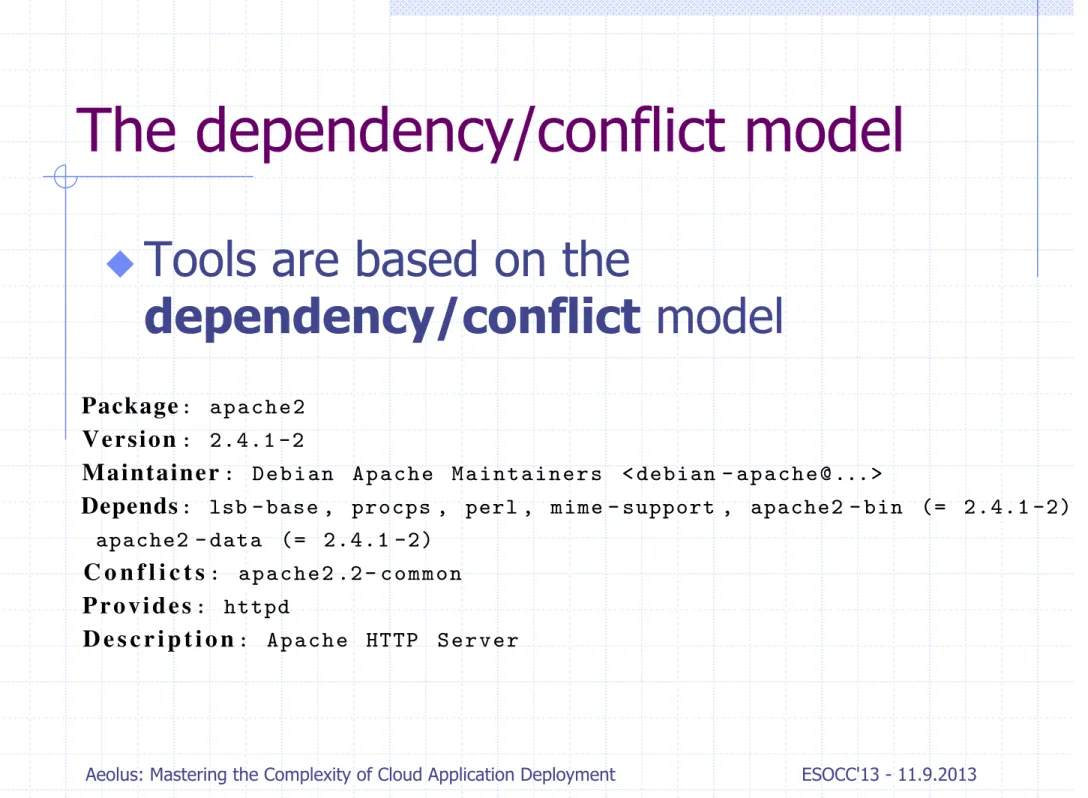
Package: apache2
Version: 2.4.1 -2
Maintainer: Debian Apache Maintainers < debian - apache@ ...>
Depends: lsb - base , procps , perl , mime - support , apache2 - bin (= 2.4.1 -2) , apache2 - data (= 2.4.1 -2)
C o n f l i c t s: apache2 .2 - common
Provides: httpd
D e s c r i p t i o n: Apache HTTP Server
Fig. 1.
Debian package metadata for WordPress, Mysql and the Apache web server (excerpt)
Use case 1 — Package installation.
Before considering the services that a machine is
offering to others (locally or over the network), we need to model the
software
instal-lation
on the machine itself, so we will see how to model the three main components
needed by WordPress, as far as their installation is concerned.
Software is often distributed according to the
package
paradigm [7], popularized
by FOSS distributions, where software is shipped at the granularity of bundles called
packages
. Each package contains the actual software artifact, its default configuration,
as well as a bunch of package metadata.
On a given machine, a software package may exists in different states (e.g. installed
or uninstalled) and it should go through a complex sequence of states in different phases
of unpacking and configuration to get there. In each of its states, similarly to what
hap-pens in most software component models [9], a package may have context
requirements
and offer some features, that we call
provides
. For instance in Debian, a popular FOSS
distribution, requirements come in two flavors:
Depends
which must be satisfied
be-fore a package can be used, and
Pre-Depends
which must be satisfied before a package
can be installed. This distinction is of general interest, as we will see later, so we will
distinguish between
weak
requirements and
strong
requirements.
An excerpt of the concrete description of the packages present in Debian for
Word-Press, Apache2 and MySQL are shown in Fig. 1.
To model a software package at this level of abstraction, we may use a simple state
machine, with requirements and provides associated to each state. The ingredients of
this model are very simple: a set of states
Q
, an initial state
q
0, a transition function
T
from states to states, a set
R
of requirements, a set
P
of provides, and a function
that maps states to the requirements and provides that are
active
at that state, and
tells whether requirements are weak or strong. We call
resource type
any such tuple
!
Q
,
q
0,
T
,
P
,
D
"
, which will be formalized in Definition 1.
A system
configuration
built out of a collection of resources types is given by an
instance of each resource type, with its current state, and a set of connections between
Package configuration
as a SAT problem
u
One boolean
variable
for each package
n
TRUE – installed
n
FALSE – not installed
u
Conflicts/dependencies can be
formalized as boolean
formulae
u
Finding a correct configuration is
mapped to a
satisfaction
problem
ESOCC'13 - 11.9.2013 Aeolus: Mastering the Complexity of Cloud Application Deployment
Package configuration
as a SAT problem
u
One boolean
variable
for each package
n
TRUE – installed
n
FALSE – not installed
u
Conflicts/dependencies can be
formalized as boolean
formulae
u
Finding a correct configuration is
mapped to a
satisfaction
problem
ESOCC'13 - 11.9.2013 Aeolus: Mastering the Complexity of Cloud Application Deployment
Advanced configuration tools
exploit state-of-the-art SAT solvers
Structure of the talk
u
The Aeolus starting point
u
Formalizing the deployment problem
u
Solving the deployment problem
n
ExpSpace-hard in the general case
n
PolyTime without conflicts
u
The Aeolus deployment tool
u
Future and related work
ESOCC'13 - 11.9.2013 Aeolus: Mastering the Complexity of Cloud Application Deployment
The Aeolus component model
u
A component has
provide
and
require
ports
ESOCC'13 - 11.9.2013 Aeolus: Mastering the Complexity of Cloud Application Deployment
Provide
ports
Require
ports
The Aeolus component model
u
A component has
provide
and
require
ports
u
A component has an internal
state machine
ESOCC'13 - 11.9.2013 Aeolus: Mastering the Complexity of Cloud Application Deployment
Provide
ports
Require
ports
The Aeolus component model
u
A component has
provide
and
require
ports
u
A component has an internal
state machine
u
Ports are
active
or
inactive
according to the
current internal state
ESOCC'13 - 11.9.2013 Aeolus: Mastering the Complexity of Cloud Application Deployment
Provide
ports
Require
ports
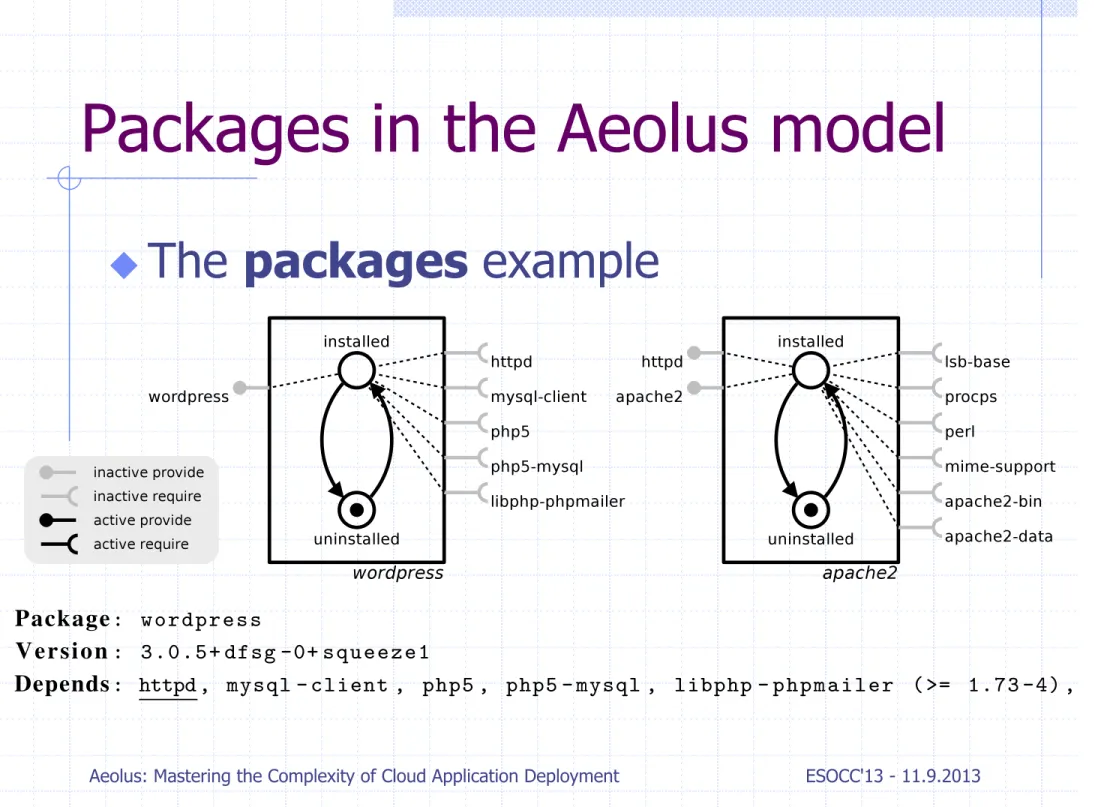
Packages in the Aeolus model
u
The
packages
example
ESOCC'13 - 11.9.2013 Aeolus: Mastering the Complexity of Cloud Application Deployment
Towards a Formal Component Model for the Cloud 159
(a) available components, not installed
(b) installed components, bound together on the httpd port
Fig. 2. A simple graphical description of the basic model of a package
requirements and provides of the different resources, that indicate which provide is
ful-filling the need of each requirement. A configuration is
correct
if all the requires which
are active are satisfied by active provides; this will be made precise in Definition 3.
A natural graphical notation captures all these pieces of information: Fig. 2 presents
two correct configurations of a system built using the components from Fig. 1 (only
modeling the dependency on
httpd
underlined in the metadata). In Fig. 2(b) the
Word-Press package is in the installed state, and activates the requirement on
httpd
; Apache2
is also in the installed state, so the
httpd
provide is active and is used to satisfy the
re-quirement, fact which is visualized by the
binding
connecting the two ports.
Use case 2 — Services and packages.
Installing the software on a single machine is a
process that can already be automated using
package managers
: on Debian for instance,
you only need to have an installed Apache server to be able to install WordPress. But
bringing it
in production
requires to activate the associated service, which is more tricky
and less automated: the system administrator will need to edit configuration files so that
WordPress knows the network addresses of an accessible MySQL instance.
The ingredients we have seen up to now in our model are sufficient to capture the
dependencies among services, as shown in Fig. 3. There we have added to each package
an extra state corresponding to the activation of the associated service, and the strong
requirement (graphically indicated by the double tip on the arrow) on
mysql up
cap-tures the fact that WordPress cannot be started before MySQL is running. In this case,
the bindings really correspond to a piece of configuration information, i.e. where to find
a suitable MySQL instance.
Notice how this model does not impose any particular way of modeling the relations
between packages and services: instead of using a single resource with an installed and
158
R. Di Cosmo, S. Zacchiroli, and G. Zavattaro
Package: wordpress
Version: 3.0.5+ dfsg -0+ squeeze1
Depends: httpd , mysql - client , php5 , php5 - mysql , libphp - phpmailer ( >= 1.73 -4) , [...]
Package: mysql - server -5.5
Source: mysql -5.5
Version: 5.5.17 -4
Provides: mysql - server , virtual - mysql - server
Depends: libc6 ( >= 2.12) , zlib1g ( >= 1:1.1.4) , debconf , [...]
Pre -Depends: mysql - common ( >= 5.5.17 -4) , adduser ( >= 3.40) , debconf
Package: apache2
Version: 2.4.1 -2
Maintainer: Debian Apache Maintainers < debian - apache@ ...>
Depends: lsb - base , procps , perl , mime - support , apache2 - bin (= 2.4.1 -2) , apache2 - data (= 2.4.1 -2)
C o n f l i c t s: apache2 .2 - common
Provides: httpd
D e s c r i p t i o n: Apache HTTP Server
Fig. 1.
Debian package metadata for WordPress, Mysql and the Apache web server (excerpt)
Use case 1 — Package installation.
Before considering the services that a machine is
offering to others (locally or over the network), we need to model the
software
instal-lation
on the machine itself, so we will see how to model the three main components
needed by WordPress, as far as their installation is concerned.
Software is often distributed according to the
package
paradigm [7], popularized
by FOSS distributions, where software is shipped at the granularity of bundles called
packages
. Each package contains the actual software artifact, its default configuration,
as well as a bunch of package metadata.
On a given machine, a software package may exists in different states (e.g. installed
or uninstalled) and it should go through a complex sequence of states in different phases
of unpacking and configuration to get there. In each of its states, similarly to what
hap-pens in most software component models [9], a package may have context
requirements
and offer some features, that we call
provides
. For instance in Debian, a popular FOSS
distribution, requirements come in two flavors:
Depends
which must be satisfied
be-fore a package can be used, and
Pre-Depends
which must be satisfied before a package
can be installed. This distinction is of general interest, as we will see later, so we will
distinguish between
weak
requirements and
strong
requirements.
An excerpt of the concrete description of the packages present in Debian for
Word-Press, Apache2 and MySQL are shown in Fig. 1.
To model a software package at this level of abstraction, we may use a simple state
machine, with requirements and provides associated to each state. The ingredients of
this model are very simple: a set of states
Q
, an initial state
q
0, a transition function
T
from states to states, a set
R
of requirements, a set
P
of provides, and a function
that maps states to the requirements and provides that are
active
at that state, and
tells whether requirements are weak or strong. We call
resource type
any such tuple
!
Q
,
q
0,
T
,
P
,
D
"
, which will be formalized in Definition 1.
A system
configuration
built out of a collection of resources types is given by an
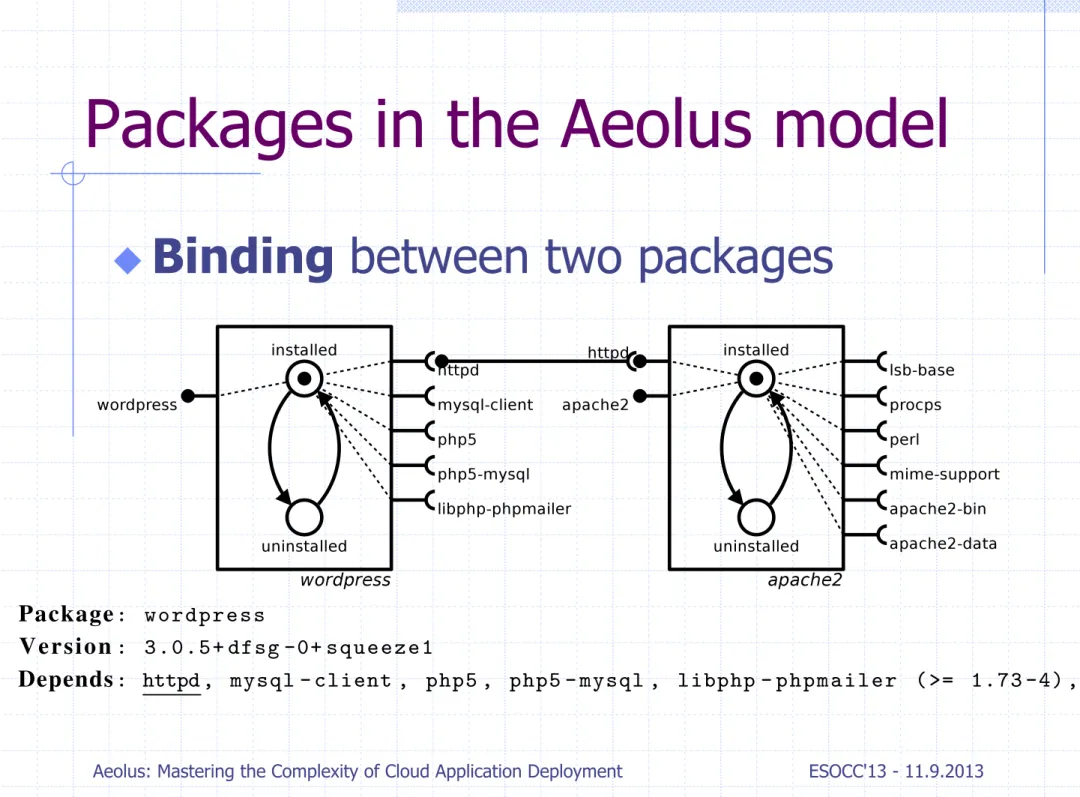
Packages in the Aeolus model
u
Binding
between two packages
ESOCC'13 - 11.9.2013 Aeolus: Mastering the Complexity of Cloud Application Deployment
158
R. Di Cosmo, S. Zacchiroli, and G. Zavattaro
Package: wordpress
Version: 3.0.5+ dfsg -0+ squeeze1
Depends: httpd , mysql - client , php5 , php5 - mysql , libphp - phpmailer ( >= 1.73 -4) , [...]
Package: mysql - server -5.5
Source: mysql -5.5
Version: 5.5.17 -4
Provides: mysql - server , virtual - mysql - server
Depends: libc6 ( >= 2.12) , zlib1g ( >= 1:1.1.4) , debconf , [...]
Pre -Depends: mysql - common ( >= 5.5.17 -4) , adduser ( >= 3.40) , debconf
Package: apache2
Version: 2.4.1 -2
Maintainer: Debian Apache Maintainers < debian - apache@ ...>
Depends: lsb - base , procps , perl , mime - support , apache2 - bin (= 2.4.1 -2) , apache2 - data (= 2.4.1 -2)
C o n f l i c t s: apache2 .2 - common
Provides: httpd
D e s c r i p t i o n: Apache HTTP Server
Fig. 1.
Debian package metadata for WordPress, Mysql and the Apache web server (excerpt)
Use case 1 — Package installation.
Before considering the services that a machine is
offering to others (locally or over the network), we need to model the
software
instal-lation
on the machine itself, so we will see how to model the three main components
needed by WordPress, as far as their installation is concerned.
Software is often distributed according to the
package
paradigm [7], popularized
by FOSS distributions, where software is shipped at the granularity of bundles called
packages
. Each package contains the actual software artifact, its default configuration,
as well as a bunch of package metadata.
On a given machine, a software package may exists in different states (e.g. installed
or uninstalled) and it should go through a complex sequence of states in different phases
of unpacking and configuration to get there. In each of its states, similarly to what
hap-pens in most software component models [9], a package may have context
requirements
and offer some features, that we call
provides
. For instance in Debian, a popular FOSS
distribution, requirements come in two flavors:
Depends
which must be satisfied
be-fore a package can be used, and
Pre-Depends
which must be satisfied before a package
can be installed. This distinction is of general interest, as we will see later, so we will
distinguish between
weak
requirements and
strong
requirements.
An excerpt of the concrete description of the packages present in Debian for
Word-Press, Apache2 and MySQL are shown in Fig. 1.
To model a software package at this level of abstraction, we may use a simple state
machine, with requirements and provides associated to each state. The ingredients of
this model are very simple: a set of states
Q
, an initial state
q
0, a transition function
T
from states to states, a set
R
of requirements, a set
P
of provides, and a function
that maps states to the requirements and provides that are
active
at that state, and
tells whether requirements are weak or strong. We call
resource type
any such tuple
!
Q
,
q
0,
T
,
P
,
D
"
, which will be formalized in Definition 1.
A system
configuration
built out of a collection of resources types is given by an
instance of each resource type, with its current state, and a set of connections between
Towards a Formal Component Model for the Cloud 159
(a) available components, not installed
(b) installed components, bound together on the httpd port
Fig. 2. A simple graphical description of the basic model of a package
requirements and provides of the different resources, that indicate which provide is
ful-filling the need of each requirement. A configuration is
correct
if all the requires which
are active are satisfied by active provides; this will be made precise in Definition 3.
A natural graphical notation captures all these pieces of information: Fig. 2 presents
two correct configurations of a system built using the components from Fig. 1 (only
modeling the dependency on
httpd
underlined in the metadata). In Fig. 2(b) the
Word-Press package is in the installed state, and activates the requirement on
httpd
; Apache2
is also in the installed state, so the
httpd
provide is active and is used to satisfy the
re-quirement, fact which is visualized by the
binding
connecting the two ports.
Use case 2 — Services and packages.
Installing the software on a single machine is a
process that can already be automated using
package managers
: on Debian for instance,
you only need to have an installed Apache server to be able to install WordPress. But
bringing it
in production
requires to activate the associated service, which is more tricky
and less automated: the system administrator will need to edit configuration files so that
WordPress knows the network addresses of an accessible MySQL instance.
The ingredients we have seen up to now in our model are sufficient to capture the
dependencies among services, as shown in Fig. 3. There we have added to each package
an extra state corresponding to the activation of the associated service, and the strong
requirement (graphically indicated by the double tip on the arrow) on
mysql up
cap-tures the fact that WordPress cannot be started before MySQL is running. In this case,
the bindings really correspond to a piece of configuration information, i.e. where to find
a suitable MySQL instance.
Notice how this model does not impose any particular way of modeling the relations
between packages and services: instead of using a single resource with an installed and
Services in the Aeolus model
u
At the service level, also a running state
becomes relevant:
n
wordpress need to know the network
address of a
running
MySQL instance
ESOCC'13 - 11.9.2013 Aeolus: Mastering the Complexity of Cloud Application Deployment
Conflicts in the Aeolus model
u
Conflicts are expressed as
special
ports
n
The apache web server is in
conflict
with
the lighttpd web server
ESOCC'13 - 11.9.2013 Aeolus: Mastering the Complexity of Cloud Application Deployment
Formalizing the
deployment problem
ESOCC'13 - 11.9.2013 Aeolus: Mastering the Complexity of Cloud Application Deployment
Fig. 1: Typical Wordpress/Apache/MySQL deployment, modeled in Aeolus core.
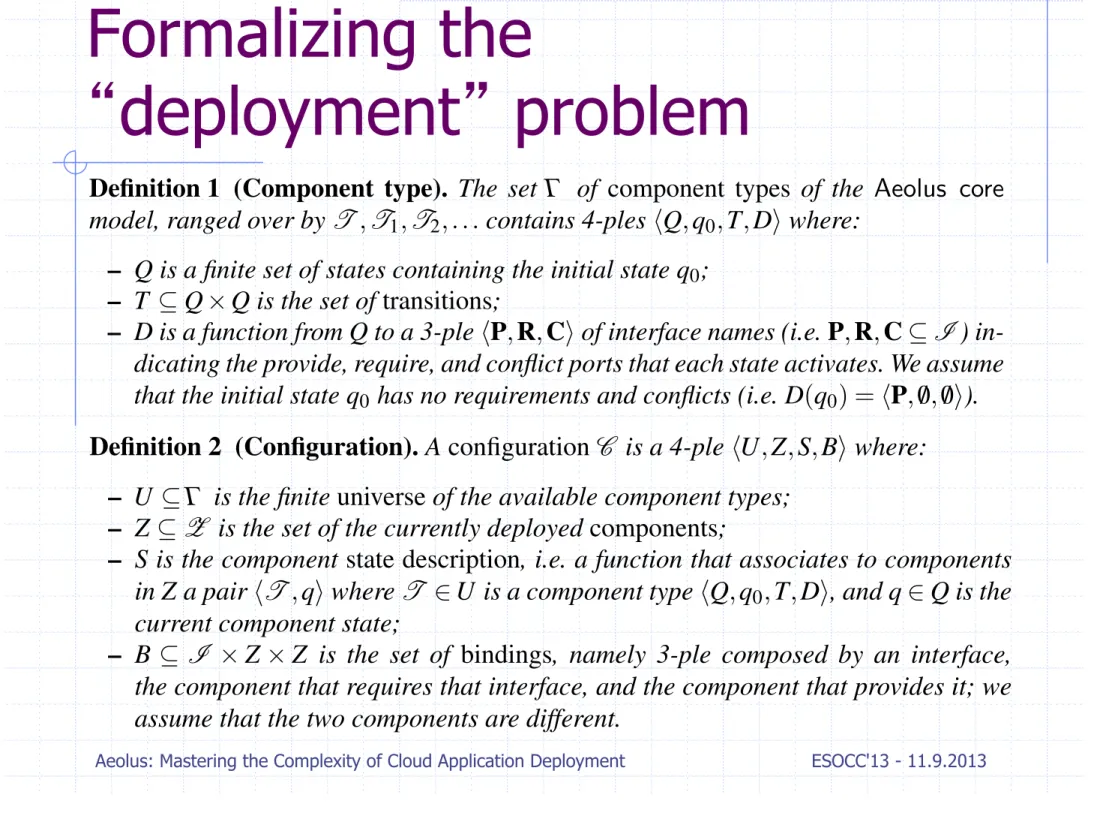
Definition 1 (Component type). The set Γ of component types of the Aeolus core
model, ranged over by T ,T1,T2, . . . contains 4-ples �Q,q0,T,D� where:
– Q is a finite set of states containing the initial state q0;
– T ⊆ Q×Q is the set of transitions;
– D is a function from Q to a 3-ple �P,R,C� of interface names (i.e. P,R,C ⊆ I)
in-dicating the provide, require, and conflict ports that each state activates. We assume that the initial state q0 has no requirements and conflicts (i.e. D(q0) = �P, /0, /0�). We now define configurations that describe systems composed by components and their bindings. Each component has a unique identifier taken from the set Z . A con-figuration, ranged over by C1,C2, . . ., is given by a set of component types, a set of components in some state, and a set of bindings.
Definition 2 (Configuration). A configuration C is a 4-ple �U,Z,S,B� where:
– U ⊆Γ is the finite universe of the available component types;
– Z ⊆ Z is the set of the currently deployed components;
– S is the component state description, i.e. a function that associates to components in Z a pair�T ,q� where T ∈U is a component type �Q,q0,T,D�, and q∈Q is the
current component state;
– B ⊆ I ×Z × Z is the set of bindings, namely 3-ple composed by an interface,
the component that requires that interface, and the component that provides it; we assume that the two components are different.
Configuration are equivalent if they have the same instances up to instance renaming.
Definition 3 (Configuration equivalence). Two configurations �U,Z,S,B� and
�U,Z�,S�,B��are equivalent (�U,Z,S,B� ≡ �U,Z�,S�,B��) iff there exists a bijective
func-tion ρ from Z to Z� s.t.
– S(z) =S�(ρ(z)) for every z∈ Z;
– �r,z1,z2� ∈ B iff �r,ρ(z1),ρ(z2)� ∈B�.
Notation. We write C[z] as a lookup operation that retrieves the pair �T ,q� = S(z), where C = �U,Z,S,B�. On such a pair we then use the postfix projection operators .type and .state
to retrieveT andq, respectively. Similarly, given a component type �Q,q0,T,D�, we use
projec-tions to decompose it: .states, .init, and .trans return the first three elements; .P(q), .R(q),
3
Fig. 1: Typical Wordpress/Apache/MySQL deployment, modeled in Aeolus core.
Definition 1 (Component type). The set Γ of component types of the Aeolus core
model, ranged over by T ,T1,T2, . . . contains 4-ples �Q,q0,T,D� where:
– Q is a finite set of states containing the initial state q0;
– T ⊆ Q×Q is the set of transitions;
– D is a function from Q to a 3-ple �P,R,C� of interface names (i.e. P,R,C ⊆I)
in-dicating the provide, require, and conflict ports that each state activates. We assume that the initial state q0 has no requirements and conflicts (i.e. D(q0) =�P, /0, /0�).
We now define configurations that describe systems composed by components and their bindings. Each component has a unique identifier taken from the set Z . A
con-figuration, ranged over by C1,C2, . . ., is given by a set of component types, a set of
components in some state, and a set of bindings.
Definition 2 (Configuration). A configuration C is a 4-ple �U,Z,S,B� where: – U ⊆Γ is the finite universe of the available component types;
– Z ⊆ Z is the set of the currently deployed components;
– S is the component state description, i.e. a function that associates to components in Z a pair �T ,q� where T ∈U is a component type �Q,q0,T,D�, and q∈Q is the
current component state;
– B ⊆ I ×Z ×Z is the set of bindings, namely 3-ple composed by an interface,
the component that requires that interface, and the component that provides it; we assume that the two components are different.
Configuration are equivalent if they have the same instances up to instance renaming.
Definition 3 (Configuration equivalence). Two configurations �U,Z,S,B� and
�U,Z�,S�,B�� are equivalent (�U,Z,S,B� ≡ �U,Z�,S�,B��) iff there exists a bijective
func-tion ρ from Z to Z� s.t.
– S(z) =S�(ρ(z)) for every z∈ Z;
– �r,z1,z2� ∈ B iff �r,ρ(z1),ρ(z2)� ∈ B�.
Notation. We write C[z] as a lookup operation that retrieves the pair �T ,q� = S(z), where
C = �U,Z,S,B�. On such a pair we then use the postfix projection operators .type and .state
to retrieve T andq, respectively. Similarly, given a component type �Q,q0,T,D�, we use
projec-tions to decompose it: .states, .init, and .trans return the first three elements; .P(q), .R(q),
Formalizing the
deployment problem
ESOCC'13 - 11.9.2013 Aeolus: Mastering the Complexity of Cloud Application Deployment
and .C(q) return the three elements of the D(q) tuple. Moreover, we use .prov (resp. .req) to
denote the union of all the provide ports (resp. require ports) of the states in Q. When there is no ambiguity we take the liberty to apply the component type projections to �T ,q� pairs. Example:
C[z].R(q) stands for the require ports of component z in configuration C when it is in state q.
We can now formalize the notion of configuration correctness.
Definition 4 (Correctness). Let us consider the configuration C = �U,Z,S,B�.
We write C |=req (z,r) to indicate that the require port of component z, with interface
r, is bound to an active port providing r, i.e. there exists a component z� ∈ Z \ {z} such
that �r,z,z�� ∈ B, C [z�] = �T �,q�� and r is in T �.P(q�). Similarly, for conflicts, we write
C |=cn f (z,c) to indicate that the conflict port c of component z is satisfied because
no other component has an active port providing c, i.e. for every z� ∈ Z \ {z} with
C [z�] = �T �,q�� we have that c �∈ T �.P(q�).
The configuration C is correct if for every component z ∈ Z with S(z) = �T ,q� we
have that C |=req (z,r) for every r ∈ T .R(q) and C |=cn f (z,c) for every c ∈ T .C(q).
Configurations evolve at the granularity of actions.
Definition 5 (Actions). The set A contains the following actions:
– stateChange(�z1,q1,q�1�, . . . ,�zn,qn,q�n�) where zi ∈ Z and ∀i �= j . zi �= zj;
– bind(r,z1,z2) where z1,z2 ∈ Z and r ∈ I ;
– unbind(r,z1,z2) where z1,z2 ∈ Z and r ∈ I;
– newRsrc(z : T ) where z ∈ Z and T ∈ U is the component type of z;
– delRsrc(z) where z ∈ Z .
Notice that we consider a set of state changes in order to deal with simultaneous instal-lations like the one needed for Apache2 and Apache2-bin in Fig. ??. The execution of actions is formalized as configuration transitions.
Definition 6 (Reconfigurations). Reconfigurations are denoted by transitions C −→α C�
meaning that the execution of α ∈ A on the configuration C produces a new
configu-ration C �. The transitions from a configuration C = �U,Z,S,B� are defined as follows:
C stateChange(�z1,q1,q � 1�,...,�zn,qn,q�n�) −−−−−−−−−−−−−−−−−−−−→ �U,Z,S�,B� if ∀i . C[zi].state = qi and ∀i . (qi,qi�) ∈ C[zi].trans and S�(z�) = � �C[zi].type,qi�� if ∃i . z� = zi C[z�] otherwise C −−−−−−−→ �bind(r,z1,z2) U,Z,S,B∪ �r,z1,z2�� if �r,z1,z2� �∈ B
and r ∈ C [z1].req∩C[z2].prov
C −−−−−−−−→ �unbind(r,z1,z2) U,Z,S,B\�r,z1,z2�� if �r,z1,z2� ∈ B C −−−−−−−−→ �newRsrc(z:T ) U,Z ∪{z},S�,B� if z �∈ Z, T ∈U and S�(z�) = � �T ,T .init� if z� = z C[z�] otherwise C −−−−−→ �delRsrc(z) U,Z \ {z},S�,B�� if S�(z�) = � ⊥ if z� = z C[z�] otherwise and B� = {�r,z1,z2� ∈ B | z �∈ {z1,z2}} 4
Formalizing the
deployment problem
ESOCC'13 - 11.9.2013 Aeolus: Mastering the Complexity of Cloud Application Deployment
and .C(q) return the three elements of the D(q) tuple. Moreover, we use .prov (resp. .req) to
denote the union of all the provide ports (resp. require ports) of the states in Q. When there is no ambiguity we take the liberty to apply the component type projections to �T ,q� pairs. Example:
C[z].R(q) stands for the require ports of component z in configuration C when it is in state q.
We can now formalize the notion of configuration correctness.
Definition 4 (Correctness). Let us consider the configuration C =�U,Z,S,B�.
We writeC |=req(z,r)to indicate that the require port of component z, with interface
r, is bound to an active port providing r, i.e. there exists a component z� ∈Z\ {z} such
that �r,z,z�� ∈ B, C[z�] =�T �,q�� and r is in T �.P(q�). Similarly, for conflicts, we write C |=cn f (z,c) to indicate that the conflict port c of component z is satisfied because
no other component has an active port providing c, i.e. for every z� ∈ Z \ {z} with C[z�] =�T �,q�� we have that c�∈ T �.P(q�).
The configuration C is correct if for every component z ∈ Z with S(z) = �T ,q� we have that C |=req (z,r) for every r ∈T .R(q) and C |=cn f (z,c) for every c ∈T .C(q). Configurations evolve at the granularity of actions.
Definition 5 (Actions). The set A contains the following actions:
– stateChange(�z1,q1,q�1�, . . . ,�zn,qn,q�n�) where zi ∈Z and ∀i �= j . zi �=zj;
– bind(r,z1,z2) where z1,z2 ∈ Z and r ∈ I;
– unbind(r,z1,z2) where z1,z2 ∈Z and r ∈I ;
– newRsrc(z : T ) where z∈ Z and T ∈U is the component type of z;
– delRsrc(z) where z ∈Z .
Notice that we consider a set of state changes in order to deal with simultaneous instal-lations like the one needed for Apache2 and Apache2-bin in Fig. ??. The execution of actions is formalized as configuration transitions.
Definition 6 (Reconfigurations). Reconfigurations are denoted by transitionsC −→α C�
meaning that the execution of α ∈A on the configuration C produces a new
configu-ration C�. The transitions from a configuration C =�U,Z,S,B� are defined as follows:
C stateChange(�z1,q1,q � 1�,...,�zn,qn,q�n�) −−−−−−−−−−−−−−−−−−−−→ �U,Z,S�,B� if ∀i . C[zi].state = qi and ∀i . (qi,qi�) ∈ C[zi].trans and S�(z�) = � �C[zi].type,qi�� if ∃i . z� =zi C[z�] otherwise C −−−−−−−→ �bind(r,z1,z2) U,Z,S,B∪ �r,z1,z2�� if �r,z1,z2� �∈ B
and r ∈C[z1].req∩C[z2].prov
C −−−−−−−−→ �unbind(r,z1,z2) U,Z,S,B\�r,z1,z2�� if �r,z1,z2� ∈B C −−−−−−−−→ �newRsrc(z:T) U,Z∪{z},S�,B� if z�∈ Z, T ∈U and S�(z�) = � �T ,T .init� if z� =z C[z�] otherwise C −−−−−→ �delRsrc(z) U,Z\ {z},S�,B�� if S�(z�) = � ⊥ if z� =z C[z�] otherwise and B� ={�r,z1,z2� ∈B | z �∈{z1,z2}} 4
Deployment problem
u
Input:
n
A set of component types (called
Universe
)
n
One
target
component type-state pair
u
Output:
n
Yes
, if there exists a deployment plan
n
No
, otherwise
Deployment plan
:
a sequence of actions bringing to a final
configuration containing at least one component
of the given target type, in the given target state
ESOCC'13 - 11.9.2013 Aeolus: Mastering the Complexity of Cloud Application Deployment
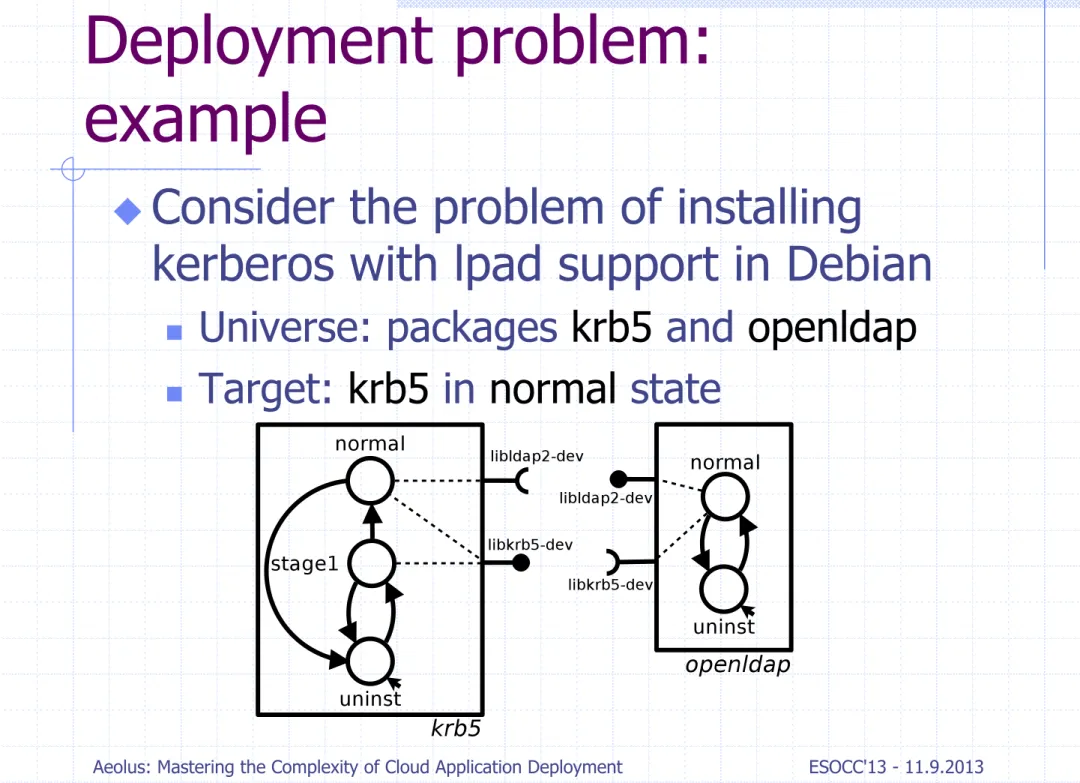
Deployment problem:
example
u
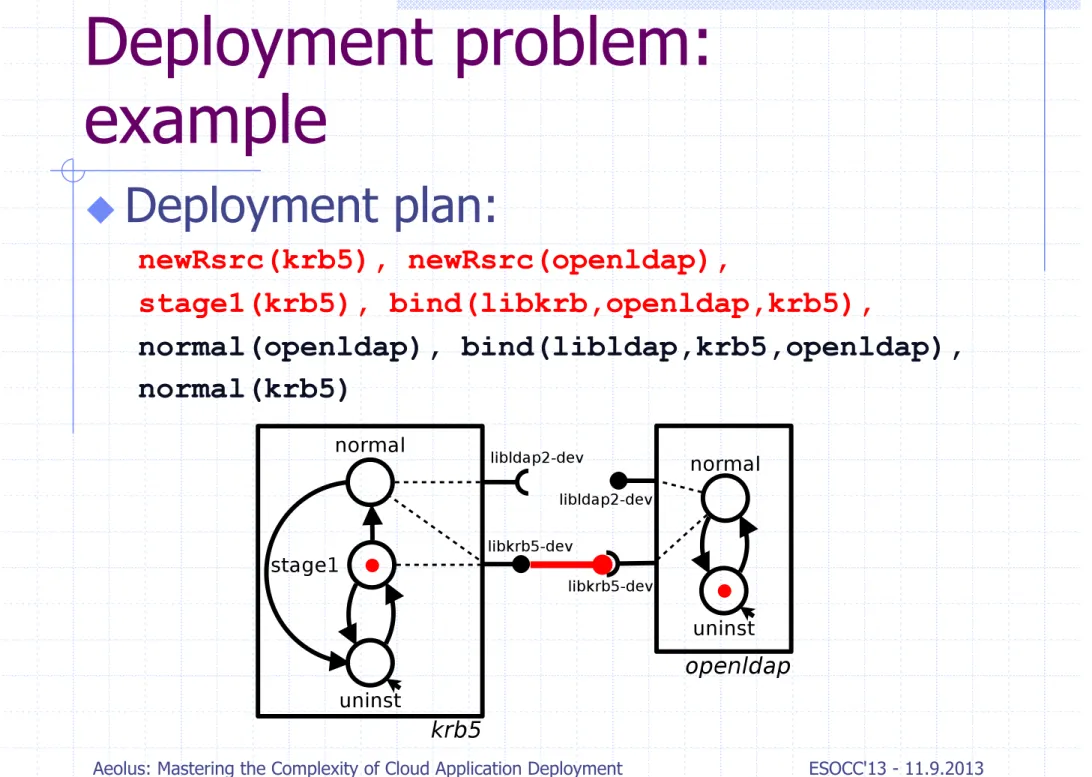
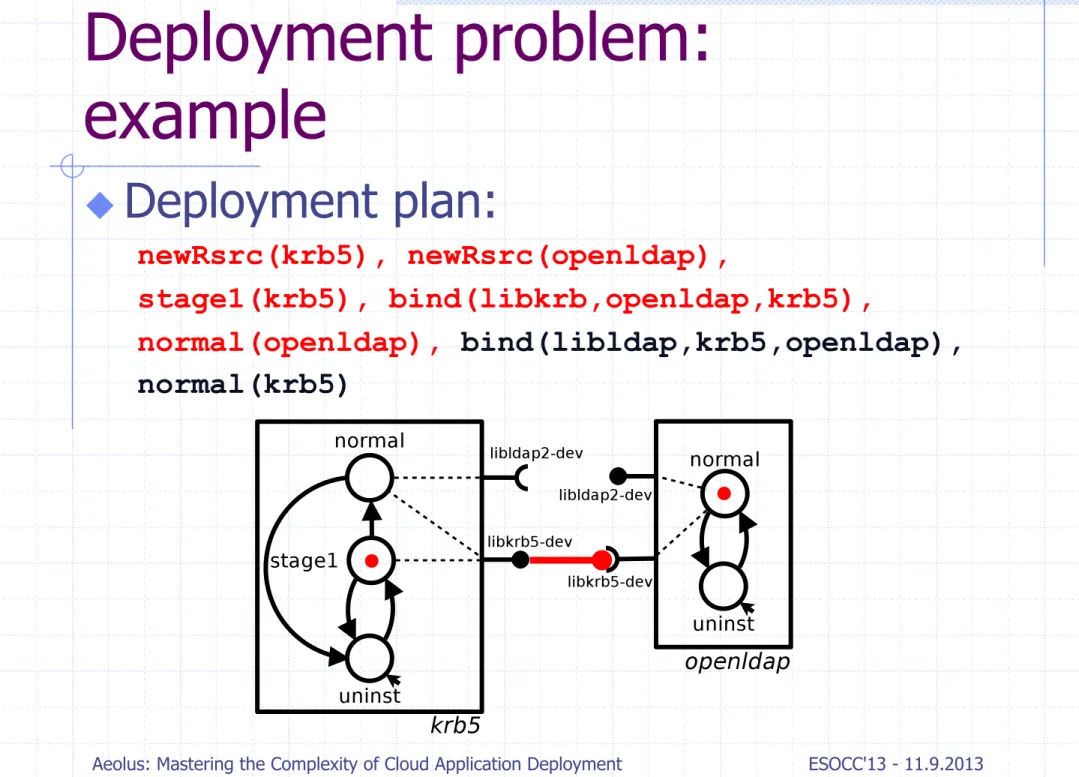
Consider the problem of installing
kerberos with lpad support in Debian
n
Universe: packages
krb5
and
openldap
n
Target:
krb5
in
normal
state
ESOCC'13 - 11.9.2013 Aeolus: Mastering the Complexity of Cloud Application Deployment
• unbind(r,id1,id2) that deletes the binding between the
provided port r of the component identified by id1 and the required port of the component identified by id2;
• stateChange(id,s0,s1) that changes the state of the
com-ponent identified by id from s0 to s1.
It is worth noticing that there can be more than one way to reach a given configuration of components. For in-stance, one possible way to obtain the configuration de-picted in Fig. 1 from scratch, is to first create the resources via the actions create(wordpress,w), create(apache2,a), and
create(mysql,m). These three actions create three new
com-ponents identified by w, a, and m respectively. All these new components will be in the uninst state that is the initial state for all of them. Then the apache2 and mysql components can be installed by performing the action stateChange(a,uninst,inst)
and stateChange(m,uninst,inst). At this point, to be able
to install wordpress, we need first to bind the mysql inst
port. This is done by performing bind(mysql inst,m,w). After
the creation of the binding, wordpress can be installed by performing stateChange(w,uninst,inst). Finally the
configu-ration depicted in Fig. 1 can be obtained by performing the
bind(httpd,a,w) and stateChange(m,inst,run) actions.
Note that the unbind, delete, and stateChange actions some-times cannot be performed since their execution would violate the constraint that each active require port must be bound to an active provide one. bind and create actions, instead, can always be performed as bindings are allowed between ports that are not active and we require that initial states do not activate require ports.
As a final remark, we observe that the decision to use one unique internal target state to specify the configuration to be reached is not a limitation. In fact, this target state could activate several require ports indicating an entire set of functionalities that must be present in the final configuration.
III. THE PLANNING ALGORITHM
We now present our algorithm to solve the deployment prob-lem defined in previous section. The algorithm is divided in three phases, namely, reachability analysis, abstract planning
and plan generation.
The first phase computes the states of the components that can be obtained, starting from an empty configuration. If the target state can be reached, an abstract plan is generated describing the needed types of components and a path to reach the target state. Subsequently a concrete plan is obtained by specifically instantiating the component types selected in the abstract plan.
As a running example we model the compilation of package kerberos with ldap support in a Debian system. To build ker-beros (krb5) the libldap2-dev package of openldap is needed. This package however depends on libkrb5-dev from krb5. There is therefore a circular dependency between krb5 and
openldap. In Debian the generic way to deal with these
cir-cular dependencies is profile builds: every package caters for multiple stages of staged/bootstrap build, so that if necessary a package can have stage1, stage2, . . . before the final, normal,
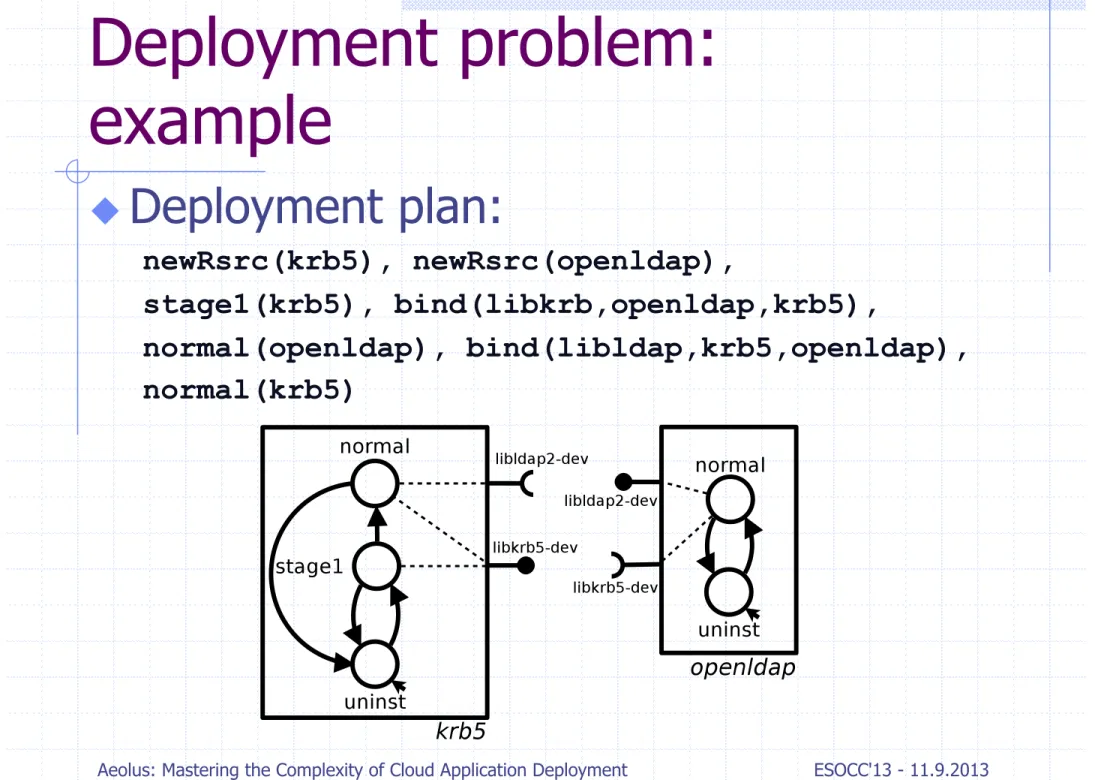
build. In the kerberos case, krb5 is built in the first stage missing out the generation of the krb5-ldap package. Then
openldap can be built directly into its normal build satisfying
its dependencies. Once openldap is built, krb5 can also be build into its normal stage. This process would be modeled in Aeolus as depicted in Fig. 2.
Fig. 2: Representation of the krb5 and openldap components.
A. Reachability analysis
The first step in the proposed technique checks if the the desired target state can be reached. To do so all reachable states are computed, for each of the component types in the given universe. In the following we use the pair �T ,q� to
denote a component type T and one of its state q.
An increasing sequence of sets of component-state pairs
S0, . . . ,Sn is built in such a way that Si+1 extends Si with
the new states that can be reached upon execution of a
state-Change action. The first set, S0, contains all the components
in their initial state, i.e. S0 ={�T ,q0� | q0 initial state of T }.
Formally Si+1 is the largest set satisfying the following
con-straints:
• Si ⊆ Si+1;
• �T ,q� ∈ Si+1 implies the existence of �T ,q�� ∈ Si such
that there is a transition from q� to q in the state automaton
of T ;
• �T ,q� ∈ Si+1 implies that for every require port r
acti-vated by the state q of T there exists �T �,q�� ∈ Si such
that the state q� of T � activates a provide port r.
The generation of sets proceeds until a fix-point is reached (i.e. Si+1 = Si). When the fix-point is reached, if the last set
does not contain the target pair it means a plan to achieve the goal does not exist and therefore the procedure terminates. Otherwise, we continue with the next phase.
As input to the next phase, we consider a graph-like repre-sentation, called reachability graph, of the sets S0, . . . ,Sn that keeps track of all the possible ways to obtain the component state-pairs at level i+1 from those at level i. More precisely,
the graph has as nodes the pairs in S0, . . . ,Sn: if one node
at level i + 1 was already present at level i, the two nodes
are connected with an arc , if a state pair �T ,q� at level i+1 can be obtained from �T ,q�� at level i by means of a
stateChange action, an −→ arc from the former to the latter is
Deployment problem:
example
u
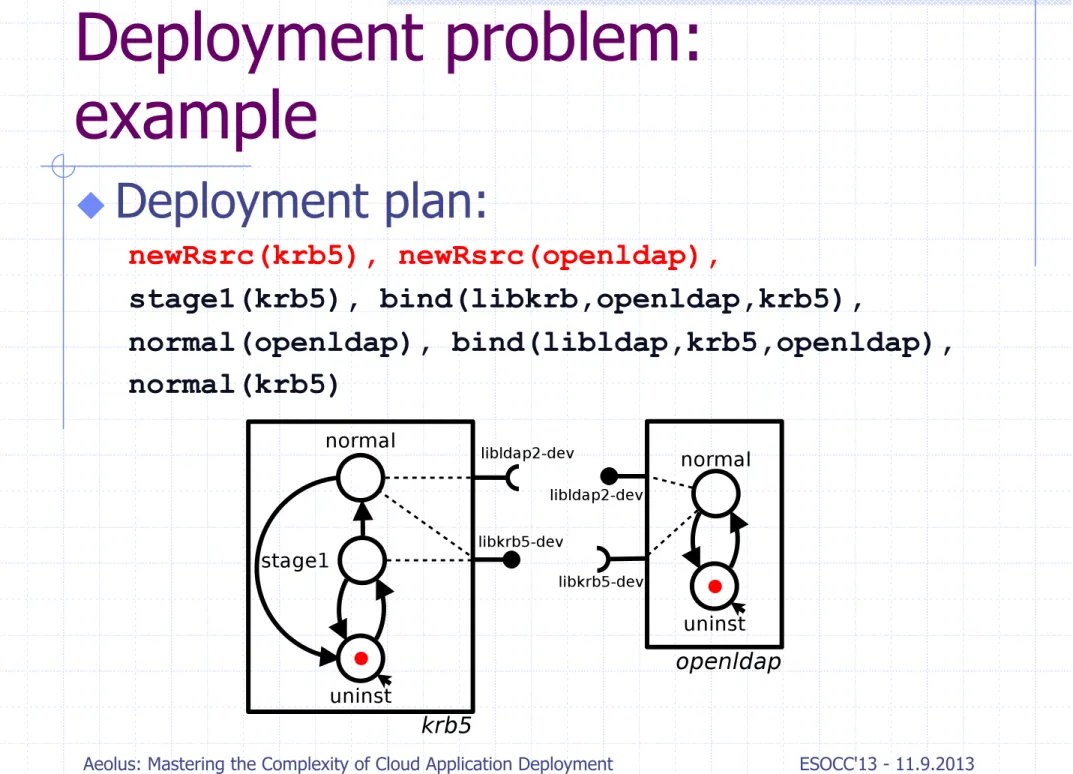
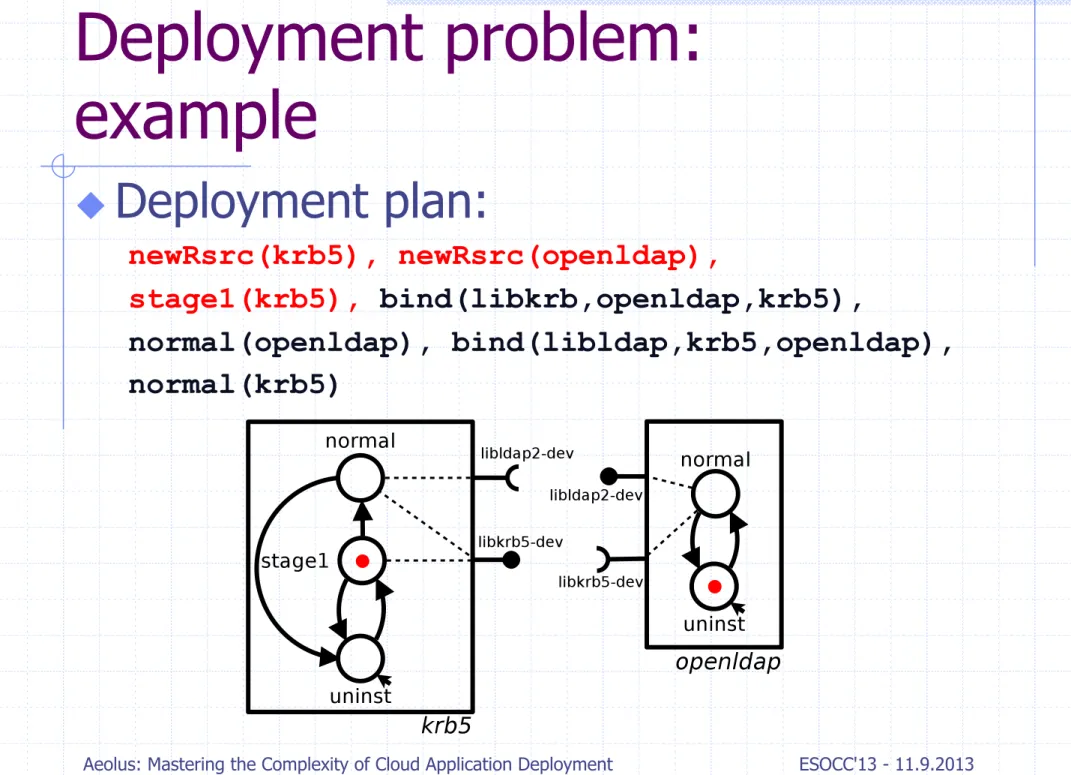
Deployment plan:
newRsrc(krb5), newRsrc(openldap),
stage1(krb5), bind(libkrb,openldap,krb5),
normal(openldap), bind(libldap,krb5,openldap), normal(krb5)
ESOCC'13 - 11.9.2013 Aeolus: Mastering the Complexity of Cloud Application Deployment
• unbind(r,id1,id2) that deletes the binding between the
provided port r of the component identified by id1 and the required port of the component identified by id2;
• stateChange(id,s0,s1) that changes the state of the
com-ponent identified by id from s0 to s1.
It is worth noticing that there can be more than one way to reach a given configuration of components. For in-stance, one possible way to obtain the configuration de-picted in Fig. 1 from scratch, is to first create the resources via the actions create(wordpress,w), create(apache2,a), and
create(mysql,m). These three actions create three new
com-ponents identified by w, a, and m respectively. All these new components will be in the uninst state that is the initial state for all of them. Then the apache2 and mysql components can be installed by performing the action stateChange(a,uninst,inst)
and stateChange(m,uninst,inst). At this point, to be able
to install wordpress, we need first to bind the mysql inst
port. This is done by performing bind(mysql inst,m,w). After
the creation of the binding, wordpress can be installed by performing stateChange(w,uninst,inst). Finally the
configu-ration depicted in Fig. 1 can be obtained by performing the
bind(httpd,a,w) and stateChange(m,inst,run) actions.
Note that the unbind, delete, and stateChange actions some-times cannot be performed since their execution would violate the constraint that each active require port must be bound to an active provide one. bind and create actions, instead, can always be performed as bindings are allowed between ports that are not active and we require that initial states do not activate require ports.
As a final remark, we observe that the decision to use one unique internal target state to specify the configuration to be reached is not a limitation. In fact, this target state could activate several require ports indicating an entire set of functionalities that must be present in the final configuration.
III. THE PLANNING ALGORITHM
We now present our algorithm to solve the deployment prob-lem defined in previous section. The algorithm is divided in three phases, namely, reachability analysis, abstract planning
and plan generation.
The first phase computes the states of the components that can be obtained, starting from an empty configuration. If the target state can be reached, an abstract plan is generated describing the needed types of components and a path to reach the target state. Subsequently a concrete plan is obtained by specifically instantiating the component types selected in the abstract plan.
As a running example we model the compilation of package kerberos with ldap support in a Debian system. To build ker-beros (krb5) the libldap2-dev package of openldap is needed. This package however depends on libkrb5-dev from krb5. There is therefore a circular dependency between krb5 and
openldap. In Debian the generic way to deal with these
cir-cular dependencies is profile builds: every package caters for multiple stages of staged/bootstrap build, so that if necessary a package can have stage1, stage2, . . . before the final, normal,
build. In the kerberos case, krb5 is built in the first stage missing out the generation of the krb5-ldap package. Then
openldap can be built directly into its normal build satisfying
its dependencies. Once openldap is built, krb5 can also be build into its normal stage. This process would be modeled in Aeolus as depicted in Fig. 2.
Fig. 2: Representation of the krb5 and openldap components.
A. Reachability analysis
The first step in the proposed technique checks if the the desired target state can be reached. To do so all reachable states are computed, for each of the component types in the given universe. In the following we use the pair �T ,q� to
denote a component type T and one of its state q.
An increasing sequence of sets of component-state pairs
S0, . . . ,Sn is built in such a way that Si+1 extends Si with
the new states that can be reached upon execution of a
state-Change action. The first set, S0, contains all the components
in their initial state, i.e. S0 ={�T ,q0� | q0 initial state of T }.
Formally Si+1 is the largest set satisfying the following
con-straints:
• Si ⊆ Si+1;
• �T ,q� ∈ Si+1 implies the existence of �T ,q�� ∈ Si such
that there is a transition from q� to q in the state automaton
of T ;
• �T ,q� ∈ Si+1 implies that for every require port r
acti-vated by the state q of T there exists �T �,q�� ∈ Si such
that the state q� of T � activates a provide port r.
The generation of sets proceeds until a fix-point is reached (i.e. Si+1 = Si). When the fix-point is reached, if the last set
does not contain the target pair it means a plan to achieve the goal does not exist and therefore the procedure terminates. Otherwise, we continue with the next phase.
As input to the next phase, we consider a graph-like repre-sentation, called reachability graph, of the sets S0, . . . ,Sn that keeps track of all the possible ways to obtain the component state-pairs at level i+1 from those at level i. More precisely,
the graph has as nodes the pairs in S0, . . . ,Sn: if one node
at level i + 1 was already present at level i, the two nodes
are connected with an arc , if a state pair �T ,q� at level i+1 can be obtained from �T ,q�� at level i by means of a
stateChange action, an −→ arc from the former to the latter is
Deployment problem:
example
u
Deployment plan:
newRsrc(krb5), newRsrc(openldap),
stage1(krb5), bind(libkrb,openldap,krb5),
normal(openldap), bind(libldap,krb5,openldap), normal(krb5)
ESOCC'13 - 11.9.2013 Aeolus: Mastering the Complexity of Cloud Application Deployment
• unbind(r,id1,id2) that deletes the binding between the
provided port r of the component identified by id1 and the required port of the component identified by id2;
• stateChange(id,s0,s1) that changes the state of the
com-ponent identified by id from s0 to s1.
It is worth noticing that there can be more than one way to reach a given configuration of components. For in-stance, one possible way to obtain the configuration de-picted in Fig. 1 from scratch, is to first create the resources via the actions create(wordpress,w), create(apache2,a), and
create(mysql,m). These three actions create three new
com-ponents identified by w, a, and m respectively. All these new components will be in the uninst state that is the initial state for all of them. Then the apache2 and mysql components can be installed by performing the action stateChange(a,uninst,inst)
and stateChange(m,uninst,inst). At this point, to be able
to install wordpress, we need first to bind the mysql inst
port. This is done by performing bind(mysql inst,m,w). After
the creation of the binding, wordpress can be installed by performing stateChange(w,uninst,inst). Finally the
configu-ration depicted in Fig. 1 can be obtained by performing the
bind(httpd,a,w) and stateChange(m,inst,run) actions.
Note that the unbind, delete, and stateChange actions some-times cannot be performed since their execution would violate the constraint that each active require port must be bound to an active provide one. bind and create actions, instead, can always be performed as bindings are allowed between ports that are not active and we require that initial states do not activate require ports.
As a final remark, we observe that the decision to use one unique internal target state to specify the configuration to be reached is not a limitation. In fact, this target state could activate several require ports indicating an entire set of functionalities that must be present in the final configuration.
III. THE PLANNING ALGORITHM
We now present our algorithm to solve the deployment prob-lem defined in previous section. The algorithm is divided in three phases, namely, reachability analysis, abstract planning
and plan generation.
The first phase computes the states of the components that can be obtained, starting from an empty configuration. If the target state can be reached, an abstract plan is generated describing the needed types of components and a path to reach the target state. Subsequently a concrete plan is obtained by specifically instantiating the component types selected in the abstract plan.
As a running example we model the compilation of package kerberos with ldap support in a Debian system. To build ker-beros (krb5) the libldap2-dev package of openldap is needed. This package however depends on libkrb5-dev from krb5. There is therefore a circular dependency between krb5 and
openldap. In Debian the generic way to deal with these
cir-cular dependencies is profile builds: every package caters for multiple stages of staged/bootstrap build, so that if necessary a package can have stage1, stage2, . . . before the final, normal,
build. In the kerberos case, krb5 is built in the first stage missing out the generation of the krb5-ldap package. Then
openldap can be built directly into its normal build satisfying
its dependencies. Once openldap is built, krb5 can also be build into its normal stage. This process would be modeled in Aeolus as depicted in Fig. 2.
Fig. 2: Representation of the krb5 and openldap components.
A. Reachability analysis
The first step in the proposed technique checks if the the desired target state can be reached. To do so all reachable states are computed, for each of the component types in the given universe. In the following we use the pair �T ,q� to
denote a component type T and one of its state q.
An increasing sequence of sets of component-state pairs
S0, . . . ,Sn is built in such a way that Si+1 extends Si with
the new states that can be reached upon execution of a
state-Change action. The first set, S0, contains all the components
in their initial state, i.e. S0 ={�T ,q0� | q0 initial state of T }.
Formally Si+1 is the largest set satisfying the following
con-straints:
• Si ⊆ Si+1;
• �T ,q� ∈ Si+1 implies the existence of �T ,q�� ∈ Si such
that there is a transition from q� to q in the state automaton
of T ;
• �T ,q� ∈ Si+1 implies that for every require port r
acti-vated by the state q of T there exists �T �,q�� ∈ Si such
that the state q� of T � activates a provide port r.
The generation of sets proceeds until a fix-point is reached (i.e. Si+1 = Si). When the fix-point is reached, if the last set
does not contain the target pair it means a plan to achieve the goal does not exist and therefore the procedure terminates. Otherwise, we continue with the next phase.
As input to the next phase, we consider a graph-like repre-sentation, called reachability graph, of the sets S0, . . . ,Sn that keeps track of all the possible ways to obtain the component state-pairs at level i+1 from those at level i. More precisely,
the graph has as nodes the pairs in S0, . . . ,Sn: if one node
at level i + 1 was already present at level i, the two nodes
are connected with an arc , if a state pair �T ,q� at level i+1 can be obtained from �T ,q�� at level i by means of a
stateChange action, an −→ arc from the former to the latter is
Deployment problem:
example
u
Deployment plan:
newRsrc(krb5), newRsrc(openldap),
stage1(krb5), bind(libkrb,openldap,krb5),
normal(openldap), bind(libldap,krb5,openldap), normal(krb5)
ESOCC'13 - 11.9.2013 Aeolus: Mastering the Complexity of Cloud Application Deployment
• unbind(r,id1,id2) that deletes the binding between the
provided port r of the component identified by id1 and the required port of the component identified by id2;
• stateChange(id,s0,s1) that changes the state of the
com-ponent identified by id from s0 to s1.
It is worth noticing that there can be more than one way to reach a given configuration of components. For in-stance, one possible way to obtain the configuration de-picted in Fig. 1 from scratch, is to first create the resources via the actions create(wordpress,w), create(apache2,a), and
create(mysql,m). These three actions create three new
com-ponents identified by w, a, and m respectively. All these new components will be in the uninst state that is the initial state for all of them. Then the apache2 and mysql components can be installed by performing the action stateChange(a,uninst,inst)
and stateChange(m,uninst,inst). At this point, to be able
to install wordpress, we need first to bind the mysql inst
port. This is done by performing bind(mysql inst,m,w). After
the creation of the binding, wordpress can be installed by performing stateChange(w,uninst,inst). Finally the
configu-ration depicted in Fig. 1 can be obtained by performing the
bind(httpd,a,w) and stateChange(m,inst,run) actions.
Note that the unbind, delete, and stateChange actions some-times cannot be performed since their execution would violate the constraint that each active require port must be bound to an active provide one. bind and create actions, instead, can always be performed as bindings are allowed between ports that are not active and we require that initial states do not activate require ports.
As a final remark, we observe that the decision to use one unique internal target state to specify the configuration to be reached is not a limitation. In fact, this target state could activate several require ports indicating an entire set of functionalities that must be present in the final configuration.
III. THE PLANNING ALGORITHM
We now present our algorithm to solve the deployment prob-lem defined in previous section. The algorithm is divided in three phases, namely, reachability analysis, abstract planning
and plan generation.
The first phase computes the states of the components that can be obtained, starting from an empty configuration. If the target state can be reached, an abstract plan is generated describing the needed types of components and a path to reach the target state. Subsequently a concrete plan is obtained by specifically instantiating the component types selected in the abstract plan.
As a running example we model the compilation of package kerberos with ldap support in a Debian system. To build ker-beros (krb5) the libldap2-dev package of openldap is needed. This package however depends on libkrb5-dev from krb5. There is therefore a circular dependency between krb5 and
openldap. In Debian the generic way to deal with these
cir-cular dependencies is profile builds: every package caters for multiple stages of staged/bootstrap build, so that if necessary a package can have stage1, stage2, . . . before the final, normal,
build. In the kerberos case, krb5 is built in the first stage missing out the generation of the krb5-ldap package. Then
openldap can be built directly into its normal build satisfying
its dependencies. Once openldap is built, krb5 can also be build into its normal stage. This process would be modeled in Aeolus as depicted in Fig. 2.
Fig. 2: Representation of the krb5 and openldap components.
A. Reachability analysis
The first step in the proposed technique checks if the the desired target state can be reached. To do so all reachable states are computed, for each of the component types in the given universe. In the following we use the pair �T ,q� to
denote a component type T and one of its state q.
An increasing sequence of sets of component-state pairs
S0, . . . ,Sn is built in such a way that Si+1 extends Si with
the new states that can be reached upon execution of a
state-Change action. The first set, S0, contains all the components
in their initial state, i.e. S0 ={�T ,q0� | q0 initial state of T }.
Formally Si+1 is the largest set satisfying the following
con-straints:
• Si ⊆ Si+1;
• �T ,q� ∈ Si+1 implies the existence of �T ,q�� ∈ Si such
that there is a transition from q� to q in the state automaton
of T ;
• �T ,q� ∈ Si+1 implies that for every require port r
acti-vated by the state q of T there exists �T �,q�� ∈ Si such
that the state q� of T � activates a provide port r.
The generation of sets proceeds until a fix-point is reached (i.e. Si+1 = Si). When the fix-point is reached, if the last set
does not contain the target pair it means a plan to achieve the goal does not exist and therefore the procedure terminates. Otherwise, we continue with the next phase.
As input to the next phase, we consider a graph-like repre-sentation, called reachability graph, of the sets S0, . . . ,Sn that keeps track of all the possible ways to obtain the component state-pairs at level i+1 from those at level i. More precisely,
the graph has as nodes the pairs in S0, . . . ,Sn: if one node
at level i + 1 was already present at level i, the two nodes
are connected with an arc , if a state pair �T ,q� at level i+1 can be obtained from �T ,q�� at level i by means of a
stateChange action, an −→ arc from the former to the latter is
Deployment problem:
example
u
Deployment plan:
newRsrc(krb5), newRsrc(openldap),
stage1(krb5), bind(libkrb,openldap,krb5),
normal(openldap), bind(libldap,krb5,openldap), normal(krb5)
ESOCC'13 - 11.9.2013 Aeolus: Mastering the Complexity of Cloud Application Deployment
• unbind(r,id1,id2) that deletes the binding between the
provided port r of the component identified by id1 and the required port of the component identified by id2;
• stateChange(id,s0,s1) that changes the state of the
com-ponent identified by id from s0 to s1.
It is worth noticing that there can be more than one way to reach a given configuration of components. For in-stance, one possible way to obtain the configuration de-picted in Fig. 1 from scratch, is to first create the resources via the actions create(wordpress,w), create(apache2,a), and
create(mysql,m). These three actions create three new
com-ponents identified by w, a, and m respectively. All these new components will be in the uninst state that is the initial state for all of them. Then the apache2 and mysql components can be installed by performing the action stateChange(a,uninst,inst)
and stateChange(m,uninst,inst). At this point, to be able
to install wordpress, we need first to bind the mysql inst
port. This is done by performing bind(mysql inst,m,w). After
the creation of the binding, wordpress can be installed by performing stateChange(w,uninst,inst). Finally the
configu-ration depicted in Fig. 1 can be obtained by performing the
bind(httpd,a,w) and stateChange(m,inst,run) actions.
Note that the unbind, delete, and stateChange actions some-times cannot be performed since their execution would violate the constraint that each active require port must be bound to an active provide one. bind and create actions, instead, can always be performed as bindings are allowed between ports that are not active and we require that initial states do not activate require ports.
As a final remark, we observe that the decision to use one unique internal target state to specify the configuration to be reached is not a limitation. In fact, this target state could activate several require ports indicating an entire set of functionalities that must be present in the final configuration.
III. THE PLANNING ALGORITHM
We now present our algorithm to solve the deployment prob-lem defined in previous section. The algorithm is divided in three phases, namely, reachability analysis, abstract planning
and plan generation.
The first phase computes the states of the components that can be obtained, starting from an empty configuration. If the target state can be reached, an abstract plan is generated describing the needed types of components and a path to reach the target state. Subsequently a concrete plan is obtained by specifically instantiating the component types selected in the abstract plan.
As a running example we model the compilation of package kerberos with ldap support in a Debian system. To build ker-beros (krb5) the libldap2-dev package of openldap is needed. This package however depends on libkrb5-dev from krb5. There is therefore a circular dependency between krb5 and
openldap. In Debian the generic way to deal with these
cir-cular dependencies is profile builds: every package caters for multiple stages of staged/bootstrap build, so that if necessary a package can have stage1, stage2, . . . before the final, normal,
build. In the kerberos case, krb5 is built in the first stage missing out the generation of the krb5-ldap package. Then
openldap can be built directly into its normal build satisfying
its dependencies. Once openldap is built, krb5 can also be build into its normal stage. This process would be modeled in Aeolus as depicted in Fig. 2.
Fig. 2: Representation of the krb5 and openldap components.
A. Reachability analysis
The first step in the proposed technique checks if the the desired target state can be reached. To do so all reachable states are computed, for each of the component types in the given universe. In the following we use the pair �T ,q� to
denote a component type T and one of its state q.
An increasing sequence of sets of component-state pairs
S0, . . . ,Sn is built in such a way that Si+1 extends Si with
the new states that can be reached upon execution of a
state-Change action. The first set, S0, contains all the components
in their initial state, i.e. S0 ={�T ,q0� | q0 initial state of T }.
Formally Si+1 is the largest set satisfying the following
con-straints:
• Si ⊆ Si+1;
• �T ,q� ∈ Si+1 implies the existence of �T ,q�� ∈ Si such
that there is a transition from q� to q in the state automaton
of T ;
• �T ,q� ∈ Si+1 implies that for every require port r
acti-vated by the state q of T there exists �T �,q�� ∈ Si such
that the state q� of T � activates a provide port r.
The generation of sets proceeds until a fix-point is reached (i.e. Si+1 = Si). When the fix-point is reached, if the last set
does not contain the target pair it means a plan to achieve the goal does not exist and therefore the procedure terminates. Otherwise, we continue with the next phase.
As input to the next phase, we consider a graph-like repre-sentation, called reachability graph, of the sets S0, . . . ,Sn that keeps track of all the possible ways to obtain the component state-pairs at level i+1 from those at level i. More precisely,
the graph has as nodes the pairs in S0, . . . ,Sn: