SEMIPARAMETRIC COINTEGRATING RANK SELECTION
By
Xu Cheng and Peter C. B. Phillips
May 2008
COWLES FOUNDATION DISCUSSION PAPER NO. 1658
COWLES FOUNDATION FOR RESEARCH IN ECONOMICS
YALE UNIVERSITY
Box 208281
Semiparametric Cointegrating Rank Selection
Xu Cheng Department of Economics Yale University and Peter C. B. PhillipsCowles Foundation for Research in Economics Yale University
January 2, 2008
Abstract
Some convenient limit properties of usual information criteria are given for coin-tegrating rank selection. Allowing for a nonparametric short memory component and using a reduced rank regression with only a single lag, standard informa-tion criteria are shown to be weakly consistent in the choice of cointegrating rank provided the penalty coe¢ cientCn! 1andCn=n!0 asn! 1:The limit dis-tribution of the AIC criterion, which is inconsistent, is also obtained. The analysis provides a general limit theory for semiparametric reduced rank regression under weakly dependent errors. The method does not require the speci…cation of a full model, is convenient for practical implementation in empirical work, and is sympa-thetic with semiparametric estimation approaches to cointegration analysis. Some simulations results on …nite sample performance of the criterion are reported.
Keywords: Cointegrating rank, Consistency, Information criteria, Model selection, Nonparametric, Short memory, Unit roots.
JEL classi…cation: C22, C32
1
Introduction
Information criteria are now widely used in parametric settings for econometric model choice. The methods have been especially well studied in stationary systems. Models that allow for nonstationarity are particularly relevant in econometric work
Our thanks go to a referee for helpful comments on the original version. Phillips acknowledges partial support from the NSF under Grant No. SES 06-47086.
and have been considered by several authors, including Tsay (1984), Pötscher (1989), Wei (1992), Phillips and Ploberger (1996), Phillips(1996), and Nielsen (2006), among others.
Model choice methods are heavily used in empirical work and in forecasting exer-cises, the most common applications involving choice of lag length in (vector) autore-gression and variable choice in reautore-gression. The methods have also been suggested and used in the context of cointegrating rank choice where they are known to be consistent under certain conditions, at least in parametric models (Chao and Phillips, 1999). This application is natural because cointegrating rank is an order parameter for which model selection methods are particularly well suited since there are only a …nite number of possible choices. Furthermore, rank order may be combined with lag length and inter-cept and trend degree parameters to provide a wide compass of choice in parametric models that is convenient in practical work, as discussed in Phillips (1996).
When the focus is on cointegration and cointegrating rank selection, it is not neces-sary to build a complete model for statistical purposes. Indeed, many of the approaches that have been developed for econometric estimation and inference in such contexts are semiparametric in character so that the model user can be agnostic regarding the short memory features of the data and concentrate on long run behavior. In such settings, it will often be desirable to perform the evaluation of cointegrating rank (or choice of the number of unit roots in a system) in a semiparametric context allowing for a general short memory component in the time series.
The present paper has this goal and looks speci…cally at the issue of cointegrating rank choice by information criteria. In the case of a univariate series, this choice reduces to distinguishing unit root time series from stationary series. In such a context, it is known that information criteria provide consistent model choice in a semiparametric framework (Phillips, 2008). The contribution of this paper is to extend that work to the multivariate setting in the context of a semiparametric reduced rank regression of the form
Xt= 0Xt 1+ut; t2 f1; :::; ng; (1)
where Xt is an m- vector time series, and are m r0 full rank matrices and ut
is a weakly dependent stationary time series with zero mean and continuous spectral density matrix fu( ):The series Xt is initialized att= 0by some (possibly random)
quantityX0=Op(1);although other initialization assumptions may be considered, as
in Phillips (2008).
A secondary contribution of the paper that emerges from the analysis is to provide a limit theory for semiparametric reduced rank regressions of the form (1) under weakly dependent errors. This limit theory is useful in studying cases where reduced rank regressions are misspeci…ed, possibly through the choice of inappropriate lag lengths in the vector autoregression or incorrect settings of the cointegrating rank.
Under (1), the time series Xt is cointegrated with cointegration matrix of rank
r0;so there arer0 cointegrating relations in the true model. Of course, r0 is generally
estimate r0 directly in (1) by information criteria. The procedure we consider is quite
simple. Model (1) is estimated by conventional reduced rank regression (RRR) for all values of r = 0;1; :::; m just as if ut were a martingale di¤erence, and r is chosen
to optimize the corresponding information criteria as if (1) were a correctly speci…ed parametric framework up to the order parameter r. Thus, no explicit account is taken of the weak dependence structure ofut in the process.
Let b(r) be the residual variance matrix from (1) …tted with rank r:The criterion used to evaluate cointegrating rank takes the simple form
IC(r) = log b(r) +Cnn 1 2mr r2 ; (2)
with coe¢ cient Cn = logn; log logn; or 2 corresponding to the BIC (Schwarz, 1978;
Akaike, 1977; Rissanen, 1978), Hannan and Quinn (1979), and Akaike (1974) penalties, respectively. Sample information-based versions of the coe¢ cient Cn may also be
em-ployed, such as those in Wei’s (1992) FIC criterion and Phillips and Ploberger’s (1996) PIC criterion. The BIC version of (2) was given in Phillips and McFarland (1997) and used to determine cointegrating rank in an exchange rate application. In (2) the degrees of freedom term 2mr r2 is calculated to account for the2mrelements of the matrices and that have to be estimated, adjusted for the r2 restrictions that are needed to ensure structural identi…cation of in reduced rank regression1.
1For example, in triangular system speci…cations (Phillips, 1991) 0 takes the form [I
r; B] for
some unrestrictedr (m r)matrixB;which involvesr2restrictions and leads to degrees of freedom
2mr r2inA:Under normalization restrictions of the form (6) on that are conventionally employed
in empirical reduced rank regression modeling, the degrees of freedom term would be2mr r(r+ 1)=2;
leading to the alternate criterion
IC (r) = log b(r) +Cnn 1(2mr r(r+ 1)=2):
In this case the outer product form of the coe¢ cient matrix in (1) implies that A= 0 = CC0 0
for an arbitrary orthogonal matrix C; so that and are not uniquely identifed even though the likelihood is well de…ned. In such cases, only the cointegrating rank and the cointegrating space are identi…ed and consistently estimable. Correspondingly, there are more degrees of freedom in the system. However, the usual justi…cation for BIC (Schwarz, 1978; Ploberger and Phillips, 1996) involves …nding an asymptotic approximation to the Bayesian data density (and hence the posterior probability of the model), which is obtained by Laplace approximation methods using a Taylor series expansion of the log likelihood around a consistent parameter estimate. In the reduced rank regression case,r2 restrictions on are required to identify the structural parameters as in the above formulation 0 = [I
r; B]. If
only normalization restrictions such as 0 =Ir are imposed, then we can write
A= 0= CC0 Ir+BB0
1=2
[Ir; B];
with 0= (Ir+BB0) 1=2[Ir; B]and whereCis an arbitrary orthogonal matrix. In this case, C is
unidenti…ed and if C has a uniform prior distribution on the orthogonal group O(r) independent of the prior on( ; B);thenCmay be integrated out of the Bayesian data density or marginal likelihood. The data density then has the same form as it does for the case where
A= Ir+BB0
1=2
[Ir; B] = 1=2[Ir; B];
For each r = 0;1; ::; m; we estimate them r matrices and by reduced rank regression and, for use in (2), we form the corresponding residual variance matrices
b(r) =n 1 n X t=1 Xt ^ ^ 0 Xt 1 Xt ^ ^ 0 Xt 1 0 ; r= 1; :::; m
with b(0) =n 1Pnt=1 Xt Xt0: Model evaluation based on IC(r) then leads to the
cointegrating rank selection criterion b
r= arg min
0 r m
IC(r):
As shown below, the information criterionIC(r) is weakly consistent for selecting the cointegrating rank r0 provided that the penalty term in (2) satis…es the weak
re-quirements that Cn ! 1 and Cn=n !0 as n! 1: No minimum expansion rate for
Cnsuch aslog lognis required and no more complex parametric model needs to be
es-timated. The approach is therefore quite straightforward for practical implementation. The organization of the paper is as follows. Some preliminaries on estimation and notation are covered in Section 2. The main asymptotic results are given in Section 3. Section 4 brie‡y reports some simulation …ndings. Section 5 concludes and discusses some extensions. Proofs and technical material are in the Appendix.
2
Preliminaries
Reduced rank regression (RRR) estimates of and in (1) are obtained ignoring any weak dependence error structure in ut. To analyze the asymptotic properties of
the rank order estimates and the information criterion IC(r) under a general error structure, we start by investigating the asymptotic properties of the various regression components. Using conventional RRR notation, de…ne
S00 =n 1 n X t=1 Xt Xt0; S11=n 1 n X t=1 Xt 1Xt0 1; S01 =n 1 n X t=1 XtXt0 1; and S10=n 1 n X t=1 Xt 1 Xt0: (3)
For some givenr and ;the estimate of is obtained by regression as b( ) =S01 0S11
1
: (4)
Again, givenr;the corresponding RRR estimate of in (1) is anm rmatrix satisfying b = arg min S00 S01 0S11 1 0S10 ; (5)
subject to the normalization
b0S11b=Ir: (6)
The estimate b is found in the usual way by …rst solving the determinantal equation
S11 S10S001S01 = 0 (7)
for the ordered eigenvalues 1 > b1 > > bm > 0 and corresponding eigenvectors b
V = [bv1; ;bvm]; which are normalized by Vb0S11Vb = Im: Estimates of and are
then obtained as
b= [bv1; ;bvr]; and b=b(b) =S01b; (8)
with b formed from the eigenvectors of Vb corresponding to the r largest roots of (7). The residuals from the RRR and the corresponding moment matrix of residuals that appear in the information criterion are
b ut = Xt bb0Xt 1; and (9) b(r) = n 1 n X t=1 b utub0t=S00 S01bb 0 S10: (10)
Using (10) we have (e.g., theorem 6.1 of Johansen, 1995)
b(r) =jS00j ri=1 1 bi ; (11)
where bi; 1 i r; are the r largest solutions to (7): The criterion (2) is then well
determined for any given value ofr:
3
Asymptotic Results
The following assumptions make speci…c the semiparametric and cointegration com-ponents of (1). AssumptionLP is a standard linear process condition of the type that is convenient in developing partial sum limit theory. The condition can be relaxed to allow for martingale di¤erence innovations and to allow for some mild heterogeneity in the innovations without disturbing the limit theory in a material way (see Phillips and Solo, 1992). Assumption RR gives conditions that are standard in the study of reduced rank regressions with some unit roots (Johansen, 1988, 1995; Phillips, 1995). Assumption LP Let D(L) =P1j=0DjLj; with D0 =I and full rank D(1), and
let ut have Wold representation
ut=D(L)"t= 1 X j=0 Dj"t j; with 1 X j=0 j1=2jjDjjj<1; (12)
for some matrix norm jj jjand where "tis iid(0; ")with ">0. We use the notation ab(h) = E atb0t+h and ab = P1h=1 ab(h) for autocovariance matrices and one
sided long run autocovariances and set =P1h= 1 uu(h) =D(1) "D(1)0 >0and "=Ef"t"0tg:
Assumption RR (a) The determinantal equation I I + 0 L = 0 has roots on or outside the unit circle, i.e. jLj 1:
(b)Set =Im+ 0 where and are m r0 matrices of full column rank r0,
0 r0 m:(If r0 = 0 then =Im; if r0 =m then has full rank m and 0Xt and
hence Xt are (asymptotically) stationary )
(c)The matrix R=Ir+ 0 has eigenvalues within the unit circle.
Assumption (c) ensures that the matrix 0 has full rank. Let ? and ? be orthogonal complements to and ; so that [ ; ?]and [ ; ?] are nonsingular and
0
? ?=Im r:Then, nonsingularity of 0 implies the nonsingularity of 0? ?. Under
RR we have the Wold representation of 0Xt
vt:= 0Xt=
1
X i=0
Ri 0ut i=R(L) 0ut=R(L) 0D(L)"t; (13)
and some further manipulations yield the following useful partial sum representation
Xt=C t X s=1
us+ 0 1R(L) 0ut+CX0; (14)
where C = ?( 0? ?) 1 0?: Expression (14) reduces to the Granger representation when ut is a martingale di¤erence (e.g. Johansen, 1995).
Under LP a functional law for partial sums of ut holds, so that n 1=2P[sn=1] us )
Bu( )asn! 1;whereBu is vector Brownian motion with variance matrix :In view
of (13) and the fact that R(1) =P1i=0Ri = (I R) 1 = 0 1, we further have n 1=2 [n] X s=1 vs=n 1=2 [n] X s=1 0X s) 0 1 0Bu( ); asn! 1: (15)
These limit laws involve the same Brownian motionBu and determine the asymptotic
forms of the various sample moment matrices involved in the reduced rank regression estimation of (1). De…ne Var 0Xt Xt 1 = 00 0 0 : (16)
Explicit expressions for the submatrices in this expression may be worked out in terms of the autocovariance sequences ofutandvtand the parameters of (1). These expressions
are given in (24) - (26) in the proof of Lemma 3 in the Appendix. The following result provides some asymptotic limits that are useful in deriving the asymptotic properties of b(r)in the criterion function (2).
Lemma 1 Under Assumptions LP and RR,
S00! p 00; 0S11 !p ; 0S10!p 0; n 1 0?S11 ? ) 0? ? 1 0? Z 1 0 BuBu0 ? 0? ? 1 ; 0 ?(S10 S11 0)) 0? ? 1 0? Z 1 0 BudBu0 + 1wu; 0 ?S11 ) 0? ? 1 0? Z 1 0 BudBu0 ( 0 ) 1+ wv; 0 ?S10) 0? ? 1 0? Z 1 0 BudBu0 ? 0? ? 1 0 ?+ 1wu+ wv 0; where 1 wu= 1 X h=1 E 0? Xt u0t+h ; wv= 1 X h=0 En 0? Xt 0Xt+h 0 o ; and wt= 0? Xt= ?0 ut+ 0? vt 1: Remarks:
(a) Whenutis weakly dependent, it is apparent that the asymptotic limits of 0?(S10
S11 0); 0?S10;and 0?S11 involve bias terms that depend on various one sided
long run covariance matrices associated with the stationary components ut; vt,
andwt= 0? Xt:Explicit values of these one sided long run covariance matrices
are given in (29) and (30) in the Appendix.
(b) When ut is a martingale di¤erence sequence, 1wu = 0 and wv = 0?E(utv0t):
Simpler results, such as
0
?(S10 S11 0)) 0? ? 1 0?
Z 1 0
BudB0u; (17)
then hold for the limits in lemma 1, and these correspond to earlier results given for example in theorem 10.3 of Johansen (1995).
From (1); Xt = ut+ 0Xt 1 = ut+ vt 1; so that (c.f. (25) - (26)) 0 =
+Eutvt0 1 and
De…ne
e = 0 1 = +Eutvt0 1 1; (19)
and let e? be anm (m r) orthogonal complement toe such that[e;e?]is nonsin-gular.
Lemma 2 Under Assumptions LP and RR, when the true cointegration rank is r0;
the r0 largest solutions to (7); denoted by bi with 1 i r0;converge to the roots of
0 001 0 = 0: (20)
The remaining m r0 roots, denoted bybi withr0+ 1 i m;decrease to zero at the
rate n 1 and fnbi :i=r0+ 1; :::; mg converge weakly to the roots of
Z 1 0 GuG0u Z 1 0 GudG0u 0?+ e? e0? 00e? 1 e0? ? Z 1 0 dGuG0u+ 0 = 0; (21) where Gu(r) = ( 0? ?) 1 ?0 Bu(r) ism r0 dimensional Brownian motion with
vari-ance matrix ( 0? ?) 1 0? ?( ? ?0 ) 1 and = 1wu+ wv 0:
Remarks:
(c) Comparing these results with those of the standard RRR case with martingale di¤erence errors (Johansen, 1995, p. 158), we see that, just as in the standard case, ther0 largest roots of(7)are all positive in the limit and them r0
small-est roots converge to 0 at the rate n 1; both results now holding under weakly dependent errors:However, when ut is weakly dependent, the limit distribution
determined by (21) is more complex than in the standard case. In particular, the determinantal equation (21) involves the composite one sided long run covariance matrix :
(d) When ut is a martingale di¤erence sequence, we …nd that e = ; e? = ?;
1
wu= 0; = wv 0; 00= 0+ and
e? e0? 00e? 1e0? = ? 0? ? 1 0?:
Then 0? ?Gu(r) = 0?Bu(r)is Brownian motion with covariance matrix 0? ?; ? = 0;and the determinantal equation (21) reduces to
Z 1 0 GuG0u Z 1 0 GudG0u 0? ? 0? ? 1 0 ? ? Z 1 0 dGuG0u = 0; which is equivalent to Z 1 0 VuVu0 Z 1 0 VudVu0 Z 1 0 dVuVu0 = 0;
where Vu(r) is m r0 dimensional standard Brownian motion, thereby
corre-sponding to the standard limit theory of a parametric reduced rank regression (Johansen, 1995).
Theorem 1 (a) Under Assumptions LP and RR, the criterion IC(r) is weakly con-sistent for selecting the rank of cointegration provided Cn ! 1 at a slower rate than
n:
(b)The asymptotic distribution of the AIC criterion (IC(r) with coe¢ cientCn= 2)
is given by lim n!1P(^rAIC =r0) = P " m \ r=r0+1 ( r X i=r0+1 i <2 (r r0) (2m r r0) )# ; lim n!1P(^rAIC =rjr > r0) = P ( m \ r0=r+1 ( r0 X i=r+1 i <2 r0 r (2m r0 r) )! \ r 1 \ r0=r0 ( r X i=r0+1 i >2 r r0 2m r r0 )!) ; and lim n!1P(^rAIC =rjr < r0) = 0;
where r0+1; :::; m are the ordered roots of the limiting determinantal equation (21): Remarks:
(e) BIC, HQ and other information criteria with Cn ! 1 and Cn=n ! 0 are all
consistent for the selection of cointegrating rank without having to specify a full parametric model. The same is true for the criterion IC (r) where only the cointegrating space is estimated and structural identi…cation conditions on the cointegrating vector are not imposed or used in rank selection.
(f ) AIC is inconsistent, asymptotically never underestimates cointegrating rank, and favors more liberally parametrized systems. This outcome is analogous to the well-known overestimation tendency of AIC in lag length selection in autoregres-sion. Of course, in the present case, maximum rank is bounded above by the order of the system. Thus, the advantages to overestimation in lag length selec-tion that arise when the autoregressive order is in…nite might not be anticipated here. However, when cointegrating rank is high (and close to full dimensional), AIC typically performs exceedingly well (as simulations reported below attest) largely because the upper bound in rank restricts the tendency to overestimate.
(g) Whenm= 1,r0 = 0corresponds to the unit root case andr0= 1to the stationary
case. Thus, one specialization of the above result is to unit root testing. In this case, the criteria consistently discriminate between unit root and stationary series provided Cn ! 1 and Cn=n!0;as shown in Phillips (2008). In this case, the
limit distribution of AIC is much simpler and involves only the explicit limiting root 1 = R01BudBu+ 2 =n R01B2 u 00 o where =P1h=1E(utut+h):
(h) While Theorem 1 relates directly to model (1), it is easily shown to apply in cases where the model has intercepts and drift. Thus, the result provides a convenient basis for consistent cointegration rank selection in most empirical contexts.
4
Simulations
Simulations were conducted to evaluate the …nite sample performance of the criteria under various generating mechanisms for the short memory component ut; di¤erent
settings for the true cointegrating rank, and for various choices of the penalty coe¢ cient Cn:Some illustrative …ndings for the case where m= 2 are brie‡y reported here.
The data generating process follows(1). When r0 = 0we have 0 = 0; and when
r0= 1 the reduced rank coe¢ cient matrix is set to
0 = (1;0:5) 1
1 :
When r0 = 2; two di¤erent simulations (design A and design B) were performed, one
with smaller and one with larger stationary roots as follows:
A: 0 = 0:5 0:1
0:2 0:4 ; with stationary roots i I+
0 =f0:7;0:4g;
B: 0 = 0:5 0:1
0:2 0:15 ; with stationary roots i I+ 0 =f0:9;0:45g: Simulations were conducted with AR(1), MA(1), and ARMA(1,1) errors, corresponding to the models
ut=Aut 1+"t; ut="t+B"t 1; and ut=Aut 1+"t+B"t 1; (22)
respectively, with coe¢ cient matrices A= Im; B = Im; wherej j<1;j j<1;and
with innovations "t=iidN(0; ");where
"=
1 + 0
0 1 >0:
0 1 2 0 1 2 0 20 40 60 80 100 Prob (b) BIC 0 1 2 0 1 2 0 20 40 60 80 100 Prob (a) AIC 0 1 2 0 1 2 0 20 40 60 80 100 Prob (c) HQ 0 1 2 0 1 2 0 20 40 60 80 100 Prob (d) log(HQ) 0 r r 0 r 0 r 0 r r r r
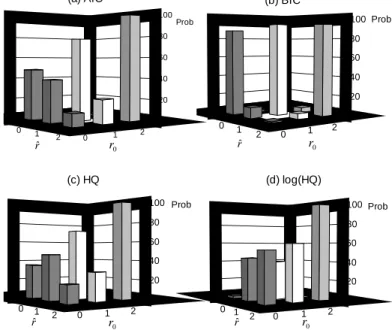
Figure 1: Cointegrating rank selection in design A whenut is AR(1) andn= 100:
The performance of the criteria AIC, BIC, HQ, and log(HQ)2 was investigated for
sample sizesn= 100in design A andn= 100;400in design B, in both cases including 50 additional observations to eliminate start-up e¤ects from the initializationsX0= 0
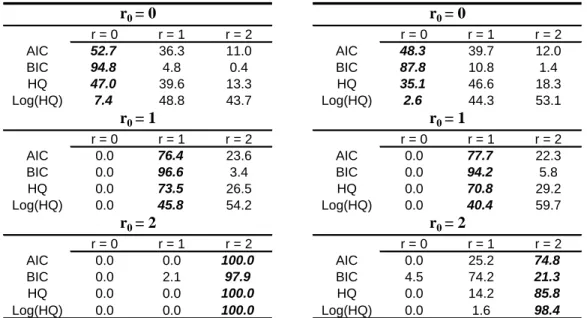
and "0 = 0: The results are based on 20;000replications and are summarized in Fig.
1, which shows the results for design A, and in Table 1, which shows the results for design B and with correct selections in bold type. The results displayed are for the model with AR(1) errors. Similar results were obtained for the other error generating schemes in (22).
As is evident in Fig. 1, the BIC criterion generally performs very well whenn 100. For design B, where the stationary roots of the system are closer to unity, BIC has a tendency to underestimate rank when n = 100 and r0 = 2, thereby choosing more
parsimoniously parameterized systems in this case, just as it does in lag length selection in autoregressions, but BIC performs well when n= 400;as seen in Table 1.
The tendency of AIC to overestimate rank is also clear in Fig. 1, but this tendency is noticeably attenuated when the true rank is 1 and is naturally delimited when the true rank is 2 because of the upper bound in rank choice. For design B, AIC performs better than BIC when the cointegrating rank is 2, as does HQ, for which the penalty is Cn < 2 when n = 100;400: Criteria with weaker penalties, such as log(HQ) with
Cn = log log logn; also do better in this case, although for other cases they perform
2
much less satisfactorily than AIC and HQ, showing a stronger tendency to overestimate cointegrating rank.
Based on overall performance, it seems that BIC can be recommended for practical work in choosing cointegrating rank and it gives generally very sharp results when n 100:The main weakness of BIC is its slight tendency to choose more parsimonious models (i.e. models with more unit roots) especially when the system is stationary and has a root near unity3.
r = 0 r = 1 r = 2 r = 0 r = 1 r = 2 AIC 52.7 36.3 11.0 AIC 48.3 39.7 12.0 BIC 94.8 4.8 0.4 BIC 87.8 10.8 1.4 HQ 47.0 39.6 13.3 HQ 35.1 46.6 18.3 Log(HQ) 7.4 48.8 43.7 Log(HQ) 2.6 44.3 53.1 r = 0 r = 1 r = 2 r = 0 r = 1 r = 2 AIC 0.0 76.4 23.6 AIC 0.0 77.7 22.3 BIC 0.0 96.6 3.4 BIC 0.0 94.2 5.8 HQ 0.0 73.5 26.5 HQ 0.0 70.8 29.2 Log(HQ) 0.0 45.8 54.2 Log(HQ) 0.0 40.4 59.7 r = 0 r = 1 r = 2 r = 0 r = 1 r = 2 AIC 0.0 0.0 100.0 AIC 0.0 25.2 74.8 BIC 0.0 2.1 97.9 BIC 4.5 74.2 21.3 HQ 0.0 0.0 100.0 HQ 0.0 14.2 85.8 Log(HQ) 0.0 0.0 100.0 Log(HQ) 0.0 1.6 98.4 n = 400 r0= 2 r0= 2 n = 100 r0= 0 r0= 0 r0= 1 r0= 1
Table 1. Cointegrating rank selection in design B whenut follows an AR(1) process.
Wang and Bessler (2005) reported some related simulation work under the assump-tion that it is known that the time series are already transformed into a form where the observed variables are either stationary or integrated. In the present context, this is equivalent to setting 0 to a diagonal matrix with elements of either zero or unity. The problem of cointegrating rank selection in this simpler framework is equivalent to direct unit root testing on each variable. We may therefore use the selection method of Phillips (2008) to estimate the cointegration rank by conducting a unit root test on each time series and simply counting the number of unit roots obtained. Simulations (not reported here) indicate that this procedure works well. However, since the trans-formation which takes the model into a canonical form where the observed variables are either stationary or integrated is seldom known, this procedure is generally not practical for estimating cointegrating rank.
3Simulations (not reported here) showed that the tendency for BIC to select models with more unit
5
Conclusion
Model selection for cointegrating rank treats rank as an order parameter and pro-vides the convenience of consistent estimation of this parameter under weak conditions on the expansion rate of the penalty coe¢ cient. The approach is easy to implement in practice and is sympathetic with other semiparametric approaches to estimation and inference in cointegrating systems where the focus is on long run behavior.
While it is not explicitly demonstrated here, the consistency result for cointegrat-ing rank selection by information criteria continues to hold in models where there is unconditional heterogeneity in the error variance of unknown form, including breaks in the variance or smooth transition functions in the variance over time. Such permanent changes in variance are known to invalidate both unit root tests and likelihood ratio tests for cointegrating rank because of their e¤ects on the limit distribution theory under the null (see Cavaliere, 2004; Cavaliere and Taylor, 2007; Beare, 2007). Since consistency of the information criteria is una¤ected by the presence of this form of vari-ance induced nonstationarity, the approach o¤ers an additional degree of robustness in cointegrating rank determination that is useful in empirical applications.
Some applications of the methods outlined here are possible in other models. First, rather than work with reduced rank regression formulations within a vector autore-gressive framework, it is possible to use reduced rank formulations in regressions of the time series on a …xed (or expanding) number of deterministic basis functions such as time polynomials or sinusoidal polynomials (Phillips, 2005). In a similar way to the present analysis, it can be shown that information criteria such as BIC and HQ will be consistent for cointegrating rank in such coordinate systems. The coe¢ cient matrix in such systems turns out to have a random limit, corresponding to the matrix of random variables that appear in the Karhunen-Loève representation (Phillips, 1998), but has a rank that is the same as the dimension of the cointegrating space, which enables consistent rank estimation by information criteria. A second application is to dynamic factor panel models with a …xed number of stochastically trending unobserved factors, as in Bai and Ng (2004). Again, these models have reduced rank structure (this time with nonrandom coe¢ cients) and the number of factors may be consistently estimated using model selection criteria of the same type as those considered here but in the pres-ence of an increasing number of incidental loading coe¢ cients. In such cases, the BIC penalty, as derived from the asymptotic behavior of the Bayes factor, has a di¤erent form from usual and typically involves both cross section and time series sample sizes. Some extensions of the present methods to these models will be reported in later work.
6
Appendix
Lemma 3 Under (1) and Assumption LP,
1 00 001 0 0 001 0 1 0 001= 1=2 00 c? c0?c? 1 c0? 001=2;
where c= 001=2 0 andc? is an orthogonal complement toc:De…ninge = 0 1 = 1=2
00 c 1 and e?= 001=2c?;we have the alternate form
1=2 00 c? c0?c? 1 c0? 001=2=e? e0? 00e? 1 e0?: (23) When 0 = ;(23) reduces to 1=2 00 c? c0?c? 1c0? 1=2 00 = ? 0? 00 ? 1 ?:
Proof of Lemma 3: Since [c; c?]is nonsingular we have
I =c c0c 1c0+c? c0?c? 1c0?; and then 1 00 1 00 0 0 001 0 1 0 001 = 001=2 n I c c0c 1c0 o 1=2 00 = 1=2 00 c? c0?c? 1c0? 1=2 00 ; as required.
Observe that when 0 = ;we havec= 1=2 00 0 =
1=2
00 and we may
choose c?= 100=2 ? where ? is an orthogonal complement to :In that case we have
1=2 00 c? c0?c? 1 c0? 001=2= ? 0? 00 ? 1 ?;
as stated. This corresponds with the result in Johansen (1995, Lemma 10.1) where ut
is a martingale di¤erence. In the present semiparametric case, Xt=ut+ 0Xt 1 =
ut+ vt 1 and the covariance vu(1) =E(vt 1ut)0 is generally nonzero, so that
=Evtvt0 = vv(0); (24)
0 =Evt 1(ut+ vt 1)0 = vu(1) + vv(0) 0 = vu(1) + 0; (25)
00 = 0+ vu(1) + uv( 1) 0+ uu(0): (26)
Note thate= 0 1 = 100=2c 1and we may choosee?= 001=2c?:In this notation,
we may write in the general case
1=2 00 c? c0?c? 1 c0? 001=2=e? e0? 00e? 1 e0 ?; (27)
as given in (23).
Proof of Lemma 1: Since both Xt= ut+ 0Xt 1 and vt = 0Xt are stationary
and satisfy Assumption LP, the law of large numbers gives
S00=n 1 n X t=1 Xt Xt0 !p 00= uu(0) + vv(0)a0+ vu(0) + uv(0)a0; 0S 11 =n 1 n X t=1 0X t 1 0Xt 1 0!p = vv(0); and 0S 10=n 1 n X t=1 0X t 1 Xt0 !p 0 = vu(1) + vv(0)a0: In view of (14) we have 0 ?Xt = 0?C t X s=1 us+ 0? 0 1R(L) 0ut+ 0?CX0 = 0? ? 1 0? ( t X s=1 us+X0 ) + 0? 0 1R(L) 0ut;
so that the standardized process n 1=2 0?X[n] ) ( 0? ?) 1 0?Bu( ); and from (15)
we have n 1=2 [n] X s=1 0X s) 0 1 0 Bu( ): (28)
It follows by conventional weak convergence methods that n 1 0?S11 ? ) 0? ? 1 0 ? Z 1 0 BuBu0 ? 0? ? 1 ; 0 ?(S10 S11 0) = 0? ( n 1 n X t=1 Xt 1 Xt 0Xt 1 0 ) = n X t=1 0 ?Xt 1 p n ut p n ) 0 ? ? 1 0 ? Z 1 0 BudBu0 + 1wu; 0 ?S11 = n X t=1 0 ?Xt 1 p n 0X t 1 0 p n ) 0 ? ? 1 0 ? Z 1 0 BudBu0 ( 0 ) 1+ wv; where 1 wu= 1 X h=1 E 0? Xt u0t+h and wv= 1 X h=0 E n 0 ? Xt 0Xt+h 0 o
are one sided long run covariance matrices involving wt = 0? Xt; ut and vt. Note
that
wt:= 0? Xt= ?0 ut+ 0? vt 1
so we may deduce the explicit form
1 wu = 1 X h=1 E 0? Xt u0t+h = 0? 1 X h=1 E utu0t+h + 0? 1 X h=1 E vt 1u0t+h = 0? uu+ 0? [ vu vu(1)]; (29) and wv = 1 X h=0 E n 0 ? Xt 0Xt+h 0 o = 0? 1 X h=0 E utvt0+h + 0? 1 X h=0 E vt 1vt0+h = 0?( uv+ uv(0)) + 0? vv: (30)
Finally, using (28) and standard limit theory again, we obtain
0 ?S10 = n X t=1 0 ?Xt 1 p n Xt0 p n = n X t=1 0 ?Xt 1 p n ut+ vt 1 p n 0 ) 0? ? 1 0 ? Z 1 0 BudBu0 0? ? 1 0 ? Z 1 0 BudBu0 0 1 0 + 1 X h=1 E 0? Xt u0t+h + 1 X h=0 E 0? Xt v0t+h 0 = 0? ? 1 0? Z 1 0 BudBu0 n I 0 1 0o + 1 X h=1 E 0? Xt u0t+h + 1 X h=0 E 0? Xt v0t+h 0 = 0? ? 1 0? Z 1 0 BudBu0 ? 0? ? 1 0 ?+ 1wu+ wv 0; since ( 0 ) 1 0+ ? 0? ? 1 0 ?=I (e.g., Johansen, 1995, p. 39).
(7) is jS( )j= 0:De…ningPn= [ ; n 1=2 ?]and using Lemma 1, we have Pn0 (S( ))Pn = 0S11 n 1=2 0S 11 ? n 1=2 0?S11 n 1 0?S11 ? 0S 10S001S01 n 1=2 0S10S001S01 ? n 1=2 0?S10S001S01 n 1 0?S10S001S01 ? ) " 0 0 ( 0 ? ?) 1 0 ? R1 0 BuBu0 ? 0? ? 1 # 0 001 0 0 0 0 = 0 001 0 0? ? 1 0 ? Z 1 0 BuBu0 ? 0? ? 1 : (31)
The determinantal equation
0 001 0 0? ? 1 0 ? Z 1 0 BuBu0 ? 0? ? 1 = 0 hasm r0 zero roots and r0 positive roots given by the solutions of
0 001 0 = 0: (32)
Thus, ther0largest roots of (7) converge to the roots of (32) and the remainder converge
to zero. De…ningP = [ ; ?];we have P0(S( ))P = 0S( ) 0S( ) ? 0 ?S( ) 0?S( ) ? = 0S( ) 0? n S( ) S( ) 0S( ) 1 0S( ) o ? : (33)
As in Johansen (1995, theorem 11.1), we let n! 1 and ! 0 such that = n = Op(1):Using Lemma 1, we have
0S( ) = n 1 0S 11 0S10S001S01 = 0 001 0 +op(1); 0 ?S( ) ? = n 1 0?S11 ? 0?S10S001S01 ?; and 0 ?S( ) = n 1 0?S11 0?S10S001S01 = 0?S10S001S01 +op(1): (34) De…ne Nn=S001 S 1 00S01 0S10S001S01 0S10S001:
Using Lemma 1and Lemma3, we have
Nn = 001 001 0 0 001 0 0 001+op(1)
= e? e0? 00e?
1
By (34)and (35);the second factor in (33) becomes 0 ? n S( ) S( ) 0S( ) 1 0S( )o ? = n 1 0?S11 ? 0?S10NnS01 ?+op(1) = n 1 0?S11 ? 0?S10e? e?0 00e? 1e0?S01 ?+op(1): (36) By Lemma1;we have 0 ? n S( ) S( ) 0S( ) 1 0S( )o ? 0 ? ? 1 0 ? Z 1 0 BuB0u ? 0? ? 1 0 ? ? 1 0 ? Z 1 0 BudB0u ? 0? ? 1 0 ?+ e? e0? 00e? 1 e0 ? ? 0? ? 1 0 ? Z 1 0 dBuBu0 ? 0? ? 1 + 0 = Z 1 0 GuG0u Z 1 0 GudG0u 0?+ e? e0? 00e? 1 e0? ? Z 1 0 dGuG0u+ 0 ;
where = 1wu+ wv 0 and Gu(r) = ( 0? ?) 1 0?Bu(r) is Brownian motion with
variance matrix
0 ? ?
1 0
? ?( 0? ?) 1:
Equations (33), (36), and Lemma 1 reveal that them r0 smallest solutions of (7)
normalized by nconverge to those of the equation Z 1 0 GuG0u Z 1 0 GudG0u 0?+ e? e0? 00e? 1 e0? ? Z 1 0 dGuG0u+ 0 = 0; (37) as stated. Proof of Theorem 1
Part (a)LetICr0(r) denote the information criterion de…ned in(2)when the true
cointegration rank is r0: Cointegrating rank is estimated by minimizing ICr0(r) for
0 r m: To check the consistency of this estimator, we need to compare ICr0(r)
withICr0(r0) for any r6=r0:
Whenr > r0;using (2) and(11);we have
ICr0(r) ICr0(r0) = r X i=r0+1 log 1 ^i +Cnn 1 2mr r2 2mr0 r20 = r X i=r0+1 log 1 ^i +Cnn 1(r r0) (2m r r0): (38)
In order to consistently selectr0 with probability 1 asn! 1 we need
r X i=r0+1
log 1 ^i +Cnn 1(r r0) (2m r r0)>0; (39)
with probability 1 as n ! 1 for any r0 < r < m: From (21); we know that ^i is
Op n 1 for all i=r0+ 1; :::; r:Expandinglog 1 ^i ;we have r X i=r0+1 log 1 ^i = r X i=r0+1 ^i+op n 1 =O p n 1 : (40)
Using(40) and Lemma 2, we then have
n r X i=r0+1 log 1 ^i +Cnn 1(r r0) (2m r r0) ! = r X i=r0+1 n^i+Cn(r r0) (2m r r0) +op(1); (41)
where n^i fori=r0+ 1; :::; r areOp(1): As such, as long asCn! 1as n! 1;the
second term on the right side of (41)dominates, which leads to(39)asn! 1:Hence, if the penalty coe¢ cient Cn ! 1, cointegrating rank r > r0 will never be selected.
So, too few unit roots will never be selected in the system in such cases. Thus, the criteria BIC and HQ will never select excessive cointegrating rank as n! 1:On the other hand the AIC penalty is …xed at Cn = 2 for all n; so we may expect AIC to
select models with excessive cointegrating rank with positive probability as n ! 1: This corresponds to a more liberally parametrized system.
Whenr < r0; ICr0(r) ICr0(r0) = r0 X i=r+1 log 1 ^i +Cnn 1 2mr r2 2mr0 r20 = r0 X i=r+1 log 1 ^i +Cnn 1(r r0) (2m r r0): (42)
In order to consistently selectr0 with probability 1 asn! 1;we need
r0
X i=r+1
log 1 ^i +Cnn 1(r r0) (2m r r0)>0; asn! 1: (43)
From Lemma 2, we know that 0<^i <1 fori=r+ 1; :::; r0:So the …rst term on the
on the right side of (42) is a negative number of order O Cnn 1 : In order for (43)
to hold as n! 1;we therefore require only that Cn=n=o(1); i.e. that the penalty
coe¢ cient must pass to in…nity slower than n: For each of the criteria AIC, BIC and HQ, the penalty coe¢ cient Cn ! 1 slower than n: Hence, these three information
criterion all select models with insu¢ cient cointegrating rank (or excess unit roots) with probability zero asymptotically.
Combining the conditions on Cn for r > r0 and r < r0; it follows the
informa-tion criterion will lead to consistent estimainforma-tion of the cointegrainforma-tion rank provided the penalty coe¢ cient satis…esCn! 1 and Cn=n!0 asn! 1:
Part (b) Under AIC, Cn = 2: The limiting probability that AIC(r0) AIC(r)
for somer r0 is given by
lim n!1PfAIC(r0) AIC(r)g = lim n!1P ( r0 X i=r+1 log 1 ^i + 2n 1(r r0) (2m r r0)>0 ) = lim n!1P ( r0 X i=r+1 log 1 ^i <2n 1(r r0) (2m r r0) ) = 1; (44)
because 0 < i < 1 for i = r+ 1; :::; r0 are the r0 r smallest solutions to (20) and
then Pr0
i=r+1log (1 i) <0;giving (44). Hence, when r0 is the true rank, AIC will
not select any r < r0 asn! 1;i.e.,
lim
n!1P(^rAIC =rjr < r0) = 0: (45)
Let r0+1 > ::: > m be the ordered roots of the limiting determinantal equation (21). When r0> r r0; AIC(r)< AIC(r0) i¤
r0
X i=r+1
log 1 ^i +Cnn 1 r0 r 2m r0 r >0;
so that the limiting probability that r will be chosen over r0 is
lim n!1P AIC(r)< AIC(r 0) = lim n!1P ( r0 X i=r+1 n^i+ 2 r0 r 2m r0 r >0 ) = P ( r0 X i=r+1 i <2 r0 r 2m r0 r ) : (46)
Accordingly, the probability that AIC will select rankr is equivalent to the probability that r is chosen over any otherr0 r0. This probability is
lim n!1P(^rAIC =rjr > r0) =P ( m \ r0=r+1 ( r0 X i=r+1 i<2 r0 r 2m r0 r )! \ r 1 \ r0=r0 ( r X i=r0+1 i >2 r r0 2m r r0 )!) ; (47)
where the …rst part is the limiting probability that r is chosen over all r0 > r and the other part is the probability thatris chosen over all r0 r0 < r:Any rank less thanr0
is not taken into account here because those ranks are always dominated in the limit by r0 from (45).
The probability that the cointegration rankr0 is consistently estimated by AIC as
n! 1is lim n!1P(^rAIC =r0) = P " m \ r=r0+1 ( r X i=r0+1 i <2 (r r0) (2m r r0) )# : (48)
This is a special case of (47) withr=r0:
The unit root case
When the system order ism= 1;the procedure provides a mechanism for unit root testing. If r0 = 0;i.e. the model has a unit root, we have by (48)
lim
n!1P(^rAIC = 1jr0 = 0) = Pf 1>2g= 1 Pf 1<2g and
lim
n!1P(^rAIC = 0jr0 = 0) = Pf 1<2g; (49)
where 1 is the solution to(21) when m= 1 andr0= 0:In this case, we see that
1 = R1 0 GudG0u 0?+ 2 R1 0 GuG0u 00 = R1 0 BudBu+ 2 R1 0 Bu2 00
sinceGu =Bu;e? = 1; ? = 1;and = in this case.
Ifr0 = 1;when the model is stationary, we have
lim
n!1P(^rAIC = 0jr0 = 1) = 0and nlim!1P(^rAIC = 1jr0 = 1) = 1; (50)
using(44):These results for the scalar casem= 1 are consistent with those in Phillips (2008).
7
References
Akaike, H. (1973). “Information theory and an extension of the maximum likelihood principle.”In B. N. Petrov and F. Csaki (eds.),Second International Symposium on Information Theory. Budapest: Akademiai Kiado.
Akaike, H. (1977). “On entropy maximization principle.” In P. R. Krishnarah (ed.), Applications of Statistics. Amsterdam: North–Holland.
Bai, J. and S. Ng (2004). “A PANIC attack on unit roots and cointegration,” Econo-metrica, 72, 1127-1177.
Beare, B. (2007). “Robustifying unit root tests to permanent changes in innovation variance.” Working paper, Yale University.
Cavaliere, G. (2004). “Unit root tests under time-varying variance shifts,” Economet-ric Reviews,23, 259-292.
Cavaliere, G. and A.M.R. Taylor (2007). “Testing for unit roots in time series models with non-stationary volatility.”Journal of Econometrics, Vol. 140, 919-947. Chao, J. and P. C. B. Phillips (1999). “Model selection in partially non-stationary
vector autoregressive processes with reduced rank structure,”Journal of Econo-metrics, Vol. 91, 227-271.
Hannan, E. J. and B. G. Quinn (1979). “The determination of the order of an au-toregression,”. Journal of the Royal Statistical Society, Series B, 41, 190-195. Johansen, S. (1988). “Statistical Analysis of Cointegration Vectors,”Journal of
Eco-nomic Dynamics and Control 12, 231–254.
Johansen, S. (1995). Likelihood-Based Inference in Cointegrated Vector Autoregres-sive Models, Oxford: Oxford University Press.
Kapetanios, G. (2004). “The asymptotic distribution of the cointegration rank estima-tion under the Akaike informaestima-tion criterion,”Econometric Theory, 20, 735-742. Nielsen, B. (2006). “Order determination in general vector autoregressions,”IMS
Lecture Notes- Monograph Series, Vol. 52, 93-112.
Phillips, P. C. B. (1991). “Optimal Inference in Cointegrated Systems,”Econometrica 59, 283–306.
Phillips, P. C. B. (1995). “Fully modi…ed least squares and vector autoregression,” Econometrica 63, 1023-1078.
Phillips, P. C. B. (1996). “Econometric Model Determination,”Econometrica, 64, 763-812.
Phillips, P. C. B. (1998). “New Tools for Understanding Spurious Regressions,” Econometrica, 66, 1299-1326.
Phillips, P. C. B. (2005). “Challenges of Trending Time Series Econometrics, Mathe-matics and Computers in Simulation,” 68, 401-416.
Phillips, P. C. B. (2008). “Unit root model selection,”Journal of the Japan Statistical Society (forthcoming).
Phillips, P. C. B. and J. McFarland (1997). “Forward Exchange Market Unbiasedness: the Case of the Australian Dollar since 1984,”Journal of International Money and Finance, 16, 885-907.
Phillips P. C. B. and W. Ploberger (1996). “An Asymptotic Theory of Bayesian Inference for Time Series,”Econometrica, 64, 381-413.
Phillips, P. C. B. and V. Solo (1992). “Asymptotics for Linear Processes,”Annals of Statistics 20, 971–1001.
Pötscher, B. M. (1989). “Model selection under nonstationarity: Autoregressive mod-els and stochastic linear regression modmod-els,”Annals of Statistics 17, 1257–1274. Rissanen, J. (1978). “Modeling by shortest data description,”Automatica 14, 465–
471.
Schwarz, G. (1978). “Estimating the dimension of a model,”Annals of Statistics 6, 461–464.
Tsay, R. S. (1984). “Order selection in nonstationary autoregressive models,”Annals of Statistics, 12, 1425-1433.
Wang, Z. and D. A. Bessler (2005). “A Monte Carlo Study on the selection of coin-tegration rank using information criteria,”Econometric Theory,21, 593-620. Wei, C. Z. (1992). “On predictive least squares principles,”Annals of Statistics 20,