(will be inserted by the editor)
Moving Towards a New Paradigm of Creation, Dissemination,
and Application of Computer-Interpretable Medical Knowledge
Paulo Novais · Tiago Oliveira · Jos´e NevesReceived: date / Accepted: date
Abstract Computer-Interpretable Guidelines (CIGs) exploit the scientific strength of evidence-based medicine to make recommendations available in Clinical Deci-sion Support Systems. However, systems that deploy them have not been widely successful, in part due to the limitations of CIG frameworks in the adoption of inclusive and open technologies and the use of Artificial Intelligence techniques as tools to make their systems stronger and more adaptable. In this work we propose a web-based CIG framework to tackle some of these challenges and facilitate the integration of CIG-based advice not only in the everyday activities of health care professionals but also in the lives of whoever may need it.
Keywords Clinical Decision Support Systems · Computer-Interpretable Guidelines · Computer-Assisted Decision Making ·Ambient Assisted Living
Paulo Novais Algoritmi Center
Department of Informatics Universidade do Minho
Braga, Portugal Tel.: +351 253 604 437 Fax: +351 253 604 471 E-mail: [email protected] Tiago Oliveira Algoritmi Center Department of Informatics Universidade do Minho
Braga, Portugal Tel.: +351 253 604 437 Fax: +351 253 604 471 E-mail: [email protected] Jos´e Neves Algoritmi Center Department of Informatics Universidade do Minho
Braga, Portugal Tel.: +351 253 604 437 Fax: +351 253 604 471
E-mail: [email protected]
1 Introduction
Clinical Decision Support Systems (CDSSs) are one of the most prominent examples of the role Medical In-formatics may have in the improvement of health care (Musen et al 2006). The ability to provide advice at different moments and in various situations of the clin-ical process, may it be to a physician, a nurse, or an assistant caregiver, tailored to the condition of a spe-cific patient, has the potential to significantly improve the quality of care delivery. Although this is not guar-anteed, there is increasing evidence of the positive ef-fects CDSSs may have on aspects such as medication safety (Kaushal et al 2003), practitioner performance (Adhikari et al 2005), and decision quality (Sintchenko et al 2004).
CDSSs may perform a wide variety of roles, depend-ing on the situation for which they were conceived. Yet it is not an easy task to build systems capable of re-sponding to all of the different moments of the clinical process, from diagnosis and treatment to follow-up. Ul-timately, this ability of CDSSs to accompany the dif-ferent stages of handling a patient depends greatly on the type of support they use for their knowledge base and whether that support is capable of modelling those different situations accurately. Computer-Interpretable Guideline (CIG) (de Clercq et al 2004; Oliveira et al 2013a; Peleg 2013) systems are regarded as the best choice when it comes to supporting health care pro-fessionals in their practice, not only for their reliance on Clinical Practice Guidelines (CPGs) for the recom-mendations, which is solid from the medical point of view, but also for their adaptability to the different stages of patient management. CPGs are systemati-cally developed statements, based on the best avail-able medical evidence, that provide recommendations
to health care professionals for specific clinical circum-stances, and are developed for a wide variety of cate-gories (e.g., diagnosis, management, treatment, follow-up, etc) and specialities (e.g., general practice, oncol-ogy, cardioloncol-ogy, etc) (Miller and Kearney 2004). CIGs, as machine-interpretable structured versions of CPGs, bring that knowledge diversity to CDSSs, along with the ability to act in different settings (Latoszek-Berendsen et al 2010).
The development of CIG technologies took off in the mid to late 1990s (Ten Teije et al 2008), with the emer-gence of numerous modelling languages and tools that went along with them and deal with the basic aspects of CIG development, namely (de Clercq et al 2004):
– Creation and Editing: this aspect refers to the representation of CPGs using a specific modelling language, the construction of clinical algorithms and the ability to change them as needed;
– Dissemination:this aspect is related with the abil-ity to spread CIGs across different institutions and professionals, to make them easily available and de-ployable;
– Execution:this aspect refers to the computer-based execution of CIGs and deals with the ways in which CPGs can be automatically applied to patients and integrated in the daily practice of health care pro-fessionals.
However, CIG development and implementation has not quite fulfilled its anticipated potential just yet. Most of the existing projects in this area are still at the aca-demic level, with little implementation in real world settings. There are but a few implemented case stud-ies that prove the feasibility of the approaches rather than their actual contribution to the improvement of health care outcomes. Moreover, most projects do not show the openness nor integrate the technologies that would allow them to have a wider reach in the health care domain.
In this paper we provide an overview of the cur-rent state of the art of CIG development regarding the three above-mentioned aspects and identify which points should be improved for the further advancement of computer-interpretable medical knowledge. This is mostly done in section 2. Then, after these points are clearly identified, we propose a CIG framework in sec-tion 3 that aims to provide solusec-tions for the identified issues and discuss their implications in CIG creation, editing, dissemination and execution. Finally, in sec-tion 4.1 we make some concluding remarks regarding the proposal and point future directions for CIG devel-opment.
2 Trends in Computer-Interpretable Guideline Development
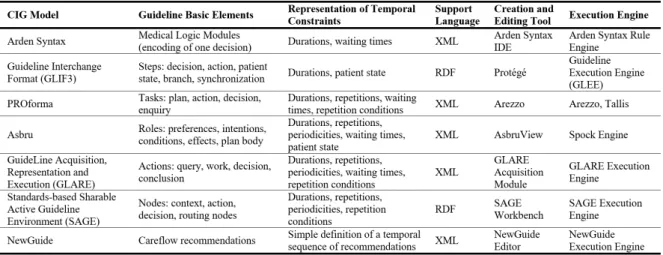
Table 1 shows a summary of the main CIG approaches headlined by the models that give them shape, namely Arden Syntax (Kim et al 2008), GLIF3 (Boxwala et al 2004), PROforma (Button and Fox 2003), GLARE (Teren-ziani et al 2004), SAGE (Tu et al 2007), and NewGuide (Ciccaresea et al 2004). While there are other impor-tant CIG approaches, these selected few follow similar guiding principles that make them relevant for this dis-cussion.
2.1 Guideline Creation and Editing
Most CIG models represent CPGs as networks of in-tertwined basic units which can assume various forms, namely modules, steps, tasks, roles, actions, nodes or
recommendations, as summarized in the basic elements
of Table 1. While this form of task network model of-fers greater flexibility in the definition of clinical care-flows by allowing one to display the respective building blocks as needed, it is also true that the existing models hardly converge when it comes to the meaning of their basic units. To give an example, it is easy to establish a parallel betweenstep and task, but a relationship is not as easily established between either of the previous two and the concepts ofrole ornode. Furthermore, it is possible to notice a tendency of the existing models to provide uneven attention to different aspects of CPG representation, of which the representation of temporal constraints is a clear example. In Table 1, it is possi-ble to observe that the completeness of their tempo-ral representation, defined as the number of different temporal patterns they include, differs greatly, with ar-guably the most complete being GLARE (Terenziani et al 2004), which does not even include temporal con-straints about the state of the patient. Thus there is a clear need for an encompassing guideline model based on a common framework, whose syntax and semantics are widely known, that is expressive enough to allow the representation of the basic units of CPGs and the relations between them.
Tools such as Arezzo (Isern and Moreno 2008), the SAGE Workbench (Tu et al 2007), or the GLARE Ac-quisition Module (Terenziani et al 2004) use a graph-like representation of the clinical careflow with the pos-sibility of dynamically adding the building blocks nec-essary for the definition of clinical protocols. This form of guideline creation and editing, although with differ-ent degrees of customization, is followed by most CIG frameworks and enables the users to have a better con-trol over the objects they are manipulating and a
bet-Table 1 Summary of the main CIG approaches, featuring the basic elements of their models, their underlying support format, and their main tools.
ter sense of the processes they are defining as a whole. However, there are different views on how the CIG cre-ation process should be conducted. Platforms such as DeGeL (Shahar et al 2004) are based on the conversion of textual documents of CPGs into CIGs, providing a well defined staged workflow for the iterative mark-up of the documents and mapping of the tagged objects to guideline elements. However, this kind of approach is not free of error and the process may be hindered by the ambiguity and vagueness of CPG documents, which are later the object of subjective interpretation by CIG encoders. An alternative is the creation of CPGs directly in a CIG format, as proposed in (Goud et al 2009), with a workflow that mimics the development process of their document counterparts in a platform that provides version control and collaborative editing features for the guideline development group. This was found to have positive effects on the quality of both the narrative and machine-interpretable versions of CPGs (Goud et al 2009).
2.2 Guideline Dissemination
Models such as GLIF3 (Boxwala et al 2004) and SAGE (Tu et al 2007) place a strong emphasis on the use of in-formation standards, namely medical terminologies and information exchange specifications, in order to make CPGs encoded in their respective models easily share-able. Most CIG frameworks feature a guideline repos-itory from which an execution engine draws informa-tion. The problem is in the accessibility of their tools. Most CIG editing and execution tools are not easily found and the access to CIG repositories is difficult. This is a point in which CIG frameworks would greatly benefit from making their technologies more web-based,
using the web as an application and guideline deploy-ment platform in order to build a truly collaborative and interactive environment. Distributed systems such as DeGeL (Shahar et al 2004) and most recently PI-CARD (Shalom et al 2015), based on service-oriented architectures, provide APIs to access their guideline de-ployment tools and seem to have taken in the above-mentioned principles in order to increase the reach CIGs have in the health care community.
2.3 Guideline Deployment and Execution
Guideline execution engines such as GLEE (Wang et al 2004), the Spock Engine (Young and Shahar 2005) or the GLARE Execution Engine (Terenziani et al 2004) were specifically developed for the application of guide-lines to patients in health care settings. Their main function is to run CIG instructions against data from patients and produce relevant recommendations, ac-cording to the patient state. Most of them, including the above-given examples, exist in the form of client-server applications, with the intelligence engine placed on the client side. Furthermore, these applications are mostly available as desktop apps, which is an obstacle to their reach and ease of deployment.
The role of these execution engines is straightfor-ward and consists in following the constraints of the clinical careflow, comparing items of the patient state with conditions stated in rules dictating whether a rec-ommendation should be provided or not. The data are acquired either from an electronic medical record or on-the-fly from data entry points in the careflow. Thus, if a situation outside of the constraints defined in the care-flow arises, the execution engine will be unable to decide and therefore produce a recommendation. Common
ex-amples of this are: the existence of missing or conflict-ing information; the emergence of situations requirconflict-ing a group decision and whose logics are not completely de-fined; or the need for predictive features such as survival prediction, very common in the management of can-cer patients. Hence, execution engines ought to include modules that extend the careflow logics and implement Artificial Intelligence (AI) techniques do deal with sit-uations requiring a more dynamic type of knowledge (Oliveira et al 2013a) and collaborative decision frame-works such as the one described in (Lima et al 2011).
As stated above, the development of CIG engines is driven towards a clinical context, meaning that they are tailored to a specific setting and to perform a rigid role, which, in turn, results in few possibilities of inte-grating their technology in other applications that de-viate a little from the clinical in-hospital scope. Yet, an area such as Ambient Assisted Living (AAL), which is dedicated to the development of intelligent systems of assistance for a better and healthier life, would greatly benefit from the existence of such integration facilities. Particularly when we imagine a scenario in which a pa-tient leaves the hospital and has to proceed treatment at home. If an AAL system such as the VirtualECare, described in (Novais et al 2010), is set up with a CIG module connected to the health care institution appli-cation, then the patient can continue the guideline exe-cution started at the previous location when he is home. This would mean that the reach of CIGs would stretch far beyond health care institutions.
3 The CompGuide CIG Framework for Integrable Guidelines
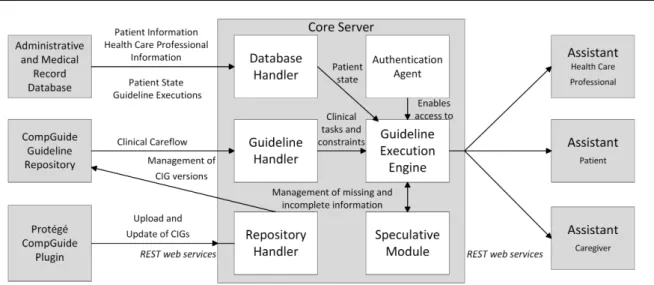
Fig. 3 shows an abstract view of the CompGuide frame-work we are developing for integrable CIGs, which aims to provide solutions to some of the challenges men-tioned in section 2. The description of its basic compo-nents, namely theCompGuide Prot´eg´e Plugin, theCore
Server, and theAssistant Applications, will be used to
showcase some of the defining features of the frame-work.
3.1 The CompGuide Prot´eg´e Plugin
The CompGuide model for CIGs (Oliveira et al 2013b) uses Ontology Web Language (OWL) Description Log-ics (DL) as its base language. OWL possesses greater machine interpretability of web content than that sup-ported by XML, RDF, and RDF Schema (RDF-S) by providing additional vocabulary for the definition of re-lationships and properties, along with a formal
seman-tics. This ultimately increases the expressiveness of the model. Additionally, there are widely known APIs that facilitate the access to content of ontologies defined in OWL, which makes the development of tools for ontol-ogy interpretation faster and easier. CompGuide follows the task network model similarly to GLIF3 (Boxwala et al 2004) and PROforma (Button and Fox 2003), as this seems to be the most inclusive and flexible orga-nization of CPG recommendations. As such, every rec-ommendation in a CPG is represented as one of the fol-lowing tasks:Plans,Actions,Questions, andDecisions. Typically, Actions describe tasks that should be car-ried out by the health care professional, such as exams, observations and so forth. Questions are used to feed information about clinical parameters to the execution engine and derive new task recommendations.Decisions use that information to perform diagnosis or update the state of the patient. Finally,Plans contain instances of any other tasks and are defined to achieve specific goals. CompGuide also provides representation primitives to define different types of conditions, including trigger conditions to select one amongst alternative tasks, pre-conditions to execute tasks, and expected outcomes. Tasks are represented as instances of classes and the rel-ative order between them is established through object properties connecting them. In this case, it is possible to establish sequential tasks, simultaneous tasks, and alternative tasks over which one can define temporal constraints such as durations, periodicities, repetitions, waiting times, and repetition conditions. Additionally, one can specify temporal constraints about the state of a patient in order to express for how long he had been experiencing certain signs or symptoms, or the period of time in which some sign should manifest as a result of a carried out task. In (Oliveira et al 2015), this on-tology was shown to satisfy the representation needs of a wide collection of CPGs.
Given the expressiveness of the model and the fact that it is based on OWL, Prot´eg´e was chosen has the tool for CIG creation and editing. However, there was a clear need to customize this tool, based on the classes and properties of the ontology, in order to make the experience of guideline encoding more user-friendly. As such theCompGuide Prot´eg´e Plugin was developed to provide an interface on which guideline developers can dynamically pick ontology elements to instantiate, and fill in their properties as predefined fields. At the same time, they can visualize the careflow as an oriented graph. Upon guideline creation, a localowl file is cre-ated and edited locally. Then the user may choose to upload it to the CompGuide Guideline Repository. If the user wants to edit an existing CIG in the repos-itory he can pull the corresponding owl file and edit
Fig. 1 Abstract view of the CompGuide CIG framework architecture for integrable guidelines with its main components: the CompGuide Prot´eg´e Plugin, the Core Server, and the Assistant Applications.
it locally, uploading it later. The plugin sets the basic components for collaborative CIG development.
3.2 The Core Server
TheCore Serveris the central component of the
frame-work and was developed as a RESTful service applica-tion. The usage of web services as the means to access
theCore Serveroffers expandability and the possibility
to improve selected services without compromising oth-ers. For their lightness and ease of access, and to stay aligned with the overall goal, REST web services were the chosen service model. This grants greater flexibil-ity when integrating functionalities of the framework in third party applications (Oliveira et al 2014a).
TheCore Server has six modules. The first is the
Authentication Agentwhich provides authentication and
authorization to the different types of users of the sys-tem, which can be administrators, health care profes-sionals, or patients. TheRepository Handler is respon-sible for managing updates to the CompGuide
Guide-line Repository requested by the Prot´eg´e CompGuide
Plugin, keeping different versions of the same CIG
or-ganized by authorship and by date. In order to use a guideline for execution, the Guideline Handler ac-cesses the selected CIG in the CompGuide Guideline
Repository and pulls the corresponding careflow,
de-livering it to the Guideline Execution Engine, which, in turn, uses information about the patient state pro-vided by the Database Handler to fill in the data en-try points of the careflow and produce recommenda-tions. The Guideline Execution Engine interprets all the scheduling constraints on the tasks and controls en-actment times, which means that starting and ending
times are verified and delivered to theAssistant
Appli-cations which, in turn, produce notifications to users.
These mechanisms to follow the application of proce-dures over time and to verify the execution of tasks are absent from most CIG frameworks (Shalom et al 2015), but they are essential to have a decision support that is truly capable of following up on the application of a CPG. As for theSpeculative Module, it is used whenever
theGuideline Execution Enginehas to reason about
rameters of the patient state and the values for these pa-rameters are not available. This may be due to delays in getting the results from exams or simply to the impos-sibility of knowing them. TheSpeculative Moduleuses a framework of Speculative Computation combined with a Bayesian Network based on previous executions of the CIG. The network is used to derive default values for the missing items, which are then given to the Specula-tive Computation framework for the generation of the most likely scenarios for the decision point in the care-flow (Oliveira et al 2014b). The scenarios are revised as information arrives, adapting themselves to new infor-mation states. This module ensures that the execution engine is always able to produce a recommendation.
The purpose of the Core Server is to make avail-able CIG services that anyone can integrate in their own applications, with a special focus on AAL appli-cations, where these functionalities would help the im-provement of care to sick and elderly people in their home environment (Costa et al 2007).
3.3 The Assistant Applications
TheAssistant Applications are a set of web-based and
Guideline Execution Engine to execute CPGs for pa-tients. According to their scope, i.e., if they are de-ployed by health care professionals, patients, or care-givers, they provide different advice based on the target of the clinical recommendation specified in the CIG.
Besides providing recommendations of clinical tasks along with their description and allowing the users to fill in data entry points of the guideline, they imple-ment a notification system that alerts the users to when they should start a task, when they should end it, and the number of repetitions of the task. The applications build calendar views with the recommendations each user should adopt, integrating these recommendations into the daily practice of health care professionals and the daily life of patients and caregivers. In this way, it is possible to build a schedule for them to follow, en-dowed with notification features about the correct time to enact clinical tasks. The system displayed herein is innovative in the sense that it is unlike other CIG execu-tion tools. It maps clinical protocols, as they are being applied, onto an agenda. The impact of this is that it enables medical personnel to keep a better track of the clinical processes they are managing, and patients, as well as caregivers, to accurately follow medical advice.
4 Final Remarks 4.1 Conclusions
There is a clear need to make CIG technologies more adaptable and context-sensitive. By making use of se-mantic web technologies, distributed easy to access fra-meworks and AI techniques, it is possible to achieve just that and tackle the current challenges in CIG and CDSS development. It is necessary to think of machine-interpretable formats not only as supporting tools but as privileged carriers of that knowledge, making it avail-able at any time in our everyday devices.
The features of the CompGuide framework men-tioned in this work aim to achieve this goal, building up on the strengths of existing approaches and proposing a new way to share and execute CPGs. These features include:
– An intuitive interface for the definition of CIGs; – A set of services enabling the integration of
CIG-based clinical decision support in any application; – A set of assistant applications that build an agenda
for health care professionals, patients and caregivers based on guideline recommendations; and
– A scenario engine that fills in information gaps in the clinical process.
Regarding the last item, by dynamically revising de-fault constraints about clinical parameters, it becomes possible to ensure that the information has the most likely configuration at all times and, in this way, pro-duce the most likely scenarios. As far as we know this kind of on-line framework is innovative in CIG systems and it may have implications in the outcome of the clin-ical process. The best possible recommendation is given every time and the CDSS is able to continue the exe-cution of the careflow based on plausible assumptions. The above-mentioned features enable the adapta-tion of CIG execuadapta-tion to different contexts, making them highly applicable in areas such as eHealth and AAL, and the tailoring of that same execution to a pa-tient by anticipating changes in his state, thus helping to keep his treatment on track. An additional effect of frameworks such as CompGuide is an increasing adop-tion of CPGs in multiple environments and the dissem-ination of best practices throughout different settings.
4.2 Future Directions
As mentioned previously, further integration of CIGs with specialized decision frameworks and more dynamic, adjustable models is necessary and shall be further ex-plored in order to make CIG-based clinical decision sup-port more adaptable and context-sensitive. The path for this may be found in he adaptation and merging of Logic Programming and Machine Learning techniques in order to produce updatable and ever-changing knowl-edge to fill in the gaps found in the rigid rules of CPGs. In order to do this, CIG components have to be modu-lar, in the sense that it should be easy to displace them in a careflow and connect them to said models.
The ultimate goal for CIG-based CDSSs is to make them self-explanatory by developing information dash-boards presented at each decision point in a careflow, showing what information is known about the patient, what information scenarios are derived by the system and their respective likelihood scores, what recommen-dations are suggested based on them, and the predicted evolution of the patient expressed in careflow paths that will likely be followed. Through this, one hopes to help health care professionals, caregivers, and patients mak-ing better-informed decisions regardmak-ing the course of the clinical process.
Acknowledgements This work has been supported by FCT – Funda¸c˜ao para a Ciˆencia e Tecnologia within the Project Scope UID/CEC/00319/2013. The work of Tiago Oliveira is supported by a FCT grant with the reference SFRH/BD/8-5291/ 2012.
References
Adhikari NKJ, Beyene J, Sam J, Haynes RB (2005) Effects of Computerized Clinical Decision Support Systems on Practitioner Performance. Journal of the American Med-ical Association 293(10):1223–1238
Boxwala A, Peleg M, Tu S, Ogunyemi O, Zeng QT, Wang D, Patel VL, Greenes Ra, Shortliffe EH (2004) GLIF3: a rep-resentation format for sharable computer-interpretable clinical practice guidelines. Journal of biomedical infor-matics 37(3):147–61
Button DR, Fox J (2003) The syntax and semantics of the PRO forma guideline modeling language. Journal of the American Medical Informatics Association 10(5):433–443 Ciccaresea P, Caffib E, Boiocchia L, Quaglinia S, Stefanellia M (2004) A guideline management system. In: Medinfo 2004, pp 28–32
de Clercq PA, Blom JA, Korsten HHM, Hasman A (2004) Ap-proaches for creating computer-interpretable guidelines that facilitate decision support. Artificial intelligence in medicine 31(1):1–27
Costa R, Novais P, Machado J, Alberto C, Neves J (2007) Inter-organization cooperation for care of the elderly. In: Wang W, Li Y, Duan Z, Yan L, Li H, Yang X (eds) In-tegration and Innovation Orient to E-Society Volume 2, IFIP International Federation for Information Processing, vol 252, Springer US, pp 200–208
Goud R, Hasman A, Strijbis AM, Peek N (2009) A paral-lel guideline development and formalization strategy to improve the quality of clinical practice guidelines. Inter-national journal of medical informatics 78(8):513–520 Isern D, Moreno A (2008) Computer-based execution of
clin-ical guidelines: a review. International journal of medclin-ical informatics 77(12):787–808
Kaushal R, Shojania KG, Bates DW (2003) Effects of com-puterized physician order entry and clinical decision sup-port systems on medication safety: a systematic review. Archives of internal medicine 163(12):1409–16
Kim S, Haug PJ, Rocha Ra, Choi I (2008) Modeling the Ar-den Syntax for medical decisions in XML. International journal of medical informatics 77(10):650–6
Latoszek-Berendsen A, Tange H, van den Herik HJ, Hasman A (2010) From clinical practice guidelines to computer-interpretable guidelines. A literature overview. Methods of information in medicine 49(6):550–70
Lima L, P, Costa R, Bulas Cruz J, Neves J (2011) Group decision making and Quality-of-Information in e-Health systems. Logic Journal of IGPL 19(2):315–332
Miller M, Kearney N (2004) Guidelines for clinical practice: development, dissemination and implementation. Inter-national journal of nursing studies 41(7):813–821 Musen MA, Shahar Y, Shortliffe EH (2006) Clinical
decision-support systems. In: Shortlife E, Cimino J (eds) Biomed-ical Informatics Computer Applications in Health Care and Biomedicine, Springer, pp 698–736
Novais P, Costa R, Carneiro D, Neves J (2010) Inter-organization cooperation for ambient assisted living. J Ambient Intell Smart Environ 2(2):179–195
Oliveira T, Novais P, Neves J (2013a) Development and im-plementation of clinical guidelines: An artificial intelli-gence perspective. Artificial Intelliintelli-gence Review pp 1–29 Oliveira T, Novais P, Neves J (2013b) Representation of Clin-ical Practice Guideline Components in OWL. In: P´erez JB, Hermoso R, Moreno MN, Rodr´ıguez JMC, Hirsch B, Mathieu P, Campbell A, Suarez-Figueroa MC, Ortega A, Adam E, Navarro E (eds) Trends in Practical
Applica-tions of Agents and Multiagent Systems SE - 10, Ad-vances in Intelligent Systems and Computing, vol 221, Springer International Publishing, pp 77–85
Oliveira T, Le˜ao P, Novais P, Neves J (2014a) Webifying the Computerized Execution of Clinical Practice Guide-lines. In: Bajo Perez J, Corchado Rodr´ıguez JM, Math-ieu P, Campbell A, Ortega A, Adam E, Navarro EM, Ahrndt S, Moreno MN, Juli´an V (eds) Trends in Practi-cal Applications of Heterogeneous Multi-Agent Systems. The PAAMS Collection SE - 18, Advances in Intelligent Systems and Computing, vol 293, Springer International Publishing, pp 149–156
Oliveira T, Satoh K, Neves J, Novais P (2014b) Applying Speculative Computation to Guideline-Based Decision Support Systems. In: IEEE 27th International Sympo-sium on Computer-Based Medical Systems 2014 (CBMS), pp 42–47, DOI 10.1109/CBMS.2014.32
Oliveira T, Novais P, Neves J (2015) Assessing an Ontology for the Representation of Clinical Protocols in Decision Support Systems. In: Bajo J, Hern´andez JZ, Mathieu P, Campbell A, Fern´andez-Caballero A, Moreno MN, Juli´an V, Alonso-Betanzos A, Jim´enez-L´opez MD, Botti V (eds) Trends in Practical Applications of Agents, Multi-Agent Systems and Sustainability SE - 6, Advances in Intelligent Systems and Computing, vol 372, Springer International Publishing, pp 47–54
Peleg M (2013) Computer-interpretable clinical guidelines: A methodological review. Journal of biomedical informatics 46(4):744–63
Shahar Y, Young O, Shalom E, Galperin M, Mayaffit A, Moskovitch R, Hessing A (2004) A framework for a dis-tributed, hybrid, multiple-ontology clinical-guideline li-brary, and automated guideline-support tools. Journal of Biomedical Informatics 37(5):325–344
Shalom E, Shahar Y, Lunenfeld E (2015) An architecture for a continuous, user-driven, and data-driven application of clinical guidelines and its evaluation. Journal of Biomed-ical Informatics (November)
Sintchenko V, Coiera E, Iredell JR, Gilbert GL (2004) Com-parative Impact of Guidelines, Clinical Data, and De-cision Support on Prescribing DeDe-cisions: An Interactive Web Experiment with Simulated Cases. Journal of the American Medical Informatics Association 11(1):71–77 Ten Teije A, Miksch S, Lucas P (2008) Computer-based
med-ical guidelines and protocols: a primer and current trends, vol 139. Ios Press Inc
Terenziani P, Montani S, Bottrighi A, Torchio M, Molino G, Correndo G (2004) The GLARE approach to clini-cal guidelines: main features. Studies in health technology and informatics 101(3):162–6
Tu SW, Campbell JR, Glasgow J, Nyman Ma, McClure R, McClay J, Parker C, Hrabak KM, Berg D, Weida T, Mansfield JG, Musen Ma, Abarbanel RM (2007) The SAGE Guideline Model: achievements and overview. Journal of the American Medical Informatics Association : JAMIA 14(5):589–98
Wang D, Peleg M, Tu SW, Boxwala AA, Ogunyemi O, Zeng Q, Greenes RA, Patel VL, Shortliffe EH (2004) Design and implementation of the GLIF3 guideline execution en-gine. Journal of biomedical informatics 37(5):305–318 Young O, Shahar Y (2005) The Spock System : Developing
a Runtime Application Engine for Hybrid-Asbru Guide-lines. Artificial Intelligence Review 3581(1):166–170