Boston University
OpenBU http://open.bu.edu
BU Open Access Articles BU Open Access Articles
Certifying RSA public keys with an
efficient NIZK
This work was made openly accessible by BU Faculty. Please share how this access benefits you. Your story matters.
Version First author draft
Citation (published version): Sharon Goldberg, Leonid Reyzin, Omar Sagga, Foteini Balditimsi. "Certifying RSA Public Keys with an Efficient NIZK." Public Key Crypto https://hdl.handle.net/2144/29231
Certifying RSA Public Keys
with an Efficient NIZK
Sharon Goldberg*, Leonid Reyzin*, Omar Sagga*, and Foteini Baldimtsi† †George Mason University
*Boston University
January 12, 2018
Abstract
In many applications, it is important to verify that an RSA public key (N, e) specifies a permutation, in order to prevent attacks due to adversarially-generated public keys. We design and implement a simple and efficient noninteractive zero-knowledge protocol (in the random oracle model) for this task. The key feature of our protocol is compatibility with existing RSA implementations and standards. The protocol works for any choice ofe. Applications concerned about adversarial key generation can just append our proof to the RSA public key without any other modifications to existing code or cryptographic libraries. Users need only perform a one-time verification of the proof to ensure that raising to the power e is a permutation of the integers modulo N. For typical parameter settings, the proof consists of nine integers modulo
N; generating the proof and verifying it both require about nine modular exponentiations.
1
Introduction
Many applications use an RSA public key (N, e) that is chosen by a party who may be adversarial. In such applications, it is often necessary to ensure that the public key defines a permutation over ZN: that is, raising to the power e modulo N must be bijective, or, equivalently, every integer
between 0 and N−1 must have aneth root moduloN.
The folklore solution to this problem (used by, for example, [MRV99], [CMS99], [MPS00], [LMRS04]) is to choose the public RSA exponent e such that eis prime and larger than N. This solution has three drawbacks.
First, because the folklore solution requirese > N,eis not in the set of standard values typically used for e in RSA implementations e.g., e ∈ {3,17,216+ 1}. Unless a large prime value for e is standardized, before using the public key, one would have to perform a one-time primality test of on e, to ensure that that ereally is prime. This primality test is quite expensive (see Section 3).
Second, most RSA implementations choose a small value for e, typically from a set of standard values e ∈ {3,17,216 + 1}. Choosing a small e significantly reduces the cost of performing an RSA public key operation. However, this efficiency advantage is eliminated in the folklore solution, which requires e > N. Unlike the previous drawback, which results in a one-time cost for each public key used, this drawback makes every public-key operation about two orders of magnitude more expensive.
Third, the folklore solution is not compatible with existing RSA standards and off-the-shelf implementations. This is because the folklore solution does not ensure that the public key operation
is a permutation overZN, whereZN ={0,1, ..., N−1}. Instead, it only ensures only that the public
key operation defines a permutation over the set Z∗N, whereZ∗N is the set of values inZN that are
relatively prime withN.
Thus, there are no assurances about the values in the setZN−Z∗N,i.e.,the set of values that are
less thanN butnot relatively prime withN. (To see this, consider the exampleN = 9 ande= 11.) If the RSA public key is generated honestly, this is not a problem, because the setZN−Z∗N contains
only a negligible fraction of ZN. However, if an adversary chooses the RSA public key (N, e), it
could choose N so that the set ZN −Z∗N is a large fraction of ZN. To address this attack, the
folklore solution additionally requires the a gcd check along withevery RSA pubic-key operation, to ensure that the exponentiated value is also relatively prime withN.
Performing a gcd check is not expensive, when compared to a full-length modular exponentia-tion. However, it does violate compliance with existing RSA standards, which donot specify that every RSA public-key operation be accompanied with a gcd check. (See, for instance, the RSA PKCS #1, Version 2.2 specification in RFC8017 [MKJR16], Section 5.) For this reason, typical implementations of RSA do not check that the input is inZ∗N. Instead, they will perform public-key
operations over any value in ZN. Thus, the folklore solution is not compatible with off-the-shelf
RSA implementations, so using it requires modifications to existing code and/or cryptographic li-braries, a non-trivial task for developers and practitioners which comes with the risk of introducing new bugs (e.g., because a developer might forget to add the gcd to an RSA operation somewhere in the code, etc.).
1.1 Our Contribution.
We present a simple noninteractive zero-knowledge proof (NIZK) in the random oracle model, that allows the holder of an RSA secret key to prove that the corresponding public key defines a permutation over all of ZN, without leaking information about the corresponding secret key.
Our NIZK can be used even when the RSA exponent e is small, which is useful for applications that require fast RSA public key operations. In addition to the NIZK algorithm and a concrete security proof, we present a detailed specification of the prover and verifier algorithms, as well as production-quality implementation and an analysis of its performance.
Because our NIZK is for all values in ZN, it is compliant with existing cryptographic
speci-fications of RSA (e.g., RFC8017 [MKJR16]). This allows implementors to cleanly combine our NIZK with off-the-shelf RSA cryptographic libraries and primitives, without modifying any exist-ing code. We present a production-quality implementation[cod] of our NIZK in C#, that is ready to be added to the bouncycastle [bou] cryptographic library. In fact, our NIZK implementation has already been integrated into the TumbleBit open-source project [Ntu], where it is being used to prevent the TumbleBit Tumbler from choosing an adversarial RSA key that allows it to steal bitcoins from its users. Integration with TumbleBit was easy, because our NIZK did not require modifications of any of the existing TumbleBit codebase. Instead, the Tumbler just publishes our NIZK along with his RSA public key (N, e), and each user that interacts with the Tumbler simply performs a one-time verification of the NIZK before the interaction begins.
For typical parameter settings, our NIZK consists of 9 elements of ZN. Generating the NIZK
costs roughly 9 full-length RSA exponentiations modulo N. Meanwhile, each verifier pays the one-time cost of verifying our NIZK, which is also roughly equal to 9 full-length exponentiations. When compared to the folklore solution we described earlier, our solution (1) avoids the more expensive one-time primality test and (2) allows the verifier to continue using a small value of e, resulting in better performance for every public-key verification. Beyond this, our NIZK is simple to understand and easy to implement.
1.2 Related Work
Kakvi, Kiltz, and May [KKM12] show how to verify that RSA is a permutation by providing only the RSA public key (N, e) and no additional information, as long ase > N1/4. They also show that when e is small, it is impossible, under reasonable complexity assumptions, to verify that (N, e) is a permutation without any additional information [KKM12, Section 1]. Thus, their approach cannot be used wheneis small. We circumvent their impossibility by having the prover additionally provide our NIZK (rather than just (N, e)) to the verifier.
Wong, Chan, and Zhu [WCZ03, Section 3.2] and Catalano, Pointcheval, and Pornin [CPP07, Appendix D.2] present protocols (similar to ours) that work only over Z∗N rather than the entire
ZN. Thus, these protocols, unlike ours, should only be used in applications that additionally verify
gcd(ρ, N) = 1 each time an RSA public-key operation is performed on inputρ. Apart from adding complexity and potentially harming performance, this is a deviation from cryptographic standards and thus requires modifications to cryptographic libraries, which risks introducing new bugs.
The protocols of Camenisch and Michels [CM99, Section 5.2] and Benhamouda et al. [BFGN17] achieve much stronger goals. The former proves N = pq is a product of two safe primes (i.e., p, q,(p−1)/2, and (q−1)/2 are all prime); the second can prove that any prespecified procedure for generating the primes p and q was followed. These protocols can be used to prove that (N, e) specifies a permutation by imposing mild additional conditions on e (and the prime generation procedure for [BFGN17]). However, these stronger goals are not necessary for our purposes. Our protocol is considerably simpler and more efficient, and does not restrictp and q in any way.
Our protocol builds on the protocol of Bellare and Yung [BY96], who showed how to prove that any function is “close” to a permutation. However, “close” is not good enough for our purposes, because the adversary may be able to force the honest parties to use the few values inZN at which
the permutation property does not hold. Thus, additional work is required for our setting. This additional work is accomplished with the help of a simple sub-protocol from Gennaro, Micciancio, and Rabin [GMR98, Section 3.1] for showing the square-freeness of N (a similar sub-protocol in the interactive setting was discovered earlier by Boyar, Friedl, and Lund [BFL89, Section 2.2]). We demonstrate how to combine the ideas of [BY96] and [GMR98] to achieve our design goals.
2
ZK Proof that RSA is a Permutation over
Z
NLet φ denote the Euler’s totient function, φ(N) = |Z∗N| (see, e.g., [Sho09, Section 2.6] for the relevant background). Recall that φ(N) = (p−1)(q−1) ifN =pq.
In this section we present a two-message public-coin honest-verifier zero-knowledge proof for the following promise problem:
Lyes ={(N, e) where gcd(N, φ(N)) = 1 and the map x7→ xe modN is a permutation of ZN}
Lno ={(N, e) where the mapx7→xe modN is not permutation of ZN}
Recall that in a knowledge proof for a promise problem, we need completeness and zero-knowledge for instances in Lyes, and soundness against any instance in Lno. (No guarantees are provided in all other instances.) In our case, the gap between Lyes and the complement of Lno is caused by the additional constraint gcd(N, φ(N)) = 1 in Lyes. This constraint enables our efficient construction without hampering its usefulness. That is, the additional constraint in Lyes will hold for an honestly generated RSA public key, because an honestly generated N will be such that
N =pqfor distinct equal-length primespand q. Thus,pwill not divideq−1 andqwill not divide
p−1, which ensures that gcd(N, φ(N)) = 1 and the additional constraint is satisfied. The prover’s witness (for instances in Lyes) is the prime factorization ofN.
Our protocol has perfect completeness, perfect honest-verifier zero-knowledge, and statistical soundness.
In the first message of our protocol, the verifier simply sends some random values from ZN
to the prover, and the prover responds by using her prime factorization of N to perform a mod-ular exponentiation on each value. In Section 2.3, we use the Fiat-Shamir transform [FS86] to turn the protocol into a noninteractive zero-knowledge proof (NIZK) in the random oracle model. Specifically, both parties will generate the verifier’s first message by hashing the input (N, e).
2.1 Overview of our Protocol.
The starting point of our protocol is the observation that if the RSA modulus is square free and values inZ∗N haveeth roots moduloN, then it follows that the values inZN\Z∗N also haveeth roots
modulo N. Thus, our protocol simultaneously tests thatN is square free, and that raising to the power eis permutation overZ∗N.
Square-freeness. Recall that a number N issquare free if it can be written as N =p1p2. . . pk
fordistinct prime numberspi. (N is not square free if it is divisible by p2, wherepis some prime.)
It is important to note that RSA will not be a permutation over ZN if N is not square free.
Specifically, if N is not square free, there will be values in ZN\ZN∗ that do not have unique eth
roots modulo N. (For instance, suppose that N is not square free because N = p3q for a small
p (e.g., around 1000) and let e= 3 so that gcd(e, φ(N)) = 1 (i.e. e = 3 does not divide p−1 or
q−1). Then raising to the power of e = 3 is a permutation of Z∗N, but not of ZN. Why? Any
x∈ZN\ZN∗ that is divisible by pwill also become divisible by p3 after being raised toe= 3. This
implies that any element of ZN that is divisible byp but not p3 will not have an eth root. Thus,
an almost 1/p fraction of elements ofZN will have noeth roots.)
To prove the square-freeness of N, we adapt the protocol of Gennaro, Micciancio, and Ra-bin [GMR98, Section 3.1] which shows that random elements ofZ∗N haveNth roots moduloN. We
modify their protocol so that it works over all ofZN, rather than just Z∗N. This way, we avoid
re-quiring a gcd computation each time a random element is chosen to check that element is inZ∗N and
not inZN−Z∗N (see Lemma 4.3). Apart from reducing the complexity of our protocol, this
modifi-cation also allows us to easily combine our square-freeness protocol with the permutation-certifying protocol described in the next paragraph.
Our modified square-freeness protocol simply shows that random elements moduloN haveNth roots. First, the verifier chooses random elementsρiofZN. Then, the prover responds by computing
their Nth roots σi = (ρi)1/N (mod N). Finally, the verifier accepts if ρi = (σi)N (modN). We
note that some some square-free integersN will fail this test (for example the integer 21, and more generally those integers for which gcd(N, φ(N)) >1). However, all square-free integers N where gcd(N, φ(N)) = 1 and will pass this test, which suffices for our purposes.
Certifying permutations. Next, we adapt the protocol of Bellare and Yung [BY96], who
showed how to certify that any function is close to a permutation. We observe that for RSA with a square-free modulus N, raising to eth power is either a permutation or very far from one (see Lemma 4.4). Thus, the protocol from [BY96] can be used to certify that (N, e) specifies a permutation. In this protocol, the verifier chooses random elements ofZN and the prover responds
Combining both protocols. Because any value that has an (eN)th root also has aneth root and anNth root, we combine the two protocols simply by checking that random values moduloN
haveeNth roots. Specifically, the prover (who holds the RSA secret key) sends the verifierσ1...σm,
where each σi is (eN)th root of a random values ρi ∈ ZN selected by the verifier. The verifier
validates that eachσi(eN)=ρi (modN).
2.2 Detailed Description of our Interactive Protocol
We are now ready to describe the honest-verifier zero-knowledge protocol.
Our protocol depends on two parameters α and e0, which are both primes, at most about 16 bits long. The verifier will reject any N that is divisible by a prime less than α and anye that is divisible by a prime less than e0. (Formally, let Lα,e0 ={(N, e) such N is divisible by a prime less
thanαoreis divisible by a prime less thane0}. We removeLα,e0 from Lyes and add its complement
to Lno.) Any setting ofαande0is valid for security; varying these parameters affects only efficiency. Setting α =e0 = 2 gives the protocol for the original promise problem, but a higher setting gives better performance. An optimal setting of these parameters is implementation-dependent, since larger e0 and α will result in some additional work for the verifier, but will also reduce work for the prover and verifier since m1 and m2 in equation (1) below become smaller. Whene is a fixed prime like 3, 17, or 216+ 1, as is standard for many RSA implementations, then we sete0 equal to
e. We further discuss parameter settings in Section 3.
The prover’s witness is the prime factorization of N. Let κ be a security parameter. The protocol will achieve statistical soundness error 2−κ.
Basic Protocol.
1. Both prover and verifier let
m1= −κ/log2 1 α and m2 = −κ/log2 1 α + 1 e0 1− 1 α . (1)
Notice that m2 ≥m1 sincee0>1.
2. The verifier chooses m1 random values ρi ∈ ZN and m2 random values ρj ∈ ZN and sends
them to Prover. 3. The Prover sends back
σi = (ρi)N
−1modφ(N)
modN
fori= 1. . . m1 (these are the Nth roots ofρi moduloN) and
σj = (ρj)e
−1modφ(N)
modN
forj= 1. . . m2 (these are the eth roots of ρj modulo N).
(Note that N−1 modφ(N) exists because gcd(N, φ(N)) = 1, and e−1 modφ(N) exists by Lemma 4.1. The factorization ofN allows the prover to compute these values efficiently.) 4. The verifier accepts that (N, e) defines a permutation if all of the following checks pass.
(a) Check thatN >0 and N is not divisible by all the primes less than α.
(Equivalently, one can let P be the product of all primes less than α (also known as
(b) Check that e >0 and ise not divisible by all the primes less than e0. (In most imple-mentations of RSA,eis a fixed prime, in which the verifier can just check thate=e0.) (c) Verify thatρi= (σi)N modN fori= 1. . . m1. It follows that the gcd(N, φ(N)) = 1 and
therefore N is square-free (with soundness error 2−κ) by Lemma 4.3.
(d) Verify thatρj = (σj)emodN forj= 1. . . m2. It follows that (N, e) define a permutation
given thatN is square-free (with soundness error 2−κ) by Lemma 4.4.
Improved Protocol. To improve performance, we observe that any value that has an (eN)th
root also has an eth root and an Nth root, obtained by raising the (eN)th root to the power N
or e, respectively). Thus, instead of requiring the protocol to test m1+m2 distinct values, we can instead test just m2 values (because m1 ≤m2). Specifically, we modify Steps 2-4 of the basic protocol above as follows:
1. As above.
2. The verifier chooses m2 random values ρi∈ZN.
3. The Prover sends back
σi = (ρi)(eN)
−1modφ(N)
(modN)
fori= 1. . . m1 (for convenience, we call this a “weird RSA signature”) and
σi = (ρi)e
−1modφ(N)
(modN) fori=m1+ 1. . . m2 (which is just a regular RSA signature).
4. The verifier accepts that (N, e) defined a permutation if all of the following checks pass. (a) As above.
(b) As above.
(c) Verify that ρi = (σi)eN (mod N) for i= 1. . . m1. (This is a “weird RSA verification”.) (d) Verify thatρi= (σi)e (mod N) fori=m1+1. . . m2. (This is a regular RSA verification.)
Note that for many natural choices of parameters (e, κ, α), we have m1 = m2, and so step 4d disappears.
We prove that the above protocols are statistically sound honest-verifier zero-knowledge in Section 4.
2.3 Making our Protocol Noninteractive.
We use the Fiat-Shamir paradigm [FS86] to make the improved protocol described in Section 2.2 non-interactive in the random oracle model.
Instead of having the verifier select the random values ρi ∈ZN in Step 2, the Prover samples
ρi ∈ZN by himself, by computing the output of the random oracle over the concatenation of (1)
the RSA public key (N, e), (2) a salt given as a system parameter , and (3) the index i. Thus, the RSA key (N, e) and the salt determine a deterministic set of ρi ∈ZN. The verifier can therefore
compute ρi ∈ ZN on his own, by following the same procedure as the prover, and subsequently
3
Specification, Implementation and Performance
Specification. The full specification of our NIZK is available in Appendix A. We specify the Improved Protocol of Section 2.2 made non-interactive using the Fiat-Shamir paradigm as described in Section 2.3. Our specification assumes e is a fixed prime and thus sets e0 = e. It takes in α
and the salt as system parameters. The random oracle used to determinstically select theρi values
is a “full-domain hash” [BR93] instantiated with the industry-standard MGF1 Mask Generation Function as defined in [MKJR16, Sec. B.2.1]. We use the industry-standard I2OSP and OS2IP to convert between octet strings and integers [MKJR16, Sec. 4.1] and the industry-standard RSASP to perform an RSA secret key operations [MKJR16, Sec. 5.2.1], and RSAVP for RSA public-key operations [MKJR16, Sec. 5.2.2].
Implementation. An open-source implementation of our specification in C#, based on the
bouncycastle cryptographic library [bou], is publicly available[cod]. We hope that our implemen-tation will become a part of bouncycastle.
Integration with TumbleBit. Our implementation has already been integrated into the
open-source reference implementation of TumbleBit, which is currently being developed for production use [Ntu] [Str17]. TumbleBit [HAB+17] is a unidirectional bitcoin payment hub that allows parties to make fast, anonymous, off-blockchain payments through an untrusted intermediary called the Tumbler. The security of the TumbleBit protocol rests on the assumption that the Tumbler’s RSA public key (N, e) defines a permutation overZN. In the absence of this assumption, the Tumbler
can steal bitcoins from payers.1 Thus, in addition to publishing (N, e), a Tumbler publishes our NIZK proof that (N, e) defines a permutation, which is verified, during a setup phase, by any payer or payee who wants to participate in the protocol with this Tumbler. Integration with TumbleBit was easy. No modification to the existing TumbleBit protocol or codebase were required; instead, our NIZK was simply added to TumbleBit’s setup phase.
1
Specifically, if RSA is not permutation, then the Tumbler can provide the payee Bob with a puzzlez that has two valid solutions16=2wherez= (1)e= (2)e modN, where1allows Bob to decrypt the Tumbler’s signature
on the transaction that allows Bob to claim his bitcoin, but 2 does not. Then, to steal a bitcoin, the Tumbler
gives payer Alice the solution2, so that the Tumbler can claim Alice’s bitcoin (because the TumbleBit puzzle-solver
protocol will complete correctly, sincee
2 =z) without passing it on to Bob (because2 cannot be used to decrypt
the Tumbler’s signature on the transaction that allows Bob to claim his bitcoin).
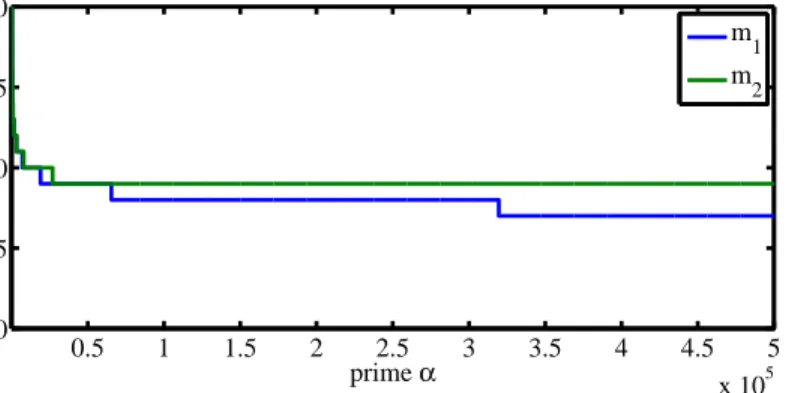
0.5 1 1.5 2 2.5 3 3.5 4 4.5 5 x 10⁵ 0 5 10 15 20
number of values sent (m1, m2)
prime α
m
1
m
2
Figure 1: Values ofm1 and m2 versus the choice of parameterα for our NIZK, when κ= 128 and
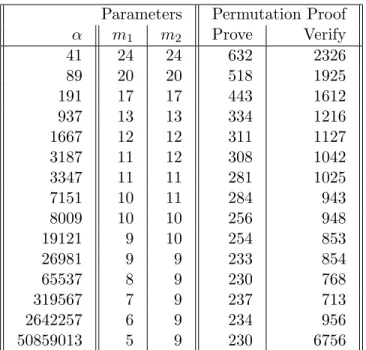
Parameters Permutation Proof α m1 m2 Prove Verify 41 24 24 632 2326 89 20 20 518 1925 191 17 17 443 1612 937 13 13 334 1216 1667 12 12 311 1127 3187 11 12 308 1042 3347 11 11 281 1025 7151 10 11 284 943 8009 10 10 256 948 19121 9 10 254 853 26981 9 9 233 854 65537 8 9 230 768 319567 7 9 237 713 2642257 6 9 234 956 50859013 5 9 230 6756
Table 1: Proving and verifying times for our C# implementation as observed on an Azure DS1 v2 virtual machine running Windows Server 2016 Datacenter (single-core 2.4 GHz Intel Xeon E5-2673 v3 Haswell processor, 3.5GiB RAM). Time is given in ms. Public exponent is e=e0 = 65537 and security parameter is κ= 128.
Parameters and performance for TumbleBit. When used with TumbleBit, our NIZK has
parametersκ= 128, the RSA key length is|N|= 2048, the public RSA exponent ise=e0 = 65537, and the salt is the SHA256 hash of the Genesis block of the Bitcoin blockchain.
The performance of our NIZK largely depends on our choice of the parameter α. A shorter α
means that the verifier has to spend less time trying to divide N by primes less than α, but also increases m1 and m2, the number of RSA values in the NIZK. The relationship between α and
m1, m2 is determined by equation (1). Specifically for the TumbleBit parameters, we show this relationship in Figure 1. To evaluate the performance of our NIZK, we choose the smallest value of αthat corresponds a given pair of (m1, m2) values, and benchmark proving and verifying times for our NIZK for the RSA key length|N|= 2048 bits in Table 1 on a single-core of an Intel Xeon processor. We can see from the table that choosingα= 319567 (so thatm1= 7 andm2 = 9) gives optimal performance, though performance forα = 65537 is roughly similar and the optimal choice is likely implementation-dependent. .
For the optimal choice ofα, proving takes about 237 ms (a small fraction of the key generation cost, which is 2022 ms) and verifying takes about 713 ms. For comparison, verification of our NIZK is about 8 times faster than the folklore solution discussed in Section 1, which requires the verifier to spend 5588 ms to perform the Rabin-Miller primality test on a 2048-bit RSA exponent, and also slows down every public-key operation by a factor of about 60 becauseeis 2048 bits long (instead of e= 65537, which is 17 bits long). We should note that even though our solution is much faster than the folklore one, and adds only 12% to the prover’s normal RSA key generation cost, it is still relatively expensive for the verifier: for comparison, the public key operation (encryption or signature verification) withe= 65537 takes only about 1.4ms.
From Table 1 we also see that verifying is generally slower than proving (until α gets so big that divisibility testing takes too long for the verifier). This follows because proving involves m1
modular exponentiations (using RSASP), which can be done separately modulopand moduloqfor
N =pq(with the exponent reduced modulop−1 andq−1), and then combined using the Chinese Remainder Theorem (CRT). Meanwhile, the verifier does not know p and q, and so cannot use (CRT); moreover, the exponent used for modular exponentiations (using RSAVP) is slightly longer than φ(n), but the verifier does not know φ(N) and so cannot reduce it. Thus, exponentiations performed by the verifier are slower than those performed by the prover.
4
Security Proofs
We present concrete security proofs for completeness, soundness, and honest-verifier zero-knowledge for the Basic Protocol and Improved Protocol described in Section 2.2. Thus, the security of our NIZK is standard by the Fiat-Shamir paradigm.
4.1 Perfect Completeness
We need to show that the honest prover will be able to carry out step 3, and the verifier’s checks in step 4 will pass.
Lemma 4.1. If for some positive integers N and e, gcd(N, φ(N)) = 1 and x 7→ xemodN is a permutation of ZN, then gcd(e, φ(N)) = 1.
Proof. Since gcd(N, φ(N)) = 1, there is no prime p such that p2 divides N (else p divides φ(N) by [Sho09, Theorem 2.10] and therefore gcd(N, φ(N))≥ p > 1). LetN = p1p2. . . pk for distinct
prime numbers pi. By Chinese Remainder Theorem (CRT) [Sho09, Theorem 2.8], the ring ZN is
isomorphic to the product of ringsZp1× · · · ×Zpk, and therefore x7→ x
emodp
i is a permutation
of Zpi for every i. It suffices to show that e is relatively prime to pi −1 for every i, because φ(N) = (p1−1)×(p2−1)× · · · ×(pk−1).
Letgibe the primitive root modulopi (also known as generator ofZpi; it exists by [Sho09,
The-orem 7.28]). Let hi =g(pi
−1)/gcd(e,pi−1)
i modpi. Note that hei modpi = (h(pi
−1)
i )e/gcd(e,pi−1)mod
pi = 1 by Fermat’s little theorem. Because 1emodpi is also 1, and raising to theeis a permutation
ofZpi, we knowhi= 1. But sincegi is a generator ofZ
∗
pi, the lowest power ofgi that is 1 is pi−1,
and therefore gcd(e, pi−1) = 1.
Lemma 4.2. If for some positive integersN andf, we havegcd(N, φ(N)) = 1andgcd(f, φ(N)) = 1, then for g=f−1 modφ(N) and for all x∈
ZN, xgf modN =x.
Proof. By the same argument as in the proof of 4.1, we know N = p1p2. . . pk for distinct prime
numberspi. By CRT, it suffices to show thatxef modpi =x for eachi. Indeed, f g =tφ(N) + 1
for some integer t, and therefore xf g = (xpi−1)s·x for some integer s, and the result follows by
Fermat’s little theorem whenxmodpi 6= 0, and trivially when xmodpi= 0.
Thus, Lemma 4.1 shows that the prover will be able to carry out Step 3, because N, e, and therefore N e are relatively prime to φ(N), and therefore their inverses modulo φ(N) (which the prover can compute given the prime factorization of N) exist and can be obtained via extended Euclidean algorithm [Sho09, Section 4.3]. Lemma 4.2 shows that the verifier’s checks 4c and 4d will pass. The verifier’s checks 4a and 4b will pass by construction of Lα,e0.
4.2 Statistical Soundness
Letφ(N) denote |Z∗
N|. The notation p|N means “p dividesN”.
The following lemma shows that one can validate if an integer N is square-free by checking if random values in ZN have Nth roots. This lemma generalizes the result of Gennaro, Micciancio,
and Rabin [GMR98, Section 3.1], which worked overZ∗N and thus required a gcd computation every time a random value was selected.
Lemma 4.3. Let N > 1 be an integer and p be a prime such that p2 divides N (i.e., N is not square free). Then, the fraction of elements ofZN that have anNth root moduloN is at most1/p.
Proof. Supposexhas anNth root modulo N. Then there is a value r such thatrN ≡x (modN). Hence, N divides rN −x, which means p2 divides rN −x (since p2 divides N), and therefore r is theNth root ofxmodulop2. Thus, in order to have anNth root moduloN,xmust have anNth root modulop2. Since a uniformly random elementx of ZN is also uniform modulo p2, it suffices
to consider what fraction of Zp2 hasNth roots.
By Claim 4.5 below, the number of elements of Zp∗2 that haveNth roots is at most φ(p2)/e0,
wheree0 is the largest prime divisor of gcd(N, φ(p2)) = gcd(N, p(p−1)). Sincep|N, we havee0 =p. Thus, the number of elements of Zp∗2 that haveNth roots is at most φ(p2)/p=p−1.
Ifx∈Zp2−Z∗
p2, thenp|x. Ifxhas anNth rootrmodulop2, thenp2|(rN−x), hencep|(rN−x),
hencep|rN (becausep|x and p|(rN−x)), hencep|r (because p is prime), hencep2|r2, hence p2|rN
(becauseN >1), and hencep2|x(because p2|(rN−x) andp2|rN). We therefore have that x∈Zp2
and p2|x, which means thatx= 0.
Thus, the total number of elements ofZp2 that have anNth root is at mostp−1 elements from Zp∗2 and one element fromZp2−Z∗
p2 (namely, the element x= 0), for a total of at most pelements
from Zp2. Thus, at most a p/|Zp2| = 1/p fraction of elements of Zp2 have Nth roots. It follows
that at most a 1/p fraction of elements of ZN has Nth roots.
The following lemma shows that if we knowNis square free (which we can test using Lemma 4.3), then we can check whether raising to the power eis a permutation of ZN, by checking if random
values in ZN have eth roots.
Lemma 4.4. Suppose N > 0 is a square-free integer so that N = p1p2. . . pk for distinct prime
numbers pi, and e >0 is an integer. If raising to the powere moduloN is not a permutation over
ZN, then the fraction of elements of ZN that have a root of degreee is at most
1 p+ 1 e0 1−1 p ,
where e0 is the smallest prime divisor of e and p is the smallest prime divisor of N (these are well-defined, because if N = 1 or e= 1, then raising to the eth power is a permutation overZN).
Proof. By Chinese Remainder Theorem (CRT) [Sho09, Theorem 2.8], the ring ZN is isomorphic
to the product of rings Zp1 × · · · ×Zpk. Note that if raising to the power e modulo N is not a
permutation over ZN, then there exist x 6≡ y (mod N) such that xe ≡ ye (modN). Let i be
such that x 6≡y (mod pi) (it must exist by CRT); then raising to the powere modulo pi is not a
permutation ofZpi, because x
e≡ye (modp
i) (by CRT).
Since a uniformly random element x of ZN is uniform modulo pi, it suffices to consider what
fraction of Zpi has eth roots. By Claim 4.5 below, the number of elements of Z
∗
roots is at most φ(Zp∗i)/e0 = (pi−1)/e0. The only element in Zpi−Z
∗
pi is the element 0. So, in
total, at most (pi−1)/e0+ 1 elements ofZpi haveeth roots. Sincepi≥p,
(pi−1)/e0+ 1 pi = 1 e0 + 1 pi 1− 1 e0 ≤ 1 e0 + 1 p 1− 1 e0 = 1 p + 1 e0 1− 1 p .
The proofs of both lemmas above relied on the claim below.
Claim 4.5. For any integers N > 1 and e > 1, if raising to the power e modulo N is not a permutation overZ∗N, then gcd(e, φ(N))>1 and the number of elements of Z∗N that have a root of
degree eis at most φ(N)/e0, where e0 is the largest prime divisor of gcd(e, φ(N)).
Proof. Suppose there exist x and y inZ∗N such that xe≡ye (mod N) butx6≡y (mod N). Then
x/y6≡1 (mod N) but (x/y)e≡1 (mod N). Therefore, the multiplicative order of (x/y) is greater than 1 and divides e[Sho09, Theorem 2.12] and φ(N) [Sho09, Theorem 2.13], which implies that gcd(e, φ(N))>1. Let e0 be the largest prime divisor of gcd(e, φ(N)).
Because e0 is a prime that dividesφ(N),Z∗N contains an elementz of ordere
0 [Sho09, Theorem 6.42]. Therefore, the homomorphism that takes each element of Z∗N to the power e has kernel of
size at least e0 (because this kernel contains distinct values z, z2, . . . , ze0 which are all eth roots of 1 because e0 divides e). The image of this homomorphism contains exactly the elements that have roots of degreee, and the size of this image is equal toφ(N) divided by the size of the kernel [Sho09, Theorem 6.23], i.e., at mostφ(N)/e0 .
We now combine the results of the above lemmas to demonstrate soundness. Suppose (N, e)∈
Lno∪Lα,e0. If x ∈Lα,e0, the verifier will reject in steps 4a or 4b, and soundness holds. Therefore,
assume (N, e)∈Lα,e0. Thus, (N, e)∈Lno.
Suppose N is not square free. Since the smallest prime divisor of N is at leastα, by applying Lemma 4.3, we know at most 1/αfraction of ZN will have an Nth root. By choosingm1 elements of ZN and verifying that they have Nth roots, we ensure that the chances that the prover passes
Step 4c withN that is not square-free are at most (1/α)m1 ≤2−κ.
Now suppose N is square-free but in Lno. Since N is square free, the smallest prime divisor of N is at least α, and the smallest prime divisor of e is at least e0, we can apply Lemma 4.4 to conclude that at most 1/α+ (1−1/α)/e0fraction ofZN have aneth root. By choosingm2 elements of ZN and verifying that they have eth roots, we ensure that the chances that the prover passes
Step 4d (of the basic protocol) or 4c and 4d (of the improved protocol) are at most
1 α + 1 e0 1− 1 α 0m2 ≤2−κ. 4.3 Honest-verifier Zero-Knowledge
If (N, e) ∈Lyes, then the functions x 7→ xN modN,x 7→ xemodN, and x 7→ xeN modN are all permutations of ZN (by Lemma 4.2). Therefore, the honest verifier’s view consists of uniformly
random values ρ ∈ ZN and their inverses σ under one of these permutations. Equivalently, the
honest verifier’s view consists of uniformly randomσ ∈ZN and their corresponding imagesρunder one of these permutations.
We now build simulators for the basic protocol and for the improved protocol. The simulator for the basic protocol will generatem1 values σi andm2 valuesσj chosen uniformly inZN, and set
ρi =σNi modN and ρj =σjemodN. The simulator for the basic protocol will generatem1 values
σi and m2−m1 values σj chosen uniformly in ZN, and setρi =σeNi modN and ρj =σjemodN.
Both simulators will output all theirσ and ρ values.
The output distributions of the simulator and the honest verifier are identical: each value σ is uniform, and each value ρ is uniquely determined byσ.
Acknowledgements
The authors thank Ethan Heilman and Alessandra Scafuro for useful discussions. This research was supported, in part, by US NSF grants 1717067, 1350733, and 1422965.
References
[BFGN17] Fabrice Benhamouda, Houda Ferradi, R´emi G´eraud, and David Naccache. Non-interactive provably secure attestations for arbitrary RSA prime generation algorithms. In Simon N. Foley, Dieter Gollmann, and Einar Snekkenes, editors, Computer Security - ESORICS 2017 - 22nd European Symposium on Research in Computer Security, Oslo, Norway, September 11-15, 2017, Proceedings, Part I, volume 10492 ofLecture Notes in Computer Science, pages 206–223. Springer, 2017. https://eprint.iacr.org/2017/ 640.
[BFL89] Joan Boyar, Katalin Friedl, and Carsten Lund. Practical zero-knowledge proofs: Giving hints and using deficiencies. In Jean-Jacques Quisquater and Joos Vandewalle, editors,
Advances in Cryptology - EUROCRYPT ’89, Workshop on the Theory and Application of of Cryptographic Techniques, Houthalen, Belgium, April 10-13, 1989, Proceedings, volume 434 ofLecture Notes in Computer Science, pages 155–172. Springer, 1989. [bou] bouncycastle c# api. https://www.bouncycastle.org/csharp/index.html.
[BR93] Mihir Bellare and Phillip Rogaway. Random oracles are practical: A paradigm for designing efficient protocols. In Proceedings of the 1st ACM conference on Computer and communications security, pages 62–73. ACM, 1993.
[BY96] Mihir Bellare and Moti Yung. Certifying permutations: Noninteractive zero-knowledge based on any trapdoor permutation. J. Cryptology, 9(3):149–166, 1996. https://
cseweb.ucsd.edu/~mihir/papers/cct.html.
[CM99] Jan Camenisch and Markus Michels. Proving in zero-knowledge that a number is the product of two safe primes. In Jacques Stern, editor, Advances in Cryptol-ogy - EUROCRYPT ’99, International Conference on the Theory and Application of Cryptographic Techniques, Prague, Czech Republic, May 2-6, 1999, Proceeding, volume 1592 of Lecture Notes in Computer Science, pages 107–122. Springer, 1999.
http://www.brics.dk/RS/98/29/BRICS-RS-98-29.pdf.
[CMS99] Christian Cachin, Silvio Micali, and Markus Stadler. Computationally private infor-mation retrieval with polylogarithmic communication. In Eurocrypt, volume 99, pages 402–414. Springer, 1999.
[CPP07] Dario Catalano, David Pointcheval, and Thomas Pornin. Trapdoor hard-to-invert group isomorphisms and their application to password-based authentication. J. Cryptology, 20(1):115–149, 2007. http://www.di.ens.fr/~pointche/Documents/Papers/2006_
joc.pdf.
[FS86] Amos Fiat and Adi Shamir. How to prove yourself: Practical solutions to identifica-tion and signature problems. In Andrew M. Odlyzko, editor, Advances in Cryptology - CRYPTO ’86, Santa Barbara, California, USA, 1986, Proceedings, volume 263 of
Lecture Notes in Computer Science, pages 186–194. Springer, 1986.
[GMR98] Rosario Gennaro, Daniele Micciancio, and Tal Rabin. An efficient non-interactive sta-tistical zero-knowledge proof system for quasi-safe prime products. In Li Gong and Michael K. Reiter, editors, CCS ’98, Proceedings of the 5th ACM Conference on Com-puter and Communications Security, San Francisco, CA, USA, November 3-5, 1998., pages 67–72. ACM, 1998. http://eprint.iacr.org/1998/008.
[HAB+17] Ethan Heilman, Leen Alshenibr, Foteini Baldimtsi, Alessandra Scafuro, and Sharon Goldberg. Tumblebit: An untrusted bitcoin-compatible anonymous payment hub. In
24th Annual Network and Distributed System Security Symposium, NDSS. The Internet Society, 2017. https://eprint.iacr.org/2016/575.pdf.
[KKM12] Saqib A. Kakvi, Eike Kiltz, and Alexander May. Certifying RSA. In Xiaoyun Wang and Kazue Sako, editors, Advances in Cryptology - ASIACRYPT 2012 - 18th International Conference on the Theory and Application of Cryptology and Information Security, Bei-jing, China, December 2-6, 2012. Proceedings, volume 7658 of Lecture Notes in Com-puter Science, pages 404–414. Springer, 2012.http://www.cits.rub.de/imperia/md/
content/may/paper/main.pdf.
[LMRS04] Anna Lysyanskaya, Silvio Micali, Leonid Reyzin, and Hovav Shacham. Sequential aggre-gate signatures from trapdoor permutations. In Eurocrypt, volume 3027, pages 74–90. Springer, 2004.
[MKJR16] K. Moriarty, B. Kaliski, J. Jonsson, and A. Rusch. RFC 8017: PKCS #1: RSA Cryptography Specifications Version 2.2. Internet Engineering Task Force (IETF), 2016.
https://tools.ietf.org/html/rfc8017.
[MPS00] Philip D. MacKenzie, Sarvar Patel, and Ram Swaminathan. Password-authenticated key exchange based on RSA. In Tatsuaki Okamoto, editor, Advances in Cryptol-ogy - ASIACRYPT 2000, 6th International Conference on the Theory and Appli-cation of Cryptology and Information Security, Kyoto, Japan, December 3-7, 2000, Proceedings, volume 1976 of Lecture Notes in Computer Science, pages 599–613. Springer, 2000. http://citeseerx.ist.psu.edu/viewdoc/download?doi=10.1.1.
89.3089&rep=rep1&type=pdf.
[MRV99] Silvio Micali, Michael O. Rabin, and Salil P. Vadhan. Verifiable random functions. In 40th Annual Symposium on Foundations of Computer Science, FOCS ’99, 17-18 October, 1999, New York, NY, USA, pages 120–130. IEEE Computer Society, 1999. [Ntu] Tumblebit implementation in .net core. https://github.com/NTumbleBit/
[Sho09] Victor Shoup.A Computational Introduction to Number Theory and Algebra. Cambridge University Press, second edition, 2009. http://www.shoup.net/ntb/ntb-v2.pdf. [Str17] Stratis Blockchain. Bitcoin privacy is a breeze: Tumblebit
success-fully integrated into breeze. https://stratisplatform.com/2017/08/10/
bitcoin-privacy-tumblebit-integrated-into-breeze/, August 2017.
[WCZ03] Duncan S. Wong, Agnes Hui Chan, and Feng Zhu. More efficient password authen-ticated key exchange based on RSA. In Thomas Johansson and Subhamoy Maitra, editors, Progress in Cryptology - INDOCRYPT 2003, 4th International Conference on Cryptology in India, New Delhi, India, December 8-10, 2003, Proceedings, vol-ume 2904 of Lecture Notes in Computer Science, pages 375–387. Springer, 2003.
http://www.ccs.neu.edu/home/ahchan/wsl/papers/pake_indocrypt03.pdf.
A
Detailed Specification
The following specification is for the improved protocol made non-interactive, as described in Sec-tion 2.2. This specificaSec-tion assumes that the RSA exponent eis prime.
A.1 System Parameters
The system parameters are the RSA modulus length len, the security parameter κ (where by default κ= 128), a small prime α (about 16 bits long or less), and a publicly-known octet string
salt.
A.2 Proving
System parameters:
1. salt (an octet string), 2. α (a prime number)
3. κ (the security parameter, use 128 by default) 4. e, the fixed prime RSA exponent
5. len, the RSA key length
Auxiliary Function: getRho, defined in Section A.4.
Input: Distinct equal-length primespandqgreater thanαsuch that the RSA modulus isN =pq
is of lengthlen, and edoes not divide (p−1)(q−1).
Output: (N, e),{σ1, ..., σm2}.
Algorithm:
1. Setm1 and m2 as in equation 1, Section 2.2, withe0 =e. 2. SetN =pq.
3. Obtain the RSA secret keyK as specified by [MKJR16, Sec. 3.2]:
K = (p, q,dNP,dNQ,qInv)
4. Compute the “weird RSA” secret key corresponding to public key (N, eN) (with exponent
eN and modulus N) in the [MKJR16, Sec. 3.2] as
K0 = (p, q,dNP,dNQ,qInv)
wherep, q,qInv are the same as in the normal RSA secret keyK and
dNP = (eN)−1mod (p−1) dNP = (eN)−1 mod (q−1) (2)
5. For integeri= 1. . . m2
(a) Sampleρi, a random element ofZN, as
ρi = getRho((N, e),salt, i,len, m2) (b) Ifi≤m1, let
σi = RSASP1(K0, ρi)
where RSASP1 is the RSA signature primitive of [MKJR16, Sec. 5.2.1]. In other words,
σ is the RSA decryption of ρi using the “weird RSA” secret keyK0.
(It follows thatσi is (eN)th root of ρi.)
(c) Else let
σi= RSASP1(K, ρi)
where RSASP1 is the RSA signature primitive of [MKJR16, Sec. 5.2.1]. In other words,
σ is the RSA decryption of ρi using the regular RSA secret keyK.
(It follows thatσi is eth root of ρi.)
6. Output (N, e),{σ1, ..., σm2}.
A.3 Verifying.
System parameters:
1. salt (an octet string), 2. α (a prime number)
3. κ (the security parameter, use 128 by default) 4. e, the fixed prime RSA exponent
5. len, the RSA key length
Auxiliary Function: getRho, defined in Section A.4.
Input: RSA public key (N, e) and {σ1, ..., σm2}.
Output: VALID or INVALID
1. Check that N is an integer and N ≥ 2len−1 and N < 2len. If not, output INVALID and stop.
2. Check thate is prime. If not, output INVALID and stop. 3. Compute m1 and m2 per equation (1), Section 2.2, with e0 =e.
4. Check that there are exactly m2 values {σ1, ..., σm2} in the input. If not, output INVALID
and stop.
5. Generate the vector Primes(α−1), which includes all primes up to and includingα−1. (This can be efficiently implemented using the Sieve of Eratosthenes when α is small.)
For eachp∈Primes(α−1):
• Check thatN is not divisible byp. If not, output INVALID and stop.
(Alternatively, letprimorialbe the product of all values in Primes(α−1). primorialshould be computed once and should be a system parameter. Check that gcd(primorial, N) = 1.) 6. For integeri= 1. . . m2
(a) Sampleρi, a random element ofZN, as
ρi = getRho((N, e),salt, i,len, m2)
(b) Ifi≤m1, check that
ρi = RSAVP1((N, eN), σi)
where RSAVP1 is the RSA verification primitive of [MKJR16, Sec. 5.2.2]. In other words, check that ρi is the RSA encryption of σi using the “weird RSA” public key
(N, eN). If not, output INVALID and stop. (Thus, check that ρi =σeNi modN).
(c) Else check that
ρi = RSAVP1(PK, σi)
In other words, check that theρi is the RSA encryption of σi using the RSA public key
(N, e)¿ If not, output INVALID and stop. (Thus, check that ρi =σei modN).
7. Output VALID.
A.4 Auxiliary function: getRho
This function is for rejection sampling of a pseudorandom element ρi ∈ZN. It is “deterministic,”
always producing the same output for a given input.
Input:
1. RSA public key (N, e). 2. salt (an octet string) 3. Index integer i.
4. Length of RSA moduluslen 5. Valuem2, withi≤m2. Output: ρi Algorithm: 1. Let |m2|= 1 8(log2(m2+ 1))
be the length ofm2 in octets. (Note: This is an octet length, not a bit length!) 2. Letj= 1.
3. While true:
(a) LetPK be the ASN.1 octet string encoding of the RSA public key (N, e) as specified in [MKJR16, Appendix A].
(b) Let EI = I2OSP(i,|m2|) be the |m2|-octet long string encoding of the integer i. (The I2OSP primitive is specified in [MKJR16, Sec. 4.2].)
(c) Let EJ = I2OSP(j,|j|) be the |j|-octet long string encoding of the integer j, where
|j|=d1
8log2(j+ 1)e.
(d) Lets=PK||salt||EI||EJ be the concatenation of these octet strings.
(e) Let ER = MGF1-SHA256(s,len) where H1 is the MGF1 Mask Generation Function based on the SHA-256 hash function as defined in [MKJR16, Sec. B.2.1], outputting values that arelen bits long.
(f) Letρi= OS2IP(ER) be an integer.
(That is, convert ER to an len bit integer ρi using the OS2IP primitive specified in
[MKJR16, Sec. 4.1].)
(g) Ifρi≥N, then letj =j+ 1 and continue; Else, break.
(Note: This step tests if ρi ∈ZN.)