DEVELOPING AND USING AN ASSESSMENT INSTRUMENT FOR SPATIAL SKILLS IN
GRADE 10 GEOMETRY LEARNERS
SUBMITTED IN FULFILMENT OF THE REQUIREMENTS FOR THE DEGREE OF
MASTER IN EDUCATION
OF RHODES UNIVERSITY BYJANE COWLEY
STUDENT NUMBER: 13C7950
DECEMBER 2014
ii
ABSTRACT
This qualitative investigation took the form of a case study and fell within the interpretive research paradigm. The Mathematics Chair at the Education Department of Rhodes University launched the Mathematics Teacher Enrichment Programme (MTEP) in 2010 in order to combat poor Mathematics performance of learners in the lower Albany district of the Eastern Cape. The challenge that the participating MTEP teachers faced was a lack of time available to implement new teaching ideas. This was because most of their time was spent catching up “lost” or untaught concepts in the classroom.
To address this problem, the Catch-Up Project was launched, whereby selected Mathematics teachers in the area taught lost concepts to Grade Ten learners during afternoon classes in an attempt to improve their fundamental Mathematics knowledge. In order to establish which sections of Mathematics were more difficult for the learners in this programme, bench mark tests were administered biannually. Whilst these tests certainly identified deficient areas within their Mathematics knowledge, the poorest performance areas were the sections of the syllabus which were spatial in nature, such as Space and Shape and Geometry. However, a more in depth assessment tool was required to establish which specific spatial skills the learners were not able to employ when doing these Geometry tasks.
To this end, the Spatial Skills Assessment Tasks (SSAT) was developed. It consisted of traditional text book type Geometry tasks and real-world context tasks, both of which were used to assess six spatial skills deemed crucial to successfully facilitate learning Geometry. The case study took place in two of the schools which participated in the Grade Ten Catch-Up project. The case was focused on Grade Ten learners and the unit of analysis was their responses to the SSAT instrument. The learners that participated all did so on a strictly voluntary basis and great care was taken to protect their wellbeing and anonymity at all times.
The results of the SSAT instrument revealed that the real world context tasks were in general far more successfully answered than the traditional text book type questions. Important trends in learner responses were noted and highlighted. For example, geometric terminology remains a huge challenge for learners, especially as they study Mathematics in their second language. The
iii
ability of the learners to differentiate between such concepts as congruency and similarity is severely compromised, partly due to a lack of terminological understanding but also due to a perceived lack of exposure to the material. Concepts such as verticality and horizontality also remain a huge challenge, possibly for the same reasons. They are poorly understood and yet vital to achievement in Geometry.
Recommendations for the development and strengthening of spatial skills support the constructivist approach to learning. Hands on activities and intensive sustained practice over a period of a few months, in which both teachers and learners are actively involved in the learning process, would be considered most beneficial to the long term enhancement of these vital spatial skills and to the learning of Geometry in general.
iv
TABLE OF CONTENTS
Abstract……….. ii
List of Tables……… vii
Table of Figures………. viii
List of Figures……….. viii
Acronyms ………... x
Acknowledgements……….. xi
Declaration of Originality………. xii
CHAPTER ONE: INTRODUCTION 1 1.1. Rationale……… 1
1.2. Purpose of the Study……… 4
1.3. Research Goals……… 4
1.4. Significance of the Study……….. 5
1.5. Limitations of the Study……… 6
1.6. Thesis Overview……… 6
1.6.1. Chapter Two………. 6
1.6.2. Chapter Three………. 7
1.6.3. Chapter Four……… 7
1.6.4. Chapter Five………. 7
CHAPTER TWO: LITERATURE REVIEW 8 2.1. Introduction……….. 8
2.2. Learning Theories………. 8
2.3. The Importance of Geometry……… 11
2.3.1. Geometry and the Real-World Context……… 14
2.4. Spatial Skills………. 14
2.4.1. Defining Spatial Skills……….. 15
2.4.1.1. Eye-motor co-ordination……… 16
2.4.1.2. Figure-ground perception……… 16
2.4.1.3. Perceptual constancy………. 16
2.4.1.4. Position-in-space perception……… 16
2.4.1.5. Perception of spatial relationships……… 17
2.4.1.6. Visual discrimination……… 17
2.4.1.7. Visual memory………. 17
2.5. Assessment in Mathematics……… 22
2.5.1. Types of Assessment……….. 23
2.5.1.1. Traditional pen and paper tests……… 23
2.5.1.2. Open-ended questions……… 24
v
2.6. The South African Context……… 26
CHAPTER THREE: METHODOLOGY 30 3.1. Orientation……… 30
3.2. Research Design……… 31
3.3. Methodology……… 31
3.3.1. Methods……….. 31
3.3.2. Assessment Instrument………. 32
3.3.2.1. The SSAT Instrument……….. 33
3.4. Participants………... 52
3.5. Data Capture and Analysis……….. 53
3.6. Validity……… 54
3.7. Ethical Issues……….. 55
CHAPTER FOUR: RESULTS AND ANALYSIS 57 4.1. Introduction………. 57
4.2. Figure-ground Perception Tasks……… 57
4.2.1. Subtask A: Hexagon Task………. 57
4.2.2. Subtask B: Animal Identification Task………. 60
4.3. Visual Discrimination Tasks………. 64
4.3.1. Subtask A: Congruent Shapes Task……… 64
4.3.2. Subtask B: Jigsaw Puzzle Task……….. 68
4.4. Spatial Visualisation Tasks……… 71
4.4.1. Subtask A: Net Identification Task………. 71
4.4.2. Subtask B: Cog Movement Task……… 73
4.5. Spatial Orientation Tasks………. 76
4.5.1. Subtask A: Staircase Orientation Task………. 76
4.5.2. Subtask B: Church Window Orientation Task……… 78
4.6. Spatial Perception Tasks……….. 80
4.6.1. Subtask A: Vertical Lines Task……….. 80
4.6.2. Subtask B: Mountain Task……… 82
4.7. Perspective Tasks………. 87
4.7.1. Subtask A: Geometric Shape Task……….. 87
4.7.2. Subtask B: Household Items Task……….. 89
4.8. Summary of Results………. 91
4.9. Emerging Themes and Trends……….. 93
4.9.1. Textbook type subtasks vs real-world context subtasks……… 93
4.9.2. Lack of exposure to 2D shapes and 3D objects……… 94
4.9.3. Congruency……….. 96
vi
4.9.5. Orientation of objects and orientation of the observer……… 104
4.9.6. Terminology………. 105
4.10. Conclusion……… 107
CHAPTER FIVE: CONCLUSION 108 5.1. Introduction………. 108
5.2. Findings……….. 108
5.2.1. Textbook type subtasks vs real-world context subtasks……… 109
5.2.2. Lack of exposure to 2D shapes and 3D objects……… 109
5.2.3. Congruency……….. 109
5.2.4. Vertical and horizontal……… 109
5.2.5. Orientation of objects and orientation of the observer……… 110
5.2.6. Terminology………. 110
5.3. Significance of the Study……….. 111
5.4. Limitations of the Study……… 112
5.5. Recommendations……….. 113
5.6. Avenues for further Research……… 115
5.7. Personal Reflection……….. 116
5.8. Conclusion……….. 116
REFERENCES……… 117
vii
LIST OF TABLES
Table 2.1. Spatial Skills to be assessed in SSAT Instrument 19 Table 2.2. Summary of Milestones in the Development of Spatial
Competence
21
viii
TABLE OF FIGURES
Figure 1.1. Results of 2011 Benchmark Tests 2
Figure 1.2. Results of 2012 Benchmark Tests 2
Figure 1.3. Results of 2013 Benchmark Tests 3
Figure 1.4. Results of 2014 Benchmark Tests 3
Figure 4.1. Results of Figure-Ground Perception Tasks 63
Figure 4.2. Results of Visual Discrimination Tasks 70
Figure 4.3. Results of Spatial Visualisation Tasks 75
Figure 4.4. Results of Spatial Orientation Tasks 80
Figure 4.5. Results of Spatial Perception Tasks 86
Figure 4.6. Results of Perspective Tasks 91
Figure 4.7. Summary of Subtask A Results 91
Figure 4.8. Summary of Subtask B Results 92
Figure 4.9. Naming Triangles 97
Figure 4.10. Congruent triangles within Parallelograms and Kites 97 Figure 4.11. Illustration of the development of the co-ordination of
horizontal and vertical planes.
100
Figure 4.12. Diagram from the “unable” category 101
Figure 4.13. Diagram from the “unable” category with 3D house 101 Figure 4.14. Diagram from the “partially able” category 102
ix
Figure 4.16. A further example of partial Spatial Perception 103
Figure 4.17. Diagram from the “able” category 103
x
ACRONYMS
2D Two Dimensional
3D Three Dimensional
ANA Annual National Assessments
CAPS Curriculum and Assessment Policy Statement
CoPF Community of Practice Forum
DBE Department of Basic Education
EC DoE Eastern Cape Department of Education
FET Further Education and Training
FRF First Rand Foundation
HSRC Human Sciences Research Council
MEC Member of the Executive Council
MTEP Mathematics Teacher Enrichment Programme
NCS National Curriculum Statement
NCTM National Council of Teachers of Mathematics PIRLS Progress in International Reading Literacy Study
SACMEQ Southern and Eastern African Consortium for Monitoring Educational Quality
SSAT Spatial Skills Assessment Tasks
STEM Science, Technology, Engineering and Mathematics TIMSS Trends in International Mathematics and Science Study TOMA-3 Test Of Mathematical Abilities (3rd edition)
xi
ACKNOWLEDGEMENTS
This work is based upon research supported by the FirstRand Foundation Mathematics Education Chairs Initiative of the FirstRand Foundation, Rand Merchant Bank and the Department of Science and Technology.
I wish to thank the following people for their assistance with regard to this study.
The Principals and Grade 10 learners from the two institutions at which I conducted my research, for their enthusiasm, hard work and willingness to communicate their thoughts while completing the SSAT tasks.
My fellow Catch-Up teachers, for their encouragement.
My supervisor and mentor, Professor Marc Schäfer, for his guidance and valuable input.
Dr. Duncan Samson and Helen Averbach, for sound advice and wonderful humour.
My husband and children, for bearing with me.
The financial assistance of the National Research Foundation (NRF) towards this research is hereby acknowledged. Opinions expressed and conclusions arrived at, are those of the author and are not necessarily to be attributed to the NRF.
xii
DECLARATION OF ORIGINALITY
I,
Jane Mary Cowley
, declare that this thesis is my own work, written in my own words.
Where I have drawn on the work, words and ideas of others, I have acknowledged them
using complete references in accordance with Departmental regulations.
Signature
Date
24 November 2014
1
CHAPTER 1 - INTRODUCTION
“Philosophy is written in that great book which is ever before our eyes…..I mean the universe…..but we cannot understand it if we do not first learn the language and grasp the symbols in which it is written. The book is written in mathematical language, and the symbols are triangles, circles and other geometrical figures, without whose help it is impossible to comprehend a single word of it; without which one wonders in vain through a dark labyrinth.”
(Galileo Galilei (1623), as quoted by Burtt, 2003, p. 75).
This introduction serves to outline the rationale behind the study which was conducted, the purpose of the study and the significance and limitations of the study. It concludes with a brief overview of the chapters that follow.
1.1.
Rationale
Many secondary school mathematics learners in South Africa struggle to achieve satisfactory results. The reasons for this poor performance in Mathematics are varied and many.
In an attempt to combat poor performance in Mathematics, the FRF Mathematics Education Chair of the Education Department at Rhodes University launched the Mathematics Teacher Enrichment Programme (MTEP) in January 2010. The MTEP implemented contact sessions with participating teachers were concept-driven as opposed to curriculum-driven. One of the problems that the MTEP teachers faced early in the programme was spending time they could ill afford on revising Mathematics content that the learners lacked, which detracted from the successful implementation of the teaching concepts that had emanated from the MTEP sessions.
This problem was addressed when the Catch-Up Programme was launched in January 2011. Mathematics teachers were employed in this after-hours programme to identify and catch up missing concepts within the Grade 10 curriculum, whilst freeing up contact time during school hours in order for the MTEP teachers to implement new teaching skills and ideas. Benchmark tests were established and administered bi-annually by FRF staff members in order to monitor
2
improvements in Grade 10 Mathematics performance. Sections of these benchmark tests which have been consistently poorly answered by the Grade 10 learners were Space and Shape,
Functions and Graphs, and Geometry. In Figure 1.1 to Figure 1.4 we can see the pre- and post- benchmark tests for 2011, 2012, 2013 and 2014 respectively.
0.0 10.0 20.0 30.0 40.0 50.0 60.0 70.0 Alg & E q u N u m b e r se n se Spa ce & S h ap e Sta ts & P ro b Fu n c & Grap h s G e o m 2011 G10 Pre 2011 G10 Post
Figure 1.1: Results of benchmark tests for 2011 (Source: CoPF Report: FRF Mathematics Education Chair 2014) 0.0 5.0 10.0 15.0 20.0 25.0 30.0 35.0 Alg & E q u N u m b er se n se Sp ace & S h ap e Sta ts & P ro b Fu n c & Grap h s G eom 2012 G10 Pre 2012 G10 Post
Figure 1.2: Results of benchmark tests for 2012 (Source: CoPF Report: FRF Mathematics Education Chair 2014)
3 0.0 5.0 10.0 15.0 20.0 25.0 30.0 35.0 40.0 Alg & E q u N u m b er se n se Sp ace & S h ap e Stats & Pro b Fu n c & Grap h s G eo m 2013 G10 Pre 2013 G10 Post
Figure 1.3: Results of benchmark tests for 2013 (Source: CoPF Report: FRF Mathematics Education Chair 2014) 0.0 5.0 10.0 15.0 20.0 25.0 30.0 35.0 40.0 Alg & E q u N u mb er se n se Sp ace & S h ap e Sta ts & P ro b Fu n c & Gra p h s G eo m 2014 G10 Pre 2014 G10 Post
Figure 1. 4: Results of benchmark tests for 2014 (Source: CoPF Report: FRF Mathematics Education Chair 2014)
These sections of the benchmark tests, namely Space and Shape, Functions and Graphs, and
Geometry, are all spatial in nature and could thus be indicative of possible weaknesses regarding the spatial skills of the learners concerned. In other words, problems which are presented as a
4
graph, a 2D shape or a 3D object seemingly present greater challenges for the learners than other sections of the syllabus. This led to the assumption that the challenges the learners face could be related to their ability with regard to spatial skills that are crucial to success in Geometry. See the comprehensive bench mark data set in Appendix 2.
However, a more reliable form of testing needed to be established in order to assess these skills, as the benchmark tests used had limitations in that they were closed pen and paper questions with marks allocated for correct steps and answers. This may well have given insight into what the learners could or could not do in Mathematics, but shed little or no light on whether they displayed the necessary spatial skills to succeed in these sections of Mathematics.
1.2.
Purpose of the Study
In order to establish which spatial skills the learners demonstrate when tackling Geometry tasks, a specific assessment instrument is required. Six specific spatial skills which have been deemed essential to successfully understand Geometry are included in the instrument. Each of these skills is assessed in two Subtasks: the first Subtask represents a typical text book type question with traditional diagrams that one would ordinarily find in a school text book or study guide; the second Subtask represents a real-world context subtask that one would ordinarily happen upon in everyday life.
The purpose of the dual Subtasks is to establish whether learners cope better with traditional tasks or real-world context tasks or whether no distinction can be made between the two sets of responses to the Subtasks. This will then inform the study as to the status of spatial ability in Geometry learners.
A further purpose of this study is to establish the terminological understanding of the Geometry learners, and the impact of a lack of understanding of basic geometric terminologies on success in Geometry.
1.3.
Research Goals
The research goals to be achieved from this study are threefold:
5
Secondly, to implement the spatial skills assessment tool in two peri-urban secondary schools in the Albany district of the Eastern Cape in order to establish which spatial skills the learners are deploying when completing Geometry tasks; and
Thirdly, to assess the terminological understanding of the learners, who are studying Mathematics in their second language.
The overarching goal of this study is to gain a better understanding of the paucity of spatial skills which prevent mathematics learners from achieving greater success in Mathematics, and specifically in Geometry. Once a clearer understanding of these issues has been reached, a suitable developmental remediation programme for the improvement of these skills can be developed.
1.4
Significance of the Study
Roger M Downs of Pennsylvania State University, as quoted in Newcombe (2006), states that “without explicit attention to spatial thinking, we cannot meet our responsibility for equipping the next generation of students for life and work in the 21st century”. This sentiment is supported by Newcombe, who highlights how critical spatial thinking is for the STEM disciplines, namely Science, Technology, Engineering and Mathematics.
The crisis in South African Education has been, for some time now, foregrounded by poor learner performance in both Mathematics and Science. While a variety of international and national bench mark tests have confirmed that South African learners do indeed perform very poorly in these learning areas, the tests are structured in such a way that they simply indicate a correct or incorrect answer, without delving into the thought processes of the learners or their interpretation of the questions presented to them. In Geometry in particular, an interactive assessment instrument which focuses on pinpointing which spatial skills learners display, or lack, is essential. Once the spatial skill sets have been identified, a suitable remediation strategy can be devised in order to develop those spatial skills which require improvement.
Another significant facet of this study is the focus on learner interpretation with regard to geometric terminology. According to Newcombe & Learmonth (2005), talking about space can be difficult, partly because the speaker and the listener need to agree on spatial frames of reference in order to avoid ambiguity. Further, proficiency in spatial language is assisted by
6
parental scaffolding. A parent may use directive prompts to improve the child’s spatial communication (Plumert & Nichols-Whitehead, 1996), for example, “tell Tom his ball is next to the red chair instead of saying it is on the carpet”. This assists the child in resolving ambiguity with regard to spatial language. If this amount of effort is necessary to develop spatial communication in one’s home language, it can be assumed that the problem of understanding spatial language when one learns in a second language is substantially exacerbated, especially when many of the parents of these learners are unable to speak the second language (in this case, English) and are thus unable to provide the necessary scaffolding.
1.5
Limitations of the Study
While several schools in the Grahamstown district took part in the Mathematics Catch-Up Programme, I was the facilitator at only two of them. As a relationship of trust and mutual respect was necessary for the learners to communicate freely whilst completing the interactive assessment instrument, only the learners from the two schools at which I facilitated took part in the case study, as we had had the opportunity to develop this relationship. Altogether, 30 learners completed the assessment instrument. This is considered a small sample and therefore no generalisations may be made.
The two schools that took part in the research were both black peri-urban schools in the Grahamstown district, so the study was geographically very limited. Further, the study only covered one section of the mathematics syllabus, namely Geometry, as this section was considered more problematic for learners and contained more spatial elements than other parts of the mathematics syllabus.
1.6
Thesis Overview
1.6.1 Chapter 2
In this chapter, the chronological development of learning theories, particularly those pertaining to the learning of Geometry, is reviewed. The importance of learning Geometry both at school and as a necessary life skill is also reviewed. Thereafter I review literature on the development of spatial skills and the expected time frames for this development in learners. I then examine literature on suitable assessment strategies for Geometry. The final section of the chapter deals
7
with learner performance in Geometry in the South African context and how a suitable assessment tool could be used to identify weaknesses in Geometry and shape future remediation strategies.
1.6.2 Chapter 3
This chapter describes how the study falls within the interpretive research paradigm. The distinction between the qualitative research perspective and the quantitative perspective is made, and the selection of the qualitative perspective is justified by elaborating on the shared experience of the researcher and the participants, which lends itself to a data-rich encounter. It then explains the research design which has two components – firstly the design of the assessment instrument, and secondly the implementation of the instrument and the consequent analysis of data. The selected methodology, which takes the form of a case study, is explicated. The structure of the instrument is then discussed, along with the participants and the ethical issues around the involvement of the participants in this study.
1.6.3 Chapter 4
In this chapter all results from both sections of the assessment instrument are presented and discussed. A comparison is drawn between the text book-type questions, which formed the A Subtasks, and the real-world context questions, which formed the B Subtasks. The results are presented graphically and in terms of percentages where applicable. A discussion of these results ensues. Lack of exposure to 2D shapes and 3D objects is discussed and the conundrum of congruency is further analysed. Issues regarding the terms horizontal and vertical are discussed. Another trend that was highlighted in the discussion is the orientation of objects in relation to the orientation of the learner. The data pertaining to terminology is then presented and discussed.
1.6.4 Chapter 5
This chapter summarises the results from the previous chapter and puts them into a teaching and learning perspective. Recommendations for remediation and development strategies and programmes that are cost effective, practical and easy to implement in the classroom are made. The significance of the study is highlighted and so are the limitations. Recommendations for further research are also made. The chapter concludes with my personal reflection.
8
CHAPTER 2 – LITERATURE REVIEW
2.1. Introduction
In this chapter I shall undertake to review literature that is relevant to this study. The review will include learning theories as they have developed chronologically, particularly those pertinent to the learning of Geometry. I will review the importance of learning Geometry at school and the impact of acquiring geometric skills both as an academic discipline and as a skill for everyday living. Thereafter I shall review literature on spatial skills and the expected time frames for the development of these skills in learners. Literature on assessment strategies that are relevant to the study of Geometry will then be reviewed, followed by a summary of Geometry performance in the South African context and how the development of a SSAT instrument will seek to establish the spatial weaknesses demonstrated by Geometry learners and how these can be remediated in the future.
2.2. Learning Theories
There has been much research on the development of geometric thinking. Jean Piaget, a genetic epistemologist, spent most of his life studying the development of intellectual structures and knowledge (Wadsworth, 1989). He believed that from birth, knowledge is constructed by the individual and stored in mental structures known as schemata. These schemata constantly assimilate and accommodate new stimuli, which results in cognitive development. Together with Inhelder, Piaget (1967) developed the theory of topological primacy, in which they assert that children firstly develop spatial concept via topological relations; thereafter projective and finally Euclidean relations develop.
When referring to topological relations, they claim that young pre-school children are unable to describe or draw shapes with any accuracy at first. For example, squares and circles are indistinguishable from each other. Topological features (such as whether a figure is open or closed) are represented first. Differentiation of the Euclidean features of shapes is a slow process, spanning over months and even years (Clements & Battista, 1992). As children develop, their thinking becomes less egocentric and they begin to imagine objects and space from differing perspectives, or points of view. Figures and objects are no longer seen in isolation and
9
children perceive that they are related to objects in space. These findings were confirmed by the well-known “three mountains” task, in which young children had to construct a certain scene from the perspective of a suitably positioned doll. All the constructions were representative of their own viewpoints, as they had not yet developed a “global” system of reference, which is the basic prerequisite for constructing projective relations. Finally, in middle childhood, children come to “see” objects as located in a 2D frame of reference. This frame is the culminating point of the development of Euclidean space. (Clements & Battista, 1992).
This theory is not widely supported, as it is believed that children’s geometric ideas do not necessarily follow such rigid order; but rather that geometric ideas of all types develop concurrently and become increasingly integrated and synthesised over time. However, their theory that children’s representation of space is not a perceptual “reading off” of their spatial environment, but is constructed from active manipulation of that environment (Clements & Battista, 1992), is supported by Fishbein (1987) who argues that people’s intuition of space is not innate and cannot be reduced to a collection of sensorial images. He elaborates that this intuition of space is a “highly complex system of expectations, and programs of action, related to the movement of our body and its parts, which constitutes the intuition of space” (p. 87).
Pierre and Dina van Hiele (Van Hiele, 1986), theorised that learners progress through levels of geometric thought, starting from a Gestalt-like visual level and then moving on to the increasingly sophisticated levels of description; analysis; abstraction and finally proof. A brief summary of the five van Hiele levels of thinking in Geometry follows:
Level 1: Visual. The learner is able to identify a figure only as a visual gestalt. He or she is not yet able to identify any characteristics of a geometric figure.
Level 2: Analysis. The learner can recognise and characterise a shape by its properties. The properties are established experimentally by observing, measuring, drawing and modelling.
Level 3: Abstract/Informal deduction. The learner can now form definitions, can classify shapes and objects according to their characteristics, can classify the shapes and objects and justify his/her classification informally.
10
Level 4: Formal Deduction. The learner is now able to interpret axioms, definitions and theorems. He or she is able to construct an original proof with regard to the properties of classes of figures, by using logic and reasoning. Links within the geometric system are established.
Level 5: Rigor. The learner is now able to reason by manipulating geometric statements. The outcome of this reasoning is the establishment, analysis and comparison of different geometric constructs. (Grinstein & Lipsey, 2001).
An additional van Hiele level was proposed by Usiskin (1982). Learners who were as yet unable to attain van Hiele Level 1 were classified as pre-recognition at van Hiele Level 0. Atebe (2008) studied these levels of geometric thinking in a comparative study of Nigerian and South African learners. His study revealed a huge discrepancy between anticipated van Hiele levels and actual van Hiele levels of attainment in senior secondary Geometry learners, with the majority of learners falling into Level 0 (pre-recognition) and Level 1 (visual). He concluded that the vast majority of learners that he had observed were not equipped to master formal deduction and proof. Characteristics that define the Van Hiele model are as follows:
Levels of learning are discrete and qualitatively different.
These levels of learning are sequential and hierarchical.
Concepts that are implicitly understood at one level become explicitly understood at the next level.
Each level has its own language. Language structure is a critical factor in the learner’s movement through the levels.
The van Hieles proposed five levels of instruction to facilitate progress from one level to the next. These are described as follows:
Level 1: Information. The teacher presents materials and activities to acquaint the learners with a topic.
Level 2: Guided orientation. Suitable tasks are presented to the learners to reveal certain relations within a topic.
Level 3: Explicitation. Learners are led to become aware of their geometric conceptualization. They describe it in their own words at first and then use correct terminology that is introduced by the teacher.
11
Level 4: Free orientation. Learners explore relations within a topic by doing more complicated tasks and using different methods.
Level 5: Integration. The learners summarize their new knowledge and integrate it into a coherent network.
Criticisms of the van Hiele theory include the fear that whilst the levels of geometric thinking have been directly linked to phases of instruction, these implications for instruction have been inadequately addressed. Language usage is a huge factor and teachers need to constantly remember that children’s concepts underlying language may be vastly different than teachers think (Burger & Shaunessy, 1986; Clements & Battista, 1989). Also, the belief that geometric levels of thought, and therefore the phases of instruction, are discrete has been refuted by some researchers. For example, a recent study conducted in Namibia concluded that “the teachers navigated quite freely from one phase of instruction to the next, but also returned to the earlier phases for clarification and reinforcement” (Dongwi, 2012). According to Burger & Shaunessy (1986), the levels “are more dynamic than static and more continuous in nature than their discrete descriptions would lead one to believe.”
Whilst these theories of cognitive development in Geometry go a long way to clarifying how children are able to solve increasingly difficult geometric problems, they do not explain why some learners appear to be unable to think geometrically.
2.3. The Importance of Geometry
We live in a 3D world and it is vital that learners are able to perceive, explore and understand the spaces and shapes that make up our natural environment. According to the National Council of Teachers of Mathematics (1989, p. 48) “Spatial understandings are necessary for interpreting, understanding, and appreciating our inherently geometric world”. Consequently, the study of Geometry at primary and secondary school level is essential in order to develop the spatial skills and reasoning required to work successfully within the geometric realm.
According to the South African Department of Education (South Africa: Department of Education, 2003, p. 10), the purpose of Mathematics in the Further Education and Training (FET) band is to establish proper connections between Mathematics as a discipline and the application of Mathematics in real-world contexts, thus allowing learners to deepen their
12
understanding of Mathematics while adding to their mathematical tools for solving real-world problems. Similarly, the Learning Outcomes set out in the same document indicate that learners of Geometry should “be able to describe, represent, analyse and explain properties of shapes in 2D and 3D space with justification”.
According to Higgins (2005) it is as learners become proficient in Geometry that their understanding of its importance is shaped. Muyeghu (2008) supports this sentiment and adds that Geometry is necessary for all learners and will contribute to them becoming effective citizens.
Geometry has always formed part of the school curriculum, as it offers opportunities to:
Extend spatial awareness,
Develop the skills of reasoning, and
Stimulate, challenge and inform (French, 2004).
According to French (2004), this spatial awareness refers to our ability to perceive and manipulate geometric objects. The usefulness of this sense of shape and space extends beyond the obvious daily tasks such as building a shelf or landscaping a garden, to the more sophisticated applications such as architecture, navigation, design and even surgery.
Mathematics, according to Goldenburg, Cuoco & Mark (1998) establishes mathematical “habits of mind”, which include the urge to pose and solve problems, searching for patterns in maths, noting connections between these patterns and attempting to prove theories. Geometry even more so, as it is rich with problems that have an intuitive appeal and require arguments that may not be procedural.
To learn Geometry successfully requires factual knowledge, an ability to argue logically and also a less tangible ability to see clues which are not obvious, but are nonetheless essential for solving a problem or proving a theorem. While the ability to reason can to some degree be learnt, what is far less apparent is how we can go about developing intuitive skills in Geometry learners.
According to the Curriculum and Assessment Policy Statement (CAPS) for Mathematics for the Senior Phase (South Africa: Department of Basic Education, 2011a, p. 27), learners should be able to acquire and demonstrate the following cognitive skills in Geometry:
13
Developing from informal descriptions of geometric figures to more formal definitions and classification of shapes and objects;
Solving more complex geometric problems using known properties of geometric figures; and
Developing from inductive reasoning to deductive reasoning.
The same document lists the following skills as necessary for measurement in the senior phase. (This topic becomes included in Geometry in the FET phase)
Progression in measurement is achieved by finding area, perimeter, surface area and volume using more complex formulae and more complex objects and shapes.
The use of formulae in this phase provides a useful context to practise solving equations.
The introduction of the Theorem of Pythagoras to calculate the lengths and sides in right-angled triangles. It becomes a useful tool when learners solve geometric problems involving right-angled triangles.
Thus, the following cognitive skills are deemed by the Department of Basic Education to be essential in Geometry learners: the ability to investigate, to apply formulae appropriately, to classify, to represent shapes and objects, to reason and to solve problems, both of a routine and non-routine nature.
While all of the cognitive skills mentioned above are necessary to develop mathematical understanding in general, and Geometry in particular, an instrument that only uses these skills as indicators of mathematical performance may not reveal the underlying problems experienced by learners who are unable to do or understand Geometry. A more in-depth approach needs to be adopted in order to establish which spatial skills the learners need to acquire or improve, in order to perform tasks that are spatial in nature.
Problems with the teaching and learning of Geometry are not new. As far back as 1923, the Mathematical Association of Great Britain proposed that deductive Geometry be preceded by an experimental stage where students engage in a range of practical activities including measuring, cutting and folding, in order to acquire an intuitive feel for geometric objects and relationships. In their second Geometry report, the Mathematical Association made the following statement, which still resonates clearly today: “One of the great mistakes in the
14
teaching of mathematics, and one to which we are always liable, is that of presenting abstractions familiar to ourselves to minds unprepared for them”. (1938)
2.3.1. Geometry and the Real-World Context
According to the CAPS document in the FET phase (South Africa: Department of Basic Education, 2011b), mathematical modelling is an important focal point of the curriculum and real life problems should be incorporated whenever appropriate. These real-world problems should not be contrived and should include issues relating to health, social, economic, cultural, scientific, political and environmental contexts (p. 8). This emphasis on real-world contexts is supported by Kolb (1984) who states that most students learn best when they can connect new concepts to the real world through their own experiences or experiences that their teachers can provide for them.
Giving meaning to problems from a real world context allows learners to construct their own mathematical knowledge, according to Freudenthal (1978). Siyepu & Mtonjeni (2014) concur and they further elaborate by stating that actively engaging learners and developing their critical thinking skills using real-world contexts will defuse the widely held belief that Geometry exists only in the classroom.
2.4. Spatial Skills
According to Newcombe & Learmonth (2005), spatial behaviour is a fundamental aspect of any creature that moves intentionally in the environment. Organisms which move need to encode their location with respect to the location of other objects, specifically objects they wish to avoid (such as predators and physical dangers) or objects they wish to encounter (such as food or social partners). Another aspect of human spatial competence is the ability to imagine what a scene would look like from another perspective, or visualise what an object would look like after it has been transformed or manipulated in some way. According to Schäfer (2003), this ability to visualise is dynamic and involves motion. It is likely to be linked to another human adaptation, which is the ability to make and use tools. A further spatial competence which is unique to humans is the ability to communicate about space using symbols. A fourth, and possibly the most interesting of spatial competencies, is the ability to use spatial thinking to resolve non-spatial problems in reasoning and problem solving.
15
With the appearance in recent years of a number of studies in space perception and visual imagery, teachers of high school mathematics have become increasingly aware of the part played in this subject by the pupil’s ability to perceive, remember, analyze and work over in imagination space relations of two and three dimensions. A brief survey of almost any classroom situation in which geometrical mathematics is the subject of study reveals the fact that the pupil’s success or failure is conditioned to no small extent by his ability to “see the figure’’, to rearrange the parts of a figure, to construct in imagination essential but missing parts of a figure, to hold certain elements of the figure or situation in mind while adding or taking away others.
Irwin (1918) This excerpt lends weight to the long-held belief that success in Geometry requires much more than simply a strong theoretical grounding. It becomes more and more apparent that the Geometry learner must be able to imagine geometric shapes undergoing various transformations and then be able to express those transformations using suitable geometric terminology.
Wheatley (1990) states unequivocally that “spatial sense plays a major role in mathematical reasoning”. He goes further to say that spatial sense is “indispensable in giving meaning to our mathematical experience”.
According to Del Grande (1990) “Geometry has been difficult for pupils due to an emphasis on the deductive aspects of the subject and a neglect of the underlying spatial abilities……that are necessary prerequisites for understanding and mastery of geometrical concepts”.
2.4.1. Defining Spatial Skills
According to Humphries & Lubinski (1998), spatial ability is the capacity to understand and remember the spatial relations among objects. This skill consists of many sub-skills which develop throughout one’s life. They are necessary not only for navigating everyday problems such as looking in one’s rear view mirror while reversing or reading maps, but are considered very important for success in many fields of study such as meteorology, radiology and engineering, to name but a few.
16
Metz, Donahue & Moore (2012) state that strong spatial-visualisation skills, particularly the ability to visualise in three dimensions, are linked to success in the STEM (Science, Technology, Engineering and Mathematics) disciplines.
Hoffer, as cited in Del Grande (1990), identified seven spatial abilities as having relevance to Mathematics and Geometry in particular. They are as follows:
2.4.1.1
Eye-Motor Co-Ordination
This is defined as the ability to coordinate vision with the movement of the body. Everyday activities such as getting dressed or cutting and pasting paper items require this ability. Geometric tasks such as tracing shapes or joining dots on geopaper also require this ability.
2.4.1.2
Figure-Ground Perception
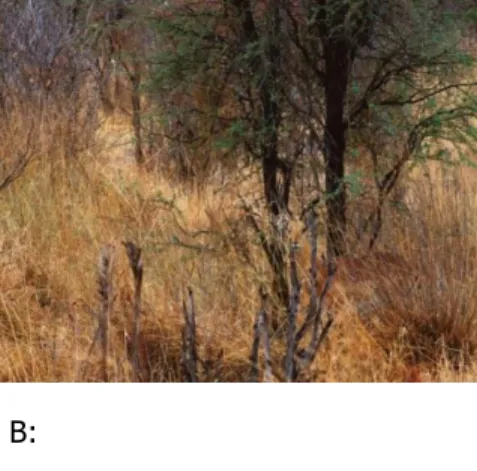
This is defined as the visual act of identifying a specific component within a complex background of hidden and overlapping forms. In nature, camouflage is a beautiful example of this ability to become “lost” in a busy background. The human ability, is, of course, being able to spot the camouflaged animal. Geometric activities involving this ability are completing a given figure and assembling a figure, such as a tangram, from its parts.
2.4.1.3
Perceptual Constancy
This is the ability to constantly recognise a shape, despite variations in size, shape, colour and orientation in space. For example, a tennis court is seldom perceived as a rectangle, but we intuitively know that it is one. Activities for Geometry learners which include perceptual constancy are identifying figures with the same shape but different size, or ordering shapes from smallest to largest.
2.4.1.4
Position-in-Space Perception
This is the ability of a learner to relate an object in space to himself or herself. For example, he or she must be able to easily distinguish between a “b” and a “d”, which are the same, but with different positions in space, and a “b” and a “b”, which are the same and have the same orientation in space. This ability leads to the learner being able to identify congruent shapes even if they have been translated in some way.
17
2.4.1.5
Perception of Spatial Relationships
This is defined as the ability to see objects in space in relation to the viewer and to each other. It is very closely linked to position-in-space perception and requires a strong sense of one’s body orientation. This ability is very useful in everyday activities such as riding a bicycle, where distances between the bicycle and other objects need to be judged with accuracy.
2.4.1.6
Visual Discrimination
This is the ability to identify differences and similarities between objects and shapes, and is independent of position. Geometric activities that enhance this ability include sorting blocks and classifying shapes according to their characteristics.
2.4.1.7
Visual Memory
This is defined as the ability to accurately recall or bring to mind objects or features of objects which are no longer in view. This ability can be developed, through exercises such as mnemonics. Activities to develop this ability in Geometry could include showing the learners a shape for a brief period of time and then asking the learners to copy what they saw onto geopaper.
The seven abilities listed above formed a solid and thorough framework from which subsequent research on spatial ability could springboard. Del Grande (1990) promotes the constructivist approach to knowledge acquisition, by including uncomplicated hands-on activities which link directly to spatial skill development that is pertinent to Geometry. This approach is supported by Pederson (1983) who stated that “Geometry is a skill of the eyes and the hands as well as the mind.
Sorby (1999) differentiated between the terms “spatial abilities” and “spatial skills” by stating that the word “ability” implies an innate characteristic which one either has or does not have, for example the ability to sing. The term “skill” on the other hand, implies characteristics that have been learned and that can improve with practise. For the purposes of my study, I adopted the same definition and hence refer from now only to spatial skills.
Sorby (1999) went further to say that spatial skills generally refer to a collection of cognitive, perceptual and visualisation skills, which traditionally focussed on understanding and manipulating 2D shapes and to a lesser degree, 3D objects. However, with dramatic advances in computer applications in the past few decades, the research emphasis has shifted to 3D space.
18
Although extensive research on spatial skills has been undertaken in the past century, it has been done in a large variety of ways which do not align well with one another and a cohesive view of the structure of spatial intellect has failed to develop (Hegarty & Waller, 2005).
According to Sutton & Williams (2008), substantial agreement exists amongst researchers that the core spatial skills are as follows:
The ability to visualise mental rotations of objects;
The ability to understand how objects appear in different positions;
The ability to conceptualise how objects relate to each other in space; and
The ability to understand objects in 3D space.
However, for the purposes of my study, the definitions of core skills given above are too vague and assessment of such skills would be problematic as much overlapping of core skills would be likely.
A more recent and appropriate typology by Newcombe & Shipley appeared in 2012. This typology is based on the understanding that all objects can be spatially represented using characteristics that are INTRINSIC to the objects. These intrinsic characteristics include the size of the object, the shape of the object, the orientation of the object relative to other objects or a frame of reference, the scaling of these objects and the bending, rotating or cross-sectioning of the objects.
In addition, all objects need to be situated EXTRINSICALLY, which means they must have a location relative to other objects or to a frame of reference. Lastly, the spatial skills required to manipulate objects in space are either STATIC(the viewer and the object remain motionless) or DYNAMIC (the viewer, the object or both move relative to a frame of reference).
The four categories of spatial skills are thus as follows:
1. Intrinsic-static: The spatial features of objects, such as size, the arrangement of their parts and their configuration are noted.
2. Intrinsic-dynamic: The spatial coding of objects is transformed in some way, such as rotating, cross-sectioning, folding or deforming of the object.
3. Extrinsic-static: The spatial location of objects relative to other objects or a frame of reference is coded.
19
4. Extrinsic-dynamic: The inter-relations of objects are transformed when one or more of them moves, including the viewer.
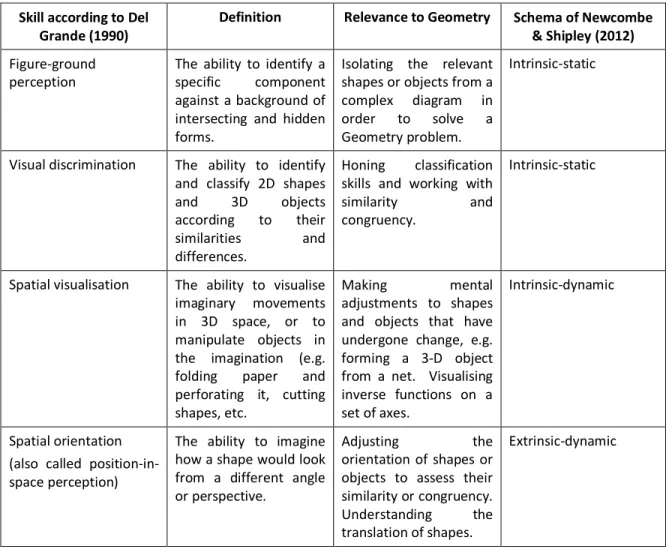
This schema is appealing in its simplicity and comfortably encompasses existing literature on spatial skills. However, it is relatively new and as yet not widely used outside of research in the STEM fields of study and the geosciences. Thus for this study I intend using a combination of the skills cited by Del Grande (1990) and those listed above by Newcombe & Shipley. In the table below, I have given a succinct definition for each of the six spatial skills that I have selected as pertinent to this study. I have included a column on how these spatial skills are relevant to the study of school Geometry at Grade Ten level and a further column linking each skill to the appropriate category from the schema of Newcombe & Shipley (2012).
Table 1: Spatial Skills to be assessed in the SSAT Instrument
Skill according to Del Grande (1990)
Definition Relevance to Geometry Schema of Newcombe
& Shipley (2012)
Figure-ground perception
The ability to identify a specific component against a background of intersecting and hidden forms.
Isolating the relevant shapes or objects from a complex diagram in order to solve a Geometry problem.
Intrinsic-static
Visual discrimination The ability to identify and classify 2D shapes and 3D objects according to their similarities and differences.
Honing classification skills and working with similarity and congruency.
Intrinsic-static
Spatial visualisation The ability to visualise imaginary movements in 3D space, or to manipulate objects in the imagination (e.g. folding paper and perforating it, cutting shapes, etc.
Making mental adjustments to shapes and objects that have undergone change, e.g. forming a 3-D object from a net. Visualising inverse functions on a set of axes.
Intrinsic-dynamic
Spatial orientation (also called position-in-space perception)
The ability to imagine how a shape would look from a different angle or perspective.
Adjusting the orientation of shapes or objects to assess their similarity or congruency. Understanding the translation of shapes.
20
Skill according to Del Grande (1990)
Definition Relevance to Geometry Schema of Newcombe
& Shipley (2012)
Spatial perception (also called perceptual constancy)
Understanding abstract spatial principles such as horizontal invariance or verticality.
Strengthening concepts such as perpendicularity and parallelism. Finding the perpendicular height of a triangle.
Extrinsic-static
Perspective Visualising a scene in its entirety when looking from a different position.
Correctly identifying shapes and objects from unfamiliar perspectives, such as above or below.
Extrinsic-dynamic
Piaget claimed that spatial understanding does not reach an adult level until a child is nine or ten (Piaget & Inhelder, 1967). Piaget’s theory of topological primacy led much of the early research in spatial development, however many of his claims have been challenged in subsequent research.
According to Newcombe & Learmonth (2005), three fairly broad approaches to spatial development have emerged from this subsequent research. The first is that of nativism, which claims that children are born with a “geometric module” and demonstrate spatial functioning at birth (Hermer & Spelke, 1994). This research has contributed much to current knowledge on infant competence, but very little on later spatial development. The second approach to spatial competence stems from Vygotskyan theories that focus on the cultural embeddedness of spatial learning (Gauvain, 1995) as well as the role of spatial language in aiding spatial thinking, but neglects the constructivist approach of children, who actively explore their environment and receive feedback from their experiences which influence how their spatial competence will develop. The third is the interactionist theory which attempts to integrate the constructivist, nativist and Vygotskyan theories (Newcombe & Huttenlocher, 2000). This theory seeks to specify the earliest starting points of spatial development, the nature of subsequent development, and the influence of the environment, neural maturation and cultural input on later changes in spatial development.
In Newcombe & Learmonth (2005), a summary of milestones in the development of spatial skills is given. I have further simplified the table and selected, where possible, the spatial skills which are pertinent to this study.
21
Table 2: Summary of Milestones in the Development of Spatial Competence. Adapted from Newcombe & Learmonth (2005)
1 – 3 years Children acquire basic spatial terms.
3 – 4 years Children can succeed at simple mental rotation of objects.
3 – 4 years Children can take the perspective of other viewers, without conflicting frames of reference.
7 years Children show adult levels of performance on place learning tasks.
6 – 9 years Map skills develop to complex level. Perspective and mapping conventions are included.
9 – 10 years Children can take perspective even when frames of reference conflict. 10 – 12 years Children show mature coding on a par with adults.
The table thus suggests that children are capable of developing sufficient spatial skills with which to order and classify objects, read and interpret maps, take or keep perspective, mentally rotate objects and mentally visualise objects in place learning tasks by the time that they reach high school.
Sadly, evidence from South African classrooms suggests otherwise. In the Department of Basic Education’s Diagnostic Report on the 2013 National Senior Certificate examinations (South Africa. DBE: 2014), the evidence that the majority of our learners demonstrate a distinct lack of spatial skills is damning:
“candidates were unable to identify perpendicular lines”
“candidates were unable to see the link between different parts of the question (on transformation Geometry)…….this could have been on account of the candidates having a poor understanding of the spoken language”
“Many candidates were unable to differentiate between rotation in a clockwise direction and rotation in an anticlockwise direction”
Recommendations made to teachers in the same report focussed largely on encouraging far more practical work and investigation of concepts as opposed to memorising sets of rules. Cutting out shapes, working with nets, navigating plans and maps, plotting points on a system of axes and using the correct mathematical terminology in the classroom were all recommended.
22
These classroom activities, if implemented, would go a long way to improving the spatial skills of Geometry learners. There is much evidence that spatial skills can be improved through well-constructed classroom activities. Del Grande (1990) highlighted the interdependence of improving spatial skills and learning Geometry and that, “like a chain reaction, an improvement in one leads to an improvement in the other” (p. 19). Newcombe (2006) states that “we know that spatial cognition is malleable, and that spatial thinking can be improved by effective technology and education”.
More recently Hill, Corbett & St. Rose (2010) recommended to teachers, parents and volunteers of professional organisations to encourage learners to “play with construction toys, take things apart and put them back together again, play games that involve fitting objects into different places, draw and work with their hands”. They went further to recommend that learners use handheld models, as opposed to computer models, whenever possible in order to help them visualise what they see on paper. All recommendations listed above firmly encompass the constructivist approach to learning, with the learners engaging in hands-on activities and constructing meaning through their own experiences.
Having reviewed the literature on the development of geometric thinking and more specifically the development of spatial skills in learners, as well as how these spatial skills can be learned and improved, it would be appropriate to now review literature on the assessment of these spatial skills in order to develop a suitable strategy for assessing the spatial skills of learners in the South African context.
2.5. Assessment in Mathematics
Assessment has been defined as “the process of gathering evidence about a student’s knowledge of, ability to use, and disposition toward, mathematics and of making inferences from that evidence for a variety of purposes” (National Council of Teachers of Mathematics, 1995). According to Brahier (2000), assessment can be broadly framed as a “data collection process”. Assessment can take many different forms and provides the teacher with helpful data with which to guide the teaching and learning process. According to the Mathematics Curriculum and Assessment Policy Statement (CAPS) of the Department of Basic Education of South Africa, assessment is “a continuous planned process of identifying, gathering and interpreting
23
information regarding the performance of learners…..and using this information in order to improve the process of learning and teaching”. (South Africa: DBE, 2011a)
Differentiation can be made between formative assessment, which is used throughout the year to assess whether a learner is progressing acceptably, and summative assessment which is essentially a summary of the learner’s performance at the end of the year.
However, assessment can also be used as a diagnostic tool to assess whether there are inherent misconceptions regarding a learner’s understanding of Mathematics, and to what extent these problems affect the learner’s disposition towards Mathematics (Ben-Hur, M. 2006). Whilst the core function of assessment is to gather information about how a learner is performing, there are many different ways of doing so – some of them formal, such as administering tests and assignments, while other methods are informal, such as observation of the learners, interviews and discussion groups (Brahier, D J., 2001). Almost seventy years ago, Sueltz, Boyton & Sauble (1946) commented on the efficacy of assessment, by stating that “in general, observation, discussion, and interview serve better than paper-and-pencil tests in evaluating a pupil’s ability to understand the principles and procedures he [sic] uses” (p. 145) .
According to Ben-Hur (2006) assessment methods should be authentic and should reveal the progress in students’ mathematics thinking and problem solving with tools and methods that focus not on the right answers, but on reasoning itself. Brahier (2001) states that using a variety of assessment strategies to capture a holistic view of learner achievement is at the same time helpful in “getting students to recognise that we, as teachers, value more than correct answers – we value the process of doing mathematics as well” (p. 18).
A critical aspect of assessment in education facilities is the use of the analysed assessment data to inform future instructional practices. If, for example, a whole school or an entire district seems to struggle with a specific mathematical concept, then the data gleaned from a variety of assessments pertaining to that mathematical concept can be used to guide the teachers in achieving the outcomes as set out in the curriculum by adjusting or enriching their teaching methods, or even perhaps to modify the outcomes set out in the curriculum (Brahier, 2000).
24
2.5.1. Types of Assessment
2.5.1.1
Traditional Pen and Paper Tests
Brahier (2001) states that mathematics achievement was traditionally based on the view that a learner either could either do mathematics or could not do mathematics. He therefore developed the Ideal Line of Inference Model, which acknowledges that mathematics achievement develops on a continuum and that as conceptual understanding develops, so does the learner’s ability to demonstrate that understanding. This Ideal Line would then also indicate a perfect marriage between what the learner knows and what the assessment instrument measures.
In traditional pen and paper tests, questions are posed and marks are allocated for correct steps and correct answers. The questions are also closed, which means they only have one correct answer. However, these tests do not always reflect the mathematic ability of the learners. For example, a learner may understand the concept of area very well, but may make a small computational error in an early step of an area problem, thus losing most, if not all, of the marks allocated to the solving of that problem. Conversely, another learner may not understand the concept of area at all, but has learned all the relevant formulae by rote, and manages to score full marks for the same question without truly understanding what area is.
In South Africa, the Senior Certificate Examination is set as a traditional closed pen and paper test. To familiarise learners with the format of this examination and the types of questions likely to be asked, most teachers set their class tests as closed pen and paper tests too. Unfortunately this type of test does little to guide the teacher with regard to the conceptual understanding that the learners may or may not display.
2.5.1.2
Open-Ended Questions
Open ended questions are those which have either one correct answer, but many methods of arriving at that answer, or several correct answers. According to Brahier (2000), these questions allow teachers to gather rich data about how the learners are thinking about Mathematics, as well as the fact that the learners’ methods of thinking hold value. Furthermore, these questions prompt learners to communicate more effectively about their findings, thus enhancing their use of mathematical terminology and their ability to effectively communicate their mathematical
25
knowledge (Brahier, 2001). An example of a traditional closed pen and paper question that has been modified to an open question follows:
Table 1: Comparison of traditional and open-ended questions. Adapted from Brahier (2001)
Traditional Question Open-Ended Question
Find the length of a diagonal in a rectangle measuring 200cm by 90 cm.
You have bought a big round mirror with a diameter of 240cm. Can you fit it through a doorway that measures 90 cm wide and 200 cm high? Show how you arrive at your answer.
The question on the left will test the learner’s ability to recall a formula, as well as any procedural skill he or she demonstrates. It is seemingly removed from any other learning area. The question on the right, however, assesses the learner’s problem-solving, reasoning and communication skills in mathematics. The question is embedded in a real-world context, (Brahier 2001) and has instant appeal to learners as it gives relevance to the knowledge they are acquiring.
2.5.1.3
Rubrics
Because open-ended questions reveal much richer data with regard to the mathematical understanding of the learner and can be answered in a variety of ways, they are potentially far more difficult to assess. Consequently, a well-designed rubric which clearly describes each performance level that the learner may demonstrate is more meaningful (Brahier, 2000). According to Kothari (2013), the use of rubrics allows for more consistent grading, which in turn gives a clearer picture of learning gains. Rubrics also give clarity to learners with regard to expectations of their performance on tasks. Rubrics may have anything from three response levels up to ten response levels, depending upon the depth of understanding and detail required by the educator. According to Brahier (2000), the number of the rubric response does not indicate a percentage, but rather a category into which the learner is placed according to his/her response. The teacher can then track the learner’s response categories over time in order to gain insight into the conceptual development of the learner (p. 227). He goes further to say that
26
rubrics provide a holistic alternative to scoring as opposed to allocating scores to correct steps when solving problems.
Schloemer (1996) states that using rubrics can be time consuming and difficult at first, but as learners and teachers become accustomed to using them, the guesswork is removed from assigning performance levels. The teacher simply decides whether performance criteria have been met or not and the learner receives instant feedback with regard to his/her performance with guidelines for better achievement in the next task.
2.6. The South African Context
According to the South African Department of Basic Education’s Curriculum and Assessment Policy Statement (CAPS), (South Africa. DBE 2011b, p. 8), Mathematics “helps to develop mental processes that enhance logical and critical thinking, accuracy and problem-solving that will contribute in decision-making. Mathematical problem solving enables us to understand the world around us and, most of all, teaches us to think creatively”. They go further to list the essential skills that learners should acquire to this end. Learners should:
Develop the correct use of the language of Mathematics;
Collect, analyse and organise quantitative data to evaluate and critique conclusions;
Use mathematical process skills to identify, investigate and solve problems creatively and critically;
Use spatial skills and properties of shapes and objects to identify, pose and solve problems creatively and critically;
Participate as responsible citizens in the life of local, national and global communities; and
Communicate appropriately by using descriptions such as words, graphs, symbols, tables and diagrams.
Sadly, matric results over the past five years suggest that mathematical cognitive and spatial skills are lacking as learner performance in Mathematics continues to be disappointingly weak. While the national Mathematics pass rate of 59.1% in 2013 improved from 54% in 2012, the skills gap in Mathematics impacts negatively on many subjects and “the lack of foundational competencies in Mathematics remains a challenge across the board” (South Africa. DBE: NCS
27
Diagnostic Report; 2013; p. 15). Even mo