The Contribution of
England’s Primary School
Libraries to the
Development of Students’
Information Literacy
by
Kristin C. Meredith Galley
A Doctoral thesis
Submitted in partial fulfilment of the requirements of the award of Doctor of Philosophy Loughborough University
14th April 2016.
3
Table of Contents
Abstract ... 10 Acknowledgements ... 11 Abbreviations ... 12 Keywords ... 12 List of Figures ... 13 List of Tables ... 13 Chapter 1 Introduction ... 14 1.1 Scope ... 14 1.2 Methodology ... 16 1.3 Literature ... 171.4 Aim and objectives ... 18
1.5 Definitions important to the study ... 19
1.6 Summary ... 20
Chapter 2 Literature Review ... 21
2.1 Introduction ... 21
2.2 Background and Context ... 21
2.3 History of School Library Provision in England... 26
2.4 The Development of School Libraries ... 28
2.5 The Role of Schools’ Library Services ... 30
2.6 ‘Good’ School Libraries... 31
2.7 Research on School Libraries ... 32
2.7.1 Research from the United States ... 33
2.7.2 Research from Australia ... 34
2.7.3 Research from Jamaica ... 35
2.8 Professional Library Bodies ... 36
2.9 Other Agencies ... 38
2.10 Education and Training of School Librarians ... 39
4
2.12 Defining Information Literacy ... 42
2.13 Multiple Literacies ... 44
2.14 The Information Literate Primary School Student ... 46
2.14.1 The Myth of the Digital Native ... 47
2.15 Models of information literacy instruction ... 48
2.16 The Primary National Curriculum in England ... 51
2.17 The School Library’s Role ... 52
2.18 Pedagogical Theory ... 54 2.19 Summary ... 55 Chapter 3 Methodology ... 56 3.1 Introduction ... 56 3.1.1 Research Questions ... 56 3.2 Philosophical stance ... 57 3.3 Ontology ... 57 3.4 Epistemology ... 58
3.5 Qualitative Research Strategy ... 58
3.6 Choice of Ethnographic case studies ... 60
3.7 Philosophy of Ethnography ... 60
3.8 Case study reporting ... 62
3.9 Other methodology considered ... 64
3.10 Research design ... 68 3.10.1 Pilot Study ... 68 3.10.2 Observation framework ... 70 3.10.3 Interview framework ... 71 3.11 Sample... 71 3.12 Ethical Considerations ... 72 3.13 Data Collection ... 73 3.13.1 Observation ... 75 3.13.2 Interviews ... 76
5
3.13.3 School Information ... 78
3.13.2 Field Notes ... 79
3.13.3 Interview recording and transcription ... 80
3.14 Data Analysis ... 80 3.15 Coding ... 81 3.16 Trustworthiness ... 82 3.16.1 Credibility ... 83 3.16.2 Transferability ... 84 3.16.3 Dependability ... 85 3.16.4 Confirmability ... 85 3.17 Summary ... 85 Chapter 4 Findings ... 86 4.1 Introduction ... 86
4.2 Schools selected for the study ... 86
4.3 Procedures for data collection ... 89
4.4 School A... 91
4.4.1 Introduction ... 91
4.4.2 School Profile ... 91
4.4.3 School Library Provision ... 91
4.4.4 Use of School Library Service ... 93
4.4.5 Use of ICT ... 93
4.4.6 Use of the Public Library ... 94
4.4.7 Perceptions of School Libraries/Librarians ... 94
4.4.8 Information Literacy Skills Instruction ... 95
4.4.9 Entering the Field ... 97
4.4.10 Observations ... 97
4.4.11 Task Definition ... 97
4.4.12 Finding and Evaluating Information ... 98
6
4.4.14 Summary of School A ... 101
4.5 School B ... 101
4.5.1 Introduction ... 101
4.5.2 School Profile ... 102
4.5.3 School Library Provision ... 102
4.5.4 Use of School Library Service ... 103
4.5.5 Use of ICT ... 103
4.5.6 Use of the Public Library ... 104
4.5.7 Perceptions of the School Library/Librarian ... 104
4.5.8 Information Literacy Skills Instruction ... 104
4.5.9 Entering the Field ... 105
4.5.10 Observations ... 105
4.5.11 Task Definition ... 105
4.5.12 Finding and Evaluating ... 106
4.5.13 Application and Acknowledgment ... 111
4.5.14 Summary ... 112
4.6 School C ... 113
4.6.1 Introduction ... 113
4.6.2 School Profile ... 113
4.6.3 School Library Provision ... 113
4.6.4 Use of School Library Service ... 114
4.6.5 Use of ICT ... 114
4.6.6 Use of the Public Library ... 114
4.6.7 Perceptions of the School Library/Librarian ... 114
4.6.8 Information Literacy Skills Instruction ... 115
4.6.9 Entering the Field ... 116
4.6.10 Observations ... 116
4.6.11 Task Definition ... 117
7
4.6.13 Application and Acknowledgment ... 121
4.6.14 Summary ... 121 4.7 Reading culture ... 122 4.8 Borrowing statistics ... 122 4.9 Financial Considerations ... 123 4.10 Expert interviews ... 123 4.10.1 Librarians ... 125 4.10.2 Information literacy... 125 4.10.3 School library ... 126 4.11 Summary of findings ... 128
Chapter 5 Discussion of Findings ... 129
5.1 Introduction ... 129
5.2 Reading Culture ... 130
5.3 School Leadership ... 134
5.4 School Library Staff ... 136
5.5 Stock Provision ... 137
5.6 Student Confidence ... 140
5.7 Information Literacy ... 141
5.8 Information Literacy Instruction ... 144
5.9 Wider implications ... 147
5.9.1 Secondary Education Information Literacy ... 148
5.9.2 Higher education information literacy ... 148
5.9.3 Information literacy beyond education ... 149
5.10 School Library Services Closures ... 151
5.11 Examples of ‘good practice’ ... 153
5.12 The impact of school library provision on information literacy ... 154
5.13 Learning objectives for information literacy instruction ... 155
5.14 Summary ... 159
8
6.1 Introduction ... 160
6.2 Aim and objective outcomes ... 160
6.2.1 Objective 1: How was information literacy implemented? ... 160
6.2.2 Objective 2: The contribution of a school librarian ... 160
6.2.3 Objective 3: Observation of students ... 161
6.2.4 Objective 4: Literature review ... 161
6.2.5 Objective 5: Visual model ... 161
6.2.6 Objective 6: Framework of learning objectives ... 161
6.2.7 Objective 7: Make recommendations... 162
6.3 Contributions to knowledge ... 163
6.3.1 Theoretical contributions ... 163
6.3.2 Methodological contributions ... 163
6.3.3 Practical contributions ... 164
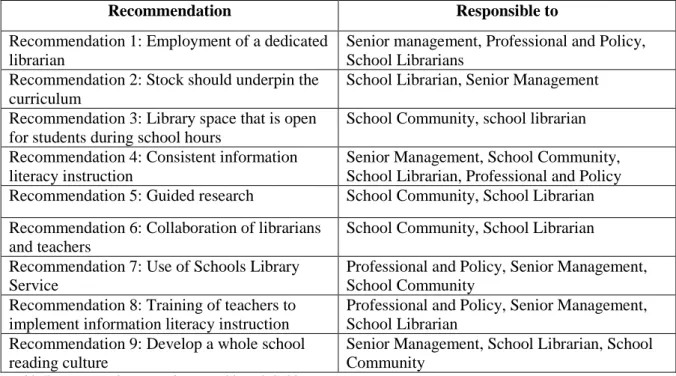
6.4 Recommendations based on the findings ... 165
6.4.1 Recommendation 1: Employment of a dedicated librarian ... 166
6.4.2 Recommendation 2: Stock should underpin the curriculum ... 168
6.4.3 Recommendation 3: Library space that is open for students during school hours ... 170
6.4.4 Recommendation 4: Consistent information literacy instruction ... 171
6.4.5 Recommendation 5: Guided research ... 172
6.4.6 Recommendation 6: Collaboration of librarians and teachers ... 173
6.4.7 Recommendation 7: Use of Schools Library Service ... 174
6.4.8 Recommendation 8: Training of teachers to implement information literacy instruction 174 6.4.9 Recommendation 9: Develop a whole school reading culture ... 175
6.5 Limitations of Research ... 175
6.5.1 Theoretical Limitations ... 175
6.5.2 Methodological limitations ... 176
6.5.3 Practical limitations... 176
9
6.7 Summary ... 177
References ... 179
Appendix 1: Parental Consent... 191
Appendix 2: Student (participant) Consent ... 192
Appendix 3: Participant Information: Parent ... 193
Appendix 4: Participant Information: Student ... 196
Appendix 5: Field Notes excerpt: School A ... 199
Appendix 6: Field Notes excerpt: School B ... 204
Appendix 7: Field Notes excerpt School C ... 210
Appendix 8 : Interview Schedule Andrew Shenton ... 212
Appendix 9: Interview Schedule Geoff Dubber... 214
10
Abstract
This study sets out to determine whether or not a primary school library, managed by a school librarian, makes a contribution to the information literacy development of year 6 students (ages 10-11 years old).
The methodological approach to this research was interpretivist, ethnographic case studies. This is a shift from other studies on school library impact because it employs direct observation of students, and studies each school as a whole, where prior studies have relied on assessment data. This study relied on data collected in the natural environment where children were working to develop rich descriptions of the schools chosen, to be written into detailed case studies.
In order to determine the contribution of the school library to information literacy development, the researcher spent time in three different schools, which had differing levels of library provision. The researcher spent time with a Year 6 (age 10-11 years) class in each school, and observed their information behaviour during a research task assigned by their classroom teacher. In order to streamline the observations, an observation framework was developed. This also ensured that each class in the three schools was observed in the same way. The researcher was immersed in each class for the duration of the class assignment, and walked around during the research lessons and spoke to the children about their research process.
Semi structured interviews were conducted with members of teaching staff and head teachers to gain information about the school, and to determine their attitudes about school library provision,
employing a librarian and the instruction of information literacy.
Each school was then written into a case study to provide a rich picture of the school, and of the specific events during the observation sessions with the students. From the case studies, themes about the ways that the students experienced information emerged, and the findings from each school was the basis for the creation of an information literacy framework and recommendations of best practice found in each of the three schools.
The investigation highlighted the important contribution that a well-managed school library made to the development of students’ information literacy.
11
Acknowledgements
I am thankful for the numerous people who made this journey possible.
To my ever patient supervisors, Dr Sally Maynard and Professor Graham Matthews, who never failed to keep me enthusiastic and reassured. Your support and guidance enabled me to keep growing as a researcher. I am grateful that you kept pushing me to get finished!
To all of the faculty of the (former) Department of Information Science; I appreciated your guidance during all the years of study. A special acknowledgment for Ann O’Brien, who will be missed. The funding from the Graduate School is gratefully acknowledged.
To the staff and students who participated in the research; allowing a stranger to observe ordinary classroom happenings is never easy, and I am grateful for the opportunity.
To organisations the SLA, CILIP, Schools Library Services and School Librarian Network for your advice, and your interest in this project. Big thanks to Helen Emery for the support, and the job that gave me my start in school libraries.
I am always indebted to my family, both in the US and the UK. For my parents, Linda and Craig, thank you for your support and guidance. Especially for my grandmother, Claire Costello, who never doubted my ability.
I am grateful for many amazing friends and their constant support. Special thanks to my six ‘soul sisters’…there aren’t enough pages to express my love and gratitude.
For my husband, Richard, I couldn’t have done this without you, thank you for being so supportive, and for not allowing me to doubt myself.
I am especially grateful, every day, for my amazing children, Duncan and Reagan. Thank you for understanding all the times I had to put ‘homework’ before play. Loved you both first!
This journey was inspired by a treasured friend, Tania Matthews. Her short but rich life is a constant reminder that life is far too short to miss opportunities, and far too long to live with regret.
12
Abbreviations
CILIP – Chartered Institute of Library and Information Professionals IFLA – International Federation of Library Associations
ALA – American Library Association IL – Information Literacy
SLA – School Library Association SLS – Schools Library Service SLN – School Librarians Network LIS – Library and Information Service
ASCEL – Association of Senior Children’s and Education Libraries SCONUL – Society of College, National and University Libraries KS2 – Key Stage 2
Keywords
Information Literacy Primary School Libraries Case studies
Naturalism
Information behaviour School Librarians
13
List of Figures
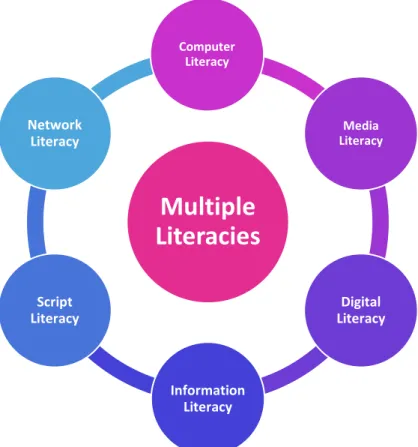
Figure 1 multiple literacies ... 45
Figure 2 Reading Culture and Information Literacy ... 130
List of Tables
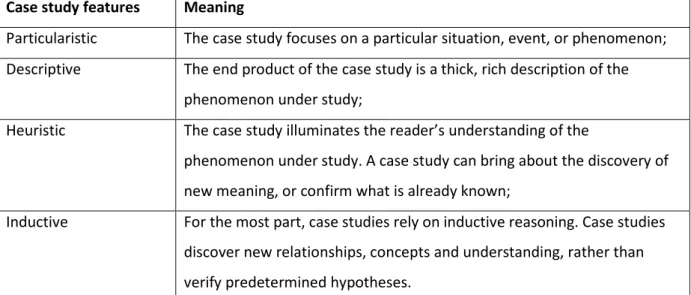
Table 1 Case study features, according to Merriam (1988, p. 11-12) ... 64Table 2 Observation categories ... 70
Table 3 Interview categories ... 71
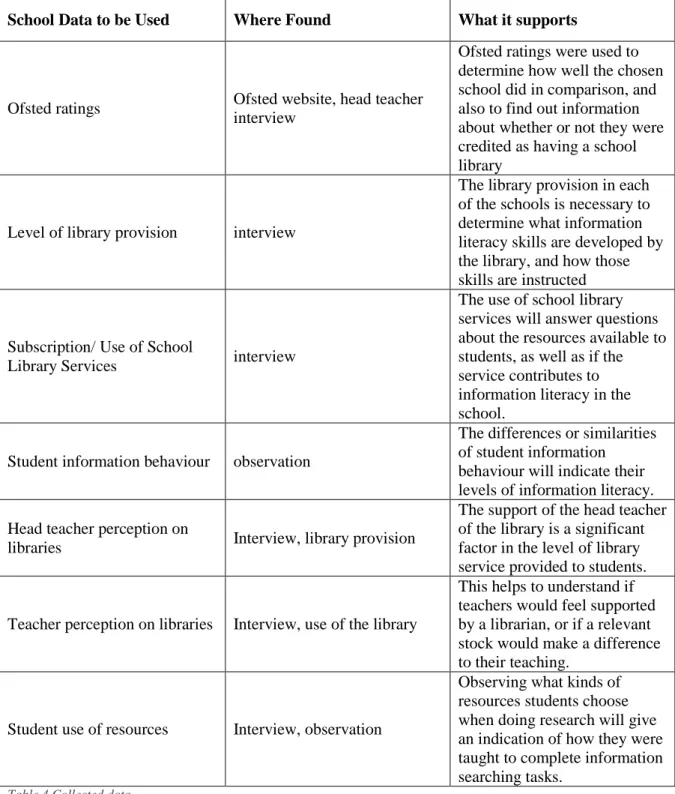
Table 4 Collected data ... 74
Table 5 Descriptions of selected schools ... 88
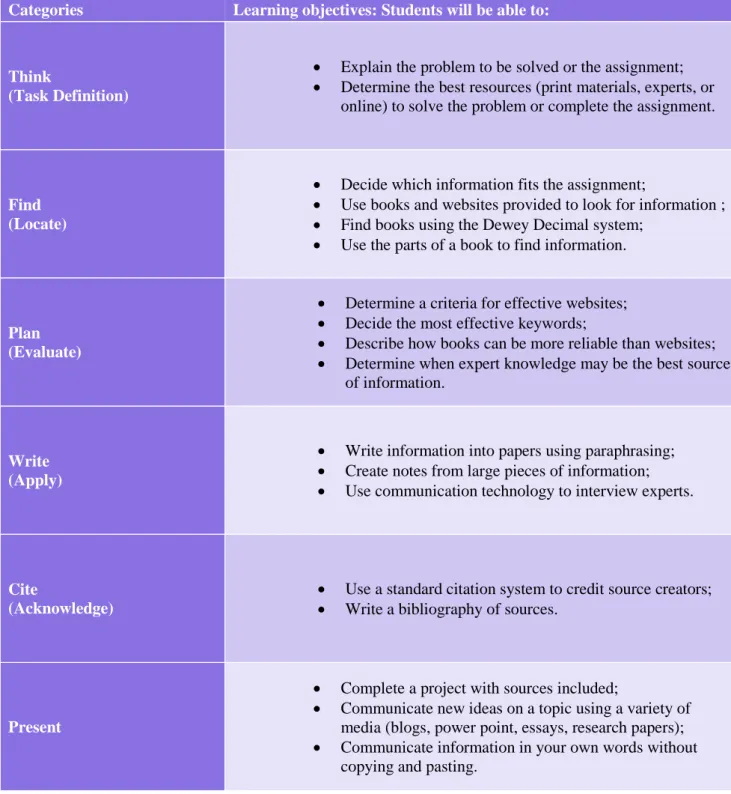
Table 6 Learning objectives for primary information literacy ... 158
14
Chapter 1 Introduction
1.1
Scope
The government’s awareness of the state of literacy in the United Kingdom has given librarians the opportunity to raise the profile of school libraries and provide evidence to suggest their roles in supporting students, especially in the area of information literacy, which, according to Bruce (1997), has been known to be a critical literacy for the 21st century. Some researchers perceive information literacy as a natural extension of the concept of literacy in our society (Zhang, Majid and Foo 2010, p. 720). People who have limited knowledge about information and knowledge acquisition argue that school libraries are no longer necessary in a society where information can be found because students are so dependent on finding information via the internet and other resources, however, they need to be taught to locate and evaluate information in order to use it efficiently and effectively. Trained, professional librarians are skilled in this area, but a lack of professional recognition and standard qualification requirements devalue the librarians’ role in a school (Sacco Ritchie 2011). Much of the research surrounding information literacy focuses on secondary and higher education. Research by Rowlands et al (2008) finds that information literacy intervention at university age is too late; these students have already developed an ingrained coping behaviour and have learned to rely on Google for all their information needs. (p. 303). If students are given information literacy instruction from primary school, it may provide a foundation that students can build on as they progress through the educational system. Smalley (2004) states that “to be effective, experience with information literacy strategies needs to be part of the entire educational experience. School
librarians and school library programmes are key educational components” (p.197).
The All Party Parliamentary Group published a report in 2014, promoting the use of school libraries in order to improve student achievement across several areas of learning, including information literacy. They state that “Librarians are contributing to essential information literacy work in the school. Librarians contribute to cultivating lifelong learning by providing pupils with a diverse range of information resources, motivating independent inquiry, and promoting critical and creative reading and thinking (p. 20).
The government’s stance is that schools should be able to choose whether or not their funding goes to providing school library services, rather than making school libraries a statutory requirement. A spokesperson for the Department for Education stated that “we want children to have the
opportunity to read widely. School libraries play a role in this and schools are responsible for deciding how to provide this service for their pupils” (Wallwork 2016).
15
International research into school libraries (Lance et al 1993, 2000) and (Softlink International 2011), illustrates that there is a positive relationship between school library provision and student academic achievement. This study will focus on the relationship between English primary school library provision and student information literacy skills acquisition.
This study set out to examine how a primary school library contributes to the development of information literacy (IL) skill in primary students. Three primary schools with differing levels of library provision were investigated by the observation of 10 and 11 year old Year 6 students engaged in a research task set by the classroom teacher. The observations were conducted in the classroom settings in which the children normally worked.
Year 6 students are in their last year at primary school, and they were chosen as the target age group to investigate whether having information literacy (IL) instruction from the start of primary school (at age 4) made the students more information literate by the time they reach year 6, and able to
effectively complete research tasks. Also, year 6 students are due to enter the secondary school system, where the ability to apply information literacy (IL) skills becomes more important because they are expected to be able to independently find information to complete assignments.
This research was conducted in England only because school library provision is not statutory in England, and the researcher was initially interested in how the lack of library provision affected students academically. There is a lack of research focused on the primary school library’s role in information literacy skills development. As Secker, Boden and Price (2007) stated, information literacy “is probably more developed among the library profession in higher education (HE) than in other sectors” (p.1123). The time allotted for this study did not allow for other countries in the UK to be included, but that could be a topic for a future school library study.
Much of the research surrounding information literacy in the UK focuses on secondary and HE, however, research by Rowlands et al (2008) finds that “information literacy intervention at university age is too late; these students have already developed an ingrained coping behaviour and have learned to rely on Google for all their information needs” (p. 303). If students are given information literacy instruction from primary school, it will provide a foundation that students can build on as they progress through the educational system. Smalley (2004) states that “to be effective, experience with information literacy strategies needs to be part of the entire educational experience. School librarians and school library programmes are key educational components” (p.197). A study completed by Streatfield, Shaper and Rae-Scott in 2010 included primary schools, however, the research team used data collected from testing data and school staff interviews but no student interviews or observations were conducted.
16
Large scale library research studies have been carried out in the United States, but those studies have focused primarily on quantitative studies which measure library impact with student test scores (Lance, et al. 1993, 2000). The findings of these studies reveal that school library provision in primary and secondary schools positively impact student achievement. Large scale studies in the UK have focused primarily on whether or not schools are providing library services, but are not addressing the school library’s role in student achievement. It is acknowledged that the educational systems in the US and the UK differ; 40 US states require librarians to have both teacher and librarian qualifications, and school libraries are statutory in US schools, while the UK has no standard qualification
requirement for school librarians and libraries are recommended, but not mandatory in primary or secondary schools.
This research study was designed to include observations of students actively using resources to find information for a teacher directed assignment. The methodological approach was carefully considered based on previous school library research studies which are included in the literature review, and also so that the combination of student observation, staff interviews and school data were all collected and processed effectively. The next section will introduce the evolution of the chosen methodology.
1.2
Methodology
A primary school library, managed by a qualified librarian would have some positive impact on the information literacy skills of the students, however, the ‘how’ and ‘why’ of the library’s contribution needed to emerge from the data collected from each of the selected schools. The research approach had to be shaped around this view to get the most balanced outcome, but also needed to reduce any bias the researcher had when entering the field. The interpretivist paradigm was chosen over
positivist; a positivist paradigm tests existing theories, but interpretivism, also called naturalism, looks at generating theory from the data.
The researcher was investigating the concept that those students who had library provision, managed by a school librarian at primary school would have better information literacy skills than those students who had little to no library provision. Observation of the students engaged in an information seeking task, and talking with them about the work that they were undertaking in order to analyse how they were able to use information to complete the task required of them. Using ethnographic case studies was the most appropriate strategy to meet this outcome because the use of case studies
allowed the researcher to collect data by direct observation of the students, and through spending time in each of the schools chosen for the study. Furthermore, creating case studies served to construct an understanding of the factors that can influence IL and report best practices of the schools who are teaching IL effectively. Yin (1989) states that case studies are an effective strategy “when ‘how’ or ‘why’ questions are being posed, when the investigator has little control over the events, and when the focus is on a contemporary phenomenon with some real life context” (p. 13).
17
In order to gather relevant data about students and their process of research, it was necessary for the researcher to be as immersed as possible with the class while they were working, and that the students work as they normally would in class, so that the observations were as natural to them as possible. Interpretivism proposes that “as far as possible, the social world should be studied in its ‘natural state’, undisturbed by the researcher (Gubrium and Holstein 1997, p. 34). The students were assigned a task by the teacher and the researcher acted as a participant observer, talking with the students and observing their process as they worked.
Semi-structured interviews were also conducted with teachers and senior management staff in each of the three schools selected for the study. The interview questions emerged from information gathered about all three schools, and during the student observation periods, however, the questions were kept similar across all three schools in order to maintain validity and equal treatment across all three schools. Keeping the interviews semi-structured also allowed for spontaneous dialogue to take place, so that maximum information could be received from each respondent.
1.3
Literature
Extensive literature searches were completed to determine where this study sits in a body of research completed about school libraries, information literacy and the role that school libraries play in the development of information literacy. Government publications on literacy helped to inform on the government stance on school libraries, while professional organisations provided publications that advocated the provision of libraries in schools and the employment of professionally qualified school librarians. Organisational publications also encouraged schools to support their local School Library Services (SLS). Academic papers that presented research carried out on the school library’s role on student academic success, as well as the role of qualified school librarians and how they contribute to the overall success of students were useful to determine how others conducted school library research, and what their findings revealed. Research on school libraries carried out in the United States was important because several, extensive studies on various facets of student success have been carried out in the US since the 1990s. An annual study of school libraries and how it impacts student achievement in Australia was an important publication that provided evidence on school library provision on national test scores. Many of the studies carried out in the UK have been focused on the secondary and higher education (HE) sectors, because those sectors are more likely to provide dedicated library space, and employ professional librarians.
It was essential to read pedagogical theories when developing models for information literacy instruction. It was thought by the researcher that using an educational design, rather than a Library and Information Service (LIS) design, would be a way for teachers to engage with a possible curriculum for information literacy, and a way to invite collaboration between teachers and school library professionals. Since the researcher was also a qualified teacher, it was knowledge of teaching
18
and learning that led to the decision to make a library based framework accessible to teachers, therefore making it more adaptable for a school who chooses not to employ a librarian.
1.4
Aim and objectives
The aim of this research is to investigate the contribution primary school library provision in England makes to the development of Year 6 (age 10-11) students’ information literacy skills. In order to meet the aim, the following objectives were developed:
• Objective 1: To explore how information literacy instruction is implemented in schools selected for the study;
• Objective 2: To determine whether or not a school librarian contributes to IL development at primary level;
• Objective 3: To observe student IL skills during the completion of a class assignment in three schools;
• Objective 4: To examine findings from other school library research to determine if positive outcomes were achieved as a result of a school’s library provision;
• Objective 5: To develop a model visualising key relationships between school library provision and IL skills development;
• Objective 6: To develop a framework to support teaching information literacy at primary level; • Objective 7: To create a list of recommendations for IL instruction based on the findings from
the schools participating in the research.
England does not have an official IL framework to guide teachers how to teach the skills needed to be information literate, which means IL instruction is variable in every school. The lack of a concrete IL framework also means that any instruction is based on the IL knowledge held by the instructors, which again, means teaching will vary from school to school. It was also important to ask questions in each school, of both teachers and senior management what their attitudes were about the teaching of IL skills. The answers to those questions provided insight into the importance of IL skills to school staff, and if those answers would differ based on the level of library service provided.
Studies in the United States and Australia provide evidence to suggest that having a qualified librarian employed in a school library, raises student achievement on standardised tests. This study sets out to discover the contribution a librarian makes to students information literacy in England, and how the librarian contributes to IL development. How does the presence of a professional librarian make a difference to the students in a school?
This study used direct observation of students during a class assignment to assess their information literacy skills, which is a move away from school library studies that focused on test data.
19
Reading other studies in the UK, and other selected countries assisted in determining the methodology for this study, but also to investigate where this study sits within a body of established research. Additionally, it was necessary to explore best practices of school libraries that support the increase in student achievement levels, to determine what best practice could look like if primary schools in England employed similar strategies.
A model (Figure 2, p. 125) illustrates how a school library supports information literacy. Table 6 (p. 152) is a framework of learning objective for IL, based on pedagogical theory. This is important because it is likely that primary schools will not have specialised librarians employed, the framework must be written so that teachers are able to use it easily. In addition, information literacy objectives must be able to work effectively across different subject areas.
Recommendations are based on the findings from all three schools, where the best practices for developing information literacy skills emerged during the observations.
1.5
Definitions important to the study
The following are definitions of the two elements that this study focused on.
School Library: The term ‘school library’ is prevalent throughout this study, and the definition can vary depending on the school that is providing a library. For the purpose of this research, a school library is defined as dedicated space where resources are provided. These resources could include books and other printed media, computers (with internet access) or tablet technology. Some schools lack the physical space to provide one area containing resources, so they have chosen to decentralise their libraries into the classrooms, where the teacher is responsible to manage the print resources. Two of the schools observed in the study had dedicated library spaces; only School B had to decentralise into classrooms because they lacked the space for a central school library.
Information Literacy: The term information literacy can cause confusion, and some of the respondents in this study mistook information literacy as being only relevant to research or library skills. According to Eisenberg, et al (2004), information literacy is to “possess the ability to recognise the need for information and be able to locate, access, evaluate and organise this information for practical application.”
A more recent definition of information literacy was offered by Jane Secker and Emma Coonan, who updated a higher education information literacy framework in 2013. They define information literate people as: “discerning in their choice of information sources and their use of knowledge. They are judicious citizens who can use information to transform their circumstances, create new knowledge and reach their full potential” (Secker and Coonan 2013).
20
These two definitions reach beyond CILIP’s definition of information literacy, which states that “Information literacy is knowing when and why you need information, where to find it, and how to evaluate, use and communicate it in an ethical manner” (2004), because they take into account the impact that being information literate has on personal growth for individuals, and how information literate people are better able to contribute thoughtfully and knowledgeably to society
1.6
Summary
This introduction provides a brief overview of the research study. It provides the reader with background information about how the aim and objectives emerged, the methodology chosen, and how published literature informed the study. Also, the reader has clear definitions about the two areas of study: school libraries and information literacy.
21
Chapter 2 Literature Review
2.1
Introduction
A literature review was conducted in order to determine where this research sits within the body of published research related to school library provision and information literacy. It has been noted that much of the published literature focuses on secondary and academic libraries, especially in England. This was one of the reasons that primary schools were chosen for this study; it was desired to get some further understanding and insight into how students at primary level used their school library which was not provided by the literature. It is important to include a brief history of school library provision in England to provide background and context into the attitude and importance of school library provision in primary schools.
Information literacy is also discussed in this chapter. Again, much of the published work focuses on secondary and higher education. One of the challenges about determining the instruction of
information literacy is the lack of standard definition of what makes a person information literate; Section 1.14 will discuss this in further detail. There is no information literacy framework in England for primary level students, however, there are models in the United States that will be discussed in Section 1.15. Additionally, suggested objectives for primary level information literacy will be provided in chapter 5, these objectives were developed as a result of the findings from the studies within the schools studied.
2.2
Background and Context
The Importance of Teaching-Schools White Paper 2010 (Department for Education, 2010) identified the need for schools to raise literacy levels, particularly among primary school students. According to the report, “one in five 11 year olds still leave primary school struggling to read and write at the standard expected of them. This figure is much higher for deprived pupils-more than one in three” (Department for Education 2010, p.43). Additionally, the report stated that children who reach level 4 at primary school are “much more likely to achieve well at GCSE” (Department for Education 2010, p.43). Though the report emphasises the need for literacy to improve, and gives some suggestions for ways to accomplish this, providing schools with a library was not mentioned among the suggestions. In fact, there was no mention of library use to support learning contained within the report. There are several sections of the report that outline the government’s wish to give schools the financial
autonomy to buy into which ever services they determine to be the most beneficial to their students. Many head teachers may not be aware of the international research that links school libraries with higher achievement (Wilson and Blake 1993), so library services may be regarded as an expense, rather than an investment (Hartzell 2002).
22
School librarians in England have been advocating for school libraries to become statutory requirements in Secondary Schools; according to the CILIP website:
While recent media focus has been on the closure of public libraries, ASCEL, CILIP and the SLA are asking people to lend their voices to a major new campaign to lead the fight to ensure children and young people across the country have access to proper library resources whether on-site, as part of a cluster of schools or through local authorities’ school library services. (CILIP 2010.)
The first two Colorado studies completed in the USA by Lance, et al (1993; 2000) included both primary and secondary aged students, but little research has been done to investigate the provision of school libraries specifically for primary schools in the UK; a larger body of the research is directed at secondary level. The current lack of development in primary school libraries may have some
grounding in the many ways that primary education has changed through the decades.
This study will add to a recent emerging body of research about school libraries being conducted in the UK since 2010. Streatfield, Shaper and Rae-Scott (2010) and Streatfield, Shaper, Rae-Scott and Markless (2011) conducted two studies in the UK to determine the current state of school library provision, and how information literacy is being taught. These national surveys were conducted between December 2009 and April 2010. Since the report does not specify individual countries, it is assumed that surveys were sent to all schools in the whole of the UK. The work with primary schools involved “a baseline e-survey of primary school libraries focused on describing the library and its resources” (Streatfield, Shaper and Rae-Scott 2010, p. 3). 651 primary schools replied to this survey, which represents 3.04% of all primary schools in the UK. Response rate was low because relatively few primary school libraries employ a qualified librarian and a number of Schools Library Services (SLSs) do not offer services to primary schools, so “obtaining responses was difficult” (p. 23). “Questions focused on baseline information about the library, rather than about the library staff, since respondents were more likely to be teachers or volunteers” (p. 68). “Opening hours, size of school book stock, book stock related to the number of students on roll and library budget were obtained from each of the respondent schools” (pp. 69-71). The baseline information from Streatfield, Shaper and Rae-Scott will also comprise part of the data collection for this study; however, the information will be used to complete a case study about each of the schools selected.
In 2011, Streatfield, Shaper, Markless and Rae-Scott published Information literacy in United Kingdom Schools: evolution, current state and prospects, which reviewed the “evolution of
information skills and information literacy work and associated research in UK schools over the past 30 years as reflected in the literature” (Streatfield et. al., 2011 p. 5). They conducted semi structured telephone interviews with primary school head teachers (8) or their nominees (2). “Three structured focus groups were held with the help of the SLSs in Portsmouth, Hertfordshire and Leicester, involving a total of 45 teachers with library responsibility and library assistants, supported by 8 SLS
23
staff” (p. 9). In their study of primary schools in Portsmouth, Hertfordshire and Leicester, Streatfield et al found that there is “relatively little attention paid to systematic IL development in primary schools” (Streatfield, et. al. 2011, p.9). “This is partly as a result of a lack of specialist librarians employed in primary schools, which is not an affordable option for many primary schools” (Streatfield et al 2011, p. 9).
All respondents to the interviews that Streatfield and his team conducted agreed that “school libraries offer a way into the world of information that should become more important as children go in through secondary and higher education” (Streatfield et.al. 2011, p. 12). The respondents felt that teachers may not be clear on how to use the school library to develop these skills, and the books and resources are not adequate to support the students’ work on projects and assignments (Streatfield et.al. 2011). Resource provision may get worse: a 2010 survey of 651 primary schools in the UK by
Streatfield, Shaper and Rae-Scott showed that “most primary school budgets are declining, with almost half the library budgets for stock and resources stuck at last year’s level; and almost a third being cut, some from a very low base” (p. 12).
The School Library Association Survey (School Library Association 2012) reports the key entitlements that a school library can fulfil for children and young people, including:
• A skilled trained library practitioner with responsibility and time to help children and young people develop the skills needed to manage today’s information world, to become lifelong learners and to meet the future job market’s need for problem-solvers and independent thinkers; • A safe and secure environment for learning during outside school hours with resources and advice freely available;
• High quality, wide-ranging library and classroom resources to support the curriculum, organised to provide easy access;
• The chance for children to be valued as individuals through access to reading materials which are tailored to support their emotional, cultural, leisure and wider needs, with help from a knowledgeable professional.
Realistically, these goals are not attainable for school libraries with limited budgets to invest in library programmes. Booktrust’s 2007 survey of school library spending (Creaser and Travis 2008)
recommended spending £10 per pupil per academic year on library books in primary schools, £14 in secondary schools.The research found that 61% of primary schools and 92% of secondary schools reported a total library spend below these figures (School Library Association 2012).
24
In Scotland, Williams and Wavell (2001) have undertaken research into the impact of school libraries on achievement at the secondary school level. The study looked at the contribution of the school library to student learning in the four areas of motivation, progression, independence and interaction, which can be difficult to assess, because standardised tests cannot measure these elements of learning. The study did not attempt to isolate the impact on learning of the school library from other variables affecting learning, but sought to monitor the learning experiences within the school’s library of the selected schools over a short period of time, seeing the process of monitoring impact as important as the evidence of actual impact. The study found evidence to support the view that school libraries can contribute to the development of a variety of information skills in students, encourage the
‘disposition’ of students towards social and individual responsibility and enhance the learning opportunities for those who already have the skills to become independent learners.
In 2012, Lucy Gildersleeves, a lecturer in the Department for Information Studies, University College of London carried out the pilot phase of a study which aims to investigate whether there are key contributions made by secondary school library provision in the four home countries of the United Kingdom. Gildersleeves’ research will build on the extensive school library impact studies from the USA, and it will aim to identify whether there are contributions made by the secondary school library, and she will use these contributions to inform school library practice. The two year study will use a mixed methods approach which will include online student surveys, interviews with members of staff and focus groups of school pupils.
Gildersleeves did note that her findings from the pilot phase tend to “support the hypotheses that a correlation may be traced between good library provision and positive pupil engagement with reading and information skills.”(p.403) another key issue identified from this study was that teachers and students found it difficult to articulate “how they experience the differences that libraries and librarians contribute.” (p.403)
Gildersleeves’ study is significant because it contributes further to the UK body of research on school libraries and their impact on student achievement. There are gaps in the research on school library impact in the UK, and with the demand on students to think critically and independently, it is a crucial area of study. This study is also limited to finding out how libraries contribute to information literacy only, but the findings from Gildersleeves’ study in her secondary library research may offer the potential for a further investigation of the school library’s impact on achievement in primary schools. In 2015, Softlink Europe Ltd, a worldwide provider of Library Management Systems, conducted the first UK wide annual school library survey. The survey results “outline the initial key trends and issues facing UK school libraries” (p. 1). Softlink did not indicate the number of schools they contacted to be involved in the survey, however, 907 schools responded, and the largest responders
25
were state schools. Softlink also did not specify whether the schools who responded were primary or secondary schools. Key findings from the 2015 UK School Library Survey are as follows:
• “54% of schools feel their library is not adequately funded; • 36% of schools receive £5000 or more for their library budget;
• 42% of schools receive £3000 or less for their budget of which the highest number of these are state and academy schools;
• 52% of schools library budget has not changed from previous years;
• 68% of school libraries have experienced no change in staffing levels from previous years; • One third of UK school library staff work term time only;
• Teaching staff interaction with the library is one of the top challenges for librarians. Other highlighted challenges include reduced physical space for the library and competing with other school activities;
• The top priority for school libraries in 2015 is to raise the profile of the school library; • Implementing eBooks and using online resources is a growing requirement for school
libraries”. (p.5).
Softlink intends to carry out this survey annually, in order to track school library trends over a number of years.
In March 2016, The Association of Teachers and Lecturers (ATL), the education union, also conducted a survey of school libraries in the UK. Again, they did not provide specific information about how many schools they surveyed, or where their specific results came from. The responses came from 485 members working in state-funded schools in England, Wales, Northern Ireland and Scotland. They did not specify whether they were primary or secondary, however, there were responses from primary school teachers included in the report. The results of the study, show that “40% of the 485 school staff who responded said their school library does not have enough space for the number of students who want to use it, with 16% saying library space has been cut since 2010. 61% said their school library lacks enough computers or laptops for all the students who want to use them.” (p.1)
Other key findings from the report include:
• 80% of staff said the library is important to the school;
• 94% of staff said school libraries have a positive impact on teaching and learning; • 22% said their school library budget has been cut by at least 40% since 2010;
• 21% said that the budget does not allow their library to encourage students to read for enjoyment;
26
• 23% of staff said a teacher or member of support staff looks after the library, while 9% said no one looks after it;
• 27% of staff said their school librarian is part time;
• 18% said that their library does not operate for the full school day (p.2).
Both studies illustrate the inconsistency of school library provision in the UK, however, they do also indicate that there is an awareness that further research needs to be conducted into school library provision in the UK.
2.3
History of School Library Provision in England
The first libraries in primary schools were established by public libraries, because the public libraries recognised that ‘reading habits are best formed in schools’. (School Library Association 1966, p.19) The provision of school libraries in secondary schools became statutory in 1944, “when the Ministry of Education issued Building Regulations requiring the provision of a library room in all newly built secondary schools” (School Library Association 1966, p. 18). Providing each secondary school with a library room meant that there was little finance to do the same for the primary schools, so it was the public library that filled in the gap. During the late 1920s and 1930s, “many children’s libraries began to appreciate the publications targeted toward children, which was reflected in the stock that was chosen. In addition, extension activities such as author talks, storytellers and reading circles were expanded by librarians and became popular with the public”(Elkin and Lonsdale 1996, p. 43).
Unfortunately, “while the motives of the public libraries in coming to the help of schools were wholly admirable, no supply of books coming from outside could take the place of sufficient funds to enable the schools to build up their own collections of books” (School Library Association 1966, p.19). The end of the Second World War brought a period of new educational initiatives. The 1944 Education Act (Dent 1968) “led to a marked improvement in educational standards and afforded a considerable stimulus for improved library services to children in schools and public libraries” (Elkin and Lonsdale 1996, p.43). The flourishing economy led to “a renewed growth in children’s publishing and there was a greater awareness of the need for selection policies” (Elkin and Lonsdale 1996, p. 43). For all these significant improvements, the children’s library movements grew slowly, and school libraries in primary schools were not mentioned as a possible alternative or addition to the public libraries efforts.
In 1967, the Plowden Report (Great Britain. Department of Education and Science, Plowden, B.H.P.) recommended that “especially for younger children, collections of books and illustrations should be housed mainly in the rooms or adjacent to the rooms where children are normally working. There must be a central collection as well, since some books, illustrations and maps are too expensive to be duplicated.” Though this statement acknowledges the importance of book access for primary aged
27
pupils, there is little evidence to suggest that primary school libraries flourished after this report was issued.
In the 1970s, information literacy skills were emerging and considered to be important to lifelong learning (Bruce 1997) however, they were often packaged as library skills (or bibliographic skills in the US). The ability to find and use information from books and periodicals was the basic skill needed to participate in an information economy, but the emergence of computer technology in schools in the 1980s meant that there was a need for students to have a different kind of knowledge that extended beyond books and periodicals. Librarians have been heavily engaged in information literacy instruction since the 1980s but as Secker, Boden and Price (2007) noted, this practice has been concentrated within academia. Our basic concept of information literacy has been developed mainly by academic librarians working within universities. This may be the reason that information literacy instruction is emphasised at secondary level and not primary level.
The Education Reform Act of 1988 (Great Britain. Department of Education) introduced a number of changes to school management in England. The local management of the schools system meant that considerable financial responsibility shifted from local education authorities (LEAs) to schools, and resulted in schools having greater responsibility in the spending of their budgets both in terms of the allocation to different items and in the choice of supplier (Heeks 1992). “From this point on, all significant decisions affecting state schools would be taken by the school governors and senior managers, including decisions about school library expenditure” (Streatfield, Shaper, Markless and Rae-Scott 2011, p.7). Individual schools are now able to spend their finances to target the needs of their specific populations, but that responsibility has meant that the government does not require schools to spend budgets on any support services, including school libraries. This government restructure also changed the position of Schools’ Library Services, which were the main support for school libraries; they were subject to the same market style buy in as every other service offered to schools, so could actually be opted out of a school’s budget.
The Reform Acts also contained centralising measures, which gave strength to the Department of Education and the Secretary of State, and decentralizing measures which introduced new
responsibilities given to governors for policy formation and head teachers for local management (Pollard 1996). This contradiction was justified by the development of a National Framework - a structure of safeguards and controls-within which there could be high levels of autonomy at school levels (Pollard 1996). Although there are benefits from an educational standpoint to giving localised control of schools to the people who are managing the schools directly, the danger for libraries is perception; if head teachers and governors are not aware of the benefit of providing students with a school library, it is likely to be seen as an unwanted or unnecessary expense, instead of a valuable academic resource.
28
2.4
The Development of School Libraries
Literacy has been the centre of attention in the media since findings of a decrease in the literacy skills of students in England was publicised after the PISA Study in 2009 (Department for Education). Though the government has emphasised the teaching of literacy in order to raise these scores, school library provision is not mentioned as a possible way to support and raise the literacy of students. Less attention is given to the school library provision from early primary school age as a way to find and use information.
The focus in primary school is teaching children to read, however, in addition to learning the fundamentals of how to read, children also need exposure to appropriate age level books that they have the ability to choose. “Children’s development of literacy grows out of their experiences, and the views and attitudes toward literacy that they encounter as they interact with social groups” (Goodman 2001, p. 317). This may suggest that if students are not encouraged to use the library at an early stage in their education, it will not become part of their experience, making it more difficult for secondary educators to show students the value in their school library. Additionally, “children develop both reading and writing skills as they participate in meaningful events” (Goodman 2001, p. 319). Reader development, implemented by qualified librarians, as well as an overall value of school libraries by all members of staff are meaningful events that could assist in student reader development as well as in the acquisition of research skills. “School is an important setting for literacy learning. There, the learning of literacy skills can be an exciting and stimulating experience; however, it can also be discouraging and inhibiting. Teaching children literacy through functional use has been advocated for more than 80 years” (Goodman 2001, p. 324). When school libraries are managed by a dedicated library manager who can ensure that there is plenty of age appropriate reading materials, librarians have opportunities to promote reading for pleasure, in a supportive environment. If libraries are open, welcoming places, then students are more likely to embrace a librarian who is guiding their literacy along with a team of teaching staff.
Harris (2003) noted in her research that the research provided evidence that supports several important findings:
• “Professionally trained librarians make a difference that affects student achievements on standardized tests;
• That teachers and principals in support of media specialists are vital to make that difference; • That librarians teach both students and faculty;
• Librarians must be deeply involved in technology to maintain their effectiveness in the school” (p. 220).
29
Williams and Coles (2007) stated that “while school librarians can provide guidance for accessing and evaluating information, it is teachers who are more directly involved with setting the activities and tasks in which learners apply information to develop their knowledge” (p.200). This speaks to the status of librarians in schools; that because they are not qualified teachers, teachers may not feel comfortable about a librarian teaching subjects they are responsible for, especially because test scores are so closely tied to the ability of the teachers, putting pressure on them to control the instruction of their students.
“One of the most consistent findings across impact studies performed in the United States is the relationship between library staffing and student achievement.” (Chan 2008, p.3). Research by Kuhlthau, Maniotes and Caspari (2007) indicates that a librarian working in collaboration with teaching staff is a successful way to teach information literacy skills and embed those skills into the curriculum so that the students can use the skills across subject areas.
Although evidence from international studies supports the argument that school libraries raise achievement (Lance et al 1993, 2000), governmental agencies in England are unwilling to make school library provision statutory because they have given schools financial control and the powers to make their own decisions about how their funds are spent. Ofsted inspections will sometimes
comment on the school library provision as part of their inspections of further resources that a school may provide, but there is no specific evaluation of libraries in Ofsted inspection reports.
In the new Framework for Inspection, which was implemented in 2012, there is mention of the positive support that a library and librarian can offer: “the adequacy and suitability of specialist learning equipment, learning resources and accommodation. Learning resources, in particular, may be deemed to include the materials provided by the library and, in fact, the library itself.” (Ofsted 2012) but there is no evidence in this new Framework to suggest a lack of library provision will devalue a school’s overall score. In 2014, the All Party Parliamentary Group on Libraries issued a report that emphasised the provision of libraries and a professional librarian in secondary schools. This report urged OFSTED inspectors to rate school library provision in their inspections.
The International Federation of Library Associations and Institutions (IFLA) World Report from 2010 states that “there are 4,033 school libraries in total in the whole of the UK. The figure of 4,033 is made up of the number of (grant-maintained) secondary schools in England, Wales, Scotland and Northern Ireland.” There is no other information given in the IFLA report about these libraries. Though this statistic may illustrate the extent to which school library provision exists in the UK as a whole, there are no details about what kind of services these libraries provide. There could be
centralized collections contained in a traditional space, or resource collections could vary from books contained in individual classrooms, to collections of books in a hallway or store cupboard.
30
secondary or primary schools; there has in the past been a greater emphasis on libraries contained in secondary school, so it may be inferred from that information that the majority of school libraries are housed in secondary schools. The vague definition of what constitutes a school library meant that even contact with local authorities did not give a full picture of library provision; if schools have books that students are able to access, then the school may consider that a library service, even if they do not have a dedicated library space. The School Library Association could not confirm how many primary schools provided library services. Additionally, two SLS were asked for estimates on how many schools provided libraries, but they could not confirm numbers because they could only comment on the schools that subscribed to their services.
2.5
The Role of Schools’ Library Services
Prior to the Education Reform Act of 1988 (Great Britain. Department for Education), the role of the Schools’ Library Service (SLS) was to be the liaison between public libraries and schools. It gave schools the opportunities to borrow resources to support their curriculums, and if they offered library provision in their schools, SLS provided support and advice to those libraries to maintain or improve provision. Primary schools do not often have a librarian to acquire stock or manage the library space, so the responsibility falls to the local SLS, if there is one provided, to assist schools in providing a library service. With a subscription to SLS, at least schools can take advantage of termly or yearly loans so that students have a collection of resources from which they can borrow. The problem is that many schools regard recreational reading as the most important function of the school library.
However, as noted by Heeks (1992) “recreational reading can never and should never be the mainstay of a school library; its core purpose must be the advancement of learning through support of the curriculum” (p.2). Schools Library Services are aware of the importance of information literacy; when the researcher visited the SLSs in two counties, it was reported that both county SLSs have developed instructional materials and training opportunities for use by teachers in schools, however, interest in these resources has been low.
One noteworthy finding in a 2010 study of school libraries in the UK (Streatfield, Shaper and Rae-Scott), was that an available SLSs makes a positive difference, “not only to the availability of books and other resources for loan, but in helping unqualified school librarians to extend what they can do and in supporting school promotion of reading for pleasure” (p. 73).
According to the School Library Association, there are 104 Schools Library Services in operation in England, which service the 150 English local authorities responsible for education. Gillian Harris, Chair of ASCEL (no date) wrote, “Teachers need a wide range of stimulating, up-to-date and relevant learning resources to deliver an exciting and vibrant curriculum. Schools Library Services are an amazing cost-effective way for schools to make sure children of all abilities have the best quality materials in the classroom to inspire their learning. Add to this the professional support, advice and
31
books Schools Library Services can provide to those wanting to build a reading culture and an excellent library, then they should be at the top of every school’s list to buy in.“
In spite of the campaign to invite more schools to buy into the service, budget constraints meant that schools in some local authorities opted out of Schools Library Services. Lack of subscriptions has meant closure of the services in a short space of time. In 2010, local authorities in Gateshead,
Cambridgeshire and Sutton made the decision to terminate their School Library Services. Birmingham School library services followed in 2011. Greenwich, which had been suspended in 2009, confirmed that they would not reopen, and the service was closed in 2011. Hertfordshire, which had a valued School Library Service, was closed in March 2012. More recent closures include Bradford (2012), Bristol (2014), Falkirk, and North Yorkshire (2015). The loss of these services will leave some of the primary schools in those regions with no access to library services in schools. Schools Library
Services were able to offer those schools without dedicated library spaces an avenue to have resources available for students.
2.6
‘Good’ School Libraries
School libraries need to meet certain criteria in order for them to impact student achievement. The use of ‘effective’ or ‘successful’ in this research indicates school libraries that have the attributes set out in the following guidelines developed by CILIP (2010, p. 7)
“A good school library should
• enrich pupils’ reading experiences and develop pupils’ skills as independent learners; • provide resources and information that teachers and pupils need;
• support the teaching and learning process, and extend the school’s curriculum; • have skilled, enthusiastic staff with time allocated for library duties;
• have up-to-date, attractive and suitable resources in a range of media; • be adequately funded to ensure continuing maintenance and development; • be planned and designed to be pleasant and stimulating environments; • be monitored regularly to assess their use;
• be guided by a whole school policy for the library;
• make good use of the expertise and stock of a Schools Library Service, and develop ongoing links with the local public library.”
32
These guidelines are meant to be a way to advocate for school libraries by CILIP, who are the professional librarianship authority in the UK. Though the definitions of what makes a ‘good’ school library demonstrate similar elements across different professional organisations, this list is generic in scope. They are not educationally measurable objectives, do not include any evidence based practice, which could illustrate the academic impact of the library on the students, and do not emphasise the use of a qualified library professional like professional organisations elsewhere. For instance, in policy statements by the American Library Association, International Federations of Library
Associations and Institutions and the International Association of School Libraries, there is emphasis on a librarian who is professionally qualified. The IFLA/UNESCO School Library Manifesto (2006) describes the school librarian as the “professionally qualified staff member responsible for planning and managing the school library, supported by as adequate staffing as possible” (p.3). General areas of knowledge that are important if school librarians are to develop and operate effective school library services are: resource, library and information management and teaching. The American Library Association position statement on the role of the school library program (2012) adds that the school librarian “provides leadership in the use of information technologies and instruction for both students and staff in how to use them constructively, ethically and safely” (p.1). Additionally, the school librarian is expected to participate fully in all aspects of the school’s instructional programs “including federally mandated programs and reform efforts” (p.1). In the Outline of Guidelines for School Libraries which is a section in Empowering Learners: guidelines for school library programs (2009) the American Association of School Librarians (AASL) also suggests a minimum of “one full-time certified/licensed school librarian supported by qualified support staff sufficient for the school’s instructional programs, services, facilities, size and numbers of teachers and students” (p.1). The International Association of School Librarians (IASL) Policy Statement on School Libraries (2003) advocates that “school librarians be qualified teachers who have, in addition, completed professional studies in librarianship” (p. 2). This ensures that librarians have the appropriate skills to manage the library effectively, but also that they have the educational background which will give them an understanding of how to frame librarianship around the vision and strategies of the school and make them collaborative partners in the education process. There is currently no requirement in England for school librarians to have library qualifications, but the research undertaken in North America (Lance et al 1993, 2000) provides evidence that there is a significant positive relationship between having a qualified librarian and student achievement.
2.7
Research on School Libraries
After examining several studies on how school libraries contribute positively to student achievement, the following studies were identified as having relevant support for this study. The Colorado studies by Keith Curry Lance (1993, 2000), The Pennsylvania study, which included the contribution of the school library to IL skills development, Softlink Australia’s annual survey of school libraries, and a
33
2014 study completed in Jamaica that did not address the school library’s role in student achievement, but assessed grade 6 students IL skills.
2.7.1 Research from the United States
There has been considerable school library research conducted in the USA, and more limited research from other countries, which will be discussed below.
In the United States, Keith Curry Lance developed a methodological approach in 1993 (revised in 2000) to examine the effect of school libraries on student academic achievement. Using student performance on standardised tests as a means of measuring student achievement, Lance successfully correlated surveys of school library provision, including library staffing, hours of availability, resource provision, and programmes of activity with overall student performance on standardised tests. (Small and Snyder 2010a). The Lance studies are part of a group of research projects using quantitative methodologies to examine student test scores against a variety of factors which intuition or experience suggest have potential to impact student academic achievement as expressed in test scores (Williams, Coles and Wavell 2002). Lance’s Colorado Study (1993) was the first study of its kind linking school library provision with academic achievement in the United States; in contrast to previous research on this subject, Lance’s study uses schools, rather than students as the units of analysis, considers service outputs as well as resource inputs, and rules out the effects of selected school and community conditions which might have explained away this relationship. (Lance, Hamilton-Pennell and Welborn 1993) To date, 22 US states and one Canadian province have replicated the first Colorado Study as a model to investigate their own state school libraries and how they impact achievement. In all of the States investigated, evidence affirms that school libraries staffed by certified library media specialists do make a measurable difference on school achievement (Scholastic 2008).
Keith Curry Lance extended the “Colorado” study in Pennsylvania schools by also investigating the library’s role in the information literacy of its students (2000). He found that school library staff was “correlated consistently and positively with the level of school library expenditures and the number and variety of available information resources (e.g., books, periodicals, databases)” (p. 42). In
addition, the more school library staff were available, the more those staffing levels contributed to the integration of IL in the school. As school library staff hours increased, “weekly hours were available to teach cooperatively with teachers, provide in-service training to teachers, meet with standards and curriculum committees, provide information skills instruction to groups or individuals and manage information technology” (p.42). With increased staffing at the elementary level, there was time to “commit to licensing and promoting up-to-date, high-quality, well-organised databases, which not only allows students to learn how to find information from these types of resources, but also addresses the concerns of some public officials and interest groups about very young children having
34
completely open access to the Web” (p. 43). It is not surprising that there is a positive correlation between library expenditure and a library’s collection of information resources. One librarian interviewed during the Pennsylvania study said that with an increase in her library budget, she was able to weed out nearly the entire 900 section of her library and replace all the outdated history and geography books, and renew the 300 section of the collection. With an up to date book collection, the librarian was able to convince students and faculty to use book resources first before resorting to the internet for fast, reliable information.
In summary, the body of research that includes twenty-two states and one Canadian province also confirms that incremental increases in the following can result in gains in student learning:
• increased hours of access for both individual student visits and group visits by classes; • larger collections of print and electronic resources with access at school and from home; • up-to-date technology with connectivity to databases and automated collections;
• instruction implemented in collaboration with teachers that is integrated with classroom
curriculum and allows students to learn and practice such 21st century skills as problem solving, critical thinking, and communication of ideas and information;
• increased student usage of school library services; • higher total library expenditures;
• leadership activities by the librarian in providing professional development for teachers, serving on key committees, and meeting regularly with the principal.(Kachel 2011, p. 4).
2.7.2 Research from Australia
Similarly in Australia, Softlink, the company that conducted the UK School Library Survey (s