University School of Nursing Adult/
Geriatric Primary Care Nurse Practitioner
Program in HIV Prevention, Treatment, and Care
Jason E. Farley, PhD, MPH, ANP-BC, FAAN, AACRN* Jennifer Stewart, PhD, RN
Joan Kub, PhD, MPH, RN, FAAN Carolyn Cumpsty-Fowler, PhD, MPH Kelly Lowensen, RN, MSN, ACRN Kathleen Becker, DNP, ANP-BC
In response to the call to create an AIDS Education and Training Center for Nurse Practitioner Educa-tion by the Health Resources and Services Adminis-tration, The Johns Hopkins University School of Nursing embarked on a transformative curriculum overhaul to integrate HIV prevention, treatment, and care into the Adult/Geriatric Nurse Practitioner Program. A six-step process outlined in the Curricu-lum Development for Medical Education was followed. A pilot cohort of Adult/Geriatric Nurse Practitioner students were enrolled, including 50% primary care setting and 50% HIV-focused primary care through a 12-month HIV continuity clinic expe-rience. Through this pilot, substantive changes to the program were adopted. Programmatic outcomes were not compromised with the modification in clinical hours. The model of a 12-month HIV continu-ity clinical experience reduced the number of required preceptors. This model has important implications for the HIV workforce by demonstrating successful inte-gration of HIV and primary care training for nurse practitioners.
(Journal of the Association of Nurses in AIDS Care, 27, 223-233) Copyright Ó 2016 The Authors. Pub-lished by Elsevier Inc. on behalf of Association of Nurses in AIDS Care. This is an open access
article under the CC BY-NC-ND license (http:// creativecommons.org/licenses/by-nc-nd/4.0/)
Jason E. Farley, PhD, MPH, ANP-BC, FAAN, AACRN, is an Associate Professor and Director, AIDS Education and Training Center for NP Education and clinical core co-director of the Johns Hopkins Center for AIDS Research, Department of Community and Public Health, Johns Hopkins University School of Nursing, Balti-more, Maryland. (*Correspondence to: jfarley1@jhu. edu). Jennifer Stewart, PhD, RN, is an Assistant Professor, Department of Community and Public Health, Johns Hopkins University School of Nursing, Baltimore, Mary-land. Joan Kub, PhD, MPH, RN, FAAN, is an Associate Professor, Department of Community and Public Health, Johns Hopkins University School of Nursing, Baltimore, Maryland. Carolyn Cumpsty-Fowler, PhD, MPH, is an Assistant Professor, Department of Community and Public Health, Johns Hopkins University School of Nursing, Baltimore, Maryland. Kelly Lowensen, RN, MSN, ACRN, is the Research and Sponsored Programs Manager, Department of Community and Public Health, Johns Hopkins University School of Nursing, Baltimore, Maryland. Kathleen Becker, DNP, ANP-BC, is an Assistant Professor and Director, AGNP Program, Department of Community and Public Health, Johns Hopkins University School of Nursing, Baltimore, Maryland, USA.
JOURNAL OF THE ASSOCIATION OF NURSES IN AIDS CARE, Vol. 27, No. 3, May/June 2016, 223-233
http://dx.doi.org/10.1016/j.jana.2015.12.006
CopyrightÓ2016 The Authors. Published by Elsevier Inc. on behalf of Association of Nurses in AIDS Care. This is an open access article under the CC BY-NC-ND license (http://creativecommons.org/licenses/by-nc-nd/4.0/)
Key words:HIV, nurse practitioner, primary care, workforce
P
ersons living with HIV (PLWH) deserve quality, patient-centered, and life-affirming care that is rooted in evidence. Poor access to such care may result in stigma, late diagnosis, opportunistic illnesses, and immunologic decline, including the potential develop-ment of AIDS. New infections continue to dispropor-tionately impact underserved and marginalized populations, such as communities of color, persons with lower socioeconomic status, and persons engaged in substance use, as well as men who have sex with men and transgender women (Centers for Disease Control and Prevention [CDC], 2013, 2015). The National HIV/AIDS Strategy for the United States provides a roadmap to reduce new HIV infections, increase access to care, improve health outcomes, increase provider diversity, and reduce HIV-related disparities and health inequities. Notably, the plan calls for ‘‘developing models of competent care that treat the whole person, as well as the virus’’ (Office of National AIDS Policy, 2015. p. 5).Baltimore, Maryland, and the District of Columbia in the United States are among the 12 metropolitan statistical areas most affected by HIV (Centers for Disease Control and Prevention, 2015). HIV care spe-cialists and primary care clinicians are widely avail-able in the urban areas of this region. However, the HIV specialist often becomes the default provider for primary care services due to overlapping needs for prevention and chronic disease management, and a lack of HIV expertise among primary care providers.
Nurse practitioners (NPs) are highly trained pri-mary care providers with evidence demonstrating that health outcomes for PLWH under their care are comparable to those of physicians (Ding et al., 2008). A recent national HIV provider survey demon-strated that NPs, more than any other clinical group, reported greater attention to adherence and retention in care (Weiser et al., 2015). Patient satisfaction is often highly rated by patients who receive care from NPs (Swan, Ferguson, Chang, Larson, & Smaldone, 2015), and fewer health inequities have been demonstrated by providers with greater cultural competence (Saha et al., 2013). Despite these findings, training programs designed to integrate
HIV clinical care competencies into primary care are lacking for the NP.
In response to the call to create an AIDS Education and Training Center for Nurse Practitioner Education by the Health Resources and Services Administra-tion, The Johns Hopkins University School of Nursing (JHUSON) embarked on a transformative curriculum overhaul to integrate HIV prevention, treatment, and care into the Adult/Geriatric Nurse Practitioner (AGNP) Program. We will review the process of curriculum development, pilot implemen-tation, and modification of the AGNP HIV-Primary Care Certificate (HIV-PCC) program, which was de-signed to enhance the development of the primary care workforce in caring for persons at risk for or living with HIV.
Methods
A six-step process outlined byKern, Thomas, and Hughes (2009)was followed to facilitate an iterative curriculum design process that was grounded in the needs of the community as well as trainees within the institution (Figure 1). The evaluation proceeded in three phases using a continuous quality-improvement process that included: Phase I (develop-mental); Phase II (pilot); and Phase III (implementation).
In Phase I, a steering committee of five faculty and a senior AIDS Certified Registered Nurse with subject matter expertise was formed. The committee chose to encompass HIV care and HIV treatment as distinct entities in the program design. HIV care refers to the health system and clinical infrastructure that support client engagement, adherence, and reten-tion, while HIV treatment focused on the use of antiretroviral therapy, management of opportunistic infections and co-infections, and the associated clinical aspects.
Step 1: Problem Identification and General Needs Assessment
The steering committee began by conducting an extensive literature review identifying the current epidemiologic profile within the greater Baltimore area and the State of Maryland, as well as national
trends in HIV treatment and care. The section below summarizes the overarching themes within the data at the time of program development, highlighting the critical need for such a program in this region. The Baltimore and Washington metropolitan areas
are among the hardest hit by HIV in the United States (CDC, 2013; Maryland Department of Health and Mental Hygiene, 2012).
Aging with HIV is a challenge for primary care management (Capeau, 2011; U.S. Department of Health And Human Services, 2013).
Despite having a greater prevalence, communities of color and sexual minorities lack providers who reflect their race, sexual identity, and/or culture (Earl et al., 2013; Sabin, Riskind, & Nosek, 2015). Great strides have been made to reduce the inci-dence of infection in people who inject drugs, yet substance abuse remains a key challenge in
primary care (Gonzalez, Barinas, & O’Cleirigh, 2011; Mimiaga et al., 2013).
There is a substantial shortage of HIV primary care providers with specialized training in HIV treat-ment and care (U.S. Department of Health and Human Services, 2010).
Step 2: Targeted Training Needs Assessment The steering committee reviewed the available data and sought to determine the level of preparation of the community of interest, the JHUSON student body. A seven-question, anonymous survey was developed and approved with exempt status by The Johns Hopkins University investigational review board. This surveymonkey.com link was e-mailed to all JHUSON students (n 5 802), with weekly reminders between February and March 2013. Figure 1. The Six-Step Curriculum Process Model. Reprinted with permission of The Johns Hopkins University Press from Kern, D. E., Thomas, P. A., & Hughes, M. T. (Eds.). (2009).Curriculum development for medical education: A six step approach.p. 6, Figure 1.1. Baltimore, MD: Johns Hopkins University Press.
A total of 232 responses (28.9%) were received: 92% female and 78.3% Caucasian, 11.7% Asian, and 9.1% African American, with 3.9% reporting Hispanic ethnicity. Of the respondents, 75.2% reported being unprepared at present to provide HIV and primary care services. Students were asked to comment on specific areas they believed were insufficient in the education program. The majority (.50%) felt their preparation was lacking in the following critical areas: counseling for newly diag-nosed patients, HIV screening in at-risk populations, caring for sexual minority communities, caring for linguistically diverse communities, primary care in HIV, HIV and older adults, and clinical opportunities with PLWH (Figure 2).
Step 3: Determine Goals and Objectives
The data led the steering committee to critically reflect on the then-current training model and challenged the assumption that entry-level HIV
content was adequately addressed in the course of study. As a result, a key programmatic objective became the development of an HIV competency roadmap to address: (a) the entry-level competencies of care, treatment, and prevention of HIV; and (b) the associated didactic and clinical coursework that facil-itated mastery of these competencies. The roadmap made it clear that modification of existing AGNP courses along with the development of three new HIV-content-focused courses was required to address the required competencies. These curriculum en-hancements were designed to transform the curricu-lum into an integrated HIV primary care program.
Performance-related goals were designed to mea-sure overall programmatic outcomes to track this transformative curriculum change. Outcomes are evaluated at several points: (a) successful completion of required courses within the prescribed time-frame, (b) clinical and cultural competency progression by preceptor assessment, (c) percentage of students completing the degree, (d) percentage graduating Figure 2. Johns Hopkins University School of Nursing curriculum survey student training needs assessment.
within the prescribed time frame, and (e) the percent-age of students who successfully pass the profes-sional examination (i.e., AGNP Certification Exam) on the first attempt. Completion and pass rate of the Advanced AIDS Certified Registered Nurse (AACRN) examination was determined to be the final measure of program outcome.
Step 4: Education Strategies
Upon initiating curriculum enhancement, the orig-inal AGNP program was a 40-credit, 18-month pro-gram of study that prepared graduates to provide person-centered, evidence-based primary care. The program had 548 clinical hours and was based on the Consensus Model for Advanced Practice Regis-tered Nurse Regulation (APRN Consensus Work Group & National Council of State Boards of Nursing APRN Advisory Committee, 2008), the Criteria for Evaluation of Nurse Practitioner Pro-grams (National Task Force on Quality Nurse Practitioner Education, 2012), the NP Core Compe-tencies with Curriculum Content (National Organization of Nurse Practitioner Faculties, 2012), and the Adult/Gerontology Primary Care Nurse Prac-titioner Competencies (American Colleges of Nursing, 2010).
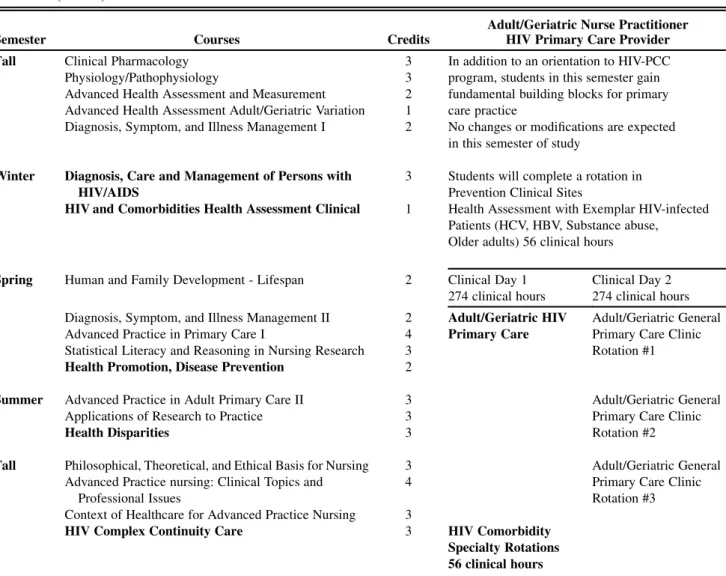
As developed for pilot implementation, the enhanced AGNP with HIV-PCC is a 52-credit, 660-clinical-hour, 18-month, fulltime course of study with 50% of the primary care training occurring in an HIV care setting (Table 1). The HIV-PCC program includes 12 credits across five required core courses and 112 additional clinical hours in specialty rota-tions. Students are required, under the supervision of their preceptors, to manage a panel of 30 patients (i.e., panel management) during a 12-month period. Faculty felt that the most effective strategy for providing competency for comprehensive HIV treat-ment and care was to facilitate experiential learning in HIV primary care settings. In this practicum, the learner spends 1 day a week (10-12 hours) in the HIV primary care clinic over a 12-month period.
A substantial change to the existing AGNP pro-gram was required to integrate HIV-PCC didactic and clinical content. This transformative model replaced the AGNP clinical rotations, which tradi-tionally rotated to a new site each semester, with
12-month continuity clinic experiences in a single HIV primary care site. The intent of this change was to allow students greater time for self-assessments and personal audits of their own patient care and clinical practice. To directly facilitate this process, an additional course was designed and placed in the student’s last semester of study. The purpose of this course is to support individual and peer-driven critical appraisal and synthesis of clinical care by addressing three key questions: (a) Who in my patient panel has an undetectable viral load and why?; (b) Who in my patient panel has a detectable viral load and why?; and (c) Have I optimized both HIV and primary care clinical outcomes in my pa-tients? The course further integrates key clinical indi-cators of quality of care while challenging students to consider barriers. Such an experience affords the stu-dent the opportunity to improve their own care cascade and enhance clinical decision-making in a patient-centered manner.
Step 5: Implementation
Transition from Phase I to Phase II (Pilot) occurred after a draft curriculum was designed and approved for implementation. In preparing to implement this program, the steering committee had to address important barriers and obtain necessary regulatory approvals to ensure that accreditation standards were met.
Overcoming barriers. Once clinical sites were identified, the potential for a reduction in clinical pro-ductivity (i.e., lower billed revenue) by precepting providers became the largest barrier to implementa-tion. A comprehensive review of The Johns Hopkins University School of Medicine approach for medical education and other nursing programs that use a compensation-based preceptor model was completed. To overcome this barrier, the steering committee decided to compensate preceptors for the potential loss of billed revenue by providing 5% effort to the preceptor for each student.
Academic and regulatory approvals. Prior to im-plementing any new academic program at JHUSON, a series of approvals must occur in the institution and with external regulatory agencies. Given that
HIV-PCC sits within and requires enhancements to an ex-isting and previously approved AGNP program of study, the approval process began with the Master’s curriculum committee and proceeded through the institution-specific review process. Once all internal clearances were granted, a submission was required to the Maryland Higher Education Commission for statewide approval and accreditation.
Examination of entry-level advanced practice nursing competency. The steering committee felt it was essential that the programmatic enhancements did not negatively impact preparation for the American Nurses Credentialing Center or American Academy of
Nurse Practitioners certification examinations. As the program was the first for NP education, the steering com-mittee also sought to recognize the exceptional efforts students put forth to gain content-level expertise. The program sought curriculum review by the HIV Nursing Certification Board and it was determined to meet the minimal education requirements to allow students to sit for the AACRN examination directly upon comple-tion of their degree. This closed-book examinacomple-tion pro-vided a comprehensive assessment of our students’ knowledge on entry into practice. In preparation for this examination, students received a comprehensive 8-hour preparatory review course. They were also given details about sitting for additional interprofessional HIV Table 1. HIV-PCC Enhancement of Johns Hopkins University School of Nursing Adult/Geriatric Nurse Practitioner Program
(in bold)
Semester Courses Credits
Adult/Geriatric Nurse Practitioner HIV Primary Care Provider Fall Clinical Pharmacology 3 In addition to an orientation to HIV-PCC program, students in this semester gain fundamental building blocks for primary care practice
No changes or modifications are expected in this semester of study
Physiology/Pathophysiology 3
Advanced Health Assessment and Measurement 2 Advanced Health Assessment Adult/Geriatric Variation 1 Diagnosis, Symptom, and Illness Management I 2
Winter Diagnosis, Care and Management of Persons with HIV/AIDS
3 Students will complete a rotation in Prevention Clinical Sites
HIV and Comorbidities Health Assessment Clinical 1 Health Assessment with Exemplar HIV-infected Patients (HCV, HBV, Substance abuse, Older adults) 56 clinical hours Spring Human and Family Development - Lifespan 2 Clinical Day 1
274 clinical hours Clinical Day 2 274 clinical hours Adult/Geriatric HIV Primary Care Adult/Geriatric General Primary Care Clinic Rotation #1 Diagnosis, Symptom, and Illness Management II 2
Advanced Practice in Primary Care I 4 Statistical Literacy and Reasoning in Nursing Research 3 Health Promotion, Disease Prevention 2
Summer Advanced Practice in Adult Primary Care II 3 Adult/Geriatric General Primary Care Clinic Rotation #2 Applications of Research to Practice 3
Health Disparities 3
Fall Philosophical, Theoretical, and Ethical Basis for Nursing 3 Adult/Geriatric General Primary Care Clinic Rotation #3 Advanced Practice nursing: Clinical Topics and
Professional Issues
4 Context of Healthcare for Advanced Practice Nursing 3
HIV Complex Continuity Care 3 HIV Comorbidity Specialty Rotations 56 clinical hours
specialty certification once the necessary number of practice hours were fulfilled.
Step 6: Evaluation and Feedback
The evaluation approach for our curriculum enhancement began with the creation of a rapid-cycle, continuous quality-improvement process. Three separate phases were developed to separate the targeted outcomes for each phase of the work, which allowed for short-term goal identification and immediate feedback into curriculum improvements through the design and the pilot implementation. The results of the pilot curriculum implementation led to the findings and changes summarized below.
As part of the evaluation process, pilot students were requested to provide ongoing feedback. Each student met individually with faculty and staff throughout the program to review progress and need for additional supportive infrastructure. Students kept a reflective journal of their clinical ex-periences and were specifically asked to detail their own views about their growth. Finally, the evaluation coordinator for the grant met with the students each month for the first three sessions of the pilot project and quarterly thereafter for the purpose of debriefing, discussing concerns, and facilitating collaborative learning approaches to clinical challenges.
Results
Pilot Implementation
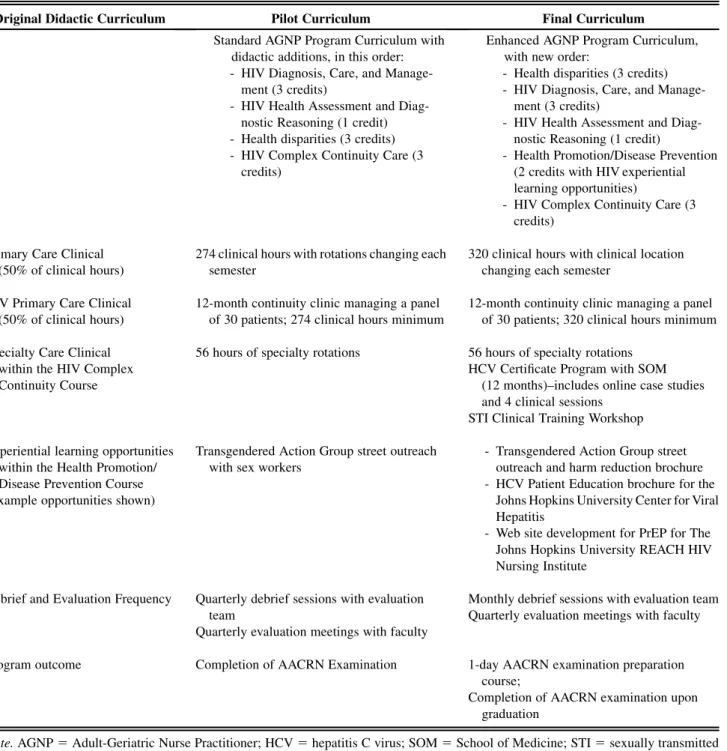
The program began with four students in September 2013, as outlined in the Pilot Curriculum inTable 2. In total, 96 patients received care during the 12-month continuity clinic, with an average of 24 patients having at least two visits per student. Pa-tients were predominantly African American (96%) and female (56%), with a mean age of 50.5 years. The student panels also included 16% sexual minor-ity, 23% past/current substance users, and 40% hepa-titis C co-infection. The median CD41T cell count at baseline was 527.5 cells/mm3 (range 452-713 cells/mm3), with the majority (86%) on antiretro-viral therapy with an undetectable antiretro-viral load.
The evaluation and feedback made by pilot stu-dents resulted in substantive changes to the program noted in the Final Curriculum. These changes included (a) reordering of the didactic coursework to facilitate mastery of health disparities content earlier in the program; (b) increasing the total number of AGNP clinical hours for both HIV and primary care; (c) adding an optional hepatitis C specialty certification in collaboration with the Johns Hopkins University School of Medicine; (d) increasing con-tent hours in sexually transmitted infections, including a standardized patient model for screening; (e) increasing experiential learning opportunities; (f) increasing evaluation sessions from quarterly to monthly; and (g) adding a 1-day AACRN test prepa-ration review at the end of the program.
All four students successfully completed the pro-gram in the specified time frame and were able to meet the standards set forth for this academic and clinically rigorous program. The pilot program out-comes included a 100% pass rate for the American Nurses Credentialing Center national AGNP certifi-cation examination. All pilot students found a career path in a primary care setting with individuals at risk or living with HIV and/or associated co-infections. The AACRN test review has been launched with stu-dents planning to sit for this examination within the first year of program completion.
Benefits of Integration of the HIV-PCC Program within the AGNP Program
The integration of the HIV-PCC program ad-dresses key populations impacted by HIV in Mary-land while maintaining the existing length of the program and ensuring alignment with national accreditation standards. This all occurred within the context of maintaining the costs of tuition in comparison to a stand-alone program. The design of the program also reduced the total number of clinical preceptors required per student from six (two per semester for three clinical semesters) to four (one HIV continuity clinical preceptor for 12 months and one primary care preceptor for three clinical semesters). For our pilot, this meant the school required eight fewer preceptors for the year for students in the program.
Preceptor Patient Schedule
During the first semester of the program it was necessary to schedule patients seen with the student in 1-hour intervals. This reduced the providers’ patient schedule by 50% for that
clinical session during the spring semester. The students transitioned by the end of the first semester to either 15- or 30-minute sched-uled appointments consistent with their respec-tive clinical site’s standard patient visit time. Table 2. Comparison of Pilot and Final Curricula
Original Didactic Curriculum Pilot Curriculum Final Curriculum Standard AGNP Program Curriculum with
didactic additions, in this order: - HIV Diagnosis, Care, and
Manage-ment (3 credits)
- HIV Health Assessment and Diag-nostic Reasoning (1 credit) - Health disparities (3 credits) - HIV Complex Continuity Care (3
credits)
Enhanced AGNP Program Curriculum, with new order:
- Health disparities (3 credits) - HIV Diagnosis, Care, and
Manage-ment (3 credits)
- HIV Health Assessment and Diag-nostic Reasoning (1 credit)
- Health Promotion/Disease Prevention (2 credits with HIV experiential learning opportunities)
- HIV Complex Continuity Care (3 credits)
Primary Care Clinical (50% of clinical hours)
274 clinical hours with rotations changing each semester
320 clinical hours with clinical location changing each semester
HIV Primary Care Clinical (50% of clinical hours)
12-month continuity clinic managing a panel of 30 patients; 274 clinical hours minimum
12-month continuity clinic managing a panel of 30 patients; 320 clinical hours minimum Specialty Care Clinical
within the HIV Complex Continuity Course
56 hours of specialty rotations 56 hours of specialty rotations HCV Certificate Program with SOM
(12 months)–includes online case studies and 4 clinical sessions
STI Clinical Training Workshop Experiential learning opportunities
within the Health Promotion/ Disease Prevention Course (Example opportunities shown)
Transgendered Action Group street outreach with sex workers
- Transgendered Action Group street outreach and harm reduction brochure - HCV Patient Education brochure for the
Johns Hopkins University Center for Viral Hepatitis
- Web site development for PrEP for The Johns Hopkins University REACH HIV Nursing Institute
Debrief and Evaluation Frequency Quarterly debrief sessions with evaluation team
Quarterly evaluation meetings with faculty
Monthly debrief sessions with evaluation team Quarterly evaluation meetings with faculty
Program outcome Completion of AACRN Examination 1-day AACRN examination preparation course;
Completion of AACRN examination upon graduation
Note.AGNP5Adult-Geriatric Nurse Practitioner; HCV5hepatitis C virus; SOM5School of Medicine; STI5sexually transmitted infections; PrEP5pre-exposure prophylaxis; REACH5Research, Education, Advocacy, Community, Health; AACRN5Advanced AIDS Certified Registered Nurse.
Discussion
Our program provides the first evidence of an HIV primary care training in-service model for the NP. The National HIV/AIDS Strategy for the United States notes,
Meaningful improvements in health outcomes require adoption of policies that will produce a diverse workforce large enough to care for all PLWH and at risk for HIV and that has the appropriate training and technical exper-tise to provide high-quality care consistent with the latest prevention and treatment guidelines. (Office of National AIDS Policy, 2015, p. 33)
In order to increase access to care and improve health outcomes for PLWH, education programs must keep pace with the clinical arena. Nursing faculty must encourage curriculum innovations that facilitate integration of primary and HIV treatment and care. The HIV-PCC program is a model of curric-ulum innovation that affords students the opportunity to work with key populations impacted by HIV in the region. The program provides students with state-of-the-science content and places them in a uniquely blended approach of HIV treatment and care within the AGNP training program. The experience prepares students for the complicated nature of engagement and retention in HIV primary care. The longitudinal nature of the program allows them to actively partic-ipate in methods to support adherence, engagement, and retention in care with a patient panel.
The focus of our curriculum on both the human el-ements of HIV disease along with the clinical aspects of management is preparing students for what the National Strategy calls, ‘‘models of competent care that treat the whole person, as well as the virus’’ (Office of National AIDS Policy, 2015, p. 5). The 12-month continuity clinic experience also affords students the opportunity to reflect and evaluate the impact of clinical, mental health, psychosocial, and other factors on patient engagement and retention in HIV care. This is a stark contrast to the baseline expe-rience at our institution that included the potential for a semester-long HIV rotation in which the student might engage with a patient only during a single encounter.
Boehler and colleagues (2015) described an in-service training model for primary care providers that included 20 hours of HIV didactic training coupled with 12 hours of clinical mentoring, which occurred over a 12-month period. The authors noted improve-ments in clinical competency across multiple domains. While our sample size during the pilot did not allow eval-uation of pre-post competency improvement, the pilot evaluation suggested that the implementation of the pre-sent model, with 50% dedicated HIV continuity of care, did not adversely impact completion of the national AGNP certification examination. Student continuity clinic patient profiles reflected the epidemiologic profile of HIV in the region and conformed to learner-identified priorities to improve deficiencies in the AGNP primary care curriculum. Student participation and feedback was critical to move the pilot program into the final cur-riculum model, including the identification of supple-mental training needs based on continuity clinical experiences. As NPs continue to provide increasing pri-mary care services on par with other providers (Ding et al., 2008), integrated training models for HIV primary care are required to meet the needs of the HIV health workforce (U.S. Department of Health and Human Services, 2013). This training approach appears to fill this important need.
Limitations
While the pilot evaluation of our program resulted in significant curriculum improvements, the pilot group was limited, including only four students. We were not able to directly measure patient satisfaction and/or perceived cultural competence within the con-tinuity clinical sessions. This would have provided greater understanding of the progam’s ability to facil-itate these aspects of care, both of which are associated with engagement and retention in care. Our program included financial support of 5% effort for partici-pating preceptors as a result of grant funding. While costs may vary, our standard allocation for 5% effort on a median salary of $102,500 including necessary fringe benefits of 34.5% (total salary 1 benefits of $137,863) would be $6,933.13 per preceptor per year, based on the current preceptor salary mix. Once funding is no longer available, the costs of pre-ceptor participation may not be sustainable and the
program will likely have to pass these costs on to stu-dents. The program reduced the required number of clinical preceptors, thereby decreasing the effort of the program to obtain these vital human resources, which may help offset student costs associated with the program in the future. Importantly, there were no additional costs in this model associated with the required elective didactic coursework.
Conclusions
We reviewed the development of an integrated HIV primary care certificate program. Our model has important implications for training the HIV work-force by demonstrating successful integration of HIV and primary care training for NPs. Graduates of the pilot program were well prepared for the current real-ities of primary care and, as such, were highly employable, with job offers both locally and nation-ally. Further evaluation is needed to determine if the success of the pilot implementation will continue with scale-up of the program.
Disclosures
The authors report no real or perceived vested in-terests that relate to this article that could be construed as a conflict of interest.
Key Considerations
Nurse practitioners are highly trained primary care providers, with evidence demonstrating that health outcomes for persons living with HIV under their care are comparable to those for patients under physicians’ care.
Despite this, options for training programs designed to integrate HIV clinical care compe-tencies into primary care are limited for nurse practitioners.
An HIV specialization program integrated into an adult-geriatric nurse practitioner program is a feasible option to increase graduates’ abilities to provide care to patients living with HIV infection.
Acknowledgments
A special thank you to the pioneering pilot cohort for their dedication to making this program a success. The authors would like to thank Paul Sacamano, ANP-BC, ACRN, for his assistance with preparing this manuscript. The AIDS Education and Training Center for Nurse Practitioner Education at Johns Hopkins University School of Nursing is funded un-der HRSA grant # 1 H4AHA26220-02-00.
References
American Colleges of Nursing. (2010). Adult-gerontology pri-mary care nurse practitioner competencies. Retrieved from
http://www.aacn.nche.edu/geriatric-nursing/adultgeroprimcare NPcomp.pdf
APRN Consensus Work Group & National Council of State Boards of Nursing APRN Advisory Committee. (2008). Con-sesus model for APRN regulation: licensure, accreditation, certification & education. Retrieved from http://www.aacn. nche.edu/education-resources/APRNReport.pdf
Boehler, M., Schechtman, B., Rivero, R., Jacob, B., Sherer, R., . Linsk, N. L. (2015). Developing the HIV workforce: The MATEC Clinical Scholars Program. Jour-nal of the Association of Nurses in AIDS Care. 27(3), 246-260. http://dx.doi.org/10.1016/j.jana.2015.06.006 Capeau, J. (2011). Premature aging and premature age-related
comorbidities in HIV-infected patients: Facts and hypotheses.
Clinical Infectious Diseases,53, 1127-1129.
Centers for Disease Control and Prevention. (2013).HIV surveil-lance report: Diagnoses of HIV infection in the United States and dependent areas, 2011. Retrieved fromhttp://www.cdc. gov/hiv/surveillance/resources/reports/2011report/pdf/2011_ HIV_Surveillance_Report_vol_23.pdf
Centers for Disease Control and Prevention. (2015).HIV among transgender people. Retrieved fromhttp://www.cdc.gov/hiv/ group/gender/transgender/index.html
Ding, L., Landon, B. E., Wilson, I. B., Hirschhorn, L. R., Marsden, P. V., & Cleary, P. D. (2008). The quality of care received by HIV patients without a primary provider.AIDS Care,20, 35-42.
Earl, T. R., Beach, M. C., Lombe, M., Korthuis, P. T., Sharp, V. L., Cohn, J. A.,.Shah, H. (2013). Race, relation-ships and trust in providers among Black patients with HIV/ AIDS.Social Work Research,37, 219-226.
Gonzalez, A., Barinas, J., & O’Cleirigh, C. (2011). Substance use: Impact on adherence and HIV medical treatment. Cur-rent HIV/AIDS Reports,8, 223-234.
Kern, D., Thomas, P., & Hughes, M. (2009).Curriculum devel-opment for medical education (2nd ed.). Baltimore, MD: Johns Hopkins University Press.
Maryland Department of Health and Mental Hygiene. (2012).
Maryland HIV/AIDS epidemiological profile. Retrieved fromhttp://ideha.dhmh.maryland.gov/OIDEOR/CHSE/Shared Documents/Maryland HIV AIDS Epidemiological Profile 12-2011.pdf
Mimiaga, M. J., Reisner, S. L., Grasso, C., Crane, H. M., Safren, S. A., Kitahata, M. M.,.Mayer, K. H. (2013). Sub-stance use among HIV-infected patients engaged in primary care in the United States: Findings from the Centers for AIDS Research Network of Integrated Clinical Systems cohort.American Journal of Public Health,103, 1457-1467. National Organization of Nurse Practitioner Faculties. (2012).
Nurse practitioner core competencies. Retrieved from
http://c.ymcdn.com/sites/www.nonpf.org/resource/resmgr/com petencies/npcorecompetenciesfinal2012.pdf
National Task Force on Quality Nurse Practitioner Education. (2012).Criteria for evaluation of nurse pratitioner programs. Retrieved from http://www.aacn.nche.edu/education-resour ces/evalcriteria2012.pdf
Office of National AIDS Policy. (2015). National HIV/AIDS Strategy for the United States: Updated to 2020. Retrieved from https://www.aids.gov/federal-resources/national-hiv-aids-strategy/nhas-update.pdf
Sabin, J. A., Riskind, R. G., & Nosek, B. A. (2015). Health care providers’ implicit and explicit attitudes toward lesbian women and gay men.American Journal of Public Health,
105, 1831-1841.
Saha, S., Korthuis, P. T., Cohn, J. A., Sharp, V. L., Moore, R. D., & Beach, M. C. (2013). Primary care provider cultural competence and racial disparities in HIV care and outcomes.
Journal of General Internal Medicine,28, 622-629.
Swan, M., Ferguson, S., Chang, A., Larson, E., & Smaldone, A. (2015). Quality of primary care by advanced practice nurses: a systematic review. International Journal of Qualitative Health Care,27, 396-404.
U.S. Department of Health and Human Services. (2013).Older adults and HIV/AIDS. Retrieved from http://www.aoa.acl. gov/AoA_Programs/HPW/HIV_AIDS/index.aspx
Weiser, J., Brooks, J. T., Skarbinski, J., Irwin, K., Gremel, G., Duke, C. C.,.Beer, L. (2015).Provision of care that sup-ports adherence to antiretroviral therapy by HIV providers in the United States. Retrieved from http://iapac.org/Adhere nceConference/presentations/ADH10_OA132.pdf