Masaryk University
Faculty of Arts
Department of English
and American Studies
English Language and Literature
Bc. Viera Boumová
Traditional vs. Modern
Teaching Methods
:
Advantages and Disadvantages of Each
Master’s Diploma Thesis
Supervisor: Matthew Nicholls, B. Sc.
I declare that I have worked on this thesis independently, using only the primary and secondary sources listed in the bibliography.
………
Acknowledgements: Special thanks to my supervisor, Matthew Nicholls, B. Sc., for his constructive comments and helpful assistance. I am grateful to all the people who helped me conduct the research, to the teachers who answered the questionnaires and to those who supported me in any other way.
Table of Contents 1. Introduction ... 6 2. Definitions ... 8 2.1 Method ... 8 2.2 Methodology ... 9 2.3 Traditional Methodology ... 10 2.4. Modern Methodology ... 20 2.5 Summary ... 29
3. Opinions on Traditional and Modern Methodologies ... 30
3.1 Introduction ... 30
3.2. Opinions about Traditional Methodology ... 30
3.3 Opinions about Modern Methodology ... 31
3.4 The respondents’ Preferences ... 33
3.5 Discussion ... 33
4. Research ... 36
4.1 Experiment Introduction and Background ... 36
4.1.1 Why at a Basic School? ... 36
4.1.2 Why at an Alternative School? ... 37
4.1.3 Description of the Two Groups ... 37
4.2 The Experiment ... 39
4.2.1 A Review of The Experiment: ... 39
4.2.2.1 A Description in Detail – Traditional Methodology ... 41
4.2.2.2 A Description in Detail – Modern Methodology ... 57
4.3 Discussion ... 82
5. Conclusion ... 84
6. Works Cited ... 89
A Printed Sources and Lectures ... 89
1. Introduction
I decided to write a thesis on Traditional and Modern Teaching methodologies because I am a new teacher, and like all my colleagues at the end of their studies, I am facing an important decision. I have come to the point where I have to choose to follow either the example of the teachers who I observed at school or the model presented to me at Masaryk University during my studies. This makes an enormous difference in the approach to the teaching itself and to the students. Therefore I decided to do my research and an experiment, which I will describe in my thesis.
These days, especially at private schools and language schools, we have great possibilities in what a teacher can do with his or her students, in terms of teaching methods, seating arrangement, visual aids, etc. With this freedom in teaching, we have as well an enormous number of ideas to use in our classrooms. A young teacher like me is discovering a great number of new ideas and activities all the time. However, since the time of our students is precious, one of the teacher’s crucial tasks is to compare, analyse and evaluate the methods they use in order to motivate the students and to make the learning as effective as possible. In my research I focused on some techniques commonly used today and tested them. With a theoretical study of these methods, I will present how I applied them in real classrooms and how they worked.
However, after reading this thesis or any other publication on methodology, one cannot say which method is the best or the worst. As Kenneth T. Henson claims, usually the methods are better for some purpose, e.g. understanding, transfer, but there is no method simply the best for everything (Henson 2). I agree with the opinion of Michael J Wallace who believes that a central factor in the choice of methods is the learners’ needs and characters; something works for one person well, but the same
method might not work at all for another person (Wallace 42). I tried to use a variety of methods in my thesis, and watch what makes the method more effective.
I start my thesis from the theoretical point of view. In chapter two I will define the terminology, quoting professionals’ books and publications. In this section, the traditional methodology and the modern methodology, as well as other terms, are clarified and a great number of valuable sources are referred to.
In section three, I will illustrate how the theory presented in the first chapter seems to work in reality from the students’ point of view. For this purpose, I will refer to my experience as well as the experience of other students of my age or older. I will also include questionnaires completed by students and teachers, asking about their opinions on teaching methods.
The following part of my thesis, chapter 4, illustrates the real-life situation from the opposite point of view: me as a teacher. This section consists of a description of my experiment and presents the results achieved in it. This section will also include a discussion in which I will analyse the data collected by the experiment.
In the concluding part, chapter 5, I will summarize the goals I set, review issues in which I did and did not succeed, and highlight the results of my thesis. In this part I will also point out some interesting issues for further research. The results and conclusions of my research are different from what I expected. However, they seem to be interesting.
2. Definitions
The key terms in my thesis are ‘traditional methodology’ and ‘modern methodology’ or ‘traditional teaching’ and ‘modern teaching’ as their synonyms. I am aware of the fact, that teaching can have a broader meaning than just methodology. However, in this thesis I will use one of the possible meanings of this term which is synonymous with methodology. Since different people can have various concepts of these two expressions, I define them in detail in this section.
I am aware of the fact that methodologies can vary from school to school as well as from teacher to teacher. I will present the definitions valid throughout my thesis. These definitions are based on the theoretical sources listed in the bibliography and they correspond to the experience of many.
2.1 Method
To start from the foundations, first I have to define the root word of this thesis: ‘method’. In the definitions of this term, Webster’s Third New International Dictionary often uses expressions such as “a procedure or process for attaining” a goal or “a systematic procedure, technique” or “a set of rules” very often related to a science or art (Method). In agreement with this Webster’s definition, Hunkis claims that “methods have form and consistency,” and later on draws attention to the form by stating that methods “have definite steps or stages and sub-behaviours that are recurrent and applicable to various subject matters” (qtd. in Henson 3). As Henson states, some examples of methods are: a lecture, a simulation game, a case study, or an inquiry.
For the purposes of this thesis, we can consider the method to be a well staged procedure to teach new language.
2.2 Methodology
The second step is to define the recurrent term ‘methodology.’ According to Webster’s Third New International Dictionary, methodology is “a body of methods, procedures, working concepts, rules and postulates employed [...] in the solution of a problem or in doing something” (Methodology). This expression can be used as an equivalent to the words teaching and strategy. Henson states, that “strategies represent a complex approach to teaching which often contains a mixture of teaching methods, utilizing a number of techniques with each method” (Henson 3). To summarize, we can say that methodology, or teaching in this sense, is a set of methods based on the same rules and having a common aim, e.g. to encourage students to use the language, involve the students in the lesson, or explain the language to students who have to listen attentively. I will give details of the modern and traditional methodologies in the following part of this section.
2.3 Traditional Methodology
Now we can turn our attention to the comprehensive description of the key terms, ‘traditional methodology’ and ‘modern methodology’. I will first focus on traditional methodology, its aims, philosophy, and procedures, and some examples of its methods.
Clearly, one of the aims of any methodology in foreign language teaching is to improve the foreign language ability of the student. However, traditional methodology is based largely on a reduction of the integrated process of using a foreign language into sub-sets of discrete skills and areas of knowledge. It is largely a functional procedure which focuses on skills and areas of knowledge in isolation. Following on from this, traditional methodologies are strongly associated with the teaching of language which is used in a certain field related to the students’ life or work. As stated in the book Teaching English as a foreign language by Geoffrey Broughton et al, “the recognition that many students of English need the language for specific instrumental purposes has led to the teaching of ESP – English for Special or Specific purposes.” The same authors illuminate the impact of this approach on the teaching output created; they inform the reader about “the proliferation of courses and materials [being] designed to teach English for science, medicine, agriculture, engineering, tourism and the like” (Broughton 9), which actually meant that the content of the course was limited to the specific vocabulary and grammar of the chosen field. For example agricultural courses included exclusively agricultural vocabulary and all grammar was presented only in an agricultural context. Vocabulary, phrases, and sample sentences from other fields and activities, even from the realm of specifically communicative English, were excluded.
A very typical feature of traditional methodology, as Broughton and his colleagues claim, is the “teacher-dominated interaction” (Broughton 22). The teaching is deeply teacher-centred. The reason for this approach is explained by the statement of Assist. Prof. Dr. Abdullah Kuzu, who asserts that it is based on the “traditional view of education, where teachers serve as the source of knowledge while learners serve as passive receivers” (Kuzu 36). This idea corresponds to the simile of Jim Scrivener, who claims that “traditional teaching [is imagined to work as] ‘jug and mug’ – the knowledge being poured from one receptacle into an empty one.” This widespread attitude is based on a precondition that “being in a class in the presence of a teacher and ‘listening attentively’ is [...] enough to ensure that learning will take place” (Scrivener 17). In his book Communicative Language Teaching Today, Jack C. Richards highlights that in traditional methodology “learning was very much seen as under the control of the teacher” (Richards 4). To sum up, the traditional methodology puts the responsibility for teaching and learning mainly on the teacher and it is believed that if students are present in the lesson and listen to the teacher’s explanations and examples, they will be able to use the knowledge.
Let us now turn our attention to the teaching of grammar in line with the traditional methodology. Tharp, in his article “Modern Foreign Languages,” introduces us to this issue by pointing out that the “emphasis was placed on the formal side of the language” (Tharp 49). After analysing the way people speak, the professionals came to the conclusion articulated by Broughton at al in their book Teaching English as a Foreign Language that “the actual choice of words and their arrangement is new virtually every time we produce an utterance ([with] a very small list of exceptions). [...] The only way to explain the process of making new sentences by analogy involves the notion of observing the regularities (rules, patterns, structure) underlying them and
working out how to operate them to generate new sentences” (Broughton 45). Richards adds that “it was assumed that language learning meant building up a large repertoire of sentences and grammatical patterns and learning to produce these accurately and quickly in the appropriate situation” (Richards 6). Based on the above mentioned opinions is “the traditional view that the English language consisted of a battery of grammatical rules and a vocabulary book” (Broughton 39). On the basis of this conclusion, the traditional methodology arose. In his book The ELT Curriculum, Ronald V. White highlights the consequences of handling the language in this grammar-governed way. He reminds us that traditional methodology does not present the language as a means of communication. Rather, this approach to teaching conceives “language [as] a body of esteemed information to be learned, with an emphasis on intellectual rigor” (White 8). Briefly, the traditional approach shows language primarily from the rule-governed point of view and concentrates on the knowledge of grammar and items of vocabulary. It is supposed that a person who knows the rules and the lexis is able to understand and speak the target language.
Because of the above mentioned facts, the teaching also focuses on the grammatical rules and items of lexis. As stated by Jack C. Richards, “earlier views of language learning focused primarily on the mastery of grammatical competence” (Richards 4). The same author offers a definition of this term in these words:
Grammatical competence refers to the knowledge we have of a language that accounts for our ability to produce sentences in a language. It refers to knowledge of building blocks of sentences (e.g. parts of speech, tenses, phrases, clauses, sentence patterns) and how sentences are formed. (Richards 3)
By professionals, teaching a foreign language with grammatical competence being the highest priority is called the ‘Grammar-Translation Method.’ The principles of this approach can be articulated by Broughton’s words, where he states that the grammatical approach to language “produced a teaching method which selected the major grammar rules with their exceptions and taught them in a certain sequence” (Broughton 39). According to Richards, this approach was “based on the belief that grammar could be learned through direct instruction and through a methodology that made much use of repetitive practice and drilling” (Richards 6). Broughton specifies the most typical features of the grammar-translation method, which are “[its] rules, [its] examples, its paradigms [...] and related exercises” (Broughton 39). This opinion is also supported by White’s assertion that “grammar translation involves the learning and application of rules for the translation of one language into another” (White 8). Richards describes this method in more detail when he declares that this “approach to the teaching of grammar was a deductive one: students are presented with grammar rules and then given opportunities to practice using them.” (Richards 6). As we can see from these statements, in language lessons, the priorities were (and still are) grammar, grammatical rules, given examples, and translating from English into the mother tongue and vice versa.
We can discover another important aspect of traditional methodology in Tharp’s statement that in language teaching the essential issue was “rules to be memorized, grammatical text analysis, and literal translation” (Tharp 49). The students were expected to memorize the grammatical rules and to practise using them while translating sentences and analysing English texts. Huaxin Xu, an English teacher at Xi’ a Foreign Language University in China agrees with the point that memorizing the grammatical rules and vocabulary is an essential feature of traditional methodology.
This author quotes the words of Bowen, Madsen, and Hilferty who describe the “main focus” of the traditional methodology as being “on committing words to memory, translating sentences, drilling irregular verbs, later memorizing, repeating and applying grammatical rules with their exceptions” (qtd in Xu 2). In Xu’s own words, “students are asked to memorize verb paradigms and exceptions to grammar rules” (Xu 13). This quotation agrees with White’s utterance that “knowledge of the rule is regarded as being more important than application and the focus is on teaching about the language” (White 8). As mentioned above, the application of rules is practised by translating from one language into the other.
Besides the grammar, one needs a knowledge of vocabulary to be able to translate. Concerning this issue, White states that “vocabulary is learned as isolated items and words are combined according to rule” (White 8). Xu specifies the way of learning new vocabulary and using it according to the grammatical rules by stating that “vocabulary lists, printed grammar rules, and sample sentences are provided for the students to translate” (Xu 13). Plainly, students are explained the grammar, they receive lists of isolated words, and they are expected to translate sentences and create the correct forms.
White articulates his opinion that “there is no oral or pronunciation work, since it is the written language which is taught, and ‘mental discipline’ is stressed rather than any ability actually to use the language” (White 8). Jack C. Richards states that “techniques that were often employed included memorization of dialogs, question and answer practice, substitution drills and various forms of guided speaking and writing practice” (Richards 6). One or the other encouraged students to memorize things and not to create their own new sentences and statements. An interesting point is made by Tyler
who describes the results of an experiment by stating that the “grammar translation method produced habits indicative of deciphering and not of reading” (Tyler 23). This impression might be caused by the constant analysing of texts: vocabulary items and grammatical forms are deliberately decoded and only then is the meaning formed and expressed in the target language. White suggests that the reason for this academic approach might be the strong influence of universities among teachers and students. He claims that the “language teaching conformed to the kind of academicism which the universities considered appropriate” (White 8).
Now I will consider some advantages and disadvantages of the traditional methodology. As all methods, it has some positive as well as negative aspects, which are highlighted by professionals in their publications. These pros and cons are mentioned in the following paragraphs.
Implied by Xu, one opinion is that “doing a little bit of translation and using students’ native language in class [...] is both economic and effective in explaining a concept” (Xu 14). He even affirms that “classes can be taught in students’ native language” (Xu 13). Xu considers using students’ native language as a good way of saving students’ precious time. Briefly, the translation of sentences from or to their mother tongue and communicating in the students’ first language reveals whether the students have really understood the main point, the concept of a new word or a grammatical relationship between the words.
Xu discusses yet another advantage of Grammar-Translation Method. He points out that “grammar translation can cut down on chances that some students, when trying to express themselves in English, are likely to produce Chinglish. [...] From the very beginning, the teacher should bring the students’ attention to the conceptual differences
in the two languages and help them establish correct concepts in English” (Xu 13). If an error still occurs, the teacher is advised to correct it as soon as possible. Concerning error correction, Broughton asserts that “by making mistakes the learner is practising the wrong thing and developing undesirable habit” (Broughton 46). Richards agrees with the above mentioned opinion by expressing a belief supported by traditional methodology:
Good habits are formed by having students produce correct sentences and not through making mistakes. Errors were to be avoided through controlled opportunities for production (either written or spoken). By memorizing dialogues and performing drills the chances for making mistakes were minimized. [...] Accurate mastery was stressed from the very beginning stages of language learning, since it was assumed that if students made errors these would quickly become a permanent part of the learner’s speech. (Richards 4, 6)
To avoid fossilizing the errors, all mistakes noticed by the teacher are immediately corrected by him or her for the student not to remember the incorrect version.
One more advantage of the traditional teaching should be mentioned here. Some authors agree that in no circumstances should some routines be broken. In a book on Czech education, the typical procedures are described. It reads that the teacher “starts the lesson with revision of the previous lesson. He examines the pupil individually by asking them to come to the blackboard, they are asked to [...] do an exercise, [...] respond to teacher’s questions or sometimes the whole class takes a written test.” According to the same book, the next step is the “examination the teacher explains a new subject matter and practises it with exercises” (Chudá 19).
As Chudá states, the very last thing the teacher does during the lesson is that “he sums up the topic and sets assignments for the next lesson” (Chudá 19). We can see that the students always know what follows. First, the previous lesson’s subject matter is revised either collectively or by one student, who is examined, or possibly in a test that all the students take. The second component is the new subject matter: the teacher’s explanation of it, followed by exercises, mostly translations as practice. The last component is revision and the assignment homework.
Traditional methodology, however, also appears to have some disadvantages. According to some authors, there is not enough attention paid to teaching the basic skills, reading and writing, speaking and listening. As mentioned above, “reading” in a foreign language seems to have more to do with deciphering than with reading in one’s mother tongue (Tyler 23). The student tries to understand every single word and its grammatical form, because he believes it is essential for understanding the text.
As I have pointed out above, other authors agree on the lack of speaking and pronunciation practice in traditional teaching methodology (White 8, Broughton 9). Instead of trying to speak and get the meaning through, the students are smothered with linguistic information, “rules with examples, its paradigms [...] and related exercises” (Broughton 39). In the view of Broughton and his colleagues, this approach “ha[s] for so many years produced generations of non-communicators” (Broughton 39). The same authors highlight that many learners experienced significant frustration at the moment of realizing that they were not able to speak in common life situations (Broughton 9).
Writing has been used as a form of punishment: ‘Write your misspelled worry 25 times.’ (This is called a reinforcement of visual memory systems.) ‘Write one hundred times, I will not chew gum in school.’ ‘Write a 300word composition on how you will improve your attitude toward school.’ Most teachers teaching in 1985 were bathed in the punishment syndrome when they were learning to write. Small wonder that most of us subtly communicate writing as a form of punishment. We have no other model of teaching. (Graves 3)
The traditional methodology teaches the written language as the highest priority in learning a foreign language. However, it presents writing in a very unpleasant way. This forms a significant contradiction in the students’ attitude to the foreign language itself: writing in the language is essential and it is highly appreciated; if one can write in the language he is considered to have reached the goal; yet on the other hand, the same activity is a form of punishing students. For the students, this approach can be highly demotivating.
To sum up the above mentioned ideas, we can say that traditional language teaching is based on a traditional approach to the target language, which regards the language as a body of grammatical rules and an enormous number of words that are combined according to the rules. Traditional methodology thus focuses on grammatical structures and isolated items of vocabulary. Jim Scrivener adds that “the teacher spends quite a lot of class time using the board and explaining things – as if ‘transmitting’ the knowledge” (Scrivener 16). Students are expected to learn the rules and the items of lexis, and it is supposed that they will be able to use the language. However, students mostly explore only narrow avenues of the language, because, according to Broughton and Scrivener,
the syllabuses are grammatical and the language is grouped by purpose (16, 31). The primary skills, such as reading, writing, listening and speaking, are generally taught at an insufficient level. Nevertheless, as Scrivener says, this method, with all its potential disadvantages, has been used very often in schools worldwide, “and is still the predominant classroom method in some cultures” (Scrivener 16, 38).
2.4. Modern Methodology
Let us now turn our attention to modern methodology, its aims, philosophy, and procedures, and some examples of its methods.
Unlike traditional methodology, modern methodology is much more student-centred. According to Jim Scrivener, the teacher’s main role is to “help learning to happen,” which includes “involving” students in what is going on “by enabling them to work at their own speed, by not giving long explanations, by encouraging them to participate, talk, interact, do things, etc.” (Scrivener 18, 19). Broughton adds that “the language student is best motivated by practice in which he senses the language is truly communicative, that it is appropriate to its context, that his teacher’s skills are moving him forward to a fuller competence in a foreign language” (Broughton 47). Briefly put, the students are the most active element in this process. The teacher is here not to explain but to encourage and help students to explore, try out, make learning interesting, etc.
Though being essential, the aim of learning a foreign language according to modern methodology is still discussed, and there is a variety of possible aims. In his book Learning Teaching, Jim Scrivener claims, that nowadays a great emphasis is put on “communication of meaning” (Scrivener 31). Jack C. Richards also highlights the communicative competence which is, as he defines it, “being able to use the language for meaningful communication” (Richards 4). Thus many professionals refer to this methodology as the Communicative Language approach. Another group of authors headed by Broughton propose a different idea. They point out that foreign languages are taught “not simply for the learner to be able to write to a foreign pen friend” but to broaden his or her horizons by introducing “certain ways of thinking
about time, space and quantity [and] attitudes towards” issues we have to face in every day life (Broughton 9,10). Briefly put, some people learn a foreign language most importantly to be able to communicate with foreign people and other people learn a foreign language above all to see the world from a different point of view, to discover new approaches to life or to find out about other cultures.
Since modern methodology is aiming for something different, also the way to achieve the goal has changed. As pointed out by Jack C. Richards, “attention shifted to the knowledge and skills needed to use grammar and other aspects of language appropriately for different communicative purposes such as making requests, giving advice, making suggestions, describing wishes and needs and so on” (Richards 8). Teachers’ methods, courses, and books had to be adjusted to new needs of the learners to fulfil their expectations. Instead of grammatical competence, communicative competence became the priority. Ronald V. White articulates three principles of modern methodology: firstly, “the primacy of speech”; secondly, an emphasis on “the centrality of connected text as the heart of teaching-learning process”; and thirdly, an “absolute priority of an oral methodology in the classroom” (White 11). Instead of memorizing grammatical rules and isolated vocabulary, modern methodology prefers to present contextualized language and to develop skills.
Let us now focus on one important part of modern teaching – teaching skills. The main skills are listening, speaking, reading, and writing. They can be classified into two groups: receptive (listening and reading) and productive (speaking and writing). These skills consist of sub-skills; for example, reading includes skimming (reading for gist), scanning (reading for specific information), intensive reading, and extensive reading. While listening, students can listen for gist, or for specific information: for some details,
like numbers, addresses, directions etc. In real life we do not normally listen for every word spoken. Therefore, as many professionals today agree, the task should be realistic too.
The tasks should improve skills, not test memory. According to Jim Scrivener, with receptive skills it is always better to assign one task, let the students accomplish it, have feedback, and then assign another task, let the students read or listen to the text again, have feedback, etc. Scrivener also points out that the tasks should be graded from the easiest to the most difficult, or, in other words, from the most general to the most detailed, and the students must know what the assignments are before the listening or reading itself is done. If the students do not manage to accomplish the task, the teacher should play the listening again or give them more time for reading (Scrivener 170-173). In the methodology course at Masaryk University the students are advised to let the students compare their answers in pairs, to get a feeling of security, and only then check the answers as a group (Zemenová). Students can become discouraged if the teacher expects them to undertake tasks which are too demanding, and tasks which are too difficult can be those not aiming where the teacher actually wants. Therefore it is vital to think and plan carefully before the lesson, so that the activity is useful.
Concerning productive skills, writing and speaking, there are some important issues to mention too. While students practice production skills, a teacher using modern methodology is aware of a contradiction between accuracy and fluency. According to Jack C. Richards, “fluency is natural language use occurring when a speaker engages in a meaningful interaction and maintains comprehensible and ongoing communication despite limitations on his or her communicative competence” (Richards 13). At Masaryk University, the opinion was presented that students should be encouraged to
speak the language, though with errors, to get the meaning through (Zemenová). As stated by Richards, modern methodology tries to keep a balance between the fluency and accuracy practice (Richards 14). There is another aspect important in speaking activities. This vital aspect is context and purpose. This is supported by the opinion expressed by Jill and Charles Hadfield who claim, that activities which mirror real life situations and which have a goal, for example finding a rule, are “more interesting and motivating for the learners (Hadfield 4). We can recapitulate the above mentioned ideas by stating that skills should be taught in a context which is close to real life situations in which students might well find themselves, the practice should be involving and the activities should be well aimed and executed. This approach helps learners to be motivated and interested in the subject matter.
Teaching grammar in a modern way is an essential part too. Unlike the traditional method, however, the presentation of new grammar also involves students very much. Students of the methodology courses at Masaryk University are advised to remember and observe four conditions of a good grammar presentation which are: the creation of a safe atmosphere, the feeling among the students that tasks are achievable, that the students show understanding, and that the students actively listen to, speak, read and write the new language (advisably in this order). As it is emphasized in these courses, the meaning should be taught before the form (Zemenová). Jim Scrivener also makes a good point by stating “Keep it short” (Scrivener 267). Keeping this rule in mind when teaching is essential, since long explanations often become confusing and boring. Scrivener also emphasizes, that “the monologue may provide useful exposure to one way of using language, but it isn’t sufficient to justify regular lessons of this kind” (Scrivener 16). This point highlights the need for the students’ participation and interaction. Some ways to involve students in the grammar presentation are elicitation
and personalization. These two methods appear to be very useful tools. Students always seem to be interested in their teacher’s personal affairs, friends, etc. In fact, situations that the teacher presents as personal do not always have to be true. Elicitation meanwhile invites students to be active, to take part in the lesson, to present their knowledge andideas.
Since most of the interaction is going on in English, modern methodologists recommend checking understanding throughout the grammar presentation. As suggested in the methodology course at Masaryk University, the teacher can carry out this essential procedure by using timelines, examples, (if suitable) visual aids, or by asking concept questions. Concept questions highlight the meaning of a target language item and are simple to understand and to answer (usually ‘yes’ or ‘no’, possibly ‘we do not know’). However, very often they are not easy to make up. They are asked in the target language, though they must not contain the structure or word being taught. The presentation should be followed up by appropriate practice which is usually controlled, guided and free respectively (Zemenová). These suggestions agree with Jim Scrivener’s statement that the “ability to use language seems to be more of a skill you learn by trying to do it [...] than an amount of a data that you learn and then try to apply” (Scrivener 19). It appears that encouraging students to ‘play’ with the target language is very effective in helping them learn to speak it.
Modern methodology includes a number of methods. One of the effective methods for presenting new language is so called ‘guided discovery.’ Scrivener defines it this way: the teacher is “leading people to discover things that they didn’t know they knew via a process of structured questions” (Scrivener 268). The teacher can also introduce a situation, a context, and elicit the language from the students. A suitable reading or
listening can be used as a source of the new language. As demonstrated at Masaryk University, yet another valuable method is Test-Teach-Test, in which the students test themselves, or in other words discover what they already know, revise or learn something new and then practice the new language (Zemenová). These methods seem to be interesting, involving, efficient and probably highly successful.
Vocabulary or lexis is a very important part of learning a language. However, what does teaching a word involve? What should a learner know about a word to be able to say “I know this word”? In a guided discussion in the methodology training at Masaryk University the students and teachers agreed that the important issues are its meaning(s), its pronunciation (both individually and in a sentence), its spelling, its various forms (tenses, plural, etc.), its uses (position in a sentence), its connotations, and its collocations (among others). All of them do not have to be taught in one lesson, of course (Zemenová).
We will now consider the modern ways of teaching lexis. One has probably met many ways to teach or revise vocabulary. As suggested by Jim Scrivener, the most popular or the most common methods in modern teaching are:
Match the words with the pictures.
Check the meaning of these words in the dictionary.
Match the words with the definitions.
Brainstorm words on a set topic (i.e. collect as many as you can).
Divide these words into two groups (e.g. food words and hobby words).
Label the items in a picture with the right names.
Complete gapped sentences with words from a list.
Say which words (from a list) you expect to be in a text about... (Scrivener 231).
Including these methods, the training at Masaryk University offers other ideas too:
miming, drawing or showing a flashcard to indicate the meaning of a word.
using timelines or percentage (in comparison with some similar words).
eliciting some words for a short preferably funny or personal (possibly repetitive) dialogue or story.
letting the students get the meaning from the context.
using synonyms and opposites.
crosswords, riddles.
for some difficult words, such as abstract items or verbs, translation is useful too; however, it is preferable to elicit the translation from the students (Zemenová).
These lists definitely do not include all the methods a teacher can use. However, these methods can be used in a variety of activities, such as pre-teaching, listening for lexis, reading for lexis, using a dictionary, etc
Pre-teaching lexis can help students to recall items they have met before as well as learn new words. Jim Scrivener points out that “the main aim is to help ensure that the following activity will work (because there will be fewer stumbling blocks of unknown lexical items).” Scrivener adds that pre-teaching can be used successfully to practice some words “useful in [their] own right” (Scrivener 230-233). In classrooms, pre-teaching seems to be helpful and can be very exciting and involving.
Introducing and establishing the meaning of new item of lexis is, nevertheless, not enough. Scrivener claims that learners need to “meet new lexical items and understand
their meaning(s), the ways they are used and the other lexical items they often come together with,” practice using the new vocabulary, remember them and finally “recall and use the lexical items appropriately” (Scrivener 228). This can be done in a vocabulary lesson. The vocabulary lesson is a lesson with the main aim of teaching and practising vocabulary, not grammar or skills. As stated in the book Teaching English as a foreign Language: “Language item which is not contextualised is more difficult to remember and to use” (Broughton 41-43). We can see that in a vocabulary lesson it is important to keep new words in context. This aim can be achieved by observing six stages of such a lesson, suggested by Jim Scrivener, which are “1 Pre-teach lexis [...], 2 Written practice of lexis [...], 3 Oral practice [...], 4 Reading to find specific information [...], 5 Further lexis work [...], 6 Communicative activity [...]” (Scrivener 233-4). These stages correspond to the stages presented to students during the methodology course at Masaryk University and they have proved successful in many lessons. From a certain point a view they also agree with the grammar lesson stages which are: presentation (first meaning, then oral form, and finally written form) and practice (controlled, guided and free respectively) as suggested by the teachers at Masaryk University (Zemenová). This procedure is also in accordance with Jim Scrivener’s above mentioned statement that “ability to use language seems to be more of a skill you learn by trying to do it [...] than an amount of a data that you learn and then try to apply” (Scrivener 19). Many people agree that with remembering lexis, using is the best method.
To sum up the modern methodology principles, we can highlight the student-centred interaction which is connected to the involvement of the students in everything going on during the lesson. This shifts the teacher’s role to not causing the learning, but helping learning to happen. The teacher’s task is to choose activities suitable for their learners,
to guide them in the lessons and to encourage them to experiment with the language. The modern methodology comprises a rich variety of methods which should have some common features: activities involving students and close to the real-life situations. To be effective, the methods follow after each other in a suitable order, and there should be a balance of teaching focused on different aspects of the language.
2.5 Summary
To conclude, I will highlight the main differences between traditional and modern methodology. When comparing the names, we notice the basic difference. The traditional Grammar-Translation Method focuses on teaching rules and practises it in translating. The aim of modern Communicative Language Teaching is to teach the learner to communicate – simply put, to get the meaning through. The Grammar-Translation Method prefers routines and a limited number of methods, such as lectures, translation activities and drills. By contrast, Communicative Language Teaching consists of a great number of activities with different aims which are (or should be) balanced. The Grammar-Translation Method relies on memorizing rules and isolated items of lexis. However, Communicative Language Teaching employs more contextualized information and practice similar to re life situations, which is attractive for learners. The Grammar-Translation Method claims that students learn well if they listen to the teacher and do not make mistakes. In contradiction to that, the Communicative Language Approach suggests that one has to experiment with the language, to learn using it. These two methodologies used in Czech schools are very different. The next chapter will present the experience and opinions of teachers and students connected to the theory described in this chapter.
3. Opinions on Traditional and Modern Methodologies
3.1 Introduction
In this section I want to illustratesome views on traditional and modern methodologies in the Czech Republic. I will present the results of a questionnaire as well as some other issues that I have come across while conducting this research. Let us start with the questionnaires.
My questionnaire consisted of only two questions: “In your opinion, what is the difference between modern and traditional methodology? Which one do you prefer and why?” I submitted the questionnaires to teachers of various subjects from a range of schools and with diverse levels of experience. Therefore the questions and answers are in Czech. Here I will present the results translated into English by me.
3.2. Opinions about Traditional Methodology
First I analyse the data on traditional methodology. Nine of the respondents mentioned that traditional teaching is teacher-centred. Five described the traditional teacher as authoritative. One person pointed out that the teacher is doing his duty when teaching. Obedience and respect for the teacher, headmaster etc are highlighted as priorities by two people. One person from her experience indicates that the traditional teacher often humiliates their students. One notion which is mentioned quite frequently is long explanations; they are emphasized by five and one person includes copying from the blackboard as a typical feature of traditional methodology. By far the most often recurring term is memorizing; it is referred to by twelve respondents. Five people claim that the priority is an encyclopaedic knowledge as opposed to skills, and three people
point at the priority of performance. According to three, error is considered to be shameful. Two people claim that traditional teaching makes learners passive; one person states that the reason for the passiveness is the popular attitude that curiosity is bad. As four respondents state, pupils are approached as empty books – the teacher has to create the content. One person declares that the teacher gets feedback from the pupils in the form of their homework or through oral examination. Three people refer to marks – in the Czech Republic one to five (best to worse) – as very important in traditional methodology. One person believes that traditional methodology is a standard at Czech schools; one person considers traditional teaching to be safe, evidently because it is a standard and nobody can object to using it. One answer brings up the idea of a 45 minute lesson being the basic unit of this teaching, while another person points out the permanent lack of time. In the opinion of two people, limited communication is connected to traditional methodology; one person evaluates traditional teaching as tedious; and three people claim it is unattractive for our youngsters.
3.3 Opinions about Modern Methodology
Now I evaluate the data on modern methodology. Concerning modern methodology, nine people agree that it is student-centred. One person describes the role of the teacher as being the organiser of the learning process. The same person states that the teacher brings materials for the learners to find problems included in them and guides pupils or helps them to find the solutions. Seven respondents highlight the importance of the positive teacher-student relationship and teacher-parent relationship. Two people underline the positive student-school and teacher-school relationship. Eight people claim that modern methodology is very motivating for the pupils. One person points
out theoretical knowledge as well as practical skills are taught and another person highlights the vital role of feedback. Ten people refer to developing independent creative thinking as a vital issue in modern methodology and ten respondents claim that involving learners in the lesson helps them remember the subject matter. One of the most popular methods is discussion which is mentioned by six people. Four respondents point out the variety of methods and two highlight that the methods are multisensual, they employ more than one sense. As opposed to traditional methodology, modern methodology uses a great deal of pair work and individual work, as one person points out. The use of visual aids and information technology such as computers, the internet etc. occurred in four answers. Three teachers consider curiosity to be good for modern methodology. Three people draw attention to the ability to know where to look for information and to be able to process and use the information. One person claims that making an error is acceptable as far as the learner can learn from it. The importance of communication is underlined by four respondents. Two people match modern methodology with positive verbal evaluation and praising pupils’ effort and results. Each issue from the following list is mentioned by only one person among the respondents: observing the rules; the basic unit is a day or a week as opposed to a 45 minute lesson, and a disadvantage: children sometimes do not respect others. One respondent adds that modern methodology is not used much here in the Czech Republic and another one states that this limited usage of modern methodology is caused by observing the traditions in the Czech Republic, such as the following: the encyclopaedic knowledge is preferred to the skills, students are used to passive learning and in the course of time this passiveness becomes a habit, etc.
3.4 The respondents’ Preferences
Concerning the second question, 12.5% of the teachers state that they prefer traditional methodology, 25% of them claim to use both, and 62.5% believe that they are using modern methodology.
3.5 Discussion
I found the replies to the second question very interesting. The minority of teachers state that they prefer traditional methodology, and the majority believe that they are using modern methodology. This is a surprising point because there are many teachers who claim that they are using modern methodology while their colleagues are not. Also many students describe their teachers’ methods as traditional, in concordance with the theoretical definitions. The questionnaires indicate that the majority of our teachers suppose they are using modern methodology though their colleagues and students do not have this impression. This contradiction in opinions prompts a question whether do teachers fully understand the difference between the modern and traditional methodologies. After analysing the questionnaires and comparing them to the theory, we can see that the complete results correspond to the theoretical definitions. However, none of the teachers mentioned all the aspects of it. This incompleteness might be caused only by the form of the questions which were open-ended. However, since many features were only mentioned by one of the respondents, this might as well indicate that teachers have vague or incomplete notions about the traditional and modern methodologies.
Nevertheless, there is another notable issue concerning training and literature on traditional methodology. It was quite a problem to find literature on traditional methodology. Even teachers trained in traditional methodology were not able to give me names of popular authors or titles of well-known books on traditional methodology. They correspondingly claimed that they only had textbooks from their university professors which they studied in the library. It seems that there is much more material on modern methodology than on the traditional one. This is also connected to teacher training. Many teachers studied their subject but not methodology. In the Czech Republic there are also many teachers who changed their subjects to accommodate new circumstances, for example, from Russian to English etc. Therefore, they either did not have confidence in their own abilities, or were unfamiliar with modern methods. This might be the reason why they so often stood in front of the class or sat at the teachers’ table and were explaining something. The teacher wanted learners just to sit quietly in the classroom and pay attention to the subject matter. Concerning English lessons, teachers spoke their first language almost all of the time. If the target language was spoken, the message was translated into the first language immediately afterwards. This is probably the feeling of safety that was mentioned in one of the questionnaires. This lack of training and self-confidence might bring us back to the issue of the vague notions about what is traditional and modern among methods. It appears that most of the teachers use a mixture of both traditional and modern methodologies.
This situation may exemplify a current situation in schools which is a mixture of modern and traditional approaches. This indicates that students, exposed to this mixed approach, can have misshapen notions and expectations from each methodology; on the other hand, they might be equally receptive to each of them.
This point is important in my experiment. The groups in my experiment might have been equally receptive (at least in the beginning) to each kind of methodology. This indicates that my experiment is well balanced because the groups were not strongly oriented towards any of the methodologies
Let us now look at the research which compares the two approaches. This is described in the next section.
4. Research
4.1 Experiment Introduction and Background
In this part of my thesis I will present how I applied the two approaches in teaching, modern methodology and traditional methodology in real classrooms and with what effect. My research includes questionnaires answered by the pupils, the opinions of pupils’ parents, and my experiment. In my experiment I taught two groups. Both of the groups had the same number of lessons (three lessons a week), they were of similar age (the fourth and fifth class, which means children between the ages of nine and eleven), and they were approximately at the same level as they started learning English at school one year before I conducted my experiment.
4.1.1 Why at a Basic School?
In this section I will explain why I decided to do my experiment at a basic school. Clearly, secondary school children already have a great deal of experience of school education and different teaching styles. Furthermore, they have studied English for several years, meaning that my experiment would be unlikely to determine how successful particular methods might be. With lower level groups, however, I could measure more accurately how much each child knew at the beginning and how much he/she knew at the end. The probability of copying or cheating in any other way would also probably be lower.
4.1.2 Why at an Alternative School?
The pupils are even more honest at the primary school Pramínek because this is one of the Waldorf schools in the Czech Republic. The school Pramínek uses a special program of teaching called “Začít spolu” which is a part of international “Step by Step” program adjusted to specific needs of Czech Education. The alternative methods used in the lessons at Pramínek support one’s personality, fellow feeling, discovering by oneself and in the group, the positive and quite close relationship to the teacher etc. This way of teaching is significantly connected to the methodology which I call modern.
The Headmistress of this school kindly allowed me to do my experiment with children in Pramínek. The parents of these children agreed too. There is a lot of space for different teaching methods and methodologies in Pramínek and all the teachers and other people concerned were supportive of the idea of conducting an experiment, so it appeared I was not discriminating against any of the methodologies.
4.1.3 Description of the Two Groups
Here I introduce and describe the two groups which I used in my experiment:
Group T: seven children in the fourth grade of a basic school, at the age of nine to eleven. Two children have learning disabilities (especially problems with spelling, therefore their spelling mistakes are not taken into consideration) and one child has a speech impediment (his speech is not taken into consideration). I used the traditional methodology in this group.
Group M: eight children in the fifth grade of a basic school, at the age of ten to eleven. One child has learning disabilities (her spelling mistakes is not taken into consideration). I used the modern methodology in this group.
4.2 The Experiment
4.2.1 A Review of The Experiment:
I started my experiment with questionnaires. I let the children work in groups of three to four and gave them a piece of paper with three questions: “What ways of learning do you like? What way of learning do you not like? In what way have you been learning?” Their replies were very similar, so I am presenting them together.
Here is a summary of pupils’ replies:
What way of learning do you like?
football, competitions, crosswords, games, break, drawing, centres , trips, projects, playing theatre performances, singing songs, pelmanism and writing letters
What way of learning do you not like?
writing, reading, tests, dictations, learning by heart, projects, pelmanism, singing songs, writing letters, centres
What way have we been learning?
quite Ok, sometimes we played games, sometimes we learned normally, we wrote dictations, played pelmanisms, did projects and crosswords, sang songs, we wrote letters, and we learned from pictures
As one can see, the answers are rather contradictory. Therefore I decided to use one more detail in my research: I gave to each child two smileys – one green and smiling, the other, red and frowning, to see how much they liked each lesson. At this point I started my experiment. However, I did not expect the results which I obtained. After
noting down children’s evaluation of the lessons for several times, I noticed that the same children usually showed the same smiley independently of the activities done and of how much they evidently enjoyed them. In the classrooms two groups of pupils appeared: the “good pupils” and the “bad pupils”. The good pupils, those who always pay attention to the teacher, like their teacher, do what they are expected, do not necessarily have the best results in the class, however, the teacher can see the effort, always showed the smiling smiley. The “bad pupils,” the ones who frequently rebel, usually are bored, no matter what the teacher does, these pupils rarely pay attention and often disturb the lesson, showed the frowning smiley. The evaluation of my lessons and methods were based not on how much the pupils enjoyed it, but on their normal attitude to teachers and to school, maybe on their desired image among the pupils. Therefore, I decided not to use this as a valid evaluation of the methods.
On the other hand, the parents of my pupils reacted quite strongly, which is in my opinion an interesting point. Concerning group T, the parents were very dissatisfied, because in their view their children became demotivated, uninterested in English, and unable to express anything new. The strong reaction of the parents of this group of pupils, a letter of complaint, led to the Headmistress of the school instructing me to discontinue the experiment with that particular group after three months. Therefore, I decided to discontinue the experiment with both of the groups, though I knew it was a too short time for such an issue. For this reason, I was not able to get completely conclusive results in the final test. However, I believe that the outcomes of my experiment indicate some interesting conclusions.
4.2.2 A description in detail
Let me now portray in detail, what happened during my experiment: I started teaching on Monday 10th September. I always had the lessons one after the other with no break in-between. The first lesson in both groups was in Czech and the pupils discussed and answered the questionnaires mentioned above. We talked about the ways of teaching and learning from the pupils’ point of view and I introduced and explained my plan to do and experiment in the first half of the school-year 2007/2008. I also informed parents about this research at the first parent-teacher meeting. Everybody agreed. During the second and third lesson, the pupils sat a test devised by me to determine how much they knew and to collect some statistical evidence. Up to this point I planned the same lessons for both groups. From the fourth lesson, the teaching started to be different.
4.2.2.1 A Description in Detail – Traditional Methodology
Let us now focus on the traditional teaching done in group T.
4.2.2.1.1 General Information on the Lessons
In this group I generally used long explanations of grammar, translating everything; I always gave the instructions in Czech; and in the tests I asked the children to translate words and sentences. We did many translations in the lessons, but very little speaking in English. The children had exercise books, glossaries, printed handouts and text books; when doing listening exercises, we listened to the CD before I gave
the instructions for the task, and we wrote a great deal. I will not describe all the lessons in my thesis, because the methods reappeared. However, I will describe all the methods.
4.2.2.1.2 Traditional Methods which I used
Here I will illustrate the methods I used in this group. After a written explanation of each method, I will also incorporate pictures of the handouts, including the illustrations. I am presenting all the material as I used it because the illustrations were a stimulus for the children and I would like to keep the presentation of the methods I used as authentic as possible.
Here is a list of the methods used:
a) Vocabulary and grammar lesson without a textbook b) Create a text according to the model
c) Translation from English into Czech d) Translation from Czech into English e) Reading
f) Listening
I also include 3 formats of tests used in this group:
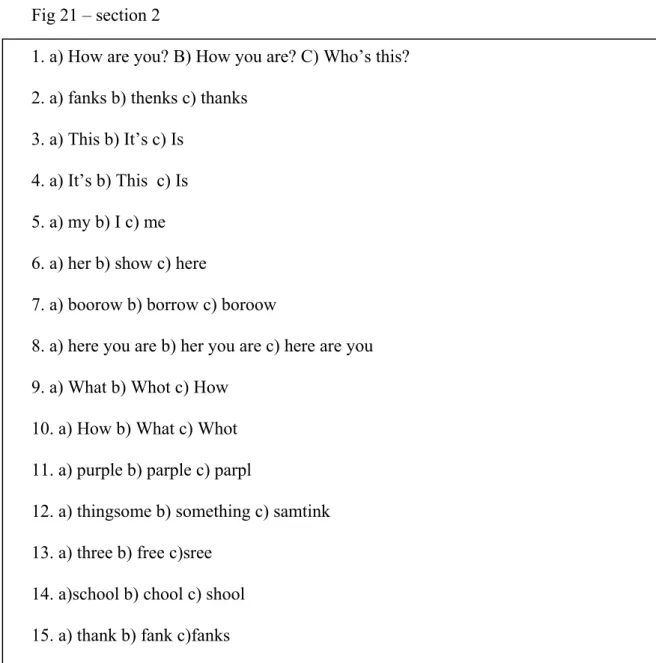
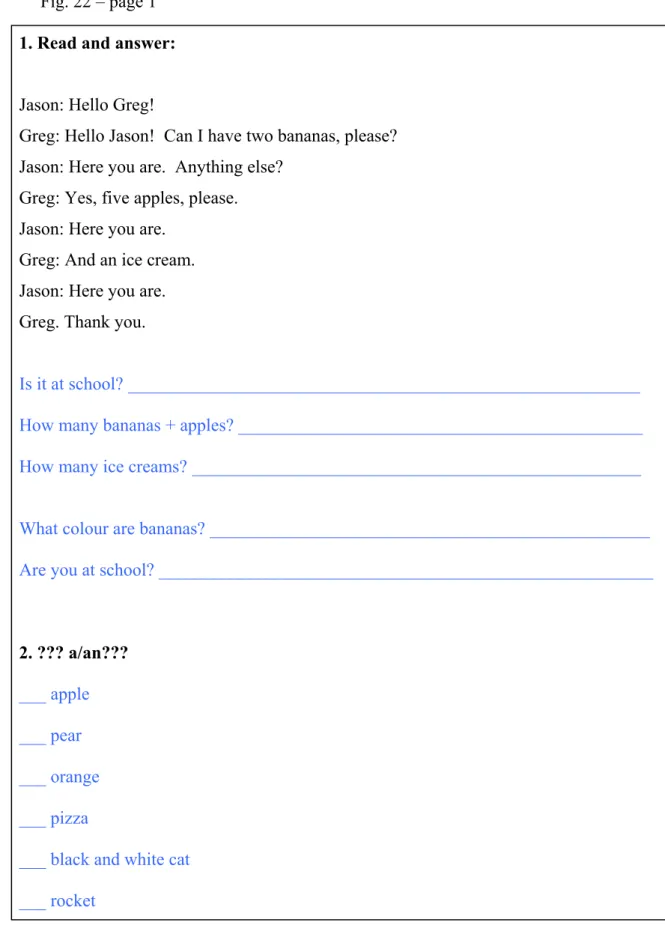
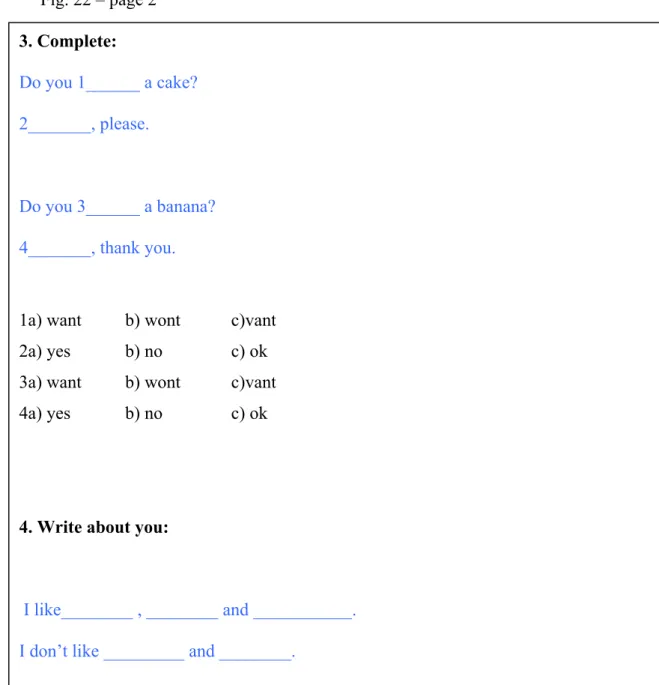
g) Test I h) Test II i) A Mini Test
a) Vocabulary and grammar lesson without a text book:
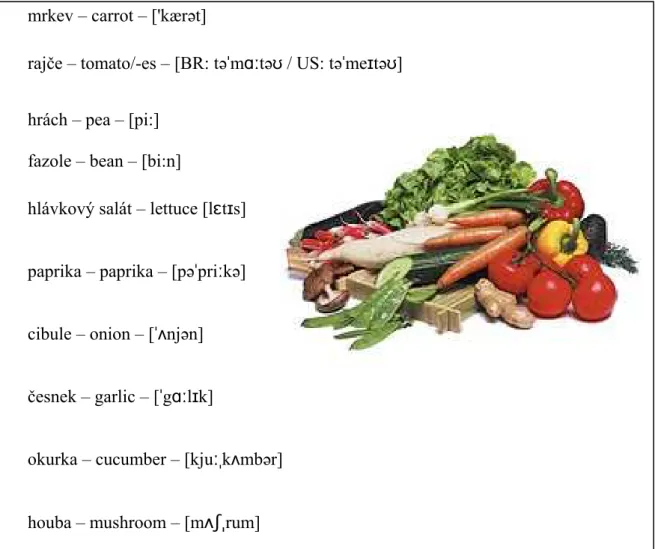
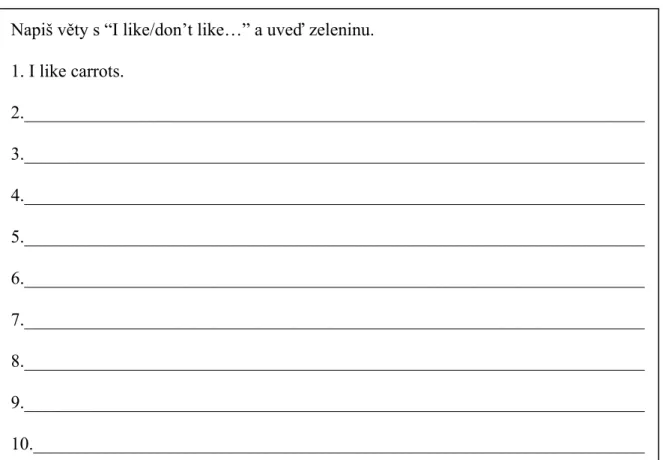
I prepared handouts and gave them to the students in the class (See Fig. 1). The first handout included ten vocabulary items on vegetables in the format ‘Czech word – English word – pronunciation’; on the other side of the handout was an exercise to write ten sentences about themselves “I like/don’t like…” with Czech instructions and one example. After the introduction, we read the words and translations; then I explained the ‘I like/I don’t like’ grammar, the pupils did the exercise and I checked it.
Fig. 1 – Page 1:
mrkev – carrot – ['kærət]
rajče – tomato/-es – [BR: təˈmɑːtəʊ / US: təˈmeɪtəʊ]
hrách – pea – [pi:] fazole – bean – [bi:n]
hlávkový salát – lettuce [lɛtɪs]
paprika – paprika – [pəˈpriːkə]
cibule – onion – [ˈʌnjən]
česnek – garlic – [ˈgɑːlɪk]
okurka – cucumber – [kjuːˌkʌmbər]
Fig. 1 – Page 2:
Napiš věty s “I like/don’t like…” a uveď zeleninu. 1. I like carrots. 2._____________________________________________________________________ 3._____________________________________________________________________ 4._____________________________________________________________________ 5._____________________________________________________________________ 6._____________________________________________________________________ 7._____________________________________________________________________ 8._____________________________________________________________________ 9._____________________________________________________________________ 10.____________________________________________________________________
b) Create a text according to the model:
After presenting the vocabulary on fruit and vegetables and the grammar - present tense of the verb “to like”, a revision of fruit and vegetable vocabulary and the grammar followed.
I prepared a handout (see Fig. 2) which includes a short text about a boy who describes what he likes and dislikes and what his family like and dislike. We read the text, practised pronunciation, and translated it, and then the pupils were expected to write a similar text about themselves and their family. Before the end of the lesson I checked their texts and corrected mistakes.
Fig. 2
Hello. My name is Robert. I like apples and oranges. I don’t like carrots, lettuce and beans. My brother likes melon and strawberries. He doesn’t like bananas and pineapples. My mother likes grapes and pears. My father likes raspberries and strawberries. They don’t like lemon. We all like peas, tomatoes and garlic.
Napiš podobný text o sobě a své rodině:
______________________________________________________________________ ______________________________________________________________________ ______________________________________________________________________ ______________________________________________________________________ ______________________________________________________________________ ______________________________________________________________________
c) Translation from English into Czech
The children received a handout (see Fig. 3) with an English text. All the vocabulary items, phrases, and grammar have already been taught in the previous lessons. The pupils were expected to translate the passage into their mother tongue.
Fig. 3
Bob: Hello. I’m Bob. What’s your name? Lucy: Hi! I’m Lucy. How are you? Bob: Fine, thanks.
Lucy: Who is this? Bob: It’s Fred.
Fred: Come and play skittles in the garden. Bob: Here are 9 skittles and one ball. Fred: 1, 2, 3, 4, 5, 6, 7, 8, 9
Lucy: Ok!
Fred: 9, 8, 7, 6, 5, 4, 3, 2, 1. ...
Lucy: Bye-bye, Bob and Fred
d) Translation from English into Czech
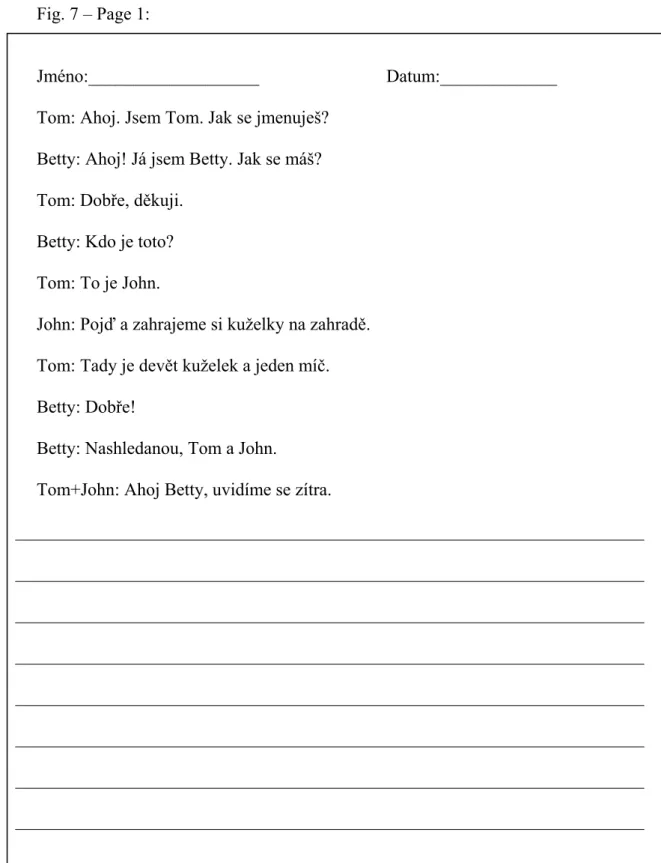
The children received a handout (see Fig. 4) with a Czech text. All the vocabulary items, phrases, and grammar have already been taught and practiced in the previous lessons. The pupils were expected to translate the passage into English.
Fig. 4
Petr: Ahoj. Jsem Petr. Jak se jmenuješ? Jitka: Ahoj! Já jsem Jitka. Jak se máš? Petr: Dobře, děkuji.
Jitka: Kdo je toto? Petr: To je Lukáš.
Lukáš: Pojď a zahrajeme si kuželky na zahradě. Petr: Tady je devět kuželek a jeden míč.
Jitka: Dobře!
Petr: deset, devět, osm, sedm, šest, pět, čtyři, tři, dva, jedna. Jitka: Nashledanou, Petře a Lukáši.
Petr+Lukáš: Ahoj Jitko, uvidíme se zítra.
______________________________________________________________________ ______________________________________________________________________ ______________________________________________________________________ ______________________________________________________________________ ______________________________________________________________________ ______________________________________________________________________ ______________________________________________________________________ ______________________________________________________________________ ______________________________________________________________________ ______________________________________________________________________ ______________________________________________________________________
d) Reading
In the class book, there is a letter (see Fig. 5) (Maidment 20). The pupils were told to read it aloud – each pupil one sentence, one by one. There were quite a lot of new vocabulary items which were read aloud and translated during the reading by the teacher. The pupils were expected to note the new words and pronunciation in their glossaries. The letter was read two times aloud, all the words were explained and then the pupils’ task was to translate the text into Czech. This was done only orally, in the same way as the reading. The homework was to write a similar letter as a reply to the one in the book.
f) Listening
The pupils were told in Czech that they were going to listen to a conversation. Then the listening followed.
Tape script:
Greg: What’s this? Is it a car? Jack: No. Wait and see! Greg: I know! It’s a robot! Greg: Is it a robot, Daisy? Daisy: I don’t know! Greg: Is it a robot, Jack? Jack: No, it isn’t!
Greg: It isn’t a car... and it isn’t a robot... hmmm. Greg: Is it rocket, Polly?
Polly+Jack: Yet, it is! It’s a rocket!
Computer: 10, 9, 8,7 , 6, 5, 4, 3, 2, 1, BLAST OFF! (end of tape script)
After the listening finished, the children were asked two questions: What were Polly, Jack and Greg talking about? What was it? If there were no correct answers in Czech or English, the conversation was replayed once or twice again. After most pupils agreed on the answers, the pupils were instructed to open their class books on page 15 (Maidment CB 15), where the story is in a form of comic strip, and to work in pairs and translate the text into Czech.