Morrell-Scott, NE
Final year pre-registration student nurses perceptions of which taught theoretical knowledge is important for practice
http://researchonline.ljmu.ac.uk/id/eprint/10519/
Article
LJMU has developed LJMU Research Online for users to access the research output of the University more effectively. Copyright © and Moral Rights for the papers on this site are retained by the individual authors and/or other copyright owners. Users may download and/or print one copy of any article(s) in LJMU Research Online to facilitate their private study or for non-commercial research. You may not engage in further distribution of the material or use it for any profit-making activities or any commercial gain.
The version presented here may differ from the published version or from the version of the record. Please see the repository URL above for details on accessing the published version and note that access may require a subscription.
For more information please contact [email protected]
http://researchonline.ljmu.ac.uk/ Citation (please note it is advisable to refer to the publisher’s version if you intend to cite from this work)
Morrell-Scott, NE (2019) Final year pre-registration student nurses
perceptions of which taught theoretical knowledge is important for practice. Nurse Education in Practice. ISSN 1471-5953
1
Final year pre-registration student nurses perceptions of which taught theoretical knowledge is important for practice
Abstract
This research illuminates the perceptions of eighteen final year undergraduate pre-registration student nurses, to understand what theoretical knowledge was perceived to be useful during their pre-registration nursing education, and what was not. The research adopted a qualitative phenomenological approach, and utilised a sample size of eighteen final year student nurses as the data source. The data collection method consisted of semi-structured interviews and the study took place at a Higher Education Institution within the North West of England approved to provide pre-registration nurse education. Participants provided their data during their final year of their undergraduate pre-registration nursing programme, via semi-structured, digitally recorded interviews, which were transcribed verbatim. The transcribed interviews were then analysed using Interpretive Phenomenological Analysis. The findings generated three themes, these were; important knowledge to learn for everyday practice, irrelevant for my future role, and, can we have some more? Findings demonstrate what aspects of the taught curriculum student nurses perceive to be of use to their practice, and why they perceive this to be the case. This affects how student nurses approach their learning during their nursing education. In addition it was clear what participants perceived was not useful for their practice and why this was the case. Additionally, participants offered suggestions of what they would also like adding to their curriculum, and provided insights for what they would like adding to the curriculum, which can be used for enhancing this. This is useful when developing future curricula to understand which aspects student nurses learn in a deep and
2
superficial way. This can provide a useful insight for to ensure that patient care is not compromised.
Keywords: theoretical knowledge, practice knowledge, transition, student learning, preparation for practice
Introduction/ Background
Currently, the National Health Service (NHS) is under the highest amount of pressure it has ever faced since its conception in 1948 (NHS England, 2013). This is due to rising numbers of patients with chronic illnesses and complex care needs, a growing and ageing population, and continuing staffing shortages (NHS England, 2013). These are not solely UK issues but are also global challenges (Edmonson et al, 2017). In addition to this, there are new technologies and treatments that are advancing on a daily basis and this can create an evolving state of change, which can cause increased pressures for staff. This melting pot of change and advancement can create challenges to adequately prepare pre-registration student nurses for transition to registrant as a Registered Nurse (RN).
The 21st century brought significant changes to the health needs of the world (Andre and Barnes, 2010). Globally, nurses of the 21st century need to be able to have the relevant knowledge and skills, to be able to safely and competently care for a diverse array of patients (Nielsen et al, 2013). The health needs of any nation are said to be critically dependent on the relevant and appropriate education of its nurses (Turale, 2011), and as such it is vital that nurse educators understand student perceptions of their education, for coordinating their preparation to registrant status.
3
The necessity to ‘hit the ground running’ and the associated ability for new registrants to be equipped with the skills and knowledge to practice effectively, has been long discussed within nursing literature (Wolff, Pesut and Regan, 2010; McKenna et al, 2006; Greenwood, 2000). It has been suggested that worldwide, new registrants feel that their pre-registration education has not prepared them adequately for their new working life (Pennbrant et al, 2013; Pike and O'Donnell, 2010). Additionally, it is suggested that this ill preparation could have been rectified by developing critical thinking skills and clinical skills (Pennbrant et al, 2013; Pike and O'Donnell, 2010; Kelly and Courts, 2007).
Research aim
The aim of the study was to explore what theoretical knowledge pre-registration student nurses perceived was useful from their programme of study.
Research Methodology
The analysis of this this study, was generated as part of a larger research study which explored the pre-registration nursing curricula. This phenomenological research was conducted from a constructivist position. In essence, constructivism is a process of idea sharing amongst individuals who learn through appraising and embracing knowledge (Fosnot and Perry, 2005). A key product of constructivism is that following the research, action should be encouraged from it (Brown Wilson and Clisset, 2010). This is congruent with the research aims of examining the student perspective of the curriculum. A key product of constructivism is that following the research, action should be encouraged from it (Brown Wilson and Clisset, 2010). This was a longer-term aim following this research being completed, to allow positive changes to the curriculum,
4
and illuminate pre-registration student nurses perspectives of how the curriculum prepared them for practice.
Qualitative methods are increasingly being used to reach areas of insight that other methods cannot reach (Pope and Mays, 2006) and as such, assisted with providing a detailed insight into the perceptions and experiences of the participants. As qualitative research focuses on subjective information, the advantage is that it does not attempt to predict or control the phenomenon of interest (Rebar et al, 2011), underpinning the rationale for the use of qualitative data within the research. Grossoehme (2014) discusses the robust nature of utilising the qualitative approach, and it was important that the research was robust and reflective of the participant’s perceptions. The aim was to gather ‘real’ data, demonstrating perceptions and lived experiences, this links with the phenomenological approach utilised.
Phenomenology aims to discover and develop understanding of experiences as identified by those living the experience (Rebar et al, 2011; Polit and Beck, 2010). Phenomenology is said to put a value on experience and consider the whole person, examining resarch in a very holistic manner (Oiler, 1982), mirroring nursing which examines patients from a holistic view.Phenomenology is suited to research in social sciences, health, and education (Cresswell, 2007), further supporting why this was used due to the research subject being nursing education. Another rationale for using a phenomenological approach is that the lived experiences of the participants, both positive and negative, are important (Liu et al, 2010). In terms of this research, the aim was to illuminate student nurses perspectives to highlight their perceptions and gain an insight why this may be the case. Additionally this may allow for teaching and learning practices to be developed within pre-registration curriculum. Not only for
5
currilculum development, but also teaching and learning strategies which could ultimately improve nursing practices.
Ethical considerations
Ethical issues relating to the undertaking of research have been well documented within the literature (Gerrish and Lacey, 2006; Lankshear and Knobel, 2006; Parahoo, 2006; Butler, 2003), and this is an extremely important aspect of any research.Ethical approval was granted through the HEI that the research took place in, approval reference no: RS2014/95. In addition to local ethical policies adherence was also made to the British Education Research Association (BERA) (2011), NMC (2015) Professional Code, and RCN (2011) research guidelines. To comply with BERA (2011) guidelines, professionalism was maintained and participants were treated with sensitivity, fairness and dignity. Coincidentally, these are some of the underlying principles of nursing practice, as stated within the NMC (2015) Professional Code. Participants provided their informed consent, this included them confirming that they understood that their anonymity and confidentiality would be maintained. In addition to this, participants were aware that they could withdraw from the study at any time.
Recruitment and sampling
The method of sampling must be appropriate to ensure that the research is of a good quality (Gray, 2014; Streubert and Carpenter, 2011). A purposive sample technique was used, from a population of ninety-eight final year pre-registration nursing students from one UK Higher Education Institution (HEI). The sample size was eighteen participants. Purposive sampling is a sampling strategy in which participants are selected as being representative of a larger population (Gray, 2014), which was
6
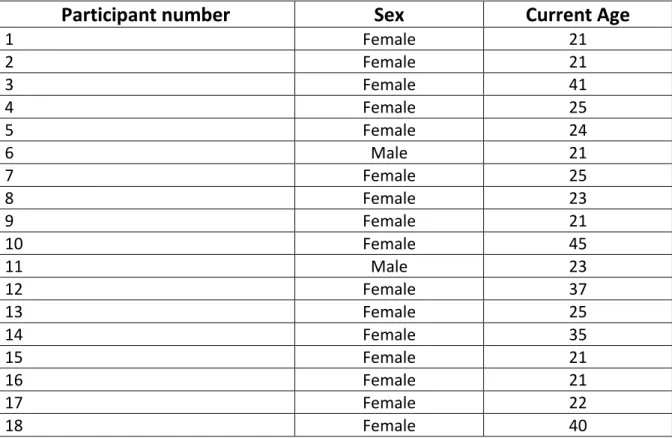
applicable to the sample used. Purposive samples have been used in many studies relating to nursing and nurse education from large cohorts (Laurencelle, Scanlan and Brett, 2016; Watts and Davies, 2014). Justification for using this group of participants was due both to their knowledge and experience of being a pre-registration student nurse. Participants were currently ‘living’ both the curriculum and the hospital experience through placements. Therefore, they had the knowledge and experience of what they felt was needed to practice, and what was being taught. Participant demographic Table1. demonstrates who made up the total participant sample.
Participant number
Sex
Current Age
1 Female 21 2 Female 21 3 Female 41 4 Female 25 5 Female 24 6 Male 21 7 Female 25 8 Female 23 9 Female 21 10 Female 45 11 Male 23 12 Female 37 13 Female 25 14 Female 35 15 Female 21 16 Female 21 17 Female 22 18 Female 40
Table 1. Participant demographics table
Data collection
The depth and detail required to answer the research questions, meant that semi-structured interviews were chosen as the data collection method for this research (Gray, 2014). This is linked to the qualitative phenomenological approach, which also
7
sought to gain detailed, rich data of lived experiences. Healthcare researchers (DiCicco-Bloom and Crabtree, 2006) often use individual in-depth interviews, allowing for further exploration of attitudes and experiences, which can be expanded upon during the interview.
Interviews are a way of people discussing their interpretations of the world in which they live (Cohen, Manion and Morrison, 2007); this closely aligns to the principles of phenomenology. As a theoretical perspective, phenomenology uses relatively unstructured methods of data collection (Gray, 2014); this allows the individual to expand on their responses to highlight their lived experience, without being constrained by set questions. Interviews are said to require high-level interpersonal skills (Oppenheim, 1996), which is akin to nursing. Clucas and Chapman (2014) in a study, which utilised final year student nurses, also noted how the use of interviews allowed for a flexible, yet thorough, approach to exploring responses.
It should be acknowledged that interviews are not a normal conversation as they are pre-arranged; question based, and have a specific purpose (Cohen, Manion and Morrison, 2007). Whilst interviews are an ‘abnormal’ situation, it was important to allow the participants to feel as comfortable and relaxed as possible to answer questions honestly. The interview schedule was followed to guide questioning. Eighteen audio-recorded semi-structured interviews, ranging from a duration of twenty minutes to one hour in length of time were undertaken. Other nursing research studies (Felstead and Springett, 2016; Valizadeh et al, 2016; Clucas and Chapman, 2014) have used this approach with similar durations of interviews, and this provided assurance that the interview timings were appropriate.
8
This research used Interpretive Phenomenological Analysis (IPA) as the method of data analysis. The main aim of IPA is to explore in detail the personal and lived experiences of participants (Lyons and Coyle, 2007). This closely aligns with the phenomenological lens used within this study, and so makes it the most appropriate method of data analysis for the study. The aim of IPA is an exploration of how participants make sense of the personal and social world, including particular experiences or events for participants (Smith and Osborn, 2008). The use of IPA is growing within qualitative research, particularly within social and health sciences, due to its commitment to examining how people make sense of life experiences (Smith, Flowers and Larkin, 2009). Small sample sizes suit the use of IPA (Lyons and Coyle, 2007); this coincides with the small sample size of eighteen participants. IPA’s theoretical underpinnings arise from phenomenology, and this further supported the rationale for why this method of data analysis was pertinent to this study.
The method of data analysis used was IPA, which consists of a multi stage approach, with each stage building on the next, and this allowed themes to be generated. The process of analysis is an iterative and inductive cycle (Smith, 2007). Smith, Flowers and Larkin (2009) suggest that whilst there is a general stage by stage approach for IPA, this can be used flexibly depending upon sample size and the experience of the researcher. Flexibility and innovation of the researcher is welcomed through IPA to adapt this process to suit the level of expertise and experience.
Data Rigour
According to Graneheim and Lundman (2004), research findings should have rigour, in relation to the procedures used to generate the themes. Lauckner, Paterson and Krupa (2012) discuss that the rigour of a study, is essential to accurately capture the
9
phenomenon of interest. This links to the use of the phenomenological approach, as it was this accuracy of the phenomenon that was what was intended to be gained. The use of the excerpt quotes strengthened the demonstration of themes that were generated. To ensure rigour, each transcript was reviewed three times to attempt to ensure that the findings were accurate, to assess that the same themes were coming through, and to assess for outliers and inconsistencies.
Findings
The findings of this research uncovered what this group of final year student nurses perceptions of their curriculum was. Participants considered the whole of their curriculum and what theoretical knowledge they had been taught and had learned. There were three themes generated, these were: important knowledge to learn for everyday practice, irrelevant for my future role, and, can we have some more? The use of participant quotes will be utilised to demonstrate the themes.
Important knowledge to learn for everyday practice
Overwhelmingly, sixteen participants suggested that the science-based subjects such as anatomy, physiology, and pathophysiology, are the most important theoretical subjects for clinical practice. Participant 2 suggests that occasionally there is a dissonance between what students understand as valuable to nursing practice and what is not:
“The only real modules that I remember really helping me with my practice were the skills and the anatomy and physiology, the rest of it was all just a bit pointless” (participant 2)
10
“All we need are the anatomy, physiology, and medications management subjects. All the rest are nonsense, you know like management, leadership, research and ethics. All I want to do is to keep my patients’ safe on a day to day basis.” (Participant 6)
Participants place significant value on theoretical subjects they perceive will directly support their nursing practice and patient care. Therefore, this may be why anatomy, physiology, and pathophysiology are frequently mentioned. Participant 4 states:
“The thing is I’m not saying that the other subjects aren’t important because they are, but everything that we do as adult nurses is about patients with illnesses and a better understanding of these illnesses would be helpful to say the least because we need to keep the patients’ safe and our registration in fact, I will have just got it and don’t want to lose it” (participant 4)
Participant 3 adds to this:
“I need the subjects that will help me on the shop floor, the rest of the stuff like, Mental Health nursing, management, leadership and sociology etc. don’t help me when I’m trying to save someone’s life” (participant 4)
This highlights what the students perceive useful, and why, and is a significant insight into their perceptions of useful theoretical subjects. There were no other theoretical subjects that participants felt the curriculum needed in order to support them.
Irrelevant for my future role
When participants reflected upon the subjects they had studied during the programme, such as mental health nursing, health promotion, law, ethics, management, leadership, research, sociology, and psychology, they asserted that they had not learned much in detail that they could remember about these specialisms. When
11
probed as to why this would be the case, the majority of participants’ answers pertained to these subjects not being useful in clinical practice, as such they approached the assessments to get a pass mark, and approached their learning in a superficial surface manner. Rationale for this was that participants perceived these subjects as irrelevant to their practice, and so this was the reason they approached their learning in this surface way. The following excerpts from three participants 17, 1 and 13 demonstrate this significant finding:
“Oh all that stuff about research and leadership it’s of no use to me all I want is to be a nurse. So when assignments came in, I did them, got a pass and concentrated on the important stuff, you know like learning medications” (participant 17)
“All these other subjects I just do to pass to get through the course, you know the stuff like health promotion and sociology, it’s a case of passing the assignment and moving on” (participant 1)
“Seriously I have too much more relevant stuff to learn about than rubbish like public health and health promotion, so I got that done and moved on” (participant 13)
Comments such as these were extremely common in the interviews, when discussing subjects and the majority of participants believe they simply need theoretical subjects which they can use in practice immediately.
Can we have some more?
Sixteen participants discussed how, within first year and second year, there was a strong component in the curriculum of anatomy, physiology, and pathophysiology. However, participants craved more physiology and pathophysiology that although this
12
was not a strong enough component in the final year, as they were learning subjects such as leadership, which was to prepare them for registrant status, they wanted more. Of these sixteen participants, fourteen discussed how they believed there should be a strong link to anatomy, physiology, and pathophysiology in the final year as a way of consolidating learning. It was suggested that this would assist with feelings of preparedness and confidence for registration. Participant 1 expresses her anxiety and demonstrates this:
“The thing is we had anatomy, physiology and pathophysiology in both years one and two, and now I think that we really need it more so than ever” (participant 1)
Participant 16 recognises the use of anatomy and physiology taught in university, and its relevance to clinical practice:
“Anatomy and physiology in the first year was so hard, but I can see now why it was, as I needed to know this stuff before going onto placement where I had people’s lives to deal with I knew I tried harder to learn these subjects over the other stuff” (participant 16)
Participant 3 suggests:
“well we had it in the first few years and that was good but actually now that I’m ready to qualify I’m thinking ok so I want to try and link things myself to illnesses and I’m wondering why these are happening, but I just don’t know, I just think that I need more physiology and pathophysiology…the role of the nurse is now so medical and we need to know this stuff” (participant 3)
13
“I would feel more settled and ready to qualify if I knew more in depth about these conditions, even little recaps would be nice, and I suppose that it’s sort of about me going to learn at home” (participant 13)
Furthermore, whilst participants do suggest they require more anatomy, physiology, and pathophysiology at the latter end of the programme, they do identify that they should take account of their own learning to support any deficits. This demonstrates how students understand the need to take control of their learning, as part of being professional final year students. Whilst participants suggest they understand they should undertake their own private study, many confess to not doing this. Often the rationale for this was a lack of extra time, as the full time nature of the programme appears to inhibit additional study.
Discussion
The findings of this research demonstrate the student nurses in this study perceive that the sciences, such as anatomy, physiology, and pathophysiology, are the most important theoretical subjects to learn for practice as a registrant. This perspective from student nurses contests previous literature (Pennbrant et al, 2013; Pike and O’Donnell, 2010; Wolff, Pesut and Regan, 2010; Kelly and Courts, 2007; McKenna et al, 2006; Greenwood, 2000) which explored both student nurses’ perceptions of practice preparedness and that of registrants.
Whilst the only theoretical subjects that participants perceived to be essential to practice were the science-based subjects, such as anatomy, physiology, and pathophysiology. McVicar, Clancy and Mayes (2010) note how it has been recognised internationally that the sciences are problematic for student nurses to learn. It has further been suggested that registrants in Sweden (Danielson and Berntsson, 2007)
14
and Ireland (Mooney, 2007) have perceived their knowledge of pharmacology and the sciences were lacking. The participants within this research did not consider difficulty an issue in relation to their understanding of the sciences. It has previously been suggested that student nurses do not enjoy learning the sciences (Dunn, Osborne and Rakes, 2013; Salamonson and Lantz, 2005; Elberson et al, 2001). However, the findings of this research contradict this, as participants stated they craved more science within the curriculum, due to the perception that this was of more use in direct clinical practice, and would support their move to registrant. Equally, it was perceived that through understanding the sciences, this allows patients to be unharmed through having the knowledge to provide care, as opposed to other subjects.
Participants suggested they would make more of an effort to learn these subjects in a more meaningful way, because of their perceived relevance to practice and delivering direct patient care. The perception by patients, doctors, and the public is that nurses should have an advanced level of understanding of the sciences (Davis, 2010; Friedel and Treagust, 2005; Jordan et al, 2000). In terms of learning the sciences, the participants appear to understand and mirror the literature in relation to sciences being needed within clinical practice. However, potentially more important is that it appears there is a lapse in understanding of the importance of the other components of nursing education. Willis (2015) highlighted how skills and knowledge once considered advanced or post-registration, should now be taught within the pre-registration curriculum, due to them now being essential for nurses in practice.
Findings from this research have identified that student nurses perceive there were some theoretical subjects that students did not find of direct use within clinical practice. These subjects were law, ethics, sociology, health promotion, research, leadership and management. For these subjects, the participants’ motivation to learn was to
15
simply pass the assessment. As stated previously within the literature, there is a clear outline of what the NMC (2010) expects newly qualified nurses to be able to have as a skill set, and this includes subjects such as leadership, management, health promotion, and sociology. The students in this study demonstrated that they approach their learning of these subjects in a superficial manner, and this is potentially concerning due to the students lack appreciation of the subject’s importance. Coincidentally, it was also highlighted by Willis (2015) that very few new registrants, within the UK, understand the use of research and apply it to practice. This highlights how curricula should respond to this and encourage research within programmes, as this would make a significant positive difference to patient care. It is important for student nurses to understand that whilst delivering direct care to patients in clinical practice is essential, there is a requirement to have an awareness and appreciation of other aspects of knowledge that support clinical practice in a non-direct way. These subjects do not appear to be important for final year student nurses when delivering patient care, or when discussing providing nursing care. This means that there are potentially gaps in care provided, and that the holistic role of the nurse is not accounted for. Future nursing practice and patient care may be affected, due to the assumptions made by students who take this approach to learning what they believe is important for clinical practice.
A potential reason for the student’s assumption that some theoretical subjects are more and less important than others, may be due to many educational programmes being three years in duration. The duration of three years often includes a high amount of theory and practice hours to be completed in this period. It is often difficult for undergraduates to manage their time, and the additional competing demands on pre-registration time such as additional working, and social time. In addition to this,
16
students often have little time to make sense of the theory, and to understand this application of theory to the practice context. Another rationale for students taking this approach to their learning may be that teaching and learning approaches, which could be utilised to assist students with understanding the relevance of many of these subjects, may not be utilised, and as such, this could be a potential area for future exploration. Taking all of this into account, there is also the added pressure of undergraduates being largely judged by meeting competencies and placement expectations, through their practice placements, in university and when preparing for their jobs. Therefore this may also be another reason for them to put the onus directly on the subjects that they perceive would help them to achieve this, such as focussing on the short term and immediate assessments in practice.
Additionally, whilst pre-registration student nurses may perceive aspects of the curriculum to be irrelevant to them, often programme teams work against a prescriptive set of educational standards. Although, the findings of this research do highlight how the technocratic content may drive the curricula, it is up to academic staff to develop programmes, which encourage students to learn subjects that they may perceive may be irrelevant to their practice. This could also allow students to see how all aspects of the curricula are relevant and fit to make a well-rounded nurse who has the ability to critically think, have decision-making skills and can promote health.
Limitations
Limitations to this study have commonalities with any other research that uses qualitative approaches. The limitations of this research are that the sample was a small size from one institution; therefore, this study does provide an in-depth snapshot of
17
the phenomenon of what this group of final year student nurses perceive, in relation to their pre-registration education.
Acknowledgement has been made that a small sample size was used, yet the rationale for this was stated. Similar sized groups have been used in previous nursing research studies (Watts and Davies, 2014), adding justification that this sample size is acceptable.
Examining perceptions can have limitations, and it should be acknowledged that this was considered. Potential limitations of examining perceptions, particularly from this small unique group, could be that there is an altered view by them in their outlook. However, it is important to consider what can be learned from this group, in terms of how they perceive their nurse education, and establish why this may be the case. The timing of the data collection can also have its own limitations, as it could be questioned if the data was collected, for example six months post-registration, would the outcomes be any different, and as such, this highlights a potential area of future.
Conclusion
The aim of the study was to explore what theoretical knowledge pre-registration student nurses perceived was useful from their programme of study. While some comparisons can be made between the works of others, the perspective of this study is different because it focuses upon the perceptions of final year student nurses. An insight has been gained into what knowledge student’s value for their practice. This research has identified what theoretical subjects student nurses perceive to be to be of use within their nursing education, and why this is the case. It is clear that for this group of student nurses the motivations for learning are to ensure that they have superficial knowledge to be able to survive within clinical practice when on duty,
18
without causing harm to patients and equally to ensure that their ability to practice is not affected. This approach to learning has highlighted potential gaps within the knowledge that student nurses possess which may affect their future practice. Therefore, if future student nurses, locally, nationally, or globally, take the position to disregard theoretical knowledge that has been exposed, then nursing knowledge, practice, and patient care would be diminished, and the implications of this could be detrimental for patients. In view of making a positive contribution to nurse education, the timing of this research is extremely important.
The preparation of nurses to become a professional encompasses a range of knowledge and skills and this research has illuminated this. Learning the correct skills and knowledge for practice, understanding how theory and practice link, and meeting the prescribed curricula in terms of regulatory bodies are the case for nursing students who have to meet the intended professional standards. It is imperative that student nurses are adequately prepared with the skills, knowledge, and experience to practice, not only now but also for the future, to ensure that the public are protected.
References
Andre, K. and L. Barnes (2010). "Creating a 21st century nursing work force:
Designing a Bachelor of Nursing program in response to the health reform agenda." Nurse Education Today 30(3): 258-263.
British Educational Research Association (2011). Ethical guidelines for ethical research. London, BERA.
Brown Wilson, C. and P. Clisset (2010). "Involving older people in research: practical considerations when using the authenticity criteria in constructivist inquiry." Journal of Advanced Nursing 67(3): 677-686.
Butler, J. (2003). "Research in the place you work: Some ethical issues." Bulletin of medical ethics (185): 21-23.
Clucas, C. and H. Chapman (2014). "Respect in final-year student nurse-patient encounters- an interpretative phenomenological analysis." Health Psychology and Behavioural Medicine 2(1): 671-685.
19
Cohen, L., L. Manion and K. Morrison (2007). Research Methods in Education. Oxon, Routledge.
Cresswell, J. (2007). Qualitative inquiry research design: Choosing among five approaches. California, Sage.
Danielson, E. and L. Berntsson (2007). "Registered nurses' perceptions of
educational preparation for professional work and development in their profession." Nurse Education Today 27(8): 900-908.
Davis, G. (2010). "What is provided and what the registered nurse needs-bioscience learning through the pre-registration curriculum." Nurse Education Today 30: 707-712.
DiCicco-Bloom, B. and B. Crabtree (2006). "The qualitative research interview." Medical Education (40): 314-321.
Dunn, K., C. Osborne and G. Rakes (2013). "It's not my fault: Understanding nursing students' causal attributions in Pathophysiology." Nurse Education Today 33: 828-833.
Edmonson, C., McCarthy, C., Trent-Adams, S., McCain, C., Marshall, J., (January 31, 2017) "Emerging Global Health Issues: A Nurse’s Role" OJIN: The Online Journal of Issues in Nursing Vol. 22, No. 1, Manuscript 2
Elberson, K., A. Vance, N. Stephenson and R. Corbett (2001). "Cooperative learning: a strategy for teaching Pathophysiology to undergraduate nursing students." Nurse Educator 26(6): 259-261.
Felstead, I. and K. Springett (2016). "An exploration of role model influence on adult nursing students' professional development: A phenomenological research study." Nurse Education Today 37: 66-70.
Fosnot, C., T. and R. Perry (2005). Constructivism: Theory, Perspectives, and Practice. New York, Teachers College Press.
Friedel, J. and D. Treagust (2005). "Learning bioscience in nursing education: perceptions of the intended and prescribed curriculum." Learning in Health and Social Care 4(4): 203-216.
Gerrish, K. and A. Lacey, Eds. (2006). The research process in nursing. London, Blackwell.
Graneheim, U., H. and B. Lundman (2004). "Qualitative content analysis in nursing research: concepts, procedures and measures to achieve trustworthiness." Nurse Education Today 24(2): 105-112.
20
Greenwood, J. (2000). "Critique of the graduate nurse: an international perspective." Nurse Education Today 20(1): 17-23.
Jordan, S., S. Philpin, S. Davies and M. Andrade (2000). "The biological sciences in mental health nursing; stakeholders’ perspectives." Journal of Advanced Nursing
32(4): 881-891.
Kelly, S. and N. Courts (2007). "The professional self-concept of new graduate nurses." Nurse Education in Practice 7(5): 332–337.
Lankshear, C. and M. Knobel (2006). A handbook for teacher research: From design to implementation. New York Press, Open University Press.
Lauckner, H., M. Paterson and T. Krupa (2012). "Using Constructivist Case Study Methodology to Understand Community Development Processes: Proposed
Methodological Questions to Guide the Research Process." The Qualitative Report.
17(25): 1-22.
Laurencelle, F., J. Scanlan and A. Brett (2016). "The meaning of being a nurse educator and nurse educators' attraction to academia: A phenomenological study." Nurse Education Today (39).
Liu, M., Y. Lei, Z. Mingxia and Y. Haobin (2010). "Lived experiences of clinical preceptors: a phenomenological study." Nurse Education Today (30): 804-808. Lyons, E. and A. Coyle (2007). Analysing Qualitative Data in Psychology. London, Sage.
McKenna, H., D. Thompson, R. Watson and I. Norman (2006). "The good old days of nurse training: Rose-tinted or jaundiced view?" International Journal of Nursing Studies 43(2): 135-137.
McVicar, A., J. Clancy and N. Mayes (2010). "An exploratory study of the application of biosciences in practice, and implications for pre-qualifying education." Nurse Education Today 30: 615-622.
Mooney, M. (2007). "Facing registration: the expectations and the unexpected." Nurse Education Today 27: 840-847.
NHS England (2013). The NHS belongs to the people: A call to action. London, NHS.
Nielsen, A. E., J. Noone, H. Voss and L. R. Mathews (2013). "Preparing nursing students for the future: An innovative approach to clinical education." Nurse Education in Practice 13(4): 301-309.
Nursing and Midwifery Council (NMC) (2015). The Code: Professional Standards of Practice and Behaviour for Nurses and Midwives. London, NMC.
Nursing and Midwifery Council (NMC) (2010). Standards for Pre-Registration Nursing Education. London, NMC.
21
Oiler, C. (1982). "The phenomenological approach to nursing research." Nursing Research 31(3): 178–181.
Oppenheim, A. (1996). Questionnaire Design, Interviewing and Attitude Measurement. London, Pinter Publishers.
Parahoo, K. (2014). Nursing Research: principles, process and issues. 3rd ed. London, Palgrave Macmillan.
Pennbrant, S., M. Skyvell Nilsson, J. Öhlén and A. Rudman (2013). "Mastering the professional role as a newly graduated registered nurse." Nurse Education Today (33): 739-745.
Pike, T. and V. O'Donnell (2010). "The impact of clinical simulation on learner self-efficacy in pre-registration nursing education." Nurse Education Today 30(5): 405–
410.
Polit, D. and C. Beck (2010). Essentials of nursing research: Appraising evidence for nursing practice. Philadelphia, Lippincott Williams & Wilkins.
Pope, C. & Mays, N. 2006, Qualitative Research in Health Care, 3rd edn, Blackwell Publishing Ltd, Oxford.
Rebar, C., C. Gersch, C. Macnee and S. McCabe (2011). Understanding nursing research: Using research in evidence based. Philadelphia, Lippincott William & Wilkins.
Royal College of Nursing (RCN) (2011). Research Ethics: RCN guidance for nurses. London, RCN.
Salamonson, Y. and J. Lantz (2005). "Factors influencing nursing students'
preference for hybrid format delivery in a Pathophysiology course." Nurse Education Today 25: 9-16.
Smith, J. A. (2007). "Hermeneutics, human sciences and health: Linking theory and practice." International Journal of Qualitative Studies on Health and Well-Being 2: 3-11.
Smith, J., P. Flowers and M. Larkin (2009). Interpretive Phenomenological Analysis: Theory, Method and Research. London, Sage.
Smith, J. and M. Osborn (2008). Interpretive Phenomenological Analysis. Qualitative Psychology: A practical guide to methods. J. Smith. London, Sage.
Streubert, H. and D. Carpenter (2011). Qualitative research in nursing: advancing the humanistic imperative. Philadelphia, Wolters Kluwer.
Turale, S. (2011). "Preparing nurses for the 21st century: Reflecting on nursing shortages and other challenges in practice and education." Nursing & Health
22 Sciences 13(3): 229-231.
Valizadeh, S., L. Borimnejad, A. Rahmani, L. Gholizadeh and S. Shahbazi (2016). "Challenges of the preceptors working with new nurses: A phenomenological research study." Nurse Education Today (44): 92-97.
Watts, T. and R. Davies (2014). "Tensions and ambiguities: A qualitative study of final year adult field nursing students' experiences of caring for people affected by advanced dementia in Wales, UK." Nurse Education Today (34): 1149-1154.
Willis, G. (2015). Raising the Bar. Shape of caring: A Review of the Future Education and Training of Registered Nurses and Health Care Assistants. London, Health Education England.
Wolff, A. C., B. Pesut and S. Regan (2010). "New graduate nurse practice readiness: Perspectives on the context shaping our understanding and expectations." Nurse Education Today 30(2): 187-191.