67
PROMOTING KNOWLEDGE SOCIETY THROUGH STUDY
PROGRAMME QUALITY MANAGEMENT
1,
2Maja Lamza – Maroni!, PhD Faculty of Economics in Osijek, Croatia
Branko Mati!, PhD Faculty of Economics in Osijek
". INTRODUCTORY CONSIDERATIONS
The processes of globalization and internationalization are inevitably recognized in the economy, with its ever more noticeable division of labour, increasing competition, changes in professional structure, as well as in required knowledge and skills. One of the consequences of globalization is increased student mobility. All these changes will have an impact on the education system.
Considering the growing possibility of student mobility, educational and training institutions must strive to retain the users of educational services by offering to provide applicable knowledge accompanied with high quality teaching.
In the last few years, the European Union has intensified activities in the area of education and research, although the responsibility still lies with the particular member states. Through exchanges of good practices in education, e.g. referring to teacher training, developing foreign language skills, acquiring skills with information and communication technology (ICT), funding, management, consultancy, informal learning and teaching, results monitoring using the agreed indicators and measures, Europe has been developing an interrelated education and research area. Croatia needs to define its profile in key knowledge areas.
In the process of accession to the European Union, Croatia is implementing the harmonization process in the education system as well. The strategies of this harmonization process rely on the principles and goals of the following:
1
Young Researchers: Jerko Glavaš, PhD candidate and Hrvoje Serdaruši!, PhD candidate 2 The presented results are the outcome of the following projects: “Bank System in the
Financing of Polycentric Development” (No. 010-0102290-1284) and “Knowledge – based management in the function of economic development of Eastern Croatia” (No. 010-0101427-0837), conducted with the support of the Ministry of Science, Education and Sports of the Republic of Croatia.
68
Lisbon Declaration3 which invites the member states to modernize their education systems,
Copenhagen Declaration4 of the European Ministers of vocational education,
Bologna Declaration5 which emphasizes the importance of promoting professional mobility of EU citizens and their access to employment. There is a growing need for knowledge. Estimates show that the demand for intellectual services will post the fastest growth, especially in the area of information and communication technologies (ICT).6 In the labour market, the demand for workers with low education is expected to fall more than for other groups.
An increasing number of potential new jobs require (and will continue to do so) superior skills with the modern technology. Professional structure will increasingly rely on the need for lifelong learning. The basic common competencies in the system of compulsory and vocational training will be developed following the European standards. This is why it will be necessary to include the following in the compulsory education teaching goals: language and communication skills, ICT literacy, understanding the basic (e.g. mathematics) and natural sciences, foreign languages, social competences and entrepreneurship, and learning how to learn.
In the framework of rapid social and economic changes, including those on the labour market, it is necessary to coordinate and connect into the vertically integrated education system pre-school institutions, primary and secondary schools, higher education, continuous and adult education. Young people should be prepared to function in the climate of ever changing requirements. It is therefore advisable to work together with social and business partners in order to define future needs in regard to workforce. How much does Croatia invest into education today?
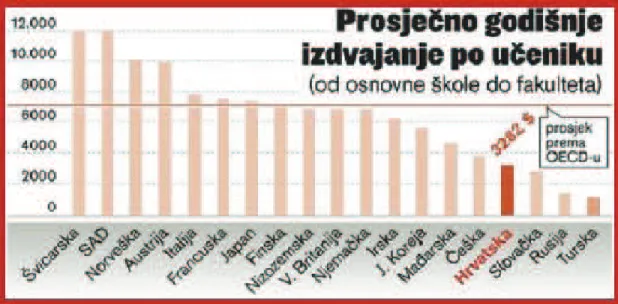
In the year 200# these investments amounted to 4.2% of Croatian GDP, whereas the
average in OECD7 countries was 5.5%, followed by the average of EU-#5 of 5%. According to the Ministry of Science, Education and Sports, between the years 2003 and 2007 public spending increased by 34.2# %. The fastest growth was in higher
education, amounting to 46.4% (Figure #).
3
Source: S.Risovi!, Suradnja s gospodarstvom i tehnologijski projekti 4 Source: http://ec.europa.eu/education/copenhagen/copenahagen_declaration_en.pdf (07.09.2008.) 5 Source: http://www.mzos.hr/Download/2005/05/03/Bolonjska_deklaracija.pdf (07.09.2008.) 6
Source: Svjetska banka, Statisti"ki podaci o obrazovanju, 2004.,
http://nvk.multilink.hr/dokumenti/#26___Obrazovanje%20za%20rast%20i%20razvoj.pdf (07.09.2008.)
7
69
Figure 1. Average public spending per student8
“Investing in people, creation of new knowledge and managing the intellectual potential of one’s employees is a competitive tool of the new economy in which knowledge is the ultimate product, the thing to be bought and sold.”9
2. IMPLEMENTATION AND DEVELOPMENT GOALS OF THE BOLOGNA PROCESS IN CROATIA
The Republic of Croatia is currently changing and adapting its study programmes, which is one of the initial phases in reengineering the higher education according to the Bologna process principles. Croatia signed the Bologna Declaration10 in May 200#. Between 2003 and late 2005 Croatia fulfilled all the prerequisites for the final goal – harmonization of the education system that will make Croatia an integral part of the common European Higher Education Area. These are:
Developing the quality assurance system in higher education (the relevant law and subordinate legislation have been passed; they will be enacted by the Agency for Science and Higher Education),
8
Source: http://www.blog.hr/print/id/#6240#3620/pisa-treba-li-nam-reforma-skolstva.html 9
Source: V.Sri!a, M.Spremi!, Informacijskom tehnologijom do poslovnog uspjeha #0
70
Adopting a higher education system based on two main cycles (the first are undergraduate studies lasting at least three years [3+2 or 4+#], whereas the
second leads to specialization and/or doctoral studies),
Recognition of foreign degrees (the new law has been in force since July 2004; it is harmonized with the EU recommendations on recognizing foreign degrees), Establishing the credit transfer system (ECTS) as a means to promote student
mobility.
The effects of the Bologna process in Croatia can be quantified since the first generation of bachelor degree graduates is trying to find their place on the labour market.
The Bologna process continues in the current academic year (2008/2009), and remains the basis for further changes and reforms in the higher education system. In parallel, the process of assessing undergraduate and graduate study programmes is under way, which is quite an achievement in an effort to internationalize higher education in the Republic of Croatia.
The stated processes have been defined as the development goals for the Bologna process in Croatia.## They should achieve the following:
Modernize study programmes and encourage more efficient student participation in the teaching process.
Before 20#0 reduce the percentage of higher education dropouts from the current
69.5% to 50%.
Before 20#0 increase the total number of higher education graduates by 30%.
Before 20#0 increase the number of teachers by 20-25%.
Strengthen the experimental basis for teaching and research.
Before 20#0 conduct external evaluation of study programmes and institutions, accompanied with development of quality assurance units in all the universities.
3. KNOWLEDGE MANAGEMENT MODEL IN CROATIAN HIGHER EDUCATION
The principles outlined in the Bologna Declaration#2 have defined the goals that are of primary importance in establishing the common European Higher Education Area and its promotion.
The goal is to construct recognizable and comparable education levels, and to introduce a Diploma Supplement. This should promote the possibility for employment of EU citizens all over Europe, as well as improve the competitiveness of the European higher education system. ## Source: http://public.mzos.hr/Default.aspx?sec=2420 #2 Bologna Declaration, #999.
71
The stated overall goal subsumes its specific sub-goals:
1. Higher education system is based on two cycles, undergraduate and graduate. In order to access the second cycle, a student needs to graduate from the first cycle lasting at least three years. The degree attained after the three years (baccalaureus) is considered to be the required level of qualification on the European labour market. The second cycle leads to specialization and/or doctoral studies, in line with the majority of European countries.
2. Introducing the ECTS is a desirable means of promoting wide-ranging student mobility. ECTS points can be acquired also outside the higher education system, for example in lifelong learning programmes, provided they are recognized by the university where a student wishes to continue his/her studies.
3. Overcoming the obstacles to free student mobility in the education process promotes the mobility of students, teachers and researchers, which enables them to gain a new access to studies, and provides continuous training. The time spent in other countries researching, teaching, or studying is recognized and acknowledged, without prejudice to their statutory rights.
4. Promoting European cooperation in quality assurance, with the aim of developing comparable criteria and methodologies.
5. Promoting the required European dimension in higher education, especially in the development of study programmes, inter-institutional cooperation, mobility schemes and integrated study programmes, further training and research.
The stated structural principles of the Bologna process are defined through the following development goals13:
Adapt the adult education system to labour market requirements and adult capacity for learning. This refers in particular to underprivileged target groups. Reduce illiteracy rates and provide everybody with the possibility to finish primary and secondary education in order to increase their employability.
4. KNOWLEDGE TRANSFER THROUGH QUALITY ASSURANCE MODEL IN HIGHER EDUCATION
Interactive approach in the dialogue between Croatian universities and their socio-political environment aims to develop a sustainable regional research programme, which would contribute to the knowledge transfer model. Investment in science and
13
72
higher education is considered to be a highly productive government spending, since it contributes directly to the economic growth of a country.
The basic responsibility and purpose of higher education institutions is the transfer of advanced knowledge and skills to individuals who will be able to apply them in practice and thus contribute to continuous growth. This in fact is the essence of knowledge transfer. Scientific institutions have a major role in this, as they gain and create new scientific and technical knowledge through research and advanced scholarship, as well as through sharing and implementing the latest European and world achievements in Croatian economy.
Since higher education is a crucial part of the whole system – starting with pre-school, primary and secondary schools, to polytechnic (vocational) and university studies, to different lifelong learning programmes – the quality assurance model at Josip Juraj Strossmayer University in Osijek aims to define the position of this university in the overall education process in the knowledge society.
The function of all the universities in Europe, as well as in Croatia, has always been to create knowledge and transfer it to new generations. In this way universities contribute to social continuity. Due to the critical nature of new knowledge, they are frequently also initiators of social change.
Every society needs a quality higher education in order to ensure continuous 'training of trainers', educate experts in all scholarly fields and promote critical thinking at all levels. The functioning of any university, including Josip Juraj Strossmayer University in Osijek, presupposes its autonomy in research work and teaching. All the representatives of political, ideological and economic power in the society traditionally acknowledge and support this role of the university.
The quality of education has always been a crucial aspect in overall success of any nation. It is important to note here the examples of 'small' countries such as Switzerland, Finland or the Netherlands.
The changes summarized in the notion of evolving into the 'knowledge society' have underpinned some already existent features of universities. They will continue to influence the role of universities in the society. This refers primarily to the increased importance of knowledge for the processes of social production, as well as for personal success, increased density of interactions between people around the world, and finally, increased speed of replacing existing knowledge with new knowledge.
The rate of knowledge substitution is steadily increasing. Knowledge creates more knowledge, thus the whole knowledge generation process, its technological implementation, and innovations in knowledge transfer through teaching have been continuously accelerating. All these factors contribute to interdisciplinarity, meaning that new combinations of knowledge from different scholarly disciplines emerge, trying to analyze and solve the issues from a different angle.
Josip Juraj Strossmayer University in Osijek has a very important role in implementing the processes discussed above. Everybody is striving for improved research and teaching practices, thus 'excellence centres' should be established wherever possible,
73
and the University in Osijek has accomplished this. Furthermore, international student and teacher exchanges should be stimulated, and joint transnational specializations, postgraduate and doctoral studies established. When we compare the science and education system in Croatia with these systems in neighbouring and other transition countries, one question looms large – how to significantly increase the number of students, and at the same time achieve high quality of studies and knowledge transfer. Planning a feasible pace and preconditions for such growth is one of the key tasks of Josip Juraj Strossmayer University in Osijek and the Faculty of Economics in Osijek, which is the biggest and oldest constituent of this university.
Economic operators are increasingly aware that their performance in the global market depends on the extent to which they have managed to incorporate scientific results into their business. They are capable of spending more and more funds on research within their organizations, but also support universities and faculties, and finance the education of professionals they will need, binding them with a contract. Companies play an important role in further transfer of knowledge from universities, and influence higher education in a way to contribute to forming well-educated, flexible experts, who are capable to quickly start functioning in their jobs after graduating from their faculty. The goal of quality assurance system at Josip Juraj Strossmayer University in Osijek is to improve overall student experience – from applying and enrolling into faculty, through classes, exams, graduation, to employment and lifelong learning.
The quality of the whole teaching process represents the university's ability – of teachers, management and services – to meet the needs of students, and achieve knowledge transfer through teaching methods and technologies. The student is at the centre of quality monitoring, assurance and improvement system at Josip Juraj Strossmayer University in Osijek. The student is an actor in the system, which is used to follow, assess and improve the quality of student experience during time spent at the university.
It is exactly through this quality assurance system that Josip Juraj Strossmayer University in Osijek intends to achieve certain improvements. The first step was to analyze the existing situation, which was carried out through a research encompassing the academic year 2005/2006 at Josip Juraj Strossmayer University in Osijek.
Some interesting indicators were obtained: • Exam passing rate is 42.21 %
• The average grade on exams is 3.47 (the range of passing grades being 2 – 5) • The ratio of applicants and enrolled students is 60.29 %
• The average length of study is 6.68 years.
Two thirds or 69.5 % of students of Josip Juraj Strossmayer University in Osijek drop out from their studies. The goal is to achieve the rate of graduation of 50% in the near future. Certain indicators (drop-out numbers, number of graduates, number of teachers) point to the areas where the teaching process needs to be improved.
The project aimed at improving the quality of studies has been initiated with the goal of achieving advancement in all the areas. It is expected that the next few years will see significant improvements in the education process, resulting in enhanced student performance, and decreased number of drop-outs.
74
If we express this in numbers, the goal over the next three years is to increase the number of graduates by 30%, decrease the number of drop-outs from 69.5% to 50%. As a prerequisite for further success, the number of teaching staff should be increased by 25%.
Achieving all these goals will bring satisfaction to all the stakeholders – students, teachers, management, administrative staff and the community – which is a prerequisite for efficient integration into global trends of modern higher education in Europe and around the world.
The foundation for achieving the stated goals is laid in the strategic approach described above, which formulates a model based on a more efficient knowledge transfer, aided and supported by ICT technologies.
The development of global information society has increased the demand for learning, i.e. education in all areas needs to become lifelong education. This is a process of continuous training which does not end when an individual exits the education system; rather, it continues in various forms till the end of his/her career. Lifelong learning is defined as the activity of learning and studying throughout one's life, in order to improve knowledge, skills and abilities within personal, civic, social and business perspectives.
“The knowledge acquired in childhood or youth will not be valid for long. Active continuation of learning is an important form of applying lifelong learning. Motivation and the diversity of education options is a basic condition for successful lifelong learning. It is necessary to increase the demand for education, and in this way also the supply. So far, formal education was the form that determined the policies and mode of acquiring education. The continuity of lifelong learning puts more emphasis on non-formal and innon-formal education and learning. Non-non-formal learning is an integral part of the concept of lifelong learning and one of the key orientations of education for the 21st century, as well as a response to challenges posed by quick changes in the world. The idea of lifelong learning has arisen from the belief that people are the most valuable asset of any society and therefore merit investment.”14
Non-formal learning promotes personal growth. This is a framework for developing one’s potentials, interests and talents. Furthermore, it promotes employability and encourages people to recognize their interest in a certain profession or to choose an appropriate job. Lifelong learning promotes active citizenship, civil society and democracy, peace and the integrated Europe. It is an instrument for attaining a higher level of social equality and justice.
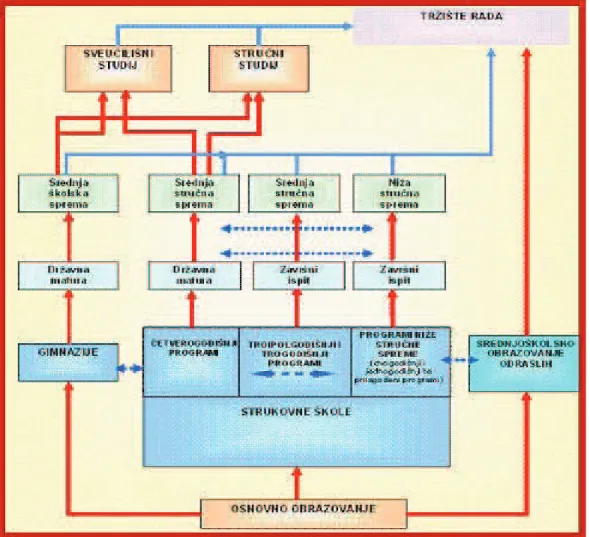
Today’s dynamic trends of volatile economic conditions in the world require lifelong learning. Figure 2 below gives an overview of the Croatian education system from primary school to lifelong learning.
14
75
Figure 2. From primary education to labour market15
Quality assurance is an important aspect in the implementation of the Bologna process as well. It emphasizes the important need to conduct a coherent policy based on the proposition that institutional autonomy creates and requires accountability, and that universities are responsible for developing the internal quality assurance system. The expected research results at the University in Osijek should be helpful in the consistent implementation of the Bologna process, but also a generator of university activities directed at regional development.
The quality assurance model is structured along the following lines: analysis of the current level of knowledge, defining new dynamic goals in raising the current knowledge level, transfer, dissemination and sharing of knowledge, possibilities to
15
76
apply the acquired knowledge (relation between declarative and ‘silent’ knowledge), knowledge measurement and assessment.
The research process is structured and included in model construction through the following phases:
Defining the research topic and structuring the research,
Defining the organization structure for particular parts of the model
Relation system / subsystem of the model
Relation of the research topic and its environment, primarily through its organization structure,
Relation of actual and potential human resources in the research topic,
Compatibility with cognate models, primarily in the implementation of the Bologna process with partner actors,
Transparency of the research topic, primarily in the implementation of the Bologna process.
The model will use research methods appropriate for particular research phases. In the initial phase the common methods of analysis, synthesis, comparison and analogy will be used. To look into the previous development of knowledge management, we will use the methods of historical and comparative analysis and synthesis, as well as certain mathematical–statistical methods and adequate software packages. To assess the current situation, we will use surveys and interviews as sources of primary data). The first phase of the research will focus on internal research methods based on secondary information (desk research). In the following phases, external information obtained in surveys and interviews will also be used. These surveys and interviews will be conducted in a transparent manner in the narrow and broader environment. External methods based on the primary information will be used in the second research phase referring to the knowledge quality model in the implementation of the Bologna process.
77
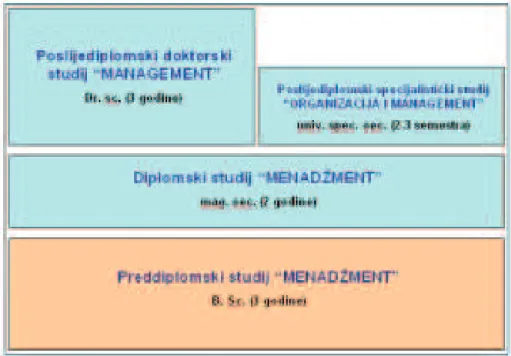
Figure 3. Higher education system on the example of vertically integrated study programme Management at the Faculty of Economics in Osijek
7. CONCLUSION
Modern ICT technologies, especially the Internet and its services, make it very easy to bypass space and time. Today we are faced with previously unconceivable problem: it is no longer scarcity, but the overload of information. A newly designed knowledge structure is required also by the much-sought economic knowledge.
Applying knowledge in economics is nowadays taken not only as a product, or a new business opportunity. In addition, it creates a critical framework for the development of scientific information. Companies are now looking for predominantly applicative solutions to the problems perceived and identified in their operation.
Awareness that investment into education brings excellent returns, a growing need for life-long learning and continuous expansion of knowledge through interdisciplinary approach is also a foundation for improved social accountability. The acquired knowledge can quickly become obsolete. It is therefore necessary to learn how to quickly acquire new knowledge.
The process of bringing the higher education system at the University in Osijek in line with the Bologna process is accompanied with the regional development model based on social accountability. In this way, the Bologna process has assumed the mentor role for the initiatives in regional development.
78
Interactive approach in the dialogue between university and its environment aims to develop a sustainable regional research programme, which would contribute to the knowledge transfer model. The proposed research project provides an opportunity for dynamic monitoring of the education process in the Republic of Croatia. The research goal is to achieve a concept of interrelated, transparent education system, and to raise the overall standard of education. Research results will be evaluated and incorporated into the future development plans for the region of Eastern Croatia and the country as a whole.
REFERENCES:
1. Edvinsson, L: Korporacijska longituda: Navigacija ekonomijom znanja, Differo, Zagreb, 2002.
2. Lamza-Maroni!, M., Glavaš, J., Puva"a, M., Roso, D., Samardžija, L.: LMS as
Bologna Process Support at the Faculty of Economics in Osijek, ITI 2008, Cavtat/Dubrovnik, SRCE Sveu"ilišni ra"unalni centar, Zagreb, 2008.
3. Lamza – Maroni!, M., Glavaš, J.: Poslovno komuniciranje, Studio HS Internet d.o.o. Osijek; Ekonomski fakultet Osijek, Osijek, 2008.
4. Lamza – Maroni!, M., Glavaš, J., Bošnjak, S.: Contribution to the development of the urban
management model, Interdisciplinary Management Research IV, Faculty of Economics in Osijek, Pore", 2007.
5. Strategija razvitka Republike Hrvatske „Hrvatska u 21.stolje!u", Informacijska i komunikacijska tehnologija, Vlada Republike Hrvatske, 2000.
6. Mati!, B., Serdaruši!, H.: Financiranje regionalnog razvitka putem subvencija i
donacija (Grant and Donation in Financing Regional Development), Proceedings of 1 st International Conference "Vallis Aurea" Pozega, 2008, pp. 581-587.
79
AbstractThe new century in the European Union countries has highlighted the importance of high quality knowledge, lifelong learning, and common dimensions of the knowledge base.
Knowledge is today one of the fundamental levers of development. Knowledge management is the capability of active formation and creation of one's immediate and wider environment.
Information and communication technologies (ICT), particularly the Internet and its applications, increase the volume, speed and accessibility of information, while eliminating the obstacles of space and time.
In today's world, companies demand applicable solutions to the problems in their environment. The central goal of university reform in the Republic of Croatia is the transition towards an integrated, competent, research-orientated and efficient higher education, with accredited programmes and institutions.
The Bologna process in the new education structure for economists (undergraduate and graduate studies, specialist graduate studies, doctoral studies) requires continuous monitoring, adapting, updating, innovation and transparency of the devised model of education.