N A T I O N A L G E N D E R A N D E Q U A L I T Y C O M M I S S I O N
NATIONAL
GENDER AND 2012 - 13
EQUALITY
COMMISSION
A N N U A L R E P O R T
©NGEC, 2014National Gender and Equality Commission
Solution Tech Place, 1 st Floor, Longonot Road, Upper Hill, Next to Crowne Plaza Hotel
P.O. BOX 27512-00506, Nairobi, Kenya Tel +254 (20)-272-7778
Email: [email protected] www.ngeckenya.org Twitter: @NGECKENYA
Abbreviation
CAJ Commission on Administrative Justice
CIC Commission for the Implementation of the Constitution CRA Commission on Revenue Allocation
CSO Civil Society Organizations
CSW Commission on the Status of Women ECOSOC United Nations Economic and Social Rights GRB Gender Responsive Budgeting
GVRCs Gender Violence Recovery Centers
IEC Information, Education and Communication IRC International Rescue Committee
IWD International Women’s Day
IWGDS Institute for Women, Gender and Development Studies KEWOPA Kenya Women’s Parliamentary Association
KNCHR Kenya National Commission on Human Rights LLM Masters in Laws
MA Masters in Arts
MDA Ministries Department & Agencies
NGEC National Gender and Equality Commission PWDs Persons with Disabilities
SGBV Sexual and Gender Based Violence UNDP United Nations Development Program
UNECA United Nations Economic Commissions for Africa
UNESCO United Nations Educational, Scientific and Cultural Organization UNFPA United Nations Population Fund
UNHCR United Nations High Commission for Refugees UNSCR United Nations Security Council Resolution
N A T I O N A L G E N D E R A N D E Q U A L I T Y C O M M I S S I O N
TAble of ConTenTs
foreword from the Chairperson ... 1
statement from the Commission secretary ... 2
eXeCUTIVe sUMMARY ... 3
PART 1 ... 4
1.0 InTRoDUCTIon ... 5
1.2 Mandate and Powers of the Commission... 5
1.3 Powers of the Commission ... 6
2.0 sTRATeGIC DIReCTIon ... 6
2.1 Overall Goal... 6
2.2 Vision Statement ... 7
2.3 Mission Statement ... 7
3. 0 KeY ACHIeVeMenTs foR THe YeAR ... 7
3.1. Programs ... 7
3.1.1 Ensuring national, county, public and private institutions and structures are guided by laws, that are cognizant of principles of equality and freedom from discrimination ... 7
3.1.2 Strengthening legislation at all levels and sectors to achieve gender equality and inclusiveness ... 16
3.1.3 State compliance with international and regional reporting obligation... 18
3.1.4 Enhanced institutions capacity to respond to, manage and reduce prevalence of SGBV ... 19
3.1.5 Enhanced national and county machinery for mainstreaming issues of SIG in the development agenda ... 21
PART 2 ... 22
4.0. InsTITUTIonAl sTRenGTHenInG ... 23
4.1 Launch of the Strategic Plan 2013 -2015 ... 23
4.2 Human Resources and Administration ... 23
4.3 Institutional Image and Branding ... 24
4.4 Information, Education and Communication ... 24
4.5 Internal Audit ... 24 4.6 Procurement ... 24 PART 3 ... 25 5.0 fInAnCIAl sTATeMenTs ... 25 5.1 Auditors Report ... 26-28 5.2 Financial Statement ...29-34 PART 4.... 35
6.0 KeY CHAllenGes, ReCoMMenDATIons AnD PRIoRITY AReAs ... 36
APPenDIX ... 38
foreword from the Chairperson
I
wish to take this opportunity to recognize the individual and collective efforts of members and staff of the National Gender and Equality Commission NGEC) for the contribution they have made in the last one year. Indeed, we began the year with a very lean staff and rudimentary structures. I am happy to re-port that in the just concluded financial year we have managed to recruit a vibrant and dedicated secretariat that has within short notice managed to pull through some remarkable fetes including the campaign moni-toring and election observation in March 2013.It has been a year of setting structures and cultivating a corporate identity. We now have a three year strategic plan in place. Plans to roll out Commission services to the counties are at an advanced stage. Soon the Com-mission will be moving to new premises with ample space to house all program and administration staff. In 2013, Commissioner Gumato Ukur Yatani was appointed by H.E The President as a commissioner in NGEC. The year under review saw two commissioners namely Naomy Wangai and Tache Bonso exit after expiry of their term.
The support from government and development partners has been overwhelming and this has been possible through sacrifice and hard work of Commissioners and staff. As we plan for the future it is important to con -duct a quick evaluation of how our operations and processes worked in order to improve.
As we navigate through the transition of the Constitution of Kenya 2010, it is important to understand how government processes both at the National and County levels will affect and relate with our mandate. With devolution now in place, the Commission has to be present in the counties to effectively undertake its role in ensuring integration of the principle of equality and freedom from discrimination in all levels of operations. NGEC shall need to rethink its programming objectives to be able to deploy accordingly. This also implies that the institutional capacity will require to be enhanced by acquiring more programs and administrative staff to coordinate county activities.
The Commission requires huge resources to conduct capacity building to the county administration on prin-ciples of equality and non-discrimination. Under the new governance structures, the Ministry of Devolution and Planning is the government’s implementing agency on gender mainstreaming and we hope to have meaningful ways of engagement to ensure seamless execution of NGEC’s mandate. This will only be pos-sible when all the stakeholders internalize the peculiar nature and mandate of NGEC that transcends both public and private spheres to bring about tangible change in ensuring inclusion and non-discrimination of all Kenyans. As we remain guided by the NGEC Act 2011, we look forward to unwavering support from the government, development partners and all stakeholders through adequate allocation of resources, capacity building and resource mobilization.
Finally I urge all Commissioners and members and staff to rededicate their energies in creating a vibrant Commission whose mandate resonates with Kenyans countrywide and strive to make a difference, a change they can believe in.
Mrs Winfred o. lichuma, ebs
Chairperson
N A T I O N A L G E N D E R A N D E Q U A L I T Y C O M M I S S I O N
statement from the Commission secretary
N
ational Gender and Equality Commission (NGEC) have continued to grow and develop both in its institutional capacity as well as in programming. The Commission secretariat is fully dedicated to continue to support this growth and increase coverage of its programs across all parts of Kenya. During the 2013/2014, the commission will be moving from its initial location, NSSF building, 24th Floor to Upper Hill, to new premises located in Upper Hill, Solution Tech Place, 1st, 2nd and 3rd floors, and open three regional offices in Garissa, Nakuru and Kisumu in our effort to creating more space and taking services closer to Kenyans.In the year 2012, the Commission experienced budget cuts, which reduced its initial projection of rolling out its physical presence in 8 regional offices. Nevertheless, the commission has implemented numerous projects in most parts of the country and is very optimistic that with government support and financial assistance from the development partners, the commission can scale up its activities in all sub-counties of Kenya. The Commission has now received approved salary structure as well as staff rationalization and establish-ment from the Salaries and Remuneration Commission, and the Ministry of Devolution and Planning’s Di-rectorate of Public Service Management (DPM) respectively. This will enable us to employ regional co-coor-dinators who can effectively engage gender equality and non-discrimination issues, taking into consideration our wide mandate of monitoring, auditing, co-coordinating, advising and investigating, while reporting to the Government and international fora.
The Commission launched its strategic plan 2013- 2015 in June, 2013 which provides strategic direction and focus to us, stakeholders, and development partners. In an effort to achieve its strategic objectives, the Com-mission has employed Human Rights Based Approach in programming and had adapted lessons and best practices benchmarked from other Commissions in Rwanda, South Africa, and United Kingdom to address gender and equality issues among most vulnerable populations.
I wish to thanks all the commissioners and staff for keeping the promise of accelerating achievements of the commission in past fiscal year. I would also like to acknowledge and appreciate the support we have received so far for institutional growth and programming from UNDP, UNFPA, Ford Foundation, UN Women, and DSW.
Prof. Rose odhiambo, HsC
Commission Secretary/CEO
T
he National Gender and Equality Commission (NGEC) is a Constitutional Commission set up pursuant to Article 59(4) & (5) of the Constitution of Kenya 2010 and the National Gender and Equality Commission Act 2011. The overall mandate of the Commission is to promote gender equality, inclusion and freedom from discrimination among all people in Kenyan though with elevat-ed attention to women, youth, children, persons with disabilities, elderly, minority and marginalizelevat-ed groups and communities. The Commission is responsible for the comprehensive integration of the principles of inclusion, equality and mainstreaming issues of Special Interest Groups (SIGs) in Na-tional, County and private sector development through four prong strategies;a) Creation of conducive and enabling environment to achieve equality in compliance with the existing legislative framework where all laws, policies and administrative guidelines observe gender equality and inclusion
b) Promotion of substantive financing of equality and inclusion issues and programs
c) Mitigation of the Gender Based Violence through public education and coordination of multi-sectoral responses to prevention and management of GBV
d) Continuous institutional development to increase the capacity to deliver on the Commis-sion’s multidimensional mandate
This report is a summary of the key achievements of the past financial year (2012/2013), and list of best practices and lessons learned. During this year, the commission realized two remarkable achievements that led to turning the first page of Kenya’s pathway to mature democracy (the 2013 elections) and NGECs strategic focus. These are:
1. Successful monitoring and observations of the special interest group’s participation and performance in the 2013 general elections, and
2. The completion, launch and early implementation of the first strategic plan 2013-2015 The report is divided into four parts. Part one describes critical programmatic achievements rang-ing from auditrang-ing, monitorrang-ing, coordination, and issuance of advisories and facilitation of interven-tions geared towards promotion of gender equality, inclusion and freedom from discrimination. The outcomes of NGEC interventions contributed meaningfully in development of the status reports on Kenya’s compliance with provisions in multiple international treaties and conventions deposited with international and regional committees and communities during the 2012/2013. Further, NGEC initi-ated implementation of interventions in county governments and in private sector as soon as elections were completed to spearhead realization of devolved democracy and governance envisioned in the 2010 Kenya constitution.
Part two of the report details the institutional growth in personnel, information and technology and in expanding business to youth and women through procurement. The staff increased fourfold between 2012 and 2013. The Commission also increased investment in Information, Education and Commu-nication (IEC). The audited accounts of the financial year 2012/2013 are presented in Part three of this report. The certification from independent auditors demonstrates NGEC’S commitment to giving Kenyans the highest returns and value for public resources, and utilization of resources to govern-ment and SIG priorities. Part four presents a summary of challenges, recommendation and priority programs for the next financial year.
N A T I O N A L G E N D E R A N D E Q U A L I T Y C O M M I S S I O N
P A R T o n e
I n T R o D U C T I o n
=
NATIONAL
GENDER AND
2012-13
EQUALITY
COMMISSION
A N N U A L R E P O R T
©
NGEC, 2014
National Gender and Equality Commission
Solution Tech Place, 1stFlr, Longonot Road, Upper hill,
Next to Crowne Plaza Hotel
P.O.BOX 27512-00506, Nairobi, Kenya
Tel +254 2(20)-272-7778
www.ngeckenya.org
Tweet: @NGECKENYA
PART 1
1.0 INTRODUCTION
T
he National Gender Equality Commission is a constitutional Commission established by an Act of Parliament in August 2011, as a successor commission to the Kenya National Human Rights and Equality Commission pursuant to Article 59 of the Constitution. NGEC derives its mandate from Articles 27, 43, and Chapter Fifteen of the Constitution; and section 8 of NGEC Act (Cap. 15) of 2011, with the objectives of promoting gender equality and freedom from discrimination.The Commission has its head office in Nairobi with three regional offices in Garissa, Kisumu and Nakuru. As per the
provisions of the NGEC Act of 2011, The Commission consists of a Chairperson and four other members appointed in accordance with its constitutive act of parliament. The Chairperson and members serve on a full time basis for a term of six years and are not eligible for reappointment.
By the end of the financial year, the Commission had a Chairperson, Commissioner Winfred Osimbo Lichuma, and
two other members namely, Commissioner Simon Ndubai and Commissioner Gumato Ukur Yatani. In March 2013 two
member commissioners Mrs. Naomy Wangai and Mr. Tache Bonsa left following the expiry of their tenure. The process
of recruiting two other Commissioners has commenced and the new Commissioners are expected to report at the
begin-ning of the coming financial year.
1.2 Mandate and Powers of the Commission
The mandate of the NGEC is spelt out under section 8 of the NGEC Act 2011 as follows:
a) Promote gender equality and freedom from discrimination in accordance with Article 27 of the Constitution;
(b) Monitor, facilitate and advise on the integration of the principles of equality and freedom from discrimination in all national and county policies, laws, and administrative regulations in all public and private institutions;
(c) Act as the principal organ of the State in ensuring compliance with all treaties and conventions ratified by Kenya relating to issues of equality and freedom from discrimination and relating to special interest groups including minorities and marginalized persons, women, persons with dis-abilities, and children;
(d) Co-ordinate and facilitate mainstreaming of issues of gender, persons with disability and other marginalized groups in national development and to advise the Government on all aspects there-of;
(e) Monitor, facilitate and advise on the development of affirmative action implementation policies as contemplated in the Constitution;
(f) Investigate on its own initiative or on the basis of complaints, any matter in respect of any viola-tions of the principle of equality and freedom from discrimination and make recommendaviola-tions for the improvement of the functioning of the institutions concerned;
(g) Work with other relevant institutions in the development of standards for the implementation of policies for the progressive realization of the economic and social rights specified in Article 43 of the Constitution and other written laws;
(h) Co-ordinate and advice on public education programs for the creation of a culture of respect for the principles of equality and freedom from discrimination;
(i) Conduct and co-ordinate research activities on matters relating to equality and freedom from discrimination as contemplated under Article 27 of the Constitution;
N A T I O N A L G E N D E R A N D E Q U A L I T Y C O M M I S S I O N
on compliance with constitutional and statutory requirements on the implementation of the prin-ciples of equality and freedom from discrimination;
(k) Work with the National Commission on Human Rights, the Commission on Administrative Jus-tice and other related institutions to ensure efficiency, effectiveness and complementarity in their activities and to establish mechanisms for referrals and collaboration in the protection and pro-motion of rights related to the principle of equality and freedom from discrimination;
(l) Prepare and submit annual reports to Parliament on the status of implementation of its obliga-tions under this Act;
(m) Conduct audits on the status of special interest groups including minorities, marginalized groups, persons with disability, women, youth and children;
(n) Establish, consistent with data protection legislation, databases on issues relating to equality and freedom from discrimination for different affected interest groups and produce periodic reports for national, regional and international reporting on progress in the realization of equality and freedom from discrimination for these interest groups;
(o) Perform such other functions as the Commission may consider necessary for the promotion of the principle of equality and freedom from discrimination; and
(p) Perform such other functions as may be prescribed by the Constitution and any other written law.
1.3 Powers of the Commission
In terms of broad powers, these are provided under Article 252 of the Constitution and NGEC Act, as follows:
➫ To conduct investigations on its own initiative or on a complaint made by a member of the public; ➫ Powers necessary for conciliation, mediation and negotiation
➫ Powers to recruit its own staff; and
➫ Any functions and exercise any powers prescribed by legislation, in addition to the functions and powers conferred by this Constitution.
Section 27 the NGEC Act 2011 also has the following powers of a court:
(a) Issue summonses or other orders requiring the attendance of any person before the Commission and the production of any document or record relevant to any investigation by the Commission; (b) Question any person in respect of any subject matter under investigation before the Commission;
and
(c) Require any person to disclose any information within such person’s knowledge relevant to any investigation by the Commission.
Other powers include:
➫ Summoning and enforcing the attendance of any person for examination; ➫ Requiring the discovery and production of any document; and
➫ Subject to the Constitution and any written law, to requisition any public record or copy thereof from any public officer.
2.0 STRATEGIC DIRECTION
2.1 Overall Goal
The over-arching goal for NGEC is to contribute to the reduction of gender inequalities and the discrimination
against all; women, men, PWDs, the youth, children, the elderly, marginalized groups, minorities, and marginal
2.2 Vision Statement
A society that upholds gender equality, dignity, respect and fairness for all.
2.3 Mission Statement
To effectively and efficiently promote gender equality and freedom from discrimination of all persons in Kenya.
3. 0 KEY ACHIEVEMENTS FOR THE YEAR 3.1. Programs
For effective implementation of strategic priority areas, the National Gender and Equality Commission used intertwined but related approaches; Public education, advocacy, research and Advisory; Monitoring compliance of laws, policies and international treaties; mainstreaming, coordination and collaboration; and institutional development and resource mobilization.
3.1.1 Ensuring national, county, public and private institutions and structures are guided by laws, that are cog-nizant of principles of equality and freedom from discrimination
a) Analysis on mainstreaming of gender in national and county, appointments and nominations
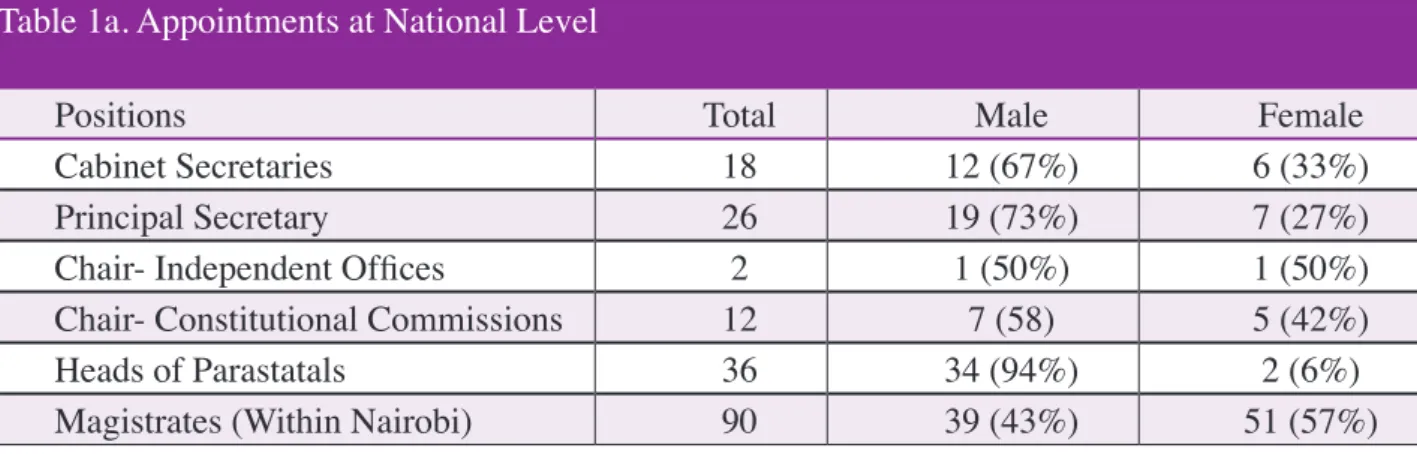
NGEC has closely been monitoring appointments and nominations at national and county levels. Of interest is compli-ance with the constitutional provision in accordcompli-ance with article 81(b) that says not more than two-thirds of members of elective public bodies shall be of the same gender. The commission analyzed the level of representation of men and women in the national and county appointments and issued advisories and congratulatory messages as appropriate. Table 1a and Table 1b show a summary of the distribution of men and women by selected public positions. The results
indicate a significant gender gap.
Table 1a. Appointments at National Level
Positions
Total
Male
Female
Cabinet Secretaries
18
12 (67%)
6 (33%)
Principal Secretary
26
19 (73%)
7 (27%)
Chair- Independent Offices
2
1 (50%)
1 (50%)
Chair- Constitutional Commissions
12
7 (58)
5 (42%)
Heads of Parastatals
36
34 (94%)
2 (6%)
Magistrates (Within Nairobi)
90
39 (43%)
51 (57%)
Data source: NGEC data base, 2013Data on appointment of persons with disabilities to various positions indicate that the country needs to raise its efforts
to-wards representation of PWDS. During the year under review, only one out of the 26 Principal Secretaries were PWDs.
Two Judges and 5 Commissioners were also persons with disability. During the reporting period, the commission issued advisories to the state on observance of the two-thirds gender representation. Excerpt 1.1 and 1.3 is an advisory letter to His Excellency the President on appointment of Principal Secretaries and directors in the communications unit. Excerpt 1.2 is a response for the president.
N A T I O N A L G E N D E R A N D E Q U A L I T Y C O M M I S S I O N
The results in Table 1b show a significant gender gap in the appointments made at the county level. The commission
issued an early advisory note to the 47 county governments on value for protection and inclusion of the special interest
groups at all levels of decision-making. It is anticipated that in the next financial year the distribution of appointive posi -tions by gender at the county level will meet the minimum thresholds set by the law.
Table 1b. Appointments At County Level For Selected Positions
Position Total Male Female County secretaries 46 40 (87%) 6 (13) County Assembly Clerks 47 37 (79%) 10 (21%)
Data source: NGEC data base, 2013
During the year under the review, the commission began assessment of the levels of equality and inclusion in the private sector. Preliminary results indicate that by end of the year 2012, thirty four per cent of the 57 companies listed at the Nai-robi bourse do not have a woman on their board; women occupied 54 out of the 449 seats on the boards of the NSE-listed
companies; there was one female chair in a listed company as at 2012, a figure that rose to 5 by end of the 2013. Further
women take about 15% of wage employment in manufacturing, building and construction, electricity and water sectors.
In the next financial year, NGEC will continue to generate trends and levels in gender representation in private and pub -lic sectors as a measure towards ensuring equitable access to opportunities and resources by all Kenyans irrespective of age, tribe, ability or sex.
b) Advisories to the government agencies: An advisory to IEBC on nomination and election of Persons with Disability
The Commission coordinated development of an advisory to the IEBC on the representation of persons with disabilities in elective and nominative positions. This was occasioned by the observation of the electoral process lacking explicit measures for inclusiveness as provided in article 10 of the Constitution, subsequently disenfranchising persons with dis-abilities. The effort contributed in nomination of persons with disabilities in all 47 counties and subsequent participation and representation in the country politics as indicated in the Table 2.
Table 2: Representation Of Pwd At County And National Assemblies
Category County Assemblies Senate National Assembly
Number by Gender M F M F M F
Nominated by political parties 31 30 1 1 2 1 Elected persons 10 0 1 0 5 1 Data source: NGEC data base,
2013
=12 = Annual Report (2012-2013)
N A T I O N A L G E N D E R A N D E Q U A L I T Y C O M M I S S I O N
=
15 = Annual Report (2012-2013)Excerpt 1.3
Advisory to President on Review of Appointments in Communications Unit
c) Coordination of public education on equality and inclusiveness for special interest groups in the 2013 general election.
Towards the end of 2012, the Commission in collaboration with other government agencies planned and executed public education program to enhance political participation of men, women, youth, persons with disabilities and minority and marginalized groups in the nomination of candidates for the 2013 elections and in subsequent voting activities in March 2013. The program facilitated by experts in the ECOSOC and civil rights were conducted in Garissa, Homabay, Kisumu,
Ki-sii, Turkana, Baringo, Nakuru, West Pokot, Kajiado, Narok,
Isiolo, Bungoma, Busia, Vihiga, Kakamega Nyeri, Kerugoya,
Kilifi, and Taita Taveta and reached at 2000 persons of the
primary audience for the Commission.
d) Monitoring of campaigns and voting in the 2013 general elections
The Commission designed an election campaigns and voting monitoring programs to audit the compliance of the state with the 2010 Constitutional provisions. The monitoring activities covered all components of the 2013 elections includ-ing voter education, campaigns, pollinclud-ing and post-pollinclud-ing. The coverage of the program is presented in Figure 1.
Figure 1: Coverage of observation and monitoring of 2013 electi
ons
‘While observers were posted in all 47 coun
-ties, 48 per cent of the counties received
moderate (4-6 observers per county) to high
(7 or more observers per county). The rest of
the counties had low coverage (presence of
1-3 observers per county)’, NGEC election
observation report, 2013
.
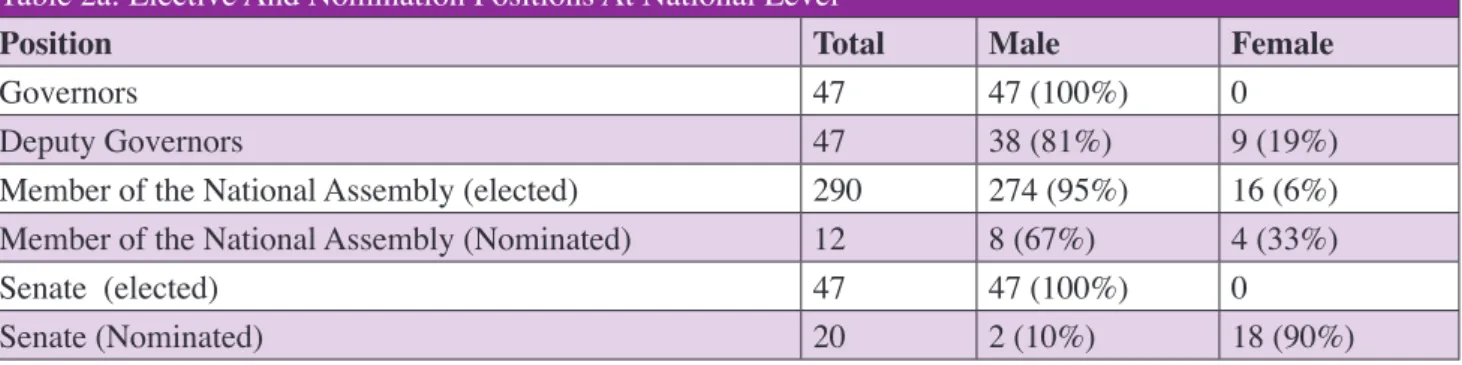
Table 2a and Table 2b show a summary of the distribution of the number of positions by gender at county and national level following the 2013 general elections. Turkana Marsabit Mandera Wajir Isiolo Samburu West Pokot Trans Nzoia BungomaKeiyo MarakwetBaringo
Uasin Gishu Laikipia Tharaka Meru Nyeri Embu Kirinyaga Murang’a Garissa Lamu Tana River Kilifi Mombasa Kwale Taita Taveta Kitui Kajiado Makueni Machakos Kiambu Narok Nakuru Nyandarua Kericho Bomet Kisii Nyamira Migori Homa Bay Kisumu Nandi Vihiga Kakamega Busia Siaya Nairobi
NGEC PRESENCE IN ELECTION OBSERVATION BY COUNTY
Legend County Intensity _ High Low Medium
N A T I O N A L G E N D E R A N D E Q U A L I T Y C O M M I S S I O N
Table 2a. Elective And Nomination Positions At County Level
Positions Total Male Female
MCA (elected) 1450 1368 (94%) 82 (6) MCA (nominated) 778 146 (19%) 632 (81%)
At the national level, 22 persons out of the 290 elected members of national assembly are youth
(about 8%).
Table 2a: Elective And Nomination Positions At National Level
Position Total Male Female
Governors 47 47 (100%) 0 Deputy Governors 47 38 (81%) 9 (19%) Member of the National Assembly (elected) 290 274 (95%) 16 (6%) Member of the National Assembly (Nominated) 12 8 (67%) 4 (33%) Senate (elected) 47 47 (100%) 0
Senate (Nominated) 20 2 (10%) 18 (90%)
e) Public education on inclusion of PWD in the construction industry
The physical access to utilities in public and private sectors is one of the greatest factors reducing empowerment oppor-tunities for persons with disabilities particularly those with physical impairments. The re-engineering of the construction
industry to increase physical access to space and utilities can significantly lead empowerment of the PWD. The com -mission in partnership with the National Construction Authority, Road and Civil Engineers Contractors Associations,
An IEBC official (left) takes a voter through the voting process
(RACECA), Ministry of Housing officials, Roads and Public Works, Kenya Federation of Master Builders, Private Sec -tor Contrac-tors delivered a comprehensive educational program on mainstreaming issues of PWD in built environments. The program reached 4,755 professionals in the industry and follow up meetings will continue in the next financial year.
f) Audit and monitoring of the participation of the vulnerable populations in interventions designed for empowerment of these populations. The case of cash transfer
In April 2013, the commission in collaboration with the current Ministry of Labor, Social Security and Services designed an audit program to assess the level of participation of the vulnerable populations receiving cash transfers (children, persons with severe disabilities, and the elderly) and their care givers in the programs designed to improve livelihoods
and image of the vulnerable population. The first phase of the program was implemented in April 2013 and involved stakeholder consultation meetings with Gender officers, county commissioners, social workers, children officers, and heads of schools in 8 counties; Kirinyaga, Machakos, Nakuru, Baringo, Mombasa, Kilifi, Nyamira, and Homabay. The second phase will be implemented in the 2013/14 financial year. The project was launched when cash transfer programs were marked with dissatisfaction among beneficiaries and complaints of misappropriation of the funds.
g) Coordination of mainstreaming issues of youth and children in development agenda
In line with the function on coordination, the commission facilitated a consultative forum of partners whose core busi-ness is funding or programming on issues of children and youth to develop a common strategy for greater mainstreaming
of principles of equality and inclusion in the children and youth agenda. Two separate forums were organized. The first
one targeted children and the other youth. Key emerging issues are as follows:
Children
➫
Need for higher budgetallocations for programs on children ➫ Facilitate research and documentation
on children’s services at the national and county levels
➫ Monitor, audit and advise the govern-ment on compliance and quality assur-ance on children’s issues
➫ Create public awareness on parental and children’s rights and responsibilities ➫ Country response to crimes committed
to children or committed by children e.g requirement of 10-15 years of experience for senior job positions
➫ Establishment of Job centers in every county to profile youth employment trends in the counties,
➫ Implementation of practicable employ-ment policies such as skills developemploy-ment and access to information,
Youth
➫ Evidence based programming using col-lated response from the child hot line ➫ Assurance of ECOSOC rights for children
at county level
➫ Programs to eliminate child labor
➫ Access to drugs and rehabilitation for destitute children
➫ Education and training
➫ Youth participation in decision making ➫ Youth health/drug abuse
➫ Establish a conducive legal framework to remove discrimination in labor laws ➫ Internship and mentorship programs,
access to markets and credit facilities and implementation of the presidential directive on 30% government contracts awards for youth.
N A T I O N A L G E N D E R A N D E Q U A L I T Y C O M M I S S I O N
3.1.2 strengthening legislation at all levels and sectors to achieve gender equality and inclusiveness
During the financial year, the commissions as single entity or in collaboration with other state and non-state actors reviewed bills, laws and policies at national and county level to assess their sensitivity and specificity on principles of equality and inclusion. Further, the commission filled court cases and petitions or enjoined other parties in court to seek
constitutional interpretation or judicial direction on matters affecting equality and inclusion.
a) litigation diary
Supreme Court Ref No 2. of 2012: Gender representation at National assembly and Senate
NGEC enjoined in this petition in which the Attorney General sought an advisory opinion from the Supreme Court on whether the enforcement of the two-third principle at the National Assembly and Senate should be immediate or progressive. NGEC in its submissions presented a case for the immediate realization of gender representation both at the National Assembly and Senate. There being no mechanism in Articles 97 and 98 of the Constitution to achieve the principle at the Senate and National Assembly, NGEC urged the Supreme Court to advice the state to put in place mea-sures to ensure the principle is realized in the general election scheduled for 4th March, 2013 to avert a constitutional crisis. The court in its majority ruling held that gender representation was progressive till 2015. The commission will coordinate efforts towards development of legal framework to help the state achieve the two-third-gender representation at the Senate and National Assembly.
Petition No 147 of 2013: Nomination process for special seats
Being the key custodian of the rights of the vulnerable in society, the Commission moved to court to secure their rights after the nomination process conducted by political parties. This was prompted by failure of the exercise to meet the
minimum threshold of the constitutional and legal provisions in articles 90, 97, and 98 and 177. NGEC’s argument
before the High Court was that the IEBC had failed in its constitutional responsibilities under Article 90(2) to conduct and supervise the elections of special seats to the National Assembly, Senate and the County Assemblies, culminating
to the flawed exercise. The court in its judgment among others ordered for the publishing of the county assembly lists
for special seats by IEBC in the local dailies and subsequently tribunals were set up to allow complaints on the basis of the published lists.
Supreme Court Advisory No 1. of 2013
Following the Judgment in Petition No 147 of 2013, NGEC moved to the Supreme Court to seek an advisory opinion on some of the unresolved issues in the petition against IEBC on party lists. Such issues include; interpretation of what
amounts to ‘special interests’ whether such meaning is fixed in law and who determines such special interests. The proceedings of the case will continue to the next financial year.
Petition No 432 of 2012: Discrimination of SDA Students
The commission enjoined as amicus curiae (friend of the court) in this petition seeking to assist the High Court on the interpretation on the right to freedom of conscience, religion, thought, belief and opinion. This petition concerns students who profess the Seventh Day Adventist faith and their right to manifest the same in schools. The petitioners claim that their right to manifest religion through worship and observing the Sabbath day was being violated. The case
proceeds to next financial year
Petition No 266 of 2013: Violation of the rights of persons with intersex condition
This case concerns persons with intersex conditions who claim violation of their fundamental right to legal recognition. This petition seeks the high court to address the vital issues surrounding intersex persons including the right of parents Vis a Vis the consent of minors in conducting corrective surgery. The intersex persons in Kenya constitute a minority category facing discrimination and stigma from the society. In pursuant of its mandate, NGEC became enjoined as an
interested party in this petition which proceeds to the next financial year.
b) Complaints
During this year the Commission received complaints distributed as follows.
c) Rapid investigations
Effect of violence in Tana River on the vulnerable populations
NGEC took a rapid response mission following lence that erupted in the Tana Delta in 2012. The
vio-lent conflict resulted in over 100 casualties, assaults,
destruction of property and internal displacements. The youth in Tana Delta were the primary actors in
the systematic conflict. The commission presented the findings to a task force set up to investigate the causes
of violence at the Tana Delta. Deserted: Chamwanamuma village in Tana Delta lies in ruins
N A T I O N A L G E N D E R A N D E Q U A L I T Y C O M M I S S I O N
d) Teenage pregnancies at Chepkurkur Primary School, Mt. Elgon
The commission executed a preliminary investigation in allegations of increased incidences of pregnancies in primary
schools located in Mt. Elgon. The report pointed to the gravity of the issue and in the next financial year, the commission
plans a public inquiry into the aspects of teenage pregnancy providing a platform for the victims to speak to experts and for NGEC to analyze the effectiveness of the existing legal framework. The inquiry will make appropriate recommenda-tions thereafter.
3.1.3 state compliance with international and regional reporting obligation
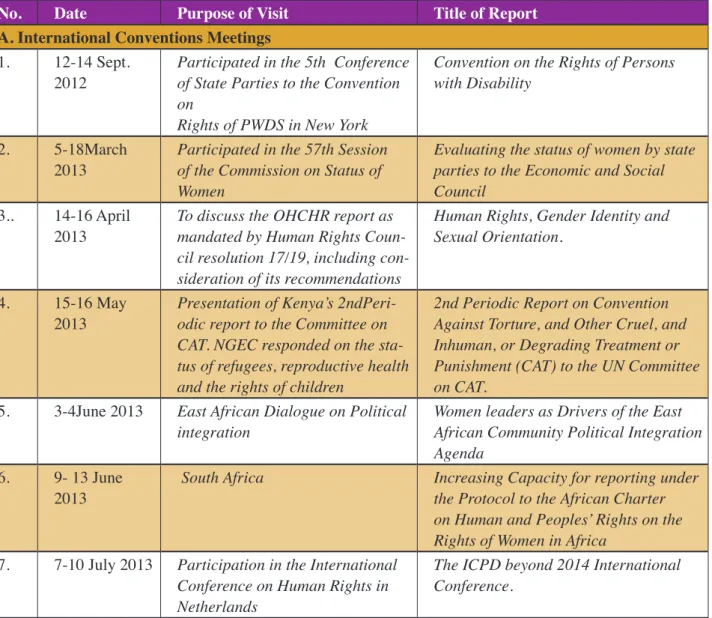
One of the key functions of NGEC is to work with other relevant institutions in the development of standards for the implementation of policies for the progressive realization of the economic and social rights (ESC rights) with the view of making recommendations for the improvement of the functioning of the institutions concerned. During the year, the
commission fulfilled this mandate through several interventions summarized in the Table 3.
Table 3. Participation in Kenya’s reporting mechanism
No. Date Purpose of Visit Title of Report
A. International Conventions Meetings
1. 12-14 Sept.
2012 Participated in the 5th Conferenceof State Parties to the Convention on
Rights of PWDS in New York
Convention on the Rights of Persons with Disability
2. 5-18March
2013 Participated in the 57th Session of the Commission on Status of Women
Evaluating the status of women by state parties to the Economic and Social Council
3.. 14-16 April
2013 To discuss the OHCHR report as mandated by Human Rights Coun
-cil resolution 17/19, including con
-sideration of its recommendations
Human Rights, Gender Identity and Sexual Orientation.
4. 15-16 May
2013 Presentation of Kenya’s 2ndPeriodic report to the Committee on -CAT. NGEC responded on the sta
-tus of refugees, reproductive health and the rights of children
2nd Periodic Report on Convention Against Torture, and Other Cruel, and Inhuman, or Degrading Treatment or Punishment (CAT) to the UN Committee on CAT.
5. 3-4June 2013 East African Dialogue on Political
integration Women leaders as Drivers of the East African Community Political Integration Agenda
6. 9- 13 June
2013 South Africa Increasing Capacity for reporting under the Protocol to the African Charter on Human and Peoples’ Rights on the Rights of Women in Africa
7. 7-10 July 2013 Participation in the International Conference on Human Rights in Netherlands
The ICPD beyond 2014 International Conference.
8. 16 – 20July
2013 Reconvening of the 2ndSectoral council on gender, youth, children, social protection and commu
-nity development held in Dar es Salaam
East African Community Report.
No Date Purpose of Visit Title of Report
B. Regional Meetings
1. 10 Dec 2012 EAC workshop on the role of pri
-vate sector and civil society in the implementation of the EAC com
-mon market protocol- Tanzania
East African Community Common Mar
-ket protocol
2. 9- 1 June 2013 Increasing Capacity for reporting under the Protocol to the African Charter on Human and Peoples’ Rights on the Rights of Women in Africa held in South Africa
Protocol to the African Charter on Hu
-man and Peoples’ Rights
3.1.4 Enhanced institutions capacity to respond to, manage and reduce prevalence of SGBV
a) Monitoring of gender mainstreaming in the public sector through performance contracting
NGEC has continued with monitoring levels and trends in mainstreaming of gender through performance contracting system in the public sector. The indicators are under revision to be both gender and equality responsive. It is envisaged that the review will ensure equality; diversity and inclusion are adhered to by all institutions that sign the performance contracts. NGEC will through this process develop a model tool that will be used to audit individual institutions for gender equality and non-discrimination.
b) Gender-based Violence (GBV) Coordination and Monitoring
The commission continued to coordinate the National GBV Sub-cluster Working Group. This working group meets
monthly and it is designed to provide a platform through which members can share information, strategize and collabo-rate in various activities. It also provides a forum through which members can coordinate responses on emerging issues. NGEC as an oversight body therefore gets the opportunity to audit policies, laws and programmatic interventions, at the national and county levels.
At county levels, NGEC supported working groups in Kangemi, Dagoretti, Langata and Makadara areas, Nakuru and Naivasha. This coordination has enabled NGEC to identify relevant gaps in GBV work and address them appropriately.
N A T I O N A L G E N D E R A N D E Q U A L I T Y C O M M I S S I O N c) International days related to gender issues
The International Day of Families
The UN International Day of Families is celebrated every year on the 15th May. The 2013 theme was;
‘Advancing social integration and inter
-generational solidarity’
To commemorate the day, the Commis-sion marked the day by facilitating an in-tergenerational forum on SGBV and female genital mutilation abandonment in Kajiado County on SGBV.
16 Days of Activism against GBV in the year 2012
The commission spearheaded the national launch of 16 Days of Activism against Gender Violence through an event held in Nairobi. Together with its
part-ners, NGEC adopted the theme: ‘Cha
-guaamani, komesha dhuluma yakijinsia’
(Vote Peace Stop Sexual Violence) as its key message, to advocate for peace before, during and after elections in March, 2013. The national launch kicked off from Uhuru Park Nairobi to Korogocho grounds and was graced by representatives from, the Commission on the Implementation of the Constitution (CIC), the Independent and Electoral Boundaries Commission (IEBC), and the International Great Conference on the Great Lakes Region among others rep-resenting the local administration and reli-gious leaders.
NGEC Program staff with Maasai women in Kajiado County
A caravan snakes its way to city estates campaigning against SGBV
3.1.5 Enhanced national and county machinery for mainstreaming issues of SIG in the development agenda
a) Advocacy for a State machinery responsible for gender equality and other SIGs
The commission with support from state and non-state agencies advocated for the establishment of a strong national machinery responsible for mainstreaming issues of gender and SIG during the constitution of Jubilee government. H.E The President committed to ensure gender issues are mainstreamed in all levels of government.
b) National Police Recruitment Monitoring
The Commission participated in monitoring of police recruitment exercise to ensure equal participation of its target
groups. Monitoring was conducted in Siaya, Narok, Bondo, Meru, Nairobi, Taita Taveta, Meru and West Pokot. A
comprehensive report was shared with the National Police Service with recommendations on strategies for incorporat-ing principles substantive equality in subsequent recruitment exercises. Overall, the recruitment reached the minimum threshold required for gender (30%).
c) Facilitation for development of marginalization policy and sharing of the Equalization Fund in Kenya
The Commission engaged relevant stakeholders in the development of marginalization policy and sharing of the equal-ization fund. The policy is intended to set out criteria for identifying marginalized areas in Kenya and to recommend procedures for the utilization of the Equalization Fund as stipulated in Article 204(2) of the Constitu
tion. A variety of
opinions generated at the workshop shaped the development of the marginalization policy and an agreeable
formula for sharing of the equalization fund in the country.
d) Understanding equality and inclusion from the perspective of minority and marginalized groups
and communities
In May 2013, the commission through invitation of selected minority and marginalized groups facilitated an
assessment on the understanding and applicability of principles of equality and inclusion among historically
marginalized small communities. The program reached 5 communities; Waata, Yiaku, Terik, Il-chamus, and
Wailwaana.
e) Empowering women and youth with the knowledge and skills to improve their socio-economic
and health situation
With financial support from European Union through DSW, the commission implemented an empowerment
program for youth and women in
the informal settlements of Nairobi
engaged in the informal businesses
through skill development, exposure
to economic empowerments, and
ex-change program. The intervention
branded ‘Fit for Life’ is implemented
with technical support from
Minis-try of Health, Directorate of youth,
and department of cooperatives. The
commission is currently reviewing
legislative framework for the
infor-mal business in Kenya to inform the
last phase of this program.
N A T I O N A L G E N D E R A N D E Q U A L I T Y C O M M I S S I O N
PART TWo
InsTITUTIonAl sTRenGTHenInG
=
1 =
Annual Report (2012-2013)
NATIONAL
GENDER AND
2012-13
EQUALITY
COMMISSION
A N N U A L R E P O R T
©
NGEC, 2014
National Gender and Equality Commission
Solution Tech Place, 1stFlr, Longonot Road, Upper hill,
Next to Crowne Plaza Hotel
P.O.BOX 27512-00506, Nairobi, Kenya
Tel +254 2(20)-272-7778
www.ngeckenya.org
Tweet: @NGECKENYA
PART 2
4.0. InsTITUTIonAl sTRenGTHenInG 4.1 launch of the strategic Plan 2013 -2015
In order to realize its full mandate, the Commission, through a broad based consultative process designed its first three-year Strategic Plan, dubbed, ‘Our First Mile’. The Strategic plan lays the foundation of engagement with State and non-state actors, the SIGs and Ke-nyans at large.
Unveiling of NGEC Strategic Plan
4.2 Human Resources and Administration
4.2.1 Application of best practices and lessons from other independent institutions: In effort to apply practical lessons and best practices in the integration of principles
of equality and inclusion, the commission has consulted numerous human rights independent institu-tions in Kenya, Eastern Africa, and Africa and in the World. Between April and June 2013, the commis-sion benefited from two learning miscommis-sions to South Africa and United Kingdom. The commiscommis-sion in -tends to embrace mechanism for realizing substantive and transformative equality learned from these two countries.
4.2.2 Staff development: During the reporting period, NGEC staffing levels grew five-fold. In order to ad-equately equip the staff with the necessary skills to deliver on the core mandate of the commission, five skill and competency development courses were offered: The Public Procurement, Corporate Gover-nance, International Treaties, Gender Mainstreaming, and Disability Mainstreaming.
4.2.3 Staff welfare: The commission has established a voluntary staff welfare association
N A T I O N A L G E N D E R A N D E Q U A L I T Y C O M M I S S I O N
4.3 Institutional Image and branding
4.3.1 Launch of Logo: During the review period, the commission launched a logo developed through a competitive creative initiative. The logo is expected to frame and position the identity of the commission along its core mandate.
4.4 Information, education and Communication
The Commission disseminated educational materials and information through simple brochures, documenta-ries, website, edited volumes, response to media requests, television and radio shows, press releases (statement and conferences), and organized dialogue and dissemination meetings. During the review period, the commission complet-ed development of a website and com-menced communications with public through social media mainly face book Page, Twitter Account and YouTube Channel to complement other communication channels.
4.5 Internal Audit
In the reporting period, the Commission established an Internal Audit function to provide assurance and improve effectiveness in the key areas of Risk Management, Control and Governance processes
4.6 Procurement
In order to streamline the procurement process, the Commission during the reporting period under-took far reaching measures aimed at strengthening the institutional and structural capacity of the de-partment to respond to the various procurement requests. These include, establishment of an adhoc committee, the Inspection and Acceptance Committee, and organizing a training on public procure-ment regulations and Act. Further, the commission has extended numerous procureprocure-ment opportunities to youth, women and PWD to comply with the 30% preferential procurement rule. Through prequali-fication of suppliers, the commission has responsive bid in 56 categories.
Gender Minister Naomi Shabaan launches the NGEC logo
N A T I O N A L G E N D E R A N D E Q U A L I T Y C O M M I S S I O N
28
PART THREE
FINANCIAL STATEMENTS
=
1 =
Annual Report (2012-2013)
NATIONAL
GENDER AND
2012-13
EQUALITY
COMMISSION
A N N U A L R E P O R T
©
NGEC, 2014
National Gender and Equality Commission
Solution Tech Place, 1stFlr, Longonot Road, Upper hill,
Next to Crowne Plaza Hotel
P.O.BOX 27512-00506, Nairobi, Kenya
Tel +254 2(20)-272-7778
www.ngeckenya.org
Tweet: @NGECKENYA
N A T I O N A L G E N D E R A N D E Q U A L I T Y C O M M I S S I O N
38
PART FOUR
KEY CHALLENGES RECOMMENDATIONS
AND PRIORITY AREAS
=
1 =
Annual Report (2012-2013)
NATIONAL
GENDER AND
2012-13
EQUALITY
COMMISSION
A N N U A L R E P O R T
©
NGEC, 2014
National Gender and Equality Commission
Solution Tech Place, 1stFlr, Longonot Road, Upper hill,
Next to Crowne Plaza Hotel
P.O.BOX 27512-00506, Nairobi, Kenya
Tel +254 2(20)-272-7778
www.ngeckenya.org
Tweet: @NGECKENYA
N A T I O N A L G E N D E R A N D E Q U A L I T Y C O M M I S S I O N
PART 4
6.0 KeY CHAllenGes, ReCoMMenDATIons AnD PRIoRITY AReAs 6.1 Challenges
● The mandate of the commission is broader than promoting gender equality. Many players,
indi-viduals and agencies in private and public sector tend to associate the Commission with women affairs only leaving out a significant proportion of the core mandate around freedom from dis -crimination, inclusion and realization of the ECOSOC rights.
● With the operationalization of the devolved system of government, the Commission must
de-volve the services to the greatest extent possible. However, special interest groups are first and foremost vulnerable due to their geographical location and residence relative to the source of development programs. This means the Commission at minimum must establish presence in all counties, a program that will require a significant amount of fiscal and human resources
● The commission like many government agencies experienced reduction in budget allocation. The
budgetary measures affected the implementation of interventions in national and county levels.
● The Commission has a significant function of integrating principles of equality and inclusion in
the private sector. During the reporting period, the commission spent significant amount of time introducing the function and concept in the private sector. The achievement so far is dismal and more effort and partnership is required in the new fiscal year to stimulate private sector to begin embracing in all their development agenda the fundamental principles of equality and inclusion
● Beginning March 2013, the Commission was functioning with mere three commissioners in offi
-cer. Given the importance and complexity of the mandate of NGEC, the performance of the Com-mission was affected. The appointment of additional two comCom-missioners as required by law will not only improve on the governance of the institution but also expand the coverage and increase intensity of coverage of functions assigned to the commission
6.2 Recommendations
● The commission will commence an intensive resource mobilization from the national
govern-ment. In order to effectively fulfill its mandate the state through parliament should consider in -creasing the budget allocation of the commission to at least 500 million per year. The commission will also work closely with the development partners to meet the financial gaps from the state funds.
● The state should consider facilitative the commission with the establishment of the regional and
county offices through allocation of minimal resources to meet recurrent expenditure on rent and salaries and some funding for programming. The state through the National Treasury should consider allowing the commission to hire additional staff at national and county offices to meet the technical gaps existing in its current staff structures.
● The appointment of two commissioners by His Excellency The President, will not only improve
the governance of the Commission but will facilitate the commission to fulfil its mandate with necessary efficiency and speed.
● The Commission should establish a stronger partnership with the private sector and with
gov-ernment institutions working with the private sector such as Vision 2030, Ministry of industrial-ization to identify key gaps and opportunities for integrating principles of equality and inclusion with greatest impact on the special interest groups.
6.3 Priorities for 2013/2014
a) Monitor the social security sector with focus to elderly and vulnerable children. NGEC will par-ticipate in the review of relevant policies in this sector.
b) Facilitate creation and review of legal frameworks to support gender equality and inclusion such as national equality policy, tax exemption for persons with disability, community land eviction and resettlement bills.
c) Advance issues of equality and inclusion in the private sector through identification of alliances and networks from private and public sectors, establishment of standards and benchmarks for equality and inclusion in the private sector.
d) Coordinate responses to reduction of sexual gender based violence including undertaking 16 international days of activism and costing of SGBV model services at national and county levels. e) Advice and support county and national governments to implement basic standards of gender
equality and inclusion of special interest groups through SIG responsive budgeting.
f) Provide county governments and private sector with guidelines for realization of the economic social cultural rights. The intervention will target county public service boards, members of the county assembly, and the county executives.
g) Facilitate the implementation of critical recommendations from Truth Justice and Reconciliation Report on land use and access among the marginalized and minority communities.
h) Support the national government in reporting at international platform of the country progress performance on international, regional treaties and conventions due during the year.
i) Develop minimal indicators for measuring mainstreaming issues of gender in the public sector. j) Collaborate with universities and research institutions to entrench equality and inclusion
pro-grams on sexual and reproductive health rights, built environments, educational curricular, na-tional and county planning, and women and peace initiatives.
N A T I O N A L G E N D E R A N D E Q U A L I T Y C O M M I S S I O N
APPENDIX
PRofIle of CoMMIssIoneRs AnD CHIef eXeCUTIVe offICeR
Winfred Lichuma is the Chairperson of The National Gender and Equality Commission (NGEC). Winfred is a Lawyer of over 20 years standing. She holds an LLB from the University of Nairobi, an LLM from the University of Essex in United Kingdom and a MA in Gender and Development from the University of Nairobi.
Previously she served as a Commissioner at the Kenya National Com-mission on Human Rights and has been a legal adviser to the National Aids Control Council.
She has also worked as a practicing Advocate of the High Court of Kenya. She began her career as a Magistrate of the High Court of Ke-nya, a position she held for ten years and served around the country, growing up the ranks to Senior Resident Magistrate. Winfred has wide experience in gender mainstreaming and in human rights promotion and programming.
Commissioner Simon J. Ndubai is a B. Com.Graduate from Poona Uni-versity. Mr. Ndubai has served as an Internal Auditor in both the Gov-ernment and parastatals for a period of over 20 years, serving various capacities. Outside his professional duties, he has served as the Trea-surer of Elimu Co-operative Society, Chairman of Nairobi Branch of the Association for the Physically Disabled of Kenya, Assistant National Treasurer of the Association for the Physically Disabled of Kenya, Di-rector of the National Council for Persons with Disabilities, Chairman of the Audit Committee of the National Council for Persons with Dis-abilities, Commissioner Simon J. Ndubai member of the Trustees of
Kenyatta National Hospital Superannuation Scheme and Chairman of the Trustees Welfare Committee of Kenyatta National Hospital Super-annuation fund. Mr. Ndubai is an expert on disability. He has been involved in the formulation of Persons with Disabilities Act 2003, Spe-cial Education Policy, Disability Policy, and implementation of African Decade for Persons with Disabilities, Constitution making process, for-mulation of the Convention on the Rights of Persons with Disabilities, and a member of the Mainstreaming Committee on issues of Persons With Disabilities at Kenyatta National Hospital.
Winfred O. Lichuma. EBS
Commissioner Simon J. Ndubai
Commissioner Gumato Ukur Yatani joined NGEC in November 2012 after taking oath of office replacing Commissioner Lydia Gachoya whose term expired on June 2012. She holds an MBA in Human Resource Man-agement from the University of Nairobi and a Bachelor of Education de-gree from Moi University. She is currently pursuing her doctoral studies on gender and diversity management at the Vienna University of Eco-nomics and business.
Commissioner Gumato formerly worked as an undersecretary in the Of-fice of the President till 2011. Between 2005 and 2008, Mrs. Yatani worked as the head of organization development and Human Resource Manager with Kenya Red Cross Society.
She has also worked with the Kenya Post Office Savings bank as a senior field service training coordinator-Western Union. Mrs. Yatani has also served in various organizations including being the Vice Chair of Ewaso Ngiro North Development Authority and board membership of several local NGOs. She is currently the convener of the Minorities and Margin-alized Department at the Commission.
Prof. Rose A. O. Odhiambohas a background in Gender Mainstreaming, Scientific Research, Curriculum Development and Institutional Manage-ment. She has worked for the Kenya Medical Research Institute as a Re-search Officer, at Egerton University’s Department of Biological Sciences as a Senior Lecturer, and was until her appointment as the Director of the University’s Institute for Women, Gender and Development Studies (IWGDS) for over 10 years
Prof. Rose A. O. Odhiambo Commission secretary Commissioner Gumato Ukur Yatani
N A T I O N A L G E N D E R A N D E Q U A L I T Y C O M M I S S I O N