Selection and Prioritization of Adaptivity
Criteria in Intelligent and Adaptive
Hypermedia e-Learning Systems
Maja Gligora Marković
1,
Nikola Kadoić
2, Božidar Kovačić
3 1Polytechnic of Rijeka,Croatia
2
Faculty of organisation and informatics Varaždin,Croatia
3
Department of Informatics, University of Rijeka,Croatia
Abstract – One of the main characteristics of Intelligent and Adaptive Hypermedia E-Learning Systems (IAHe-LS) are adaptivity criteria. Selecting adaptivity criteria is one of the main steps in developing a prototype of a System for Dynamic Generating of Learning Objects (SDGLO) that will support the individual personalised learning process. The selection of those criteria has a high impact on the quality of usage of those systems. This paper presents research into prioritisation of adaptivity criteria from the perspective of their usage and the selection of adaptivity criteria for creating the SDGLO prototype. The methods that were used in the research are: descriptive statistics, Cronbach Alpha, one-way ANOVA, and Analytic Hierarchy Process (AHP) with final qualitative analysis. In conclusion, for the development of a prototype of SDGLO, the adaptivity criteria that are selected are learning style, cognitive style and learning goals.
Keywords – SDGLO, adaptivity, criteria, adaptive hypermedia e-learning system, intelligent e-learning system
DOI: 10.18421/TEM71-16
https://dx.doi.org/10.18421/TEM71-16 Corresponding author: Maja Gligora Marković,
Polytechnic of Rijeka,Croatia
Email: [email protected]
Received: 14 October 2017. Accepted: 22 December 2017. Published: 23 February 2018.
© 2018 Maja Gligora Marković, Nikola
Kadoić, Božidar Kovačić; published by UIKTEN. This work
is licensed under the Creative Commons Attribution-NonCommercial-NoDerivs 3.0 License.
The article is published with Open Access at www.temjournal.com
1. Introduction
One of the main social activities is a transfer of knowledge. The learning process is a dynamic process that can be found in many different forms. The form of learning in which ICT technologies are used to access learning materials is called e-learning. E-learning systems enable access to electronic learning sources without space and time limitations [1]. Together with these systems, learning materials creation paradigm has been changed, and objects of learning have been introduced as holders of learning materials. Learning objects in most cases have to satisfy criteria such as: reusability, multi-purposefulness, the interdependence of technology and modularity [2]. Traditional hypermedia e-learning systems enable access to the same e-learning materials for all students, however the specific needs of the specific students are not satisfied in a compatible way [3], [4]. On the other hand, adaptive hypermedia e-learning systems enable the adaptation of content and navigation according to different criteria [5–7]. These systems are often integrated into intelligent e-learning systems [8–10]. A System for Dynamic Generating of Learning Objects (SDGLO) represents a subsystem of Intelligent and Adaptive Hypermedia e-Learning Systems, IAHe-LS. In the SDGLO the dynamism is realised through adaptivity criteria and decision-making methods about their application.
This paper presents research into adaptivity criteria prioritization (from the perspective of their use in practice) and the selection of adaptivity criteria for creating the SDGLO prototype by using different methods: descriptive statistics, Cronbach Alpha, one-way ANOVA and the Analytic Hierarchy Process (AHP). The goal of the research is to determine how often teachers in Croatia use adaptivity criteria in diverse ways of teaching (individual, group, direct) during the teaching process. The second goal is to make a decision on selecting the adaptivity criteria in the SDGLO prototype creation. In that direction,
there are four research questions related to this research:
1. How often are specific adaptivity criteria used in the teaching process considering the way of teaching?
2. Is there any difference in the frequency of usage of different adaptivity criteria in the teaching process?
3. How to make a decision on the selection of adaptivity criteria for creating the SDGLO prototype?
4. Which adaptivity criteria should be chosen with the goal of creating the SDGLO prototype?
2. Adaptivity criteria – state of the art
One of the main characteristics of Intelligent and Adaptive Hypermedia E-Learning Systems (IAHe-LS) are adaptivity criteria. Selecting adaptivity criteria is one of the main steps in developing the prototype of a System for Dynamic Generating of Learning Objects (SDGLO) that will support individual personalized teaching process. The selection of those criteria has a high impact on the quality of usage of those systems.
Authors Kurilovas et al. investigated and proposed Semantic Web approaches to improving the adaptation quality of Virtual Learning Environments (VLEs). These approaches are the method for the semantic search for Web 2.0 tools in VLEs, and the method for curriculum mapping and semantic search for Learning Objects (LOs) in VLEs [11].
In paper [12] the general agent-based architecture of MAGADI and some results of the prototype-testing are presented. The MAGADI framework resulted from merging characteristics of three current technologies: adaptive intelligent systems, authoring tools and LMS technologies. The goal was to create a dynamic system for blended learning. In addition, the paper presents a design of an adaptive e-learning application architecture based on the IEEE LTSA reference model. The model is based on the learners’ preference and knowledge level. Similarly, author of the paper [13] proposed the ways how to enhance an existing e-education system, namely, Moodle LMS, by developing a method for creating adaptive courses and comparing its effectiveness with a non-adaptive education approach.
Authors of paper [14] identified and analysed the characteristics of the IAHe-LS by examining the published scientific papers indexed in relevant databases with special focus to adaptivity criteria. They identified and analysed 24 different adaptivity criteria. In that previous research, analysis of characteristics of the IAHeLS from the position of
adaptivity criteria has been done. The adaptivity criteria were the following: login to the server (system), teaching strategy, personality, motivation, mood, emotions, student needs, progress in learning, students capabilities, visits of recommended web addresses, teachers’ preferences, access to learning resources, eye tracking, ICT skills, information about students, cognitive style, pedagogical rules and practices, students’ priorities, history of system usage, selection of learning content by students, learning goals, foreknowledge, learning style, knowledge.
The login to the server (system) criterion implies recording the number of user logs in the system for e-learning. The teaching strategy refers to a defined way of teaching such as direct teaching, individual teaching or teamwork. Personality as criterion refers to some specific characteristics of individual person which are stable over time and are psychological by their nature [15].
Motivation “refers to reasons that underlie behaviour that is characterized by willingness and volition [16].” Emotion “is a cultural and psychobiological adaptation mechanism which allows each individual to react flexibly and dynamically to environmental contingencies [17].” Mood is “considered as a group of persisting feelings associated with evaluative and cognitive states which influence all the future evaluations, feelings and actions [18].”
Students’ needs criterion refers to specific needs in the context of the learning content. These needs are individual for each subject. The criterion progress in learning is usually measured by the percentage of adoption of knowledge or with some other parameters which can be measured.
Students’ capabilities refer to their ability to read, learn, think critically and so on. The criterion visits of recommended web addresses refer to counting of recommended web addresses and using them for learning. The teachers’ preferences criterion refers mostly to the teaching method used by the teacher in the teaching process. The criterion’s access to learning resources refers to student’s opportunity for using different learning resources. The eye tracking criterion implies eye tracking during the usage of the e-learning system. ICT skills refer to skills in using information and communication technology. The criterion information about student refers to demographic data about a student. The criterion cognitive style refers to the way the students perceive and organize the world around them. The criterion pedagogical rules and practices implies a set of rules and practices defined by the teacher depending on the subject. The criterion students’ priorities refers to the priorities during learning. The criterion history of system usage implies all data about student’s history
of system usage. The criterion selection of learning content by students refers to tracking student’s ways of selecting the learning content in the system. The criterion learning goals refers to goals defined by the teacher or the student, which they want to achieve. The criterion foreknowledge refers to verification of the previous knowledge acquired. The criterion learning style implies the form of learning content that learner prefers during the learning process. The criterion knowledge refers to level of knowledge acquired during the learning process.
3. Research methodology
A questionnaire (using open source Lime Survey tool) was administered. The questionnaire was distributed through a web portal for e-learning Croatian academic and research network and web portal ucitelji.com. The main users of portal ucitelji.com are distinguished teachers in Croatia. The questionnaire consists of 2 sections. Section one relates to the demographic questions about respondents. Section two aims at determining the frequency of usage of adaptivity criteria in three ways of teaching.
The usual practice in the teaching process differs three basic ways of teaching: directed teaching, group teaching and individual teaching. Those ways were used in the questionnaire. Adaptivity criteria in the questionnaire were taken from previous research [19]. For the purpose of further research, the following adaptivity criteria were selected: learning goals, motivation level, learning style, cognitive style, foreknowledge, the knowledge adopted during the teaching class, progress during the teaching process, the psychophysical possibilities of the students, the availability of learning materials (sources), and the mood (emotions) of the student.
The selection of those criteria is based on the context of individual-personalised teaching, which proves and focuses on the student. The respondents were invited to assess the usage of each adaptivity criterion in specific ways of learning. The scale that was used is: never, rarely, sometimes, often and always. After the data were collected, data were processed by using the previously mentioned methods. The data collected from the participants that didn’t use all three ways in the teaching process weren’t used in data processing.
The collected data were processed by using several tools: MS Excel 2010, SPSS19 and Super Decision. 3.1. Statistical methods
Descriptive statistics, one-way ANOVA and Cronbach Alpha were used.
The descriptive statistics have been used to present the summarised description of the participants and their responses. It is the most often used part of the statistics. By using descriptive statistics, the collected data, such as the demographic data of the participants, can be easily presented. Besides that, descriptive statistics has been used in qualitative research to interpret the collected data, for example in the Delphi method [20]. In the interpretation, both absolute and relative numbers are used, as well as measures of central tendency (mode, average) and dispersion measures (standard deviation, variation coefficient).
ANOVA (analysis of the variance) is a method for comparing arithmetic means of several samples (data sets) to determine if there is any difference between means of several populations. In that way, the influence of one or more independent variables on one dependent variable is analysed. Independent variables are called “factors”, so we talk about one-factor, two-factor or multi-factor analyses of variance. The number of modalities of dependent variables influences the number of groups between which the differences are tested. One-way ANOVA represents method in which we have one independent variable (factor).
The reliability estimation procedure based on the internal consistency of the instrument is performed by computing the correlation of each particle with each other and estimating reliability based on the average amount of correlations thus obtained. Reliability is estimated by the internal consistency coefficient, and the most common is the Cronbach Alpha coefficient if the Likert scale was applied in the instrument [21].
3.2. The Analytic hierarchy process
The analytic hierarchy process (AHP) was applied to decide on the selection of adaptivity criteria important in creating the prototype of SDGLO. For each way of the teaching process, the AHP model was created in order to calculate weighted factors (priorities) of adaptivity criteria. The final goal is to reduce the number of adaptivity criteria.
There are several steps in applying the AHP:
1. Problem structuring – identifying the decision-making goal, criteria, subcriteria and alternatives and creating a hierarchal structure
2. Pairwise comparisons on each level of hierarchy (comparisons of criteria on first level of hierarchy in pairs with respect to the decision-making goal; comparisons of subcriteria in pairs with respect to superior
criteria; comparisons of alternatives in pairs with respect to the criteria and subcriteria in hierarchy that are not decomposed to subordinate subcriteria (leaves))
3. Calculating the criteria and subcriteria weights, local priorities of alternatives, as well as global priorities of alternatives 4. Conducting the sensitivity analysis.
In step 2, Saaty scale is used. It consists of nine degrees. In pairwise comparison, process decision-makers have to take care of the consistency of the comparisons. The details of the method can be found in [22–26].
4. Results
4.1. Survey participants profile
Fifty respondents that use three ways of learning in the teaching process participated in the survey: 11 males and 39 females.
Most of them are between 45-49 years old. Also, most of them are highly educated. All of them use ICT technologies in the teaching process. The frequency of usage of ICT technologies is given in Table 1. Experience in digital learning material development is given in Table 2. Workplaces of the respondents are given in Table 3.
Table 1. Usage of ICT in the teaching process
Always 18
Often 8
Sometimes 20
Rarely 4
Didn’t respond 3
Table 2. Experience in digital teaching material development
Much better than average 15
Better than average 7
Average 19
Worse than average 8
Didn’t respond 1
Table 3. Work place of survey respondents
Elementary school 28
High school 10
Vocational school 1
Polytechnic 8
University 3
50% of the participants have some experience in student online mentoring
4.2. Frequency of adaptivity criteria usage (descriptive statistics)
As it was already written, three ways of the teaching process were processed: direct, individual and group teaching. To respond to the first research question, the results will be interpreted separately for each way of teaching.
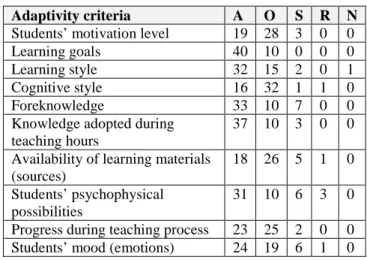
For each adaptivity criterion, the respondents could evaluate how often they use each of them in direct teaching. The results are presented in Table 4.
Table 4. Frequency of adaptivity criteria usage in direct teaching (A-always, O-often, S-sometimes, R-rear, N-never)
Adaptivity criteria A O S R N
Students’ motivation level 19 28 3 0 0
Learning goals 40 10 0 0 0
Learning style 32 15 2 0 1
Cognitive style 16 32 1 1 0
Foreknowledge 33 10 7 0 0
Knowledge adopted during teaching hours
37 10 3 0 0
Availability of learning materials (sources)
18 26 5 1 0
Students’ psychophysical possibilities
31 10 6 3 0
Progress during teaching process 23 25 2 0 0
Students’ mood (emotions) 24 19 6 1 0
The responses that prevail are “always” and “often” for all the above-mentioned criteria. The most used criteria are the learning goals. Also, it is possible to conclude that all criteria are used very frequently.
The results about frequency of adaptivity criteria usage in group teaching are presented in Table 5.
Table 5. Frequency of adaptivity criteria usage in direct teaching (A-always, O-often, S-sometimes, R-rear, N-never)
Adaptivity criteria A O S R N
Students’ motivation level 30 18 2 0 0
Learning goals 39 10 1 0 0
Learning style 26 18 4 1 1
Cognitive style 22 18 10 0 0
Foreknowledge 32 12 4 2 0
Knowledge adopted during teaching hours 28 17 4 1 0 Availability of learning materials (sources) 33 12 4 1 0 Student’s psychophysical possibilities 33 11 4 1 1
Progress during teaching process
18 29 3 0 0
Students’ mood (emotions) 26 20 3 1 0
When it comes to direct teaching, the responses that prevail are “always” and “often” for all criteria.
The results about the frequency of adaptivity criteria usage in individual teaching are presented in Table 6.
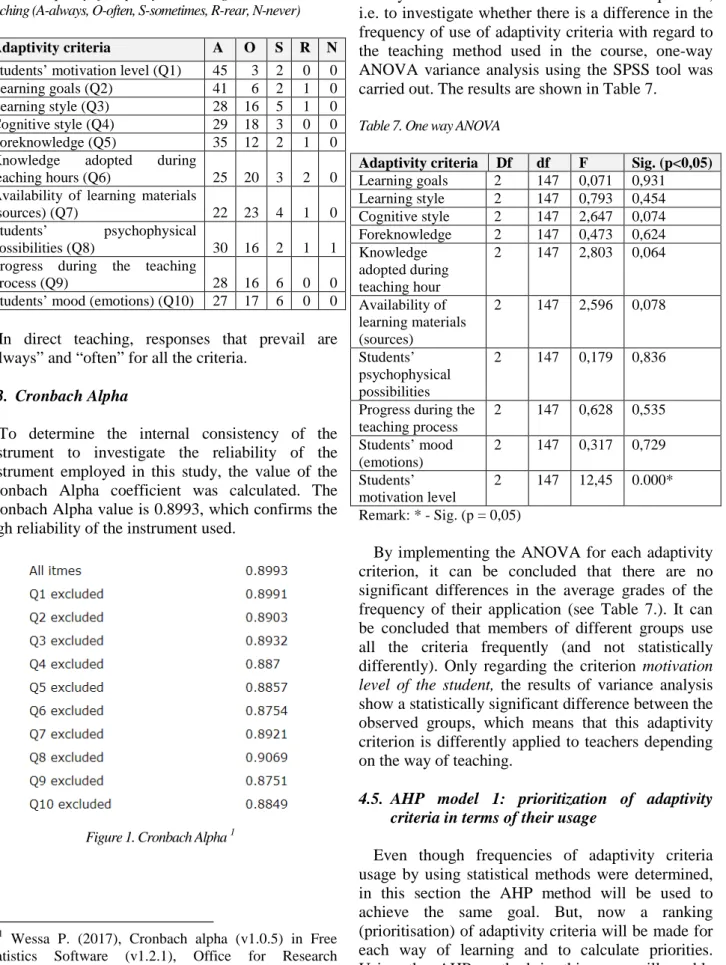
Table 6. Frequency of adaptivity criteria usage in individual teaching (A-always, O-often, S-sometimes, R-rear, N-never)
Adaptivity criteria A O S R N
Students’ motivation level (Q1) 45 3 2 0 0
Learning goals (Q2) 41 6 2 1 0
Learning style (Q3) 28 16 5 1 0
Cognitive style (Q4) 29 18 3 0 0
Foreknowledge (Q5) 35 12 2 1 0
Knowledge adopted during
teaching hours (Q6) 25 20 3 2 0
Availability of learning materials
(sources) (Q7) 22 23 4 1 0
Students’ psychophysical
possibilities (Q8) 30 16 2 1 1
Progress during the teaching
process (Q9) 28 16 6 0 0
Students’ mood (emotions) (Q10) 27 17 6 0 0
In direct teaching, responses that prevail are “always” and “often” for all the criteria.
4.3. Cronbach Alpha
To determine the internal consistency of the instrument to investigate the reliability of the instrument employed in this study, the value of the Cronbach Alpha coefficient was calculated. The Cronbach Alpha value is 0.8993, which confirms the high reliability of the instrument used.
Figure 1. Cronbach Alpha 1
1 Wessa P. (2017), Cronbach alpha (v1.0.5) in Free
Statistics Software (v1.2.1), Office for Research Development and Education, URL https://www.wessa.net/rwasp_cronbach.wasp/
4.4. One way ANOVA
From the analyses so far, it can be concluded that within all the criteria mostly are used “often” or “always”. To answer the second research question, i.e. to investigate whether there is a difference in the frequency of use of adaptivity criteria with regard to the teaching method used in the course, one-way ANOVA variance analysis using the SPSS tool was carried out. The results are shown in Table 7.
Table 7. One way ANOVA
Adaptivity criteria Df df F Sig. (p<0,05)
Learning goals 2 147 0,071 0,931 Learning style 2 147 0,793 0,454 Cognitive style 2 147 2,647 0,074 Foreknowledge 2 147 0,473 0,624 Knowledge adopted during teaching hour 2 147 2,803 0,064 Availability of learning materials (sources) 2 147 2,596 0,078 Students’ psychophysical possibilities 2 147 0,179 0,836
Progress during the teaching process 2 147 0,628 0,535 Students’ mood (emotions) 2 147 0,317 0,729 Students’ motivation level 2 147 12,45 0.000* Remark: * - Sig. (p = 0,05)
By implementing the ANOVA for each adaptivity criterion, it can be concluded that there are no significant differences in the average grades of the frequency of their application (see Table 7.). It can be concluded that members of different groups use all the criteria frequently (and not statistically differently). Only regarding the criterion motivation level of the student, the results of variance analysis show a statistically significant difference between the observed groups, which means that this adaptivity criterion is differently applied to teachers depending on the way of teaching.
4.5. AHP model 1: prioritization of adaptivity criteria in terms of their usage
Even though frequencies of adaptivity criteria usage by using statistical methods were determined, in this section the AHP method will be used to achieve the same goal. But, now a ranking (prioritisation) of adaptivity criteria will be made for each way of learning and to calculate priorities. Using the AHP method in this case will enable aggregation of frequencies of usages for each
criterion into single priority. In addition, at the same time, differences between usages of certain criterion with usages of all other criteria are taken into account when calculating the criteria priorities.
In the decision-making problem, decision making goal was defined as follows: prioritization of adaptivity criteria in Intelligent and Adaptive Hypermedia E-Learning Systems. The alternatives in the decision-making problem are adaptivity criteria (Students’ motivation level, Learning goals, Learning style, Cognitive style, Foreknowledge, Knowledge adopted during the teaching class, Availability of the learning materials (sources), Psychophysical possibilities of the students, Progress during the teaching process, the Mood (emotions) of the student). The criteria in the decision-making problem are frequencies of usage of each adaptivity criterion. The hierarchy structure of the decision-making problem is presented in Figure 2.
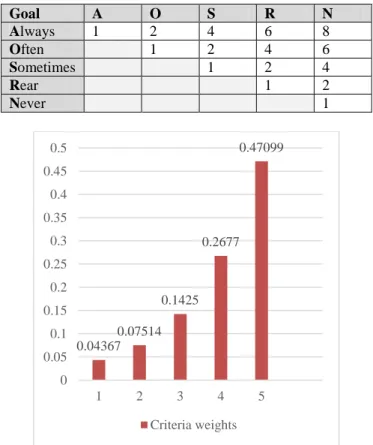
As explained in Section 2.2., the second step in the AHP is making pairwise comparisons on each level of the hierarchy. Firstly, decision-making criteria have to be compared with respect to the goal by using a Saaty scale. The comparison table is presented in Table 8. To achieve more objective comparisons, criteria were coded (always=5, often=4, sometimes=3, rarely=2, never=1) and differences between the codes were calculated and linearly mapped to the Saaty scale.
The final priorities (decision-making criteria weights) are presented in Figure 3. Criterion with the highest weight is “always”, criterion with the lowest
priority is “never”.
Table 8. Pairwise comparison table (decision-making criteria)
Goal A O S R N Always 1 2 4 6 8 Often 1 2 4 6 Sometimes 1 2 4 Rear 1 2 Never 1
Figure 3. Decision-making criteria weights
Secondly, pairwise comparisons of the making alternatives with the respect to each decision-making criterion is made. For each teaching way, a new AHP model is created, respecting the data in
0.04367 0.07514 0.1425 0.2677 0.47099 0 0.05 0.1 0.15 0.2 0.25 0.3 0.35 0.4 0.45 0.5 1 2 3 4 5 Criteria weights Prioritization of adaptivity criteria
Always Often Someti
mes Rarely Never
Learning goals Learning style Cognitive style Fore-knowledge Knowledge adopted during teaching hour Availability of learning materials Psychophys ical possibilities of students Progress during teaching process Mood (emotions) of the student Student’ motivation level
tables 4, 5 and 6. To achieve more objective comparisons, pairwise comparisons were evaluated following the next procedure. Differences in frequencies of alternative usages respecting tables 4, 5 and 6 were mapped to specific value from the Saaty scale. The maximum value of the frequency of alternative usage is 50; the minimum value is 0. That interval is linearly mapped to the Saaty scale values, as presented in Table 9.
Table 9. Mapping differences of frequencies of alternatives’ usages to the Saaty scale
S
aat
y s
cal
e
Alternative 1 Differences in frequencies of
usages of Alternative1 and Alternative 2 9 from 41 to 50 8 from 36 to 40 7 from 31 to 35 6 from 26 to 30 5 from 21 to 25 4 from 16 to 20 3 from 11 to 15 2 from 6 to 10 1 from -5 to 5 2 from -6 to -10 3 from -11 to -15 4 from -16 to -20 5 from -21 to -25 6 from -26 to -30 7 from -31 to -35 8 from -36 to -40 9 from -41 to -50 Alternative 2
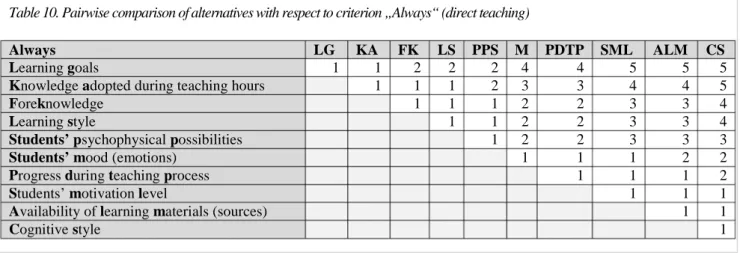
In Table 10. pairwise comparisons of alternatives with respect to criterion “always” in direct teaching (Table 4.) is presented. Ex. The value of the alternative “Learning goals” is 40, and the value of the alternative “Availability of learning materials (sources)” is 18 with respect to criterion “Always”. The difference between those two values is 22, and according to Table 9., it is possible to conclude that alternative “Learning goals” dominates over the
criterion “Availability of learning materials (sources)” with 5 in terms of the Saaty scale. Using Table 9. decreases time consumption for pairwise comparisons and the possibility of achieving the unfavourable inconsistency ratio.
The third step of the AHP is calculating decision-making criteria weights and decision-decision-making alternatives’ priorities. To calculate weights and priorities we used the software Super Decisions. Weights and priorities are calculated automatically when judgements of pairwise comparisons are put in. Inconsistency indexes are also automatically calculated for each comparison matrix. All the overall inconsistency ratios were lower than 0.1 which means that pairwise comparisons were consistent. Priorities of alternatives for each way of teaching are presented in tables 11, 12 and 13 and they are exported from the Super Decision software.
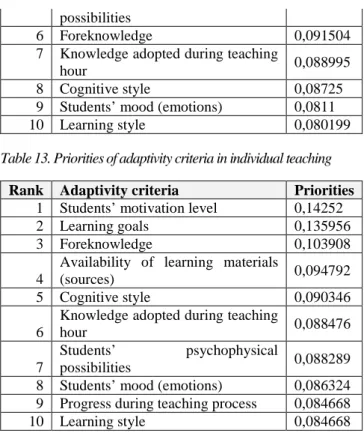
Table 11. Priorities of adaptivity criteria in direct teaching
Rank Adaptivity criteria Priorities
1 Learning goals 0,21901
2 Knowledge adopted during
teaching hour 0,17
3 Learning style 0,1276
4 Foreknowledge 0,1276
5 Students’ psychophysical
possibilities 0,11557
6 Students’ mood (emotions) 0,06085
7 Progress during teaching process 0,05674
8 Students’ motivation level 0,04452
9 Availability of learning materials
(sources) 0,04151
10 Cognitive style 0,0366
Table 12. Priorities of adaptivity criteria in group teaching
Rank Adaptivity criteria Priorities
1 Availability of learning materials
(sources) 0,146041
2 Learning goals 0,139937
3 Progress during teaching process 0,098166
4 Students’ motivation level 0,094344
5 Students’ psychophysical 0,092465
Table 10. Pairwise comparison of alternatives with respect to criterion „Always“ (direct teaching)
Always LG KA FK LS PPS M PDTP SML ALM CS
Learning goals 1 1 2 2 2 4 4 5 5 5
Knowledge adopted during teaching hours 1 1 1 2 3 3 4 4 5
Foreknowledge 1 1 1 2 2 3 3 4
Learning style 1 1 2 2 3 3 4
Students’ psychophysical possibilities 1 2 2 3 3 3
Students’ mood (emotions) 1 1 1 2 2
Progress during teaching process 1 1 1 2
Students’ motivation level 1 1 1
Availability of learning materials (sources) 1 1
possibilities
6 Foreknowledge 0,091504
7 Knowledge adopted during teaching
hour 0,088995
8 Cognitive style 0,08725
9 Students’ mood (emotions) 0,0811
10 Learning style 0,080199
Table 13. Priorities of adaptivity criteria in individual teaching
Rank Adaptivity criteria Priorities
1 Students’ motivation level 0,14252
2 Learning goals 0,135956
3 Foreknowledge 0,103908
4
Availability of learning materials
(sources) 0,094792
5 Cognitive style 0,090346
6
Knowledge adopted during teaching
hour 0,088476
7
Students’ psychophysical
possibilities 0,088289
8 Students’ mood (emotions) 0,086324
9 Progress during teaching process 0,084668
10 Learning style 0,084668
The final step of the AHP is conducting the sensitivity analysis. The role of the sensitivity is mainly related to multicriteria decision-making problems in which there is need to opt for one alternative. Our problem is the problem of prioritisation, so that the influence of independent variable(s) on the final choice is not tested.
The adaptivity criteria priorities differ in each way of teaching, which is expected, due to methods of teaching and didactics that are appropriate in each
way of teaching.
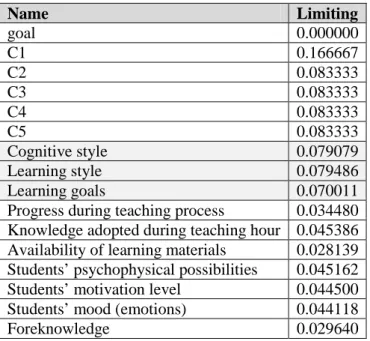
4.6. AHP model 2: selection of adaptivity criteria for the implementation of SDGLO prototype Given the third and the fourth research questions, a new AHP model will be created, which will cover criteria that are related to implementation of the SDGLO prototype. The adaptivity criteria will be evaluated from the position of possibility to be implemented in the prototype of SDGLO.
A hierarchical model of the problem has been presented in Figure 4. The decicion-making goal is: selection of the adaptibility criteria for creating the SDGLO prototype. The decision-making criteria are:
C1:Complexity of the implementation of the adaptivity criterion (existing of the instrument to measure the adaptivity criterion value);
C2:Complexity of the technical implementation; C3:Price of the implementation (experts that
have to be included, technical requirements of the system);
C4:Time needed for the implementation of the characteristics related to the adaptivity criterion;
C5:Risks related to the implementation.
The decision-making alternatives are the same as in first AHP problem. Pairwise comparisons were made by authors of the paper since they are the ones that will build prototype. The results are presented in Table 14.
Selection of adaptivity criteria for SDGLO prototype
C1 C2 C3 C4 C5 Learning goals Learning style Cognitive style Fore-knowledge Knowledge adopted during teaching hour Availability of learning materials Psychophys ical possibilities of students Progress during teaching process Mood (emotions) of the student Student’ motivation level
Following the research and analyses of the research results, the research team decided to apply the following adaptivity criteria in the new system for the dynamic generation of the learning objects: learning goals, cognitive style and learning style. They are the adaptivity criteria that will be taken into account when creating the prototype of SDGLO. However, the prototype will obtain some functionalities (related to other adaptivity criteria).
Table 14. Limiting priorities of nodes in the AHP model from Super Decisions software
Name Limiting goal 0.000000 C1 0.166667 C2 0.083333 C3 0.083333 C4 0.083333 C5 0.083333 Cognitive style 0.079079 Learning style 0.079486 Learning goals 0.070011
Progress during teaching process 0.034480 Knowledge adopted during teaching hour 0.045386 Availability of learning materials 0.028139 Students’ psychophysical possibilities 0.045162 Students’ motivation level 0.044500 Students’ mood (emotions) 0.044118
Foreknowledge 0.029640
The criterion learning goals is a high-ranked criterion, regardless of the way of teaching, so it is in the first place in the direct teaching model as the most important decision-making alternative, while in the group teaching model and the individual teaching model the alternative is the second priority (Tables 11, 12 and 13). Additionally, it is highly ranked from the position of creating the SDGLO prototype. It will be included in the SDGLO prototype. The criterion
learning style as one of the components of the
cognitive style will be applied as the adaptivity criterion. Learning style will be determined according to the VARK method.
The criterion student’s motivation level is a component of each student which is highly variable: different topics of the same subject have a different influence on student’s motivation and, considering the psychological complexity of the concept, potential use of that criterion will be in the guidelines for future work and development of this system.
The adaptivity criteria foreknowledge is already included in the system (teachers can determine the level of current student’s knowledge about a topic by using some test or quiz as regular function of the LMS). Therefore, a new module for this functionality is not needed in the prototype. Similarly, the criterion
availability of learning materials (sources) will not be used in the new system given that all the learning objects will be in the system itself. Also, the criteria
knowledge adopted during the teaching class will be used to check the concepts adopted during the system use (grading of the students).
The criterion psychophysical possibilities of the students will not be included: determining students’ psychophysical possibilities is a long-lasting process and requires the work of more experts from different fields that goes beyond the scope of creating the prototype. The criterion students’ mood (emotions) is also very demanding and, thus, will not be applied in the prototype. The criterion progress during the teaching process will not be used at this time, but it certainly needs to be included in the future development of the system.
5. Conclusion
In this paper the frequencies of usage of adaptivity criteria in direct, group and individual way of teaching were investigated. All of those criteria have so far been often used in each way of teaching, no matter what type of teaching (independent of face-2-face, group or individual teaching) is performed. While the descriptive statistics showed similarity in frequencies of adaptivity criteria usage, the priorities of adaptivity criteria from the (first) AHP model showed more precise results in frequencies of adaptivity criteria usage.
This paper is motivated by creating the prototype of SDGLO system which will support some new functionalities. In the second AHP model, a selection of the adaptivity criteria that have to be supported by SDGLO was performed. The research team decided to apply the following adaptivity criteria in the new system for the dynamic generation of learning objects: learning goals, cognitive style and learning style.
Acknowledgements
The research has been partly supported under the project "Enhancing the efficiency of an e-learning system based on data mining", (reference number 13.13.1.2.02) supported by the University of Rijeka (Croatia).
Croatian Science Foundation has partly supported this paper under the project Higher Decision, IP-2014-09-7854.
References
[1] Stankov, S., Rosić, M., Granić, A., Maleš, L.,
Grubišić, A., & Žitko, B. (2004, January). E-learning paradigm & Intelligent tutoring systems. In Savjetovanje Računala u obrazovanju., pp. 21–34. [2] Wang, C., Wang, D. Z., & Lin, J. L. (2010). ADAM:
An adaptive multimedia content description mechanism and its application in web-based
learning. Expert Systems with Applications, 37(12),
8639-8649.
[3] Brusilovsky, P. (1996). Methods and techniques of
adaptive hypermedia. User modeling and
user-adapted interaction, 6(2-3), 87-129.
[4] ÖZyurt, Ö., ÖZyurt, H., & Baki, A. (2013). Design and development of an innovative individualized adaptive and intelligent e-learning system for teaching–learning of probability unit: Details of
UZWEBMAT. Expert Systems with
Applications, 40(8), 2914-2940.
[5] Popescu, E. (2010). Adaptation provisioning with
respect to learning styles in a Web‐based educational
system: an experimental study. Journal of Computer
Assisted Learning, 26(4), 243-257.
[6] Albert, D. (2001). E-learning future–The contribution
of psychology. In Catching the Future: Women and
Men in Global Psychology, Proceedings of the 59th Annual Convention, International Council of Psychologists, Winchester, England (pp. 30-53).
[7] Vukovac, D. P., & Oreški, D. (2012, January). Active and Collaborative Learning at the University Blended
Learning Course. In 5th International Conference of
Education, Research and Innovation.
[8] Hogo, M. A. (2010). Evaluation of e-learning systems based on fuzzy clustering models and statistical
tools. Expert systems with applications, 37(10),
6891-6903.
[9] Ullrich, C., & Melis, E. (2009). Pedagogically founded courseware generation based on
HTN-planning. Expert Systems with Applications, 36(5),
9319-9332.
[10] Gamalel-Din, S. A. (2010). Smart e-Learning: A greater perspective; from the fourth to the fifth
generation e-learning. Egyptian Informatics
Journal, 11(1), 39-48.
[11] Kurilovas, E., Juskeviciene, A., Kubilinskiene, S., & Serikoviene, S. (2014). Several Semantic Web Approaches to Improving the Adaptation Quality of
Virtual Learning Environments. J. UCS, 20(10),
1418-1432.
[12] Alvarez, A., Ruiz, S., Martín, M., de Castro, I. F., & Urretavizcaya, M. (2009, July). MAGADI: a Blended-Learning Framework for Overall Blended-Learning.
In AIED (pp. 557-564).
[13] O. Sciences & J. Ili, (2012). Providing Adaptivity in
Moodle LMS Courses Srdjan Kr č o Adaptive e-learning systems. vol. 15, pp. 326–338.
[14] Marković, M. G., Jakupović, A., & Matejčić, R.
(2014, January). Identification and Analysis of Characteristics of Intelligent and Adaptive
Hypermedia E-learning Systems. In International
Conference on Education and Educational Technology (EDU'14).
[15]Allport, G. W., & Ross, J. M. (1967). Personal
religious orientation and prejudice. Journal of
personality and social psychology, 5(4), 432.
[16] E. R. Lai, (2011). Motivation : A Literature Review
Research. Research Reports, no. April, p. 43.
[17] Scherer, K. R. (2009). Emotions are emergent processes: they require a dynamic computational
architecture. Philosophical Transactions of the Royal
Society of London B: Biological Sciences, 364(1535), 3459-3474.
[18] Amado-Boccara, I., Donnet, D., & Olié, J. P. (1993). The concept of mood in
psychology. L'Encephale, 19(2), 117-122.
[19] Marković, M. G., Jakupović, A., & Kovačić, B.
(2014). A prevalence trend of characteristics of intelligent and adaptive hypermedia e-learning
systems. WSEAS Transactions on Advances in
Engineering Education, 11, 80-101.
[20] Visković, I. (2016). Mogućnosti primjene Delfi
metode u pedagogijskim
istraživanjima. Napredak, 157(1-2), 187-204.
[21] Cronbach, L. J. (1951). Coefficient alpha and the
internal structure of tests. psychometrika, 16(3),
297-334.
[22]Harker, P. T., & Vargas, L. G. (1987). The theory of ratio scale estimation: Saaty's analytic hierarchy
process. Management science, 33(11), 1383-1403.
[23] Saaty, T. L. (2008). Decision making with the analytic
hierarchy process. International journal of services
sciences, 1(1), 83-98.
[24] Begičević, N., Divjak, B., & Hunjak, T. (2007).
Development of AHP based model for decision
making on e-learning implementation. Journal of
information and organizational sciences, 31(1), 13-24.
[25] N. Kadoić, N. Begičević Ređep, & B. Divjak, (2017).
“Decision Making with the Analytic Network Process,” Bled, Ljubljana.
[26] Kadoić, N., Ređep, N. B., & Divjak, B. (2017). A new
method for strategic decision-making in higher
education. Central European Journal of Operations