Advancing the epistemology of intelligence
analysis: A Polanyian perspective
By
Owen Ormerod, BA (Hons), BCrim
Submitted in fulfilment of the requirements for the degree of
Master of Arts
Deakin University
ACKNOWLEDGEMENTS
First and foremost I would like to thank my wife Jessica. Her love and support made this journey possible. She helped me stoke the fire and kept my passion burning for this project. It is a blessing to have Jessica in my life, as we navigate together through the hurdles we encounter. It is a privilege to share this achievement with her. This could not have been possible without her.
I would like to thank Dr Chad Whelan, my principal supervisor. His brutal honesty and practical advice kept me from going too far down the rabbit hole.
The assistance provided by Dr Struan Jacobs, particularly around understanding the ideas of Michael Polanyi, and being so generous with his time with me, was greatly appreciated. I would also like to thank Dr Darren Palmer for his practical advice on the thesis.
Thank you to Dr Floriana Badalotti, from Arte Lingua, for her assistance with the professional editing of this thesis.
My family have been of great assistance and moral support throughout this project. They have helped me stay focused and achieve this important goal. Their love and care helped sustain me.
Table of Contents
ACKNOWLEDGEMENTS ... i
LIST OF FIGURES ... iii
LIST OF APPENDICES ... iii
ABBREVIATIONS ... iv
ABSTRACT ... v
Introduction ... 1
Method and approach ... 8
Chapter 1: The ‘Art’ and ‘Science’ of intelligence analysis ... 14
Introduction ... 14
Understanding the intelligence field... 14
The intelligence cycle ... 27
Intelligence analysis as ‘Art’ ... 29
Intelligence analysis as ‘Science’ ... 31
Education and training ... 34
Conclusion ... 38
Chapter 2: Exposition of Polanyi ... 40
Introduction ... 40
Discovery as the aim of scientific research ... 42
No overarching ‘scientific method’ ... 47
Tacit knowing ... 50
Practical knowledge and skilful practice ... 54
Tacit knowing and learning ... 59
Personal knowledge ... 63
Conclusion ... 67
Chapter 3: Tacit knowing ... 69
Introduction ... 69
Tacit knowing and the use of tools ... 70
SATs: an outline ... 75
Skilful performance ... 82
Destructive analysis ... 88
Conclusion ... 94
Chapter 4: Personal knowledge ... 97
Introduction ... 97
The School of Athens – Ways of Knowing ... 98
Genuine knowledge and belief ... 107
Tradecraft: training and education ... 114
Conclusion ... 123
Conclusion ... 125
Reference list ... 133
LIST OF FIGURES
Figure 1: The Intelligence Cycle ... 27Figure 2: The School of Athens ... 100
LIST OF APPENDICES
Appendix 1: Email from Glenn Carle……….167ABBREVIATIONS
ACH Analysis of Competing Hypotheses CIA Central Intelligence Agency
FBI Federal Bureau of Investigation IC Intelligence Communities
KM Knowledge Management
SATs Structured Analytic Techniques NSA National Security Agency
ODNI Office of the Director of National Intelligence ONA Office of National Assessments
UK United Kingdom
UNODC United Nations Office on Drugs and Crime WMD Weapons of Mass Destruction
ABSTRACT
Epistemological considerations are at the heart of both understanding and developing a deeper perception of the tradecraft of intelligence analysis as a field of study and its practice. Ranging from the intelligence fields of national security to law enforcement, intelligence analysis as a practice and area of study engages a series of fundamental questions, covering what we know, how we know such things and the reliability of knowledge claims. This thesis situates itself within the sociology of knowledge with respect to the discourse on the discipline of intelligence analysis.
The primary research question guiding this thesis is: How can Michael Polanyi’s views of science contribute towards understanding the ‘process’ and ‘product’ of intelligence analysis? As revealed by intelligence literature, a clear and persistent aim for the transformation of intelligence analysis as a discipline has been to align the field with scientific principles and practices. Within intelligence literature, there are noticeable efforts within some quarters to align intelligence analysis, most observably within the US Intelligence Community, with generally accepted principles of science by requiring analysts to engage in more rigorous standards and systematic processes. Such efforts aim towards generating more accurate and reliable intelligence assessments, or for better ‘connecting the dots’. Michael Polanyi’s arguments regarding the activities of scientists are transferable to the field of intelligence analysis, providing a nuanced perspective for perceiving epistemological challenges and issues facing analysts. Specifically, Polanyi’s concepts of ‘tacit knowing’ and ‘personal knowledge’ contributes towards developing a more epistemologically robust and complete understanding of some aspects of the process and the product of intelligence analysis.
Keywords
:
Intelligence analysis, science, Michael Polanyi, tacit, knowledge, epistemology
Introduction
Discovery consists of seeing what everyone else has seen and thinking what nobody has thought. Albert Szent-Györgyi, 1937 Nobel Prize scientist (cited in Lathrop 2008)
The primary research question guiding this thesis is the following: How can Michael Polanyi’s views of science contribute towards understanding the ‘process’ and ‘product’ of intelligence analysis? This question emerged from observations regarding the discernible trend, both within the national security and law enforcement literature, of attempts to align intelligence analysis to ‘scientific’ principles and practices (Cooper 2005; Gill 2009; Innes, Fielding & Cope 2005; Marrin 2011b; Marrin & Clemente 2005, 2006; Spielmann 2014; Wirtz 2014a). With respect to the goal in the intelligence field to become more ‘scientific’, this thesis argues Polanyi’s view of science can shed important light on the matter; specifically, his understanding of how problems are solved within science, involving the practitioner’s ‘tacit knowing’ and practical ‘craft skills’. The thesis argues that these insights of Polanyi are transferrable to the intelligence field. Similarly, understanding what it means to ‘know’ something as an intelligence product can be enhanced by Polanyi’s concept of the knower as using his/her ‘personal knowledge’. Polanyi’s understanding of the nature of science, covering the ‘tacit’ processes involved in solving problems and what it means to ‘know’ something by acknowledging the ‘personal knowledge’ of the practitioner, provides us with a more nuanced way to understand intelligence analysis. Polanyi’s views offer a perspective for better understanding fundamental epistemological issues facing intelligence analysts, specifically considerations regarding the tacit processes involved in solving problems and understanding the personal dimension of knowledge claims. The aim of this thesis is to utilise Polanyi’s depictions of ‘personal knowledge’, ‘tacit knowing’ and craft skill within the discourse of intelligence analysis in order to contribute towards a more epistemologically robust account of the analytical processes and products of intelligence analysis.
Closely related to the primary research question are the questions, ‘What is the nature of science?’ and ‘What is the nature of intelligence analysis?’ We need to understand what constitutes a science, and this is no simple matter since science has been defined in many different ways (Mehlberg 1955; Moore 2007; Sokal 2001). One of the more influential definitions in recent times is that of Karl Popper in terms of scientific theories being falsifiable, and the method of science (the method of assessing scientific theories) featuring criticism (Popper 1959). The approach taken in this thesis to the question ‘What is the nature of science?’ will rely on the writings of Polanyi. Besides exercising considerable influence on philosophers and sociologists of science, Polanyi has the merit of having known science with great intimacy. He was an accomplished scientific researcher, working alongside Einstein and others in Berlin in the 1920s and the 1930s.
Moving beyond ways of understanding science, the next task to explore is the nature of intelligence analysis. Polanyi’s perspective of science, including his views around how discoveries are made, contributes toward understanding certain aspects of intelligence analysis. In particular, Polanyi’s concepts of tacit and personal knowledge have a strong bearing on perceiving the practice of intelligence analysis. Given there has been a rekindling of interest in a search for a ‘theory of intelligence’ (Hunter & MacDonald 2017; Johnson 2017; Marrin 2007b, pp. 821-846; Phythian 2013, p. 54; Treverton & Gabbard 2008; Warner 2017; Zohar 2013) one can expect epistemological issues to come increasingly to the fore around intelligence analysis (Lillbacka 2013, p. 304). Key epistemological considerations will be explored in this thesis from a standpoint grounded in Polanyi’s writings, including the question, ‘What exactly is ‘knowledge?’ This is discussed with reference to intelligence analysis. The study of Polanyi’s views regarding epistemological issues in relation to science will help us better understand related issues in intelligence analysis. A number of scholars have agreed with Polanyi that tacit knowledge is an essential part of science (Beckett 2000; Gilbert 2000; Piccini & Kershaw 2004; Schön 1995), while others regard the whole idea of tacit knowledge as
being irrational mysticism (Popper 1959, p. 8). Polanyi explored the subject of tacit knowledge in great depth.
The dynamics of the contemporary information environment has an impact on the activities of analysts. The problems associated with this environment is most clearly visible with respect to the ‘information overload’ facing modern intelligence analysts – a phenomenon which has emerged as a result of the expansion of ‘open source’ material (unclassified and freely available information in the public domain) (Flood 2004, p. 108; Friedman, RS 1998, p. 161; Gaudet, J 2013, p. 169; Zegart, AB 2009).
It is important to acknowledge that there are some limitations with Polanyi’s experience and understanding of science. His perspective of science itself is not universally agreed on by scientists or scholars in this area. For example, Polanyi disagreed with the Positivist perspective of science and the idea of a ‘scientific method’. There are some who have challenged these positions for characterising science in that way (Kelleher 2008/2009, p. 8; Creswell & Poth 2017; Johnson, J 2006a, p. 224; Mackenzie, JIM 2011, pp. 543-46; Manjikian, M 2013, pp. 563-67; Ryan, P 2015, pp. 417-31). It is beyond the scope of this thesis to examine these criticisms in-depth, but it is nonetheless important to acknowledge that Polanyi’s perspective of science is not necessarily the definitive ‘truth’ for understanding this field and knowledge more generally.
This thesis shows that Polanyi’s account of tacit knowledge and related issues has direct relevance to understanding the activities of analysts, including the nature of their knowledge claims, whether those claims are objective, and tradecraft in the processes of intelligence analysis.
Agreeing with commentators who argue that at its core, intelligence analysis is a discipline concerned with thinking and knowledge claims (Bruce & George 2008; Lillbacka 2013; Marrin 2017; Mole 2012; Waltz 2014, p. 1; Wheaton & Richey 2015), this thesis is largely concerned with matters epistemological. Specifically, it concentrates on ‘intelligence
analysis’ in terms of better understanding the processes involved in solving problems in this discipline and comprehending the knowledge claims or final intelligence products (i.e. the knowledge claims that analysts produce at the end of their analysis). Polanyi’s contribution to this area is his insights into the practice of science. For example, his discussions regarding the art/science aspects of craftsmanship involved in making discoveries. Other scholars have examined these matters, including Harry Collins and Richard Evan’s treatment around expertise
(Collins and Evans, 2008), Collins’ work on tacit and explicit knowledge (Collins, 2010), and Richard Sennet’s examination of ‘craft’ (Sennett, 2008). Polanyi’s engagement in these topics is arguably more detailed and offers sufficient insights.
Intelligence analysis is a knowledge-building activity, and to improve analysis requires an understanding of epistemology or the theory of the origin and nature of relevant knowledge (Bruce 2008, p. 171). This thesis provides a deeper understanding of the epistemological nature of intelligence analysis by examining and analysing salient features of Polanyi’s view of science. Using Polanyi to sharpen our understanding of the epistemology of intelligence analysis will generate a new way of envisaging the discipline of intelligence analysis.
A number of scholars have observed from a psychological point of view the importance of cognitive awareness in helping people avoid errors in processes of reasoning (Bar-Joseph 2010; Bruce 2008; Heuer 1999). However, comparatively little research has been conducted into the theoretical nature of analysis from a more philosophical, or specifically epistemological, standpoint (Vrist Rønn 2014). Scholars such as Vrist Rønn and Høffding (2012) rightly complain that epistemological contributions to intelligence theory are ‘still alarmingly low in number and thoroughness’, stating:
Even though fundamental questions from the domain of epistemology are often posed in the field of intelligence (e.g. ‘how do we arrive at new knowledge?’ and how robust are our conclusions related to the evidence at hand?), there are, to our knowledge, very few attempts to
qualify these questions from the perspective of professional epistemology (Vrist Rønn & Høffding 2012, pp. 4‒5).
The Macquarie Dictionary defines epistemology as a branch of philosophy which investigates the origin, nature and methods and limits of human knowledge (The Concise Macquarie Dictionary 1982, p. 410). Knowledge and information are ‘inextricably linked’ to the definition of intelligence, so it is clear that epistemology matters to intelligence (Brown 2007, p. 337; Vandepeer 2011a, p. 106). Epistemology is seen to bear on intelligence analysis when we ask questions about when and how knowledge can be ascribed to an agent in terms of warrant, methodology, and justification of knowledge claims (Vrist Rønn & Høffding 2012, p. 697).
Examining the literature concerning the epistemological/cognitive nature of intelligence analysis, particularly around the issue of whether it is an ‘art’ or a ‘science’, will reveal a variety of positions as to how this epistemology can be understood (Cooper 2005; Gill 2009; Hall & Citrenbaum 2010; Marrin 2011b; Wirtz 2012). Beyond clarifying these different views, Polanyi’s theoretical analysis will help us better understand the art/science distinction as it applies to the discipline of intelligence analysis. Polanyi’s thought will be seen in this thesis to provide an alternative way of thinking about the epistemology of intelligence analysis, concerning both the process of intelligence analysis and the product; more specifically, the ways in which to recognize the epistemological processes by which analysts skilfully solve problems, and a clearer understanding of what it means to ‘know’ the knowledge as a product.
An important feature of Polanyi’s epistemology of science consists in his view that there is no set method of science. This contrasts the view of Karl Popper who believed science has a single defining method, the method of scientists striving to falsify their hypotheses. Polanyi does not doubt there are methods of science, but he says they change over time and they vary from discipline to discipline, being examples of local knowledge. There is, for Polanyi, no criterion of sound data or evidence for the purposes of judging hypotheses as worthy of adoption or rejection. Each scientist has to use his/her trained judgment in order to surmise and
make decisions. There is no fixed set of rules for scientists to follow. It is the same with the standards for judging what constitutes ‘good science’, according to Polanyi. These considerations are discipline-specific and subject to change. These and other insights of Polanyi into the nature of scientific research and knowledge have obvious relevance to the way intelligence analysis is undertaken. This thesis will study his account of processes of science as involving scientists’ use of their ‘practical skills’ and their ‘tacit’ and ‘personal’ knowledge in solving the problems that their theoretical assumptions and expectations have thrown up.
The justification for choosing Michael Polanyi as our source of guidance about the nature of scientific research and the nature of scientific knowledge is, as suggested earlier, that he himself was a distinguished scientific researcher. After training in, and practicing, medicine for a short period of time, he completed his Ph.D. in physical chemistry and devoted the next 20 years to research in this field (Jacobs 2009, p. 20). His understanding of scientific research has been widely approved of. For example, Thomas Kuhn in his highly influential The Structure of Scientific Revolutions (Kuhn 1962, p. 47) writes approvingly of Polanyi’s work in the context of presenting his own concept of paradigms as being the objects of scientists’ unformulated knowledge (Jacobs 2009, p. 20). As the scholar Zammito (Zammito 2004, p. 57) noted, Kuhn ‘insists on the essential role of the implicit or, in the terminology of Michael Polanyi, the ‘“tacit”… It is here, perhaps more than anywhere else, that Kuhn’s work has affected a long-term shift of inquiry in the philosophy of science: from logic to practice’. Despite fleeting references to some aspects of Polanyi’s ideas regarding ‘tacit knowing’, especially in relation to discussions around ‘know how’, there has not been a sustained engagement of his epistemology and its relevance to intelligence analysis (Alschuler 2007; Dennis 2013; Margolis et al. 2012, p. 2; Vogel & Dennis 2012; Waltz 2003).
Throughout intelligence literature there has not been any sustained attention given to describing Polanyi’s views of science in relation to intelligence analysis. This was an important reason for deciding to use
Polanyi as the main theorist to unpack and examine epistemological issues facing intelligence analysts. The researcher fully agrees with Maxwell (2005, p. 40) that at times the most productive conceptual frameworks are located outside of the traditional field of study (Maxwell 2005, p. 40), and believes Michael Polanyi’s ideas regarding the nature of science can generate valuable insights into the nature of intelligence analysis.
Some intelligence scholars have characterized the discipline as being ‘under-theorised’ with respect to epistemological considerations (Agrell 2012, p. 130; Betts 2007; Jervis 2010; Johnson 2017; Kreuzer 2016; Moore 2007; Posner 2006). Given intelligence analysis is a ‘knowledge-building’ activity (Bruce & George 2008), this lack of theoretical reflection and analysis regarding the epistemology of intelligence analysis is both striking and telling. This may be partly due to limited human and financial resources being made available for this sort of research, and it may also owe something to the fact that theoretical reflection is located at the end of the ‘intelligence cycle’ – at the end of the assembly line (Agrell 2012, p. 129). Others have argued that the neglect is largely due to the general acceptance of the underlying logic of what has been referred to as the ‘industrialised’ form of knowledge (Herman 1996), which assumes ‘reality’ will more or less reveal itself if only more ‘facts’ are collected. In this light, reflection and analysis regarding epistemological issues have been neglected in intelligence literature (Agrell 2012, p. 129; Evans 2009; Hatch 2013). Part of this neglect around the epistemology of intelligence analysis can be attributed to the dominance of the discipline of psychology in shaping the discourse within intelligence analysis (as a practice and field of study), which posits that the latter can only be improved marginally (Betts 2009, p. 87) by focusing on the cognitive limitations of intelligence analysis: specifically, the cognitive limitations of analysts’ efforts to ‘link the dots’ within the process of analysis, or making sense of the collected information and data (Bar-Joseph 2010, p. 24; Quarmby & Young 2010; Vrist Rønn 2014, p. 352). Although these views of managing cognitive aspects of intelligence analysis have some validity,
the intelligence discipline could benefit from examining the process and product of intelligence beyond the lens of psychology, and expand the discussions to include a greater sensitivity and awareness of epistemological considerations.
Method and approach
This thesis has been sensitive to the view that different methodological approaches are based on certain theoretical and philosophical standpoints (Ormston et al. 2014) and researchers should maintain consistency between their philosophical starting position and the methods that they employ (Ritchie et al. 2013, p. 2). A range of methods and approaches were considered for this thesis to permit for high quality research (Li & Seale 2007; Patton 2005; Seale 1999). This author was aware of some of the limitations of this theoretical approach. The absence of empirical observations and data limited the capacity of this thesis to ‘test’ the accuracy or reliability of Polanyi’s understanding of science, as applied to the intelligence field. Yet ‘testing’ with empirical studies was beyond the scope of this thesis, which supported the decision to focus on a more theoretical exploration within this thesis. In support of this decision regarding the methodology, this author was further mindful of the importance of maintaining consistency of the research methodology throughout this project to generate more ‘valid’ research findings (Meadows & Morse 2001).
There are difficulties with clearly defining qualitative research (Silverman 2011). Qualitative research does not contain a universal theory or paradigm that is distinctively its own, nor does it possess a core set of methods or practices that are entirely or characteristically ‘qualitative’ (Denzin & Lincoln 2011, p. 6). Qualitative research can be understood as covering a broad church, including a wide range of approaches and methods contained within a variety of research disciplines. Despite such diversity, some scholars have attempted to outline the defining aspects of qualitative research (Barbour 2013; Carter & Little 2007; Denzin & Lincoln 2011; Nicholls 2009; Silverman 2011). In a broad sense, qualitative
research is often described as possessing an interpretive approach, focused on examining issues and taking in different views of research participants (Flick 2014). Denzin and Lincoln argue that qualitative research can be described as a set of interpretive research practices that take into account the perspectives of research participants, and attempt to represent those findings by making sense of it all (Denzin & Lincoln 2011, p. 3). Qualitative research is also often described as involving words or images rather than numbers (Ritchie et al. 2013, p. 3).
Whilst some scholars have stressed that qualitative and quantitative research methods should be understood as being complementary strategies, (Gilbert 2008; Silverman 2011), this thesis has adopted qualitative research largely because intelligence studies research is traditionally qualitative (Judge, Colbert & Ilies 2004; Ratcliffe 2014; Waltz 2014), and there would be limitations to exploring this field through the ‘lens’ of quantitative methods (Hawley 2008).
This research approach adopted in this thesis considered the function or role of ‘theory’ in relation to qualitative research, and the issues around whether the research should be conducted under the banner of a specific ‘school’ or theoretical tradition. The interpretivist approach was adopted for this thesis, since it was arguably the most pragmatic approach to best fit the specific research question (Creswell & Poth 2017). This approach allowed for a more flexible treatment of attention towards the ideas and concepts examined across a broad range of fields (Carson et al. 2001). This is unlike positivism, which adopts a more structured approach to research, emphasizing that there is a single objective reality independent of the researcher’s standpoint (Creswell & Poth 2017).
The interpretivist position holds that researchers generate meaning as they interpret their world (Williamson 2002; Williamson et al. 2002) and it is an approach that has enabled the author to meaningfully engage with Polanyi’s view of science, especially regarding his ideas regarding the way scientists make discoveries and skilfully solve problems. This appreciation would have been hindered, indeed prevented, had a positivist approach been pursued, particularly since Polanyi’s argument that scientists
routinely make discoveries and solve problems using thought-processes which are ‘tacit’ and in some sense pre-logical, or extra-logical, is an anathema to positivism. The interpretivist approach easily accommodates Polanyi’s ideas, whereas the positivist position adopts the restrictive view that scientists, social scientists and typically most people are animated by rational and logical arguments (Carson et al. 2001; Willis & Jost 2007). Adopting the positivist position would have prevented the inquiry of this thesis by excluding Polanyi’s pre- or extra-logical arguments as being outside of science. As Latour has observed, the methods of scientists powerfully affect how problems are identified and characterized (Latour 1990).
The goal of the design was to construct a logical sequence of steps to conduct the research. The literature review was the principal means for the collection of information for the thesis. The review explored a range of multi-disciplinary issues, including intelligence studies, theories of intelligence and viewpoints on science. The core tasks of this stage were to:
Review the available literature relating to intelligence studies, intelligence analysis developments across law enforcement and national security fields
Develop a thematic review of the literature in order to identify the core issues and drivers for improving intelligence analysis
Outline pertinent insights of Polanyi regarding his understanding of the nature of science.
The literature review chapter outlines some of the views around the nature of intelligence analysis and ends with situating Polanyi as a scientist whose outlook in epistemology can contribute to the discourse within intelligence analysis. The literature around intelligence analysis outlines definitions of key terms, common challenges facing analysts and epistemological arguments and developments in the field. Key authors on the subject of intelligence analysis expanded over time as required. Articles from the 20th century to the present day were included since this is
the period in history in which developments can be observed in some areas of intelligence analysis, particularly after the Second World War. A reading of the abstract of each article established its pertinence as a resource for inclusion. Articles that examined issues around intelligence analysis, especially from an epistemological basis, were included along with works that were illustrative of pertinent aspects of Polanyi’s epistemology.
An outline of Polanyi’s epistemology and his understanding of science specifically a) sketches the contributions of Michael Polanyi in the field of knowledge, setting out his main perception of science, and b) clarifies how these insights into knowledge and the nature of science can contribute to more completely understanding the discipline of intelligence analysis. These findings then allowed for the development of a more nuanced epistemological understanding of both the process of intelligence analysis, along with a clearer perception of the knowledge generated, or the product.
The structure of the thesis is as follows. Chapter 1 presents a detailed literature review relating to the core debates around the nature of intelligence analysis. ‘Intelligence’ and ‘intelligence analysis’ are distinguished from each other and considered in relation to some key epistemological considerations. The main focus of this thesis is around discussions as to the nature of intelligence analysis and whether Polanyi’s insights into science can shed light on this discipline. This will involve outlining different perspectives around the activities of intelligence analysts. This will help to contextualise the ongoing debate over whether intelligence analysis is best understood as an ‘art’ or a ‘science’, or some combination of the two. How these features are defined has implications for the study and practice of the tradecraft of intelligence analysis.
Chapter 2 describes a number of important themes of Polanyi’s understanding of the nature of science and the activities of scientists engaged in solving problems and producing knowledge. The logic of discovery, or the processes from which scientists make discoveries, is a key feature for how Polanyi understands the nature of science. A central
argument of Polanyi is there is no single ‘method’ of science, or a single set of rules for how science should be conducted. Developing this view, Polanyi posits that the nature of science is not based on falsificationism. He presents an alternative way for understanding science, broadly applicable to other fields involving knowledge claims and research. According to Polanyi’s understanding, a ‘skilful performance’ necessarily involves the practitioner’s ‘practical knowledge’, which further engages their ‘tacit knowing’ and ‘personal knowledge’. Polanyi explains how the ‘apprentice’ submits to the ‘master’ within the tradition observing their ‘practical’ and ‘tacit’ ways of solving problems. These insights are transferrable to the field of intelligence analysis, both in terms of better understanding the process of solving problems skilfully and more clearly recognising what it means to ‘know’ truth-claims as a product.
Chapter 3 examines in greater depth Polanyi’s arguments regarding tacit knowing applied to intelligence analysis, specifically by providing a more enriched way of understanding ‘know how’ and by detailing epistemologically how we know. The aim is to clarify his characterisation of the process of skilfully solving problems, which is transferrable to the field of intelligence analysis. To this end, the chapter draws on some aspects of Polanyi’s concepts of ‘tacit knowing’, ‘structure of skills’ and a ‘skilful performance’. This chapter examines Structured Analytical Techniques (SATs) with respect to this discussion of Polanyi’s understanding of the skilful use of tools, including his concept of ‘indwelling’. Polanyi’s discussions regarding tacit knowing, especially in regard to the skilful use of tools, contributes to a deeper appreciation of the process of skilfully solving problems for the intelligence analysis profession.
Chapter 4 examines Polanyi’s concept of personal knowledge as a way to better understand what it means to ‘know’ something in intelligence analysis as a knowledge product. Polanyi’s theme of learning a tradecraft from skilled masters is arguably applicable to intelligence analysts as it is to scientists, leading to the development of the practitioner’s personal knowledge. Some key epistemological distinctions and ways of knowing will be outlined and used to show how Polanyi’s standpoint on how we
know things provides a way for considering knowledge claims within intelligence analysis.
The Conclusion summarises the main findings of this thesis in light of Polanyi’s understanding of science and the epistemological bearing his views have to the profession of intelligence analysis. Polanyi’s concept of tacit knowing, with respect to a ‘skilful performance’, illustrates that one of the key insights regarding the process of solving problems involves the practitioner’s relationship between their tacit and explicit knowledge. Polanyi provides a more technical and nuanced accounting of how tacit knowing operates within solving problems as a process, involving a ‘from-to’ orientation by the practitioner. The analyst, like the scientist, learns these skills by practice, education and close observation of masters in the tradition in their skilful performance of tasks. The analyst ‘dwells’ in the problem they are attempting to solve, using tools as an extension of themselves, in an effort to tacitly integrate all the pertinent information and theories coherently together. According to Polanyi’s outlook, the analyst generates knowledge as a product, which is characteristically personal. For there to be knowledge there must be a ‘knower’, and such a ‘personal coefficient’ within knowledge claims is not an imperfection but an important epistemological tenet of knowledge. Taken together, Polanyi’s perspective regarding the process of skilfully solving problems, the learning of a tradecraft, and the personal dimension to knowledge, contributes to the epistemological discourse within the intelligence analysis field.
Chapter 1: The ‘Art’ and ‘Science’ of intelligence
analysis
Introduction
There have been perennial attempts to better understand and refine intelligence analysis, both in relation to the broad aims of improving the practice and the study within this field. Intelligence analysis as a profession and a field of study has long wrestled with debates regarding defining and universally agreeing on the core nature of the activities of analysts. A discernible trend from available literature is the sustained interest for aligning intelligence analysis along ‘scientific’ lines with an emphasis on the value of explicit knowledge (Cooper 2005; Gill 2009; Innes, Fielding & Cope 2005; Marrin 2011b; Marrin & Clemente 2005, 2006; Spielmann 2014; Wirtz 2014a). Yet comparatively there has been less attention towards sufficiently understanding the ‘intuitive’ and ‘tacit’ processes and products of knowledge claims within intelligence literature (Dennis 2013; Kamarck 2005, p. 12; Margolis et al. 2012, p. 2; Ouagrham-Gormley 2014; Tang 2017; Vogel 2013a, 2013b). Exploring the arguments regarding whether the intelligence analysis profession is an ‘art’ or a ‘science’, or some combination of both, will reveal that epistemological considerations are fundamental within this discourse. Importantly, this question has a bearing on how ‘expertise’ is conceptualised, along with considerations regarding how the tradecraft is best learned and taught, as field of study and as a practice. Within this aspect, the intelligence field has identified the medical profession as a model to follow in relation to the learning and practice of their tradecraft. A preliminary outline of the defining qualities and aims of intelligence analysis will situate the broader discussions regarding whether the field is characteristically an ‘art’ or a ‘science’, or some combination of both.
Understanding the intelligence field
For at least half a century, intelligence literature reveals a preoccupation with the development of an overarching theory of intelligence (Kahn 2009).
Efforts for developing a universal theory of intelligence (Dahl 2012; Marrin & Clemente 2006, pp. 642-665) have been motivated out of a sense of better understanding and improving the practice of analysis, along with the scholarly study of this tradecraft (George 2010; Herbert 2013; Kerbel 2008; Tan 2014; Treverton 2009; Walsh 2014). There is a variety of positions as to how intelligence as a profession can be understood (Cooper 2005; Gill 2009; Hall & Citrenbaum 2010; Marrin 2011b; Wirtz 2012), and the development of a universal theory of intelligence remains an open debate (Davis 2002a, pp. 2-4; Gill 2009; Lowenthal 2013, pp. 32-35; Treverton & Gabbard 2008; Warner 2009, p. 17). A broad understanding of the term ‘intelligence’, outlined below, will be adopted for the purposes of this thesis, covering the common qualities or characteristics contained across the national security and law enforcement domains of intelligence.
Taken from the literature, a discernible way of perceiving the field of ‘intelligence’ can be distinguished in two fundamental ways (Bang 2017): a) the way information is obtained; b) how information can enable decision-makers, based on insight from collected and analysed information (Mudd 2015; Pherson 2013; Shaw 2007). The school of thought that defines intelligence with an emphasis on the former category generally includes references to the secret aspect of intelligence. This view is captured in the following quotes:
Intelligence is the official, secret collection and processing of information on foreign countries to aid in formulating and implementing foreign policy, and the conduct of covert activities abroad to facilitate the implementation of foreign policy (Random 1958, p. 76).
Secret intelligence is intelligence that others are seeking to prevent you from knowing, often with formidable security barriers and violent sanctions against those who cooperate with intelligence officers (Omand 2014, p. 22).
Advocates of category a) for conceptualizing the nature of intelligence place greater emphasis on the involvement of covert collection activities (Johnson 2009) and the aspect of secrecy as a defining feature (Gill 2009; Hall & Citrenbaum 2013; Lowenthal 2014; Phythian 2017; Warner 2009, p. 18). Lowenthal bluntly states this
characterisation of intelligence: ‘Secrets are the essence of intelligence’ (Lowenthal 2011, p. 61). In a publication from the Office of National Assessments (ONA) in 2006, the agency endorsed this view that intelligence is fundamentally secret in nature, stating ‘Intelligence is covertly obtained information. That is, it is obtained without the authority of the government or group that ‘owns’ the information’ (Office of National Assessments 2006, p. 3).
In contrast, ‘intelligence’ can be characterised in terms of category b), with an emphasis on assisting decision-makers generate an impact on the security environment. Specifically, according to this position, ‘intelligence’ can be perceived as assisting decision-makers in optimising their resources for responding to or shaping the security environment. The following formulations captures this view:
Probably the simplest definition of intelligence is that it is useful information (Gyngell 2011).
Intelligence is information gathered for policy makers in government which illuminates the choices open to them and enables them to exercise good judgment (Rockefeller Commission 1975).
The alternative argument is that intelligence can be ‘anything from any source’ which can assist the customer (Treverton & Gabbard 2008; Warner 2009, pp. 16-17). This position, which places primacy of intelligence on information from all sources (covert and overt), can be observed from the Flood Report into Australian intelligence. The Report stated:
While intelligence information is important, and often vital, to assessment, it is normally not the main source of information used by intelligence assessment agencies. Open sources ... provide the greater part of the information available to the Australian Government (Flood 2004, p. 10).
Interestingly, even though the ONA claimed in 2006 that ‘Intelligence is covertly obtained information’ (Office of National Assessments 2006, p. 3), the Flood Report had already revealed two years earlier that the ‘ONA product draws heavily on published or open source material – it is the single largest source of material for ONA reporting’ (Flood 2004, p. 108). The argument that ‘intelligence’ is limited
to or can even be characterised as drawing significantly on covertly obtained information appears to be questionable.
Moving beyond general ways of characterising the intelligence field from a national security perspective, the law enforcement profession offers its own position and understanding of intelligence. At the outset, it is worth acknowledging that one of the most significant developments in the theory and practice of policing relates to changing perceptions of ‘intelligence’ within law enforcement (Brown 2007; Parliamentary Joint Committee on Law Enforcement 2013; Gill 1998; Sheptycki 2009); specifically, the appreciation for the importance of intelligence, and the growing recognition of the police as ‘knowledge workers’ (Brodeur & Dupont 2006, p. 1). Ericson and Haggerty coined the term ‘knowledge workers’ to refer to professionals engaging in the collection and analysis of data and information, leading to informed action (Ericson & Haggerty 1997, pp. 83-84). In this sense, police have become increasingly ‘knowledge workers’ with respect to the institutional acknowledgement, over the last 35 years, of the core value of collecting and analysing pertinent information and data for shaping policing methodologies (Ratcliffe 2014). It would be amiss though to consider policing as having only recently become interested in ‘intelligence’, since information collection and analysis has been a fundamental aspect of policing in the US, UK, Australia, and Canada well before ‘intelligence-led’ policing methodologies emerged (Kelling & Coles 1997; Peak & Glensor 1999; Walsh 2001, pp. 347-350).
The idea of police officers operating as ‘knowledge workers’ within the so-called ‘intelligence-led’ policing paradigm (beginning in the 1990s) does not necessarily re-imagine the role of police, but rather refines policing in terms of the allocation of resources and the exercising of their duties (Eck, Clarke & Petrossian 2013; Peters & Cohen 2017; Scott 2017; Shearing & Wood 2007, p. 55; Townsley 2017). Intelligence-led policing has a more objective basis for deciding priorities and resource allocation (Ratcliffe 2016, p. 3). This is achieved by design, by applying analytical techniques and statistical predictions for identifying likely targets or vulnerable areas for police to anticipate and intervene (James 2017;
Knutsson 2017; Lewandowski, Carter & Campbell 2017; Perry 2013, p. xiii; Townsley, Mann & Garrett 2011).
This ‘intelligence-led’ paradigm shift within policing can be further recognised with respect to perspectives on ‘criminal intelligence’. Findings from the Parliamentary Joint Committee on Law Enforcement (2013, p. 6) observed that despite ‘criminal intelligence’ escaping a universally agreed definition, the Committee concluded the concept is constituted by the following key elements:
information that has been validated and value-added;
information that has been analysed; and
not evidence.
The inquiry further elaborated as to the nature of intelligence by citing the United Nations Office on Drugs and Crime, which outlines intelligence as constituted by the following equation: ‘information +
evaluation = intelligence (United Nations Office on Drugs and Crime 2011, p. 1).
It is clear that ‘intelligence’ in terms of criminal investigations is less preoccupied with whether the information is obtained covertly or overtly, but rather with a greater interest in the end product – making an impact on the security environment. As previously discussed, this is consistent with one of the main ways of characterising intelligence as understood by the national security field; namely, information and data collected (covert or overt) to ‘…protect your interests or to maintain a valuable advantage in advancing your interests over those posing threats to them’ (Cornall & Black 2011, p. 6). What matters for intelligence for both law enforcement and national security agencies has less to do with whether the information was obtained secretly or with publicly available sources, and more with the conferring of insight to promote decision-advantage (Cornall & Black 2011, p. 6).
The epistemological foundations of intelligence studies, it can be argued, is largely drawn from the ‘national security’ paradigm (O'Malley
2016; Sheptycki 2009, pp. 166-168). This paradigm has been shaped by the discourse on international relations, with a focus on conflict and the use of state power (Lawson 2003, pp. 78-82). In contrast, there is an increasingly large body of research from law enforcement intelligence, with its own paradigm based on the theory of human security (Coyne 2014; Black 2016; Bradford et al. 2016; James et al. 2017; Picciotto 2017; Rubenstein 2017; Weber, Fishwick & Marmo 2016). The theory of human security posits that intelligence considerations go beyond the use of state power (Lawson 2003, pp. 89-91), partly because of the rise of the ‘pluralisation’ of policing, or the provision of policing services from non-law enforcement agencies (Bradley & Sedgwick 2009; Crawford 2005; de Maillard & Zagrodzki 2017; Newburn 2003; O’Neill & Fyfe 2017; Terpstra 2017; van Steden 2017). The paradigm of human security within law enforcement holds that ‘intelligence’ is aimed towards proactively seeking to better understand the causes of insecurity, with less of a focus of reacting to insecurities (Broll 2016; Bullock 2013; Dupont 2017; Phythian 2012; Sheptycki 2009, p. 171; Wall 2007).
Whilst there is a discernible agreement within intelligence literature regarding the aim of the field being directed to: a) reducing uncertainty and b) assisting decision-makers make an informed decision on how to respond to or shape the security environment (Bammer 2010; CIA 2009; Eck, Clarke & Petrossian 2013; Fingar 2011a; Ratcliffe 2016; Weiss 2007; Wheaton & Richey 2015), there has been some challenges in defining the profession (Walsh 2011); for example, whether intelligence is a tool to explain (a scientific approach) or understand (an interpretive approach) the security environment (Walsh 2011, p. 283). These distinct aims stem from a bifurcating choice between the ‘positivist’ position and the ‘interpretivist’ perspective on understanding intelligence. Methodologically, the positivist position concentrates on describing and explaining phenomena (Johnson 2006a; Lillbacka 2013; Mackenzie 2011; Ryan 2015; Walsh 2011, p. 283-285; Zohar 2013), whereas the interpretivist view focuses on an understanding and interpretation of the objects in
question (Carson et al. 2001, p. 6; Grant & Giddings 2002; Moini 2011; Xinping 2002).
The intelligence field is constituted by a broad church of practitioners, but in an attempt to satisfy such a diverse tradition, Patrick Walsh outlined three core characteristics which arguably represent the foundation of the intelligence profession: the ‘intelligence environment’ (the focus of the collection and analysis), ‘secrecy’ (covert action and collection) and ‘surveillance’ (observing the subjects in question) (Walsh 2011, p. 29). Other scholars, such as Jerry Ratcliffe, have observed similar models for defining the intelligence enterprise, such as his ‘3-I’s model covering the following elements: interpret the environment, inform decision-making, impact on the environment (Ratcliffe 2004). Kahn, an historian in cryptology, emphasises that ‘intelligence’ should have an impact on the environment, by accurately perceiving the nature of threats, so as to ‘optimize one’s resources’ (cited in Pringle Jr 2015, p. 843). While much attention has been devoted to outlining the importance of adequate collection – or sufficient information and data on the identified subject – it is important to acknowledge that at the heart of ‘intelligence’ is the process and product of analysis (Agrell 2002; Bruce & George 2008; Davis 1995; Fini 2004; Herbert 2013; Horelick 1964; Pfautz et al. 2006; Phythian 2017).
Organizationally, the central role of the analyst within the intelligence community was outlined by the former Director of Central Intelligence at the CIA, William Colby, who observed that ‘At the center of the intelligence machine lies the analyst, and he [sic] is the fellow to whom all the information goes so that he can review it and think about it and determine what it means’ (Colby 1992, p. 21). As the information and data is collected, the analyst then engages in the process of interpreting that information and data (Johnson 1996, p. 657). If the intelligence enterprise can be characterised as a knowledge-building activity, then analysts can be understood as the ‘knowledge workers’ (Brodeur & Dupont 2006). The analyst must decide, based on often incomplete, ambiguous or deceptive information, whether a threat exists and assess its precise nature (Knorr,
1979, p. 70). The intelligence product then allows for the decision-maker to optimize their resources (Kahn cited in Pringle Jr 2015, p. 843). The focus of the work of the analyst, within the organisation, is shaped by the aims set by that organisation. These aims can broadly cover the following categories: 1. Prescriptive models require analysts to represent how systems could work; for example, engineers use this model to outline how a structure could be built; or within political science to provide clarity regarding how a political organisation could operate. 2. Descriptive models are used to understand a given situation and the way it functions; this could involve describing the parts of a system and how they behave together. 3. Predictive or exploratory models represent the fashion by which a dynamic system could function in the future, under certain circumstances (Waltz 2014, pp. 2-3).
Moving beyond the broad aims of intelligence, it is necessary to outline aspects of the activities of analysts – being principally the business of analysis itself. Precisely what steps are followed within ‘intelligence analysis’ to deliver assessments and judgments is elusive or defies clear articulation (Gentry 2016; Herbert 2013; James et al. 2017; Kreuzer 2016; Lowenthal & Marks 2015; Zafeirakopoulos 2014). This is arguably because publications on this topic do little to provide definitive guidance as to what universally accepted actions comprise analysis and the purposes these actions are designed to support (Eck, Clarke & Petrossian 2013, p. 10). In a broad sense, Lord Butler in his 2004 report on Weapons of Mass Destruction outlined the aims of ‘intelligence analysis’ in terms of providing ‘validation’ and ‘assessment’ (Butler 2004, p. 5). The process of ‘validation’ is aimed towards ensuring the collection of information and data is accurate (Barnes 2016; Butler 2004, p. 9; Howis 2015; Jones 1993; Pringle Jr 2015; Smith 2014). Following the validation phase is the efforts towards providing ‘assessments’, a process generally conducted by subject matter experts, involving the assemblage of intelligence reports into the meaningful context of the security environment (Butler 2004, p. 10; Clarke 2013; Gainor & Bouthillier 2014; Marrin 2016; Pherson & Beebe 2015). It is widely acknowledged within the intelligence field that ‘analysis’
in terms of the aims of ‘validation’ or ‘assessment’ does not impart judgments of certainty (Bammer 2010; Butler 2004, p. 15; CIA 2009; Fingar 2011a; Phythian 2012; Posner 2006). This acknowledgement is based on the recognition that evidence and clues are sometimes incomplete, ambiguous, or deceptive and the world of human affairs is often contingent on a range of (largely indeterminate) factors (Agrell & Treverton 2015; Hicks 2013; Hoffman et al. 2011; Marrin 2013; Puvathingal & Hantula 2012; Townsley, Mann & Garrett 2011; Zegart 2009).
With respect to navigating the complex security environment, intelligence analysis as a field has drawn on a series of disciplines and social research methodologies, ranging from how to best understand political behaviours to illicit drug markets (Bruce & George 2008; Chauvin & Fischhoff 2011; Sinclair 2010; Walsh 2011). The field of intelligence has a strong alignment to that of a ‘social science’, an acknowledgement which can be observed by Sherman Kent, one of the earliest pioneers in the field at the CIA. As Kent observed, ‘…the social sciences are very largely constituting the subject matter of strategic intelligence’ (Kent 1949, p. 156). Whilst there are methods and aspects of intelligence that involve the ‘hard’ sciences, it is at heart a social science in many of its core characteristics (Chauvin & Fischhoff 2011; Dupont 2017; Fingar 2011b; Hudson 2009; Phythian 2017; Tang 2017; Walsh 2011, p. 287). To the extent to which ‘intelligence analysis’ can be understood as a practice in social science, this raises the question whether analytical methods can accurately measure variables, and therefore what can really be definitively ‘known’ in the intelligence context (Hall & Citrenbaum 2010; Phythian 2017; Walsh 2012, p. 244).
In relation to the acknowledgement that intelligence analysis is largely devoted to exploring epistemological considerations, from what is known to that which is not known, it is not surprising that there is a strong interest in viewing aspects of analysis psychologically (Heuer 1999; Hoffman et al. 2011; Kan et al. 2013; Puvathingal & Hantula 2012; Wastell, Clark & Duncan 2006). This is particularly the case with
reference to understanding cognition within analysis (Hudson 2009; Manjikian 2013; Waltz 2014, p. 1). Analysts are required to be sensitive not just to the conclusions they arrive at, but also to how they reached such knowledge claims. As Heuer observed:
Intelligence analysts should be self-conscious about their reasoning processes. They should think about how they make judgments and reach conclusions, not just about the judgments and conclusions themselves (Heuer 1999, p. 31).
In this psychological sense, intelligence analysis is an activity which engages in ‘meta-cognition’, or as Mark Lowenthal remarks, ‘thinking about thinking’ (Lowenthal cited in Moore 2007, p. 8). The psychological features of intelligence analysis are one of the most widely accepted aspects within this field and are featured prominently in the literature (Agrell & Treverton 2015; Bang 2017; Coulthart 2017a; Evans & Kebbell 2012; Gentry 2014; Hare & Coghill 2016; Kreuzer 2016; Lowenthal 2013; Marchio 2014; Pherson & Beebe 2015; Phythian 2017).
Given that the practice of intelligence analysis is based around knowledge claims, evidence, and clues (Agrell 2002; Clare 2012; Johnson 2010; Ratcliffe 2014), it has been generally acknowledged that the types of reasoning employed throughout the analysis process can profoundly influence the judgments generated by the analysis (Bruce 2008, p. 135; Fingar 2011b; Heuer 1999; Lahneman & Arcos 2017; Lillbacka 2013; Lowenthal & Marks 2015; Phythian 2017; Tan 2014; Zohar 2013). The intelligence scholar Edward Waltz outlines the broad reasoning processes involved in intelligence analysis in terms of the distinctions between analysis and synthesis (Waltz 2003, p. 16). Analysis meaning the movement from presumed effects (the imagined solution) backwards – by searching for antecedent causes which could deliver the effect. This process is followed until the causes are known for being responsible for the effect. Demonstrating that the effect is caused by the proposed process amounts to validating the hypothesis. Synthesis, in contrast, proceeds by already knowing the causes, and constructing or assembling the cause-to-effect chain which proves the hypothesis (Waltz 2003, p. 160). The final outcome of this process is the intelligence analysis product
which can be the representation of static content or dynamic relationships of the objects in question, in relation to the security environment (Coulthart 2017a; Dunn 2012; Eck, Clarke & Petrossian 2013; Goodman & Omand 2008; Odom 2008; Prunckun 2015; Vandepeer 2011b; Waltz 2003, p. 3).
With respect to more clearly acknowledging the different types of ‘evidence’ which may be drawn upon within the field of intelligence analysis, Pherson and Pherson refer to Schum’s schema (2001), outlining six main types of evidence in intelligence analysis (Pherson & Pherson 2012, pp. 90-92). These types of evidence are as follows:
1) Tangible evidence: direct observation, and consists of such materials as original documents, pictures, or physical objects.
2) Authoritative evidence: scientific data such as the periodic table of elements and tidal charts, government records such as birth and death certificates, property records and motor vehicle records. 3) Testimonial evidence: reports of a development, conversation or
event by an observer or participant in the activity.
4) Circumstantial evidence: conclusions that rest on some observations plus assumptions that the analyst has made.
5) Negative Evidence: information that falsifies or is not consistent with a hypothesis.
6) Missing Evidence: information that one would expect if a hypothesis were to be verified, but which has not been found (at least presently).
Great expertise is central to clearly identifying the most credible clues and evidence, along with making reliable and accurate judgments and assessments (Bruce & George 2008; Dahl 2012; Hicks 2013; Kreuzer 2016; Martin et al. 2011b; Mole 2012; Moore, Krizan & Moore 2005; Phythian 2017; Waltz 2014). For example, there was more evidence indicating at the time that Saddam Hussein had WMDs (Dahl 2014; Jervis 2006, p. 14) compared to the meagre evidence that Osama Bin Laden was in a hidden compound in Abbottabad (Intelligence analysis in the 21st century 2016). As remarked by Robert Jervis, it is sometimes the case that, in the intelligence world, scenarios which have the least amount of
evidence can turn out to be the closest to the truth (Jervis 2010a). This general acknowledgement regarding the difficulties facing analysts in their core task of understanding the reliability and credibility of evidence and clues is captured by Roberta Wolhstetter’s summary of the failure to predict and prevent the Pearl Harbor attack:
After the event … a signal is always crystal clear; we can now see what disaster it was signalling since the disaster has occurred. But before the event it is obscure and pregnant with conflicting meanings (Wolhstetter 1962, p. 387).
The goal of intelligence analysis is the provision of reliable and credible assessments to demarcate truth from falsehoods and sometimes reveal deception (Corkill 2011, p. 8). Whilst this objective is clear, in practice this aim has been described by intelligence scholars and practitioners as being at times elusive (Dahl 2017; Ellis-Smith 2016; Hicks 2013; Jensen 2018; Intelligence analysis in the 21st century 2016). Government reports and academic articles into ‘failures of intelligence’ often refer to analytical shortcomings in terms of not sufficiently making the epistemological distinctions between knowledge claims based on inferences and belief, in contrast to more objective and credible knowledge (Betts 2009; Cooper 2005; Hatch 2013; Lahneman & Arcos 2017; Marrin 2011a; Pritchard & Goodman 2008; Shelton 2011; Smith 2014; Vrist Rønn 2014). For example, being mindful of the epistemological difference between what one knows and what one believes can test the mettle of the best analysts (Agrell 2012; Herbert 2006, p. 667; Westera et al. 2013; Puvathingal & Hantula 2012; Smith 2017). The former US Secretary of Defence Donald Rumsfeld made the now famous observation regarding ‘known unknowns’ and ‘unknown unknowns’. One of the points Rumsfeld was making was that for any given intelligence problem there are an indefinite quantity of unknown facts, some of which are relevant and others which are not. The central task of the analyst is to identify the relevant ‘knowns’ and possible ‘unknowns’, whilst also being aware they do not know all the unknowns (Evans & Kebbell 2012; Knorr-Cetina 1999; Lowenthal 2014; Moore 2007).
A core aim of intelligence analysis is an activity of transitioning from ‘knowing’ to ‘understanding’ (Ellis-Smith 2016, p. 36). ‘Knowing’ refers to identifying what pieces of the puzzle are relevant (Trent, Patterson & Woods 2007; Hoffman et al. 2011; Lowenthal 2011; Mole 2012; Nolan 2012); ‘understanding’ involves recognising the most salient pieces of information and fixing them in context to the whole picture (Bar-Joseph 2010; Dahl 2017; Puvathingal & Hantula 2012; Warner 2017; Zohar 2013). The merits of discovering new clues or evidence are only valuable in terms of contributing to understanding the context of the security environment (Brown 2007, p. 339; Marrin 2012b; Martin et al. 2011a; Pherson 2013; Ryan 2006; Treverton & Gabbard 2008; Wirtz 2014a). Understanding provides a greater perception of the objects, persons or groups, or locations within the context of the security environment. Such understanding is only valuable if it is communicated effectively and in a timely manner (Agrell & Treverton 2015; Bruce & George 2008, p. 10; Clarke 2013; Davis et al. 2015; Ellis-Smith 2016; Marrin 2017). ‘Understanding’ translates to proving decision-makers with either a) insight – knowing how and/or why something is happening, and/or b) foresight – using gained insights to anticipate what may plausibly occur in the future (Ministry of Defence 2010; Hare & Coghill 2016; Westera et al. 2013; Wippl 2014).
The intelligence analysis discipline is most certainly plural (Evans & Kebbell 2012; James et al. 2017; Kreuzer 2016; Lowenthal & Marks 2015; Peters & Cohen 2017; Treverton & Gabbard 2008, p. 3). In the military context, the aims of analysis could be directed towards penetrating the secrets, capabilities, and intentions of states, to short-term tactical analysis to support current operations in an effort to protect assets and resources on the battlefield (Bang 2017; Coyne 2014; Czerwinski 1998; Evans 2009; Mole 2012; van Riper 2006; Wahlert 2012). In the law enforcement field, intelligence analysis is oriented towards uncovering, disrupting and potentially (or even ultimately) prosecuting criminal behaviour (Evans & Kebbell 2012; James et al. 2017; Silverman 2007; Townsley, Mann & Garrett 2011; Wall 2007). For national security, intelligence analysis can
assist with planning for the future, by identifying emerging trends and the nature or levels of risk (real or perceived) posed by threat actors, either of state or non-state entities (Fishbein & Traverton 2004; Goodman 2009; Hare & Coghill 2016; Howis 2015; Manningham-Buller 2005). Analysts may be directed to pierce the shroud of secrecy—and sometimes deception—that state and non-state actors use to mislead (Fournie 2004; Pherson 2013; Picornell 2013; CIA 2009, p. 1; Smith 2014; Whitney 2005). The intelligence cycle
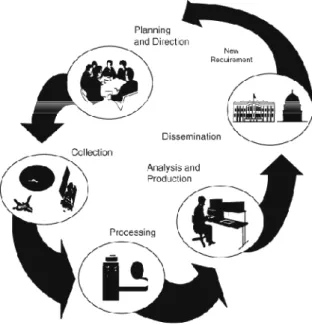
A common reference made around the discipline of intelligence analysis concerns the ‘intelligence cycle’. The intelligence cycle constitutes a methodology that is traditionally presented or described as a sequential process (George 2011; Hatch 2013; Herman 1996, p. 56; Hulnick 2006; Johnson 2009; Phythian 2013). The intelligence cycle is intended to present the analyst with a series of steps to guide their analytical activities (Quarmby & Young 2010, p. 12). This process is graphically represented below.
Figure 1: The Intelligence Cycle
(Johnson 1986, p. 2)
The fundamental aim of the intelligence cycle is the process of breaking down the information and data to their essential respective components, then constructing meaning from those data sets (Baartz
2005; Hatch 2013; Holmes 1992; Kreuzer 2016; Mitchell 2005). The cycle is partly designed to assist analysts to ‘cope with epistemic complexity’ (Herbert 2006, p. 667; Heuer 1999; Richards & Pherson 2010). This model or process generally takes the following form: 1) identifying the requirements of the customers who will consume the intelligence products; 2) collecting ‘raw’ information and data as required, potentially via human sources, electronic communication signals, imagery and geospatial intelligence; 3) processing the collected information and data to further assist with the analysis phase; 4) analysis of the raw information and data to generate a ‘finished’ intelligence product; 5) dissemination of the product to the consumers (Tan 2014, p. 219). The process also includes feedback from the policymakers concerning how effective and useful the product was for their needs (Evans 2009; Lowenthal 2014, pp. 54-67). As observed by the practice of intelligence analysts, the ‘intelligence cycle’ is not generally sequential as traditionally articulated or visually represented (Corkill 2011; Gill 2009; Hulnick 2006; Johnson 2009; Lowenthal & Marks 2015; Martinez-Conesa et al. 2017; Waltz 2003). Instead, the analyst is constantly in a never-ending conversation with policy makers and collectors over events and developments (Dahl 2012; Ellis-Smith 2016; Howis 2015; Kreuzer 2016; Marrin 2003a, p. 623; Quarmby & Young 2010, p. 15).
The ‘intelligence cycle’ has been recognised by some as representing a ‘scientifically founded methodology’ (Lillbacka 2013, p. 305; Marrin & Torres 2017; Prunckun 2015). As Prunckun observes, ‘Scientific methods of inquiry are founded on the steps of the intelligence cycle – problem formulation, data collection, data collation, analysis (including hypothesis testing), and dissemination’ (Prunckun 2014, p. 68). On the other hand, others have claimed that since the process of accurately identifying and perceiving risks cannot be always codified, the ‘intelligence cycle’ is best understood as involving both ‘art’ and ‘science’ (Cain 2012, p. 137; Evans & Kebbell 2012; George 2010; Hulnick 2006; Johnson 2010; Mudd 2015). One of the key observations within the ‘art’ versus ‘science’ debates regarding the defining characteristic of ‘intelligence’ and