A
DVANCES
inNATURAL
andAPPLIED SCIENCES
ISSN: 1995-0772 Published BYAENSI PublicationEISSN: 1998-1090 http://www.aensiweb.com/ANAS
2017September 11(11): 11-18 Open Access Journal
ToCite ThisArticle: Adel A. Eidan, Assaad Alsahlani, Kareem J. Alwan., Experimental investigation on the performance of evacuated tube solar collector with wickless heat pipe under Iraq climatic conditions. Advances in Natural and Applied Sciences. 11(11);Pages: 11-18
Experimental
investigation
on
the
performance of evacuated tube solar
collector with wickless heat pipe under Iraq
climatic conditions
1Adel A. Eidan, 2Assaad Alsahlani, 1Kareem J. Alwan
1Najaf Technical Institute, ALFurat Al-Awsat Technical University. 31003 Al-Kufa, Iraq.
2Department of Aeronautical Engineering Engineering-Technical College / Najaf, ALFurat Al-Awsat Technical University. Received 12 June 2017; Accepted 15 September 2017; Available online 20 September 2017
Address For Correspondence:
Adel A. Eidan, Najaf Technical Institute, ALFurat Al-Awsat Technical University, 31003 Al-Kufa, Iraq. E-mail: [email protected]
Copyright © 2017 by authors and American-Eurasian Network for ScientificInformation (AENSI Publication). This work is licensed under the Creative Commons Attribution International License (CC BY).
http://creativecommons.org/licenses/by/4.0/
ABSTRACT
A wickless heat pipe evacuated tube solar collector (HP-ETSC) is considered in this work. Where an experimental investigation is conducted to study the thermal performance for the (HP-ETSC). The proposed heat pipe is charged with distilled water as a working fluid, where different values of filling ratios and inclination angles are considered. Namely, five values of filling ratios (40, 50, 60, 70 and 80 %) and three inclination angle values (30ᵒ, 45ᵒ and 60ᵒ). The Gravity-assisted wickless heat pipe (GAHP) is made of a copper tube with outer diameter 0.016 m and the dimensions of the evaporator and condenser are 1.15 m and 0.2 m respectively. The core and wall temperatures are measured by means of thermocouples that are located in the center and at the wall of GAHP. This study aims to observe the thermal performance of the HP-ETSC when using different values of working fluid, filling ratio, inclination angle and hot water mass flow rate in Najaf city climate (Iraq: latitude 31 ᵒN and longitude 44 ᵒE) during clear weather days in February 2017. The results show that the optimal filling ratio and inclination angles are 70% and 45ᵒ respectively when compared with other values during the course of study. Hence, in Najaf city ,
it is recommended to implement
wickless heat pipe evacuated tube solar collector with filling ratio and inclination angles are 70% and 45ᵒ respectively to obtain the optimal thermal performance.
KEYWORDS: Gravity-assisted wickless heat pipe, evacuated tube solar collector, GAHP, Filling ratio, inclination angle.
INTRODUCTION
The unique physical characteristics of Gravity-assisted wickless heat pipes (GAHPs), encouraged the researchers and manufacturers to use it in many different applications and research fields. It has the simple design and ability to transfer heat even with very small temperature difference, hence GAHPs are widely used in waste heat and renewable energy applications [1] [2]. Where GAHPs is successfully implemented to increase the efficiency of conventional solar collectors [3] [4]. Also, GAHPs have several advantages when it is used in solar collectors, where in addition to its powerful ability to transfer heat with a comparison to small size finned conductors, GAHPs eliminate excessive heating and freezing disadvantage occurred in a wide range of solar water collectors.
The GAHPs basically works with aid of small charging of vaporizable fluid in a sealed evacuated tubular container where the evaporation occurs at one end and the condensation occurs at the other end and, hence, the fluid circulates continuously as long as there is temperatures difference. A various number of investigations have been conducted to address the full understanding of the parameters (working fluids, inclination angle, heat
input, and filling ratio.. etc) that might affect the performance of GAHPs especially in solar water heater applications. For instance, Mustafa Ali Ersoz [5] studied the effect of six different working fluids on the thermal performance of evacuated tube solar collectors with GAHP, where the air velocity is considered in three different values (and the results showed that the maximum energy transfer is associated with THPETC-Acetone). Mobin Arab and Ali Abbas [6] concluded that the water is the best working fluid when they investigated the effect of using many working fluids on the performance of a semi-dynamic model of a concentric (evacuated tube solar water heater (ETSWH) located in Sydney, Australia. A similar study on (ETSWH) was conducted by Redpath et al. [7], where experimental data were collected from (ETSWH) in the Climate of Northern Maritime. They implemented two identical models of the manifold chamber of a thermosyphon heat-pipe ETSWH in the laboratory where the two models are built with same dimensions to observe and compare the behavior of the two models when exposed to the same similar rates of heat input. Hayek et al. [8] used water-in-glass and heat pipe collectors models to investigate the overall performance under Mediterranean weather conditions. They showed that the heat pipe based collectors are more efficient than water-in-glass collectors where its efficiency is almost 15-20% higher, and they stated that the initial cost of heat pipe based collectors still a challenge to be considered as local markets items. Nkwetta et al. [9] presented a study on the internal low-concentrating evacuated tube heat pipe solar collector where they used optical method for the evaluation and analysis. The design was performed to enhance the collection of solar radiation where they tested different transverse angles and implemented ray trace techniques which determine flux distribution, optical efficiencies and related optical losses. Similar work on concentrated evacuated tube heat pipe solar collectors was presented by Nkwetta and Smyth [10] where they compared two profiles of single-sided and double-sided absorbers. Where the proposed design was tested at a tilt angle of 60 to the horizon. And under indoor conditions with five transverse angles (0-40ᵒ) with an increment of 10ᵒ, they compared heat loss coefficients, energy collection rates, and collection efficiency. In Southeast University, China, Du et al. [11] conducted an experimental study to implement a platform to test solar collectors where a heat pipe is used to transfer heat to the water by means of the designed flat form and the performance of an evacuated heat pipe solar collector is investigated. The main aim of their study is to observe the instantaneous efficiency and its correlations with the receiver and absorber areas, the incidence angle modifier, pressure drop, and the effective heat capacity. Also, they presented the theoretical analysis of the solar collector for these parameters. Arab and Abbas [12] investigated using different working fluids, during a typical day of operation, namely acetone, water, ammonia, pentane, and methanol on the performance of the fully integrated model for a grooved type evacuated tube solar water heater, and they found that the water is the best-working fluid. Another study was conducted by Jahanbakhsh et al [13], where they built and tested evacuated tube solar collector with thermosyphon heat pipe and two fluids were used, namely water and ethanol. The data were collected for different tilt angles and concentrations. The results showed that the heat pipe performance at low heat flux is enhanced when they used ethanol, also, the performance of transferring the heat reached its best level when concentrations are of 50% and 75% where the efficiency of the heat pipe was about 52%. This investigation came to conclude that adding wick or evacuating of the heat pipe do not affect significantly on the heat pipe performance and the optimal tilt angle of maximum heat transfer coefficient is 35ᵒ. Jalal M. Jalil et al [14] worked on increasing the condenser lengths (0.15, 0.20 and 0.30 m) numerically and experimentally to improve the performance of solar collector heat pipe. The results showed that the water tank temperature is increased by 17% for a filling ratio of 30% and inclination angle 45º when the condenser length is increased by 25%.
One can see that most of the experimental studies above dealt with the performance of wickless heat pipe evacuated tube solar collector (HP-ETSC) where the performance depends on a number of parameters such as the type of working fluid, filling ratio, inclination angle, and operating conditions. However, for each heat pipe setup, dimensions, working fluid and condition, there are specific optimal filling ratio and inclination angle and it differs from heat pipe to another. Moreover, there is no good way of linking all parameters together and predict the change in heat pipe performance when one or more parameters are changed. In this work, we conducted an experimental study to address a wide range of parameters changes namely five values of filling ratios along with three different inclination angles to evaluate the performance of GAHP solar collector using water as working fluid, where the data are collected during February 2016 in Najaf city- Iraq climate; (latitude 31 ᵒN and longitude 44 ᵒE).
I. Experimental rig setup, procedure and uncertainty:
A. Experimental rig setup:
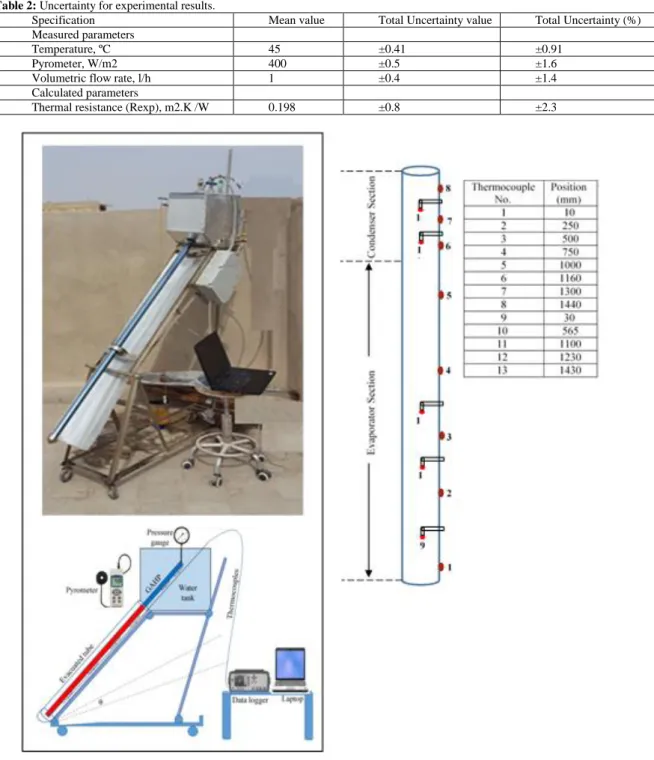
The primary objective of the experimental section is to study the effect of some parameters on the heat pipe evacuated tube solar collector (HP-ETSC) thermal performance in terms of temperature distribution, the Evaporation, Condensation heat transfer coefficient and thermal resistance. The considered parameters are solar intensity, a filling ratio (amount of liquid charge in evaporator section in GAHP) and inclination angle by using distilled water as working fluid. The schematic diagram and a photo of experimental set up of HP-ETSC that was used in this research are illustrated in Fig. 1. The details of the HP-ETSC that were used in this experiment
are shown in Table 1. The measurements were performed during sunny days in February 2017 between 8 Am and 4 Pm. The GAHP and the water tank temperature were monitored during the period of the experiment by using twenty-four K-type thermocouples, positioned at different levels and locations inside the HP-ETSC, and the increase in internal energy of the system could be calculated. In order to study the boiling and condensation phenomena inside the heat pipe at the core for both evaporator and condenser sections, five K-type thermocouples were used; three in the evaporator region at the center of the tube and two others in the condenser region. The thermocouple readings’ data by Data Acquisition system type Lab-Jack (T7 Series) were recorded at 5 s intervals in the experiment work. Thermocouple location is shown in Fig. 2.
The experimental part was conducted under Najaf city climate; (Iraq latitude 31 ᵒN and longitude 44 ᵒE). The title angle of solar collector change within the range (30 to 60ᵒ) measured from horizontal, capacity of the water tank is 6 liters. The instantaneous value of global solar radiation intensity was measured by using the pyrometer (Model-DWR 8101, Make-DynaLab) [15]. The mass flow rate of cooling water was measured by using a rotameter and also measured by using a stopwatch and by using a measuring glass bottle.
B. Experimental rig setup
The experiment procedure for the heat pipe evacuated tube solar collector (HP-ETSC) steps are: Fix the tilted angle and water mass flow at the recommended value.
1. Choose the filling ratio (FR) for the distilled water (40, 50, 60, 70 and 80 %).
2. The surface and core temperatures along the GAHPs as well as the water tank temperatures are measured and recorded at each quasi-steady state condition.
3. Change the FR to a new value and repeat step 2.
4. Change water mass flow and repeat steps 1-3.
5. Change solar collector tilted angle and repeat steps 1- 4.
During each experiment, the amount of solar energy input (1 in w/m2) at evaporator region of GAHP is transferred to the condenser region and removed by the condenser, and the overall thermal resistance (Rexp)for
the solar collector were calculated as follows[16]:
(1)
Where and are the average wall temperatures at the evaporator and condenser regions
measured by the surface temperature thermocouples in eight different locations as shown in Fig. 2.
C. Uncertainty:
The effect of uncertainty for the present work is an accumulation of the effect of the uncertainties for each element used in the set-up. Abernethy and Thompson [17] method is used in this work to combine uncertainties for all elements. The main inherited and calculated uncertainties in this work are summarized in Table 2. Table 1: Details of the design specifications of the HP-ETSC system
Part Item Specification
Solar collector Type Evacuated tube heat pipe
Collector area 0.06912m2
Gravity assisted wickless heat pipe
Material Copper
Outer diameter 16 mm
Inner diameter 14 mm
Evaporator length 1150 mm Condenser length 200 mm
Working fluid DI water
Glass envelope
Material Pyrex glass
Length 1200mm Outer diameter 50mm Inner diameter 45mm Wall thickness 2.5mm Vacuum 10-4 torr Transmittance 93 %
Flat reflector Material Aluminum sheet foil
Area 1250*300mm
Storage tank
Material Galvanized steel 0.6mm thickness
Capacity 6L
Insulation Glass wool 25mm thickness Outer shell Sheet of 1mm aluminum
Table 2: Uncertainty for experimental results.
Specification Mean value Total Uncertainty value Total Uncertainty (%) Measured parameters
Temperature, ºC 45 ±0.41 ±0.91
Pyrometer, W/m2 400 ±0.5 ±1.6
Volumetric flow rate, l/h 1 ±0.4 ±1.4
Calculated parameters
Thermal resistance (Rexp), m2.K /W 0.198 ±0.8 ±2.3
Fig. 1: The schematic diagram and a photo of experimental set up of HP-ETSC.
Fig. 2: GAHP thermocouple positions (surface wall and core)
RESULTS AND DISCUSSION
For the twenty nine days during February month in 2016 of experiments, Figs. 3–5 show the instantaneous variation during each day of the solar time, filling ratio, inclination angle and the hot water mass flow rate of the wickless heat pipe evacuated tube solar collector (HP-ETSC).
D. Effects of the fluid filling ratios on evaporator surface temperature:
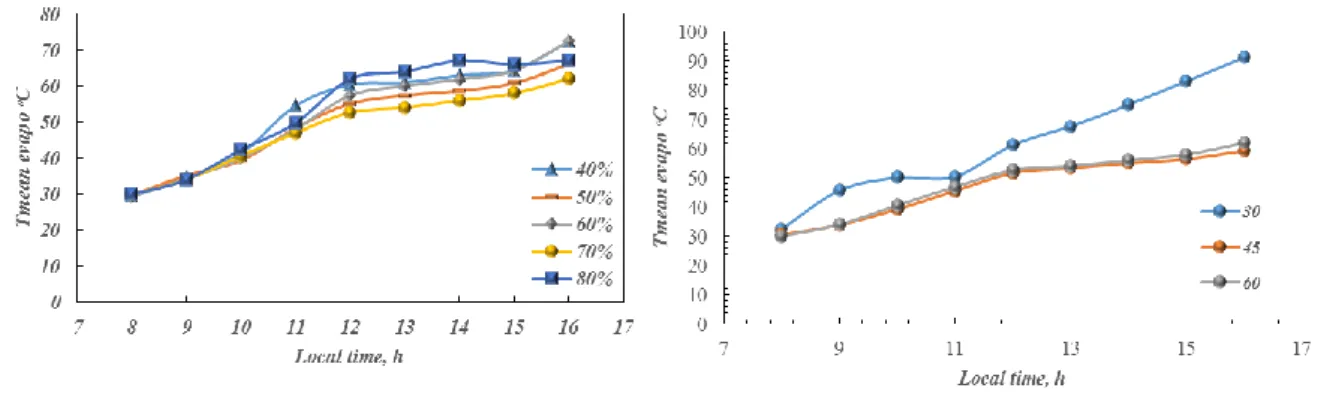
Figures. 3 through 5 show the effect of the working fluid filling ratio on the evaporator mean surface temperature at the three nominated title angles for HP-ETSC. These figures indicated that the mean evaporator wall temperature decreases from its maximum value at fill ratio 40% to the minimum value at 70% then increases again to a certain value at fill ratios 80%. However, at a low solar intensity in the morning before the solar noon (from 8.00 to 10.00 in the morning), there is a slight change in mean evaporator wall temperature
between the five tested filling ratios. Therefore, the effect of filling ratio on mean evaporator wall temperature is clearer at the relatively high solar intensity. Decreased fill charge ratio causes an increase in the mean evaporator surface temperature for all inclination angle, which reduces the thermal resistance to heat flux resulting in a lower evaporator wall temperature. This result was obtained for all experimental heat pipes with all fluids. This behavior is due to the hydrodynamic stratification of the liquid film flowing downwards along the inner evaporator surface at small filling ratios, this phenomenon was named the geyser effect by Casarosa et al. [18], The reason behind increasing the surface wall temperature in the evaporator section at highest filling ratio (80%) is attributed to the fact that the thermal resistance of liquid film in the evaporator increases as liquid height increase (fill ratio) above the optimum value. These Figs. indicate that a filling ratio of 70% gives the higher performance (lower thermal resistance) where it has a small evaporator mean temperature throughout the day this result was supported by the results obtained by Mahdy [19], Aljboory [20] and Jalal M. etal[14] where an optimum distilled water filling ratio in the range of 50–70% was obtained.
Fig. 3: Variation of mean wall temperature of evaporator with fill ratio during solar time at title angle 30ᵒ
Fig. 4:Variation of mean wall temperature of evaporator with fill ratio during solar time at title angle 45ᵒ
Fig. 5:Variation of mean wall temperature of evaporator with fill ratio during solar time at title angle 60ᵒ.
Fig. 6: Variation of mean wall temperature of evaporator at different inclination angles for optimal fill ratio 70%.
E. Effects of inclination angle on evaporator surface temperature:
The effect of inclination angle at optimum filling charged (70%) according to the above results on the mean surface temperature of the evaporator section during the solar time is illustrated in Fig. 6. It can be seen that the evaporator temperature increases as the inclination angle decreases toward the horizontal orientation for all solar intensity and this increase is higher when the solar intensity is higher. However, at angles of 30ᵒ and 60ᵒ the value of the evaporator mean surface temperatures are greater than that at angle 45ᵒ for both closed and withdraw systems. Therefore, the effectiveness of the HP-ETSC is better at 45ᵒ than that at other inclination value (similar conclusions were reported by [21]).
F. Effects of inclination angle on thermal resistance:
Figure 7 shows the effect of inclination angles on thermal resistance for optimal filling ratio. It is seen that the thermal resistance decreases with increasing solar time for all inclination angles. A higher thermal resistance is observed at 30ᵒ due to the fact that the working fluid covers part of the internal space of the evaporator whereas is has a lower value at 45ᵒ during the sunny day (similar trend was obtained by [22]). However, a lower difference in thermal resistance between the inclination angles is seen at the period of after noon, especially, between 45ᵒ and 60ᵒ. Thus, the best inclination angles is 45ᵒ and this is a similar conclusion as those were concluded by [14, 20 and 22].
G. Effects of inclination angle on the wall surface temperature distribution along GAHP:
A precise experimental determination of the thermal performance of the wickless heat pipe evacuated tube solar collector (HP-ETSC) requires accurate measurements of the temperatures in the condenser and evaporator regions in addition to the inclination angle. The each measuring location point, the final temperature reading is obtained by averaging of the readings over the measuring period of time. Figures 6-8 show the temperature distribution over the wall surface of GAHP associated with the optimal filling ratio 70% from the results which are illustrated in figs. 3-5. In figures 7 and 8, one can see the behavior of temperature distribution which is nearly isothermal over the evaporator section. This behavior is because of the existence of fluid lining that covers the internal surface of the evaporator. In GAHPs with low tilt angle, the liquid film (hydrodynamic stratification of the liquid flow downwards to the liquid pool in the evaporator) does not touch the entire wall surface of the evaporator section.
Moreover, with high solar intensity after noon time and lower tilt angle 30ᵒ, the liquid film covers the upper half from the evaporator causing the internal evaporator wall surface to dry-out (Geyser effect) [1,18] at the upper location, resulting in a sudden rise in the evaporator surface temperature. As shown in Fig. 6 the GAHP operates at a higher wall temperature with 30ᵒ. It is clear from Fig. 6 that the temperature has a trend of starting with sharp gradient behavior between the two regions of GAHP and slightly the trend becomes isothermal for the rest of condenser section. This trend is expected to because of the absence of adiabatic section in GAHP.
Fig. 7: Variation of GAHP thermal resistance for the three angles at optimal filling ratio 70%.
Fig. 8: Variation of temperature with the distance along the wall of GAHP at optimal fill ratio 70% during solar time at title angle 30ᵒ.
Fig. 9: Variation of temperature with the distance along the wall of GAHP at optimal fill ratio 70% during solar time at title angle 45ᵒ.
Fig. 10: Variation of temperature with the distance along the wall of GAHP at optimal fill ratio 70% during solar time at title angle 60ᵒ.
Conclusions:
Use From the present experimental investigation on HP-ETSC with different values of filling ratio, inclination angles, hot water mass flow rate and wide range of solar intensity, it is concluded that:
1. The optimum working fluid filling ratio of the HP-ETSC is 70%.
2. In evaporator section, the vapor core temperature was less than surface temperature, whereas in condenser section the behavior was opposite.
3. The best performance can be achieved with no closed system (zero water mass flow rate).
4. The minimum thermal resistance at 45ᵒ as a tilt angle.
5. More experimental studies are needed to investigate the optimum filling ratio of different working fluids and different cross-sectional geometries on the performance of HP-ETSC.
REFERENCES
1. Adel, A. Eidan, Saleh E. Najim, Jalal M. Jalil, 2016. Experimental and numerical investigation of thermosyphone performance in HVAC system applications. Heat Mass Transfer, 52(12): 2879-2893. 2. Adel, A. Eidan, Saleh E. Najim, Jalal M. Jalil, 2017. An experimental and a numerical investigation of
HVAC system using thermosyphon heat exchangers for sub-tropical climates. Applied Thermal Engineering, 114: 693-703.
3. Jamar, Z.A.A., Majid, W.H. Azmi, M. Norhafana, A.A. Razak, 2016. A review of water heating system for
solar energy applications. International Communications in Heat and Mass Transfer, 76: 178-187.
4. Davoud Jafari, Alessandro Franco, Sauro Filippeschi, Paolo Di Marco, 2016. Two-phase closed
thermosyphons: A review of studies and solar applications. Renewable and Sustainable Energy Reviews, 53: 575-593.
5. Mustafa Ali Ersoz, 2016. Effects of different working fluid use on the energy and exergy performance for
evacuated tube solar collector with thermosyphon heat pipe. Renewable Energy, 96: 244-256.
6. Mobin Arab, Ali Abbas, 2013. Model-based design and analysis of heat pipe working fluid for optimal performance in a concentric evacuated tube solar water heater. Solar Energy, 94: 162-176.
7. Redpath, D.A.G., P.C. Eames, S.N.G. Lo, P.W. Griffiths, 2009. Experimental investigation of natural convection heat exchange within a physical model of the manifold chamber of a thermosyphon heat-pipe evacuated tube solar water heater. Solar Energy, 83: 988-997.
8. Hayek, M., J. Assaf, W. Lteif, 2011. Experimental investigation of the performance of evacuated tube solar
collectors under eastern Mediterranean climatic conditions. Energy Procardia, 6: 618-626.
9. Nkwetta, D.N., M. Smyth, A. Zacharopoulos, T. Hyde, 2012. Optical evaluation and analysis of an internal
low-concentrated evacuated tube heat pipe solar collector for powering solar air-conditioning systems. Renewable Energy, 39: 65-70.
10. Nkwetta, D.N., M. Smyth, 2012. Performance analysis and comparison of concentrated evacuated tube heat
pipe solar collectors. Applied Energy, 98: 22-32.
11. Du, B., E. Hu, M. Kolhe, 2013. An experimental platform for heat pipe solar collector testing. Renewable
and Sustainable Energy review, 17: 119-125.
12. Arab, M., A. Abbas, 2013. Model-based design and analysis of heat pipe working fluid for optimal performance in a concentric evacuated tube solar water heater. Solar Energy, 94: 162-176.
13. Jahanbakhsh, H.R., Haghgou, S. Alizadeh, 2015. Experimental analysis of a heat pipe operated solar collector using water ethanol solution As the working fluid. Solar Energy, 118: 267-275.
14. Jalal M. Jalil, Sabah T. Ahmed, Ahmed H. Jassim, 2016. Study the Effect of Variable Condensers Length
on Improving the Performance of a Heat Pipe Solar Collector. Advances in Natural and Applied Sciences, 10(13): 68-80.
15. Dhafer Manea Hachim, Assaad Alsahlani, Adel A. Eidan, 2017. Measurements of Wind and Solar Energies
in Najaf, Iraq. Advances in Natural and Applied Sciences, 11(9): 110-116.
16. Hussein, H.M.S., H.H. El-Ghetany, S.A. Nada, 2006. Performance of wickless heat pipe flat plate solar collectors having different pipes cross sections geometries and filling ratios. Energy Conversion and Management, 47: 1539-1549.
17. Abernethy, R.B., J.W. Thompson, 1980. Handbook uncertainty in gas turbine measurements. In:
Measurement uncertainty handbook. Sponsored by Instrument Society of America ISA.
18. Casarosa, A., E. Latrofa, A. Shelginski,1983. The Geyser Effect in a Two- Phase Thermosyphon. Int. J. Heat Mass Transfer, 26(6): 933- 941.
19. Mahdy, M., 2005. Experimental Investigation of Low Heat Flux Heat Pipes With and Without Adiabatic Section For Solar Application. Ph.D. Thesis, Mech. Eng. Dept., College of Engineering, University of Baghdad.
20. Aljboory, 2009. Experimental Investigation of Evacuated Tube Heat Pipe Solar Water Heating System. Ph.D. Thesis,Mech. Eng. Dept., College of Engineering, University of Baghdad.
21. Ayompe, L.M., A. Duffy, 2013. Thermal performance analysis of a solar water heating system with heat pipe evacuated tube collector using data from a field trial. Solar Energy, 90: 17-28.
22. Ahmed, A. Alammar, Raya K. Al-Dadah, Saad M. Mahmoud, 2016. Numerical investigation of effect of fill ratio and inclination angle on a thermosiphon heat pipe thermal performance. Applied Thermal Engineering, 108: 1055-1065.