ORIGINAL ARTICLE
Exploration of cell lysis in a bioreactor using
Escherichia coli
expressing single-chain variable-domain antibody fragments
Xiuxia Liu1&Weiguo Hu1&Zhanfei An1&Zhonghu Bai1&Xiaofeng Dai1&Yankun Yang1Received: 24 November 2015 / Accepted: 2 February 2016 / Published online: 3 March 2016
#Springer-Verlag Berlin Heidelberg and the University of Milan 2016
Abstract Cell lysis has long been a process problem in pro-tein expression using bacterial hosts. To explore the pathways involved in cell lysis in a bioreactor,Escherichia colistrain W3110 was used as the host to express single-chain variable-domain antibody fragments (scFv). Under the same fermenta-tion condifermenta-tions,E. colistrain W3110 expressing a humanized scFv entered the viable but nonculturable (VBNC) state 6 h before the wild-type strain, and the accumulation of the scFv within the cells accelerated cell lysis. At the transcriptional level, the scFv not only altered the expression of rpoH,
dnaK,dnaJ, groES, andgroEL in the heat stress response, but also rpoS,gadE, and gadX in the acid stress response pathway andsodAand katE in the oxygen stress response pathway. During cell lysis in a fermenter, the expression of the membrane protein-encoding genesompA,ompC,ompW, andompXsignificantly decreased, and the high-level expres-sion ofrpoEwas not sustained. These findings provide new insights into cell lysis as well as a theoretical foundation for improving fermentation conditions and engineering bacteria to minimize cell lysis during fermentation.
Keywords Bioreactor . Engineering cell lysis .σEpathway . Stress response . Viable but nonculturable
Introduction
Industrial-scale production of single-chain variable-domain antibody fragment (scFv) expression inEscherichia coliwas made possible by genetic engineering. To achieve large-scale microbial biomass production in fed-batch cultures, high cell density cultivation and efficient exogenous protein expression are required (Zarschler et al.2013). However, cell lysis fre-quently occurs during the fermentation process because of diverse reactor microenvironments and the expression of het-erologous transcripts and proteins. At present, study of the cell autolysis mechanism has mainly focused on the shaking flask level; however, in order to gain more target protein, the culture level of engineering strain expressing foreign protein often needs to enlarge its culture bioreactor level, so it is of great significance to study the effect of the specific expression of foreign proteins at the bioreactor level on cell activity and cell lysis (Sandén et al.2003). The unpredictable cell lysis phe-nomenon in the large-scale culture process of E. colioften causes significant difficulty in the downstream purification process and leads to degradation of the target protein, eventu-ally resulting in a decline in the output and quality of the target protein (Andersson et al.1996).
Overexpressing foreign proteins impose different levels of toxicity to cells, resulting in physical defects and lower cellu-lar activity. Simultaneously, the additional metabolic burden can result in a reduction in the metabolic energy required for effective protein and nucleic acid biosynthesis (Chou2007). To explore the negative impact of cell lysis on host cells in a biological reactor, it is needed to understand the mechanisms underlying the stress-induced cell lysis caused by the expres-sion of recombinant, exogenous proteins in anE. colihost.
Escherichia coli has formed a sophisticated stress response mechanism during its evolution, and it is regulated by com-plex protein–protein interactions and protein phosphorylation
Xiuxia Liu and Weiguo Hu contributed equally to this work.
Corresponding authors Xiaofeng Dai and Yankun Yang contributed equally to this work.
* Xiaofeng Dai [email protected] * Yankun Yang
1 National Engineering Laboratory for Cereal Fermentation
Technology, Jiangnan University, Wuxi 214122, China DOI 10.1007/s13213-016-1202-x
events that are governed by signal transduction pathways. These responses allow the bacteria to adapt to a variety of external and/or internal stimuli, including temperature, pH, osmolarity, nutrient concentrations, the production of second-ary metabolites, and the accumulation of misfolded proteins in the periplasmic space (Sikdar et al.2013). Furthermore, a recent study found that cell death and lysis inE. coli are regulated by programmed cell death, which is similar to apoptosis in eukaryotic cells. Based on a shaking flask culture, Murata et al. (2012) identified a σE-dependent cell lysis process, which is considered to be a survival strategy when cells suffer from adverse environmental stresses. When cells suffer from stresses during the early stationary phase of growth, most of them enter the viable but nonculturable (VBNC) state, and cell lysis is induced to re-move these damaged cells, thereby maximizing the use of nutrients to maintain cell viability for prolonged periods.
However, current progress on understanding stress and cell lysis mechanisms is limited to the shake flask level, so a com-prehensive understanding of the impact of exogenous protein expression on cell lysis in bioreactors is needed. To fill this knowledge gap, we have investigated the correlation between exogenous protein expression and cell lysis in a bioreactor, as well as the role ofσE-directed stress response pathways on cell lysis, using an scFv-expressingE. coliW3110 system.
Methods
Strains, plasmids, and culture conditions
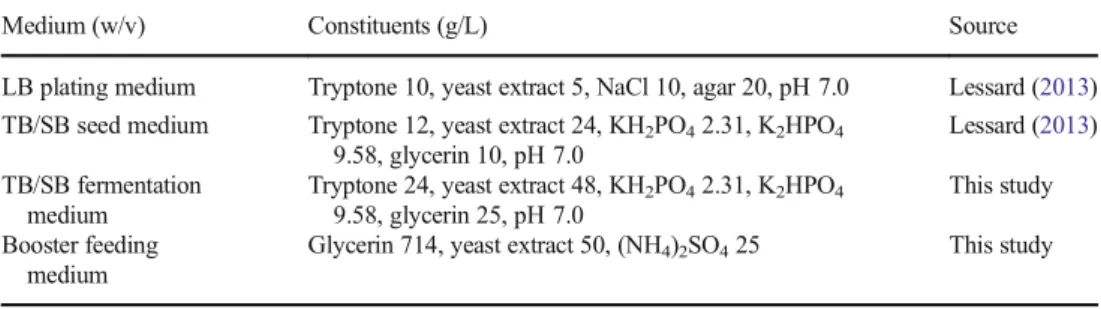
The strains used in this study are theE. coliW3110 wild-type strain and a W3110 strain carrying the vector pBZ001 (W3110/pBZ001). This vector contains the scFv gene (939 bp), the expression of which is driven by the T7A3 pro-moter, and an operator system consisting of two perfect pal-indromic sequences. The signal sequence used for the peri-plasmic production of scFv was derived from OmpA, and this sequence is cleaved when the recombinant protein is translocated across the cytoplasmic membrane, thereby allowing the mature protein to fold into a functional scFv. The strains were cultured overnight at 37 °C on Luria– Bertani (LB) plates. A single colony was picked and inoculat-ed into 100 mL of Terrific Broth/Super Broth (TB/SB) (Table1) seed medium in a 1-L Erlenmeyer flask and cultured at 37 °C with shaking at 230 rpm on an oscillatory shaker. When the optical density at 600 nm (OD600) reached 4, the seed culture was inoculated into 2 L of TB/SB fermentation medium in an ez-Control 5-L fermenter (Applikon, Delft, The Netherlands). The fermenter temperature was maintained at 30 °C ± 0.1 °C, and the pH was maintained at 7.0 ± 0.05 by the addition of 17 % phosphoric acid or 25 % aqueous ammo-nia. To ensure that the level of dissolved oxygen (DO)
achieved 30 % oxygen saturation, the air flow rate was main-tained at 2 volumes of air per volume of fermentation broth per minute (vvm); when necessary, 1 vvm of pure oxygen was provided. Before DO spiking, feeding was initiated using a precalibrated peristaltic pump at different flow rates (3.5 or 6 mL h−1l−1). Tetracycline was sterilized by filtration through a 0.2-μm cellulose acetate membrane filter and added to a final concentration of 15μg mL−1. To induce the expression of exogenous scFv inE. coliW3110/pBZ001, a final isopro-pyl β-D-1-thiogalactopyranoside (IPTG) concentration of 100μM was achieved by injecting IPTG into the fermenter 1 h after feeding was initiated, and the fermentation process was continued for approximately 38 h after induction.
Determination of VBNC cell number
Sample treatment
Culture broth samples (1 mL) were collected aseptically at different fermentation stages based on the OD600and culture time, and they were serially diluted 10-fold to an appropriate concentration using 0.01 M phosphate-buffered saline (PBS) for counting. One hundred microliters of the diluent was used for colony-forming unit (CFU) determinations by plating it onto LB agar plates and counting the number of colonies after 24 h of incubation at 37 °C (viable and culturable cell num-ber). Meanwhile, an appropriate dilution (100μL) was centri-fuged at 9000 × g at 4 °C for 3 min (FRESCOL-7, Thermo Fisher Scientific). The supernatant was discarded, and the pel-let was washed twice with 0.01 M PBS.
CTC staining
5-Cyano-2,3-ditolyl tetrazolium chloride (CTC) fluorescent staining counting was conducted as described previously (Abe et al.2007), with slight modifications. Viable bacteria cells transport electrons via respiration, thereby reducing CTC to CTC formazan (CTF), which results in the formation of a red fluorescent precipitate in the cell membrane. The washed pellets were resuspended in approximately 100μL of a 3 mM CTC solution (dissolved in 0.01 M PBS) and incubated for 30 min at 25 °C with shaking at 200 rpm in the dark.
Fluorescence microscopy count
As Hobbie et al. (1977) described, stained samples were sub-sequently harvested by filtration through a black polycarbon-ate membrane filter (0.02 μm pore size, 13 mm diameter; Sartorius AG, Göttingen, Germany). The cell number was determined using a BX53F fluorescence microscope (Olympus, Tokyo, Japan) with a Fluotar objective (U Plan Semi-Apochromat objective 100×/1.3, oil) and a wide-field eyepiece (10×, focusable). An Olympus filter set
(BP425-445 exc./FF593/BA628-640 em.) was used to detect CTF. At least 30 to 50 cells in ten randomly chosen areas on a filter were counted, and the average value and standard deviation were calculated. The cell number was calculated as follows:
E¼XS1
S2
1
V
whereEis the cell number in the sample,Xis the average cell number in the microscopic fields,S1andS2are the areas of the membrane and microscopic field, respectively, andVis the sample volume.
RNA extraction, cDNA synthesis, and RT-PCR
Bacteria (5 × 10⁶–107cells) in fermented broth were immedi-ately centrifuged at 8000 × g (4 °C, 2 min), the supernatant was discarded, and the pellet was stored in liquid nitrogen for RNA extraction. Total RNA was isolated from E. coli
W3110 cells using the RNAiso Plus Kit (TaKaRa, Shiga, Japan), according to the manufacturer’s instructions. The amount and purity of the RNA were reflected by the absor-bance at 260 and 280 nm (A260and A280, respectively), and the RNA purity was assessed by 2 % agarose gel electropho-resis. The primers used in our study were designed with Primer 5.0 software, and the sequences of the primers are given in Table2. After removing the genomic DNA, total RNA was reverse-transcribed into cDNA, as described in the instructions of the PrimeScript™RT Reagent Kit with gDNA Eraser (TaKaRa). Real-time polymerase chain reaction (RT-PCR) was conducted using an iCycler CFX96 quantitative PCR system (Bio-Rad, Hercules, CA, USA), SYBR® Premix Ex Taq™II (Tli RNaseH Plus) fluorescence quantita-tive reagents (TaKaRa), and individual eight-tube PCR strips (Bio-Rad). Each reaction mixture (10μL) consisted of 5μL SYBR® Premix Ex Taq™II (2×), 0.4μL of forward primer (10μM), 0.4μL of reverse primer (10μM), and appropriate volumes of cDNA template and sterile double-distilled H2O. The reaction mixture was incubated at 95 °C for 30 s for predenaturation, followed by 40 cycles of amplification, which consisted of a denaturation step (95 °C for 5 s), an annealing step (60 °C for 30 s), and a denaturation step (95 °C for 30 s). Gene expression was calculated relative to
Table 2 The sequences of the primers used in real-time polymerase chain reaction (RT-PCR)
Primers Sequences (5′to 3′) Source 16s-rRNA-F ACGACCAGGGCTACACAC This study 16s-rRNA-R ACTACGACGCACTTTATGAGG This study RpoH-F CCCGTGAACTGGGCGTAACC This study RpoH-R TGGCTGTCGGAATCGTCGTC This study DnaK-F ATGAACATCAAAGTGACTCGTG This study DnaK-R TTCTGAACCATTGGCATACG This study GroEL-F GTACCATCTCCGCTAACTCC This study GroEL-R CGAACTGCATACCTTCAACC This study GroES-F GCGTCACCCATAACAGATAC This study GroES-R AAATAACGATGTCGCCAAC This study DnaJ-R CCATAGCGAAGTTGATCGGGAC This study RpoS-F AGCCGTATGCTTCGTCTTAAC This study RpoS-R TATCGTCATCTTGCGTGGTATC This study H-NS-F GTATTGACCCGAACGAACTG This study H-NS-R GATTTACCTTGCTCATCCATTG This study GadE-F GAACAACGATTCGGACAAGG This study GadE-R TTTCGTGATTATCTTTCAACTGC This study GadX-F ACGCCCACAGAGTATCAGGAG This study GadX-R: TTCCGCAGAACGGTCAGTG This study KatE-F TGTGGGAAGCCATTGAAGCAG This study KatE-R AGCACCATTTTGCCGACACG This study SodA-F GTCTGAAAAAAGGCACCACCC This study SodA-R TCACCCATCAGCGGAGAATC This study RpoE-F GGTCCAGAAGGGAGATCAGAAAGC This study RpoE-R AACATCACCCGACGGCACATAG This study OmpA-F TGAGCCTGGGTGTTTCCTAC This study OmpA-R CAGAGCAGCCTGACCTTCC This study OmpC-F CGGCAACCCATCTGGTGAAG This study OmpC-R GCAGCGGTGTTCTGAGCATC This study OmpW-F AGGTGGGGGTTGATTATCTG This study OmpW-R TACGCTATCGTGTTGCTGTG This study OmpX-F CACTGAATACCCGACCTACAAAC This study OmpX-R CTCGTAAGAGAAGTCCAGAGCAAC This study 16sRNA as the reference gene;rpoH,dnaK,dnaJ,groeL, andgroeSare the genes of the heat stress response pathway;rpoS,H-NS,gadE, and
gadXare the genes of the acid stress response pathway;katEandsodAare the genes of the oxygen stress response pathway;rpoE,ompA,ompC,
ompW, andompXare the genes of theσE-dependent cell lysis pathway
Table 1 The medium used in the
study Medium (w/v) Constituents (g/L) Source LB plating medium Tryptone 10, yeast extract 5, NaCl 10, agar 20, pH 7.0 Lessard (2013) TB/SB seed medium Tryptone 12, yeast extract 24, KH2PO42.31, K2HPO4
9.58, glycerin 10, pH 7.0
Lessard (2013) TB/SB fermentation
medium
Tryptone 24, yeast extract 48, KH2PO42.31, K2HPO4
9.58, glycerin 25, pH 7.0
This study Booster feeding
medium
that of 16S rRNA expression using the 2−ΔΔCTmethod. Three independent RT-PCR replicates were performed. Relative gene expression was shown as the ratio of gene expression inE. coliW3110/pBZ001 and wild-typeE. coliW3110 at the same culture time.
The degree of cell lysis
We defined the degree of cell lysis as the ratio between the reduction of maximum biomass at timetand the maximum biomass, which occurred whenE. coliW3110/pBZ001 and wild-typeE. coliW3110 entered stationary phase after 15 h of incubation:
Cell lysis degree¼OD600ð15 hÞ‐OD600ð Þt OD600ð15 hÞ
Secreted and intracellular scFv levels as determined by an enzyme-linked immunosorbent assay
Ninety-six-well microtiter plates were coated with 100μL of human serum albumin (HAS) (25μg mL−1) in 50 mM car-bonate buffer at pH 9.6 and incubated at 4 °C overnight. The plates were emptied and washed five times with PBS-Tween-20 (PBS-T) washing solution (0.15 M sodium phosphate buff-er, pH 7.4, supplemented with 0.05 % Tween-20). One hun-dred and fifty microliters of 20 % (w/v) bovine serum albu-men solution in PBS-T buffer was added and incubated for 1 h at 37 °C to block the unoccupied sites on the surfaces of the polystyrene wells. The plates were emptied and washed as described above. Antibody samples (the fermentation super-natant) and controls (scFv standard after protein A purifica-tion) were diluted in phosphate buffer, pH 7.4, and 50μL of the antibody and control diluents were preincubated for 1 h at 37 °C. The plates were washed as before. Goat anti-mouse horseradish peroxidase-conjugated secondary antibody, dilut-ed 1:1000, was adddilut-ed (50μL per well) to the plates. The plates were incubated for 1 h at 37 °C, emptied, and washed. One hundred microliters of substrate and chromogenic reagent were mixed for 15 min at 37 °C in the dark, and 100μL of 2 M H2SO4was added to stop the reaction. The absorbance at 450 nm was read by a microplate reader.
Results and discussion
scFv expression caused cell lysis inE. coliW3110/pBZ001
The prebatch cultivation results showed that DO levels always spiked after 11.5 h ±1 h of inoculation, which indicates that the glycerol in the culture was exhausted (data not shown). Therefore, feeding was started at 9 h. One hour after feeding
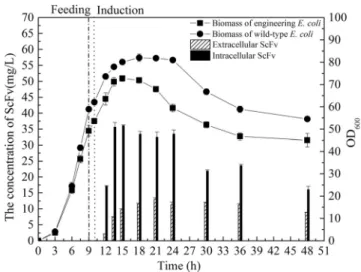
was initiated, scFv expression was induced by 1 mM IPTG when the OD600was greater than 40. AlthoughE. coliW3110/ pBZ001 grew slightly slower than the wild-type W3110 strain, they roughly entered stationary phase after 15 h of induction. Obvious cell lysis ofE. coliW3110/pBZ001 started at 18 h, whereas lysis of the wild-type strain began at 12 h. At 24 h, the degree of cell lysis of E. coli W3110/pBZ001 reached 18.3 %, which was significantly higher than that of the wild-type strain (Fig.1).
The expression of scFv in the pBZ001vector was regulated by the T7A3 promoter. This expression system was character-ized by weak basal activity, which was the reason why scFv was barely detected in cell supernatants and the fermentation broth prior to induction. Within 3.5 h after induction, scFv production was rapidly induced at the rate of 0.906 mg g−1 DCW h−1. Most of the products are intracellular accumulated and less than one-fifth of the total amount of scFv was secret-ed into the extracellular space; no scFv expression was detect-ed in the wild-type strain (Fig.1).
As shown in Fig.1, introducing the plasmid containing the exogenous scFv gene slightly inhibited cell growth. Moreover, it was obvious that the high-level expression of scFv after induction led to early cell lysis. These problems in anE. colihost can be a major bottleneck that hampers heter-ologous protein production in bioreactors (Schlegel et al.
2013). However, the cell lysis phenomenon is not obvious in a shake flask. The stability culture stage can be maintained for a long time(>72 h) and the cell density decreases little in the decline phase (data not shown).
Cell lysis mainly occurs in VBNC cells in a bioreactor
The VBNC state of bacteria was proposed by Xu et al. (1982), and it represents cells that have lost the ability to form colonies
Fig. 1 Comparison of cell lysis and single-chain variable-domain antibody fragment (scFv) expression betweenEscherichia coliW3110/ pBZ001 and the wild-type strain
on a medium when they suffer from stresses; however, their cell structure (e.g., cell membrane integrity), metabolic activ-ity (such as respiration, biochemical substance absorption, etc.), DNA synthesis, and the expression of specific mRNA genes that are characteristic of living cells remain intact. Once a suitable environment is restored, VBNC cells can be trans-formed into the cultivable state.
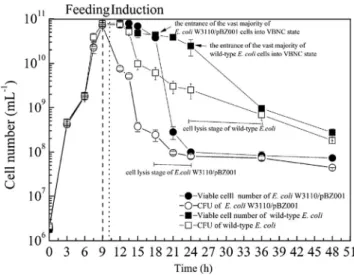
As shown in Fig.2, after scFv overexpression in W3110/ pBZ001, the number of CFU immediately decreased expo-nentially, while a slight reduction in living cells occurred from 10 to 18 h, indicating the entrance of the vast majority of cells into the VBNC state. A significant reduction in living cells and a slight CFU decrease, which accompanied the cell lysis, was detected after 18 h, indicating that cell lysis mainly occurs in cells entering the VBNC state. A similar conclusion was drawn for the wild-type strain. Most VBNC cells accumulated in the wild-type strain after 15 h and substantially lysed at 24 h. This is consistent with the assumption proposed by Noor et al. (2009) that VBNC cells are formed during the stationary phase and, in turn, are lysed by aσE-dependent process.
Lin (2000) expressed yeast α-glucosidase inE. colias a model system to obtain a more comprehensive understanding of the cell physiological response to the overexpression of heterologous genes during glucose-limited, fed-batch cul-tures. They found that the synthesis of recombinant proteins inhibited the synthesis of cellular housekeeping proteins, as there was a competition for RNA polymerase, ribosomes, and translation factors. As a result, there was a decrease in differ-ent cellular metabolic reactions, such as replication, transcrip-tion, translatranscrip-tion, glucose uptake, and respiratranscrip-tion, and this competitive effect led to the inhibition of cell growth. Thus, the host cells became VBNC cells, which maintain metabolic
activity, but irrevocably lose their ability to grow (Lin2000). Therefore, we assume that the lysis ofE. coliW3110/pBZ001 cells observed in our study occurred mainly in VBNC cells.
The stress response andσE-dependent cell lysis in W3110/pBZ001
The heat shock response
Figure 3 compares the expression of heat shock response genes between W3110/pBZ001 and wild-type strain in an identical culture system. From 3 to 15 h after induction, the expression ofrpoH was notably higher in W3110/pBZ001 than in the wild-type strain, reaching a maximum 12 h after induction and undergoing a dramatic decline after 15 h when cell lysis began. The expression ofdnaK,dnaJ,groES, and
groEL, which are controlled byrpoH, showed the same ten-dency. The expression of all genes in the two strains tended to converge to the same level at the end of the fermentation (48 h), indicating that their metabolic activity stagnated after cell lysis.
The heat shock response inE. coliis self-regulated under adverse conditions to enable survival in various microenviron-ments (Arsène et al.2000). TherpoHgene, encoding theσ32 regulator, is responsible for degrading misfolded proteins, preventing protein misfolding, or refolding misfolded proteins by regulating the DnaK/J–GrpE and GroEL–GroES chaper-one pairs (Hoffmann and Rinas 2004; Kumar and Sourjik
2012). By binding to hydrophobic regions of unfolded poly-peptides, the role of heat shock proteins, such as DnaK/DnaJ in prokaryotes, is to maintain protein solubility and prevent aggregation, while GrpE functions as a trigger to separate DnaK/DnaJ/polypeptide complexes via nucleotide exchange
Fig. 2 The relationship between the occurrence of cell lysis and the reduction of the viable but nonculturable (VBNC) number inE. coli
W3110/pBZ001 and the wild-type strain. The VBNC number is equal to the difference between the viable cell number and the colony-forming unit (CFU) number
Fig. 3 The relative expression of heat stress response genes inE. coli. The relative expression is the ratio of gene expression inE. coliW3110/ pBZ001 and wild-typeE. coliat the same time point
(Hartl et al.2011; Noor 2015). After IPTG induction in a fermentation culture, the expression ofrpoH,dnaK,dnaJ,
grpE,groEL, and groESinE. coli W3110/pBZ001 signifi-cantly increased compared with that in the wild-type strain at each time point, indicating that the heat shock response of W3110/pBZ001 cells was intensely triggered by scFv overexpression.
The acid stress response
Figure4compares the dynamics of the expression ofH-NS,
rpoS,gadE, andgadXin the acid stress response pathway. The mRNA level ofH-NS, the senior negative regulator in the acid resistance (AR) regulating system (Krin et al.2010), substan-tially decreased 2 h after the induction of scFv expression in
E. coliW3110/pBZ001, while that ofrpoS and gadX, the general regulators of the stress response (Talukder et al.
1996) and the retrograde transport gene in the AR system, increased by approximately 6- and 8-fold, respectively, com-pared with the wild-type strain. It is noteworthy that the tran-scriptional level ofgadE, encoding GadE, the central activa-tion element of the glutamate-dependent AR system, in-creased by more than 200-fold dramatically before the induc-tion and remained at a high level 2 h later and then declined 5 h eventually.
H-NS is believed to promote the degradation of rpoS
mRNA and suppress the expressions of certain regulators, such asgadX,adiY, andcadCin amino acid-dependent AR systems (Krin et al.2010; Talukder et al.1996). During the phase of rapid scFv synthesis (10–13.5 h of induction), the expression ofH-NSdecreased and removed the inhibition of
rpoSexpression, directly or indirectly, and promoted the ex-pression of the gadX and gadE genes in the glutamate-dependent AR system to cope with changes in the intracellular pH caused by scFv overexpression.
The oxygen stress response
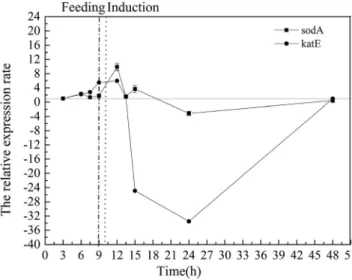
Figure5compares the dynamics of two major oxygen stress response genes between the W3110/pBZ001 and wild-type strains. sodA andkatE, encoding superoxide dismutase and catalase HPII, respectively, can cope with protein carbonyla-tion damage caused by sudden oxygen stresses (Dukan and Nyström1999). Two hours after the induction of scFv expres-sion in the W3110/pBZ001 strain, the mRNA levels ofsodA
andkatEincreased by approximately 10- and 6-fold, respec-tively. However, the expression of sodA in the W3110/ pBZ001 strain declined 3 h later to an extremely low level compared with that of the wild-type strain, and reached its minimum level at 24 h, while the expression ofkatEin the W3110/pBZ001 strain also decreased by approximately 3-fold at 24 h (Fig.5).
TheσE-dependent cell lysis and repair pathway
Figure 6shows the expression patterns of the rpoE,ompA,
ompC,ompW, andompXgenes duringσE-dependent cell ly-sis, which was discovered by Murata et al. (2012), in the W3110/pBZ001 and wild-type strains. Prior to IPTG induc-tion, the mRNA level ofrpoE, which encodes the σE tran-scription factor, was lower in the W3110/pBZ001 strain than in the wild-type strain, and it increased by approximately
8-Fig. 4 The relative expression of acid stress response genes inE. coli. The relative expression is the ratio of gene expression inE. coliW3110/ pBZ001 and wild-typeE. coliat the same time point
Fig. 5 The relative expression of oxygen stress response genes inE. coli. The relative expression is the ratio of gene expression inE. coliW3110/ pBZ001 and wild-typeE. coliat the same time point
fold 2 h after induction. The enhanced mRNArpoElevels eventually decreased to a significantly low level 14 h after induction. The mRNAs ofompA and ompC, which encode the two main outer membrane proteins inE. coli, remained at high levels in the W3110/pBZ001 strain up to 12 h of induction, and then decreased to extremely low levels. Prior to induction, the mRNA levels ofompWand ompX in the W3110/pBZ001 strain were approximately 18-fold lower after 9 h of incubation and 2.5-fold lower after 7.5 h of incubation, respectively. However, the expression ofompWand ompX
significantly increased after induction, but decreased after 5 h, compared with that in the wild-type strain.
The σEtranscription factor was originally defined in a study of the heat shock factorσH and σEregulates genes, which are required to repair abnormally folded periplasmic and membrane proteins that occur in response to thermal stress or other external stimuli (Ades2008). Murata et al. (2012) presented a completeσE-dependent cell lysis pathway. Because of the intolerable accumulations of unfolded proteins in the periplasmic space or the cell membrane induced by sudden stresses, theσEprotein in the cytoplasm is activated to upregulate the transcription of the small RNA MicA and
rybB, which reduce the expression of genes encoding outer membrane proteins such asompA,ompC, andompW, resulting in defects in the outer membrane and ultimately leading to cell lysis. ThisσE-dependent cell lysis proceeds in a cascade fol-lowingrpoEoverexpression during the logarithmic and sta-tionary phases in shake flask cultures. However, the sustained high level of expression ofrpoEdoes not occur during dra-matic cell lysis in bioreactor cultures, indicating that there are alternative ways of governing cell lysis inE. coli. OmpA is an important outer membrane structural protein that maintains
cell morphology and transfers hydrophilic compounds across the cell membrane (Danoff and Fleming2011), and OmpC is the main cation-selective porin that enables the entry of small molecules into the bacteria (Baslé et al.2006; Joseph Sahaya Rajan et al.2015). In Gram-negative bacteria, OmpW encodes a smallβ-sheet membrane protein that allows the bacteria to adapt to environmental changes (Brambilla et al.2014), while the mechanism that controls OmpX expression is not clear. The levels of the mRNAs that encode these four proteins increased with the enhanced expression ofrpoEduring the early stage of induction (about 10 to 15 h) in the fermentation culture of W3110/pBZ001. When cells are exposed to extracytoplasmic stresses caused by the rapid accumulation of exogenous proteins,σEinduces its own expression in re-sponse to RseB or RseA degradation by the DegS and YaeL proteinases, which leads to the repair of the outer membrane (Missiakas et al.1997). Five hours after induction, the expres-sion of genes encoding outer membrane proteins inE. coli
W3110/pBZ001 was significantly lower than that in the wild-type strain. This phenomenon may be caused by the de-creased synthetic capacity of the outer membrane proteins and the negative regulatory effect of cell lysis on the expression of these genes (Nitta et al.2000), which, in turn, led to earlier cell lysis.
Numerous advances have been achieved in the engineering ofσtranscriptional regulators, which have provided us with an effective means by which to tune the regulatory networks of bacteria, improve bacterial stress resistance, and increase the yields of desired products (Tripathi et al.2014). Recently, Dragosits et al. (2012) constructed a novel, self-regulatory protein production system, which controls recombinant pro-tein production through a stress-induced, negative feedback mechanism. To screen for molecular targets that increase cell resistance to stresses and to control cell lysis, further explora-tion of the mechanisms underlying the σ-dependent stress response and cell lysis is needed. Such knowledge could help to maximize the yields of heterologous proteins by balancing exogenous protein expression and cell growth.
Conclusion
The present study investigated how the induction of single-chain variable-domain antibody fragment (scFv) expression in
Escherichia coli W3110/pBZ001 influenced the viability of host cells and their cell lysis pattern in a 5-L bioreactor. Furthermore, the transcriptional levels of genes related to the general stress response and cell lysis were compared between the W3110/pBZ001 and wild-type strains throughout identical fermentation processes. The scFv protein was rapidly synthe-sized from 10 to 13.5 h of induction, and most of the protein
Fig. 6 The relative expression of cell lysis genes governed byσEin
E. coli. The relative expression is the ratio of gene expression inE. coli
accumulated in the intracellular space until 24 h (Fig.1). The viable but nonculturable (VBNC) cell number in W3110/ pBZ001 began to increase rapidly 10 h after induction, and reached its maximum of approximately 7.34 × 10¹⁰ colony-forming units (CFU) mL−1at 13.5 h after induction, while the rapid increase in the VBNC cell number in the wild-type strain was postponed for 6 h (Fig.2). Because of scFv over-expression, multiple stress response pathways in E. coli
W3110/pBZ001 were activated to accommodate the microen-vironmental changes, as evidenced by the results shown in Figs.3,4,5, and 6. VBNC cells lysed after 18 h of scFv induction in the W3110/pBZ001 strain, which was followed by a loss of cell viability, as evidenced by the substantial decrease in the expression of stress response genes (from 15 to 24 h of induction).σEparticipated in cell membrane repair, but no overexpression was detected during cell lysis (from 18 to 24 h of induction in the W3110/pBZ001 strain).
According to the findings of this study, we assume that recombinantE. colicell lysis occurs mainly in VBNC cells. Comprehensive investigations of VBNC cell formation and changes in bioreactor conditions are essential for the industrial-scale production of scFv (Chou 2007). Further study is required in order to assess the effects of external stresses, such as process design parameters, on recombinant cells, as well as to understand the variations in the cellular profiles of VBNC cells (Lin2000), which may contribute to the definition of the physiological states of the cells, i.e., sur-vival or cell lysis.
Acknowledgments This work was financially supported by the National Basic Research Program of China (973 Program) (grant number 2013CB733602), the National High Technology Research and Development Program of China (863 Program) (grant number 2015AA020802), the Fundamental Research Funds for the Central Universities (grant numbers JUSRP51401A and JUSRP11409), the National Natural Science Foundation of China (grant number 31570034), and the Natural Science Foundation of Jiangsu Province (grant number BK20150148).
References
Abe A, Ohashi E, Ren HF, Hayashi T, Endo H (2007) Isolation and characterization of a cold-induced nonculturable suppression mutant ofVibrio vulnificus. Microbiol Res 162:130–138
Ades SE (2008) Regulation by destruction: design of the sigma(E) enve-lope stress response. Curr Opin Microbiol 11:535–540
Andersson L, Strandberg L, Enfors SO (1996) Cell segregation and lysis have profound effects on the growth ofEscherichia coliin high cell density fed batch cultures. Biotechnol Prog 12:190–195
Arsène F, Tomoyasu T, Bukau B (2000) The heat shock response of
Escherichia coli. Int J Food Microbiol 55:3–9
Baslé A, Rummel G, Storici P, Rosenbusch JP, Schirmer T (2006) Crystal structure of osmoporin OmpC fromE. coliat 2.0 A. J Mol Biol 362:933–942
Brambilla L, Morán-Barrio J, Viale AM (2014) Expression of the
Escherichia coli ompW colicin S4 receptor gene is regulated by temperature and modulated by the H-NS and StpA nucleoid-associated proteins. FEMS Microbiol Lett 352:238–244
Chou CP (2007) Engineering cell physiology to enhance recombinant protein production inEscherichia coli. Appl Microbiol Biotechnol 76:521–532
Danoff EJ, Fleming KG (2011) The soluble, periplasmic domain of OmpA folds as an independent unit and displays chaperone activity by reducing the self-association propensity of the unfolded OmpA transmembraneβ-barrel. Biophys Chem 159:194–204
Dragosits M, Nicklas D, Tagkopoulos I (2012) A synthetic biology ap-proach to self-regulatory recombinant protein production in
Escherichia coli. J Biol Eng 6(1):1754–1760
Dukan S, Nyström T (1999) Oxidative stress defense and deterioration of growth-arrestedEscherichia colicells. J Biol Chem 274:26027– 26032
Hartl FU, Bracher A, Hayer-Hartl M (2011) Molecular chaperones in protein folding and proteostasis. Nature 475:324–332
Hobbie JE, Daley RJ, Jasper S (1977) Use of nuclepore filters for counting bacteria by fluorescence microscopy. Appl Environ Microbiol 33:1225–1228
Hoffmann F, Rinas U (2004) Roles of heat-shock chaperones in the pro-duction of recombinant proteins inEscherichia coli. Adv Biochem Eng Biotechnol 89:143–161
Joseph Sahaya Rajan J, Chinnappan Santiago T, Singaravel R, Ignacimuthu S (2015) Outer membrane protein C (OmpC) of
Escherichia coliinduces neurodegeneration in mice by acting as an amyloid. Biotechnol Lett. doi:10.1007/s10529-015-2025-8
Krin E, Danchin A, Soutourina O (2010) Decrypting the H-NS-dependent regulatory cascade of acid stress resistance in
Escherichia coli. BMC Microbiol 10:273–282
Kumar M, Sourjik V (2012) Physical map and dynamics of the chaperone network inEscherichia coli. Mol Microbiol 84:736–747
Lessard JC (2013) Growth media forE. coli. Methods Enzymol 533:181– 189
Lin H (2000) Cellular responses to the induction of recombinant genes in
Escherichia colifed-batch cultures. PhD dissertation, Universitäts und Landesbibliothek
Missiakas D, Mayer MP, Lemaire M, Georgopoulos C, Raina S (1997) Modulation of theEscherichia colisigma(E) (RpoE) heat-shock transcription-factor activity by the RseA, RseB and RseC proteins. Mol Microbiol 24:355–371
Murata M, Noor R, Nagamitsu H, Tanaka S, Yamada M (2012) Novel pathway directed by sigma(E) to cause cell lysis inEscherichia coli. Genes Cells 17:234–247
Nitta T, Nagamitsu H, Murata M, Izu H, Yamada M (2000) Function of the sigma(E) regulon in dead-cell lysis in stationary-phase
Escherichia coli. J Bacteriol 182:5231–5237
Noor R (2015) Mechanism to control the cell lysis and the cell survival strategy in stationary phase under heat stress. Springerplus 4:599 Noor R, Murata M, Yamada M (2009) Oxidative stress as a trigger for
growth phase-specific sigma(E)-dependent cell lysis inEscherichia coli. J Mol Microbiol Biotechnol 17:177–187
Sandén AM, Prytz I, Tubulekas I, Förberg C, Le H, Hektor A, Neubauer P, Pragai Z, Harwood C, Ward A, Picon A, De Mattos JT, Postma P, Farewell A, Nyström T, Reeh S, Pedersen S, Larsson G (2003) Limiting factors inEscherichia colifed-batch production of recom-binant proteins. Biotechnol Bioeng 81:158–166
Schlegel S, Rujas E, Ytterberg AJ, Zubarev RA, Luirink J, de Gier JW (2013) Optimizing heterologous protein production in the peri-plasm ofE. coliby regulating gene expression levels. Microb Cell Fact 12:24–36
Sikdar R, Simmons AR, Doerrler WT (2013) Multiple envelope stress response pathways are activated in anEscherichia colistrain with mutations in two members of the DedA membrane protein family. J Bacteriol 195:12–24
Talukder AA, Yanai S, Nitta T, Kato A, Yamada M (1996) RpoS-dependent regulation of genes expressed at late stationary phase in
Escherichia coli. FEBS Lett 386:177–180
Tripathi L, Zhang Y, Lin Z (2014) Bacterial sigma factors as targets for engineered or synthetic transcriptional control. Front Bioeng Biotechnol 2:33
Xu H-S, Roberts N, Singleton FL, Attwell RW, Grimes DJ, Colwell RR (1982) Survival and viability of nonculturableEscherichia coliand
Vibrio choleraein the estuarine and marine environment. Microb Ecol 8:313–323
Zarschler K, Witecy S, Kapplusch F, Foerster C, Stephan H (2013) High-yield production of functional soluble single-domain anti-bodies in the cytoplasm ofEscherichia coli. Microb Cell Fact 12:97–104