Western University
Scholarship@Western
Business Publications Business (Richard Ivey School of Business)
2013
The Use of Management Control Systems to
Formulate and Implement CSR Strategy: A Levers
of Control Perspective
Diane-Laure Arjaliès
Ivey Business School, [email protected]
Julia Mundy
University of Greenwich
Follow this and additional works at:https://ir.lib.uwo.ca/iveypub
Part of theAccounting Commons,Business Administration, Management, and Operations Commons, and theBusiness Law, Public Responsibility, and Ethics Commons
Citation of this paper:
Arjaliès, D-L., & Mundy J. (2013), The Use of Management Control Systems to Formulate and Implement CSR Strategy: A Levers of Control Perspective, Management Accounting Research, 24(4): 284-300.
1
The use of management control systems to manage CSR strategy:
A levers of control perspective
Diane-Laure Arjaliès Accounting and Control Department
HEC Paris 1 rue de la Libération 78351 - Jouy-en-Josas –France Tel: +33 (0)1 39 67 72 89 Fax: +33 (0)1 39 67 70 86 [email protected] Julia Mundy
Centre for Governance, Risk and Accountability University of Greenwich
Old Royal Naval College London
SE10 9LS UK
Tel: +44 (0)20 8331 9695 [email protected]
Forthcoming in “Management Accounting Research”, special issue on “Challenges for management accounting arising from the sustainable development agenda” edited by
Jan Bebbington and Ian Thomson 23 April 2013
Acknowledgements
The authors acknowledge the helpful comments of Jan Bebbington and Ian Thomson, the editors of the special issue, the two anonymous reviewers, and participants at the following conferences: the EABIS Conference (2009), FDIR Chair workshop (2010), MACORG/MCA symposium (2011), BAFA, EAA and CSEAR Conferences (2012). This research project has benefited from co-funding from the French Ministry Responsible for Research and the European Social Fund (ESF) regarding the hiring of CIFRE women according to objective 3: 5 /89: ‘Improving women's access to the labour market.’
2
The use of management control systems to manage CSR strategy:
A levers of control perspective
Abstract
Little is known about the role of management control systems (MCS) in managing the strategic processes that underpin Corporate Social Responsibility (CSR). To enhance our understanding of this phenomenon, this study employs Simons’ (1995) levers of control framework to explore how organizations leverage MCS in different ways in order to drive strategic renewal and trigger organizational change while simultaneously supporting society’s broader sustainability agenda. Drawing on data gathered from France’s largest listed companies – members of the CAC 40 – we provide insights into the structures and processes that companies employ to design, implement and monitor their CSR strategy. In doing so, we provide evidence of the way that organisations seek to attain their CSR objectives, and of the relationship between the management of CSR and other business processes. Of particular interest is the role of the levers of control in enabling managers to identify and manage threats and opportunities associated with CSR strategy, thus forming risk management processes that support organisations in their attainment of strategic objectives. Furthermore, the study provides evidence suggesting the use of MCS has the potential to contribute to society’s broader sustainability agenda through processes that enable innovation, communication, reporting, and the identification of threats and opportunities.
Keywords: Corporate Social Responsibility – CSR Strategy – Levers of Control – Management Control Systems – Sustainability
3
1. Introduction
The perceived importance of Corporate Social Responsibility (CSR) has developed in recent years in line with a growing recognition that it offers companies the potential to develop a competitive advantage (Porter & Kramer, 2006, 2011). CSR consists of a set of social and environmental activities that companies implement on a voluntary basis in order to address the social and environmental impact of their business and the expectations of their stakeholders (European Commission, 2001). In contrast to a stream of accounting literature that regards CSR strategy as part of an instrumental plan by corporations to gain legitimacy or manage reputation, offering limited capacity to contribute to society’s broader sustainability agenda (cf. Gray, 2010; Milne et al., 2006), in this study we adopt a perspective that views CSR strategy as an essential element of an organisation’s core business. This approach does not exclude the possibility of
‘greenwashing’1 as a set of legitimizing actions within this strategy, but advocates that CSR
strategy is essentially concerned with embedding socially and environmentally responsible actions throughout the organisation in order to enhance long-term value (Moon, 2007).
Firms face increasing pressures in relation to their management of CSR. First, if improvements in social and environmental performance are to translate into long-term shareholder value, firms will need to ensure that associated activities are fully integrated into strategic processes (Adams & McNicholas, 2007; Perez et al., 2007). Research is therefore required to understand the role of management control systems (MCS) in facilitating the management of CSR activities that can in turn support the attainment of organisational objectives (Gond et al., 2012; Perez et al., 2007). This also requires a greater understanding of the internal processes through which CSR performance is managed and linked to other business processes. Second, as stakeholders demand more information about CSR performance, or about the relation between economic and CSR performance, firms will need to become more proactive and transparent in their management of social and environmental activities (Bartolomeo et al., 2000; Burnett & Hansen, 2008; O'Dwyer, 2002, 2005; Perego & Hartmann, 2009). For example, social and environmental reporting and auditing processes can enhance corporate transparency and accountability by providing a greater visibility of the inner functioning of organizations (Hopwood, 2009). Third, increasingly stringent environmental legislation means that firms will need to incorporate external costs into their business planning in order to manage the risks associated with undertaking or even avoiding CSR activities (Bartolomeo et al., 2000; Porter & Kramer, 2006, 2011; Porter & van der Linde, 1995; Schaltegger & Burritt, 2010). This implies an important role for MCS in helping managers to identify and manage potential threats and opportunities.
With these concerns in mind, this paper addresses recent calls in the literature for empirical research into the role of MCS in relation to the social and environmental activities undertaken by organisations (for example Ferreira et al., 2010; Gond et al., 2012; Henri & Journeaut, 2010; Perez et al., 2007) by shedding light on the following research question: How do organizations use management control systems to manage CSR strategy? The distinction between the different levers of control used by senior managers to control strategy (Simons, 1995) provides the conceptual framework for the paper. We employ the LOC framework to explore how managers combine two types of processes, diagnostic and interactive, to balance ‘intended’ (i.e. top-down) and ‘emergent’ (i.e. bottom-up) strategies, while simultaneously identifying opportunities and managing risks through the use of two other types of systems, beliefs and boundaries. A balance between these different uses of MCS is fundamental to the success of any strategy (Mundy, 2010;
1Greenwashing refers to a form of marketing and promotional activity that is used to promote the
4
Simons, 1995; Widener, 2007) and therefore appears of primary importance for the successful management of CSR strategy.
In seeking to address the above research question, the current study draws on data collected via a questionnaire from the CAC 40 group of publicly listed companies in France. Prior research in this area has tended to employ in-depth case studies (cf. Crutzen & Herzig, 2012), but is limited in its ability to provide a broader picture of practices across a group of organisations. The findings from the study demonstrate how organizations use their MCS to facilitate change and strategic renewal in CSR. Specifically, by employing the levers of control framework, we show how organizations use their MCS to communicate the vision and purpose of CSR; to combine intended and emergent strategy; to prescribe acceptable CSR activities, and to manage CSR performance. Of particular interest is the use of MCS in enabling managers to identify and manage threats and opportunities associated with CSR strategy, thus forming risk management processes that support organisations in their attainment of strategic objectives. Furthermore, the study provides evidence suggesting that MCS have the potential to support the transformation of organisational practices that can contribute to sustainable development through processes that facilitate innovation, communication, reporting, and the identification of threats and opportunities.
The paper makes several contributions to the literature. First, it addresses recent calls in the literature for research into the role of MCS in the transformation of organisational practices that contribute to society’s sustainability agenda (Adams & McNicholas, 2007; Gond et al., 2012; Perez et al., 2007). By focusing on the management and control of CSR within a group of large organisations, the current study provides insights into the structures and processes that companies use to manage CSR strategy, and enhances our understanding of the relationship between the management of CSR and other business processes. Second, by investigating how managers use MCS to identify and manage risks and opportunities associated with CSR, the current study addresses recent calls in the literature for more research into risk management processes, an important but under-developed area in MCS research (Binder, 2007; Tessier & Otley, 2012). Third, this study seeks insights from managers who are directly involved in the development of CSR activities, an approach which is being increasingly encouraged, whether such research is associated with achieving radical change or simply supporting managers in their efforts to undertake CSR activities (Schaltegger & Burritt, 2010). Fourth, the study provides evidence of managers’ use of MCS in managing the subsequent tension between intended (‘top-down’) and emergent (‘bottom-up’) strategies. The current study thus addresses calls in the literature for further insights into the use of the LOC as an analytical tool for understanding the management of strategic processes (Gond et al., 2012).
The paper is structured as follows. The following section outlines the LOC framework and outlines its relevance and application to the study of the management of CSR strategy. This is followed by the research design, including the methods used to conduct the study. The subsequent section presents the study’s findings and discussion. The final section provides some concluding comments.
2. CSR strategy and the role of MCS
2.1. The relationship between sustainability, CSR and MCS
Sustainable development (SD) and sustainability are highly complex notions whose various definitions are heavily value-laden (Byrch et al., 2007; Moon, 2007). Definitions therefore abound: ‘There is clearly no single “sustainability” that can be known and accounted for’ (Gray,
5
2010: 56). Pivotal to this debate is the publication of the Bruntland Report in 1987, in which SD was defined as:“[D]evelopment that meets the needs of the present without compromising the ability of future generations to meet their own needs”. It contains within it two key concepts: the concept of “needs”, in particular the essential needs of the world’s poor, to which overriding priority should be given; and the idea of limitations imposed by the state of technology and social organization on the environment’s ability to meet present and future needs.” (World Commission for Environment and Development, 1987: 43). In this context of series of major conflicts between generations, economies, cultures, and institutions (Milne et al., 2006), sustainability appears as a ‘state’ of ‘human-nature relationships’ and SD as ‘a process through which we move towards that state’ (Gray, 2010: 53).
Regardless of the motivations behind individual managers’ actions in relation to CSR activities, it is generally assumed that firms tend to view SD in terms of its compatibility with some modified version of their existing business model (O'Dwyer, 2002). Adopting a ‘business case for SD’, proponents of this view argue that business actions towards sustainability will be beneficial both for the economy and the environment. This position is often known as the ‘win-win’ situation (Porter & van der Linde, 1995). In particular, the recent development of the concept of ‘shared value’ by Porter and Kramer (2011), understood as ‘creating economic value in a way that also creates value for society by addressing its needs and challenges’, has reinforced the idea that ‘good’ business can contribute to sustainability. “The corporate sector has the finances, the technology and the management to make this happen.” (United Nations quoted by Wade, 2005). Consequently, the perceived benefits of CSR are expected to ‘bring incentives for corporations to act socially responsibly and this includes contributions to the sustainable development agenda’ (Moon, 2007; 296).
Some observers believe, however, that companies exploit sustainability issues solely for the purposes of increasing shareholder wealth, with little genuine connection to sustainability concerns (cf. Gray, 2010; Milne et al., 2006). Companies driven by such self-interested behaviour will necessarily disregard elements of the SD agenda that are not perceived as directly supporting their businesses (particularly in the short term) or as sufficiently ‘material’. While conscious of these limitations, we do not seek in our study to assess organisations’ motives for engaging in CSR, but instead adopt their view of CSR and sustainability as a departure point. Our aim is to explore the potential role played by management accounting and control in managing this set of activities, in relation to the core-business strategy. The question of how the corporate sector can be persuaded or incentivized to contribute to sustainability beyond its own narrow interests is a topic for further discussion beyond the scope of this paper.
Given the central role of companies in contributing, even in a narrow and self-interested way, to sustainability, managers’ use of MCS can be instrumental in transforming practices that are congruent with sustainable development: ‘they can, if used appropriately, push organizations in the direction of sustainability’ (Gond et al., 2012: 206). MCS are the ‘formal, information-based routines and procedures managers use to maintain or alter patterns in organisational activities’(Simons, 1995: 5). They play a significant role in ensuring that environmental and social activities are incorporated into an organisation’s strategic plans and objectives (Adams & McNicholas, 2007; Gond et al., 2012). MCS provide information to managers for use in decision-making, regardless of whether the company’s objective in implementing a CSR strategy is competitive advantage, legitimacy, reputation management, compliance, industry pressures, greenwashing or an attempt to conserve resources (Schaltegger & Burritt, 2010). MCS enable managers to make decisions about relevant risks, such as forthcoming legislation, and potential opportunities, such as better waste management processes or reduced consumption (Bartolomeo et al., 2000; Schaltegger & Burritt, 2010). They also support managers by providing information
6
on the use and cost of resources that impact the environment (Bartolomeo et al., 2000) - potentially providing a competitive advantage (Burnett & Hansen, 2008) - and by enabling managers to identify and involve relevant stakeholders in organisational decisions (O'Dwyer, 2005).
Environmental management systems (EMS) are an increasingly popular means of coordinating, monitoring and managing information that relates to environmental strategy (Larrinaga-Gonzales & Bebbington, 2001). EMS incorporate traditional mechanisms, including budgeting, performance measurement systems, and risk management processes that are commonly used in mainstream business but which are tailored to address the specific issues that relate to environmental issues (Henri & Journeaut, 2010).
In summary, the long term focus of CSR strategy means that its activities are increasingly treated by organizations as a form of strategic investment. A greater understanding of how MCS enable managers to control and monitor CSR strategy is required in order to provide insights into the role of MCS in transforming business practices and in managing threats and opportunities related to CSR. As we argue above, such research forms a necessary element of understanding more about role that the corporate sector can play in contributing to sustainability. The research question addressed in this study is therefore: How do organisations use their MCS to manage CSR strategy?
2.2. The role of MCS in developing and renewing CSR strategy: a levers of control perspective
An enhanced understanding of the role of MCS in managing CSR strategy may be attained by investigating the use, rather than the existence, of specific accounting tools and mechanisms. The current study thus employs Simons’ (1995) levers of control framework as an analytical tool to address the research questions investigated in this study. The use of the LOC framework is appropriate in the current study for several reasons. First, it is fundamentally concerned with the use of control systems to drive strategic renewal while simultaneously exerting control over how strategic objectives are achieved (Abernethy & Brownell, 1999; Bruining et al., 2004; Henri, 2006; Kober et al., 2007; Simons, 1995; Tuemola, 2005). Managers use MCS to manage CSR strategy and also to support the renewal of mainstream business strategy through the development of CSR (Arjaliès & Ponssard, 2010). Second, a central element of the LOC framework is its focus on how managers ensure that intended strategies are implemented successfully while also remaining open to strategies that emerge from other areas of the business (Abernethy & Brownell, 1999; Kober et al., 2007; Simons, 1995; Skærbæk & Tryggestad, 2010). Third, the LOC framework is an analytical tool for investigating how managers use MCS to deal with strategic uncertainty (Simons, 1995). CSR is accompanied by strategic uncertainty because it introduces into the business new sets of risk and opportunities that must be managed (Schaltegger & Burritt, 2010). Gond et al.’s (2012) conceptualization of eight configurations of diagnostic and interactive uses of MCS that each produce a different level of integration of sustainability within organizational strategy is another illustration of the relevance of the LOC framework to address these questions. In contrast to their development of a typology of sustainability integration, our aim in this paper is to investigate whether and how companies use MCS in their attempts to achieve strategic renewal through CSR. In summary, the focus of the LOC framework on the different uses of MCS rather than on other attributes, such as their existence or structure, is designed to shed insights into the influence of MCS on strategy.
The LOC framework identifies four key processes – beliefs, boundaries, diagnostic, and interactive – as a way of analysing how organizations leverage their MCS in order to implement
7
business strategies. The full potential of the four levers of control is realised when they are mobilized together so that they facilitate the implementation and attainment of an organisation’s strategic objectives (Bruining et al., 2004; Henri, 2006; Mundy, 2010; Widener, 2007). Belief systems consist of an explicit and formal set of organizational statements that managers use in order to communicate the organization’s values and provide a coherent strategic agenda (Ahrens & Chapman, 2004; Simons, 1995). They are “created and communicated through such documents as credos, mission statement, and statements of purpose.” (Simons, 1995; 34) Their purpose is to secure the commitment of employees towards common goals while also inspiring them to search for organizational opportunities. Belief systems help to foster a sense of stability and continuity, but can also enable organizational change when managers use them to introduce new priorities or values (Bruining et al., 2004; Simons, 1995). Any MCS that incorporates explicit information about the organization’s values and purpose can be leveraged as a beliefs system. Within a CSR context, belief systems can be expected to incorporate a broad set of values based around an agenda that garners the commitment of an organization’s employees and other stakeholders to its long-term sustainability objectives. Belief systems underpin the way that the other levers of control operate and are therefore central to the way that all four work together (Widener, 2007).
Managers also use MCS to establish boundaries that restrict employees in their search for strategic opportunities. The boundary lever of control is represented by an explicit set of organizational definitions and parameters, commonly expressed in negative or minimum terms that support managers in their attempts to identify risks that must be avoided if the organisation’s objectives are to be achieved (Simons, 1995). Risk management processes thus play an important role in the attainment of strategic objectives (Binder, 2007; Tessier & Otley, 2012). Managers use strategic boundaries to communicate to employees those activities deemed acceptable and those considered off-limits so that employees do not waste the organization’s resources. For example, environmental threats and the potential liabilities associated with ignoring CSR activities can be included in regular internal reports and environmental audits can be used to remind employees about major risks to the business (Schaltegger & Burritt, 2010). A second type of boundary, business conduct boundaries, are formed by drawing on external and internal frameworks, such as voluntary guidelines, codes of conduct, and legal standards. They are particularly important when environmental uncertainty, costs of non-compliance or reputational costs are high because they guide and control the behaviour of employees. Companies cannot rely on regulation and legislation alone because these are not sufficient to prevent individual employees behaving in ways that place an organisation at risk of loss of earnings or even failure (Sarre et al., 2001). Careful management of CSR activities is thus crucial to an organisation’s overall management of risk because it helps managers to identify risks associated with irresponsible practices (Sarre et al., 2001).
Diagnostic use of MCS occurs when managers compare performance against targets in order to identify critical exceptions and deviations from plans (Abernethy & Brownell, 1999; Simons, 1995). Progress on strategic initiatives is evaluated against performance measures that incorporate a combination of short-term and long-term measures, financial and non-financial objectives, and comparative data on competitors (Abernethy & Lillis, 1995; Ittner & Larcker, 2003). Feedback on performance enables managers to adjust their actions when results are below expectations. Diagnostic processes make tangible and visible the activities that employees must undertake in order to achieve the organization’s strategic goals (Bhimani & Langfield-Smith, 2007).
Organizations need to monitor and control costs relating to CSR activities because the ability of many firms to identify and internalise the net benefits of CSR is a critical success factor in maintaining a competitive advantage (Arjaliès & Ponssard, 2010). Diagnostic processes are crucial
8
to the successful attainment of CSR objectives because CSR activities that are not accompanied by measurable outcomes are likely to be overlooked in favour of mainstream business measures (Gond et al., 2012). Appropriate compensation schemes are similarly essential if managers are to be encouraged to undertake CSR activities that enhance performance, particularly where these may conflict with the attainment of financial goals. More broadly, performance measures are used to monitor compliance with external regulations and standards; to facilitate environmental decision-making by managers; and to provide information about social and environmental activities and performance for external stakeholders (cf. Henri & Journeaut, 2010). Companies may consult with external stakeholders in order to obtain agreement on appropriate measures and indicators for measuring CSR performance (Schaltegger & Burritt, 2010).
Finally, interactive controls are formal processes that managers use to manage strategic uncertainties and to identify opportunities. Strategic uncertainties are contingencies that could threaten or invalidate the assumptions underlying an organisation’s strategy (Simons, 1995). Interactive processes enable managers to identify challenges to their strategic agenda (Schaltegger & Burritt, 2010). They enable senior managers to gain a richer understanding of potential opportunities and capabilities while simultaneously signalling to junior managers the organization’s strategic priorities (Miles et al., 2006; Simons, 1995). Interactive use of a control is characterized by three elements: intensive use by superiors, intensive use by subordinates, and frequent personal communication between the two groups (Bisbe & Otley, 2004; Tessier & Otley, 2012). Senior managers use interactive processes to facilitate debate about the underlying action plans that drive an organization’s activities and to obtain access to local knowledge about strategic uncertainties that can be used to develop strategic plans (Ahrens & Chapman, 2004; Binder, 2007; Tessier & Otley, 2012). Interactive processes to support CSR strategy usually incorporate the views of a range of external stakeholders, such as NGOs, local communities, and investors, so that managers can uncover strategies that have not been previously considered by internal groups and receive feedback on current CSR initiatives (cf. Gond et al., 2012). Interactive processes thus play a crucial role in stimulating and guiding the emergence of new initiatives that provide the impetus for strategic change and renewal (Abernethy & Brownell, 1999; Bisbe & Otley, 2004; Ittner & Larcker, 2003; Kober et al., 2007; Simons, 1995). Any MCS that facilitates processes of debate around strategic uncertainties, such as formal strategy reviews, budget planning meetings, and strategic risk management processes can be used interactively (Abernethy & Brownell, 1999; Binder, 2007; Ittner & Larcker, 2003). Finally, interactive processes are critical when performance measures are multi-dimensional, such as in CSR strategy, because they enable senior managers to support junior managers in their attempts to deal with conflicting goals (Lillis, 2002).
Managers combine the four levers of control to exert control over the attainment of organizational goals while simultaneously enabling employees to search for opportunities and solve problems (Ahrens & Chapman, 2004; Frow et al., 2005; Mundy, 2010; Simons, 1995). Controlling features of MCS are activated through diagnostic and boundary processes that constrain employees through the use of targets and rules as they attempt to achieve the organization’s objectives. In contrast, enabling features are promoted through belief and interactive processes that stimulate debate and encourage innovation.
3. Research design
The study responds to recent calls in the literature for greater insights into the role of MCS in the integration of CSR into business strategy and into the development of risk management processes (cf. Gond et al., 2012; Perez et al., 2007; Schaltegger & Burritt, 2010). We address our research question by drawing on data collected from questionnaires, triangulated with secondary
9
data where available, and further supported by an interview with the director of an agency advising on socially responsible investment. In line with other studies in the MCS literature (cf. Abernethy & Brownell, 1999; Bisbe & Otley, 2004; Henri, 2006; Widener, 2007), the choice of a questionnaire rather than a longitudinal field study of one or a few companies was driven by our intention to provide an overview of the management control practices of one group of companies, at a given moment in time. In doing so, we aim to provide a broad picture of the role of MCS in managing CSR strategy, as well as a comparison point for future research, a position which has been notably lacking in previous literature (Crutzen & Herzig, 2012).
In order to develop insights, we employed both open and closed questions (Blumberg et al., 2005). Closed questions were used to collect data on factual aspects such as the scale and scope of existing structures, systems, and processes associated with CSR strategy, while open questions were used to elicit longer responses about the use of such practices. The questionnaire was sent to the Head of the CSR Departments of the companies in the CAC 40 index. The CAC 40 is a benchmark stock market index that tracks the 40 largest French stocks based on market capitalization. A list of the companies included in the CAC 40 is provided in Appendix A. These organisations represent an interesting research site because in 2001 France introduced the Nouvelles Regulations Economiques (NRE) law with the aim of enforcing a consistent approach to social and environmental reporting across all publicly listed French companies. Companies are required to report against three types of information: internal social data (training, safety, hygiene, etc.); territorial impact of activities on subsidiaries, subcontractors, etc.; and environmental
aspects (effluent discharge, C02 emissions, etc.). They are free to select their own reporting
methods, including the scope and choice of indicators. The NRE reporting requirements are not aligned with the indicators specified under GRI guidelines with the result that many companies report on them separately (Delbard, 2008). Of the wide variety of voluntary CSR reporting standards that are globally used, the Global Reporting Initiative (GRI) has become the most widely accepted (Samy et al., 2010) although France has adopted this to a lesser extent than other countries. The GRI provides guidelines for reporting on the social and environmental impact of an organization’s activities.
This study benefited from a close collaboration with the Socially Responsible Investment (SRI) Analysis & Research Department of a French asset management company. SRI analysts are responsible for analysing the CSR strategies of companies in order to identify those which are the most socially responsible and therefore which might be more likely to be profitable in the long
term.2 The questionnaires were sent out under the name of the French asset management
company together with a covering letter from the CEO of the company explaining that this
information was requested both for investment reasons and academic purposes.3 The asset
management firm’s involvement in the project was for the purposes of informing their overall SRI policy, and not for reasons associated with investment in particular organisations. This was made clear in the covering letter sent to respondents. The letter also guaranteed that no company would be identifiable in the subsequent publicly available report. The questionnaires were returned to the researchers, who anonymised the data before sharing it, in the form of a summary
level report, with the asset management company and the participating companies. This formal
request for information about each company’s CSR practices was expected to produce a high response rate.
2 In France, SRI is financially driven: the most ‘socially responsible’ companies are expected to become the
most profitable in the long term: a relationship which has not yet been borne out by the evidence.
3 This collaboration was obtained through a doctoral agreement – known as a CIFRE (Industrial Contracts
for Training through Research) – between the company, the research laboratory and one of the researchers, under the control of the French Ministry of Research.
10
Efforts to discourage greenwashing were incorporated into the process where possible. First, by customising each questionnaire to the practices of the company, we were able to demonstrate to the respondents that we were knowledgeable about the activities of their organisation. Second, we sought the opinions of the SRI analysts where responses seemed at odds with the secondary data or with the researchers’ own in-depth knowledge of the organisations’ CSR activities. In these few instances, respondents were contacted for further clarification. Finally, we also organized an open meeting with respondents from the firms, during which we presented the initial findings and we were able to communicate directly with the attendees, thereby enriching our understanding of their activities and observing the exchanges between the representatives of the different companies (which confirmed, for instance, that most of them were facing the same problems, regardless of the sector).
In investigating the existing practices of the CAC 40 companies, we examined their CSR activities in relation to social, environmental, societal and governance concerns. We also added the management of stakeholders’ relationships as a dedicated topic because it represents a broad concern of these companies in relation to their CSR activities.
3.1. Questionnaire design, data collection, and sources
We framed each questionnaire based on each company’s own understanding and practices of CSR, thereby adopting their view of the link to sustainability. The content of the questionnaire was based on an in-depth analysis of secondary data gathered from documentary evidence and social ratings as follows:
Companies’ reports: An analysis of the companies’ annual CSR reports together with other
relevant documents4 (65 in total) revealed a range of management control systems, such as
Environmental Management Systems, incentives, audited indicators, social audits, used by each company. Prior to developing the questionnaires, we also conducted one interview lasting two hours with the CSR Director of an insurance company in order to confirm our understanding of the content of these reports and the information available regarding various MCS.
Social ratings: the analysis of companies’ reports was complemented by a study of the social ratings provided by three social rating agencies (French, British and American). A social rating agency is paid by an asset management company to evaluate the social, environmental and governmental aspects of companies, referred to as ESG criteria. An interview lasting one hour was also conducted with the Head of Research of the French social rating agency to gain a better understanding on how management control systems were assessed by the agency.
Using the data gathered from secondary sources, both governmental and non-governmental organisations, we developed a common framework (cf. Table 1) that was then adapted to each company’s known practices. For instance, when it was known that there were CSR managers within the business units of a company, further details were asked about their role, their profile and the utilization of information they provided. If we did not know whether there were CSR managers, we first asked if the role existed. Open questions were used to provide the respondents with further opportunities to company to explain their practices.
[Insert Table 1 here]
11
Questionnaires were sent out by post. We followed up with individual calls when questionnaires were not returned. In total, 36 companies participated in the study. The final
response rate was high, with 87.5% of the CAC 40 companies responding to the survey.5 All of
the companies that responded by post provided contact details should any further information be required and 8 firms were subsequently contacted for additional information. The individual respondents belonged either to the CSR Department or its equivalent (27 or 75% respondents), or to the Financial Communication and/or Investor Relations Department (seven or 20%). The remaining two respondents indicated that they belonged to both of these Departments. These managers were selected because they are directly responsible for ensuring the attainment of their companies’ CSR objectives, and so are best placed to respond to questions about the use of different process and practices that directly support this. In eleven (30%) of cases, the Head of the CSR department reported directly to the Chairman or CEO, in a further seven (21%) of cases they reported more generally into the Executive Committee, five (14%) to the Company Secretary, and in one case to the Board of Directors. The seniority of our respondents is consistent with the importance attached by French organisations to CSR following the introduction of the NRE in 2001.
3.2. Data analysis
The data were translated by one of the researchers, a native French speaker. We used an open coding system and coded at two levels. First-order codes were used to denote the types of MCS in use, such as an EMS (Langley, 1999). Second-order codes were attached to denote the levers of control as operationalised in recent MCS studies (cf. Henri, 2006; Mundy, 2010). For instance, we aimed to explore how CSR reporting was used in the companies to manage strategic uncertainties. The data were independently coded by the researchers and any differences in coding were discussed until a consensus was reached. Due to the broad scope of the coding, very few differences arose and were readily resolved by referring back to definitions previously established in the literature. For example, standard operating procedures are not generally regarded as part of the LOC and so were be eliminated from the analysis.
While the research design limits our ability to measure relations between different variables, the nature of the study necessitated a method that would enable us to gain a better understanding of the existing practices in our sample, while simultaneously ensuring a high response rate and collection of a large amount of information at a particular point in time. Although only one respondent from each organization completed the survey, reliability and validity of the primary data were enhanced by comparison with approximately equivalent information from secondary sources where available.
4. Findings
4.1. Overview of CSR strategic processes
The study’s findings indicate that the CAC40 companies readily accept the necessity of CSR as an important consideration for their continued success, whether for the purpose of enhancing shareholder value or to gain legitimacy. All of the companies in our study have implemented a CSR strategy, with some respondents specifically stating their belief that CSR provides a vital competitive edge because it plays a key role in driving internal change and helps to focus
5Because the merger of GDF and SUEZ was still recent at the time of the study, the merger of the respective
CSR departments had not yet been effected. Therefore, it was decided, after discussion with GDF SUEZ, to include the responses corresponding to the two former entities, as well as the response of SUEZ ENVIRONNEMENT, new arrival in the CAC 40. This increased the population to 41.
12
attention on innovation and communication. In fourteen (39%) of the companies, the process of developing CSR strategy also helps to unite employees around shared values in relation to the company’s overall strategic direction. Several respondents claimed that employees in their respective companies are particularly interested in CSR issues and they are able to exploit this to capture interest in overall strategy. Nine (25%) of companies state that their main objective behind developing CSR strategy is to ensure compliance with statutory and legal frameworks, such as the NRE law, European directives, and the United Nations Global Compact, while a further seven claim to be responding directly to stakeholder expectations and requests in their focus on developing a strategy for CSR. Many of the respondents in our study also report that CSR helps their companies to promote a ‘good’ image of the company to their stakeholders, in particular customers and future employees.
Thirty four out of the thirty six CAC 40 companies in our study have established a separate department responsible for managing group CSR strategy. For ease of terminology, we give this department the generic name of the CSR Department (CSRD). Twenty five (70%) of companies have subordinated their CSRD to executive committee or board level, and with a decision-making role at group level. The CSRD has overall responsibility for formulating, implementing and monitoring the CSR strategy within each group and its entities. Its primary objectives are to ensure the consistency of CSR strategy in a multi-activity and multi-national group, to gather and disseminate good practices throughout the group, and to coordinate CSR reporting at group level.
The CSRD suggests and implements CSR strategy within the group…It also helps in formulating objectives and monitoring key indicators.
Service Company 1
Ten (28%) of the companies develop CSR strategy around themes that transcend the different activities of the company. The themes chosen correspond most frequently to recognisable topics in CSR: environment, social, governance, and society. A further four firms develop their CSR strategy around the specific functions or activities represented in the organization. Half of the companies choose to combine both approaches, while the remaining four companies claim to have a completely decentralized approach in which CSR policy is decided in an autonomous manner at Department level.
Thirty two (89%) of the firms re-evaluate their CSR commitments on a regular basis by reviewing their action plans. For most of them, this occurs on an annual basis, but others (18%) use the 3-5 year cycle of business strategy as the vehicle for also reviewing CSR strategy. Four companies have not yet undertaken a review of CSR strategy, preferring to concentrate on the actions already underway before considering new issues and commitments.
Typically, administrators from either the CSRD or from operational departments are responsible for managing and reporting information on CSR performance. Only three companies have retained partial or fragmented systems that existed prior to the implementation of the group’s CSR strategy, although the data is collected by the CSRD and reported at group level. As a particular example, we examined the extent to which the companies conduct employee satisfaction surveys. Almost half of the companies conduct these on a regular basis, usually once every few years due to the logistical issues involved. Four of the companies are currently in the process of conducting employee satisfaction surveys. However, a further 40% do not have tools for measuring employee satisfaction and are not seeking to develop any.
13
We also captured the scope of CSR reporting, measured in terms of the proportion of the company that is subject to CSR reporting. Thirty out of the thirty six companies claim a reporting scope of 100%. This very high percentage reflects the requirements of the NRE law that applies to French publicly listed companies. Four companies claim to have a low scope of CSR reporting, either because the headquarters and other administrative offices were excluded from their environmental reporting, or because the organization’s boundaries are in a state of flux.
The reliability of CSR data is a major concern for the companies in our study, so the large majority (thirty) submit their CSR reporting to an external or internal audit process.
In the future, we want to improve the reliability of our indicators.
Industrial Company 8 We need a robust consolidation at the level of the group, which is not the case today.
Industrial Company 5
Statutory auditors are used exclusively in about half of these companies, while a further six (17%) rely on an internal control process that is usually conducted by the CSRD rather than by the internal audit departments.
Each year, when publishing our Corporate Responsibility Report, we carry out an external audit conducted by X to guarantee the validity of data published in the report.
Industrial Company 4
While five companies use both external and internal processes to check the reliability of their CSR data, an equivalent number claim to have no formal control procedures over their CSR reporting.
Separate budgets or investments for CSR strategy are assigned at operational level in only half of the companies in our study and are usually managed collaboratively between the CSRD and operational departments. In those companies where CSR strategy does not have an allocated budget, additional funds are allocated to operating departments on a case-by-case basis as determined by the CSRD or other group-level authorities.
There is no ‘CSR budget’ as such at the corporate level given the diversity of activities (human resources, EMS, CSR products, etc.). The ‘CSR budget’ would not be a relevant indicator.
Service Company 2 Sometimes there is a budget, such as for the ISO 14001 certification.
Service Company 1 4.2. Communicating values and purpose
Six (17%) of the companies claim that their main goal is to structure and communicate existing CSR actions around shared organizational values. Merger and acquisition events were mentioned in several cases as specific instances in which the process of amalgamating existing CSR activities of previously autonomous companies enabled senior managers to build a set of shared values for the newly combined organization.
14
When X and Y merged in 2006, we realized that the two groups had two different approaches regarding CSR: X had a ‘Sustainable Development’ approach, which means an integrated approach, more focused on health, safety and the environment while Y was more community oriented and governance-compliant. With the emergence of the new group, we needed to find a mutual denominator, which was made possible by internal and external benchmarking and to the new CSR vision.
Industrial Company 2
Formal communication of the purpose and values surrounding CSR strategy is used by senior management to indicate to operational departments how these align with those of the general business strategy. In half of the companies, CSR strategic initiatives are communicated primarily through existing channels, such as intranet and institutional communication, that are also used to communicate general business strategic plans. The remaining half make use of new channels that have been especially developed for the purpose of communicating information on agreed CSR initiatives to their employees. Examples of communication channels include company-specific programmes (14%), one-off or ad hoc training sessions or seminars (17%), and the use of CSRD representatives that facilitate the alignment of the values and purpose of CSR and mainstream business strategy during their regular and formal dealings with operational teams.
These values are commonly expressed in a mission statement for CSR strategy and communicated through a variety of means within each company, including strategic planning documents, organizational-wide conferences, company intranet, and physical artefacts such as posters.
The CSR strategy was formally communicated by the board to the local managers through different means, notably: communication of the minutes of the board’s meeting on this topic, a requirement for self-evaluation of the local strengths and weaknesses regarding the new strategy, a requirement for local action plans in line with this new strategy, various internal communications through the usual corporate communication channels (intranet, e-mails, booklets, etc.).
Service Company 2 4.3. Risks to be avoided
Half of the respondents claim that the process of developing CSR strategy highlights high risk areas such as governance, security, health and safety, and reputation and thus contributes to risk management processes. In fact, some CSR managers choose to frame CSR concerns in terms of risk because prior experience has shown them that this approach is more likely to attract a positive response from senior managers. Although CSR is largely perceived in terms of cost, the heads of the CSRDs anticipate that effective CSR management will play an important role in supporting a wide range of objectives. The respondents claimed that the companies view their development of CSR strategy less as a set of standards imposed externally than as a means to give the company a competitive edge.
Our objectives are numerous but our main motivations relate to the management of risks, to the increase of performance due to the development of new markets, to customer satisfaction, to reputational stakes and public image and to employee motivation. The managing of costs is not an end as such due to the nature of our activities.
15
We believe that the CSR is a tool to better manage our risks and thereby create more value for the company…We invite business units to calculate the ‘business case’ for CSR that can easily be evaluated with some earnings indicators.
Industrial Company 2
In fact, legal or voluntary standards, such as the NRE or GRI, were mentioned by almost two thirds (twenty two) of the respondents as the starting point for identifying key aspects of CSR
strategy, such as a reduction in CO2 emissions, indicating the centrality of risk mitigation in the
overall process.
Our company formulated its commitments in terms of CSR vis-à-vis its different stakeholders and international organizations, notably: Global Compact, United Nations – Principles for Responsible Investment, Carbon Disclosure Project,Climatewise, European Partners for Environment and Observatoire de la ResponsabilitéSociale de l’Entreprise.
Service Company 2
The same number of companies also regard information exchange with other companies as a means to identify approaches to managing risks. A major concern is the potentially unethical behaviour of their employees such as, for example, fraud or corruption in the purchasing department. To deter such behaviours, ethical codes and whistle blowing processes are common. Such approaches help the companies to restrict employees’ activities with respect to CSR plans and to define appropriate or inappropriate behaviours.
We also ask other companies, such as Y, about specific topics such as whistle blowing. Industrial Company 3 Our Company’s confidential ‘X Book’, outlining our Group common guidelines, procedures and policies that govern our fundamental operations, is updated twice a year. Our code of ethics, environmental policies and ethical purchasing policies are part of our ‘Book’.
Service Company 3
Of the twenty two firms that engage in ISO certification processes for quality management, eight (22%) employ a case-by-case approach to the certification of subsidiaries or activities while
the remaining fourteen (39%) have adopted a more global perspective at the corporate level.6 The
fourteen companies that do not engage in certification (mainly service companies) provide several explanations for their choice. Some claim that they conform to ISO 14001 requirements but regard certification as an unnecessary additional expense. Others do not regard ISO 14001 as a priority in their CSR strategy. A further explanation was provided by companies that were waiting to gauge the impact of the new ISO 26000.
Thirty (83%) of the companies in our study carry out a systematic examination of their suppliers in order to collect information about their social, ethical, and environmental activities. A range of methods is employed, such as questionnaires that incorporate specific CSR concerns, the inclusion of criteria in invitations to bid, and voluntary or contractual commitments. One third of these firms (i.e. 9) additionally use supplier audits that they conduct either alone or in partnership with other companies also using the same supplier, or via an independent organization.
16
We want 60% of our suppliers to sign the Global Compact. We want to improve adherence to this approach through risk mapping, by determining which suppliers are the riskiest, by auditing them and by possibly undertaking some partnerships.
Industrial Company 3
The remaining six companies not implemented a systematic control process to evaluate CSR aspects of their suppliers. Stated reasons for this include the complexities involved in attempting to monitor CSR indicators with a large number of suppliers spread globally, and also the difficulties involved in translating CSR values into different cultural backgrounds.
Nearly three quarters of the companies have implemented formal processes for exchanging ‘good practices’ across the group. This is a way of standardising CSR activities, potentially reducing the likelihood of employees undertaking unacceptable activities. Ten (28%) rely mainly on a computerised process, often in the form of a company intranet, that provide consultable databases that all members of the same practice community, such as purchasers of a particular good or service, are expected to use in making decisions.
Good practices are essential for the company. Each year, we launch a ‘good practices campaign’ involving all sites and organizations. We promote these good practices via several media: internal newsletters, intranet, C[orporate] R[esponsbility] Report, etc. We are developing an online tool with the objective of creating a community where members will share good practice, and have access to a template to document good practices in an homogenous way, permitting us to replicate them at worldwide level, consolidate them in one single tool to promote them better, and finally publish them online, available to each employee.
Industrial Company 4
Thirteen (36)% companies rely primarily on the CSRDs to transfer information between lower and higher levels of management. In these instances, the CSRDs are responsible for identifying good practices and for communicating them throughout the group. For a further thirteen, the primary means for identifying good practices is the group audit process. For example, several companies reported that comparative performance studies between sites or production units helps to identify key productivity factors relating to CSR strategy.
Several respondents openly discussed their concerns about any controversy that could threaten their licence to operate or the reputation of their brands, potentially resulting in a fall in share price. For example, they referred to past problems involving toys, medicines or pet or baby food that were linked to health or safety concerns. All the companies in our study are concerned about increasing the visibility of their CSR behaviour to key external and internal stakeholders. Some respondents stated that their companies also actively engage in dialogue with certain key stakeholders in an attempt to defray potential criticisms.
The smooth functioning of the company relies on the quality of the dialogue with the stakeholders in order to establish a confidence building approach, reconcile everyone’s expectations, share the expertise of its partners, and create some value for everyone. That is the reason why our company has created several occasions during which it can engage with its stakeholders.
Industrial Company 1 In June 2008, we implemented a panel of stakeholders (NGOs and social rating agencies) to obtain their feedback on the quality of our work.
17
Service Company 4
Finally, we did not find any evidence that perceived discrimination against various groups in society is a major concern. This relative lack of importance is notably explained by the illegality of asking employees about their ethnic origins, in contrast to the UK or the US, for instance. Promotional prospects at senior management levels for women (i.e. the glass ceiling problem) were not mentioned as a concern either.
4.4. Strategic uncertainties and opportunities
All companies report the use of consultations between senior managers and/or the CSRD and operational departments during the annual reporting process or in periodic meetings as a means of identifying strategic uncertainties and opportunities and developing ideas about CSR based on the input from different areas of the organization.
The business units are responsible for their own objectives and results. The CSRD helps them in their identification of the processes, advises them on their decisions and makes sure that these decisions are coherent with the politics and recommendations of the company.
Industrial Company 4
Eight (22%) companies employ a rigid top-down approach in which CSR strategy is developed at board level, involving various combinations of managing directors, executive committees, and non-executive directors. Once the strategic direction has been agreed, operational departments are expected to follow it.
Our company is very top-down. Our actions take the form of large corporate programmes which are imposed on the whole company. The coherence of the strategy is managed at the central level.
Industrial Company 3
In contrast, fourteen (39%) claim that CSR strategy is formulated by involving operational departments in the process. In these cases, the intended plans of senior management and the emergent ideas of employees are discussed and negotiated with employees at different levels of the organization.
In the remaining fourteen companies, CSR strategy is mostly decided at senior levels of the organization, but operational departments are consulted on an occasional basis, thus allowing some scope for new ideas to emerge from lower levels. Interestingly, just over half of the companies do not permit local particularities or ideas to influence their overall CSR strategy, as a means of ensuring that CSR objectives remain identical for all parts of the company.
Each country must follow the CSR strategy as articulated at group level.
Industrial Company 1
Furthermore, 90% of respondents claim that their companies incorporate into their plans advice and guidance from specialised external stakeholders such as non-governmental organizations (NGOs) and social rating agencies obtained via ad hoc consultations or regular panel meetings with SDDs and operational managers. Information obtained from these external sources provides additional input to company processes around the identification and management of strategic uncertainties.
18
Finally, thirteen (36%) of the companies in our study actively and systematically draw on information from their historical reports to identify new CSR opportunities that can be incorporated into CSR strategy.
We believe that the CSR is a tool to stimulate innovation, via the relationships with our stakeholders, whoever they are.
Industrial Company 2
Companies in sectors, such as the automobile industry, that are facing economic difficulties are doubtful about their ability to develop new markets in the short term that are congruent with their CSR strategy, although longer-term possibilities exist in areas such as the development of hybrid cars. However, companies in other sectors, such as chemicals or food, where new business models such as green chemicals or ‘bottom of the pyramid’ (BOP) projects are being developed,
are more optimistic about their prospects for developing new markets.7 From a general
perspective, respondents also indicated that, by taking into consideration the CSR aspect of its activities, their companies are better placed to deal with complexity, can innovate and facilitate communication between their different entities, and thus improve their overall management processes. However, few of them report large-scale profitable innovations as a result of CSR management, raising concerns about companies’ long-term commitment to CSR activities that do not demonstrably enhance shareholder value.
4.5. Critical performance variables
Measurement of CSR activities is a crucial element for all the companies in our study, not least because it helps to increase the visibility of their CSR behaviour to their main stakeholders. Two thirds of the companies have developed a specific group reporting system for CSR indicators that is separate from mainstream financial reporting processes. These include all CSR indicators used by the company. The initial indicators are usually selected with the purpose of conforming to external requirements, such as the NRE law and the GRI. Nearly half of the companies base their indicators on the existing standards proposed under these frameworks, with ten of this group using the indicators without modification or addition. A quarter of the companies in our study use information from statutory and legal frameworks, such as the NRE law and the Global Compact, to ensure compliance with externally imposed directives.
We have based our indicators on the NRE law and the GRI. At present, our logic is very ‘compliance’ oriented. We will adopt other indicators when we have managed these ones.
Industrial Company 5
Six companies (17%) add indicators that reflect CSR activities not included in these frameworks. In a further six, CSR indicators are selected either by the CSRD or in partnership with external stakeholders. Only one company in the study claims to use sector benchmarking to establish its CSR indicators. This is explained in part by the limited number of companies in the CAC 40 representing each sector and also by the leadership of these same companies in their respective industries.
While some respondents advocate the integration of performance against CSR performance into the mainstream reporting process, others state a preference for specific tools that are more appropriate for CSR reporting. One third of the companies have therefore chosen to integrate
7 ‘Bottom of the pyramid’ refers to the 2.5 billion people who live on less than US$2.50 per day. The BOP
19
information on CSR performance against pre-set targets into fully integrated systems, usually enterprise resource planning systems (ERPs).
We have implemented a dedicated reporting system, which relies on the X solution.8 This
tool is used to collect, consolidate and manage data and indicators.
Industrial Company 6
Some companies report that the process of selecting CSR indicators has a re-structuring impact throughout the organization because the integration of external stakeholders’ requirements in the selection of indicators demands a customised response that extends beyond CSR activities. This is evident in the 60% of companies that have implemented an EMS that is ISO 14001 certified for all or part of their sites. This figure rises to 100% for companies in the industrial sector within our sample.
One third of the companies claim to have included CSR criteria into their compensation programmes for managers. However, these criteria are not extensive, incorporating only a small element of CSR strategy and not covering all managers in the company. Only those CSR criteria that are deemed to directly impact in a financial way the activities of the relevant departments tend to be included. Inevitably, this affects managers in manufacturing departments more than those in support teams. The data show that the principle indicators used to reward managers include accident rates, energy consumption, and ‘responsible’ purchasing. Few details on incentive amounts or the number of managers included were made available to us. The two thirds of companies that do not include CSR criteria in their compensation plans provide two main reasons for this: either it reflects their (lower) prioritisation of CSR strategy in relation to mainstream business strategy, or they believe that CSR commitments are implicitly integrated in financial performance.
It depends… Foremen have objectives in relation to safety, but computer scientists have less obvious stakes…Top management has a variable dimension of their salary that depends on CSR performance.
Service Company 1 Incentives have been implemented regarding certain criteria. Safety is part of the bonus for all the management executives, at all levels, and represents 25% on average. But, of course, depending on the responsibilities, criteria change. For instance, in R&D, bonuses are given for ecologically-friendly solutions.
Industrial Company 7
Several respondents noted their concerns about the relevance of CSR indicators, particularly where industry standards had not been adapted to the company’s specific situation.
The ISO 14001 certification is a difficult topic. In practice, more than 85% of our activity is compliant with the standard, including our EMS, but in theory, very few entities obtained the certification. The relevance of this certification is at the origin of many debates within the company.
Industrial Company 8
Half of the companies integrate CSR indicators into the operating reports used by senior management. These indicators typically fall into three categories: security (accident rates), quality,
20
and CO2 emissions. A further seven (19%) do not integrate CSR indicators into senior management operating reports, but instead utilise processes through which the operational departments report upwards.
Some CSR indicators (e.g. employees’ commitment and client satisfaction) are integrated in the global scorecards. But the environmental and social KPIs benefit from a much more detailed reporting. The CSR Department manages the environmental indicators; the HR department, the HR indicators; and the Legal Department or even the secretary of the steering committee, the governance indicators.
Service Company 2
However, according to our respondents, a surprisingly large proportion (29%) of the companies do not integrate CSR indicators into other reporting processes, and admit that CSR reporting has no formalised follow-up procedure.
Regarding the amount of CSR data which are effectively used by the top management… It is difficult to know: a bit of all and a bit of nothing. I am sure that there is a committee that analyses the data regarding the safety and the emissions of C02 emissions every two
weeks. But for the rest of the data, I must admit that I don’t know…
Industrial Company 1
Several respondents noted the difficulties involved in measuring the financial benefits of CSR. This, coupled with the lack of operational level CSR budgets, causes operational departments to focus their efforts primarily on those activities that are directly measurable, such as cost reduction actions, rather than on longer-term investment opportunities. Those variables that are critical to performance may thus be overlooked in favour of those that are more easily captured but not necessarily of critical importance.
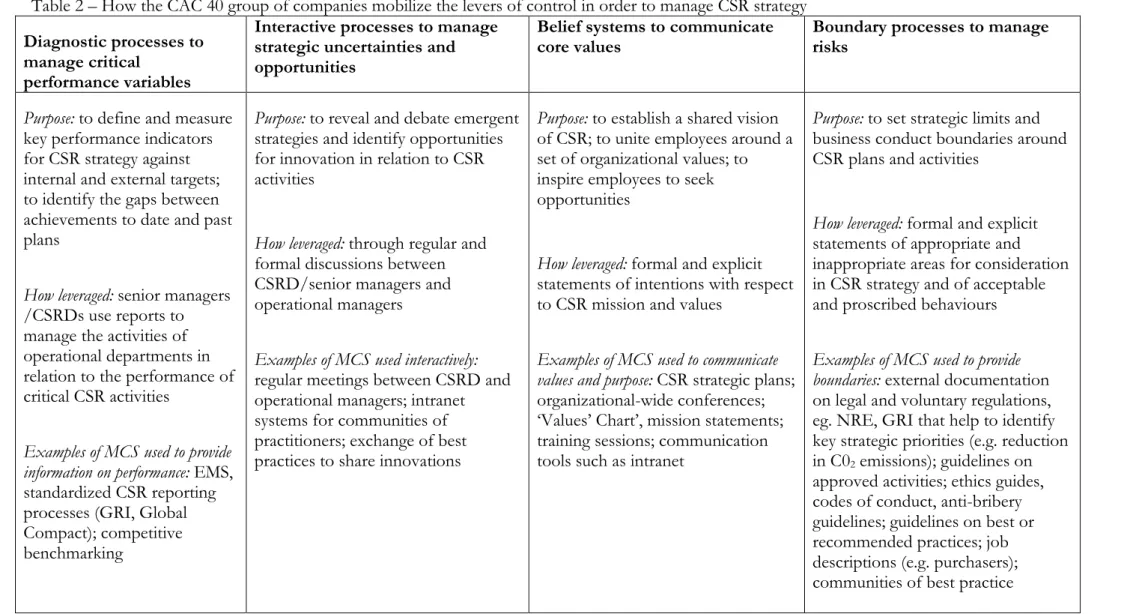
In summary, the findings indicate that the companies in our study manage CSR strategy through a variety of MCS including extensive internal and external communication processes, EMS, CSR reporting systems, and processes for reporting best practices. Table 2 below summarizes these findings. The companies report a variety of motivations for undertaking CSR strategy, and these go some way to explaining the different approaches to activities such as dedicated budgets, performance measures, and compensation. In the next section, we explore in greater detail some of the issues revealed by the findings as they relate to the specific aim of this study.
[Insert Table 2 here] 5. Discussion
5.1. The role of the levers of control in managing CSR strategy
The data indicate that the companies in our study mobilize the levers of control through a variety of MCS, such as EMS, codes of conduct, and formal meetings that are used to discuss CSR activities in relation to the attainment of strategic objectives. Explicit statements of intention with respect to the organization’s mission for CSR and associated values demonstrate the use of belief systems to convey purpose and to inspire employees to search for opportunities. Some of the companies in our study use MCS to establish a shared vision of CSR and to unite employees around a set of organizational values. They employ a range of MCS to mobilize their belief systems because this helps to reinforce the key messages about CSR strategy as well as ensuring