Embedded Systems
2012 Linux Symposium Geunsik Lim Sungkyungkwan University Samsung Electronics [email protected] [email protected] Changwoo Min Sungkyungkwan University Samsung Electronics [email protected] [email protected] YoungIk Eom Sungkyungkwan University [email protected] AbstractMost commercial embedded devices have been de-ployed with a single processor architecture. The code size and complexity of applications running on embed-ded devices are rapidly increasing due to the emer-gence of application business models such as Google Play Store and Apple App Store. As a result, a high-performance multicore CPUs have become a major trend in the embedded market as well as in the personal computer market.
Due to this trend, many device manufacturers have been able to adopt more attractive user interfaces and high-performance applications for better user experiences on the multicore systems.
In this paper, we describe how to improve the real-time performance by reducing the user waiting time on mul-ticore systems that use a partitioned per-CPU run queue scheduling technique. Rather than focusing on naive load-balancing scheme for equally balanced CPU usage, our approach tries to minimize the cost of task migration by considering the importance level of running tasks and to optimize per-CPU utilization on multicore embedded systems.
Consequently, our approach improves the real-time characteristics such as cache efficiency, user responsive-ness, and latency. Experimental results under heavy background stress show that our approach reduces the average scheduling latency of an urgent task by 2.3 times.
1 Introduction
Performance improvement by increasing the clock speed of a single CPU results in a power consump-tion problems [19, 8]. Multicore architecture has been widely used to resolve the power consumption problem as well as to improve performance [24]. Even in embed-ded systems, the multicore architecture has many advan-tages over the single-core architecture [17].
Modern operating systems provide multicore aware in-frastructure including SMP scheduler, synchronization [16], interrupt load-balancer, affinity facilities [22, 3], CPUSETS [25], and CPU isolation [23, 7]. These func-tions help running tasks adapt to system characteristics very well by considering CPU utilization.
Due to technological changes in the embedded mar-ket, OS-level load-balancing techniques have been high-lighted more recently in the multicore based embedded environment to achieve high-performance. As an exam-ple, the needs of real-time responsiveness characteristics [1] have increased by adopting multicore architecture to execute CPU-intensive embedded applications within the desired time on embedded products such as a 3D DTV and a smart phone.
In embedded multicore systems, efficient load-balancing of CPU-intensive tasks is very important for achieving higher performance and reducing scheduling latency when many tasks running concurrently. Thus, it can be the competitive advantage and differentiation. In this paper, we propose a new solution,operation zone based load-balancer, to improve the real-time perfor-mance [30] on multicore systems. It reduces the user
START Tasks Scheduler tick Rebalance tick
Caculation of CPU usage
Imbalance controller
Load-balance among CPUs ?
Find busiest group Find busiest queue
Move tasks (Task migration) CPU rescheduling Dequeue tasks Enqueue tasks Task rescheduling (Context switching) END NO YES TasksTasks
Figure 1: Load-balancing operation on Linux
waiting time by using a partitioned scheduling—or per-CPU run-queue scheduling—technique. Our solution minimizes the cost of task migration [21] by consid-ering the importance level of running tasks and per-CPU utilization rather than focusing on naive per-CPU load-balancing for balanced CPU usage of tasks.
Finally, we introduce a flexible task migration method according to load-balancing operation zone. Our method improves operating system characteristics such as cache efficiency, effective power consumption, user responsiveness, and latency by re-balancing the activi-ties that try to move specific tasks to one of the CPUs on embedded devices. This approach is effective on the multicore-based embedded devices where user respon-siveness is especially important from our experience.
2 Load-balancing mechanism on Linux
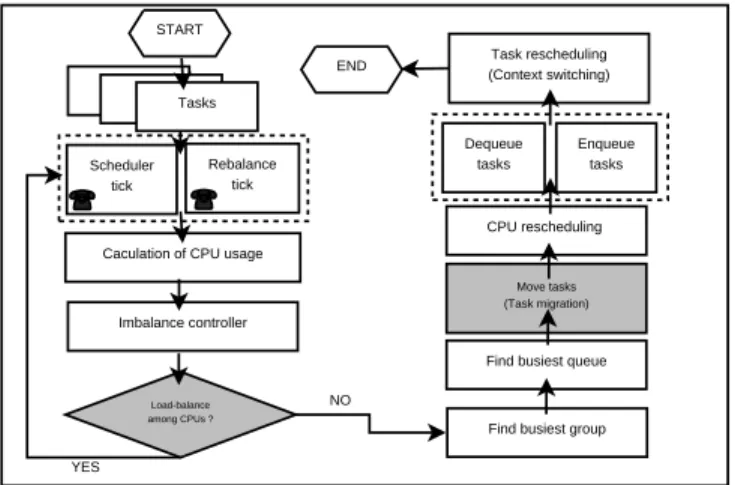
The current SMP scheduler in Linux kernel periodically executes the load-balancing operation to equally utilize each CPU core whenever load imbalance among CPU cores is detected. Such aggressive load-balancing oper-ations incur unnecessary task migroper-ations even when the CPU cores are not fully utilized, and thus, they incur additional cache invalidation, scheduling latency, and power consumption. If the load sharing of CPUs is not fair, the multicore scheduler [10] makes an effort to solve the system’s load imbalance by entering the proce-dure for load-balancing [11]. Figure 1 shows the overall operational flow when the SMP scheduler [2] performs the load-balancing.
At every timer tick, the SMP scheduler determines whether it needs to start load-balancing [20] or not, based on the number of tasks in the per-CPU run-queue. At first, it calculates the average load of each CPU [12]. If the load imbalance between CPUs is not fair, the load-balancer selects the task with the highest CPU load [13], and then lets the migration thread move the task to the target CPU whose load is relatively low. Before mi-grating the task, the load-balancer checks whether the task can be instantly moved. If so, it acquires two locks,busiest->lockandthis_rq->lock, for syn-chronization before moving the task. After the suc-cessful task migration, it releases the previously held double-locks [5]. The definitions of the terms in Fig-ure 1 are as follows [10] [18]:
• Rebalance_tick: update the average load of the run-queue.
• Load_balance: inspect the degree of load imbal-ance of the scheduling domain [27].
• Find_busiest_group: analyze the load of groups within the scheduling domain.
• Find_busiest_queue: search for the busiest CPU within the found group.
• Move_tasks: migrate tasks from the source run-queue to the target run-run-queue in other CPU.
• Dequeue_tasks: remove tasks from the external run-queue.
• Enqueue_tasks: add tasks into a particular CPU.
• Resched_task: if the priority of moved tasks is higher than that of current running tasks, preempt the current task of a particular CPU.
At every tick, the scheduler_tick() function calls
rebalance_tick() function to adjust the load of
the run-queue that is assigned to each CPU. At this time, load-balancer uses this_cpu index of lo-cal CPU, this_rq, flag, and idle (SCHED_IDLE,
NOT_IDLE) to make a decision. The rebalance_
tick() function determines the number of tasks that
exist in the run-queue. It updates the average load of the run-queue by accessing nr_running of the run-queue descriptor andcpu_loadfield for all domains from the default domain to the domain of the upper layer. If the
load imbalance is found, the SMP scheduler starts the procedure to balance the load of the scheduling domain by callingload_balance()function.
It is determined by idle value in the sched_domain
descriptor and other parameters how frequently load-balancing happens. If idle value is SCHED_IDLE, meaning that the run-queue is empty, rebalance_
tick() function frequently calls load_balance()
function. On the contrary, ifidle value isNOT_IDLE, the run-queue is not empty, and rebalance_tick()
function delays callingload_balance()function. For example, if the number of running tasks in the run-queue increases, the SMP scheduler inspects whether the load-balancing time [4] of the scheduling domain belonging to physical CPU needs to be changed from 10 millisec-onds to 100 millisecmillisec-onds.
Whenload_balance()function moves tasks from the
busiest group to the run-queue of other CPU, it calcu-lates whether Linux can reduce the load imbalance of the scheduling domain. If load_balance() function can reduce the load imbalance of the scheduling do-main as a result of the calculation, this function gets pa-rameter information likethis_cpu,this_rq, sd, and
idle, and acquires spin-lock called this_rq->lock
for synchronization. Then, load_balance()function returns sched_groupdescriptor address of the busiest group to the caller after analyzing the load of the group in the scheduling domain by calling find_busiest_
group() function. At this time, load_balance()
function returns the information of tasks to the caller to move the tasks into the run-queue of local CPU for the load-balancing of scheduling domain.
The kernel moves the selected tasks from the busiest run-queue tothis_rqof another CPU. After turning on the flag, it wakes up migration/*kernel thread. The migration thread scans the hierarchical scheduling do-main from the base dodo-main of the busiest run-queue to the top in order to find the most idle CPU. If it finds relatively idle CPU, it moves one of the tasks in the bus-iest run-queue to the run-queue of relatively idle CPU (calling move_tasks() function). If a task migration is completed, kernel releases two previously held spin-locks, busiest->lock and this_rq->lock, and fi-nally it finishes the task migration.
dequeue_task()function removes a particular task in
the run-queue of other CPU. Then, enqueue_task()
function adds a particular task into the run-queue of
lo-cal CPU. At this time, if the priority of the moved task is higher than the current task, the moved task will preempt the current task by callingresched_task()function to gain the ownership of CPU scheduling.
As we described above, the goal of the load-balancing is to equally utilize each CPU [9], and the load-balancing is performed after periodically checking whether the load of CPUs is fair. The load-balancing overhead is controlled by adjusting frequency of load-balancing op-eration, load_balance() function, according to the number of running tasks in the run-queue of CPU. How-ever, since it always performs load-balancing whenever a load imbalance is found, there is unnecessary load-balancing which does not help to improve overall sys-tem performance.
In multicore embedded systems running many user ap-plications at the same time, load imbalance will occur frequently. In general, more CPU load leads to more frequent task migration, and thus, incurs higher cost. The cost can be broken down into direct, indirect, and latency costs as follows:
1. Direct cost: the load-balancing cost by checking the load imbalance of CPUs for utilization and scalability in the multicore system
2. Indirect cost: cache invalidation and power con-sumption
(a) cache invalidation cost by task migration among the CPUs
(b) power consumption by executing more in-structions according to aggressive load-balancing
3. Latency cost: scheduling latency and longer non-preemptible period
(a) scheduling latency of the low priority task be-cause the migration thread moves a number of tasks to another CPU [29]
(b) longer non-preemptible period by holding the double-locking for task migration
We propose ouroperation zone based load-balancerin the next section to solve those problems.
New tasks Idle tasks Wait queue Run queue CPU0 (50%) CPU1 (23%) CPU2 (65%) CPU3 (30%) Kernel timer Load Balancer Run queue Run queue Run queue Multi-core CPU X Delayed Balancing
Figure 2: Flexible task migration for low latency
3 Operation zone based load-balancer
In this section, we propose a novel load-balancing scheduler called operation zone based load-balancer which flexibly migrates tasks for load-balancing based on load-balancing operation zone mechanism which is designed to avoid too frequent unnecessary load-balancing. We can minimize the cost of the load-balancing operation on multicore systems while main-taining overall CPU utilization balanced.
The existing load-balancer described in the previ-ous section regularly checks whether load-balancing is needed or not. On the contrary, our approach checks only when the status of tasks can be changed. As illus-trated in Figure 2,operation zone based load-balancer checks whether the task load-balancing is needed in the following three cases:
• A task is newly created by the scheduler.
• An idle task wakes up for scheduling.
• A running task belongs to the busiest scheduling group.
The key idea of our approach is that it defers load-balancing when the current utilization of each CPU is not seriously imbalanced. By avoiding frequent unnec-essary task migration, we can minimize heavy double-lock overhead and reduce power consumption of a bat-tery backed embedded device. In addition, it controls
Hot Zone Warm Zone Cold Zone C P U U s a g e (%) 100 90 80 70 60 50 40 30 20 10 0 Threshold * High spot * Mid spot * Low spot [/proc/sys/kernel/balance_level] 0: Cold zone * 1: Warm zone(Low spot) 2: Warm zone(Mid spot ) 3: Warm zone(High spot) 4: Hot zone
No load-balancing
[/proc/sys/kernel/balance_idle_cal] 0: No consider idle CPUs 1: Consider idle CPUs *
* Lowest task migrations * Highest task migrations
Always load-balancing
[/proc/sys/kernel/bal_cpus_avg_enable] 1: Calculation of avg cpus 0: Specified local cpu *
’*’ mark : default value
Figure 3: Load-balancing operation zone
the worst-case scenario: one CPU load exceeds 100% even though other CPUs are not fully utilized. For ex-ample, when a task in idle, newidle, or noactive
state is rescheduled, we can make the case that does not executeload_balance()routine.
3.1 Load-balancing operation zone
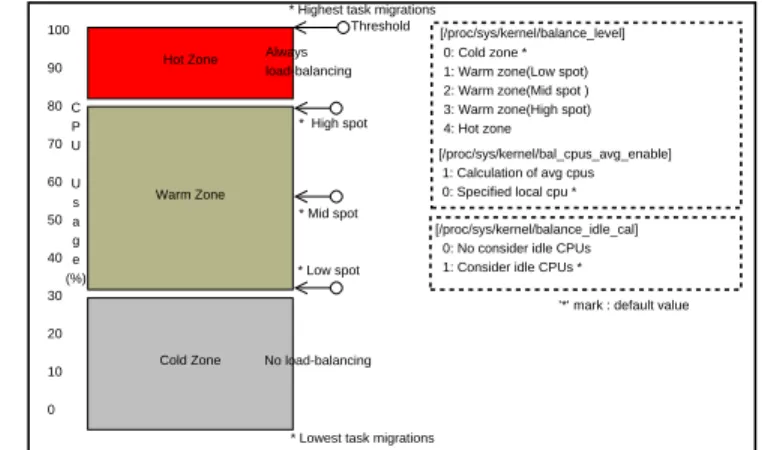
Ouroperation zone based load-balancerprovides load-balancing operation zonepolicy that can be configured to the needs of the system. As illustrated in Figure 3, it provides three multicore load-balancing policies based on the CPU utilization. The cold zone policy loosely performs load-balancing operation; it is adequate when the CPU utilization of most tasks is low.
On the contrary, the hot zone policy performs load-balancing operation very actively, and it is proper under high CPU utilization. The warm zonepolicy takes the middle betweencold zoneandhot zone.
Load-balancing under thewarm zonepolicy is not triv-ial because CPU utilization inwarm zonetends to fluc-tuate continuously. To cope with such fluctuations, warm zone is again classified into three spots—high, mid, and low—and our approach adjusts scores based on weighted values to further prevent unnecessary task migration caused by the fluctuation. We provide/proc
interfaces for a system administrator to configure the policy either statically or dynamically. From our experi-ence, we recommend that a system administrator config-ures the policy statically because of system complexity.
3.1.1 Cold zone
In a multicore system configured with thecold zone pol-icy, our operation zone based load-balancing scheduler does not perform any load-balancing if the CPU utiliza-tion is incold zone, 0~30%. Since there is no task mi-gration incold zone, a task can keep using the currently assigned CPU. Kernel performs the load-balancing only when the CPU utilization exceedscold zone.
This policy is adequate where the CPU utilization of a device tends to be low except for some special cases. It also helps to extend battery life in battery backed de-vices.
3.1.2 Hot zone
Task migration in thehot zonepolicy is opposite to that in thecold zonepolicy. If the CPU utilization is inhot zone, 80~100%, kernel starts to perform load-balancing. Otherwise, kernel does not execute the procedure of load-balancing at all.
Under thehot zonepolicy, kernel defers load-balancing until the CPU utilization reacheshot zone, and thus, we can avoid many task migrations. This approach brings innovative results in the multicore-based system for the real-time critical system although the system throughput is lost.
3.1.3 Warm zone
In case of thewarm zonepolicy, a system administrator chooses one of the following three spots to minimize the costs of the load-balancing operation for tasks whose CPU usage is very active.
• High spot (80%): This spot has the highest CPU usage in thewarm zone policy. The task of high spotcannot go up any more in thewarm zone pol-icy
• Low spot (30%): This spot has the lowest CPU us-age in thewarm zonepolicy. The task oflow spot cannot go down any more in thewarm zonepolicy.
• Mid spot (50%): This spot is in between high spot and low spot. The weight-based dynamic score ad-justment scheme is used to cope with fluctuations of CPU utilization. CPU0 CPU1 CPU2 CPU3 Utilization 85% Utilization 25% Utilization 55% Utilization 50%
Warm zone (Mid spot) Warm zone (High spot)
CPU0 CPU1 CPU2 CPU3 Utilization 85% Utilization 25% Utilization 55% Utilization 50%
if(CPUs Average Usage 53.75% >50%(Normal)) go load-balancing
if (CPUs Average Usage 53.75% > 80%(High)) go load-balancing
Task Migration O Task Migration X
if(Local CPU1 Usage 85% > 50%(Normal)) go load-balancing
if (Local CPU1 Usage 85% > 80%(High)) go load-balancing /proc/sys/kernel/bal_cpus_avg_enable=1
[bal_cpu_avg_enable=1] [bal_cpu_avg_enable=0]
Figure 4: Task migration example in warm zone policy The spot performs the role of controlling the CPU usage of tasks that can be changed according to weight score. In the warm zone policy system, weight-based scores are applied to tasks according to the period of the CPU usage ratio based onlow spot,mid spot andhigh spot. The three spots are detailed for controlling active tasks by users. The CPU usages of tasks have penalty points or bonus points according to the weight scores.
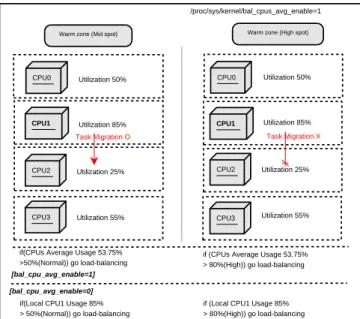
Although the score of task can increase or decrease, these tasks cannot exceed the maximum value, high spot, and go below the minimum value, low spot. If CPU usage of a task is higher than that of the con-figured spot in the warm zone policy, kernel performs load-balancing through task migration. Otherwise, ker-nel does not execute any load-balancing operation. For example, we should consider that the CPU utiliza-tion of quad-core systems is 50%, 85%, 25% and 55% respectively from CPU0 to CPU3 as Figure 4. If the system is configured inmid spot of thewarm zone pol-icy, the load-balancer starts operations when the aver-age usaver-age of CPU is over 50%. Kernel moves one of the running tasks of run-queue in CPU1 with the high-est utilization to the run-queue of CPU2 with the lowhigh-est utilization.
In case ofhigh spotand thewarm zonepolicy, the load-balancer starts the operations when the average usage of CPU is over 80%. Tasks that are lower than the CPU usage of thewarm zonearea is not migrated into another
Low
CPU utilization is low.
CPU utilization is high.
Mid High * /proc/sys/kernel/balance_weight_enable * /proc/sys/kernel/balance_weight_{prize|punish}_time (default: 5000msec) * /proc/sys/kernel/balance_weight_{prize|punish}_score (default:5%) 80% 30%
Figure 5: Weight-based score management CPU according to migration thread. Figure 4 depicts the example of load-balancing operations on thewarm zone policy.
Figure 5 shows weight-based load score management for thewarm zonepolicy system. When the usage period of CPU is longer than the specified time, five seconds by default, kernel manages bonus points and penalty points to give relative scores to the task that utilizes CPU re-sources continually and actively. Also, kernel operates the load weight-basedwarm zonepolicy to support the possibility that the task can use the existing CPU con-tinually.
At this time, tasks that reach the level of thehigh spot, stay in thewarm zonerange although the usage period of CPU is very high. Through these methods, kernel keeps the border of the warm zone policy without moving a task to thehot zonearea.
If a task maintains the high value of the usage of CPU more than five seconds as the default pol-icy based on/proc/sys/kernel/balance_weight_
{prize|punish}_time, kernel gives the task CPU
us-age score of -5 which means that CPU utilization is lower. At this point, the CPU usage information of the five seconds period is calculated by the schedul-ing element of a task via proc file system. We as-signed the five seconds by default via our experimen-tal experience. This value can be changed by
us-ing /proc/sys/kernel/balance_weight_{prize|
punish}_timeby the system administrator to support
various embedded devices.
In contrast, if a task consumes the CPU usage of a spot shorter than five seconds, kernel gives the task CPU
us-age score of +5 which means that CPU utilization is higher. The task CPU usage score of +5 elevates the load-balancing possibility of tasks. Conversely, the task CPU usage score of -5 aims to bring down the load-balancing possibility of tasks.
The value of the warm zone policy is static, which means it is determined by a system administrator with-out dynamic adjustment. Therefore, we need to identify active tasks that consume the usage of CPUs dynami-cally. The load weight-based score management method calculates a task’s usage in order that kernel can con-sider the characteristics of these tasks. This mechanism helps the multicore-based system manage the efficient load-balancing operation for tasks that have either high CPU usage or low CPU usage.
3.2 Calculating CPU utilization
In our approach, the CPU utilization plays an im-portant role in determining to perform load-balancing. In measuring CPU utilization, our approach provides two ways: calculating CPU utilization for each CPU and averaging CPU utilization of all CPUs. A sys-tem administrator also can change behaviors through
proc interface, /proc/sys/kernel/balance_cpus_
avg_enable. By default, kernel executes task
migra-tion depending on the usage ratio of each CPU.
If a system administrator selects /proc/system/
kernel/balance_cpus_avg_enable=1
parame-ter for their system, kernel executes task migration depending on the average usage of CPUs.
The method to compare load-balancing by using the av-erage usage of CPUs, helps to affinitize the existing CPU as efficiently as possible for some systems. The system needs the characteristics of CPU affinity [14] although the usage of a specific CPU is higher than the value of the warm zonepolicy, e.g. CPU-intensive single-threaded application in the most idle systems. 4 Evaluation
4.1 Evaluation scenario
Figure 6 shows our evaluation scenario to measure the real-time characteristics of running tasks in multicore based embedded systems. In this experiment, we mea-sured how scheduling latency of an urgent task would
Figure 6: Evaluation scenario to measure scheduling la-tency
be reduced under very high CPU load, network stress, and disk I/O.
To measure scheduling latency, we usedcyclictest util-ity of rt-test package [28] which is mainly used to measure real-time characteristics of Redhat Enterprise Linux (RHEL)and real-time Linux. All experiments are performed inLinux2.6.32onIntelQuadcoreQ9400.
4.2 Experimental result
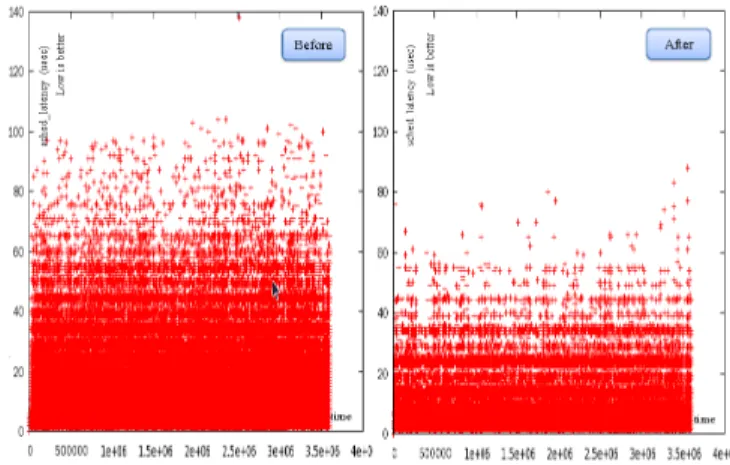
In Figure 7, we compared the scheduling latency distri-bution between the existing approach (before) and our proposed approach (after).
Our approach is configured to usewarm zone - high spot policy. Under heavy background stress reaching to the worst load to the Quad-core system, we measured the scheduling latency of our test thread which repeatedly sleeps and wakes up. Our test thread is pinned to a par-ticular CPU core by setting CPU affinity [15] and is con-figured as the FIFO policy with priority 99 to gain the best priority.
In the figure, X-axis is the time from the test start, and Y-axis is the scheduling latency in microseconds from when it tries to wake up for rescheduling after a speci-fied sleep time. As Figure 7 shows, the scheduling la-tency of our test thread is reduced more than two times: from 72 microseconds to 31 microseconds on average. In order to further understand why our approach reduces scheduling latency more than two times, we traced the
Figure 7: Comparison of scheduling latency distribution
caller/callee relationship of all kernel function during the experiment by using Linux internal function tracer, ftrace[26].
The analysis of the collected traces confirms three: first, the scheduling latency of a task can be delayed when mi-gration of other task happens. Second, when task migra-tion happens, non-preemptible periods are increased for acquiring double-locking. Finally, our approach can re-duce average scheduling latency of tasks by effectively removing vital costs caused by the load-balancing of the multicore system.
In summary, since the migration thread is a real-time task with the highest priority, acquiring double-locking and performing task migration, the scheduling of the other tasks can be delayed. Since load imbalance fre-quently happens under a heavily loaded system with many concurrent tasks, the existing very fair load bal-ancer incurs large overhead, and our approach can re-duce such overhead effectively.
Ouroperation zone based load-balancerperforms load-balancing based on CPU usage with lower overhead while avoiding overloading to a particular CPU that can increase scheduling latency. Moreover, since our ap-proach is implemented only in the operating system, no modifications of user applications are required.
5 Further work
In this paper, we proposed an operation zone based load-balancing mechanism which reduces scheduling latency. Even though it reduces scheduling latency, it does not guarantee deadline for real-time systems where
the worst case is most critical. In order to extend our approach to the real-time tasks, we are considering a hybrid approach with the physical CPU shielding tech-nique [6] which dedicates a CPU core for a real-time task. We expect that such approach can improve real-time characteristics of a CPU intensive real-real-time task. Another important aspect especially in embedded sys-tems is power consumption. In order to keep longer bat-tery life, embedded devices dynamically turn on and off CPU cores. To further reduce power consumption, we will extend our load-balancing mechanism considering CPU on-line and off-line status.
We experimented with scheduling latency to enhance the user responsiveness on the multicore-based embed-ded system in this paper. We have to evaluate various scenarios such as direct cost, indirect cost, and latency cost to use our load-balancer as a next generation SMP scheduler.
6 Conclusions
We proposed a novel operation zone based load-balancing techniquefor multicore embedded systems. It minimized task scheduling latency induced by the load-balancing operation. Our experimental results using the cyclictestutility [28] showed that it reduced scheduling latency and accordingly, users’ waiting time.
Since our approach is purely kernel-level, there is no need to modify user-space libraries and applications. Although the vanilla Linux kernel makes every effort to keep the CPU usage among cores equal, our proposed operation zone based load-balancerschedules tasks by considering the CPU usage level to settle the load im-balance.
Our design reduces the non-preemptible intervals that require double-locking for task migration among the CPUs, and the minimized non-preemptible intervals contribute to improving the software real-time charac-teristics of tasks on the multicore embedded systems. Our scheduler determines task migration in a flexible way based on theload-balancing operation zone. It lim-its the excess of 100% usage of a particular CPU and suppresses the task migration to reduce high overhead for task migration, cache invalidation, and high syn-chronization cost. It reduces power consumption and scheduling latency in multicore embedded systems, and
thus, we expect that customers can use devices more in-teractively for longer time.
7 Acknowledgments
We thank Joongjin Kook, Minkoo Seo, and Hyoyoung Kim for their feedback and comments, which were very helpful to improve the content and presentation of this paper. This work was supported by the IT R&D pro-gram of MKE/KEIT [10041244, SmartTV 2.0 Software Platform].
References
[1] J.H. Anderson. Real-time scheduling on
multicore platforms. InReal-Time and Embedded Technology and Applications Symposium, 2006. [2] ARM Information Center. Implementing DMA on ARM SMP System. http://infocenter. arm.com/help/index.jsp?topic=/com.arm.
doc.dai0228a/index.html.
[3] M Astley. Migration policies for multicore fair-share schedulingd choffnes. InACM SIGOPS Operating Systems, 2008.
[4] Ali R. Behrooz A. Shirazi, Krishna M. Kavi. Scheduling and load balancing in parallel and distributed systems. InIEEE Computer Society Press Los Alamitos, 1995.
[5] Stefano Bertozzi. Supporting task migration in multi-processor systems-on-chip: a feasibility study. InIn Proceeding DATE ’06 Proceedings of the conference on Design, automation and test in Europe, 2006.
[6] S Brosky. Shielded processors: Guaranteeing sub-millisecond response in standard linux. In Parallel and Distributed Processing, 2003. [7] S Brosky. Shielded cpus: real-time performance
in standard linux. InLinux Journal, 2004. [8] Jeonghwan Choi. Thermal-aware task scheduling
at the system software level. InIn Proceeding ISLPED ’07 Proceedings of the 2007
international symposium on Low power electronics and design, 2007.
[9] Slo-Li Chu. Adjustable process scheduling mechanism for a multiprocessor embedded system. In6th WSEAS international conference on applied computer science, 2006.
[10] Daniel P. Bovet, Marco Cesati. Understanding the Linux Kernel, 3rd Edition. O’Reilly Media. [11] Mor Harchol-Balter. Exploiting process lifetime
distributions for dynamic load balancing. InACM Transactions on Computer Systems (TOCS), volume 15, 1997.
[12] Toshio Hirosaw. Load balancing control method for a loosely coupled multi-processor system and a device for realizing same. InHitachi, Ltd., Tokyo, Japan, Patent No. 4748558, May 1986. [13] Steven Hofmeyr. Load balancing on speed. In
PPoPP ’10 Proceedings of the 15th ACM
SIGPLAN Symposium on Principles and Practice of Parallel Programming, 2010.
[14] Vahid Kazempour. Performance implications of cache affinity on multicore processors. In EURO-PAR, 2008.
[15] KD Abramson. Affinity scheduling of processes on symmetric multiprocessing systems. http:
//www.google.com/patents/US5506987.
[16] Knauerhase. Using os observations to improve performance in multicore systems. InMicro IEEE, May 2008.
[17] Markus Levy. Embedded multicore processors and systems. InMicro IEEE, May 2009. [18] Linus Toavalds. Linux Kernel.
http://www.kernel.org.
[19] Andreas Merkel. Memory-aware scheduling for energy efficiency on multicore processors. In HotPower’08 Proceedings of the 2008 conference on Power aware computing and systems, 2008. [20] Nikhil Rao, Google. Improve load balancing
when tasks have large weight differential.
http://lwn.net/Articles/409860/.
[21] Pittau. Impact of task migration on streaming multimedia for embedded multiprocessors: A quantitative evaluation. InEmbedded Systems for Real-Time Multimedia, 2007.
[22] Robert A Alfieri. Apparatus and method for improved CPU affinity in a multiprocessor system. http:
//www.google.com/patents/US5745778.
[23] H PÃ˝utzl S Soltesz. Container-based operating system virtualization: a scalable,
high-performance alternative to hypervisors. In ACM SIGOPS, 2007.
[24] Suresh. Siddha. Ottawa linux symposium (ols). In Chip Multi Processing (CMP) aware Linux Kernel Scheduler, 2005.
[25] Simon Derr, Paul Menage. CPUSETS.
http://http://www.kernel.org/doc/
Documentation/cgroups/cpusets.txt.
[26] Steven Rostedt. Ftrace (Kernel function tracer).
http://people.redhat.com/srostedt.
[27] Suresh Siddha. sched: new sched domain for representing multicore.
http://lwn.net/Articles/169277/.
[28] Thomas Gleixner, Clark williams. rt-tests (Real-time test utility).
http://git.kernel.org/pub/scm/linux/
kernel/git/clrkwllms/rt-tests.git.
[29] V Yodaiken. A real-time linux. InProceedings of the Linux Applications, 1997.
[30] Yuanfang Zhang. Real-time performance and middleware on multicore linux platforms. In Washington University, 2008.