APPENDIX M
INDIVIDUAL CASE ANALYSIS
1.0 THE LEO BUILDING
The LEO building is a Government Complex to house the Ministry of Energy, Green Technology and Water (KeTTHA) which formerly known as the Ministry of Energy, Water and Communication (MEWC) consisting of a six storey with two basement car park building on Parcel E, P.T. 111, Precinct 1, Putrajaya. The goal of this building development was to provide a good and comfortable working environment for the end-users through incorporation of certain energy efficient features in the building design. The proposed development of Parcel E has obtained approval at Building Development Plan (PB) level under the submission jurisdiction of Messrs. RSP Akitek Sdn Bhd on 08th April 2000. Being situated within the Parcel E Development, these building features had been designed to respond to the harmonizing architectural elements of the other Government Complexes. LEO was first occupied in September 2004. This is the first government building that has been designed as an energy efficient building which also becomes a demonstration project of feasibility of MS1525:2001 (Malaysian Standard: Code of Practice on Energy Efficiency and Use of Renewable Energy for Non Residential Buildings). The LEO building was designed to be a showcase building for energy efficiency and low environmental impact without compromising on users’ comfort reinstating the role of the Ministry towards conserving energy in the future buildings of Malaysia.
1.1 Stakeholders Involvement
KeTTHA was the owner and Putrajaya Holdings (PjH) was the master developer of LEO project. To come out with the conceptual planning and preliminary design, PjH had appointed SNO architects (the architect), NDY sdn bhd (M&E engineer) and Syed Mansur sdn bhd (civil engineer) as their consultants and charrette sessions had been done during this stage among them. Putra Perdana Construction Sdn. Bhd. (PPC) was the main contractor of this project. They were appointed a bit late at the detail design stage and development of the project. Danish Agency for Development Assistance (DANIDA) was appointed by the government of Malaysia as the energy consultant for LEO project. DANIDA, in cooperation with PPC, consultants, specialist subcontractors, manufacturers and suppliers, determined to improve the building design to be the first energy efficient building in this country. The project commenced in 2001, prior to the development of the GBI rating system, thus, it did not go through the GBI certification process at the time. On top of the usual laws and guidelines that should be considered by the project team, they should also considered the MS1525 Code of Practice throughout the development of the building. A typical project planning process in Malaysia is involved with legislature and development plan. Preliminary discussion took placed between the planning consultants and the planning department at Putrajaya Corporation (PjC) during the layout plan, building plan or planning permission submission process (O1, E1, L1). Most of them were about to get approval (L1).
Respondents were asked about their involvement during the planning process of the LEO building project. The owner (O1) admitted that he was actively involved throughout the planning process of the project. The local authority involvement this stage was little as the respondent (L1) mentioned: ‘We were only involved in the approval part of the project. We requested them to fulfil the existing technical requirement, laws and guidelines such as Urban Design Guidelines (UDG) and so forth’.
DANIDA was involved a bit late in this project which is during the detail design stage as the energy consultant (E1) pointed out: ‘It was two phase of planning process during
pre-construction of the project. The first was planning process at the conceptual design stage including to get approval and budget view, I was not really much involved at this stage, but when came to the planning process at the details design stage, where PPC should develop detail
design based on the conceptual, I was fully involved to give inputs into the design especially on energy efficient aspects. The architect produced the design first before we joined the project. So, it was quite limited to be done for LEO building. Some materials like wall materials and some of the design was already there and couldn’t be changed’.
In discussing the involvement of the energy consultant in LEO project, the energy consultant (E1) said that he was involved in the detail design and development process, construction, migration, fine tuning, re-commissioning, monitoring and validating of the project. Until now, he is still continuing on monitoring the operation and maintenance of the building. The energy consultant (E1) highlighted that he was involved in consulting about decisions being taken by the others and when come to the area that need him to make decision, then he will make decision. ‘It was some decision that they agreed and also sometimes the decision was taken as average. I was also involved in advising, for example in term of the selection of materials, the architect chooses the materials and we looked at the performance of the material.’ The role of energy consultant in the project was integrated. The architect, mechanical engineer and the rest of the professionals were also very clear with their own boundary.The most important thing is willing to listen and understand the issues as the energy consultant (E1) said: ‘we can’t bring a
bunch of egos to the charrette sessions because it is just doesn’t work’.
As a design and build contractor, PPC performed design and construction of the project, thus they appointed the same architect and engineer to continue with the detail design to ease the process. However, they appointed different engineer, their own M&E engineer (VY consult) during this stage. Through the planning process of detail design and development stage, the team had involved in series of charrette sessions; they called it as ‘detail design workshop’. The client was also involved in this session (O1). The contractor (C1) mentioned that he was also sent to Norway and Denmark to visit other people works and adapted some of them into the LEO building.However, the contractor (C1) admitted that PPC were not fully involved in the planning process of the project as he mentioned: ‘The architect and DANIDA had designed everything prior forwarding the design to us. We designed and built based on the concept that given to us. We had only taken care about the structure and M&E aspects of the building. We contributed more on the M&E part compared to the architectural part. Nevertheless, if there were something wrong with the design, we highlighted to them for instances, the specifications of the glazing in the design were confusing and not available in the market, so we did advise them the other glazing in order to achieve the required OTTV.’
An ambitious goal was set for the energy efficiency of the building. Energy savings of more than 50% (BEI of 100 kWh/m2year) compared to the traditional new office buildings in Malaysia (200-300 kWh/m2year) should be achieved at an extra construction cost of less than 10%, giving a payback period of the extra investment of not more than 10 years. The project team optimized the overall design of the building and its energy systems for minimum energy consumption which was set to achieve the targeted energy savings. The cost target of maximum 10% extra costs for the energy efficiency measures and a comprehensive list of energy efficient features was integrated and confirmed through the project tender document. The energy manager and the end users of the building were responsible to operate the building in sustainable manners in order to achieve and maintain the energy saving target as the energy manager pointed out: ‘I was informed about the building systems and the target since the early
project planning process. I was also trained on how to operate, maintain and control the building system. As an energy manager, I have to ensure that energy index of this building is not more than 100kWh/m2/year. The challenges were when the number of employees increased, plug load also increased and the air-condition consumptions as well increased. So, we have to hardly control the energy consumption. We have our own contractor who is doing maintenance for this building and the systems and I am the one who monitor and control their works also monitor the building energy consumption. However, luckily the energy consultant is still helping us in monitoring the operation and maintenance works of this building so that this building is operated and maintained in sustainable manners’ (M1).
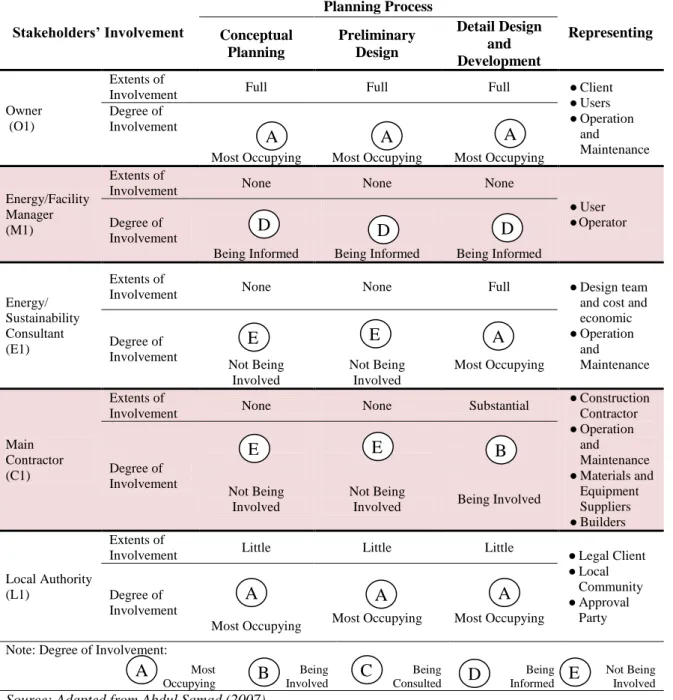
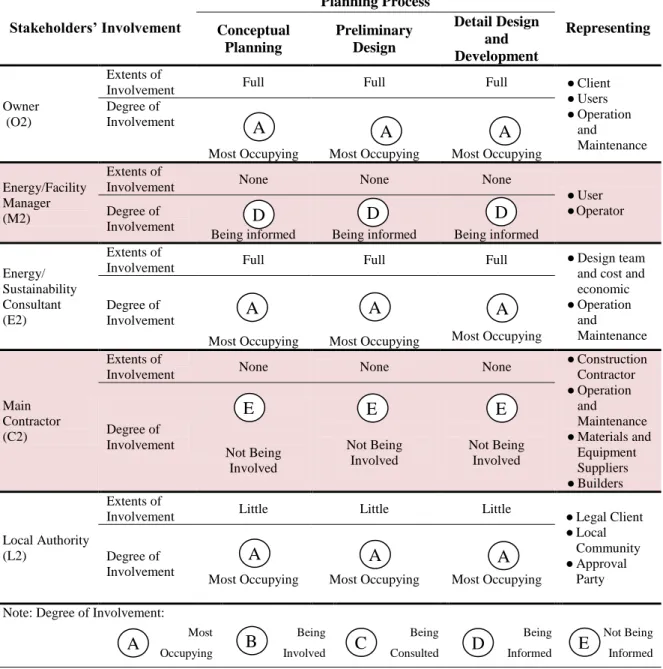
Table 1: Stakeholders’ Involvement in Project Planning Process (LEO)
Stakeholders’ Involvement Planning Process Representing Conceptual Planning Preliminary Design Detail Design and Development Owner (O1) Extents ofInvolvement Full Full Full ●●Client
Users ●Operation and Maintenance Degree of Involvement
Most Occupying Most Occupying Most Occupying
Energy/Facility Manager (M1)
Extents of
Involvement None None None
●User ●Operator Degree of
Involvement
Being Informed Being Informed Being Informed
Energy/ Sustainability Consultant (E1)
Extents of
Involvement None None Full ●Design team
and cost and economic ●Operation and Maintenance Degree of Involvement Not Being Involved Not Being Involved Most Occupying Main Contractor (C1) Extents of
Involvement None None Substantial
●Construction Contractor ●Operation and Maintenance ●Materials and Equipment Suppliers ●Builders Degree of Involvement Not Being Involved Not Being
Involved Being Involved
Local Authority (L1)
Extents of
Involvement Little Little Little ●Legal Client
●Local Community ●Approval Party Degree of Involvement
Most Occupying Most Occupying Most Occupying Note: Degree of Involvement:
Most Occupying Being Involved Being Consulted Being Informed Not Being Involved Source: Adapted from Abdul Samad,(2007)
As shown in Table 1, it is clear that the owner had the ‘most occupying’ involvement in the whole planning process of the project. They led and took decisions. The local authority is also had the ‘most occupying’ involvement in the whole planning process, however, their involvement was too limited on taking decision for the approval reason. They were not involved at all in the charrete and discussions throughout the planning process of the project. Energy consultant had the ‘most occupying’ involvement, but a bit late which is at the detail design and development stage of the project. The main contractor was being involved in generating information or options on the structure and M&E aspects as inputs to design decision being taken. Although the energy manager did not directly join the planning process of the project as compared to others, he was informed by the owner’s representative about decisions being taken by the project planning team as he is the person who responsible on monitoring, maintaining and controlling the building systems in the future.
relate to the Questions of Part A in the interview schedule (Appendix B, p307)
A
A
A
D
D
D
A
B
A
A
A
E
E
E
E
A
B
C
D
E
Although the planning process was almost typical as the conventional ones (O1, E1, C1, L1), nevertheless LEO project is the first classic example of integrated design especially during the detail design phase of the project. For instances, before the architect finalizing the detail design, the project team involved in a series of workshops; The project stakeholders sit down together including the owner, architect, structural and M&E engineers, energy consultant and the main contractor for discussions. The energy consultant was also represented the operation and maintenance stage because they are responsible for energy audit and monitoring the operation and maintenance of the building (O1, E1, C1). The contractor scope was a bit wider during the detail design stage as the contractor (C1) said: ‘we had to gone through a bit detail during the
detail design process than a typical project’.
1.2 Sustainability Practices in LEO Building Project
This part aims to explore the extent of sustainability practices in LEO building project in order to define the gaps that should be bridged towards achieving sustainability. This part comprises of four issues; 1) The project goals 2) Sustainability principles consideration in LEO building project and 3) The project’s strategy to achieve the goal for sustainable project 4) The strategies to integrate sustainability through project planning process. Each of the issues is described in the followings.
1.2.1 The Project Goals
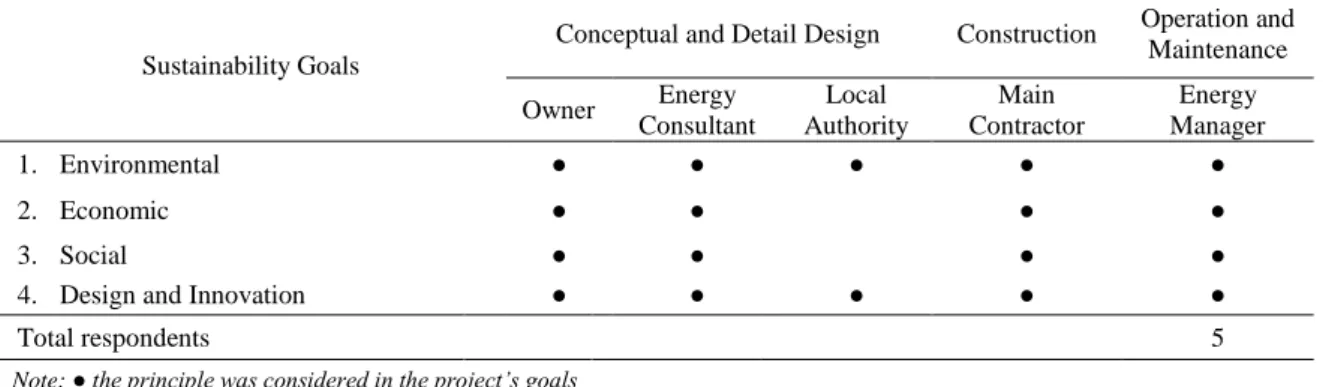
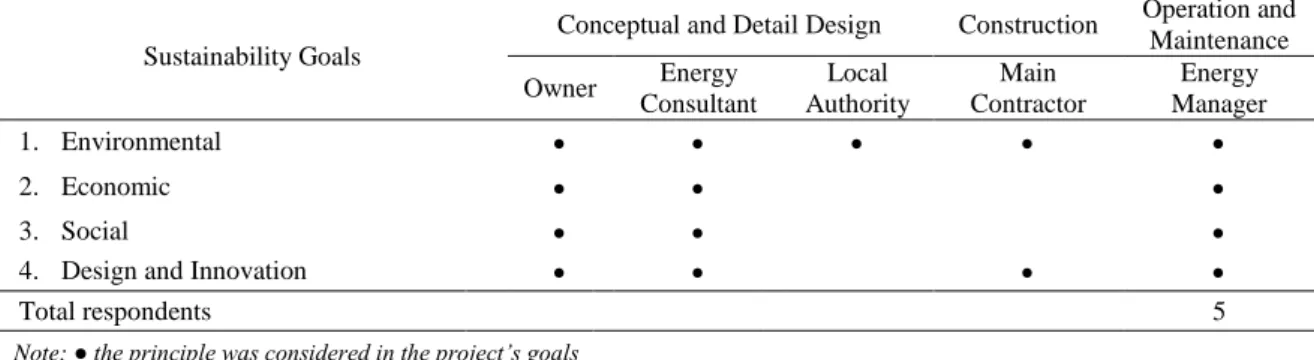
The interviewees were asked the extent to which they were motivated to consider the sustainability principles of buildings (environmental, social, economic and design and innovation) as the main goals of the project that should be achieved. It was found that the interviewees (O1, M1, E1, C1, L1) agreed that the project had the goals on environmental, economic, social and sustainable design and innovation (refer Table 2) for instance, the main contractor (C1) said: ‘PPC was very committed on sustainability. In term of social
sustainability, they employed legal workers, taken care their charity and offered expensive wages to them. Thus, the workers were loyal to them. PPC has the quality and capacity’.
Table 2: Stakeholders’ Responses on the Sustainability Goals of LEO Project
Sustainability Goals
Conceptual and Detail Design Construction Operation and Maintenance Owner Energy Consultant Local Authority Main Contractor Energy Manager 1. Environmental ● ● ● ● ● 2. Economic ● ● ● ● 3. Social ● ● ● ●
4. Design and Innovation ● ● ● ● ●
Total respondents 5
Note: ● the principle was considered in the project’s goals
However, the local authority (L1) highlighted that the project was skewed towards environmental sustainability target as he mentioned: ‘For a government building like LEO,
economic and social aspects are not considered very much because it is not developed for profit’. The answer was quite shocked as the local authority’s exposure on the economic and social sustainability considerations of the building were quite low. This situation was though understandable due to the limited involvement of them throughout the project planning process. Without a common understanding on sustainability, it will be difficult to achieve synergy and consensus on the strategies to be formulated for the sustainable project.
1.2.2 Sustainability Principles Consideration during the Planning Process of LEO Building Project
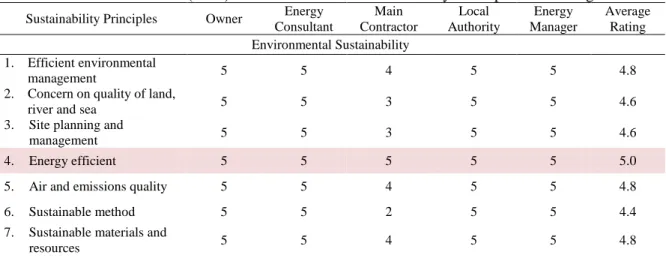
The stakeholders except the main contractor and energy manager of LEO building project were asked to assess the sustainability principles that had been considered and documented during the project planning process. The project documents that prepared and handed out are among others include Development Proposal Report for Layout Plan and Building Development Plan, development brief, design requirements and specifications. As stated in the Development Proposal Reports, the concept of the building was to incorporates energy efficient elements which combines passive (Architectural) and active (Mechanical & Electrical) features. This building shall be a “Show Piece” for KeTTHA, reinstating the role of the Ministry towards conserving energy in the future buildings of Malaysia.
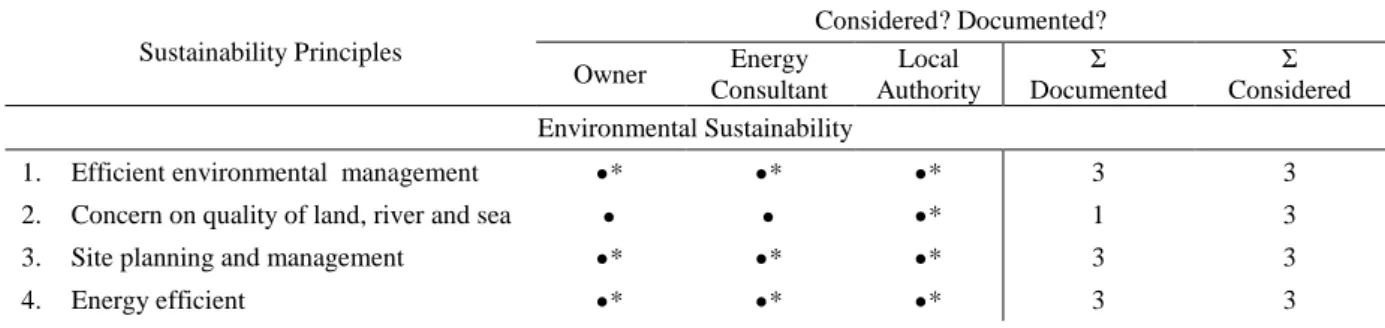
The result (refer Table 3) clearly shows that 14 out of 22 principles were included in the project documents that prepared for and referred by the owner and consultants throughout the project. The principles were clearly communicated among the owner and designers team and also appraised by them during the planning process of the project.
Other four principles which are ‘concern on quality of land, river and sea’, ‘sustainable
method’ and ‘sustainable materials and resources and ‘optimized materials and resources’
were also considered by them during the planning process even though the principles were not explicitly mentioned in the project documents. There are 4 principles not mentioned in any project documents and also did not considered by the owner and the design team during the planning process of the project which are ‘efficient water consumption, ‘transport
management’, ‘improve local market presence’ and ‘indirect economic impact’.
Meanwhile, only 10 out of 22 principles were mentioned clearly in the project documents that submitted to the local authority of Putrajaya. The principles were clearly considered by the local authority as the requirements that should be fulfill by the client and the team members. Transport management aspects such as parking requirements and the accessibility had been documented and communicated earlier during the approval submission process for the whole Parcel E of Putrajaya. However, it was not specifically discussed during the development of the individual building (L1).
Eight principles had been practiced by all project stakeholders and mentioned clearly in the project documents. The principles are ‘efficient environmental management’, ‘site planning’,
‘energy efficient’, ‘air and emissions quality’, ‘urban design, visual impact and esthetic’, occupational health and safety’ and sustainable design and innovations’. Other 3 principles which are ‘efficient water consumption’, ‘improve local market presence’ and ‘indirect economic impact’ were not mentioned in any project document and had not been considered by all the stakeholders during the planning process of the project. Overall, the sustainability principles mentioned in the project documents was at a medium level and the consideration of the principles during the project planning process was at a high level.
Table 3: Interviewees’ Comments on Sustainability Principles Consideration during the Planning Process of LEO Building Project
Sustainability Principles Considered? Documented? Owner Energy Consultant Local Authority Σ Documented Σ Considered Environmental Sustainability
1. Efficient environmental management * * * 3 3
2. Concern on quality of land, river and sea * 1 3
3. Site planning and management * * * 3 3
Sustainability Principles Considered? Documented? Owner Energy Consultant Local Authority Σ Documented Σ Considered
5. Air and emissions quality * * * 3 3
6. Sustainable method 0 2
7. Sustainable materials and resources 0 2
8. Optimize materials and resources used 0 2
9. Efficient water consumption 0 0
10. Transport management * 1 1
11. Urban design, visual impact and
aesthetic * * * 3 3
12. Noise control * * 2 3
Economic Sustainability
13. Whole life cost efficiency * * 2 2
14. Improve local market presence 0 0
15. Indirect economic impact 0 0
16. Economic benefit to the stakeholders * * 2 3
Social Sustainability
17. Occupational health and safety * * * 3 3
18. Product responsibility * * 2 2
19. Training, education and awareness * * 2 2
20. Stakeholder participation * * 2 2
Design and Innovation
21. Sustainable Innovation * * * 3 3
22. Sustainable Design * * * 3 3
Mentioned in the project documents 14
(Medium) 14 (Medium) 10 (Low) 38 Average: 13 (Medium) 48 Average: 16 (High)
Considered by the interviewees 18
(High) 18 (High) 12 (Medium) Total respondents 3
Level of Practices: 22-20 Very High 19- 16 High 15-11 Medium 10-7 Low 6-0 Very Low Note: ● Considered during the project planning process
*Mentioned in the project documents
1.2.3 The Project Strategies to achieve the Goals for Sustainability
Realizing the goals and sustainability principles practiced by the interviewees, the interview went further to examine the strategies that they implemented throughout the LEO project to achieve the targets successfully. Twelve strategies were pointed out as shown in Table 4. Majority (4 out of 5) of stakeholders’ from the conceptual and design, construction and operation and maintenance stage (owner, energy consultant, main contractor and energy manager) were providing ‘regular awareness, brief and campaign on energy efficiency to the project team and to the building occupants in order to save energy by operating the building in sustainable manners’ in order to prepare the team members with the capability towards delivering a sustainable project. The strategies are related and supported the second, third, fourth and fifth strategies of sustainability integration into the planning process of building projects as address in the proposed framework (refer Table 5.63, part b, p217) up to some extent which are: ‘the project should has specific sustainability goals and project priorities’ ‘The team should have the core knowledge of sustainable building’, ‘Team members are educated on sustainability issues including vendors’ and ‘Team members are fully informed on sustainability goals and priorities of the project.’ The stakeholders were also planned and designed the project towards fulfillment of ‘the requirements of MS1525:2001’ as the project was a demonstration of
feasibility of the standard. The strategies are related and supported the eighteenth and twentieth strategies of the proposed framework namely; ‘government policies to encourage sustainable
development’ and ‘compliance with code and regulatory tool of sustainability’ up to some extent.
It was only 2 out of 5 stakeholders (owner and energy consultant) highlighted that they have practiced ‘multidisciplinary collaboration and integrated design throughout the project
planning process’ up to some extent to be among the strategies to reach the sustainability goals
of the project. The design was also considered the end user needs by involving the owner (the users’ representative) throughout the project planning process (O1, E1). The strategies are related and supported some of the sub strategies of integrated design process as suggested in the proposed framework (Table 5.63, p217) such as ‘design should reflect the end user community’,
‘do whole building design and systems analysis’, ‘committed and collaborative team throughout the process’, ‘involve diverse set of stakeholders on the team’, ‘effective communication and incorporation of charette process’ and ‘planning should reflect all the project stakeholders’. Three (3) out of 5 the stakeholders from conceptual, design and construction stage (owner, energy consultant and the main contractor) concerned 4 strategies namely, ‘workshop among the stakeholders’, ‘visiting the energy efficient building’, ‘attending sustainable conference’ and ‘attending a lot of seminars including presenting the progress and project performance among stakeholders in every single stage of development’ as their strategies to deliver the sustainability goals of the project successfully. The strategies are related and supported some of the proposed strategies in the framework such as ‘committed and collaborative team throughout project’,
‘involve diverse set of stakeholders on the team’, ‘planning should reflects all the project stakeholders’, ‘incorporation of charette process’, ‘the team should have the core knowledge of sustainable building’, ‘team members are educated on sustainability issues including vendors’, ‘team members are fully informed on sustainability goals (energy efficiency) and priorities of the project.’
Other three stakeholders (owner, energy consultant and energy manager) concerned the strategies of ‘monitoring and controlling the building energy and operate the building in sustainable manners’, ‘monitor indoor environmental performance and occupant satisfaction’
and ‘to get GBI certification as their strategies to achieve the project sustainability goals’ during operation and maintenance stages of the project. In order to achieve GBI points, they had also ‘exchanged the existing equipments with the latest energy efficient equipments’ in order to reduce the building energy consumption. Local authority’s strategy was related ‘to mention the goal of sustainability in Structure Plan, Local Plan and Strategic Plan’. The strategy is also related and supported the strategies of ‘government policies to encourage sustainable
development’ and ‘compliance with code and regulatory tool of sustainability’ up to some extent, in the proposed framework. However, the local authority (L1) admitted that the guideline and procedure has not changed much to promote sustainability. There is no specification was put on how to plan and manage sustainable development. The requirement to include specification of sustainability in local authority manual and guidelines depend on the willingness and creativity of individual local authority to implement it.
Table 4: The Project Strategies to Achieve the Sustainability Goals of LEO Project
Strategies Practiced Stakeholders No. of times recorded Owner Energy Consultant Main Contractor Local Authority Energy Manager N 1.
Workshop among stakeholders to reveal the energy efficient and sustainability knowledge and worldwide experiences in order to enhance their awareness and capability.
● ● ● 3
2. Multidisciplinary collaboration and
integrated design ● ● 2
3.
Visiting the energy efficient building in Thailand and Copenhagen with the project team members
Strategies Practiced Stakeholders No. of times recorded Owner Energy Consultant Main Contractor Local Authority Energy Manager N
4. Attending sustainable conference in
Oslo along with the key stakeholders ● ● ● 3
5.
A lot of seminars among stakeholders have been arranged in every single stage of development and also presenting the progress and project performance
● ● ● 3
6.
Regular awareness, brief and campaign on energy efficiency to the project team, and to the occupant to save energy and to operate the building in sustainable manners since the early planning process and over the course of the project.
● ● ● ● 4
7.
Monitoring and controlling the building energy and operate the building in sustainable manners
● ● ● 3
8. Exchanged existing equipment with the
latest energy efficient equipments ● ● ● 3
9. Monitor indoor environmental
performance and occupant satisfaction ● ● ● 3
10
. Fulfil the requirements of MS1525 ● ● ● ● 4
11
. To get GBI certification ● ● ● 3
12 .
Mentioned the goal of sustainability in Structure plan, Local plan and Strategic plan.
● 1
Total number of strategies practiced 11 11 6 1 6 35
Total respondents 5
Note: ● the strategies practiced by the interviewees
Generally, the strategies practiced by the stakeholders are relatively related to the sustainability integration strategies as tabulated in the proposed framework. The owner and energy consultant were found to have the highest numbers of efforts to achieve the goals of sustainability of the project (11 out of 12 cited strategies) and the local authority had the lowest involvement among the cited strategies (1 out of 12). As the stakeholders of this project were still new with this type of project, the strategies were found to be implemented up to certain extents. The strategies were realized skewed towards to implement 3 basic strategies of sustainability integration which are to ‘prepare the stakeholders with the core knowledge of sustainable building’, ‘educate the
stakeholders on sustainability’ and ‘to inform the stakeholders on sustainability goals and priorities of the project’.
Eight strategies to integrate sustainability into the project as listed in the proposed framework are not related to any strategy that have been mentioned by the stakeholders to reach the sustainability targets of the LEO project which are;
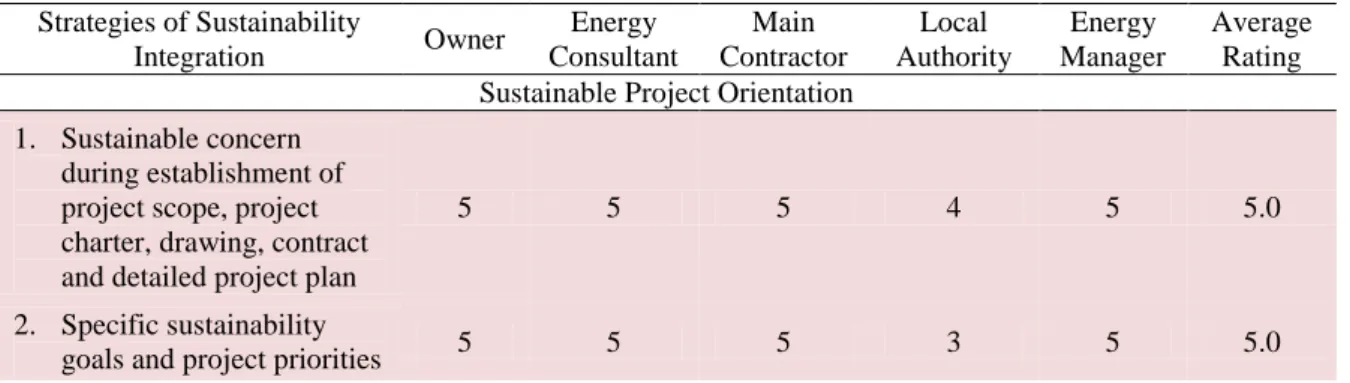
1. Sustainable concern during establishment of project scope, project charter, drawing, contract and detailed project plan
2. Team members’ selection with sustainable development quality and capability 3. Bringing the team together as early as possible during planning process
4. Commissioning process is added during this process and described in a specific section 5. An integrated design/ sustainability coordinator is appointed as one of the project’s
team members
7. Sustainability and integrated design requirements and the process are included into the project documentations, strategic and comprehensive plan.
8. Incentive to encourage sustainable development
LEO building was the pioneer project related to sustainability at the time it was developed. It was still not exists a clear route towards sustainable building projects and the exact process of the sustainability integration strategies. The only guideline that they had was MS1525:2001 in addition to the usual laws and guidelines that the project should fulfil. Thus, even though the project had their specific sustainability goals and project priorities but they were more towards energy efficiency goals instead of the comprehensive sustainability concept. The process of delivering the project was quite the same as a typical project (O1, E1, L1). Though, the project was a unique and being eyes opener in the industry.
1.2.4 The Practiced of Sustainability Integration Strategies into the Planning Process of LEO Building Project
Integrating sustainability consideration during planning process could minimize the negative effects of building project development. The owner and energy consultant of LEO building were asked to indicate in details the strategies that have been practiced to integrate sustainability into the project throughout the planning process. The local authority, contractor and energy manager have not been involved to answer this question as they were not able to give their opinion (L1, C1, M1).
Findings reveal that 16 out of 20 strategies were practiced among the owner and designers team during the project planning process (refer Table 5, p368). Four strategies were not practiced during the process which are ‘team members’ selection with sustainable development quality
and capability’, ‘Local community representative is involved in support of the project’, ‘bringing the team together as early as possible during planning process’, ‘sustainability and integrated design requirements and the process are included into the project documentations, strategic and comprehensive plan’. Malaysia was still infancy in sustainable building project at the time of LEO building was developed. The exposure towards sustainability integration strategies among the project stakeholders were also little. Thus, the strategy of ‘team members’
selection with sustainable development quality and capability’ was not able to be practiced as the owner (O1) and the contractor (C1) mentioned, ‘Not much sustainability capability in
Malaysia at that time. We opened the opportunity to everyone who is passionate to get involved in the project. They were trained throughout the process to get the knowledge and experiences towards delivering the project successfully’ (O1). The contractor proved the statement as he (C1) mentioned: ‘At that time we were very fresh and new but we were very lucky to learn a
new thing and working together with the team members. We were sent to the other country to visit and to get the knowledge and experiences. If not, we might be just followed the conventional specification. Talking about sustainable building, it was not many people really understand that. During the process, we have learned a lot. Today, PPB is the pioneer of green and sustainable building development and we have involved in many green building projects.’
The local authority of Putrajaya was only involved in the approval part of the project. Other local community representative was not involved at all during this process. This situation is normal in the country. In the part of the stakeholders, it was such view that having more public and local authority input during this process sometimes would not add anything to the project and would create more complexity in decision making system.
The strategy of ‘bringing the team together as early as possible during planning process’ was not implemented as the energy consultant and the contractor were only appointed during the detail design stage and the energy manager was only informed during the stage. The failure of practicing the strategies has caused of stoppage of the project to gain input from the stakeholders in the early stage of planning process. The sustainability and integrated design requirements and the process were also not properly documented at the time as the team members were in a learning process of delivering such project.
Table 5: Interviewees’ Comments on Sustainability Integration Strategies into the Planning Process of LEO Building Project
Sustainability Integration Strategies
Stakeholders
Owner Energy
Consultant Sustainable Project Orientation
1. Sustainable concern during establishment of project scope, project charter,
drawing, contract and detailed project plan ● ●
2. Specific sustainability goals and project priorities ● ● Integrated project team
3. The team should have the core knowledge of sustainable building ● ● 4. Team members are educated on sustainability issues including vendors. ● ● 5. Team members are fully informed on sustainability goals and priorities of the
project. ● ●
6. Team members’ selection with sustainable development quality and capability 7. An integrated design/ sustainability coordinator is appointed as one of the
project’s team members ● ●
8. Local community representative is involved in support of the project Integrated design process
9. Bringing the team together as early as possible during planning process
10. Design should reflect the end user community ● ●
11. Sustainability and integrated design requirements and the process are included into the project documentations, strategic and comprehensive plan.
12. Do whole building design and systems analysis ● ●
13. Committed and collaborative team throughout the process ● ●
14. Involve diverse set of stakeholders on the team ● ●
15. Effective communication and incorporation of charette process ● ● 16. Planning should reflect all the project stakeholders ● ● 17. Commissioning process is added during this process and described in a specific
section. ● ●
Regulations and code compliances
18. Government policies to encourage sustainable development ● ●
19. Incentive to encourage sustainable development ● ●
20. Compliance with code and regulatory tool of sustainability ● ●
TOTAL 16 16
Level of the Strategies Practiced: High High
Total respondents 2
Level of Practices: 20-18 Very High 17- 14 High 13-10 Medium 9-6 Low 5-0 Very Low Note: ● Practiced during the project planning process
Of the 16 practiced strategies, 4 strategies were not highlighted by the stakeholders earlier in the previous section. The strategies are;
1. Sustainable concern during establishment of project scope, project charter, drawing, contract and detailed project plan
2. An integrated design/ sustainability coordinator is appointed as one of the project’s team members
3. Commissioning process is added during this process and described in a specific section 4. Incentive to encourage sustainable development
After in depth investigations, the interviewees revealed that sustainable concerns have been integrated during the establishment of the project scope, project charter, drawing, contract and the detailed project plan. However, their priority was towards to achieve energy efficiency of the building. ‘A comprehensive list of energy efficient features was also integrated and confirmed through the project tender document (E1).’ Commissioning process was added during the project planning process and described in a specific section. This section was even implemented in traditional projects. A sustainability coordinator or energy consultant (DANIDA) was appointed during the project planning process but a bit late which is at the detail design stage (O1, E1). ‘DANIDA’s consultancy was paid by the government of Denmark.’
It was an incentive that has been received by the project to be sustainable. Overall, the sustainability integration strategies that have been practiced during the planning process of the project was at a high level.
1.3 The Project Performances
This part aims to explore the performances of the LEO project at the conceptual and design, construction and operation and maintenance stage. The performances are discussed in the aspect of four main success criteria: 1) Sustainability Performances 2) Cost 3) Time 4) Quality and Stakeholders Satisfaction. The impact of the sustainability principles and the integration strategies that have been practiced throughout the early project planning process (at the pre-construction stages) on influencing the project performances is discussed at the end of this part.
1.3.1 Sustainability Performances
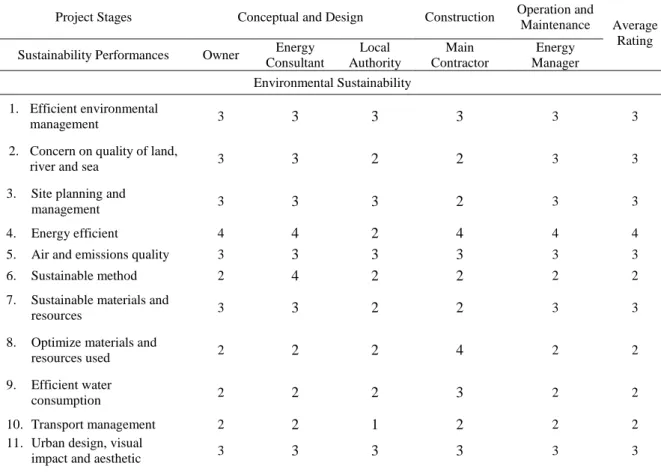
The stakeholders were asked to assess the performance level of sustainability principles delivered by the project. The owner, energy consultant and local authority of the project were asked to assess the project’s sustainability performances delivered at the conceptual and design stage, contractor was asked to evaluate the performances delivered at the construction stage and energy manager was asked to judge the sustainability performances at the operation and maintenance stage of the building. The results are illustrated in Table 6 below:
Table 6: Stakeholders’ Responses on the Level of Sustainability Performances of LEO Project
Project Stages Conceptual and Design Construction Operation and
Maintenance Average Rating Sustainability Performances Owner Energy
Consultant Local Authority Main Contractor Energy Manager Environmental Sustainability 1. Efficient environmental management 3 3 3 3 3 3
2. Concern on quality of land,
river and sea 3 3 2 2 3 3
3. Site planning and
management 3 3 3 2 3 3
4. Energy efficient 4 4 2 4 4 4
5. Air and emissions quality 3 3 3 3 3 3
6. Sustainable method 2 4 2 2 2 2
7. Sustainable materials and
resources 3 3 2 2 3 3
8. Optimize materials and
resources used 2 2 2 4 2 2
9. Efficient water
consumption 2 2 2 3 2 2
10. Transport management 2 2 1 2 2 2
11. Urban design, visual
Project Stages Conceptual and Design Construction Operation and
Maintenance Average Rating Sustainability Performances Owner Energy
Consultant Local Authority Main Contractor Energy Manager 12. Noise control 3 4 3 3 3 3 Economic Sustainability
13.Whole life cost efficiency 3 4 3 4 3 3
14. Improve local market
presence 2 4 2 4 2 3
15. Indirect economic impact 3 4 2 2 3 3
16. Economic benefit to the
stakeholders 3 4 3 4 3 3
Social Sustainability 17.Occupational Health and
Safety 3 4 3 4 3 3
18. Product responsibility 3 4 2 4 3 3
19.Training, education and
awareness 3 4 2 3 3 3
20.Stakeholders participation 3 4 2 4 3 3
Design and Innovation
21.Sustainable Innovation 3 4 3 3 3 3
22.Sustainable Design 4 4 3 4 4 4
TOTAL SCORE 63 76 53 69 63 65
Average Rating 3 3 2 3 3 3
Level of Performances Good Good Fair Good Good GOOD
Note: 1 = Poor 2 = Fair 3 = Good 4 = Excellent
a. Conceptual and Design Stage
Different responses have been revealed on the level of sustainability performances of the LEO project’s that have been delivered at the conceptual and design stage. There are 5 sustainability principles have been placed by the owner and energy consultant to be at the same level but at the different level of performance by the local authority. The principles are as follows;
Excellent (4 Points)
1.
Energy efficiency2.
Sustainable designGood (3 Points)
3.
Concern on quality of land, river and sea4.
Sustainable materials and resourcesFair (2 Points)
5.
Transport managementHowever, all of them (owner, energy consultant and local authority) placed at the same level of performances for 6 principles as follows;
Good (3 Points)
1. Efficient environmental management 2. Site Planning and management 3. Air and emission quality
4. Urban design, visual impact and aesthetic
Fair (2 Points)
5. Optimized materials and resources used 6. Efficient water consumption
It was clear that the principles of ‘optimized materials and resources used’ and ‘efficient water
consumption’ have been practiced at the ‘fair’ level during conceptual and design process of the project. Both principles were not mentioned in any project documents during planning process of the project. Though, the issue of ‘optimized materials and resources used’ has been considered by owner and energy consultant during the early project planning process such as to use reuse elements and recycle content materials for the building and to separate reusable construction waste during construction stage. The contractor has practiced the waste separation during construction. However, the utilisation of sustainable materials and resources such as reused and recycled content materials was still at the ‘fair’ level as these materials were very limited in terms of their range and quantities in this country. The findings concurred by a recent research by Shari (2011:175-178) who pointed out that the using of reused or recycled components/materials were rarely practiced in Malaysia. The water efficiency performance was assessed to be at the ‘fair’ level at the conceptual and design stage of LEO building. It was no wondered as the principle was just ignored throughout this stage. This issue was still new in Malaysian construction industry at that time. The guideline such as GBI was also not yet developed. Overall, the stakeholders assessed the project sustainability performances of LEO building during conceptual and design stages to be at the ‘good’ level.
b. Construction Stage
Nine principles were responded as delivered at an excellent level during construction stage of the project as follows;
Excellent (4 points)
1. Sustainable design 2. Energy efficiency
3. Optimized materials and resources used 4. Whole life cost efficiency
5. Improve local market presence 6. Economic benefit to the stakeholders 7. Occupational health and safety 8. Product responsibility
9. Stakeholders participation
Seven principles were assessed as delivered at a good level during construction process.
Good (3 points)
1. Efficient environmental management 2. Air and emissions quality
3. Efficient water consumption
4. Urban design, visual impact and aesthetic 5. Noise control
6. Training, education and awareness 7. Sustainable innovation
Six principles were measured as delivered at a fair level during construction process.
Fair (2 points)
1. Concern on quality of land, river and sea 2. Site Planning and management
3. Sustainable method
4. Sustainable materials and resources 5. Transport management
6. Indirect economic impact
Overall, the stakeholders assessed the project sustainability performances of LEO building during construction stage to be at the ‘good’ level.
c. Operation and Maintenance Stage
Two principles were assessed as delivered at an excellent level during operation and maintenance stage as follows;
Excellent (4 points)
1. Energy efficiency 2. Sustainable design
Most of the principles (15 principles) were measured as delivered at a good level during operation and maintenance stage as follows;
Good (3 points)
1. Efficient environmental management 2. Concern on quality of land, river and sea 3. Site Planning and management
4. Air and emissions quality
5. Sustainable materials and resources 6. Urban design, visual impact and aesthetic 7. Noise control
8. Whole life cost efficiency 9. Indirect economic impact 10. Benefit to the stakeholders 11. Occupational Health and Safety 12. Product responsibility
13. Training and education 14. Stakeholders participation 15. Sustainable Innovation
Five principles were perceived as delivered at a fair level during this stage as follows;
Fair (2 points)
1. Sustainable method
2. Optimized materials and resources used 3. Efficient water consumption
4. Transport management
5. Improve local market presence
Overall, the stakeholders assessed the project sustainability performances of LEO building during operation and maintenance stage to be at the ‘good’ level.
Considering all cycles of the project that has been discussed, the stakeholders assessed the delivery of 2 principles at the excellent level which making the building project was exceptional in the quality as follows;
Excellent (4 points)
1. Energy Efficiency 2. Sustainable Design
Regarding the achievement, the energy consultant (E1) mentioned: ‘The LEO building
demonstrates the feasibility of the energy efficiency measures according to the new Malaysian Standard MS 1525:2001. Based on this code, the LEO building must have an energy consumption less than 135 kWh/m2year but LEO managed to achieve the BEI of 100/kWh/m2 which was better than the requirement of MS 1525:2001’.
Good (3 points)
1. Efficient environmental management 2. Concern on quality of land, river and sea 3. Site Planning and management
4. Air and emissions quality
5. Sustainable materials and resources 6. Urban design, visual impact and aesthetic 7. Noise control
8. Whole life cost efficiency 9. Improve local market presence 10. Indirect economic impact
11. Economic benefit to the stakeholders 12. Occupational health and safety 13. Product responsibility
14. Training, education and awareness 15. Stakeholders participation
16. Sustainable innovation
Some of the short comments given for the reasons of the answers were as follows;
‘Putrajaya Holdings has implemented the Environmental Management System (EMS) since the beginning of Putrajaya development. EMS aimed to fulfil EIA requirements and to maintain Putrajaya lake’s water quality towards achieving good environmental performance target’ (O1).
‘We were still new about sustainable materials. DANIDA as well were not well known with the local product. As a result, they sometimes made mistakes when choosing the materials. By the time materials came, it was spoil. However, overall I would say the sustainable materials and resources selection in this project were not at the excellent level but it was still could be considered as good’. (C1)
Four principles were measured as delivered at the fair level as follows;
Fair (2 points)
1. Sustainable method
2. Optimized materials and resources used 3. Efficient water consumption
4. Transport management
A number of stakeholders gave short comments the reasons for their answers for instances;
‘Water harvesting was provided only for watering plants. This idea came later after the early planning process in order to achieve the GBI points’. (E1)
‘The local authority’s requirement was to provide 30% less car parking space than the usual requirement in order to encourage the use of public transport. For me, the plan was good but the execution was not good. The public transportation services are unreliable and inefficient. People have to take more time to reach this building by public transport than by their own transport. Thus, park and ride area was provided but people not use it. Without tackling this issue, private transport ownership will continue to become a necessity rather than an option. This is the whole Putrajaya‘s problem, it is not only problem for this building. Currently, one parking area was provided nearby this building area in order to overcome insufficient parking space problem’. (O1)
The main contractor (C1) admitted that unsustainable method of construction are a normal practice and not clearly mentioned in any project documents as he said; ‘Method of construction
but ‘how to break it’ is up to the contactors. It is a common practice among contractors to flatten the whole site, chop all the trees during site clearance even though the footprint is small, but we need a bigger site for operation.’
The stakeholders assessed the overall project sustainability performances of LEO building to be at the ‘good’ level.
1.3.2 Cost Performance
The capital budget of LEO project was around RM55 million and the final cost was around RM56.9 million. Ten percents (10%) of the total actual costs of the project which is around RM5 million was expended for energy efficient features of the building which was integrated and confirmed through the project tender document. The differences cost was about RM1.9 million which is more less 4% of the initial cost (O1, E1, C1). Return on investment analysis (ROI) has been undertaken as part of the decision making process on the project. Even though the upfront cost was a bit higher which is extra another 10%, however the extra costs will be paid back within the first 8 - 10 years of the building lifespan (O1, E1). It was clearly profitable for the rest of the building life time because the building has been saving about RM900 thousand energy cost annually (O1, E1).
Interviewees were asked to comment on what they thought about the planning process of LEO project, whether the planning process add more cost than a conventional project planning process. Positive responses were received from the owner and energy consultant of the project as they mentioned that the process was not increase the cost of the project. With regard to the cost issues, the energy consultant (E1) explained: ‘This project had implemented integrated
process. Even though may be the implementation was not perfect but it was able to reduce the cost by reducing changes order’.
However, as the main contractor was not involved from early planning process thus, there were some issues came out during the construction phase of the project for instances the contractor (C1) mentioned: ‘Among others…in architectural aspect, the designers had specified the types
of glasses but the glasses cannot achieve the overall EE requirements. Specification of the glazing was also confusing and it was not available in the market. Thus, we advise the designers for other types of glazing in order to achieve the requirement of EE. I remember that the glass issues gave us a bit hassle where it took another around 4 months to get approval’.
The contractor (C1) also pointed out: ‘Most of the cost variation was due to the variation order
especially on M&E side during construction of the project’.
The building was planned to be an energy efficient building at the first time it was developed. After completion of the building, the owner decided to fulfill others green requirements in order to get GBI certification. Thus, another extra cost was expended as the owner (O1) mentioned:
‘When at the first time we tried to get GBI certification, we realised that the building was not able to fulfil some requirement of the greens. Thus, we have to hold the application at that time. To get GBI certification, we had retrofitted the Building Control System throughout the year of 2004 to 2010. We upgraded some of equipments and software. The retrofitting process was completed in October to November 2011. We did GBI submission in July 2011 and LEO was successfully certified at Silver level of NREB category of GBI Malaysia in December 2011’.
The cost of retrofitting and replacement of the old equipments and software in order to achieve sustainable target were quite expensive. It was due to the sustainability goals were not considered since the planning phase of the project as the energy manager (M1) mentioned: ‘Now we use T5 and LED for meeting room instead of T8 for room and CFL for meeting room. However, it will depend on budget. The cost was quite expensive. If we have budget, then we will change the equipments for continuous energy saving’.
However, the energy manager (M1) admitted that the replacement was beneficial to the organisation by generating saving throughout the building operation and maintenance period as he mentioned: ‘Before relamping, we spent about RM155k/month. After relamping, we only
have to spend around RM131k/month. Saving bill after relamping is about 23-24k/month, even though there was only second flour has been relamping. Relamping cost was about 330k. So, the ROI is only about 13 months’.
Besides, the end users’ attitudes also have contributed a lot to the building energy index as the energy manager (M1) said: ‘We do keep campaign to switch off light from 1-2pm and do
encourage other possible savings. Everybody understands already their role and responsibility here towards energy saving’.
1.3.3 Time Performance
The proposed development of the whole Parcel E including LEO building had initially obtained approval at Building Plan (PB) level in April 2000 where LEO building was designed to be located at block E14. However, the original block designated for KeTTHA as approved under PB, did not allow for the additional space requirement requested by the end user. In 2001, it was decided to combine the area of Block E4 and E5, which originally dedicated to the Ministry of Education. These blocks have been redesigned as Block E4/5 to meet the new requirement of KeTTHA. The building plinths for Block E4 and E5 have been merged to create a single Block redesigned as E4/5. This reinforces KeTTHA as a single entity with its own identity, which is expressed architecturally as well as oriented strategically in relation to the rest of the Blocks and Ministries in Parcel E. The new plintharea for Block E4/5 is 5,022.27 m2, which is an increase of 964.27 m2 from the original combined plinth areas of Block E4 and E5 at 2,350 m2 and 1,708 m2 respectively. This increase is brought about by the introduction of a central atrium core that links both E4 and E5 together, forming Block E4/5. The new GFA for Block E4/5 is 22,976 m2, which is a reduction of 6,490 m2 from the original combined GFA of Blocks E4 and E5 at 16,914 m2 and 12,552 m2 respectively. This figure was derived from KeTTHA’s new office space requirement (O1, L1). All of those conceptual planning, detail design and approval processes were last about one and a half years when then construction process was started in August 2002. The construction stage took about 24 months, where it was completed in 2004 and fully occupied in September 2004 (O1, C1, and M1).
Interviewees were asked to comment on the estimated time and actual duration of the project. This question was aims to assess duration and progress of the project whether it was delayed or delivered on time. Positive responses were received from the stakeholders (owner, energy consultant, local authority and main contractor) of the project as they mentioned that the project was completed within the given time period. With regard to this issue, the owner, local authority and main contractor said as follows;
‘This project was completed in time. LEO was the earliest completed building among the rest of buildings in Parcel E development. Interestingly, LEO was started later than other buildings in the parcel. It was due to the integrated design process that has been practiced throughout the planning process.’ (O1)
‘Estimated time for LEO construction period was about 2 years. Yes, LEO completion was in time’. (L1)
‘Even though we took around 4 months to get approval on M&E, a bit delayed, but we still able to complete the construction works within the given time frame’. (C1)
Interviewees (owner, energy consultant, local authority, main contractor) then were asked to comment on the LEO project planning process, whether it took more time than a conventional project planning process. The interviewees agreed that the process was a bit longer that a conventional project. It involved charrete, study visit, learning process and many efforts especially because the stakeholders were not used to the project. However, the detailed planning
process has shortened the rest of the project duration. The contractor mentioned that their late involvement in the planning and design process made the project took longer time to resolved M&E and energy efficiency aspects of the building to get approval. If this situation could be overcome, the project might be completed earlier than the time it was completed. Thus, it was clear that the planning process did not take too much time than a conventional building. LEO has proved that the project was completed earlier than more less the same category and size of buildings at the same parcel E, even though it was started later than them and it delivered a new energy efficient concept, a fresh concept in this country. But, through integrated design process, it was successfully delivered earlier than others. This project had involved the contractor who responsible for the structure and M&E aspects later which was at the detail design stage. The contractor also had appointed a new M&E engineer (VY Consults) rather than employing the previous M&E engineer (NDY Sdn. Bhd.) who involved since the conceptual stage of this project. This situation might be one of the causes why they a bit delay to handled and get approval on this aspect. If this situation could be avoided, the project might be could be completed earlier than the time it was completed.
All respondents were asked to comment on any change during the project execution and its effect on the estimated cost and duration of the project. Three respondents (local authority, main contractor and energy manager) gave responses as some changes happened which involved the cost and duration of the projects. However, the project was still able to be completed within the given time. The changes involved were as follows;
o Conceptual and detail design stage- Some changes during approval process (changes were not about green requirements) (L1)
o Detail design and construction stage- Variation order on M&E aspects during construction of the project (C1)
o Operation and Maintenance stage- Retrofitting of the building to fulfill green aspects for GBI certification and renovations to fulfil increment number of occupants (O1,M1)
1.3.4 Quality and Stakeholders’ Satisfaction Performance
In term of quality, the LEO building has been recognized by two prestigious awards. It won the first place in the ‘Energy Efficient Building Best Practices Competition 2006’ at the ASEAN level under the ‘New and Existing Building’ category by the ASEAN Centre for Energy. The award was presented at a special ceremony organized on 27 July 2006 in conjunction with the 24th ASEAN Energy Ministers meeting in Vientiane, Lao PDR. The LEO building also has been awarded with Silver Certificates for meeting the standard of the Malaysia GBI under the “Non Residential Existing Building’ category on 1st
December 2011. The building is able to reduce energy consumption until 100 kWh/m2/year compared to its first targeted achievement which is about 114kWh/m2/year. There was only minor complaint about the building performances have been received by the management and the rest of the stakeholders as they mentioned:
‘Yes, we have received complaints but it was not very critical. It all about air conditioning and air supply whether too cold or too hot especially after renovation, for example this room was designed to be a corridor. Air diffuser was designed to allow air that very minimum for a corridor. But now, this space becomes a room. Air supply (cpm) should be higher for a room. So it becomes too hot and stuffy. The problem was because of the renovation. This building was designed for 200 occupants only, but now it is become 300 occupants. So, we have to look back the air diffusion..because it was diverted from the original design. The rest such as lighting, we received no complaint by people’. (M1). ‘Some people said that the building is not beautiful. People expect energy efficient building should be futuristic in looks. For me, the comment was a credit for us, we able to convince people that a traditional building as well is able to be an energy efficient building. No need to be all glasses to reduce energy consumption’. (E1)
Meanwhile, the contractor and local authority have never been received any complaint or negative feedback about the building performances.
1.3.5 The Impact of Sustainability Practices on the Overall Performances of LEO building Project
Table 7 indicates the impact of the sustainability principles and the integration strategies that have been practiced throughout the early project planning process on influencing the LEO project performances. The owner and energy consultant perceived that the sustainability practiced exerted a positive on the overall performances of the project. The contractor (C1) highlighted his own opinion in order to improve the planning process of LEO project as he mentioned: ‘we (contractor) should be involved since the early planning process of the project, it will be better. If we are involved only during the construction stage, it will lengthen the project’s duration. The developer and consultants have many different opinions and ideas but all of them will be tied back with the method of construction. We are the team who is going to implement the design on the site. If the project can have contractor in place to discuss, since the conceptual and design stage, I believe it will be fruitful to the project in term of duration. It also will more competitive during tender stage because we able to help with pricing alternative approaches to require comfort level in a sustainable building’.
Table 7: Interviewees’ Responses on the Overall Impact of LEO Sustainability Principles Practices and the Integration Strategies into the Project Planning Process on Influencing the
Project Performances Representing the Stakeholders of Planning
Process Owner Energy Consultant
Rating +2 +2
+3 Very Positive +1 Somewhat Positive 0 Negligible -2 Negative
+2 Positive -1 Somewhat Negative -3 Very Negative
Besides, all stakeholders were asked to make some general comments on the full set of 22 sustainability principles of building and 20 integration strategies during project planning process as listed in the proposed framework (Table 5.63, p217) towards improving theoverall performances of sustainable buildings. All of them have given their positive responses such as the owner and energy consultant mentioned:
‘The framework is fine. It will reduce cost, changes and time and enhance the quality and sustainability aspects of the building’. (E1)
‘Overall, yes, the framework is excellent. We have expended extra money due to late consideration on sustainability principles in LEO project - green principles were considered later after the building was completely done’. (O1)
1.4 Barriers to the LEO Project
This part identifies interviewees’ perceptions on the major barriers or obstructions during the LEO project delivery. The most common barriers that were replied (all replies) are ‘there was
no clear aspect concerning sustainability and the integration strategies in the current building and the project planning standards and guidelines’ as the interviewees mentioned that the project was only referred to MS1525 in addition to the rest usually compulsory laws, standard and guidelines that they should comply to get approval from the local authority (O1, E1, C1, L1, M1). The main contractor (C1) added that there was no specific sustainability standard or guideline that they have referred for this project as he mentioned: ‘We did not have a proper
guideline. I believe MS1525 was only focus on energy efficient and renewable energy. It was not specifically designed for sustainable building. At that time, GBI as well was still not existed’.
One of the contributing factors to the absence of sustainable building standards and the integration strategies guidelines was majority of the regulatory stakeholders have a very limited understanding on sustainable development. Lack of sustainable development knowledge and awareness among construction players (all replies) were also contribute to the lack of demand and misinterpretation about this project. The need to make additional investments on in technology, training and process was very often an excuse not to involve in this type of project. However, the project’s client has a strong desire to incorporate energy efficient features into their building project which is very crucial to ensure the successful of the project. As this project was the first in Malaysia, the stakeholders took time to study the knowledge of sustainable project. They have been involved in workshops, seminars, charrette process and visiting sustainable building projects around the world. They had to spend time to learn. Fortunately, the stakeholders were guided by DANIDA throughout the process as the contractor (C1) said: ‘during the process they (DANIDA) guided us, we were involved in many meetings so
that any problem arises could be properly resolved together’.
Luckily, the stakeholders of this project have given a very positive contribution towards this project as they were willing to learn and responsible for the successful performance of this project. Lack of sustainable development knowledge and awareness among construction players were also contribute to the lack of local sustainable materials, technology that adapted to the local climate and condition and local expert in this industry (4 out of 5 replies - cited by all stakeholders except local authority)
The third (3 out of 5) most cited barrier was about the ‘lack of sustainability integration process
and technical understanding’ that resulted to several process issues such as sustainability measures were not considered since early planning process as the project was first designed for energy efficient only (O1, E1, C1). Another process issues was the stakeholders such as the energy consultant and contractor were not involved during the early planning process. The maintenance of the building also was delivered by the contractor (outsider) who had never been involved in planning and design process. As the stakeholders were still new about the process during that time, there were some negative impacts that can be detected such as variation and changes order during detail design and construction stage and retrofitting and renovations were conducted to match the occupants’ needs during operation and maintenance stage of the project. However, this barrier once again was contributed by the lack of sustainable development knowledge and awareness among the stakeholders and also due to the absence of a clear sustainability project standard and the integration strategies guidelines during the time.
The fourth most cited barrier during the project delivery (2 out of 5 replies) was about the funding issues (L1, M1). High investment on technology and materials was claimed by the energy manager and local authority as a challenge to the project delivery as the project was designed in the beginning more towards an energy efficient building. Extra money had to be expended in order to fulfill other sustainable features which involved retrofitting process on the building control systems, relamping facilities and upgraded some equipments and software. In choosing a new building systems and equipments, the energy manager also has to be more careful so that the choices are best suit to fit into the existin