Specification and Implementation of
Exceptions in Workflow Management
Systems
FABIO CASATI and
STEFANO CERI, STEFANO PARABOSCHI, and GIUSEPPE POZZI Politecnico di Milano
Although workflow management systems are most applicable when an organization follows standard business processes and routines, any of these processes faces the need for handling exceptions, i.e., asynchronous and anomalous situations that fall outside the normal control flow.
In this paper we concentrate upon anomalous situations that, although unusual, are part of the semantics of workflow applications, and should be specified and monitored coherently; in most real-life applications, such exceptions affect a significant fraction of workflow cases. However, very few workflow management systems are integrated with a highly expressive language for specifying this kind of exception and with a system component capable of handling it.
We present Chimera-Exc, a language for the specification of exceptions for workflows based on detached active rules, and then describe the architecture of a system, called FAR, that implements Chimera-Exc and integrates it with a commercial workflow management system and database server. We discuss the main issues that were solved by our implementation, and report on the performance of FAR. We also discuss design criteria for exceptions in light of the formal properties of their execution. Finally, we focus on the portability of FAR and on its unbundling to a generic architecture with detached active rules.
Categories and Subject Descriptors: H.2.4 [Database Management]: Systems; Rule-based databases
General Terms: Design, Languages, Management, Performance
Additional Key Words and Phrases: Active rules, asynchronous events, exceptions, workflow management systems
The research in this paper was sponsored by the WIDE Esprit project. 20280, by CNR-CESTIA, and by the Hewlett-Packard Internet Philanthropic Initiative.
Authors’ addresses: F. Casati; S. Ceri, S. Paraboschi, and G. Pozzi, Dipartimento di Elet-tronica e Informazione, Politecnico di Milano, Piazza L. Da Vinci, 32, Milano, I-20133, Italy; email: [email protected]; [email protected]; [email protected].
Permission to make digital / hard copy of part or all of this work for personal or classroom use is granted without fee provided that the copies are not made or distributed for profit or commercial advantage, the copyright notice, the title of the publication, and its date appear, and notice is given that copying is by permission of the ACM, Inc. To copy otherwise, to republish, to post on servers, or to redistribute to lists, requires prior specific permission and / or a fee.
© 2000 ACM 0362-5915/99/0900 –0405 $5.00
1. INTRODUCTION
Workflow management systems (WfMSs) are software systems for support-ing coordination and cooperation among members of an organization, helping them to perform complex business processes [Georgakopoulos et al. 1995]. Workflow systems represent business processes by means of elemen-tary activities and connections among them; activities represent either fully automated tasks executed by computers, or tasks assigned to human actors executed with the support of a computer. WfMSs control the evolu-tion of processes by initiating and assisting their different activities and by checking that they are correctly performed by all the actors.
An important feature of workflow systems is the ability to represent exceptions that alter the normal flow of processes [Dayal et al. 1990]. Among exceptions, a class which is gaining recognition and importance is that ofexpected exceptions [Eder and Liebhart 1995], i.e., of those anoma-lous situations that are known in advance to the workflow designer. When an exception is unexpected, the exception handler typically resorts to halting the process and invoking a human intervention. Instead, when exceptions are expected, the exception handler can rely on the semantics of the workflow application in order to handle the exception, typically by means of some form of reactive processing. For instance, in a car rental workflow, an accident to a rented car causes an exception to the regular rental process. The accident, although expected, is an unlikely event; once it has occurred, however, a variety of activities become needed, including, e.g., giving assistance to the renters, scheduling the car’s repair, and rescheduling the future rentals for the affected car. All such activities constitute the (planned)reactionsto raising the exception.
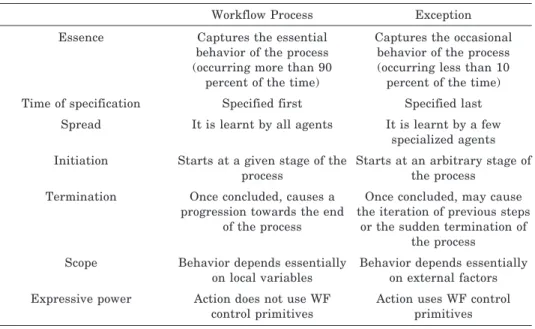
Workflows and expected exceptions capture different aspects of the application semantics, as summarized in Table I. Workflows describe the “normal behavior” of a process, while expected exceptions model the “occa-sional behavior.” Expected exceptions are unpredictable, and therefore cannot be conveniently represented in the process in the form of special tasks and connections among tasks. They are not frequent, but once they occur they may require special treatment, which may lead to the execution of a completely different process. They are asynchronous (hence, initiated at an arbitrary stage of the process) and highly influenced by external factors. Their execution may cause the backtracking of previous steps in the process or even sudden termination.
There is growing interest and need for languages and systems to inte-grate workflow specifications with expected exceptions; commercial work-flow systems typically support only a selected number of them, without enough generality. In this paper we present a comprehensive approach to the management of expected exceptions; we define a new language for expressing expected exceptions, and then describe the features of a system for integrating the exception handler with the workflow manager. For brevity, we use the term “exception” to denote asynchronous expected
exceptions (a classification of the various kinds of exceptions can be found in Section 7).
The exception-handling mechanism must be able to capture exceptional events and toreactto them. Each reaction must first assess the state of the process and then, in a few cases, adopt the corrective action; in many cases events correspond to false alarms and do not need to be followed by a corrective action. This model has a strong similarity to the trigger manage-ment strategy used in active databases [Ceri and Widom 1990; Widom and Ceri 1996]. In fact, since most workflow systems execute on top of commer-cial databases, it is quite natural to use active database functionality to manage exceptions.
Active rules are characterized by the following components, each with an immediate correspondence to exceptions:
—The event part defines the symptoms of an exception, e.g., database modifications or signals coming from other components of the workflow, thattriggerthe rule, i.e., put it in the set of rules to be considered by the rule management system.
—The condition is a boolean predicate that checks that the symptoms really identify an exception to be managed; it can also be used to select, among several exception management alternatives, the most adequate to deal with the current workflow state.
—Theactiondescribes the updates and procedures that must be invoked to respond to the exception occurrence.
Each rule is executed in a new transactional context, different from the one in which the exceptional event was generated; in terms of active databases, rules have a detached execution mode [Dayal et al. 1990]. In most cases, rules do not need immediate service and should interfere as little as possible with regular workflow processing. Thus, we have engineered an exception handler in which triggered rules are batched and considered at given periods of time. Very few events are classified as “real time” and cause an immediate invocation of the rule management system.
In this paper we present the design and implementation of a rule-based exception handler for workflow management. Exceptions are specified in Chimera-Exc, a new language specifically designed for expressing excep-tions in a WfMS; Chimera-Exc is an extension of Chimera [Ceri et al. 1996] for the conceptual specification of database applications incorporating object orientation, deductive rules, and active rules. We describe the innovative features of Chimera-Exc and the corresponding expressive power in modeling exceptions; then we describe the implementation of the language and its interfaces for a commercial WfMS and DBMS. Next, we discuss the formal properties of workflow applications augmented with exceptions, and indicate criteria for a sound use of exception handlers in workflow management. Finally, we focus on the portability of FAR and on its unbundling to a generic architecture with detached active rules.
(This research is part of the WIDE project, funded by the Esprit IV program of the European Union, with the goal of developing an advanced commercial workflow management system, called FORO. The team at Politecnico di Milano designed and implemented FAR, the FORO Active Rule component for exception management in the FORO environment.) 2. PRELIMINARIES
This section introduces basic workflow concepts and terminology, based on the model and definitions of the Workflow Management Coalition (WfMC) [Workflow Management Coalition 1996; 1998]. FORO provides several extension to that model, but such extensions are not relevant in the context of this paper; for a complete description, see Grefen et al. [1999]. This section then presents a case study used throughout the paper to exemplify the new concepts. Finally, we show the need for exceptions in the case study, drawing requirements on the exception-specification language. 2.1 Basic Workflow Concepts
A workflow process definition (or simply workflow schema) is the formal representation of a business process. A workflow schema is composed of subprocesses and elementary activities (tasks) that collectively achieve the business goal. Activities are organized into a directed graph (the flow structure) that defines the order of execution among the activities in the process. Arcs (transitions) in the graph may be labeled with transition predicates defined over process data, meaning that as an activity is completed, tasks connected to outgoing arcs are executed only if the
Table I. Comparing Flows and Exceptions
Workflow Process Exception Essence Captures the essential
behavior of the process (occurring more than 90
percent of the time)
Captures the occasional behavior of the process (occurring less than 10 percent of the time) Time of specification Specified first Specified last
Spread It is learnt by all agents It is learnt by a few specialized agents Initiation Starts at a given stage of the
process
Starts at an arbitrary stage of the process
Termination Once concluded, causes a progression towards the end
of the process
Once concluded, may cause the iteration of previous steps
or the sudden termination of the process
Scope Behavior depends essentially on local variables
Behavior depends essentially on external factors Expressive power Action does not use WF
control primitives
Action uses WF control primitives
corresponding transition predicate evaluates to true. Aprocess instance(or simply case) is an enactment of a workflow schema. A schema may be instantiated several times, and several instances may be running concur-rently. WfMSs support case execution by scheduling tasks (as defined by the flow structure) and by assigning them for execution to human or automated agents.
A process may create and access several types of data. The WfMC identifies three types of workflow data: workflow relevant data includes typed data created and used by a process instance; this data can be made available to subprocesses and activities, and accessed by the WfMS in order to evaluate transition predicates.Application datais domain-specific, must be processed with external tools and generally cannot be accessed by the WfMS, although the system may control and restrict accesses to them.
System and environmental datais maintained by the local system environ-ment or by the WfMS itself, and can also be used to evaluate transition predicates. Activities are typically executed atomically, and data modifica-tions are made visible as the task is completed.
A critical issue in workflow management is the assignment of tasks and cases to the appropriateagent(also calledworkflow participant), in order to execute activities or supervise their execution. The approach adopted by most WfMSs consists in allowing the definition of an organization schema
that describes the structure of the organization relevant to workflow management. In the organization schema, agents are grouped in several ways, for instance, according to their skills or to the organizational unit they belong to. In the definition of the workflow schema, processes and activities are (statically) bound to elements of the organization schema (e.g, to roles or organizational units) rather than to individual agents. This approach decouples the definition of the process from the definition of the organization, and provides more flexibility, since changes in the organiza-tion schema may not affect process definiorganiza-tions.
At runtime, as a task is scheduled for execution, the WfMS determines all the agents allowed to execute it and inserts the task into theirworklists. As an agent pulls the task from his/her worklist in order to start working on it, the task is removed from the worklists of the other agents. Once a task execution is completed, the WfMS schedules the next task(s) to be activated.
2.2 The Car Rental Case Study
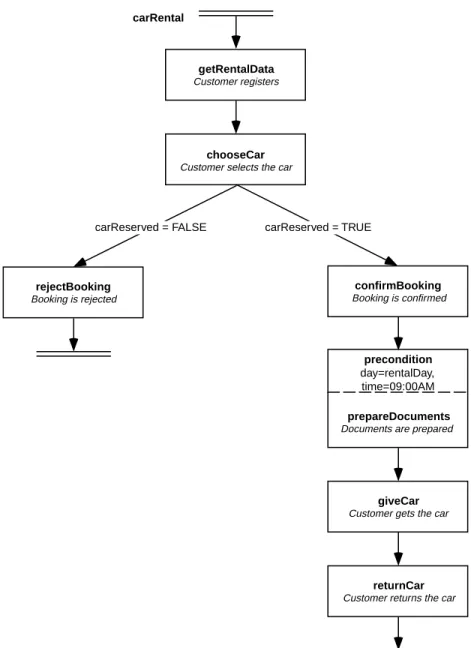
The process model (orworkflow schema) of the car rental example is shown in Figure 1. A new process instance (or case) is started as the car rental company receives a car reservation request. The first activity (or task) collects the customer data along with the desired car size and rental day (getRentalData), updating the corresponding workflow relevant data. The next activity chooseCar is then started, to find a car of the requested size available on the requested day; the execution of the task may involve dealing with the customer in order to adapt the request as a function of car ACM Transactions on Database Systems, Vol. 24, No. 3, September 1999.
availability. If, after termination of the task, no suitable car is found (variablecarReservedisfalse), then the taskrejectBookingis activated and causes the end of the case: otherwise, task confirmBooking is started, causing the confirmation to the customer that the reservation is accepted.
After the confirmation, the precondition of the taskprepareDocuments— delimited by a dashed line inside the task rectangle in Figure 1—waits until the morning of the rental day, when the documents of rentals for the day are prepared by the agents at the local rental site: The precondition is
chooseCar Customer selects the car carRental getRentalData Customer registers rejectBooking Booking is rejected confirmBooking Booking is confirmed prepareDocuments Documents are prepared
giveCar Customer gets the car
precondition
day=rentalDay, time=09:00AM
returnCar Customer returns the car
carReserved = FALSE carReserved = TRUE
Fig. 1. The carRental process model. The dashed line for the prepareDocuments activity delimits the preconditions from the body of the activity.
an expression that must be satisfied before the activity can start. The subsequent task (giveCar) is pulled by an agent when the customer shows up. The final task (returnCar) is pulled by an agent when the customer returns the car.
2.3 Need for Exceptions
The car rental schema models the typical car rental process; the flow structure corresponds to the sequence of operations that must be performed in order to achieve the business goal, i.e., renting the car and satisfying the customer. This process is very simple, but in reality business processes can be quite complex, and the corresponding workflow schemas can be very intricate. However, it frequently happens that a particular execution of a process needs to deviate from the normal behavior defined by the flow structure. The typical exceptions to the car rental process can be summa-rized as:
—Changes to shared variables stored in the database; for example, a delay in returning a car as perceived by another case where that same car is booked to a different customer.
—Violation of time-related constraints or alarms, such as deadlines for the execution of tasks and cases; for example, the no-show of a client two hours after the agreed reservation time.
—Asynchronous external events, notified to the WfMS by a human or automated agent; for example, the cancellation of a car reservation or the notification of a car accident.
—Violation of constraints over workflow data; for example, booking the same car to two different customers during overlapping time intervals. —Changes in the process organization; for example, the sudden
unavail-ability of agents at the local rental company.
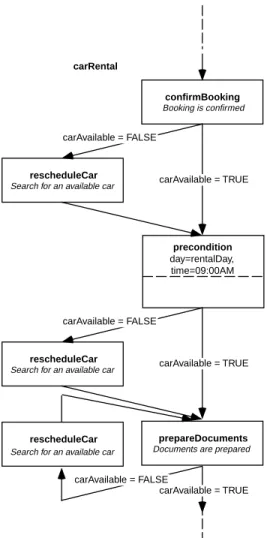
Such situations cannot be efficiently modeled and handled within the flow structure, since they are asynchronous and their occurrence is not related to the completion of other tasks in the case. For instance, consider an exception related to a late car return, causing the rescheduling of the rentals for that car: the rescheduling is an intrinsically asynchronous event, but in order to take it into account it has to be checked at all stages of the flow following car selection and prior to giving the car to the customer. Figure 2 shows the impact of such a modification upon the workflow schema in Figure 1; clearly, the resulting schema is more complex and less effective in conveying the semantics of the application.
However, such exceptions need to be considered by the WfMS, because their handling is part of the semantics of the process. Therefore, ad-hoc constructs, extending those introduced in the previous sections, must be added to the workflow model. These constructs should enable the specifica-ACM Transactions on Database Systems, Vol. 24, No. 3, September 1999.
tion of both the conditions to be monitored by the WfMS and of the sequence of operations to be performed in order to handle them.
3. THE EXCEPTION LANGUAGE: CHIMERA-EXC
The exceptions need to query the state of the workflow cases, which is stored within a database shared by the workflow interpreter and the exception handler itself. Therefore, prior to introducing the exception language, we describe the schema definition language for managing state information about workflows.
3.1 Class Definitions for Chimera-Exc
Chimera-Exc rules execute upon a simple, object-oriented schema, consist-ing of object classes. Chimera-Exc does not need structural and behavioral
carRental
confirmBooking
Booking is confirmed
prepareDocuments
Documents are prepared
precondition day=rentalDay, time=09:00AM rescheduleCar
Search for an available car
rescheduleCar
Search for an available car
carAvailable = FALSE
carAvailable = TRUE
rescheduleCar
Search for an available car
carAvailable = FALSE
carAvailable = TRUE
carAvailable = FALSE
carAvailable = TRUE
Fig. 2. Changes to a part of the carRental process model in absence of an exception management system.
complexity, which is typical of object-oriented databases (and can be found in Chimera). So an object class is just a record of attributes; each attribute has an atomic type, chosen among the classical types supported by data-base systems (e.g., character, string, integer, date). The names of all classes within the database and of all attributes within classes must be different. Each class is simply a collection of typed objects; all objects have a distinct object identifier.1
Classes in Chimera-Exc are of three different kinds:
—Workflow management classes store metainformation about workflows and their enactment; they are defined within the FORO WfMS.
—Exception management classes store metainformation about exceptions and their management; they are defined in the FAR exception handler. —Workflow-specific classes store the values of variables defined within
workflow schemas. All variables relative to a given workflow schema are collected within one object class, whose name derives from the workflow name. For example, a particular car reservation may be represented by an object C ofcarRental class, and the expression C.reservationNumber
denotes the string variable containing the reservation number.
Note that workflow and exception management classes are workflow-independent, hence their structure is defined once and for all in the system;2 their content changes while flows are executed or exceptions are managed. Workflow-specific classes are instead defined when a given workflow is presented to the WfMS; each case is associated to an object generated when the case is created with a unique case identifier (caseId).
Workflow-specific classes use a restricted form of inheritance: they all inherit from the generic, workflow-independent class case. Thus, a work-flow-specific object, e.g., belonging to the class carRental, inherits the attributes of the class case, e.g., the case responsible; having aresponsible
is a generic property that holds for all workflows.
3.2 Events, Conditions, Actions, and Priorities in Chimera-Exc
This section describes informally the characteristics of events, conditions, actions, and priorities in Chimera-Exc. The full syntax of the language is given in the Appendix, which appears in electronic format only; see http://www.acm.org/pubs/contents/journals/tods/1999-24/.
3.2.1 Events. Each rule in Chimera-Exc can monitor multiple events. Events in Chimera-Exc belong to four categories: data manipulation events, external events, temporal events, and workflow events. Data manipulation events are present in Chimera, but external, temporal, and workflow
1Given this simple schema, classes of Chimera-Exc can be stored within relational tables; each
tuple is provided with a system-generated object identifier.
2In the context of the WIDE project, workflow classes are defined and managed within FORO;
the exception handler has only retrieval privileges regarding workflow classes.
events are defined specifically for Chimera-Exc. These categories are detailed in the remainder of the section.
Data manipulation events enable the monitoring of operations that change the content of the database; these events include instantiating an object via thecreatestatement, removing an object via thedeletestatement, or changing the value of one of the object variables via the modify
statement.3 For instance, the eventmodify(carRental.returnTime) is raised as the return time of a car is modified, where carRentalis the name of a workflow and returnTime is the name of one of the variables for that workflow.
External events are raised by external applications interacting with the exception handler. External events must first beregisteredby applications; all event names must be different. Then events can be raised by external applications. For instance, the event carAccident can be raised by the application that responds to calls from the renters and provides them with assistance. With the raise primitive, external applications can provide several application-specific parameters (e.g., the license number of the car and the place and time of the accident). In Chimera-Exc, raise is also the event language construct that defines the external events to which a rule is made sensible; thus, event raise(carAccident) is raised as an external application notifies an occurrence of thecarAccident event.
Workflow eventsenable the monitoring of starts and completions of tasks and cases. The progression of a given case is marked by the times of initiation and termination of the case itself and of its tasks. These times are expressed by means of the predefined events caseStart, caseEnd,
taskStart, andtaskEnd, denoting theDateTimein which the case or a given task is started or completed. The workflow executor notifies the exception handler of these events.
Temporal events are classified as instant, periodic, and interval events. Informally, an instant event occurs when a certain temporal instant is reached (e.g., at midnight of the 31st of December 1999); an interval event occurs when a given temporal interval elapsed from a given time (e.g., two hours since the start of a case); and a periodic event occurs when periodic time conditions are fulfilled (e.g., every first Monday of the month). We next characterize each class of events more precisely.
—Instant events are expressed as DateTime constants of SQL-92 [Cannan and Otten 1992]; partial specifications, e.g., of the date or the time, have a default completion. An instant event can occur only once; if it has already occurred at the time when the rule is compiled, it is disregarded. —Periodic events are expressed using a notation taken from Leban et al. [1986]. A period is defined by means of two components, separated by the
during keyword; the latter component indicates the time period and the former component indicates how many units of time should be spent
3The obvious relational counterparts of these operations are insertions, deletions, and updates
waiting since the start of the period in order for the event to occur. For instance, 1/days during weeksdenotes the period of time defined by the first day of each week;18/hours during days is a periodic event ocurring at 6:00 pm every day;any/hours during daydenotes a periodic event at every hour. We also enable comparison expressions for limiting periodic events within a time window, e.g., date ’12/25/1997’ , 1/days during weeks , date ’12/25/1998’; this expression denotes every Sunday be-tween the days of Christmas in 1997 and 1998.4
—Interval eventsare defined by means of two components, a duration and a
DateTime, called the anchor time; the event occurs when the specified duration has elapsed since the anchor time. For ease of reference, interval events are named in the condition. Syntactically, the duration is preceded by the keyword elapsed and followed by the keyword since, which precedes the anchor time. For instance, elapsed (interval 60 days) since date ’1/1/1998’, or elapsed (interval 60 days) since caseStart are simple examples of interval events.
Legal anchor times are DateTime constants, the raising of external events, or the start or completion of tasks and cases; when an anchor time is not defined (because it refers to an external event that is not raised or to a workflow event that has not occurred), the interval event is also not defined. Durations are expressed in the notation used in SQL-92 [Cannan and Otten 1992]; partial specifications have a default comple-tion. Predefined constants, such as the maximum or expected duration of a case or task, can be used. Arithmetical operations on time values are permitted, such as the addition or multiplication of durations with constants.
3.2.2 Conditions. The condition part enables us to verify that rule triggering really corresponds to an exception that needs to be processed: false conditions denote false alarms, while true conditions denote an exceptional situation that must be handled. In Chimera-Exc, conditions and actions normally share some variables; when the evaluation of the condition produces bindings for these variables, the condition is satisfied, thus identifying the objects of the database that are affected by an exception. When no bindings are produced, the condition is not satisfied and the action is not executed. Conditions in Chimera-Exc derive their syntax and semantics from Chimera, which in turn derives them from the logical language Datalog, adapted to an object-oriented style. Thus, condi-tions in Chimera-Exc have a declarative nature, are set-oriented, and use a logic-programming style.
4The notation presented in Leban et al. [1986] allows us to specify complex periodic events,
such as the election day in the US (the first Tuesday after the first Monday of November), which can be expressed as1/(3/days during weeks) . (1/(2/days during weeks) during 11/ months); in Chimera-Exc, comparison expressions are only used between periodic events and givenDateTimeconstants representing the extremes of a time interval.
Syntactically, a condition is a conjunction of atomic formulas [Ceri et al. 1990]. Class formulas introduce variables ranging on the current extent of an object class (e.g., carRental(C)); type formulas introduce variables of a given type (e.g., integer(I)); comparison formulas are built by means of comparisons between expressions, which in turn are built by means of constants, attribute terms, or aggregate terms, composed in the usual way. Attribute terms use the classical object-oriented notation in which the attribute name acts as a selector of an object variable (e.g., C.bookedCar-Plate) while aggregate terms are introduced by aggregate functions applied to attribute terms (e.g.,avg(C.carMaxSpeed)), again with a classical object-oriented notation. The following condition binds objects of class carRental
whose customer is Italian and whose rental day is on the first of January 1998:
carRental(C), C.customer.nationality5 “Italy”, C.rentalDay5 1/1/1998
The condition is evaluated at a time subsequent to the time of the triggering, and there is no guarantee that the database state has not been changed meanwhile. The metapredicate old enables the evaluation of attribute terms in the state prior to the operation that causes the trigger-ing. Use of the old predicate requires logging such database states into special object classes. The following condition binds objects of class carRen-talsuch that the boolean variablecarReservedwas true before the trigger-ing and is false at the time of rule evaluation:
carRental(C), old(C.carReserved)5 true, C.carReserved5 false
The predicate occurred, followed by an event specification, binds a variable defined on a given class to the objects of that class that are affected by the event. This predicate can be used in many different contexts, shown below:
(1) agent(A), occurred(create(agent), A) (2) agent(A), occurred(modify(agent.name), A) (3) agent(A), occurred(delete(agent), A) (4) externalEvent(E), occurred(raise(“carAccident”),E) (5) temporalEvent(T), occurred(lateCarReturn,T) (6) task(T), occurred(taskStart(“assignCar”),T) (7) case(C), occurred(caseEnd,C)
In Examples 1, 2, and 3, A is a workflow-specific object agent that has been created, modified, or deleted. In Examples 4 and 5, E and T are objects of exception-management classes externalEvent or temporalEvent, respectively, whose events, the raising of the exception carAccident or the temporal event lateCarReturn, have occurred. Finally, in Examples 6 and 7, T and C are objects of workflow-independent classes task and case, which are bound by workflow events.
3.2.3 Actions. The action part of a rule consists of one or more primi-tives executed in sequence. Unlike conditions, Chimera-Exc actions are instance-oriented: a different primitive call is issued for every binding produced by the condition. Primitives are divided into the following main categories:
—data modification primitives for creating objects (createprimitive), modi-fying the value of an object’s attributes (modify primitive), or deleting objects (delete primitive). These primitives are applied to the set of objects that are bound by conditions; their semantics is the same as in Chimera [Ceri et al. 1996];
—workflow management primitives for the notification of alarms to agents, starting new tasks, cases, or subprocesses, reassigning tasks to a differ-ent agdiffer-ent, rejecting or canceling tasks, or the global rollback of cases. Alarms may refer to the values of the variables that are bound by the condition, typically manipulated as character strings and inserted within notification messages. Several examples of these actions are given in the next sections, and their concrete syntax is given in the Appendix.
Active rules in Chimera-Exc must be safe, i.e., the input parameters of the action part must appear in some positive literal (i.e., a term outside the scope of the notoperator) of the condition part.
Note that the expressive power of Chimera-Exc also enables the imple-mentation of the basic workflow functionality (i.e., task scheduling and assignment) by means of Chimera-Exc rules. Indeed, we have designed and implemented a prototype workflow engine by exploiting active rules [Casati et al. 1996; Pernici and Sanchez 1996]. However, after assessing the performance of the prototype implementations, we decided to implement the workflow engine in WIDE by means of an interpreter of a workflow definition language, generated by the workflow compiler from the graphical description of the schema.
3.2.4 Priorities. Rules have a statically defined priority, specified as an integer (positive or negative), which is used to determine the order of execution within a set of triggered rules. Default priority is set to zero; the rule with the highest number has the highest priority. When two rules have the same static priority, their relative priority is determined by their creation time, with oldest rules having highest priority.
3.3 Examples
We show Chimera-Exc at work by means of some of the exceptions informally introduced in Section 2.3. Trigger lateCarReturn notifies the clerk responsible for a car rental that the car’s return is delayed.
define trigger lateCarReturn
events modify(carRental.returnTime)
condition carRental(C), occurred (modify(carRental.returnTime),C), C.returnTime . old(C.returnTime)
actions notify (C.responsible, “Late return for car ” 1 C.bookedCarPlate)
order -2 end;
The following version of the same trigger checks whether the car that is returned late is booked by some other customers at a time preceding the new expected return time of the car; and, if so, the notification goes to the agents who are responsible for these car rentals.
define trigger lateCarReturn
events modify(carRental.returnTime)
condition carRental(C1), occurred (modify(carRental.returnTime),C1), carRental(C2), C1.bookedCarPlate 5 C2.bookedCarPlate, C1.returnTime . C2.rentalTime
actions notify (C2.responsible, “Need of rescheduling car ” 1 C2.bookedCarPlate)
order 3 end;
The trigger customerCancel reacts after cancelling a reservation by notifying the responsible agent and by starting the task rejectBooking, which belongs to the workflow schema (see Figure 1). The external event notification includes as a first parameter the reservation number of the affected car rental.
define trigger customerCancel
events raise(“customerCancel”)
condition carRental(C), externalEvent(E), occurred(raise (“customerCancel”), E),
C.reservationNumber 5 E.parameter1
actions notify (C.responsible, “Customer cancelled reservation: ” 1 E.parameter1),
startTask(C, rejectBooking) order -3
end;
The realtime trigger carAccident notifies the agent responsible for the rental of the damaged car and all the agents for future reservations of that car of such an external event. The event also starts the execution of a new case of another workflow, called Accident, which receives as a parameter the plate number of the damaged car and manages its repair.
define trigger carAccident
events realtime raise(“carAccident”)
condition externalEvent(E), carRental(C1), occurred(raise (“carAccident”), E),
E.parameter1 5 C1.reservationNumber,
carRental(C2), C1.bookedCarPlate 5 C2.bookedCarPlate actions notify (C1.responsible, “Accident for car ”
1 C1.bookedCarPlate),
notify (C2.responsible, “Need of rescheduling car ” 1 C2.bookedCarPlate),
startCase(Accident, C1.bookedCarPlate) order 5
end
The triggernoShowis activated every hour, and selects those car rental reservations where the customer has not shown up two hours after the reservation time; the customer’s name and driver’s license number are
recorded. The condition is formulated in such a way that the recording is done only once.
define trigger noShow
events any/hours during days
condition carRental(C), C.rentalTime . sysTime - 3:00:00,
C.rentalTime ,5 sysTime - 2:00:00, C.carRented 5 false actions notify (C.responsible, “No show for ” 1 C.reservationNumber),
create(noShowRecord,
[C.customer.name, C.customer.drivingLicence,sysDate]) order 2
end;
The trigger stopWork is activated every day at 6:00 pm, and notifies every task executor of thecarRentalworkflow that work-time is over.5
define trigger stopWork
events 18/hours during days
condition carRental(C), task(T), T.caseId5C, T.status5“running” agent(A), T.executor5A
actions notify (A, “Time to go home!”)
order 100 end;
Note that each agent receives at most one notification message due to the execution of the stopWork trigger. In fact, one notification action is exe-cuted for each agent bound to object variable Aafter the condition evalua-tion. Replacing the action with the primitive notify (T.executor, “Time to go home!”) yields slightly different semantics, where a notification message is sent for every active task. So agents executing several tasks will receive several notifications.
The trigger slowCaseEnd is activated two hours after the start of the
returnCar task, and checks whether the case is still running. If so, it notifies the case responsible as to who must use a form in order to enter the final data about the rental and creates a record reporting the delay.6
define trigger slowCaseEnd
events slowCaseEnd: elapsed (interval 2 hour)
since taskStart(returnCar)
condition temporalEvent(TE), occurred(slowCaseEnd,TE),
carRental(C), TE.dependsOnCase5C, C.status5“running” actions notify(C.responsible,“Enter final data about ”
1 C.reservationNumber), create(slowCaseRecord,
[C.responsible,C.reservationNumber,sysTime]) order 1
end;
3.4 Rule Execution Semantics
Rule execution semantics is defined operationally by explaining the mech-anisms of rule scheduling. After their creation, rules are stored within a
5AttributecaseIdofTasklinks each task activation to its case.
6AttributedependsOnCaseoftemporalEventlinks a temporal event to the case that caused the
event occurrence.
rule repository, defined next. Each rule is initially untriggered, and be-comestriggeredwhen any of its events occur.
The exception handler has a component calledSchedulerthat is activated either periodically or when special events, tagged as realtime, are raised. When the Scheduler is activated, it first determines which rules are triggered; these rules are entered into the set ofready rulesand the state of these rules is set to untriggered. Building the ready rules set and changing the state of ready rules to untriggered occurs atomically. Then, the Sched-uler orders ready rules according to a statically defined priority, and starts their execution according to the ordering. Rules can be executed in parallel, so rules for different priorities can execute concurrently. When a given rule is started, it is deleted from the set of ready rules; its condition is evaluated, and if the condition is satisfied then its action is executed.
When the period expires or is interrupted by a realtime rule, there may be ready rules that have not been executed; these rules carry on to the next period, where they are executed according to their relative priority within the set of all ready rules. Thus, a rule with low priority could, in principle, carry on from one period to the next one, without ever being executed. However, we make it a requirement that exceptions should normally be considered within the period that immediately follows its triggering; in Section 5.3 we discuss how such a result can be accomplished by suitable parameter settings.
After the triggering of a realtime rule, the Scheduler immediately recom-putes the set of ready rules (which now includes the realtime one) and orders them according to their priority, then executes the rules of the new ready set in priority order. In this way, if a realtime rule is given high priority, it has good chances of being scheduled for execution quite rapidly after its triggering. However, rules scheduled prior to the triggering of the realtime rule, and which could still be executing at the end of the ordering operation, are not preempted.
During the evaluation of the condition occurred, predicates bind suitably typed variables to the events that have caused rule triggering. At each rule execution, the binding of events to variables takes place for those events that have occurred since the start of the period preceding the last execution of the same rule and up to the start of the current period. If a triggered rule is not considered during some scheduling periods (e.g., because the rule has low priority), bindings to its occurred predicates include all bindings accumulated during those periods: we informally say that bindings carry on to the next period in the same way as rules. In this way, each event is considered by each rule exactly at one execution; we say that the event is
consumed by the rule. The old predicate allows rules triggered by data events to refer to the database state prior to the modification. If the same object is modified several times between two successive rule executions, then the oldpredicate binds variables to the most recent old value.
Note that the triggering and execution of an exception does not necessar-ily suspend or abort the execution of the case in whose context the exception was generated. However, a Chimera-Exc rule may identify the
exceptional case in the condition part, and then suspend or rollback the execution of selected tasks or of the entire case.
Chimera-Exc rules are detached, i.e., they are executed in a different transaction than the triggering one. The choice of a detached execution mode is mandatory because Chimera-Exc actions must often be performed outside the database context, and therefore cannot be rolled back. Thus, it is essential that the triggering transaction commits before executing ac-tions; in fact, only as the transaction commits are we guaranteed that the exception actually occurred. The use of a detached mode allows us to manage data events in a uniform fashion with respect to temporal, exter-nal, and workflow events; rule detachment, coupled with set-oriented execution semantics and periodic scheduling, is a good solution in terms of performance, as demonstrated in Section 5.3.
3.5 Rule Execution Contexts
Several workflow schemas can be managed by the same WfMS that can concurrently activate cases of the various workflows. Rules in Chimera-Exc are either defined in the context of a specific workflow or are global. In the former case, we say that rules are targeted to a workflow, and their side effects are propagated only to the cases and tasks of that workflow. Syntactically, we indicate the rule target in the definition, by adding the keywordforand the workflow name, as follows:
define trigger slowCaseEnd for carRental
All the rules in Section 3.3 are targeted and should be completed with the
for clause. Once targeted, the trigger may be simplified by assuming as context the target workflow. Thus, trigger stopWork can be simplified as shown below, where the variable T implicitly ranges over the tasks of the
carRentalworkflow:
define trigger stopWork for carRental
events 18/hours during days
condition task(T), T.status5“running”, agent(A), T.executor5A
actions notify (A, “Time to go home!”)
order 100 end;
Untargeted rules, also calledglobalrules, have side effects that affect all the cases of all the workflows managed by the WfMS. They can be used for writing generic WfMS exceptions, which monitor all the workflow schemas, or exceptions that connect two or more workflow schemas, enabling a form of interoperability among workflows. The following example shows a ge-neric WfMS exception calling for the reassignment of all the agent’s tasks, which become suddenly unavailable.
define trigger replaceAgent
events modify(agent.status)
condition agent(A), occurred(modify(agent.status),A),
old(A.status) 5 “available”, A.status 5 “unavailable”, task(T), T.executor 5 A
actions reassign(T)
end;
The next exception relates the workflows for submitting and evaluating proposals, and detects the situation where the proposer’s company is the same as the evaluator’s. In such cases the evaluator must be changed.
define trigger replaceResponsible global
events caseStart(ProposalEvaluation) condition case(C1), case(C2), C1.wfName 5 “ProposalSubmission”, C2.wfName 5 “ProposalEvaluation”, occurred(caseStart,C2), C1.proposer.company 5 C2.evaluator.company
actions notify(C2.responsible, “Conflict of interests: Proposal ” 1 C1.proposalNumber 1 “ should have a different evaluator” end;
4. ARCHITECTURE
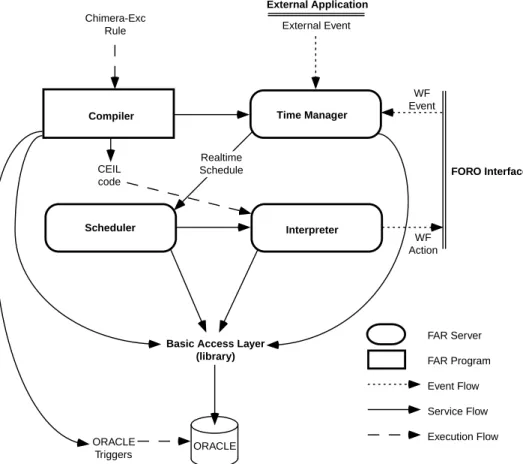
Exceptions written in Chimera-Exc are processed by the FAR (FORO Active Rule) system, implemented at Politecnico di Milano. The architec-ture of FAR consists of four modules:
—Thecompileraccepts rules written in Chimera-Exc as input and produces their translation to an internal language specifically developed within this project. In addition, the compiler produces relational triggers for capturing data events directly within the database.
—The time manager is responsible for the optimal management of time-dependent events (including workflow and external events).
—The scheduler is activated periodically or in response to realtime rule triggering; it orders the rules and then submits them to the interpreter for execution.
—The interpreter is responsible for executing rules with a given degree of parallelism.
The above modules interact with a database interface, called the basic access layer(BAL), capable of executing standard SQL queries on top of a relational server, thus providing interoperability with any relational data-base; BAL was developed at SEMA and is used by FORO. High-level communication with the FORO WfMS occurs through the FORO inter-face, which informs the time manager of workflow events and receives from the interpreter the exception management primitives. This overall architecture is shown in Figure 3.
In the next sections we describe the more interesting features of each module.
4.1 Compiler
The FAR compiler compiles Chimera-Exc rules by filling in the rule repository and by translating the event, condition, and action parts of a rule.
As a rule is submitted to the FAR for compilation, the compiler first generates one tuple in the table RuleDictionary, storing the rule’s name and identifier, the priority, and the timestamp of its latest execution (initially set to the compilation time), needed to restrict rule execution to process only those events that occurred after the previous execution of the rule. The compiler then populates tableRuleEventsby adding one tuple for every event of every rule, each defining the characteristics of a triggering event, such as its type (data, workflow, temporal, or external), the involved object class and attributes (e.g.,carRental andcarStatus, respectively, for event modify(carRental.carStatus)), whether the event is to be man-aged inrealtimeor not, and finally the identifier of the newly compiled rule triggered by the described event. This table enables the identification of which rule is triggered by which event.
The event, condition, and action part of the rule are then managed by the FAR compiler as follows:
Basic Access Layer (library)
ORACLE
Interpreter Compiler Time Manager
Scheduler FORO Interface External Event Chimera-Exc Rule ORACLE Triggers FAR Server FAR Program Event Flow Service Flow Execution Flow CEIL code WF Event WF Action Realtime Schedule External Application
Fig. 3. FAR architecture. The FAR compiler is activated on demand; the FAR interpreter, the FAR scheduler, and the FAR time manager are daemon programs, i.e., they are always active waiting for requests coming from other modules.
—Data manipulation events are captured by simple row-level granularity triggers as currently defined in the SQL3 standard; each Chimera-Exc data manipulation event is translated into a corresponding database trigger [Cochrane et al. 1996]. Triggers operate in the context of transac-tions running in the FORO environment; for each tuple inserted, up-dated, or deleted from the underlying tables, triggers write a tuple to a suitable table, called DataEvent, to signal that a given object has been created, deleted, or updated. For instance, the compilation of the excep-tions presented in Section 3.3 produce only one database trigger, needed to detect modifications of the car return time for the lateCarReturn
exception.
—External, temporal, and workflow events are analyzed by the time man-ager, and are described next.
—The condition is translated into a query written in standard SQL2; the query computes a binding table that contains all the bindings of the variables shared between the condition and the action. Thus, if the binding table is empty, the condition is not satisfied. If an oldpredicate is used in the condition, then the compiler writes a tuple in a suitable
RuleLogtable that defines the characteristics of the object attribute to be logged (the attribute’s name and type and the object’s class). Further-more, the compiler also generates one database trigger for each old
predicate found in the condition that, before an attribute is modified or deleted, captures the value of the attribute and logs it in suitable Log tables. One Log table exists for each data type; the trigger adds one tuple in the appropriate table for every rule interested in logging the value. In the car rental example, compilation of the exceptions presented in Section 3.3 produces only one database trigger that logs old values needed by exception lateCarReturn in order to refer to the old value of the returnTimeattribute. Thus, compiling the carRental exceptions pro-duces two triggers, both resulting from the compilation of exception
lateCarReturn: one to detect updates to attribute returnTimeand one to log the value of this attribute prior to the modification.
Note that native database triggers are defined only to detect data manipulation events and to log old values. No other trigger or database-specific construct is needed by the FAR: this is an important feature that eases the portability of our system onto different database platforms. —Actions are translated into calls to the BAL (for changing the database
content) or the FORO interface (for interacting with the WfMS). Explicit iterators generate as many calls as the tuples of the binding table; each tuple provides the actual input parameters of a call.
The translation of condition and actions produces a piece of code written in an intermediate language, responsible of submitting the query to the BAL and then retrieving its tuples and generating the action calls.
4.2 Time Manager
The time manager is sensible to external events, workflow events, and wake up requests; it manages temporal events detected by means of the local clock.
External and workflow events are considered as special cases of interval events, in which the interval is set to zero and the anchor time is set equal to the time at which the external event is raised or the workflow event occurs. Similarly, instant events are reduced to special cases of interval events, with the interval set to zero. Therefore, all events are reduced to either interval or periodic events. Interval events are characterized by their anchor time and duration, while periodic events are characterized by their periodic duration and, possibly, two anchor times limiting the time interval in which periodic events should be considered.
Anchor times of a given evente are either time constants or other events that may occur in the future; in the former case we say that e is defined, and in the latter case we say thate is undefined. Thus, a given event may initially be undefined, then it may become defined, and finally it may occur. The time manager keeps a list of defined events, sorted by their time of occurrence. Insertions into the list of defined events are due to the occurrence of workflow events and external raises or to the compilation of a defined event. Whenever a periodic event occurs, a suitable algorithm must inspect the periodic event definition in order to possibly enter another event, relative to the next period, into the defined events list. Suitable data structures hold undefined events (together with the specification of their anchor times) and periodic events; algorithms generate defined events from these data structures.
The time manager constantly compares the first event in the defined events list with the current value of the clock. Whenever an event occurs, the time manager deletes the event from the list and inserts a tuple into theTemporalEvent table, storing the event’s identifier and timestamp. By this act, each temporal event that has occurred is matched with an insert to the database, and this insert causes an action of the Scheduler that will eventually consider all the rules triggered by that event.
External applications must register events to the time manager prior to raising them. We enable an arbitrary ordering of either the registration of the event or the compilation of the event within a rule, but both of them must occur before considering the external event as defined.
4.3 Scheduler
The scheduler is activated periodically or because a real-time event has occurred. It initially copies and then empties the tables DataEvent and
TemporalEvent, which contain the events that have occurred since the last execution of the scheduler. A copy of these tables is made to enable access to them by rules, in particular to evaluate the occurred predicates within conditions. Then, the scheduler determines which rules are triggered and ACM Transactions on Database Systems, Vol. 24, No. 3, September 1999.
orders them according to their priority, writing them into the ReadyRules
table.
The motivation behind periodic scheduling is the need for batching multiple instances of the same exception. Exceptions may be raised rather frequently (many times as false alarms). Batching their handling and using a set-oriented evaluation for testing all the event occurrences at once is highly beneficial. This has been proven both experimentally and through simulation, as described in Section 5.3. We considered both the batching of rule executions and immediate scheduling as alternatives to periodic sched-uling. Batching rules means activating the scheduler after a fixed number of events. Periodic activity dominates batching rules because it yields similar performances, but with much smaller variance in exception service time. On the other hand, immediate scheduling would generate a much lower throughput because every event would be followed by execution of the corresponding rule, without any scaling advantage. In our prototype we observed that immediate execution was infeasible even for simple work-flows.
The scheduler is multithreaded and supports the parallel execution of rules; each rule is independently executed. Given the maximum degree of parallelismn, the scheduler selects the first n rules and invokes a thread of the interpreter for each of them; rulen 1 1 is considered as soon as one thread becomes available, and this process continues until either all triggered rules have been considered or the period has expired. In this way, the number of rules executed in parallel is constant, at least during the time that follows the start of a scheduling period.
The period of activation and degree of parallelism are critical parameters for characterizing FAR behavior; we expect them to be set so that all rules are normally processed within one scheduler period. We consider this issue further in Section 5.3.
4.4 Interpreter
The interpreter executes each exception as an atomic thread. Instructions are written in CEIL (Chimera-Exc Internal Language), an intermediate language that enables table generations, set-oriented query submission, and tuple-oriented retrieval and update actions. These are executed by invoking the corresponding BAL services.
5. IMPLEMENTATION OF FAR
The FORO and FAR systems operate on top of Oracle Server, a commercial relational system. In particular, triggers generated by the FAR compiler are written in the Oracle SQL and installed into the Oracle database; Oracle Server must be version 7.2 or subsequent [Oracle Corporation 1996] to enable multiple triggers on the same event.
5.1 Transactions in FAR
FAR uses transactions as provided by Oracle Server. Mapping computa-tions to ACID transaccomputa-tions was carefully studied to provide the required operational semantics and minimize the interference of FAR with the workflow applications managed by FORO. Interference occurs in the table
DataEvent, whose content is written by Oracle triggers running in the workflow applications context and must be copied and deleted by the scheduler. The scheduler adds the tuples in the DataEvent table into its own private copy, then deletes all its content and commits as an ACID transaction; during this time, workflow applications cannot produce data events because they conflict in the DataEvent table, which is exclusively locked by the scheduler. However, such time is quite negligible, and the interference is acceptable.
For similar reasons, the scheduler adds the tuples of theTemporalEvent
table into its own private copy, then deletes all its contents, and commits as an ACID transaction; during this time, the time manager cannot produce new temporal events. Finally, the scheduler accesses its own DataEvent
and TemporalEvent copies, determines which rules are scheduled, and writes their rule identifiers into theReadyRulestable. Again, these opera-tions are performed as an ACID transaction, so that the determination of triggered rules is reliable. Each rule is then executed by the Interpreter as an ACID transaction. Before committing the transaction, the scheduler deletes from theReadyRules table the tuple corresponding to the executed rule. Exceptions may interfere with other exceptions or with workflow applications, and such interference is properly regulated by means of standard transactions. In particular, we assume that deadlocks are de-tected by the underlying database server that chooses suitable victims; the corresponding transactions are rolled back and then restarted.
The private copies of DataEvent and TemporalEvent tables are used to evaluate the occurred predicate; given that rules and their events may carry on from one period of scheduling to the next one, the content of these two tables can be deleted only when the FAR becomes idle after the execution of all the rules of a given period, since at such time all events are certainly consumed by their relevant rules.
5.2 Interaction of FAR with FORO
The FAR environment interacts with that of FORO in the following way: —At system generation time, CORBA-IDL classes storing the WfMS data
dictionary are generated. Translators IDL2SQL and SQL2Chimera gen-erate the appropriate data dictionary descriptions for use in the Oracle database and in the FAR environment. Chimera-Exc exceptions may refer to FORO metadata, so their translation is invalidated when the system is regenerated.
—At workflow definition time, one class definition is associated to each workflow, storing the variables and constants associated to each case. ACM Transactions on Database Systems, Vol. 24, No. 3, September 1999.
The workflow-specific class inherits from classcase. Inheritance is imple-mented in the underlying relational database by means of the vertical approach [Atzeni et al. 1999]. Each case corresponds to one tuple in the generic table case (storing the cases’ common attributes such as the
responsible or the initiator) and one tuple of the workflow-specific table (storing the value of workflow-specific attributes such as theplate of the rented car). Inherited attributes of a given case can be retrieved by joining the two tuples that share the same case identifier. Again, IDL2SQL and SQL2Chimera translators provide suitable mappings. —Due to case execution, the FORO interface informs the time manager of
the beginning and end of cases and tasks. The time manager also provides a WakeUpRequest service to the FORO interpreter, which accepts requests for wakeup with a parameterDateTime. At the specified time, the time manager raises aWakeUpCall to the FORO interpreter. —Due torule execution, the FAR Interpreter notifies the FORO interface of
the workflow management primitives to be executed in order to handle exceptions.
5.3 Performance Analysis
In order to evaluate the performances of the FAR server, we ran a few experiments on top of our prototype.7Our first observations were concerned with confirming the adequacy of our rule execution mode. To further confirm the advantages of the detached execution mode over a deferred execution mode (in which rules are executed at the task’s commit time), we built a detailed queuing network model of our system. The model is described in Ceri et al. [1998]. Synthetically, the model is an open queuing network model with three service centers (CPU, disk, and exception man-ager) and four client classes (user transactions, also called tasks; tions with true conditions; exceptions with false conditions; and an excep-tion scheduler). The distribuexcep-tion of task’ interarrival times is considered exponential, assuming a random arrival. The interarrival times for the exception scheduler are assumed constant.
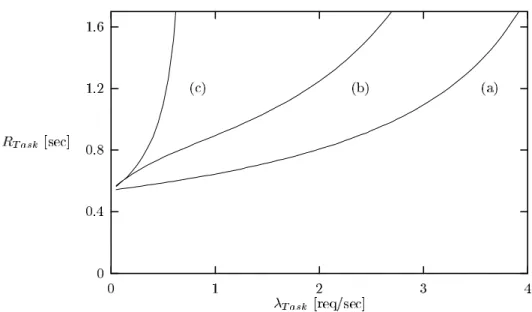
We then developed a model for a deferred execution mode for exceptions, and compared it with the detached mode. The curves show the tasks’ execution time as a function of the tasks’ frequency of arrival; execution times tend to the infinite when the system saturates. In Figure 4, we show the behavior of a system with no rules, or with detached rules (as in Chimera-Exc), or with deferred rules. Deferred rules saturate the system much earlier than detached rules, due to the batching factor. With de-tached execution all the event instances occurring in the same period (e.g., of all task starts) are processed together by a single rule execution.
7The database server was a Sun Sparc 10 with 32 MB of RAM, running the Oracle server
v. 7.3.2.1 on Solaris 2.5.1. The machine running the FAR environment was a Sun Sparc Ultra 2/140 with Solaris 2.5.1.
Therefore, we take advantage of set-oriented processing. Several ad-hoc experiments have confirmed the results of the queueing model.
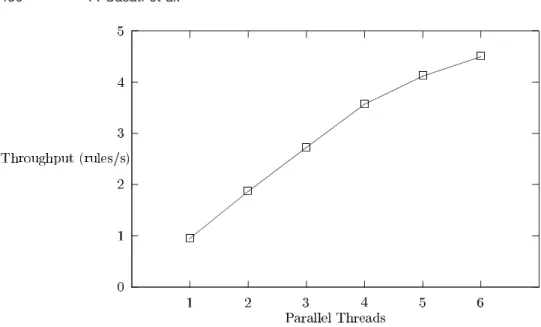
In order to obtain an adequate level of performance, we dedicated a considerable effort to obtain a multithreaded implementation of the FAR scheduler. In our implementation, the threads are a fixed number, each one responsible of a connection with the database. The FAR scheduler dis-patches exceptions to threads, monitoring the status and assigning a new exception as soon as the thread has terminated the execution of the previous one, until there are no more exceptions to run. The diagram in Figure 5 illustrates the throughput of the system, measured in rules per second, and how it correlates with the number of threads dedicated to the execution of exceptions. The figure shows a quasilinear increase of through-put with the increase in the number of threads;8the flattening of the curve of the throughput as the number of threads increases is due to the fact that the system tends to reach saturation.
If the goal of the system was simply to maximize the exception through-put, then a high number of threads should be selected, so as to guarantee system saturation. Such a solution, however, would cause the system to suddenly dedicate most of its resources to exception handling at the beginning of a scheduling period, thereby slowing the processing of task-originated transactions. Instead, our goal is to choose the number of threads that offers a good throughput for exception execution, while caus-ing marginal impact on the response time of task-originated transactions.
8This figure indicates as well that each rule requires about one second of execution time,
which is better than acceptable from an application standpoint (each “rule” is indeed a rather complex transaction that accumulates and processes all the events occurred during a period of time, translated to a high number of SQL calls through the BAL interface).
Fig. 4. System throughput for: (a) no rules; (b) detached rules; (c) deferred rules.
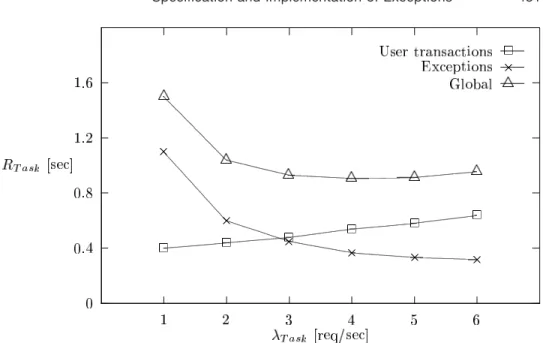
We measured the average response times of tasks and exceptions on our prototype, increasing the number of threads. The results of these observa-tions are shown in Figure 6. The top curve in the figure represents the sum of both response times, whose minimum indicates a good empirical tradeoff between exceptions and task-related user transactions. We observe that in that particular experiment the number of threads that minimizes the top curve is four.
The scheduling period is another parameter with a strong impact on performance. With short scheduling periods, it is possible to shorten exception-handling delay, thereby increasing its quality, but also increas-ing the cumulative response time due to the lack of batchincreas-ing effects for events (as discussed above, see Figure 4). Thus, the behavior of the FAR system depends essentially on the tuning of these two parameters: the number of threads and the length of the scheduling period. In addition, in a real system the load changes during execution (e.g., due to peak times during the day). To this end, we implemented an adaptive algorithm, which monitors the load on the system. This adaptive algorithm dynamically modifies the scheduling period, but not the number of threads. In fact, in the Oracle implementation we experienced that dynamically changing the number of threads does not improve throughput, due to the overhead required in opening and closing the database channels associated with them.We perform the fine tuning on the scheduling period instead, which can be adapted after a previous period according to an iterative formula. A complete description of the adaptive algorithm for setting the scheduling period can be found in Ceri et al. [1998].
6. DETECTING TERMINATION IN WORKFLOW EXCEPTIONS
Although exceptions are typically designed individually, by considering the exceptional event and by defining the appropriate reaction to it, the designer must also consider the characteristics of the entire set of the defined exceptions in order to verify whether undesired interactions can occur.
Two significant properties of a set of exceptions are termination and
confluence. Informally, termination occurs when exceptions do not trigger each other indefinitely, so that exception processing eventually terminates, while confluence requires that the effect of exception processing be inde-pendent of the order in which triggered rules are executed.
In general, it is impossible to devise sufficient conditions for confluence in practical workflow applications, mainly due to the difficulty of perform-ing a semantic analysis of the effect of exception execution. In addition, the Chimera-Exc language is intrinsically nondeterministic because it associ-ates a set-oriented, declarative condition with a tuple-oriented imperative action, without any language construct for imposing an order on the bindings selected by the condition. Thus, it is sufficient that action execu-tions on collecexecu-tions of objects be nonconfluent for the entire rule evaluation to also be nonconfluent. For instance, if a collection of objects representing selected tasks to be assigned needs to be matched with another collection of objects representing available agents and these are not semantically re-lated, then it is not possible to repeat the same assignment at different executions of the same rule. This situation is not surprising, as it occurs whenever the language supports the declarative set selection, followed by
Fig. 6. Response times for tasks and exceptions.
the individual management of each element in the set. So it occurs in most SQL triggers and procedures of conventional database applications.
Termination has been widely studied in the context of active databases, but the results of such analysis are not immediately applicable to workflow exceptions. Active databases consider rules that are triggered by data events and act within the scope of given transactions, while workflow exceptions consider arbitrary events and are executed within separate transactions in a detached mode. The very essence of termination has to be understood well, since the exception handler is a nonterminating machine that processes external and temporal events. In order to concentrate our analysis on exceptions, we assume that all processes terminate in finite time, and disregard the issue of process termination; the interested reader is referred to Jensen [1992] and ter Hofstede et al. [1998].9
We introduce a Termination Analysis Machine (TAM) as an abstraction of WfMS and exception handler that sequentially processes the exceptions and workflows that are explicitly initiated by triggered exceptions. The assumption of sequential processing simplifies the use of the TAM in proving termination, but it is not restrictive because rules and tasks execute as ACID transactions upon the same database, and their serializ-ability is guaranteed by the underlying database server. Therefore, any concurrent execution of rules and tasks is equivalent to some serial execution of the same rules and tasks, and therefore to some execution of the TAM machine. The TAM does not accept new workflow cases besides those generated by exceptions, so it is the appropriate device for studying pathological cases of infinite executions, which are caused by the exception-handling behavior.
We define theState of the TAMas the triple S 5 ^DB, R, A&, whereDB
represents the WfMS database state;Rrepresents the set of triggered rules taken from the set of workflow exceptions E; and A represents the set of active tasks operating in the set of workflowsW.
A TAM execution is a sequence of TAM states; at each step the TAM executes either a rule or a task and removes it from eitherR or A; due to execution, new rules can be triggered or tasks may become active. We denote the sequence of executed rules and tasks as a traceof the TAM.
Definition 1. A given set of exceptions E, defined for a set of workflow schemas W, terminates iff, for an arbitrary initial state S0, the TAM
executes and produces a final stateSf 5 ^DBf, B , B& such that no rule is triggered and no task is active.
In the following we give sufficient conditions for termination applicable to classes of rules; we first concentrate on data-dependent rules and then consider workflow-dependent and time-dependent rules.
9Note that process termination is trivial if the process scheme does not include loops, and
otherwise is based on a semantic analysis of loop conditions. But semantic analysis is possible only if the variables used in the analysis are isolated, so they cannot be subject to changes induced by exceptions.