Putting in place a performance management framework: reflections
on a functional model
Irina Ross and Ali Barr
Irina Ross [email protected] Victorian Health Promotion Foundation Ali Barr Victorian Health Promotion Foundation Paper presented at the Australasian Evaluation Society 2004 International Conference, 13-15
October-Adelaide, South Australia www.aes.asn.au
Abstract
The Functional Performance Management Framework (The Functional Framework)
provides a structure for collecting information in a systematic and ongoing way to guide strategic and operational planning, ensure accountability for public funds, and create evidence of health promotion effectiveness. The Functional Framework covers the strategic and operational functions of VicHealth (an independent statutory body charged with health promotion in Victoria) as well as major programs.
The development of the framework is premised upon the principles of utilisation-focused evaluation.
Although valuable in providing a systematic framework for information gathering,
The Functional Framework has its limitations.
This article describes the process of the framework development, provides some examples of its application and discusses its limitations.
Organisational Context
The Victorian Health Promotion Foundation (VicHealth) is an independent statutory body established by the Tobacco Act in1987. Since the Australian High Court ruled these fees were unconstitutional in 1997, VicHealth has been funded by a state government budget appropriationi. Since this change, health promotion competes with the rest of health care system for funds.
VicHealth aims to improve health outcomes of Victorians through changing social, economic and physical environments and strengthening the skills of individuals in ways that support their efforts to achieve and maintain health. VicHealth operates within the social model of health1 and employs capacity building2 as the major
1 A social model of health is a framework for thinking about health. Within this framework, improvements in
health and wellbeing are achieved by addressing the social and environmental determinants of health, in tandem with biological and medical factors. Underpinning and supporting this conceptual framework is the Alma Ata declaration and the World Health Organisation definition of health: Health is a complete state of physical, mental and social wellbeing, not merely the absence of disease or infirmity (Integrated health promotion: A practice guide for service providers, DHS, 2002)
approach in most of its programs and initiatives. Capacity building strategies, such as partnership development, advocacy, resource allocation, strengthening internal organisational management, skill development and others, are applied at different levels of influence: individual participant, entity (whether it is an organisation or a community) and/or a broader system level.
VicHealth funds health promotion initiatives in tobacco control, physical activity and healthy eating, and mental health and wellbeing. It also supports public health research. Implementation, research and development activities and initiatives are focussed in several key settings, including sport, recreation, education, community, health, the arts, workplace and local government. In addition, some of the initiatives and the programs address the needs of the selected population groups, such as people from low socio-economic groups, Kooris, people from rural and remote communities, young and older people and other groups.
VicHealth is uniquely positioned in the health promotion field in Victoria: it operates at ‘arm length’ to State Government to ensure an innovative, rapid and flexible approach to resolving current and emerging health promotion demands and has had continuous tri-partisan political support over the years. Such an operating environmentii, however, places several demands on the agency for advancing knowledge and building evidence for health promotion interventions and systematically managing acquired health promotion knowledge.
This complex organisational context demands effective strategies for data gathering and information management. The Functional Performance Management Framework
is one of the strategies that enables collecting data in a systematic way.
Theoretical considerations
The Functional Performance Management Framework is designed to monitor and
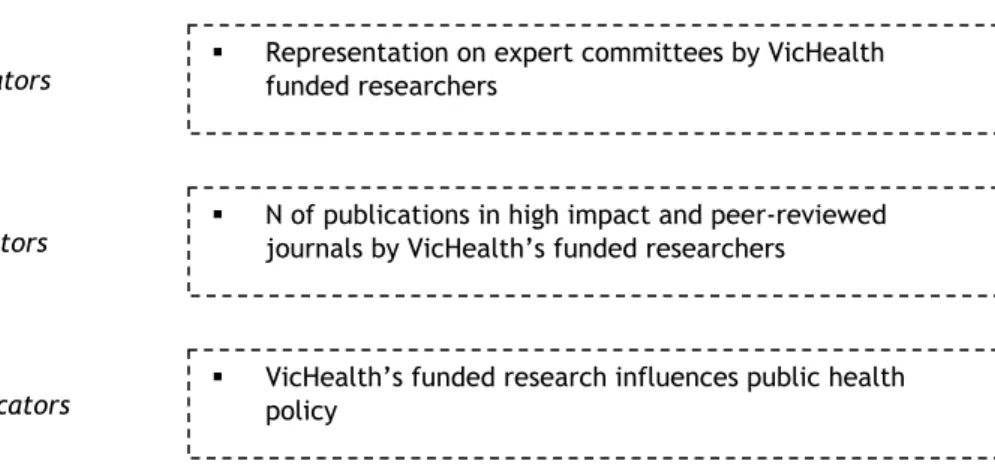
report on the progress towards pre-established goalsiii. Performance measures capture the activities (process measures), direct results of activities (outputs) and effects of the programs (outcomes). The examples of the performance measures relating for each group are in figure 1.
Figure 1. Examples of process, outputs and outcome performance measures
2 Capacity Building is a process. Engaging in activities that strengthen the abilities of an individual, organisation,
community or society possesses to perform functions or address issues which enable them to achieve their aims is the process. Therefore capacity building is a way of improving and sustaining the ability of each individual, organisation, community or society to achieve their aims (Capacity Building Fact Sheet, VicHealth, 2004).
The development of The Functional Framework is premised upon utilisation-focused evaluation, which encourages the development of evaluations responsive to the needs of well identified stakeholder groups thus increasing the potential for use of the evaluation information. In this case, the Functional Framework was developed in to meet the need of VicHealth’s management (including Board of Governance) and program staff to respond to their needs in information to support strategic and operational planning and decision-making and ascertain the effectiveness of the programs3. The development process is briefly described below.
Most importantly, however, application of the utilisation-focused principles ensures intended information use. The use of information in utilisation-focused evaluation has three purposes: making judgments, facilitating improvements and generating knowledgeiv. Each level of The Functional Framework responds to at least one of these information uses.
As utilisation-focused evaluation does not advocate for any particular evaluative purpose (formative, process, summative), model, method or theory, different theories and methods are used at each level of the framework. For example, at the strategic level of the framework, performance management principles are applied, whereas at the program level, a program logic approach is used.
The Functional Framework structure, development and influence on organizational evaluative culture
The Functional Framework is essentially a management-oriented tool designed to facilitate decision making for improvement and resource allocation based on objective evidence.
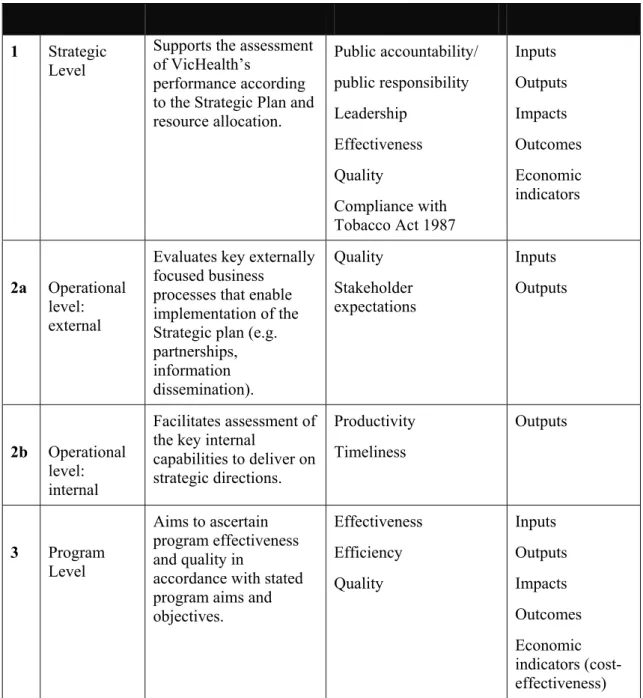
The framework has four levels: strategic, operational (externally and internally focused) and program level (figure 2).
Figure 2. The Functional Framework Structure
Level Description Focus Outcome level
3 In case of the Functional Framework, the program effectiveness is about “making the comparisons of actual
program performance with some standard of expected program performance, and the drawing of conclusions about program effectiveness and value”. (Wholey, 1986)
Process indicators
Output indicators
Outcome indicators
Representation on expert committees by VicHealth funded researchers
N of publications in high impact and peer-reviewed journals by VicHealth’s funded researchers
VicHealth’s funded research influences public health policy
1 Strategic Level
Supports the assessment of VicHealth’s
performance according to the Strategic Plan and resource allocation. Public accountability/ public responsibility Leadership Effectiveness Quality Compliance with Tobacco Act 1987 Inputs Outputs Impacts Outcomes Economic indicators 2a Operational level: external
Evaluates key externally focused business
processes that enable implementation of the Strategic plan (e.g. partnerships, information dissemination). Quality Stakeholder expectations Inputs Outputs 2b Operational level: internal Facilitates assessment of the key internal
capabilities to deliver on strategic directions. Productivity Timeliness Outputs 3 Program Level Aims to ascertain program effectiveness and quality in
accordance with stated program aims and objectives. Effectiveness Efficiency Quality Inputs Outputs Impacts Outcomes Economic indicators (cost-effectiveness) Each level of the framework has well defined performance and outcome measures, which are vertically and horizontally integratedv.
Vertical integration enures that each performance and outcome measure fits with VicHealth’s strategic objectives and organisational mission. For example, to support its mission in improving health of Victorians, VicHealth funds several initiatives in sport and active recreation sector to improve physical activity. Figure 3 shows how the outcomes of the Participation in Sport and Active Recreation (PICSAR) Scheme contribute to VicHealth’s mission.
* Relational Contracting is a type of contract management where the contract starts brief and open ended and gets refined over time as parties gather more information. Involved parties develop a high level of trust and the relationship between parties is complex and resilient. Administrative processes are specific to the parties involved. There is an assumption that the relationship will extend into the future.
Horizontal integration assures that the performance measures are aligned with key business processes. For example, the grant administration is one of the business processes that ensures achievement of the strategic outcomes through selection of good quality initiatives, effective administrative practices and building grantees’ capacity in project implementation and evaluation.
The framework, together with its performance and outcome measures, methodologies and tools has been developed in collaboration with VicHealth’s senior management, including Board of Governance, and staff.
Change social, economic, cultural and physical environments to improve health for all Victorians
Increase participation in community sport and active recreation
Increased community awareness and understanding of the benefits of participation in physical activity
Increased opportunities for people to participate in community sport, active recreation and physical activity
PICSAR agencies advocate for increasing participation in community sport and active recreation
PICSAR agencies accept the synergies between community sport, active recreation and health All funded Regional Sport Assemblies
attend VicHealth’s facilitated Network and Workforce Development meetings Relational contracting management style*
Improved quality and range of funding applications that
The involvement of key staff and senior management in developing of the methods, indicators and tools at each of the levels of the framework has had a two fold positive effect. First, this collaborative effort ensured relevance of the performance indicators and tools to the program/strategic goals and staff and managerial needs in information. Staff and management engagement in the process of developing performance indicators, program logics and the data collection tools created understanding, loyalty and commitment to the performance measurement process and motivation to collect necessary data. Involvement of the senior management and the Board brought in a strong authority to act on performance measurement.
Second, and perhaps, the most important implication of the staff engagement into the developments associated with the framework, has produced a considerable shift towards more evaluative organisational culture. Weiss noted that “What evaluators should aspire to achieve in the area of use is influence, not the status of philosopher-kings whose dictates determine program futures … In essence, evaluation should be continuing education for program managers, planners, and policy makers”.vi Furthermore, Owenvii and Ryanviii have recently both argued that creating evaluation culture within the organisations will enable application of working knowledge to decision making, facilitate internal learning and improve organisational effectiveness. Staff (including some senior management staff) involved in the process of the framework development, particularly at the program level of the framework, developed skills in program logic, identification and design of hierarchy of outcomes and “SMART4” performance indicators. Since their involvement, some staff now undertake a practice leader role in evaluation in their program areas and assist other staff with performance monitoring and evaluation. The management now demands clearer definitions of the program intent and identification of measurable and achievable program targets and outcomes.
Strategic Level
The strategic level supports the assessment of VicHealth’s performance according to the Strategic Plan and resource allocation. Performance management principles are applied at this level of the framework, which include the followingix:
Performance measures should provide intelligent information for decision makers, not just compile data. To comply with this principle, performance measures were developed in consultation with whole organisation to ensure their relevance to strategic directions and operational and strategic planning needs of management;
A conceptual framework is needed for the performance measurement system. In this case, performance measures are closely linked to the objectives in the strategic plan. The performance indicators were developed at the time of the strategic planning and followed a process of logical mapping;
Effective internal and external communications are crucial for establishing and maintaining a successful performance measurement. Management were kept
informed during the performance indicator and the Functional Framework
development process with regular updates. The performance measures are documented in the Strategic Plan 2003-2006 and the performance data are reported to the Board of Governance, senior management, VicHealth staff and external stakeholders annually through an annual performance monitor and annual report;
Accountability for results must be clearly assigned and well-understood. Every staff at VicHealth has different levels of accountability or responsibility for performance management and evaluation. These responsibilities range from performance measurement data management to having a practice leader role in performance monitoring or evaluation. The staff accountabilities are monitored through individual performance reviews;
Leadership is critical in designing and deploying effective performance measurement and management systems. While leadership and skills in developing performance measures can be provided by one or several staff, the united support of senior management is important in the success of the performance monitoring; and
When developing an integrated performance measurement system, employees should be involved in the process. After all, they are the ones who directly contribute to the input, output, outcome, performance, process, and every other aspect of the organizational operation. Existing performance measures were mapped against the strategic plan and the gaps identified. Then, new performance indicators were defined in consultation with senior management and program staff and subsequently signed off by the Board of Governance. Key program staff were also involved in the development of data collection tools, which were formally signed off by the directors of all program units at VicHealth. A number of evaluators currently evaluating VicHealth’s programs provided their comments in relation to the relevance of the questions to the field.
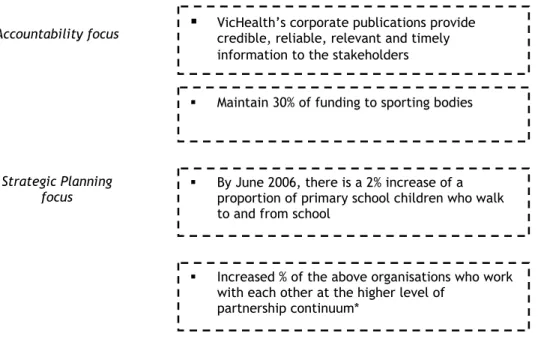
The performance information collected at this level of the framework is used for two purposes: making judgments (accountability focus) and facilitating improvements (strategic planning focus). For example, one of the performance indicators stipulates that 60% of investments should be made to the target population groups. So far, VicHealth has managed to maintain the investments to target population group at this level, therefore fulfilling the accountability requirement. In case of the strategic indicator, such as “by June 2006, there is a 2% increase of a proportion of primary school children who walk to and from school”, achievement of this target may influence the program expansion beyond year 2006 and prompt the assessment of different funding mechanisms to sustain the level of engagement of primary school children in the program over a number of years.
The performance indicators at the strategic level of The Framework form a core set of indicators to be reported to the management and Board (see figure 4 for examples of indicators and their purpose).
* Partnership is a broad term used to describe working with other organisations. Most partnerships move up and down a continuumx which shows progression from networking to collaborating based on degree of commitment, change required, risk involved, levels of interdependence, power, trust and a willingness to share turfxi. VicHealth collects the performance indicator data at this level from all projects successful in securing VicHealth’s funding using Project Report Proforma. The Project Repot consists of two parts: a Core Section and a Tailored Section.
The Core Section contains questions relating to the agreed strategic performance measures. The Tailored Section collects two types of information:
performance information that is not available through the Core Section because not all performance indicators are uniformly applicable (e.g. partnerships, workforce development etc)
project management, “stories” and publication information.
The additional section of the Project Report – Participant Questionnaire – is in the developmental stage.
Figure 5 gives an example of the question from the tailored section of the Proforma, which collects the information about the level of partnerships funded organisations engage in to maximize the implementation of the project and its benefits. This question relates to the strategic indicator in figure 4.
Figure 5. Partnership continuum question
1. Please describe the level and quality of the partnership formed with each organisation listed in question 3, and importance of the partnership with each organisation in achieving the objectives of this project.
VicHealth’s corporate publications provide credible, reliable, relevant and timely information to the stakeholders
Accountability focus
Maintain 30% of funding to sporting bodies
By June 2006, there is a 2% increase of a proportion of primary school children who walk to and from school
Strategic Planning focus
Increased % of the above organisations who work with each other at the higher level of
Type of partnership5 Quality of partnership Importance of partnership to achieving objectives Organisatio n number
Networking Cooperation Coordination Collabora
tio
n
Excellen
t
Very good Good
Fair
Critically important Very important Moderately important Of little importance
Unimportant
1… F F F F F F F F F F F F F
…5 F F F F F F F F F F F F F
The Project Report Proforma is currently undergoing a six months field trial to ascertain the consistency and quality of responses and identify any reporting errors due to question clarity. Following the trial, the collected data will be analysed and a summary provided to key program staff and management to assess the usefulness of data to their needs. The Project Report Proforma will then be revised based on provided feedback from field and VicHealth’s staff.
The design of the performance measures and the data collection tool has been somewhat a rocky road for several reasons. The anticipated resistance to having clearly defined performance indicators was encountered at the beginning of the process: people felt that their performance was being judged. This obstacle was overcome by using two strategies: having a series of small group discussions with key project officers and some senior managers who saw the need in and usefulness of performance measurement system, involving them in the process and demonstrating the usefulness of information to their purpose. This strategy has created some pressure for a robust performance management system. The second strategy was introducing performance measures during the strategic planning process. The Board of Governance have been strong advocates for clearly defined performance measures. Such resistance to performance measurement is not unusual in organisations. Weiss writes: “There are few sadder sights that a well intentioned researcher embarking on an evaluation study … who comes a-cropper on the organisational, interpersonal, and political barriers in the program setting”xii. Although she applied this view to an
5Networking – involves exchange of information for mutual benefit. It requires little time, trust or sharing of turf
between partners and is a useful strategy for organisations in initial stages of working relationships
Coordinating – involves exchange of information for mutual benefit and altering activities for a common purpose. It requires more time and trust but does not include sharing the turf.
Cooperating – involves exchange of information, altering activities and sharing resources for mutual benefit and a common purpose. It requires significant amounts of time, high level of trust and significant sharing turf and may require complex organisational processes and agreements in order to achieve the expanded benefits of mutual action.
Collaborating - involves all of the as above plus a willingness to enhance the capacity of another for mutual benefit and a common purpose. It requires the highest levels of trust, considerable amounts of time and extensive sharing of turf. It involves sharing risks and rewards and can produce the greatest benefits of mutual action.
external evaluation, it still is relevant for performance monitoring (as one of the evaluation tools) conducted by an internal person in an organisation: organisational culture is driven by individual ideologies, interests and different needs in information. The second obstacle relates to the definition of the terms used in the performance measures, such as partnership, capacity building, knowledge management, innovations etc. These concepts are quite complex, have evolved over time and brought to health promotion from other disciplines. The use of these terms has not been consistent and there is different understanding among the organisations VicHealth works with about what these concepts mean. Undertaking definitional work and communicating VicHealth’s understanding in plain language will encourage uniformity of understanding and use of this terminology.
Design of performance measures that are clear, measurable, attainable and applicable across most of the grants is yet another difficult task, particularly when these indicators relate to the terms above and or the concepts such as participation in physical activity, which can mean, for example participation in organised sport by people for whom the interventions were designed, participation in organised sport by the officials in sport clubs, participation in non-organised sport, level of memberships in sporting clubs (recorded and/or social membership), or overall participation in any type of moderate physical activity on most days of the week. In these situations, when the issues around the definitions are resolved, the next problem is to define some measurable and achievable targets. As a rule of thumb, there is a lack of baseline data directly comparable to the needed performance indicators. In this case, a best guess about the level of change would probably be good enough. However, when the program staff are involved in the design of performance measures, it soon becomes obvious that they possess a wealth of knowledge about what level of expected change based on the daily interaction with grant holders. Therefore, the estimates of change (and therefore a likelihood of attaining and measuring that level of change) become based on existing practice.
For the grant holder, the issues relate to designing simple data collection tools that make sense to grant holders and collect information on complex issues in plain language format from projects receiving various amounts of grant and ensuring reporting compliance.
Operational (Externally focused) Level
The externally focused operational level of the framework is designed to evaluate key externally focused business processes that enable implementation of the Strategic plan. These business processes include managing external relations, grant management and information dissemination.
The Study of Stakeholders’ Perspectives is a triennial survey to obtain regular feedback about these business processes as well as to gather feedback from key industry partners about VicHealth’s strategic achievements. This feedback assists VicHealth in strategic and operational planning. The first survey was conducted in 2000 by the Australian Institute of Primary Care at La Trobe University, followed by another study in 2002 conducted by Wallis Consulting.
The Study of Stakeholders’ Perspectives uses a combination of qualitative (interview) and quantitative (survey) approaches in eliciting the stakeholder perspectives. The qualitative part of the Study focuses on the stakeholders’ views of VicHealth’s strategic directions and factors affecting VicHealth’s organisational capacity to deliver on the outcomes. The survey part of the Study is about matters relating to operational performance.
The group of stakeholders who provided their feedback in the 2002 Study of Stakeholders’ Perspectives included:
key stakeholders – those agencies and/or individuals who have developed a close association with VicHealth over time and are in a position to comprehensively comment on its organisational development and challenges it faces; and
industry partners – key players in the public health system who are likely to be more familiar with health promotion or VicHealth position in the health promotion field.
Current VicHealth’s grant holders, organisations whose funding ceased and organisations unsuccessful in securing VicHealth’s funding represented another stakeholder group.
The information at this level is used for facilitating improvements. For example, the 2002 Study of Stakeholders’ Perspectives indicated that VicHealth falls down in the area of “closing” the loop with criticisms amongst current and past grant holders on giving feedback, showing interest in the work being done and promoting findings. This reflects qualitative comments from key stakeholders mentioned previously. This criticism is being addressed through rethinking the strategy to enable effective information dissemination and knowledge management6.
Operational (Internally focused) Level
Operational (internally focussed) level of the framework facilitates assessment of the key internal capabilities to deliver on strategic directions. These capabilities include administrative processes around grant making, information technology infrastructure, evaluation and performance monitoring and staff satisfaction with work processes and work culture.
The assessment at this level aims to find the “best fit” organisational structure and use of resources through a thorough organisational review, followed by a coherent implementation plan and agreed follow-up at certain time intervals.
Program Level
6 Knowledge management is defined as formalisation and access to experience, knowledge and expertise that
The program level process, output and outcome indicators have been developed on program by program basis using program logic approach. Development of a clear logic in each of the program, including “the logic of assumptions linking expenditure to resources, the implementation of a program, intervention the immediate outcomes to be caused by that intervention, and the resulting impact…”xiii allowed the program staff to describe the program, make linkages between the assumptions and the expected outcomes, hypothesise the cause and effect relationships between the program strategies and outcomes and, as a result, develop confidence to test the assumptions and cause-effect relationships.
As the development of the Functional Framework progressed, it has become apparent that staff are most engaged with and enthusiastic about the program level of the framework. Although many factors may have influenced higher level of interest at this level (for example, different facilitation styles during workshops with staff), immediate program management implications influence this level of engagement the most. Albeit program logic exercise had initially been perceived extremely challenging and difficult to accomplish, program staff appreciated the results of their work because engagement in the exercise allowed them to:
develop a consistent and common understanding of their programs and concisely outline the complexity and interdependencies within their programs, including outcomes, targets, strategies, activities, key performance indicators, information sources and data collection tools. This is likely to result in externally funded evaluation of the schemes being more reflective of the true nature of the program;
provide funding recipients with a clear understanding of the intentions of the programs;
provided funded organisations with a framework for their own internal planning and development; and
build their own capacity in program evaluation through informal education, evaluation framework and theory development and mentoring and coaching in application of evaluation approaches.
These performance measures are designed to guide collection of information for knowledge generation and ascertain program effectiveness. The information gathered at this level is also sued strategically to make decisions about continuation or modifications of programs.
The program level performance monitoring and evaluation is conducted with the assistance of the independent evaluators. Over time, VicHealth has seen 3 evaluation models evolving at the program level of the framework:
1. Totally outsourced model, where an evaluation brief specifies evaluation criteria and deliverables from an external evaluation. The evaluator maintains full control over methodology. There is usually limited involvement of VicHealth in evaluation design.
2. Two-step outsourced model. In this model, an evaluation group is funded to develop an evaluation framework, usually following consolation with key stakeholders. At this stage, clear program logic is developed and detailed evaluation methodology is specified. Budget is more specifically allocated. Upon successful assessment by VicHealth, proposed evaluation framework and methodology are implemented. The contract management usually follow a relational contracting model.
3. Partially outsourced model. In this model, the program logic and evaluation methodology is developed internally and data collection is outsourced. Data analysis is also conducted internally.
Each of these models has its own constrains and benefits. The totally outsourced model requires limited staff involvement (to the administration of evaluation contract), but provides limited opportunities to understand the evaluation reasoning, exercise control over evaluation methodologies and data collection methods. This model, while being perhaps the most objective, does not encourage commitment of the funding agency to use evaluation findings and implementation of its recommendations particularly where evaluators are totally “detached” from the organisation.
The two-step outsourced model provides advantages of:
influencing evaluation methodology and encouraging theory based evaluation; encouraging staff participation and commitment to evaluation which can lead
to subsequent increase of evaluation use;
building knowledge and skills of staff in evaluation;
identification of logic gaps in the programs and availability of immediate feedback to improve program implementation.
The downsides to this model is considerable time contribution from the staff. The relationship between the funding agency and the evaluator can be more fragile in this model, particularly when the funding agency takes too much control and the evaluators can feel their expertise and knowledge being questioned.
The third model, while encourages evaluative culture within funding organisation, requires considerable staff resources and threatens the objectivity of the evaluation.
Strengths and Weaknesses of the Functional Framework
Many advantages of instilling the Functional Performance Management Framework
were described in the paper. In summary, the Functional Performance Management
Framework:
provides VicHealth with a good structure for systematic data collection of performance and evaluation information for the range of purposes;
encourages commitment to performance monitoring and evaluation across organisation and creates evaluative culture across VicHealth;
encourages performance- and evidence-based strategic, operational and program planning and resource allocation;
facilitates use of performance information; and
through program level, it has a potential to create evidence for health promotion: both around the implementation and decision-making around health promotion grants and health promotion program effectiveness.
It has, however, a number of limitations. First, the performance indicators were identified in response to the need of senior staff in information for managerial decision-making. Although every effort was made to follow the “rules” of performance measurement development process and the process adhered to the conceptual framework of the strategic plan, this process is still open to criticism in that the resulted performance indicators may be systematically biased to meet certain agendas and decision are made based on the limited information. To guard against this, the Functional Framework should be continuously monitored and improved. There should be an opportunity for the revision of the performance indicators and perhaps, more quantitative methods in the identification of new and confirmation of existing of the performance measures, such as balance score card, can be used.
The second limitation of the framework is that it does not enable collecting of timely contextual information about the projects making it is difficult to explain why strategies and activities worked in particular settings or for a particular population group and why they did not (this information is collected at the program level of the framework, but the evaluation results are not usually available till the evaluations are completed, particularly in the totally outsourced model). This represents a strong limitation of the framework as sometimes poor results can be interpreted as poor implementation.
Third, no linkages are established (except at the program level for some programs) between inputs, strategies, performance measures and the outcomes. This has a potential to create measures that only approximate what happens in real world. While this is a major limitation that has to be addressed with the time, it was important to have established the Framework and gained commitment to performance measurement.
Where to from here…
The limitations of the Functional Performance Management Framework make it vulnerable and open to criticism. Therefore, a revision which takes into account social model of health and perhaps utilises program logic approach at all levels of the framework together with some objective methods for identification of performance measures, is necessary.
i Strategic Directions 1999-2002, VicHealth, 1999.
ii Strategic Directions 1999-2002, VicHealth, 1999.
iii The Performance-Based Management Handbook. Volume two: establishing and integrated performance measurement system. U.S. Department of Energy and Oak Ridge Associated Universities, 2001
iv Patton, MQ 1997, Utilization-Focused Evaluation; The New Century Text. 3rd Ed. Sage Publications.
v The Performance-Based Management Handbook. Volume two: establishing and integrated performance measurement system. U.S. Department of Energy and Oak Ridge Associated Universities, 2001
vi Weiss, 1988. Cited in Shadish, W R & Cook, TD & Leviton, LC 2000. Foundations of Program Evaluation: Theories of Practice, Sage Publications, pp. 200
vii Owen, J M 2003, Evaluation culture: a definition and analysis of its development within organizations. Evaluation Journal of Australasia, Vol 3 (new series), no. 1, pp. 43-47.
viii Ryan, B 2003, “Death by evaluation”? Reflections on monitoring and evaluation in Australia and New Zealand. Evaluation Journal of Australasia, Vol 3 (new series), no. 1, pp. 6-15.
ix The Performance-Based Management Handbook. Volume two: establishing and integrated performance measurement system. U.S. Department of Energy and Oak Ridge Associated Universities, 2001
x Himmelman, A 2001, ‘On Coalitions and the Transformation of Power Relations: Collaborative Betterment and Collaborative Empowerment’, American Journal of
Community Psychology, Vol 29, no. 2, pp.277-284.
xi Partnerships fact sheet. VicHealth, 2004
xii Weiss, 1972. Cited in Shadish W. R, Cook T.D, Leviton L.C. Foundations of Program Evaluation: Theories of Practice, Sage Publications, 1991, p 186
xiii Horst et al, 1974. Cited in Shadish W. R, Cook T.D, Leviton L.C. Foundations of Program Evaluation: Theories of Practice, Sage Publications, 1991, p 231