Printed in the United States of America 1 2 3 4 5 6 7 13 12 11 10 09
© 2011, 2008 South-Western, Cengage Learning
ALL RIGHTS RESERVED. No part of this work covered by the copyright hereon may be reproduced or used in any form or by any means—graphic, electronic, or mechanical, including photocopying, recording, taping, Web distribution, information storage and retrieval systems, or in any other manner—except as may be permitted by the license terms herein.
ExamView® is a registered trademark of eInstruction Corp. Windows is a registered trademark of the Microsoft Corporation used herein under license. Excel® spreadsheet software is a registered trademark of Microsoft Corporation. Peachtree® and the Peachtree logo are registered trademarks of Sage Software, Inc. in the United States and other countries. Intuit and QuickBooks are trademarks and service marks of Intuit Inc., registered in the United States and other countries.
Cengage Learning WebTutor™ is a trademark of Cengage Learning. Library of Congress Control Number: 2009940238
ISBN-13: 978-0-538-74521-5 ISBN-10: 0-538-74521-5
South-Western Cengage Learning 5191 Natorp Boulevard
Mason, OH 45040 USA
Cengage Learning products are represented in Canada by Nelson Education, Ltd. For your course and learning solutions, visit www.cengage.com
Purchase any of our products at your local college store or at our preferred online store www.ichapters.com
College Accounting, 20th edition, Chapters 1-15 James A. Heintz and Robert W. Parry, Jr.
Vice President of Editorial, Business: Jack W. Calhoun Editor-in-Chief: Rob Dewey
Executive Editor: Sharon Oblinger Developmental Editor: Sara Wilson, CPA,
CATS Publishing
Associate Marketing Manager: Laura Stopa Marketing Coordinator: Heather Mooney Senior Content Project Manager: Tim Bailey Director of Media Development: Rick Lindgren Media Editor: Bryan England
Senior Frontlist Buyer, Manufacturing: Doug Wilke Production Service: LEAP Publishing Services, Inc. Compositor: KnowledgeWorks Global Limited Senior Art Director: Stacy Jenkins Shirley Cover and Internal Designer: Grannan Graphic
Design
Cover Image: Digital Vision/Juice Images Rights Acquisition Account Manager-Image:
John Hill
Photo Researcher: Megan Lessard, Pre-PressPMG
For product information and technology assistance, contact us at Cengage Learning Customer & Sales Support, 1-800-354-9706 For permission to use material from this text or product, submit all requests online at
www.cengage.com/permissions Further permissions questions can be emailed to
CHE-HEINTZ-09-0502-0FM_Ch1 to 15.indd Sec1:ii
CHE-HEINTZ-09-0502-0FM_Ch1 to 15.indd Sec1:ii 12/2/09 12:30:44 AM12/2/09 12:30:44 AM Copyright 2010 Cengage Learning. All Rights Reserved. May not be copied, scanned, or duplicated, in whole or in part. Due to electronic rights, some third party content may be suppressed from the eBook and/or eChapter(s).
Introduction to Accounting
N
eed a private jet to get away for the weekend, attend a business meeting, or visit Mom? Call Jets.com. Established in 1999, Jets.com serves as a broker for private jet services. Call or go online, and its technology will automatically send your trip request/itinerary to a network of approved operators who will locate available aircraft. Operators will competitively bid for your business, resulting in signifi cant savings and increased aircraft options for you.In addition to a system that links customers with private jet ser-vice, Jets.com needs a system to account for its business transac-tions. Thus, it employs accounting professionals who understand the accounting process and generally accepted accounting principles.
Welcome to the world of accounting. We are delighted that you have decided to join us. A solid foundation in accounting concepts and techniques will serve you well. This is true whether you accept a professional position in accounting, work for or own a business, or simply seek a better understanding of your personal fi nances.
Oh, and what does it cost to take a private jet to the Super Bowl? Rates run from $2,000 to $7,000 per hour on the busiest weekend of the year.
LEARNING OBJECTIVES
Careful study of this chapter should enable you to:LO1 Describe the purpose of accounting.
LO2 Describe the accounting process.
LO3 Define GAAP and describe the process used by FASB to develop these principles.
LO4 Define three types of business ownership structures.
LO5 Classify different types of businesses by activities. LO6 Identify career opportunities
in accounting.
Chapter 1
IAN BR A CEGIRDLE PHO T OGR APH Y /IST OCKPHO T O .C OM CHE-HEINTZ-09-0502-001.indd 3 CHE-HEINTZ-09-0502-001.indd 3 11/25/09 8:41:52 PM11/25/09 8:41:52 PMCopyright 2010 Cengage Learning. All Rights Reserved. May not be copied, scanned, or duplicated, in whole or in part. Due to electronic rights, some third party content may be suppressed from the eBook and/or eChapter(s). Editorial review has deemed that any suppressed content does not materially affect the overall learning experience. Cengage Learning reserves the right to remove additional content at any time if subsequent rights restrictions require it.
A
ccounting is the language of business. You must learn this language to understand the impact of economic events on a specifi c company. Common, everyday terms have very precise meanings when used in accounting. For example, you have probably heard terms like asset, liability, rev-enue, expense, and net income. Take a moment to jot down how you would defi ne each of these terms. After reading and studying Chapter 2, compare your defi nitions with those developed in this text. This comparison will show whether you can trust your current understanding of account-ing terms. Whether you intend to pursue a career in accountaccount-ing or simply wish to understand the impact of business transactions, you need a clear understanding of this language.THE PURPOSE OF ACCOUNTING
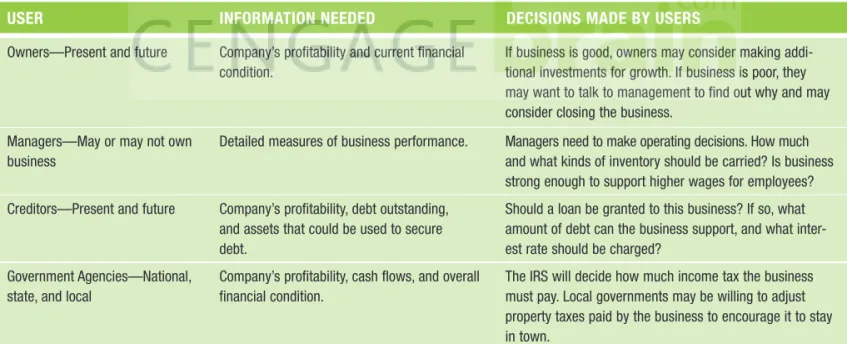
The purpose of accounting is to provide financial information about the current operations and financial condition of a business to individuals, agencies, and organiza-tions. As shown in Figure 1-1, owners, managers, creditors, and government agencies all need accounting information. Other users of accounting information include cus-tomers, clients, labor unions, stock exchanges, and financial analysts.
LO1 Describe the purpose of accounting.
FIGURE 1-1 Users of Accounting Information
USER INFORMATION NEEDED DECISIONS MADE BY USERS
Owners—Present and future Company’s profitability and current financial condition.
If business is good, owners may consider making addi-tional investments for growth. If business is poor, they may want to talk to management to find out why and may consider closing the business.
Managers—May or may not own business
Detailed measures of business performance. Managers need to make operating decisions. How much and what kinds of inventory should be carried? Is business strong enough to support higher wages for employees? Creditors––Present and future Company’s profitability, debt outstanding,
and assets that could be used to secure debt.
Should a loan be granted to this business? If so, what amount of debt can the business support, and what inter-est rate should be charged?
Government Agencies—National, state, and local
Company’s profitability, cash flows, and overall financial condition.
The IRS will decide how much income tax the business must pay. Local governments may be willing to adjust property taxes paid by the business to encourage it to stay in town.
THE ACCOUNTING PROCESS
Accounting is a system of gathering financial information about a business and report-ing this information to users. The six major steps of the accountreport-ing process are analyz-ing, recordanalyz-ing, classifyanalyz-ing, summarizanalyz-ing, reportanalyz-ing, and interpreting (Figure 1-2). Computers are often used in the recording, classifying, summarizing, and reporting steps. Whether or not computers are used, the accounting concepts and techniques are the same. Information entered into the computer system must reflect a proper application of these concepts. Otherwise, the output will be meaningless.
LO2 Describe the accounting process.
4 PART 1 Accounting for a Service Business
CHE-HEINTZ-09-0502-001.indd 4
CHE-HEINTZ-09-0502-001.indd 4 11/25/09 8:41:56 PM11/25/09 8:41:56 PM
Copyright 2010 Cengage Learning. All Rights Reserved. May not be copied, scanned, or duplicated, in whole or in part. Due to electronic rights, some third party content may be suppressed from the eBook and/or eChapter(s). Editorial review has deemed that any suppressed content does not materially affect the overall learning experience. Cengage Learning reserves the right to remove additional content at any time if subsequent rights restrictions require it.
Analyzing
• is looking at events that have taken place and thinking about how they affect the business.
Recording
• is entering financial information about events into the accounting system. Although this can be done with paper and pencil, most businesses use computers to perform routine record-keeping operations.
Classifying
• is sorting and grouping similar items together rather than merely keep-ing a simple, diary-like record of numerous events.
Summarizing
• is the aggregation of many similar events to provide information that is easy to understand. For example, a firm may buy and sell baseballs during the year. Summarizing provides information on the total baseballs bought and sold and the change in the number of baseballs held from the beginning to the end of the period.
Reporting
• is telling the results. In accounting, it is common to use tables of num-bers to report results.
Interpreting
• is deciding the meaning and importance of the information in various reports. This may include ratio analysis to help explain how pieces of information relate to one another.
GENERALLY ACCEPTED ACCOUNTING
PRINCIPLES (GAAP)
Soon after the stock market crash of 1929, the federal government established the Securities and Exchange Commission (SEC). The purpose of this government agency is to help develop standards for reporting financial information to stockholders. The SEC currently has authority over 12,000 companies listed on the major stock exchanges (New York, American, and NASDAQ). It has the power to require these firms to follow certain rules when preparing their financial statements. These rules are referred to as generally accepted accounting principles (GAAP).
Rather than developing GAAP on its own, the SEC encouraged the creation of a private standard-setting body. It did so because it believed the private sector had better access to the resources and talent necessary to develop these standards. Since 1973, the Financial Accounting Standards Board (FASB) has filled this role. In developing accounting standards, FASB follows a specific process and relies on the advice of many organizations. When an accounting issue is identified, the following steps are fol-lowed:
1. The issue is placed on FASB’s agenda. This lets everyone know that the Board plans to develop a standard addressing this issue.
2. After researching an issue, FASB issues a discussion memorandum. This document identifies the pros and cons of various accounting treatments for an event.
3. To gather additional views on the issue, the Board will often hold public hearings around the country. Interested parties are invited to express their opinions at these hearings.
LO3 Define GAAP and describe the process used by FASB to develop these principles.
FIGURE 1-2 The Accounting Process
Analyzing Recording Classifying Summarizing Reporting Interpreting
Chapter 1 Introduction to Accounting 5
CHE-HEINTZ-09-0502-001.indd 5
CHE-HEINTZ-09-0502-001.indd 5 11/25/09 8:41:57 PM11/25/09 8:41:57 PM
Copyright 2010 Cengage Learning. All Rights Reserved. May not be copied, scanned, or duplicated, in whole or in part. Due to electronic rights, some third party content may be suppressed from the eBook and/or eChapter(s). Editorial review has deemed that any suppressed content does not materially affect the overall learning experience. Cengage Learning reserves the right to remove additional content at any time if subsequent rights restrictions require it.
4. Following these hearings, the Board issues an exposure draft. This document explains the rules that FASB believes firms should follow in accounting for this event.
5. After considering feedback on the exposure draft, the Board issues a final statement of financial accounting standards (SFAS).
Throughout this process, many parties participate by testifying at public hearings or by sending letters to the Board explaining why they agree or disagree with the pro-posed standard. These parties include the American Institute of Certified Public Accountants (AICPA), the American Accounting Association (AAA), the Institute of Management Accountants (IMA), the Financial Executives Institute (FEI), corporate executives and accountants, representatives from the investment community, analysts, bankers, industry associations, and the SEC and other government agencies. Clearly, FASB considers the views of a wide range of parties. By doing so, it maximizes the likelihood of developing and gaining acceptance of the most appropriate accounting and disclosure requirements.
The International Accounting Standards Board (IASB) issues accounting standards followed by many firms in countries outside the United States. These are called International Financial Reporting Standards (IFRS). In recent years, the IASB and FASB have worked together to try to minimize the differences in these standards. These standards may eventually converge into one set of standards used around the world.
THREE TYPES OF OWNERSHIP STRUCTURES
One or more persons may own a business. Businesses are classified according to who owns them and the specific way they are organized. Three types of ownership struc-tures are (1) sole proprietorship, (2) partnership, and (3) corporation (Figure 1-3). Accountants provide information to owners of all three types of ownership structures.
LO4 Define three types of business ownership structures.
The largest corporations in the United States are known as the “Fortune 500.”
Most businesses in the United States operate as sole proprietorships or partnerships. However, corporations earn the highest amount of revenue.
SOLE PROPRIETORSHIP
A sole proprietorship is owned by one person. The owner is usually called a proprietor. The proprietor often manages the business. The owner assumes all risks for the busi-ness, and personal assets can be taken to pay creditors. The advantage of a sole pro-prietorship is that the owner can make all decisions.
PARTNERSHIP
A partnership is owned by more than one person. One or more partners may manage the business. Like proprietors, partners assume the risks for the business, and their
FIGURE 1-3 Types of Ownership Structures—Advantages and Disadvantages
Sole Proprietorship
• One owner
• Owner assumes all risk • Owner makes all decisions
• Two or more partners • Partners share risks • Partners may disagree on how to run business
• Stockholders
• Stockholders have limited risk
• Stockholders may have little influence on business decisions
Partnership
TYPES OF OWNERSHIP STRUCTURES
Corporation
CHE-HEINTZ-09-0502-001.indd 6
CHE-HEINTZ-09-0502-001.indd 6 11/25/09 8:41:58 PM11/25/09 8:41:58 PM
Copyright 2010 Cengage Learning. All Rights Reserved. May not be copied, scanned, or duplicated, in whole or in part. Due to electronic rights, some third party content may be suppressed from the eBook and/or eChapter(s). Editorial review has deemed that any suppressed content does not materially affect the overall learning experience. Cengage Learning reserves the right to remove additional content at any time if subsequent rights restrictions require it.
Chapter 1 Introduction to Accounting 7
assets may be taken to pay creditors. An advantage of a partnership is that owners share risks and decision making. A disadvantage is that partners may disagree about the best way to run the business.
CORPORATION
A corporation is owned by stockholders (or shareholders). Corporations may have many owners, and they usually employ professional managers. The owners’ risk is usually limited to their initial investment, and they often have very little influence on the business decisions.
TYPES OF BUSINESSES
Businesses are classified according to the type of service or product provided. Some businesses provide a service. Others sell a product. A business that provides a service is called a service business. A business that buys a product from another business to sell to customers is called a merchandising business. A business that makes a product to sell is called a manufacturing business. You will learn about all three types of businesses in this book. Figure 1-4 lists examples of types of businesses organized by activity.
LO5 Classify different types of businesses by activities.
FIGURE 1-4 Types and Examples of Businesses Organized by Activities
SERVICE MERCHANDISING MANUFACTURING
Travel Agency Department Store Automobile Manufacturer
Computer Consultant Pharmacy Furniture Maker
Physician Grocery Store Toy Factory
A B
ROADER
V
IEW
All Kinds of Businesses Need
Accounting Systems
Even small businesses like those that provide guided horse-back tours of the Rocky Mountains need good accounting systems. Proper records must be maintained for the cost of the horses, feed, food served, tour guides’ salaries, and office expenses. Without this information, the company would not know how much to charge and whether a profit is made on these trips.
DESIGN PICS INC/PHOTOLIBRARY
CHE-HEINTZ-09-0502-001.indd 7
CHE-HEINTZ-09-0502-001.indd 7 11/25/09 8:41:59 PM11/25/09 8:41:59 PM
Copyright 2010 Cengage Learning. All Rights Reserved. May not be copied, scanned, or duplicated, in whole or in part. Due to electronic rights, some third party content may be suppressed from the eBook and/or eChapter(s). Editorial review has deemed that any suppressed content does not materially affect the overall learning experience. Cengage Learning reserves the right to remove additional content at any time if subsequent rights restrictions require it.
CAREER OPPORTUNITIES IN ACCOUNTING
Accounting offers many career opportunities. The positions described below require varying amounts of education, experience, and technological skill.
ACCOUNTING CLERKS
Businesses with large quantities of accounting tasks to perform daily often employ accounting clerks to record, sort, and file accounting information. Often, accounting clerks will specialize in cash, payroll, accounts receivable, accounts payable, inventory, or purchases. As a result, they are involved with only a small portion of the total accounting responsibilities for the firm. Accounting clerks usually have at least one year of accounting education.
BOOKKEEPERS AND PARA-ACCOUNTANTS
Bookkeepers generally supervise the work of accounting clerks, help with daily accounting work, and summarize accounting information. In small-to-medium-sized businesses, the bookkeeper may also help managers and owners interpret the account-ing information. Bookkeepers usually have one to two years of accountaccount-ing education and experience as an accounting clerk.
Para-accountants provide many accounting, auditing, or tax services under the direct supervision of an accountant. A typical para-accountant has a two-year degree or significant accounting and bookkeeping experience.
ACCOUNTANTS
The difference between accountants and bookkeepers is not always clear, particularly in smaller companies where bookkeepers also help interpret the accounting informa-tion. In large companies, the distinction is clearer. Bookkeepers focus on the processing of accounting data. Accountants design the accounting information system and focus on analyzing and interpreting information. They also look for important trends in the data and study the impact of alternative decisions.
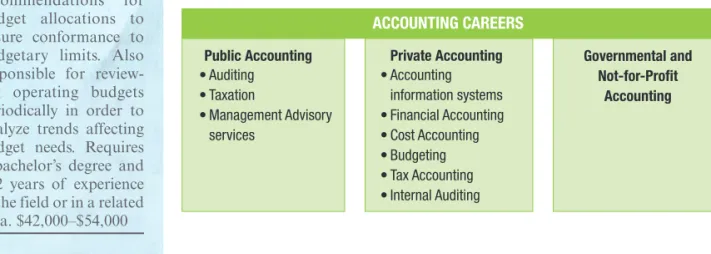
Most accountants enter the field with a college degree in accounting. In fact, since many states require 150 credit hours to sit for the CPA exam, many students are also earning a master’s degree in accounting before entering the profession. Accountants are employed in public accounting, private (managerial) accounting, and governmen-tal and not-for-profit accounting (Figure 1-5).
LO6 Identify career opportunities in accounting.
ACCOUNTING CLERK I
Performs accounting activities such as main-tenance of the general ledger and preparation of various accounting statements and finan-cial reports. Requires a high school diploma or its equivalent with 0–2 years of experience in the field or in a related area. $27,000–$34,000
BOOKKEEPER Maintains and records business transactions. Balances ledgers and prepares reports. May require an associate’s degree or its equivalent with 2–4 years of expe-rience in the field or in a related area. $32,000– $42,000 BUDGET ANALYST I Analyzes accounting records to determine financial resources required to implement programs and makes recommendations for budget allocations to ensure conformance to budgetary limits. Also responsible for review-ing operatreview-ing budgets periodically in order to analyze trends affecting budget needs. Requires a bachelor’s degree and 0–2 years of experience in the field or in a related area. $42,000–$54,000
FIGURE 1-5 Accounting Careers
Public Accounting • Auditing • Taxation • Management Advisory services • Accounting information systems • Financial Accounting • Cost Accounting • Budgeting • Tax Accounting • Internal Auditing Private Accounting ACCOUNTING CAREERS Governmental and Not-for-Profit Accounting CHE-HEINTZ-09-0502-001.indd 8 CHE-HEINTZ-09-0502-001.indd 8 11/25/09 8:42:01 PM11/25/09 8:42:01 PM
Copyright 2010 Cengage Learning. All Rights Reserved. May not be copied, scanned, or duplicated, in whole or in part. Due to electronic rights, some third party content may be suppressed from the eBook and/or eChapter(s). Editorial review has deemed that any suppressed content does not materially affect the overall learning experience. Cengage Learning reserves the right to remove additional content at any time if subsequent rights restrictions require it.
Chapter 1 Introduction to Accounting 9
Public Accounting
Public accountants offer services in much the same way as doctors and lawyers. The public accountant can achieve professional recognition as a Certified Public Accountant (CPA). This is done by meeting certain educational and experience requirements as determined by each state and passing a uniform examination prepared by the American Institute of Certified Public Accountants.
Many CPAs work alone, while others work for local, regional, or national accounting firms that vary in scope and size. The largest public accounting firms in the United States are known as the “Big Four.” They are Deloitte, Ernst & Young, KPMG, and PricewaterhouseCoopers.
Services offered by public accountants are listed below. Auditing.
• Auditing involves the application of standard review and testing pro-cedures to be certain that proper accounting policies and practices have been followed. The purpose of the audit is to provide an independent opinion that the financial information about a business is fairly presented in a manner consistent with generally accepted accounting principles.
Taxation.
• Tax specialists advise on tax planning, prepare tax returns, and repre-sent clients before governmental agencies such as the Internal Revenue Service. Management Advisory Services.
• Given the financial training and business
experi-ence of public accountants, many businesses seek their advice on a wide variety of managerial issues. Often, accounting firms are involved in designing computerized accounting systems.
Forensic Accounting.
• Forensic accounting is a rapidly growing segment of
accounting practice. It includes fraud detection, fraud prevention, litigation support, business valuations, expert witness services, and other investigative activities. Public accounting firms offer forensic accounting services, but foren-sic accountants also work for insurance companies, banks, law enforcement agencies, and other organizations. By meeting certain requirements, and passing the Certified Fraud Examiner exam, a forensic accountant may earn a Certified Fraud Examiner (CFE) designation.
In 2002, the Sarbanes-Oxley Act (SOX) was passed by Congress to help improve reporting practices of public companies. The act was in response to accounting scan-dals at firms like Enron, WorldCom, Cendant, Xerox, and others. Key provisions of SOX are listed below.
The Public Company Accounting Oversight Board (PCAOB) was created to
•
enforce SOX rules and regulations. The PCAOB also has authority to set audit-ing standards for public company audits and to perform inspections of auditaudit-ing firms.
External auditors are required to report on the effectiveness of a public company’s
•
accounting procedures.
Auditing firms are prohibited from offering many nonaudit services to their public
•
audit clients.
Auditing firms must rotate audit partners off audit engagements every five years.
•
The CEO and CFO must personally certify that the financial statements are
•
accurate.
It is difficult to guarantee that information provided in financial statements is always complete and accurate. These measures are a step in the right direction. If our economy and financial markets are to function properly, information provided in financial state-ments must be reliable.
ACCOUNTS PAYABLE MANAGER Responsible for all activ-ities in the accounts pay-able function. Ensures timely payments of ven-dor invoices and expense vouchers and maintains accurate records and control reports. Reviews applicable accounting reports and accounts payable register to ensure accuracy. May require a bachelor’s degree in a related area and at least 7 years of experience in the field. Familiar with a variety of the field’s concepts, practices, and procedures. Relies on experience and judgment to plan and accomplish goals. Manages a staff of administrators/clerks and typically reports to the controller. $59,000– $80,000
TOP AUDIT EXECUTIVE Oversees all aspects of an organization’s auditing function. Responsible for plan-ning and directing all accounting and financial data. Requires a bach-elor’s degree with at least 15 years of experience in the field. Familiar with a variety of the field’s concepts, practices, and procedures. Relies on extensive experience and judgment to plan and accomplish goals. Performs a variety of tasks. Leads and directs the work of others. A wide degree of creativity and latitude is expected. Typically reports to top management. $138,000– $200,000
CHE-HEINTZ-09-0502-001.indd 9
CHE-HEINTZ-09-0502-001.indd 9 11/25/09 8:42:03 PM11/25/09 8:42:03 PM
Copyright 2010 Cengage Learning. All Rights Reserved. May not be copied, scanned, or duplicated, in whole or in part. Due to electronic rights, some third party content may be suppressed from the eBook and/or eChapter(s). Editorial review has deemed that any suppressed content does not materially affect the overall learning experience. Cengage Learning reserves the right to remove additional content at any time if subsequent rights restrictions require it.
Private (Managerial) Accounting
Many accountants are employees of private business firms. The controller oversees the entire accounting process and is the principal accounting officer of the company. Private or managerial accountants perform a wide variety of services for the business. These services are listed below.
Accounting Information Systems.
• Accountants in this area design and implement
manual and computerized accounting systems. Financial Accounting.
• Based on the accounting data prepared by the bookkeepers and accounting clerks, accountants prepare various reports and financial state-ments and help in analyzing operating, investing, and financing decisions. Cost Accounting.
• The cost of producing specific products or providing services must be measured. Further analysis is also done to determine whether the prod-ucts and services are produced in the most cost-effective manner.
Budgeting.
• In the budgeting process, accountants help managers develop a finan-cial plan.
Tax Accounting.
• Instead of hiring a public accountant, a company may have its own accountants. They focus on tax planning, preparation of tax returns, and dealing with the Internal Revenue Service and other governmental agencies. Internal Auditing.
• Internal auditors review the operating and accounting control procedures adopted by management to make sure the controls are adequate and are being followed. They also monitor the accuracy and timeliness of the reports provided to management and to external parties.
A managerial accountant can achieve professional status as a Certified Management Accountant (CMA). This is done by passing a uniform examination offered by the Institute of Management Accountants. An internal auditor can achieve professional recognition as a Certified Internal Auditor (CIA) by passing the uniform examination offered by the Institute of Internal Auditors.
Governmental and Not-for-Profit Accounting
Thousands of governmental and not-for-profit organizations (states, cities, schools, churches, and hospitals) gather and report financial information. These organizations employ a large number of accountants. Since these entities are not profit oriented, the rules are somewhat different for governmental and not-for-profit organizations. However, many accounting procedures are similar to those found in profit-seeking enterprises.
JOB OPPORTUNITIES
Job growth in some areas will be much greater than in others. Newspaper advertise-ments often indicate that accountants and accounting clerks are expected to have computer skills. Computer skills definitely increase the opportunities available to you in your career. Almost every business needs accountants, accounting clerks, and bookkeepers. Figure 1-6 shows the expected growth for different types of businesses. Notice that growth will be greatest in health care services. Chapters 2 through 9 introduce accounting skills that you will need to work in a service business, like health care. Chapter 10 begins the discussion of merchandising businesses. Accounting for manufacturing businesses is addressed in the last chapters of the book.
Figure 1-7 shows the expected demand for accounting skills. A 12.5% increase in demand is expected for bookkeeping, accounting, and auditing clerks. These types of
CONTROLLER Responsible for direct-ing an organization’s accounting functions. These functions include establishing and main-taining the organization’s accounting principles, practices, procedures, and initiatives. Prepares financial reports and presents findings and recommendations to top management. Requires a bachelor’s degree and at least 15 years of direct experience in the field. Typically requires a CPA. Usually reports to top financial officer or CEO. $135,000–$201,000
© Salary.com 2009.
CHE-HEINTZ-09-0502-001.indd 10
CHE-HEINTZ-09-0502-001.indd 10 11/25/09 8:42:04 PM11/25/09 8:42:04 PM
Copyright 2010 Cengage Learning. All Rights Reserved. May not be copied, scanned, or duplicated, in whole or in part. Due to electronic rights, some third party content may be suppressed from the eBook and/or eChapter(s). Editorial review has deemed that any suppressed content does not materially affect the overall learning experience. Cengage Learning reserves the right to remove additional content at any time if subsequent rights restrictions require it.
Chapter 1 Introduction to Accounting 11
FIGURE 1-6 Expected Growth
The growth in the number of new jobs from 2006 to 2016 will vary according to industry. The major area of growth will be in health care services. Businesses providing educational, health care, and professional/business services are expected to have the strongest employment growth. Moderate growth is expected in merchandising businesses and state and local governments. Employment in manufacturing and the federal government is expected to decline. Total employment for all industry sectors will increase 10.4%. Source: U.S. Department of Labor—Bureau of Labor Statistics (http://www.bls.gov/news.release/ ecopro.t01.htm) as of January 20, 2009. Job Growth 2006–2016 –10% –5% 0% 5% 10% 15% 20% 25% 30% 35% 20.9% 27.0% 23.3% 7.4% 4.5% 7.3% –3.8% –10.6% Educational Services Health Care Services
Professional and Business Services
State and Local Government
Retail Merchandising Wholesale Merchandising
Federal Government Manufacturing
FIGURE 1-7 Expected Demand
The highest number of jobs available will be for bookkeepers, accounting and auditing clerks, and accountants and auditors. The growth for each area shown from 2006 to 2016 will be as follows:
Thousands Percentage
Accountants and auditors 226 17.7%
Budget analysts 4 7.1%*
Bookkeeping, accounting, and auditing clerks 264* 12.5%* Billing and posting clerks, and machine operators 24 4.4% *Differences due to rounding.
Source: Arlene Dohm and Lynn Shniper, “Occupational Employment Projections to 2016,” Monthly Labor Review, November 2007.
0 200 400 600 800 1,000 1,200 1,400 1,600 1,800 2,000 2,200 2,400 Thousand Bookkeeping, Accounting, and Auditing Clerks Accountants and Auditors Billing and Posting Clerks, and Machine Operators Budget Analysts 2,114 2,377 1,274 1,500 542 566 62 66 2006 2016 Accounting Job Opportunities from 2006 to 2016
CHE-HEINTZ-09-0502-001.indd 11
CHE-HEINTZ-09-0502-001.indd 11 11/25/09 8:42:05 PM11/25/09 8:42:05 PM
Copyright 2010 Cengage Learning. All Rights Reserved. May not be copied, scanned, or duplicated, in whole or in part. Due to electronic rights, some third party content may be suppressed from the eBook and/or eChapter(s). Editorial review has deemed that any suppressed content does not materially affect the overall learning experience. Cengage Learning reserves the right to remove additional content at any time if subsequent rights restrictions require it.
positions will offer the highest number of job opportunities over the next several years. The next highest demand is for accountants and auditors, and this demand is expected to increase by 17.7% over the next several years.
Regardless of the type of career you desire, writing skills are important in business and your personal life. Becoming a good writer requires practice and a strategy for the process used to prepare memos, letters, and other documents. On pages 12, 13, and 14, Ken Davis offers an excellent approach to managing your writing. Take a moment to read Ken’s tips. Then, practice his approach by completing the writing assignments as you finish each chapter.
File Edit View Go Tools Actions Help
Delete Save Reply Reply All Forward New Get Mail
▼
Here’s a secret: the business writing that you and I do—the writing that gets the world’s work done—requires no special gift. It can be managed, like any other business process.
Managing writing is largely a matter of managing time. Writing is a process, and like any process it can be done efficiently or inefficiently. Unfortunately, most of us are pretty inefficient writers. That’s because we try to get each word, each sen-tence, right the first time. Given a letter to write, we begin with the first sentence. We think about that sensen-tence, write it, revise it, even check its spelling, before going on to the second sentence. In an hour of writing, we might spend 45 or 50 minutes doing this kind of detailed drafting. We spend only a few minutes on overall planning at the beginning and only a few minutes on overall revising at the end.
That approach to writing is like building a house by starting with the front door: planning, building, finishing—even washing the windows—before doing anything with the rest of the house. No wonder most of us have so much trouble writing.
Efficient, effective writers take better charge of their writing time. They manage their writing. Like building contractors, they spend time planning before they start construction. Once construction has started, they don’t try to do all of the finishing touches as they go.
As the following illustration shows, many good writers break their writing process into three main stages: planning, draft-ing, and revising. They spend more time at the first and third stages than at the second. They also build in some “manage-ment” time at the beginning and the end, and some break time in the middle. To manage your writing time, try the following steps.
From: Ken Davis
Subject: Managing Your Writing
To: Accounting Students
▼
▼
CHE-HEINTZ-09-0502-001.indd 12
CHE-HEINTZ-09-0502-001.indd 12 11/25/09 8:42:05 PM11/25/09 8:42:05 PM
Copyright 2010 Cengage Learning. All Rights Reserved. May not be copied, scanned, or duplicated, in whole or in part. Due to electronic rights, some third party content may be suppressed from the eBook and/or eChapter(s). Editorial review has deemed that any suppressed content does not materially affect the overall learning experience. Cengage Learning reserves the right to remove additional content at any time if subsequent rights restrictions require it.
Chapter 1 Introduction to Accounting 13
At the MANAGING stage (perhaps two or three minutes for a one-hour writing job), remind yourself that writing can be managed and that it’s largely a matter of managing time. Plan your next hour.
At the PLANNING stage (perhaps 20 minutes out of the hour):
1. Find the “we.” Define the community to which you and your reader belong. Then ask,
“How are my reader and I alike and different?”—in knowledge, attitudes, and circumstances.
2. Define your purpose. Remember the advice a consultant once gave Stanley Tool executives:
“You’re not in the business of making drills: you’re in the business of making holes.” Too many of us lose sight of the difference between making drills and making holes when we write letters and memos. We focus on the piece of writing—the tool itself—not its purpose. The result: our writing often misses the chance to be as effective as it could be. When you’re still at the planning stage, focus on the outcome you want, not on the means you will use to achieve it.
3. Get your stuff together. Learn from those times when you’ve turned a one-hour
home-im-provement project into a three- or four-hour job by having to make repeated trips to the hardware store for tools or parts. Before you start the drafting stage of writing, collect the information you need.
4. Get your ducks in a row. Decide on the main points you want to make. Then, make a list or
rough outline placing your points in the most logical order. At the DRAFTING STAGE (perhaps 5 minutes out of the hour):
5. Do it wrong the first time. Do a “quick and dirty” draft, without editing. Think of your
draft as a “prototype,” written not for the end user but for your own testing and improve-ment. Stopping to edit while you draft breaks your train of thought and keeps you from being a good writer. (Hint: If you are writing at a computer, try turning off the monitor during the drafting stage.)
At the BREAK STAGE (perhaps 5 minutes):
6. Take a break and change hats. Get away from your draft, even if for only a few minutes.
Come back with a fresh perspective—the reader’s perspective. At the REVISING STAGE (perhaps 25 minutes):
7. Signal your turns. Just as if you were driving a car, you’re leading your reader through new
territory. Use “turn signals”—and, in addition, but, however, or, therefore, because, for
example—to guide your reader from sentence to sentence.
8. Say what you mean. Put the point of your sentences in the subjects and verbs. For example,
revise “There are drawbacks to using this accounting method” to “This accounting method has some drawbacks.” You’ll be saying what you mean, and you’ll be a more effective communicator.
9. Pay by the word. Reading your memo requires work. If your sentences are wordy and you
are slow to get to the point, the reader may decide that it is not worth the effort. Pretend you are paying the reader by the word to read your memo. Then, revise your memo to make it as short and to the point as possible.
10. Translate into English. Keep your words simple. (Lee Iacocca put both these tips in one
“commandment of good management”: “Say it in English and keep it short.”) Remember that you write to express, not impress.
To Do List
✓
▼
CHE-HEINTZ-09-0502-001.indd 13
CHE-HEINTZ-09-0502-001.indd 13 11/25/09 8:42:05 PM11/25/09 8:42:05 PM
Copyright 2010 Cengage Learning. All Rights Reserved. May not be copied, scanned, or duplicated, in whole or in part. Due to electronic rights, some third party content may be suppressed from the eBook and/or eChapter(s). Editorial review has deemed that any suppressed content does not materially affect the overall learning experience. Cengage Learning reserves the right to remove additional content at any time if subsequent rights restrictions require it.
▼
11. Finish the job. Check your spelling, punctuation, and mechanics.
Finally, at the MANAGING STAGE again (2 to 3 minutes):
12. Evaluate your writing process. Figure out how to improve it next time.
By following these 12 steps, you can take charge of your writing time. Begin today to manage your
writing. As a United Technologies Corporation advertisement in The Wall Street Journal
admon-ished, “If you want to manage somebody, manage yourself. Do that well and you’ll be ready to stop managing and start leading.”
Dr. Kenneth W. Davis is Professor of English and Adjunct Professor of Communication Studies at Indiana University-Purdue University, Indianapolis. He is also president of Komei, Inc., a
communication consulting and training company.
LEARNING OBJECTIVES
Key Points to Remember
LO1
Describe the purpose ofaccounting.
The purpose of accounting is to provide financial information about a business to individuals and organizations.
LO2
Describe the accounting process. The six major steps of the accounting process are analyzing,recording, classifying, summarizing, reporting, and interpreting.
LO3
Define GAAP and describe theprocess used by FASB to develop these principles.
Generally accepted accounting principles (GAAP) are the rules that businesses must follow when preparing financial statements. FASB takes the following steps to develop an accounting standard:
1. The issue is placed on the Board’s agenda.
2. After researching the issue, a discussion memorandum is issued.
3. Public hearings are held. 4. An exposure draft is issued.
5. The statement of financial accounting standards is issued.
LO4
Define three types of businessownership structures.
Three types of business ownership structures are the sole pro-prietorship, the partnership, and the corporation.
LO5
Classify different types ofbusinesses by activities.
Different types of businesses classified by activities are a service business, a merchandising business, and a manufacturing business.
LO6
Identify career opportunities in accounting.Career opportunities in accounting include work in public accounting, private accounting, and governmental and not-for-profit accounting.
S E L F - S T U D Y
CHE-HEINTZ-09-0502-001.indd 14
CHE-HEINTZ-09-0502-001.indd 14 11/25/09 8:42:06 PM11/25/09 8:42:06 PM
Copyright 2010 Cengage Learning. All Rights Reserved. May not be copied, scanned, or duplicated, in whole or in part. Due to electronic rights, some third party content may be suppressed from the eBook and/or eChapter(s). Editorial review has deemed that any suppressed content does not materially affect the overall learning experience. Cengage Learning reserves the right to remove additional content at any time if subsequent rights restrictions require it.
Chapter 1 Self-Study 15
KEY TERMS
accountant (8) Designs the accounting information system and focuses on analyzing and interpreting information.
accounting (4) A system of gathering financial information about a business and reporting this information to users.
accounting clerk (8) Records, sorts, and files accounting information.
accounting information systems (10) Accountants in this area design and implement manual and computerized accounting systems.
analyzing (5) Looking at events that have taken place and thinking about how they affect the business.
auditing (9) Reviewing and testing to be certain that proper accounting policies and practices have been followed.
bookkeeper (8) Generally supervises the work of accounting clerks, helps with daily accounting work, and summarizes accounting information.
budgeting (10) The process in which accountants help managers develop a financial plan.
Certified Fraud Examiner (CFE) (9) A forensic accountant who has passed the exam offered by the Association of Certified Fraud Examiners.
Certified Internal Auditor (CIA) (10) An internal auditor who has achieved profes-sional recognition by passing the uniform examination offered by the Institute of Internal Auditors.
Certified Management Accountant (CMA) (10) An accountant who has passed an examination offered by the Institute of Management Accountants.
Certified Public Accountant (CPA) (9) A public accountant who has met certain educational and experience requirements and has passed an examination pre-pared by the American Institute of Certified Public Accountants.
classifying (5) Sorting and grouping similar items together rather than merely keep-ing a simple, diary-like record of numerous events.
controller (10) The accountant who oversees the entire accounting process and is the principal accounting officer of a company.
corporation (7) A type of ownership structure in which stockholders own the busi-ness. The owners’ risk is usually limited to their initial investment, and they usu-ally have very little influence on the business decisions.
cost accounting (10) Determining the cost of producing specific products or provid-ing services and analyzprovid-ing for cost effectiveness.
discussion memorandum (5) The first document issued by FASB when developing an accounting standard. This document identifies the pros and cons of various accounting treatments for an event.
exposure draft (6) This document explains the rules that FASB believes firms should follow in accounting for a particular event. Based on the responses to the expo-sure draft, the Board will decide if any changes are necessary before issuing a final standard.
financial accounting (10) Includes preparing various reports and financial state-ments and analyzing operating, investing, and financing decisions.
forensic accounting (9) A specialized field that combines fraud detection, fraud prevention, litigation support, expert witnessing, business valuations, and other investigative activities.
CHE-HEINTZ-09-0502-001.indd 15
CHE-HEINTZ-09-0502-001.indd 15 11/25/09 8:42:07 PM11/25/09 8:42:07 PM
Copyright 2010 Cengage Learning. All Rights Reserved. May not be copied, scanned, or duplicated, in whole or in part. Due to electronic rights, some third party content may be suppressed from the eBook and/or eChapter(s). Editorial review has deemed that any suppressed content does not materially affect the overall learning experience. Cengage Learning reserves the right to remove additional content at any time if subsequent rights restrictions require it.
generally accepted accounting principles (GAAP) (5) Procedures and guidelines developed by the Financial Accounting Standards Board to be followed in the accounting and reporting process.
internal auditing (10) Reviewing the operating and accounting control procedures adopted by management to make sure the controls are adequate and being followed; assuring that accurate and timely information is provided.
interpreting (5) Deciding the meaning and importance of the information in various reports.
management advisory services (9) Providing advice to businesses on a wide variety of managerial issues.
manufacturing business (7) A business that makes a product to sell. merchandising business (7) A business that buys products to sell.
para-accountant (8) A paraprofessional who provides many accounting, auditing, or tax services under the direct supervision of an accountant.
partnership (6) A type of ownership structure in which more than one person owns the business.
public hearing (5) Following the issuance of a discussion memorandum, public meetings are often held by FASB to gather opinions on the accounting issue. recording (5) Entering financial information about events affecting the company
into the accounting system.
reporting (5) Telling the results of the financial information.
Sarbanes-Oxley Act (SOX) (9) An act passed by Congress to help improve reporting practices of public companies.
service business (7) A business that provides a service.
sole proprietorship (6) A type of ownership structure in which one person owns the business.
statement of financial accounting standards (SFAS) (6) A standard issued by the Financial Accounting Standards Board. These standards must be followed when preparing financial statements.
summarizing (5) Bringing the various items of information together to determine a result.
tax accounting (10) Services focused on tax planning, preparing tax returns, and dealing with the Internal Revenue Service and other governmental agencies. taxation (9) See tax accounting.
REVIEW QUESTIONS
LO1
1. What is the purpose of accounting?LO1
2. Identify four user groups normally interested in financial information about a business.A P P L Y I N G Y O U R K N O W L E D G E
CHE-HEINTZ-09-0502-001.indd 16
CHE-HEINTZ-09-0502-001.indd 16 11/25/09 8:42:07 PM11/25/09 8:42:07 PM
Copyright 2010 Cengage Learning. All Rights Reserved. May not be copied, scanned, or duplicated, in whole or in part. Due to electronic rights, some third party content may be suppressed from the eBook and/or eChapter(s). Editorial review has deemed that any suppressed content does not materially affect the overall learning experience. Cengage Learning reserves the right to remove additional content at any time if subsequent rights restrictions require it.
Chapter 1 Applying Your Knowledge 17
LO2
3. Identify the six major steps of the accounting process and explain each step.LO3
4. What are generally accepted accounting principles (GAAP)?LO3
5. Describe the steps followed by the Financial Accounting Standards Board when developing an accounting standard.LO3
6. What is the name of the organization that issues accounting standards followed by many firms in countries outside the United States?LO4
7. Identify the three types of ownership structures and discuss the advantages and disadvantages of each.LO5
8. Identify three types of businesses according to activities.LO6
9. What are the main functions of an accounting clerk?LO6
10. Name and describe three areas of specialization for a public accountant.LO6
11. What is the purpose of the Sarbanes-Oxley Act?LO6
12. Name and describe six areas of specialization for a managerial accountant.SERIES A EXERCISES
E 1-1A
(LO1)
PURPOSE OF ACCOUNTING Match the following users with the information needed.1. Owners a. Whether the firm can pay its bills on time 2. Managers b. Detailed, up-to-date information to measure
3. Creditors business performance (and plan for future operations) 4. Government agencies c. To determine taxes to be paid and whether other
regulations are met
d. The firm’s current financial condition
E 1-2A
(LO2)
ACCOUNTING PROCESS List the six major steps of the accounting process in order (1–6) and define each.________ Recording ________ Summarizing ________ Reporting ________ Analyzing ________ Interpreting ________ Classifying
SERIES B EXERCISES
E 1-1B
(LO1)
PURPOSE OF ACCOUNTING Describe the kind of information needed by the users listed.Owners (present and future) Managers
Creditors (present and future) Government agencies
CHE-HEINTZ-09-0502-001.indd 17
CHE-HEINTZ-09-0502-001.indd 17 11/25/09 8:42:08 PM11/25/09 8:42:08 PM
Copyright 2010 Cengage Learning. All Rights Reserved. May not be copied, scanned, or duplicated, in whole or in part. Due to electronic rights, some third party content may be suppressed from the eBook and/or eChapter(s). Editorial review has deemed that any suppressed content does not materially affect the overall learning experience. Cengage Learning reserves the right to remove additional content at any time if subsequent rights restrictions require it.
Recording b. Looking at events that have taken place and thinking about Classifying how they affect the business
Summarizing c. Deciding the importance of the various reports
Reporting d. Aggregating many similar events to provide information that is Interpreting easy to understand
e. Sorting and grouping like items together
f. Entering financial information into the accounting system
MANAGING YOUR WRITING
Take a moment to think about what it would be like to run your own business. If you started a business, what would it be? Prepare a one-page memo that describes the type of business you would enjoy the most. Would it be a service, merchandising, or manufacturing business? Explain what form of ownership you would prefer and why.
CHE-HEINTZ-09-0502-001.indd 18
CHE-HEINTZ-09-0502-001.indd 18 11/25/09 8:42:09 PM11/25/09 8:42:09 PM
Copyright 2010 Cengage Learning. All Rights Reserved. May not be copied, scanned, or duplicated, in whole or in part. Due to electronic rights, some third party content may be suppressed from the eBook and/or eChapter(s). Editorial review has deemed that any suppressed content does not materially affect the overall learning experience. Cengage Learning reserves the right to remove additional content at any time if subsequent rights restrictions require it.