Contents
What is Referencing? ... 3
Why reference? ... 3
Two parts to referencing ... 3
When a reference is not needed ... 3
Final check ... 3
In-text Citations ... 4
Paraphrasing ... 4
Citing one source. ... 4
Citing more than one source for the same idea. ... 4
Citing multiple works published in the same year by the same author. ... 4
Citing a secondary source. ... 4
Quoting ... 5
Quotations of fewer than 40 words. ... 5
Quotations of 40 or more words. ... 5
Adding and Omitting material ... 6
Figures (image, graph, chart, map, drawing, photograph) ... 6
Tables ... 7
Reference List ... 8
Format ... 8
Example of a reference list ... 8
Finding the reference information ... 8
Information needed for a reference ... 9
Reference Elements ... 9
1. Author or Editor ... 9
One author. ... 9
Two authors. ... 10
Three to five authors. ... 10
Six to seven authors. ... 10
Eight or more authors. ... 11
Corporate author and corporate author as publisher. ... 11
No author. ... 11
Editors. ... 12
Edited reference books. ... 12
Author of a chapter in an edited book. ... 13
2. Publication Date ... 13
Books, journals and other periodicals, brochures, websites (year only). ... 13
Magazines, newspapers, newsletters, social media (full date). ... 13
No date... 14
3. Titles and source type ... 14
Source types. ... 14
Other source type examples. ... 15
4. Retrieval Information ... 15
Hard copy – non-periodicals (books, reports, brochures and other hard copy, non-periodical sources). ... 15
Hard copy – periodicals (journals, newsletters, magazines and other periodical sources). ... 16
DOI. ... 16
Database. ... 16
Website ... 17
What is Referencing?
Referencing is acknowledging the source/s of the information, ideas, words, and images you have used in your assignment.
Why Reference?
• to distinguish between your ideas and words and those that belong to other people • to support what you are writing by referring to evidence
• to enable readers to investigate ideas they find interesting/useful • to show your tutor exactly which sources you have read
• to avoid plagiarism
Two Parts to Referencing
APA referencing has two parts:• an in-text citation, which is in the body of your assignment and can be
- paraphrasing: putting in your own words what the author has written, or
- quoting: copying the author’s exact words, using quotation marks and giving the page number/s.
NB: Both paraphrasing and quoting need to be referenced.
• a reference list of all the sources you have used, which is placed at the end of your assignment/writing.
When a Reference is not Needed
There will be occasions when you will not need to provide references:
• when you are using your own experiences, artwork, photographs, and so forth • when you are using generally accepted facts
• when you are using “common knowledge” such as folklore and myths, or historical events.
Final check
When you have completed your reference list, check that• each entry appears in both the text and the reference list
• the in-text citation and reference list entry match exactly in spelling and publication date.
In-text Citations
The in-text citation corresponds to the author and publication date shown in your reference list.
Paraphrasing
Paraphrasing is rewriting a passage in your own words. It is not sufficient to change the sentence order or replace some of the original author’s words with synonyms. Write the author’s idea so that your own voice and writing style are present.
Citing one source.
When paraphrasing an idea from one source, include the authors’ surnames and year of publication.
Creme and Lea (2003) suggest that the more students write, the more confident they will become about writing.
OR
The more students write, the more confident they will become about writing (Creme & Lea, 2003).
Citing more than one source for the same idea.
When there is more than one source for the same idea, all relevant sources should be cited within one set of brackets, in alphabetical order, and separated with semicolons.
(Grace, 2009; Haynes, Butcher, & Boese, 2004; National Animal Welfare Advisory Council, 2007).
It is not necessary to repeat an author’s name when citing multiple works by the same author in a citation.
(Brown, 1982, 1988).
Citing multiple works published in the same year by the same author.
Use “a”, “b”, and so forth, to differentiate between works published by the same author in the same year. This includes multiple webpages from one website.
. . . (Napier, 1993a) . . . Napier (1993b) claimed that . . . . . . (Smith, n.d.-a) . . . Smith (n.d.-b) claimed that . . .
Citing a secondary source.
When presenting an idea from an author when you have not read their original work but have found it paraphrased or quoted by someone else, acknowledge both the original author and the source author. In the citation, firstly acknowledge the original author, and then the source author preceded by the words “as cited in . . .”
Seidenberg and McClelland’s study (1990, as cited in Coltheart, Curtis, Atkins, & Haller, 1993) compared . . .
OR
. . . (Seidenbery & McClelland, 1990, as cited in Coltheart, Curtis, Atkins, & Haller, 1993).
Quoting
A quotation involves using someone else’s exact words. Quotations should be used sparingly. However, they may be appropriate when emphasising an important point, providing a
definition, or stating a controversial point that will be explored further in the assignment.
Quotations of fewer than 40 words.
If the quotation is fewer than 40 words, enclose it in quotation marks. Include the authors’ names, year of publication and page number(s). When quoting from an unpaginated source, in place of the page number, include the paragraph number (e.g., para. 2), and from a video, include a time stamp (e.g., 00:26:48 represents 26 minutes and 48 seconds into the video).
It was discovered that “the old schema is exercised by being used in familiar ways” (Claiborne & Drewery, 2010, p. 13).
OR
Claiborne and Drewery (2010) found that “the old schema is exercised by being used in familiar ways” (p. 13).
Quotations of 40 or more words.
A quotation of 40 or more words is displayed in a block and quotation marks are left off. Start on a new line and indent by a default tab space (1.27cm). Include the authors’ names, year of publication and page number(s). Notice in the examples below that the full stop comes before the page number in the first example, and before the in-text citation in the second example.
Claiborne and Drewery (2010) found
The old schema is exercised by being used in familiar ways. Play was seen by Piaget as a way for children to practise a schema. For example, a child who had learned to blow a whistle might want to blow it over and over, varying the noise only slightly, in order to practise the schema of producing the noise. (p. 13)
OR
The old schema is exercised by being used in familiar ways. Play was seen by Piaget as a way for children to practise a schema. For example, a child who had learned to blow a whistle might want to blow it over and over, varying the noise only slightly, in order to practise the schema of producing the noise. (Claiborne & Drewery, 2010, p. 13)
Direct quotations must be exact copies. Follow the wording, spelling, and interior punctuation of the original source, unless the source contains double quotation marks, which are to be converted to single quotation marks.
“Material processes for constructing past, present and future are wrapped up in our sense of the national ‘present’”(Murphy & Kraidy, 2003, p. 43).
Adding and Omitting material
Use square brackets (i.e., [ ]) to show you have inserted words that are not part of the original quote. This is sometimes necessary to retain correct grammar in your work. Care must be taken not to alter the meaning of the original text.
Use three ellipsis points (i.e., . . .) within a sentence to show you have left out part of the original quote.
“Many young adults also become skeptical . . . [and] understand that emotions can play a role in thinking” (Santrock, 2002, p. 431).
Figures (image, graph, chart, map, drawing, photograph)
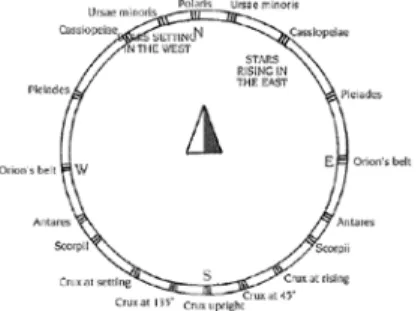
Beneath the figure, label with the italicised word “Figure” and a number. Include a caption (which serves as the title), explanatory notes if required, and the citation. Note the use of brackets and the word “from”. Where figures have been adapted, replace “from” with “adapted from”.
Figure 1. Star compass (from Evans, 1998, p. 62)
Figure 2. Māori pattern (from Schoon, 1962)
Figure 3. Total information for the Mindful Attention Awareness Scale across trait estimates. Information is determined for each item at each trait level at each response threshold, where there are k _ 1 response thresholds (k = total number of response options). Total information is the sum of information across all trait levels and all response options for each item. In this figure, total scale information Is represented by the solid line and information for a select subset of items (7, 8, 9, 10,14) is represented by the dotted line. Note that information is relatively consistent between trait levels _2 and 1.5, but declines sharply below h = 2 and above h = 1.5.
(from Van Dam, Earleywine, & Borders, 2010, p. 809)
If a figure or image list is required for your course, seek advice from your tutor as to how they would like this presented.
Tables
Tables are headed with the word “Table” and a number. On a new line, the title is italicised and only the first word and proper nouns have a capital letter. Beneath the table, insert the
italicised word “Note.” followed by explanatory notes if required, and the citation preceded with “from” or “adapted from”.
Table 1 Medal Table
Place Country Gold Silver Bronze Total
1 RUS 13 11 9 33
2 NOR 11 5 10 26
3 CAN 10 10 5 25
Note. Adapted from BBC, 2014
NB.
Graduate Diploma and Postgraduate students
are expected to include a full reference in figure
captions and table notes. Refer to the APA 6th
edition manual, pages 128-160.
Reference List
The first part of the reference (author or editor name or document title in the absence of an author or editor, and the publication date) must match the in-text citation.
Format
• Start the reference list on a new page at the end of your assignment with the title “References” centred at the top.
• Place the list in alphabetical order, sorted by the first word of each reference.
• Format the list as hanging indent (first line of each reference is aligned to the left margin with all subsequent lines of the reference indented).
• Use the same line spacing as the rest of your assignment – usually 1.5 or double spacing.
Example of a reference list
References
Brown, P. (1982). Corals in the Capricorn group. Rockhampton, Australia: Central Queensland University.
Brown, P. (1998). The effects of anchor on corals. Rockhampton, Australia: Central Queensland University.
Creme, P., & Lea, M. R. (2003). Writing at university: A guide for students (2nd ed.). Philadelphia, PA: Open University Press.
Fitzgerald, J., & Galyer, K. (2008). Collaborative prescribing rights for psychologists: The New Zealand perspective. New Zealand Journal for Psychology, 37(3), 44-52.
Lefait, S. (2013). Surveillance on screen: Monitoring contemporary films and programs. Lanham, MD: Scarecrow Press.
Napier, A. (1993a). Fatal storm. Sydney, Australia: Allen & Unwin. Napier, A. (1993b). Survival at sea. Sydney, Australia: Allen & Unwin. Schoon, T. (1962). Maori pattern [Painting]. Retrieved from
http://www.aucklandartgallery.com/the-collection/browse-artwork/12800/maori-pattern
Note that works by the same author with different publication dates are listed chronologically, while works by the same author with the same publication date are listed alphabetically, and this determines the allocation of a, b, and so forth.
Finding the reference information
Reference information can be found in the first few pages of a book, the front page or journal cover of a journal or magazine, and in the bibliographic information sourced through Primo Search on the library webpage. Art books often have the publication information at the back.
Information needed for a reference
There are four main elements of a reference:1. Author or Editor.
2. Publicationdate.
3. Title and additional information to identify the type of source, if needed.
4. Retrieval Information. This may be a publisher’s location and name, database name, website URL, or a digital object identifier (DOI).
To construct a reference, ensure each of these elements is included in the order and format outlined below.
Reference Elements
1.
Author or Editor
References begin with the surname(s) of the author(s) or editor(s) followed by their initials, unless there is no author. Note the use of commas after each surname and between each author. Note also the use of full stops and spaces.
One author.
In-text citation example
Bernstein (1965) claimed that . . .
OR
The theory was first put forward in 1960 (Bernstein, 1965).
Reference list example
Bernstein, T. M. (1965). The careful writer: A modern guide to English usage. New York, NY: Atheneum.
Two authors.
Always cite both authors. Note the different use of “and” and “&”.
In-text citation example
Strunk and White (1979) found . . .
OR
The majority found . . . (Strunk & White, 1979).
Reference list example
Strunk, W., & White, E. B. (1979). The elements of style (3rd ed.). New York, NY: Macmillan.
Three to five authors.
Cite all authors the first time.In subsequent in-text citations, include only the surname of the first author followed by “et al.” and the publication year.
In-text citation example First citation
Morreale, Spitzberg, and Barge (2007) examined . . .
Subsequent citations
Morreale et al. (2007) suggested that . .
Reference list example
Morreale, S. P., Spitzberg, B. H., & Barge, J. K. (2007). Human communication:
Motivation, knowledge and skills (2nd ed.). Belmont, CA: Thomson Wadsworth.
Six to seven authors.
Cite only the surname of the first author followed by “et al.” When a reference has up to seven authors, list all authors’ names in the reference list.
In-text citation example
Smith et al. (1997) found . . .
OR
. . . (Smith et al., 1997).
Reference list example
Smith, A. B., Taylor, N. J., Gollop, M., Gaffney, M., Gold, M., & Henaghan, M. (1997). Access and other post-separation issues: A qualitative study of children’s, parents’ and lawyers’ views. Dunedin, New Zealand: Children’s Issues Centre.
Eight or more authors.
Cite only the surname of the first author followed by “et al.” List the first six and the final author’s name, preceded by three spaced ellipsis points, in the reference list.
In-text citation example
Gloster et al. (1997) found . . .
OR
. . . (Gloster et al., 1997).
Reference list example
Gloster, J., Jones, A., Redington, A., Burgin, L., Sorensen, J. H., Turner, R., . . . Paton, D. (2010). A handbook of critical approaches to education. New York, NY: Oxford University Press.
Corporate author and corporate author as publisher.
Publications that are authored by a company, organisation or government department rather than by individuals should be referenced accordingly. If the company name is long and appears more than three times in your assignment, an abbreviation may be assigned in the first citation and the abbreviation used thereafter.
As it is possible for anyone to design a website with the appearance of backing or authorship of a larger organisation, care should always be taken to determine credibility and authorship of websites.
No author.
If an author or corporate author cannot be identified, and if the source has been verified as credible, the reference should be cited as having no author. Use the title or the first few words of the source text if there is no title, and the publication year. When the source is not
considered to be a complete work, such as a website, article, or chapter in an edited book, encase the title in quotation marks. Begin each main word with a capital letter. Note that the complete title is not necessary in the citation.
In-text citation example
(“Gianni Versace Biography,” n.d.).
OR
In “Gianni Versace Biography” (n.d.), it is claimed that . . .
Reference list example
Gianni Versace biography. (n.d.) Retrieved from http://www.thebiographychannel.co.uk/biogra phies/gianni-versace.html
In-text citation example First text citation
(American Psychological Association [APA], 2010).
Subsequent text citations
(APA, 2010).
Reference list example
American Psychological Association. (2010). Publication manual of the American Psychological Association (6th ed.). Washington, DC: Author.
If the non-authored source is a complete work, such as a book, brochure, or movie, the title should be italicised. Place the title in the author position. In the reference list, alphabetise items with no author or editor by the first significant word in the title.
In-text citation example
(Merriam-Webster's Collegiate Dictionary, 2005).
OR
Merriam-Webster’s Collegiate Dictionary (2005) defines . . .
Reference list example
Merriam-Webster's collegiate dictionary (11th ed.). (2005). Springfield, MA: Merriam-Webster.
If the author has identified themselves as “Anonymous”, the word “Anonymous” should be placed in the author position of the citation and reference.
Editors.
Where a source has editors rather than authors, use the editors’ names.
In the reference list, indicate editors by including “Ed.” (one editor) or “Eds.” (two or more editors) within brackets after the names.
In-text citation example
Emerson and McPherson (1997) state . . .
OR
. . . (Emerson & McPherson, 1997).
Reference list example
Emerson, L., & McPherson, J. (Eds.). (1997). Writing guidelines for education students. Palmerson North, New Zealand: Dunmore Press.
Edited reference books.
For reference works with a large editorial board, list the name of the lead editor only, followed by “et al.”
In-text citation example
(Hanks et al., 1989).
Reference List Example
Hanks, P., et al. (Eds.). (1989). Collins pocket English dictionary. London, England: Collins.
Author of a chapter in an edited book.
Begin the reference with the chapter author’s name and chapter title, and then include the editors’ names with their initials before their surnames. In the reference list, indicate editors by including “Ed.” (one editor) or “Eds.” (two or more editors) within brackets after the names.
In-text citation example
O’Neill (1990) found that . . .
OR . . . (O’Neill, 1990).
Reference list example
O’Neill, A. (1990). Gender and education: Structural inequality for women. In J. Codd, D. Harker, & R. Nash (Eds.), Political issues in New Zealand education (2nd ed., pp. 74-97). Palmerston North, New Zealand: Dunmore Press.
Personal communication.
Personal communications may include letters, conversations, email messages, lectures, guest speakers, and so forth. They are not included in the reference list because the information is not retrievable by your readers. To cite, give initials as well as the surname of the person and as exact a date as possible.
In-text citation example
In the opinion of local kaumatua A. Brown (personal communication, June 13, 1997), communities . . .
2.
Publication Date
The publication date is always presented within brackets, followed by a full stop.
Books, journals and other periodicals, brochures, websites (year only).
Present the year of publication in brackets after the editor or author information.Magazines, newspapers, newsletters, social media (full date).
Include the full date in the reference list.In-text citation example
Walker (1990) identifies . . .
OR
. . . (Walker, 1990).
Reference list example
Walker, R. (1990, April 16). Cultural continuities. New ZealandListener, 126, 24-26.
No date.
Where there is no publication date, write “n.d.” in brackets.
In-text citation example
McApple (n.d.) identifies . . .
OR
. . . (McApple, n.d.).
Reference list example
McApple, J. (n.d.). An apple a day keeps the doctor away. Retrieved from
http://www.applemania.org
3.
Titles and source type
All titles and subtitles should be included and separated with a colon.
For titles of articles, websites, or a chapter in an edited book, use capital letters for the first word of titles and subtitles, and proper nouns, and finish with a full stop. Do not italicise. For titles of complete works, such as books, movies, images, brochures, and other stand-alone documents, use capital letters for the first word of titles and subtitles, and proper nouns, and finish with a full stop. Italicise the title.
For titles of periodicals such as journals and newspapers, capitalise all of the main words, and italicise.
Where additional information is provided, such as edition numbers or page ranges of chapters in edited books, write these in brackets after the title and before the full stop. Do not italicise.
Article title Newspaper title
Newspaper Johnstone, B. F. (1992, May 28). Treaty claim upheld. The Daily Telegraph, p. 2.
Chapter in an edited book
Girdlestone, B. (1989). Prisoner of the green. In. A. Rogers (Ed.)., The war years: New Zealanders remember 1939-1945 (pp. 69-92).
Wellington, New Zealand, Platform Publishing.
Chapter title Page range of chapter Book title
Source types.
Only include a source type when the source is non-routine, for example, brochures, fact sheets, blog posts, and DVDs. Identify the source type in square brackets after the title and edition numbers.
Blog Freakonomics. (2010, October 29). E-ZPass is a life-saver (literally) [Blog post]. Retrieved from
http://freakonomics.blogs.nytimes.com/2010/10/29/e-zpass-is-a-life-saver-literally/ Source Type
Audio visual
Source Type
Howe, D. (Producer), & Newman, G. (Director). (1988). Sensitive
communication [Video]. Auckland, New Zealand: Society for the Intellectually Handicapped.
Brochure
Source Type
Work and Income New Zealand. (2000). Guidelines for interview preparation [Brochure]. Wellington, New Zealand: Author.
Other source types examples.
[Fact sheet] [Audio podcast] [Blog comment] [Lecture notes] [Kindle DX version] [Computer software] [Special issue] [Audio podcast] [Motion picture] [Abstract] [Video webcast] [Twitter page] [Press release] [Photograph] [Pinterest post] [Video]
[Painting] [Installation] [Bronze scuplture] [DVD]
4.
Retrieval Information
The format for recording the retrieval of the source varies according to whether the source is a hard copy or has been retrieved from a database or another electronic source.
Hard copy – periodicals (books, reports, brochures and other hard copy,
non-periodical sources).
Include the publisher location and publisher name, separated by a colon. • If publication location is in the USA, use city and state.
• If not in the USA, use city and country.
The type of publishing company, for example, Incorporated (Inc.) or Limited (Ltd.) does not need to be included. Finish the reference with a full stop.
Reference list examples Non USA location
North Ryde, Australia: McGraw-Hill. Wellington, New Zealand: Author.
USA location
Belmont, CA: Thomson Wadsworth. New York, NY: Elsevier.
Where a publisher is the same as the author, write the word “Author”in place of the publisher name. Refer to the brochure example above.
If no city has been identified in print material, search online and use the city/state for the publisher’s head office.
Hard copy – periodicals (journals, newsletters, magazines and other periodical
sources).
Give the volume number in italics, followed immediately by the issue number, if available, in brackets and not italicised. Add the page range of the article and finish with a full stop.
Hammill, D. D. (1990). On defining learning disabilities: An emerging consensus. Journal of Learning Disabilities, 23(2), 74-84.
Volume in italics Issue number Page range
Where there is no volume number but an issue number exists, insert the year of publication in italics, in place of the volume number.
Wordsworth, A. (2010). Evaluating a post anaesthetic care unit orientation programme. Whitireia Nursing Journal, 2010(17), 21-37.
DOI.
A digital object identifier (DOI) is a string of characters uniquely designated to a document. When a DOI exists, it shoud be used as it provides a reliable link to the document on the internet. The DOI is sufficient, and a database name or website URL is not included in the reference. Copy the DOI exactly. Do not finish with a full stop as this may be incorrectly interpreted as part of the DOI.
Hamlin, R. P., Lindsay, S., & Insch, S. (2012). Retailer branding of consumer sales promotions: A major development in food marketing? Appetite, 58, 256–264. doi:10.1016/j.appet.2011.10.008
Database.
Indicate which database the source was retrieved from by adding “Retrieved from [insert database name] database” to the end of the reference. Finish with a full stop.
Friesen, G. B. (2005). Organization design for the 21st century. Consulting to Management, 16(3), 32-51. Retrieved from ABI/Inform database.
Websites.
For a source retrieved from the internet, state the URL address. Do not finish with a full stop as this may be incorrectly interpreted as being part of the URL.
UKHealthCare. (2011). UK heart transplant: Heart anatomy. Retrieved from http://ukhealthcare.uky.edu/transplant/heart/anatomy.asp
Include a retrieval date for information that is likely to change over time.
Earnhart, H. [Hallie]. (n.d.). Long bob [Pinterest post]. Retrieved March 22, 2013, from http://pinterest.com/pin/25579045380814163 Retrieval date
References
American Psychological Associaton. (2010). Publication manual of the American Psychological Association (6th ed.). Washington, DC: Author
American Psychological Association. (2012). APA style guide to electronic references (6th ed.). Retrieved from ebrary database.
Lee, C. (2013, November 14). How to cite part of a work [Blog post].Retrieved from http://blog.apastyle.org/apastyle/2013/11/how-to-cite-part-of-a-work.html
Lee, C. (2014, January 17). Timestamps for audiovisual material in APA style [Blog post]. Retrieved from http://blog.apastyle.org/apastyle/2014/01/timestamps-for-audiovisual-materials-in-apa-style.html