Beadle Scholar
Beadle Scholar
Masters Theses & Doctoral Dissertations
Spring 3-2020
Network Traffic Analysis Framework For Cyber Threat Detection
Network Traffic Analysis Framework For Cyber Threat Detection
Meshesha K. Cherie
Follow this and additional works at: https://scholar.dsu.edu/theses
Part of the Databases and Information Systems Commons, Information Security Commons, OS and Networks Commons, and the Software Engineering Commons
NETWORK TRAFFIC ANALYSIS FRAMEWORK FOR
CYBER THREAT DETECTION
A dissertation submitted to Dakota State University in partial fulfillment of the requirements for the degree of
Doctor of Philosophy in Cyber Operations March 2020 By Meshesha K. Cherie Dissertation Committee: Dr. Wayne E. Pauli Dr. Michael Ham Dr. Tom Halverson Dr. David Bishop
ACKNOWLEDGMENT
A very special gratitude goes out to Dr. Wayne E. Pauli, my advisor and dissertation committee chair. Thank you for your advice, guidance, support, and encouragement
throughout the program. I am also grateful to the dissertation committee members, Dr. Michael Ham, Dr. Tom Halverson, and Dr. David Bishop for their valuable comments, suggestions, and encouragement. Finally, I would like to thank my family, relatives, and friends for supporting and encouraging me throughout my life. Thank you all!
ABSTRACT
The growing sophistication of attacks and newly emerging cyber threats requires advanced cyber threat detection systems. Although there are several cyber threat detection tools in use, cyber threats and data breaches continue to rise. This research is intended to improve the cyber threat detection approach by developing a cyber threat detection framework using two complementary technologies, search engine and machine learning, combining artificial intelligence and classical technologies.
In this design science research, several artifacts such as a custom search engine library, a machine learning-based engine and different algorithms have been developed to build a new cyber threat detection framework based on self-learning search and machine learning engines. Apache Lucene.Net search engine library was customized in order to function as a cyber threat detector, and Microsoft ML.NET was used to work with and train the customized search engine.
This research proves that a custom search engine can function as a cyber threat detection system. Using both search and machine learning engines in the newly developed framework provides improved cyber threat detection capabilities such as self-learning and predicting attack details. When the two engines run together, the search engine is
continuously trained by the machine learning engine and grow smarter to predict yet unknown threats with greater accuracy. While customizing the search engine to function as a cyber threat detector, this research also identified and proved the best algorithms for the search engine based cyber threat detection model. For example, the best scoring algorithm was found to be the Manhattan distance. The validation case study also shows that not every network traffic feature makes an equal contribution to determine the status of the traffic, and thus the variable-dimension Vector Space Model (VSM) achieves better detection accuracy than n-dimensional VSM.
Although the use of different technologies and approaches improved detection results, this research is primarily focused on developing techniques rather than building a complete threat detection system. Additional components such as those that can track and investigate the impact of network traffic on the destination devices make the newly developed framework robust enough to build a comprehensive cyber threat detection appliance.
DECLARATION
I hereby certify that this dissertation constitutes my own product, that where the language of others is set forth, quotation marks so indicate, and that appropriate credit is given where I have used the language, ideas, expressions or writings of another.
I declare that the dissertation describes original work that has not previously been presented for the award of any other degree of any institution.
Signed,
Meshesha K. Cherie
_____________________________________________
TABLE OF CONTENTS
DISSERTATION APPROVAL FORM ... II ACKNOWLEDGMENT ... III ABSTRACT... IV DECLARATION ... V TABLE OF CONTENTS ... VI LIST OF TABLES ... IX LIST OF FIGURES... X LIST OF CODE LISTINGS ... XI
INTRODUCTION ... 1
1.1BACKGROUND ... 1
1.2DESIGN RESEARCH PROBLEMS ... 2
1.3DESIGN THEORIES AND HYPOTHESES ... 3
1.4RESEARCH GOALS AND SCOPE ... 5
1.5STRUCTURE OF THE RESEARCH PAPER ... 5
LITERATURE REVIEW ... 7
2.1INTRUSION DETECTION SYSTEMS ... 8
2.1.1 Signature-Based Detection Systems ... 8
2.1.2 Anomaly-Based Detection Systems ... 10
2.2MACHINE LEARNING ALGORITHMS IN INTRUSION DETECTION SYSTEMS ... 11
2.2.1 Machine Learning ... 11
2.2.2 Machine Learning Tools ... 12
2.2.3 Classification Algorithms ... 13
2.2.4 Performance Analysis of Classification Algorithms ... 14
2.3SEARCH ENGINE AND VECTOR SPACE MODEL ... 16
2.3.1 Search Engine Libraries ... 18
2.4NETWORK TRAFFIC ANALYSIS TOOLS... 19
2.4.1 Microsoft Message Analyzer ... 19
2.4.2 Wireshark ... 20
2.4.3 Other Tools ... 20
2.5LITERATURE REVIEW SUMMARY ... 21
SYSTEM DESIGN ... 23
3.1RESEARCH METHODOLOGY ... 23
3.2TREATMENT EVALUATION AND SOLUTION VALIDATION ... 24
3.3ARTIFACT DESIGN AND IMPLEMENTATION ... 25
3.3.1 Training Phase ... 26 3.3.2 Detection Phase ... 27 3.3.3 Development Tools ... 29 3.3.4 Datasets ... 30 3.3.5 Similarity Measurements ... 30 3.4PROTOTYPE PROJECT ... 32
3.5DEPLOYMENT AND CONTINUOUS TRAINING ... 35
3.6SUMMARY ... 36 SYSTEM DEVELOPMENT ... 38 4.1DATA PROCESSOR ... 38 4.1.1 Feature Engineering ... 39 4.1.2 Data Balancer ... 40 4.1.3 Data Partitioning... 41
4.2CUSTOM SEARCH ENGINE DATA PREPARATION ... 45
4.2.1 Feature Name Representation ... 47
4.3CUSTOM SEARCH ENGINE ... 48
4.3.1 Feature Analyzer ... 49
4.3.2 Custom Indexer ... 51
4.3.3 Custom Similarity ... 52
4.3.4 Custom Searcher ... 56
4.4BINARY CLASSIFIER ENGINE ... 58
4.4.1 Model Trainer ... 58 4.4.2 Predictor ... 61 4.5DECISION ENGINE ... 63 4.5.1 Detection Engine ... 63 4.5.2 Decision Algorithms ... 65 4.6ALERT SERVICE ... 66 4.7MONITOR APPLICATION ... 69 4.8SUMMARY ... 72 CASE STUDY ... 73 5.1.INITIAL EVALUATION ... 73 5.1.1. Evaluation Metrics ... 73
5.1.2. Model Evaluation ... 77
5.2.OPTIMIZATION ... 78
5.2.1 Feature Reduction ... 78
5.2.2 Euclidean Distance versus Manhattan Distance ... 81
5.2.3 Changing the Number of Nearest Vectors in KNN Algorithm ... 82
5.2.4 Variable Vector Dimension ... 83
5.2.5 ML.NET Binary Classifier Optimization ... 83
5.2.6 Class Balancing ... 84
5.3FINAL EVALUATION ... 85
5.4SYSTEM TESTING ... 86
5.4.1 Continuous Training ... 87
5.4.2 Enterprise Scale Testing ... 89
5.5SUMMARY ... 94
CONCLUSIONS ... 95
6.1CONTRIBUTIONS ... 95
6.2LIMITATIONS AND FUTURE RESEARCH ... 98
6.3SUMMARY ... 99
REFERENCES ... 101
APPENDIX A: CLASS DIAGRAMS... 108
DATA PROCESSOR ... 108 FEATURE GENERATOR ... 108 ENGINE CONSTANTS ... 108 CORE ENGINE... 109 MLENGINE ... 109 SEARCH ENGINE ... 110 DETECTION ENGINE ... 110 ALERT SERVICE... 111 UTILITY ... 111
LIST OF TABLES
Table 1. Summary of Snort, Suricata, and Bro ... 10
Table 2. Comparison between Signature-Based and Anomaly-Based Intrusion _______Detection Techniques ... 11
Table 3. Classification Algorithms and Models ... 13
Table 4. Performance of Classification Algorithms ... 16
Table 5. Term Frequency Table of a Sample Text ... 45
Table 6. Feature Value Table of Sample Traffic Data Features ... 45
Table 7. Initial Model Parameters... 77
Table 8. Initial Evaluation of Classification Models ... 78
Table 9. Model Evaluation Metrics Using Important Features ... 81
Table 10. Euclidean Distance versus Manhattan Distance ... 82
Table 11. Number of Nearest Vectors versus Accuracy ... 82
Table 12. Performance of Variable versus Fixed Dimension Vectors... 83
Table 13. Optimized ML.NET Binary Classifier Model ... 84
Table 14. Detection Performance with 2:3 Attack-Benign Ratio Training Dataset ... 84
Table 15. Optimized Model Parameters... 85
Table 16. Final Model Evaluation Result... 85
Table 17. Load Testing Performance Comparison Table ... 90
Table 18. Performance of the Detection Engine Running as a Host-Based Detection ________System ... 94
LIST OF FIGURES
Figure 1. Conceptual design of the proposed framework. ... 24
Figure 2. High level model of the framework. ... 26
Figure 3. Training process. ... 26
Figure 4. Detection process. ... 28
Figure 5. Decision engine activity diagram... 28
Figure 6. Vectors in two-dimensional space. ... 31
Figure 7. Process flow design. ... 37
Figure 8. Data processor process flow diagram. ... 39
Figure 9. Lucene customization basic architecture. ... 49
Figure 10. Process flow diagram of the monitor application. ... 70
Figure 11. ROC curve. ... 75
Figure 12. Detection framework dashboard. ... 87
Figure 13. Project publish settings. ... 91
Figure 14. CICFlowMeter extracting features from live traffic. ... 93
LIST OF CODE LISTINGS
Listing 1. Partial implementation of VSM. ... 32
Listing 2. Partial implementation of VSM evaluation. ... 33
Listing 3. Implementation of similarity measures. ... 34
Listing 4. Partial implementation of prediction model and KNN algorithm. ... 35
Listing 5. Feature Extractor method implementation. ... 40
Listing 6. Implementation of the data preparation method. ... 43
Listing 7. Implementation of the data split method. ... 44
Listing 8. Custom search engine-compatible data preparation method. ... 47
Listing 9. Partial implementation of Feature Analyzer. ... 50
Listing 10. Implementation of the Feature Value Token Filter. ... 51
Listing 11. Assigning Feature Analyzer to the Index Writer. ... 51
Listing 12. Extending Lucene Similarity Base. ... 53
Listing 13. Implementation of Score method in Euclidean distance similarity. ... 55
Listing 14. Implementation of the Score method in Manhattan distance similarity. .... 56
Listing 15. Partial implementation of Searcher returning K nearest vectors. ... 57
Listing 16. ML Model Trainer implementation... 59
Listing 17. Implementation of model evaluation. ... 61
Listing 18. Feature Data class... 61
Listing 19. Implementation of ML Model Predictor. ... 62
Listing 20. Partial implementation of the detection engine. ... 64
Listing 21. Implementation of threat detection method. ... 66
Listing 22. Log4net logger instance configuration. ... 67
Listing 23. Custom MemoryAppender implementation. ... 68
Listing 24. Implementation of AlertLogWatcher class. ... 69
Listing 25. Partial implementation of SignalR Service Hub. ... 71
Listing 26. Partial implementation of client-side service. ... 71
Listing 27. Implementation of evaluation metrics. ... 76
Listing 28. Partial implementation of Permutation Feature Importance (PFI). ... 80
Listing 30. Implementation of search engine retraining. ... 89 Listing 31. Live traffic feature file watcher implementation. ... 92
CHAPTER 1
INTRODUCTION
1.1 Background
This dissertation examines existing cyber threat detection approaches and introduces a new approach to cyber threat detection framework development using hybrid technologies such as search engines and machine learning. Although the primary purpose of search engines is for text mining, this research shows that they can serve as cyber threat detection
frameworks as well.
When people and organizations connect to the Internet, there is a corresponding growth in risk as they increase their exposure to cyber threats. New threats are emerging, and the number of previously unseen malware and attack techniques is growing (Statista, 2019). Threat detection systems provide the frontline defense against cyber attacks. Using machine learning-based threat detection techniques enhances accuracy by detecting previously unseen attacks (Lin et al., 2018). Furthermore, using hybrid detection techniques increases the accuracy of detection (Samrin & Vasumathi, 2017).
Currently no cyber threat detection system combines search engine and machine learning techniques. This research focuses on the design and development of a hybrid cyber threat detection framework using a customized search engine model that functions as a cyber threat detection engine and a machine learning model. Search engines process a huge amount of data related to search queries every day. Search engines often generate results that match the search query, and the results are generally ranked based on relevancy to the search query. According to Yahoo research (Yin et al., 2016), ranking relevance is the most critical problem in search engines; search problems can be treated as filtering relevant search results from less relevant ones. Using machine learning classification algorithms such as decision trees on search engines can filter out bad search results and increases relevance (Yin et al., 2016). This research investigates the capabilities of a search engine used as a cyber threat detection
system. The purpose of threat detection systems is to filter out threat activities from normal activities or to detect anomalies from regular activities. Anomaly-based threat detection systems use machine learning classification algorithms to classify threats and normal events. In addition to the custom search engine, the newly developed framework uses a machine learning-based cyber threat detection model to work together with the search engine. The main purpose of the machine learning model is to reinforce and continuously train the search engine.
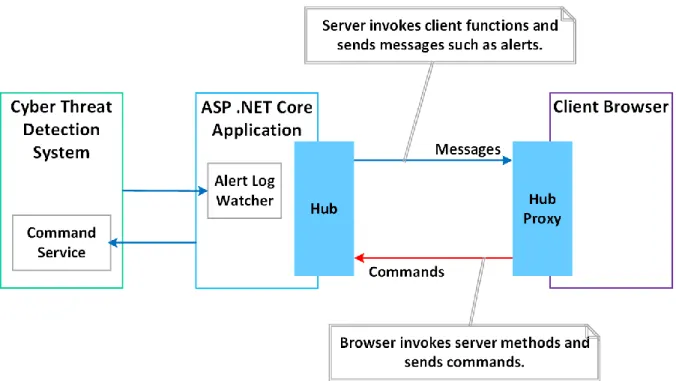
The new framework analyzes network traffic behaviors to detect cyber threats. The framework is intended to be used by security analysts and security tool developers. Design science research methodology was used to design, develop, and evaluate the proposed framework. Each component of the framework has been developed using superior cutting-edge technologies such as .NET Core to target multiple platforms, multithreading for robust performance, the machine learning framework used in security tools, and WebSocket for real-time communication for alerting service. Mathematical analysis has been performed to design efficient algorithms when necessary. A case study has been employed to evaluate the
framework and compare the customized search engine model with the machine learning model.
1.2 Design Research Problems
As a solution-oriented technical research project, this research designs artifacts that improve existing threat detection approaches and conducts experiments to answer empirical questions about the efficiency, accuracy, and performance of the designed artifacts. The following are a list of Knowledge Problems (KP) and Design Problems (DP) that are investigated and answered in the research:
A. KP: How do the signature-based and anomaly-based detections systems function?
• What specific techniques are used?
B. KP: What are the advantages and disadvantages of signature-based and anomaly-based detection techniques?
C. DP: How can the threat detection framework be designed using search engine and machine learning techniques?
• KP: What are the benefits of using a search engine for a threat detection framework?
D. DP: Which system requirements and specifications need to be included in the proposed framework?
E. DP: Which design makes for the best cyber threat detection framework using search engine and machine learning?
• What is the training data selection strategy?
F. KP: Are there standard evaluation criteria for intrusion detection techniques?
• DP: What comparison criteria can be designed if they are not already available?
G. KP: How should the evaluation dataset be chosen?
• DP: What is the evaluation data selection strategy?
H. KP: What is the performance of the proposed threat detection technique and the framework as a solution?
• How fast are the algorithms?
• How efficient are the components at handling large datasets?
• How accurate is the detection system?
• How broad is the training data coverage?
1.3 Design Theories and Hypotheses
A design science project uses prior knowledge, which includes design specifications, useful facts, and practical knowledge, to produce additional knowledge, called posterior knowledge (Wieringa, 2014). A design theory contains generalizations (treatment) about the effects of the interaction between an artifact and its context. The design theory describes the effect of an artifact in the context. Artifacts include devices, software, techniques, notations, and so on that are designed for the purpose of contributing to stakeholder goals (Wieringa, Daneva, & Condori-Fernandez, 2011). In this research, the primary artifacts include two engines—a custom search engine and a machine learning model—as well as algorithms and techniques such as indexing, searching, training, prediction, and binary classification within the context of cyber threat detection. The developed cyber threat detection framework is
intended to be used primarily by security analysts and security tool developers (stakeholders). Wieringa’s (2014) effect generalization states that “(an artifact designed like this) interacting with (a context satisfying these assumptions) produces (effects like these)” (p. 96). This can be expressed as (specifications of artifact) X (assumption about context) → effects. The effect is a generalization over a class of similar artifacts and a class of similar contexts. The
following design theories using effect generalization provide the basis for this research and are thoroughly investigated within it. These serve as warrants and arguments used to prove the main research hypothesis, which is that the use of a search engine as a cyber threat detection system with machine learning techniques provides an improved cyber threat detection approach:
1. Search engines use similarity measures between indexed documents in a Vector Space Model (VSM) to search for matching documents for a given query (Turney & Pantel, 2010).
2. A search engine can be tuned up to efficiently process data within a specific context (for example, Google image search, Google Scholar). Therefore, a search engine can be customized to process network traffic data in cyber threat detection contexts. 3. As a search engine is primarily used for text data mining, machine learning can be
applied to it for the best result (Chauhan et al., 2015). Therefore, machine learning can also be applied to the custom search engine specially designed to process network traffic data.
4. Network traffic data can be mapped to a special form of dataset that uniquely specifies the traffic, which is called feature extraction. The extracted features set can be
arranged in a way that makes it suitable for indexing in a search engine. Based on the training data, the set of features data represents a single event and can be classified as safe and unsafe while indexing. Each feature set can be represented as a vector within the search engine VSM.
5. The search engine has a searcher component that can retrieve the best matches for a given query from the index based on configured similarity algorithms. Input traffic data can be a query for the searcher to return the top matching results. Similarity measures can be used to compare the similarity between documents. When VSM is used for classification, the nearest-neighbor algorithm can use similarity measures
(Turney & Pantel, 2010). Therefore, the matching results likely determine the type of the input traffic—that is, whether it is safe or a threat.
6. The search engine can be reinforced by machine learning techniques to increase its accuracy (Mitra et al., 2017; Yin et al., 2016) and to expand its capability to detect yet unknown malicious traffic.
1.4 Research Goals and Scope
The purpose of this research project is to design and develop a network traffic analysis framework for cyber threat detection primarily using search engine and machine learning techniques. The popular opensource Intrusion Detection Systems (IDS), Snort, Suricata, and Bro (Hu et al., 2017; Thongkanchorn et al., 2013), as well as machine learning-based
detection techniques, are investigated to identify the basic design specifications for the proposed framework. This research is intended to improve cyber threat detection approaches by using hybrid technologies, such as a search engine that is specifically customized to classify traffic data, and a machine learning model in order for security analysts to analyze network traffic activities for the purpose of cyber threat detection.
The scope of this research comprises customizing search engine components such as the analyzer, tokenizer, indexer, and searcher, developing a machine learning based threat detection engine, and evaluating and validating these components. The research is limited to the development of a threat detection framework that can be used in security tools or can grow to a standalone cyber threat detection application and does not produce a complete end-to-end cyber threat detection appliance.
1.5 Structure of the Research Paper
This research paper has been divided into six chapters. As it involves the development of software, contents are organized to show the details of each major software engineering phase, such as requirement analysis, system design, system development, testing, and deployment. Chapters are organized as follows:
Chapter 1. Introduction: This chapter discusses the background of the research, research problems, theories and hypothesis, and research goals and scope.
Chapter 2. Literature Review: The literature review chapter provides a comparative analysis of existing cyber threat detection tools, intrusion detection approaches, network traffic analysis tools, and detection algorithms. This chapter also discusses existing machine learning and search engine technologies. Finally, this chapter lays out the basic specifications for the new cyber threat detection framework.
Chapter 3. System Design: This chapter incorporates research methodology as well as the new framework design from a software engineering perspective. Several architectural diagrams, algorithm designs, and use cases are discussed in this chapter. A prototype project analysis is included in this chapter to make design decisions on the core algorithms.
Chapter 4. System Development: This chapter discusses implementation of the new framework and its components as designed in Chapter 3. This chapter involves mathematical analysis and the development of algorithms and components.
Chapter 5. Case Study: This chapter discusses setting up evaluation metrics, evaluating of algorithms and components, optimizing techniques, and validating and
deploying the new framework. Empirical analysis and performance results of the framework are discussed in this chapter.
Chapter 6. Conclusion: This chapter concludes with the overall outcome of the research, its contributions and limitations, and recommendations for future development.
CHAPTER 2
LITERATURE REVIEW
The National Institute of Standards and Technology (NIST) defines the term intrusion as the “unauthorized act of bypassing the security mechanisms of a system” (p. 104). The institute defines the term “threat” as “any circumstance or event with the potential to adversely impact organizational operations (including mission, functions, image, or
reputation), organizational assets, individuals, other organizations, or the Nation through an information system via unauthorized access, destruction, disclosure, modification of
information, and/or denial of service” (Kissel, 2013, p. 202). Intrusion detection is the formal process of detecting intrusions, generally characterized by gathering and analyzing
information about abnormal usage patterns and processes in order to determine if a security breach or violation has occurred.
Before the development of Intrusion Detection (ID) tools, system administrators used to check user and device activities by sitting in front of screens. Then in the late 1970s and early ’80s, administrators were able to print activity logs although the manual log analysis was time consuming and inefficient at catching attacks in progress. In the early ’90s real-time intrusion detection systems that could detect attacks as they occurred emerged; in some cases, this allowed real-time responses to the attacks (Kemmerer & Vigna, 2002).
The first idea of ID was published in 1980 by James P. Anderson who outlined computer security problems within United States Air Force operations. The first model of a real-time Intrusion Detection System (IDS), the Intrusion Detection Expert System (IDES), was developed between 1984 and 1986 by Dorothy Denning and Peter Neumann. The tool was a rule-based system that detected known malicious activities. Then in the 1980s and ’90s, research about IDS was begun and funded by the US government, and IDS tools such as Discovery, Haystack, Multics Intrusion Detection and Alerting System (MIDAS), and Network Audit Directory and Intrusion Reporter (NADIR) were developed. In 1997 the first commercial real-time attack detection called RealSecure was developed for Windows NT 4.0. But as networks expanded and got faster, carrying out network-based attack detection became
difficult. Therefore, to solve this problem, host-based intrusion detections such as TCP Wrappers, Tripwire, and Snort were introduced. Snort was introduced in 1998 for UNIX systems, and then was ported to Windows systems in 2000 (Bruneau, 2001).
2.1 Intrusion Detection Systems
Based on the scope of the detection, there are two types of IDS: Network Intrusion Detection Systems (NIDS) and Host-Based Intrusion Detection Systems (HIDS) (Samrin & Vasumathi, 2017). Based on the detection techniques, intrusion detection systems can be classified into two groups: signature-based detection and anomaly-based detection (Bello et al., 2015; García-Teodoro et al., 2009). In some research (Bello et al., 2015; Samrin & Vasumathi, 2017) signature-based detections are called misuse detections.
2.1.1 Signature-Based Detection Systems
Signature-based detection mechanisms search for predefined signatures or patterns within the analyzed data to determine an attack (García-Teodoro et al., 2009). There are several IDS in the cybersecurity industry, but the popular opensource IDS solutions are Snort, Suricata, and Bro (Hu et al., 2017; Thongkanchorn et al., 2013).
Snort: Snort is an opensource intrusion detection and prevention system originally developed in 1998. Snort is capable of real-time traffic analysis and packet logging with minimal disruption to running operations. Snort uses rule-based pattern-matching techniques to detect intrusions. Snort rules specify unique characteristics of the network traffic and trigger an alert when conditions met. In Snort, rules are divided into two parts: the header and the options. The rule header contains the action, protocol, IP addresses, and port numbers of the rule. The rule option part contains alert messages and information on which parts of the packet should be inspected (Cisco, 2019). As Snort is a signature-based detection system, it cannot detect previously unseen attacks. Developing a Snort rule, therefore, requires a core understanding of how the vulnerability works. Because Snort is widely known in the industry, extension works have also been created to optimize it. For instance, (Gómez et al., 2009) extended Snort by adding a statistical anomaly-based detection feature. The training model is
stored in a MySQL database. The performance of this approach depends on the database operations and the statistical model.
Suricata: Introduced in 2009, Suricata is another popular signature-based detection system. Like Snort, it is an opensource threat detection engine using extensive rules and signature language. Suricata supports standard input and output formats like YAML Ain’t Markup Language (YAML) and JavaScript Object Notation (JSON), and it integrates with external systems like Logstash, Kibana, and different databases. Suricata signatures/rules consist of three parts: the action that determines when the rule matches; the header that defines the protocol, IP addresses, and direction of rules; and the rule options that define specific properties of the rules. Suricata offers compatibility with Snort rules (Suricata, 2019), and can handle larger volumes of traffic than Snort with similar detection capability (Albin, 2011). As Suricata is a multithreaded system, its detection capability is more accurate in multicore environments; however, Suricata has higher system overhead than Snort and is less accurate in stressed environments (Day & Burns, 2011). Suricata uses Lua scripting language, which provides the flexibility to create dynamic rules that would be difficult to create with Snort.
Bro: Bro, recently renamed Zeek, is a network security monitor system used to detect suspicious activity, measure performance, and troubleshoot. Bro is an opensource project that has been in development since 1995, but the project has been widely supported since 2010. Unlike Snort and Suricata, Bro focuses extensively on network analysis. Bro has the
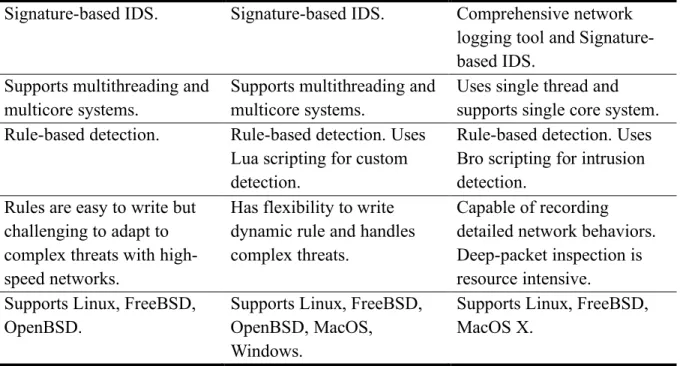
capability to log and store network activities in high-level terms (ASCII forms) for several application-layer protocols, such as DNS, FTP, HTTP, IRC, SMTP, SSH, and SSL. Bro uses standard log file formats, which is suitable for postprocessing with external log searchers and databases, such as Elasticsearch. Bro supports pattern-based intrusion detection and uses an event-based programming model for anomaly detection. Bro is a single-threaded application and runs on a single core; however, it supports clustered deployment so that multiple workers can process the traffic streams (The Zeek Project Revision, 2019). Table 1 summarizes the three popular intrusion detection systems.
Table 1. Summary of Snort, Suricata, and Bro
Snort Suricata Bro
Signature-based IDS. Signature-based IDS. Comprehensive network logging tool and Signature-based IDS.
Supports multithreading and multicore systems.
Supports multithreading and multicore systems.
Uses single thread and supports single core system. Rule-based detection. Rule-based detection. Uses
Lua scripting for custom detection.
Rule-based detection. Uses Bro scripting for intrusion detection.
Rules are easy to write but challenging to adapt to complex threats with high-speed networks.
Has flexibility to write dynamic rule and handles complex threats.
Capable of recording detailed network behaviors. Deep-packet inspection is resource intensive. Supports Linux, FreeBSD,
OpenBSD.
Supports Linux, FreeBSD, OpenBSD, MacOS, Windows.
Supports Linux, FreeBSD, MacOS X.
2.1.2 Anomaly-Based Detection Systems
Anomaly-based detections identify a suspicious event from a security perspective by analyzing its behavior. Anomaly-based detection techniques can be classified into three groups based on the nature of the behavioral model processing: statistical-based, knowledge-based, and machine learning-based. Statistical-based detection is based on the metrics of the network traffic, such as traffic rate, number of packets per protocol, and number of IP addresses. The detection system compares the current traffic behavior with the previously trained statistical profile. Knowledge-based systems are expert systems intended to identify classes from the audit data according to a set of rules, parameters, or procedures. Machine learning-based techniques are based on models that enable the patterns analyzed to be categorized (García-Teodoro et al., 2009).
In anomaly-based detection systems, there are two phases: the learning phase and the detection phase. The detection system builds a system profile in the learning phase and compares the current system parameters with the one stored in the learning phase; if there is a deviation, an alert is reported. Therefore, anomaly-based detection systems can detect yet unknown attacks (Al-Jarrah & Arafat, 2015). Machine learning detection techniques such as
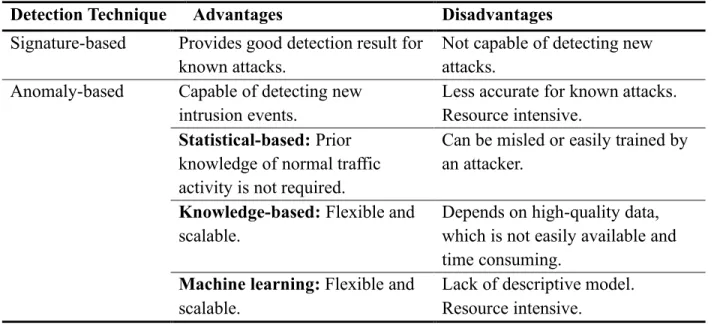
Neural Networks classify different forms of network attacks (Mowla et al., 2017). Using intrusion detection techniques based on Convolutional Neural Networks (CNN) improves the accuracy of detection system since they can extract enhanced behavior features (Lin et al., 2018). Table 2 summarizes the pros and cons of signature-based and anomaly-based intrusion detection systems.
Table 2. Comparison between Signature-Based and Anomaly-Based Intrusion Detection Techniques
Detection Technique Advantages Disadvantages Signature-based Provides good detection result for
known attacks.
Not capable of detecting new attacks.
Anomaly-based Capable of detecting new intrusion events.
Less accurate for known attacks. Resource intensive.
Statistical-based: Prior knowledge of normal traffic activity is not required.
Can be misled or easily trained by an attacker.
Knowledge-based: Flexible and scalable.
Depends on high-quality data, which is not easily available and time consuming.
Machine learning: Flexible and scalable.
Lack of descriptive model. Resource intensive.
2.2 Machine Learning Algorithms in Intrusion Detection Systems
2.2.1 Machine Learning
There are several machine learning algorithms such as classification, logistic
regression, etc. In machine learning the intrusion detection lies in the classification problem category. There are two machine learning techniques for data classification and clustering: supervised and unsupervised learning. The supervised learning method uses labeled datasets to learn the classification, whereas unsupervised learning finds similar groups within the training dataset (Kong et al., 2018).
2.2.2 Machine Learning Tools
Machine learning tools vary by the algorithms and techniques they support,
programming languages they use, ease of implementation, and prediction accuracy of trained models. Machine learning tools share trained models. For instance, a TensorFlow trained model can be used by ML.NET (Microsoft, 2019a). Some of the machine learning tools that support classification algorithms are listed as follows:
Weka: Weka (Waikato Environment for Knowledge Analysis) is collection of data mining algorithms. It was first developed in C by the University of Waikato, New Zealand in 1997, then later rewritten in Java. It is composed of several data processing and classification algorithms such as classification, clustering, and regression (Choudhury & Bhowal, 2015; Hall et al., 2009).
TensorFlow: A machine learning tool developed by Google that focuses on deep neural networks, TensorFlow uses unified dataflow graphs to represent the computation in an algorithm, a shared state, and the operations that mutate that state. Several Google services use TensorFlow (Abadi et al., 2016).
Microsoft Cognitive Toolkit (CNTK): An opensource artificial intelligence toolkit developed by Microsoft, (Microsoft, 2019) claims that the CNTK toolkit is commercial-grade quality and compatible with many programming languages and algorithms. The CNTK is scalable for efficiency and capable of running on CPU, GPU, and distributed environments.
ML.NET: ML.NET framework is an opensource and cross-platform machine learning framework used to develop machine learning models using C# or F# languages. The ML.NET framework incorporates data loading, transformation, model training, and evaluation. Data transformation, normalization, and different machine learning algorithms, such as SymSGD, SDCA, FastTree, LightGBM, K-Means, SVM, and Averaged Perceptron, are supported by the framework. ML.NET works with other machine learning tools such as TensorFlow,
Accord.NET, and CNTK (Microsoft, 2019a). Although ML.NET was initially released as recently as 2018 as an opensource machine learning component, the underlying machine learning components have been used for over a decade in Microsoft products such as Microsoft Defender Advanced Threat Protection (ATP), Windows Defender, and Anomaly Detection in Azure Stream Analytics (Microsoft, 2019d, 2020).
2.2.3 Classification Algorithms
In (Choudhury & Bhowal, 2015; Garg & Khurana, 2014) machine learning classifier techniques are grouped into several types based on their functionality and the machine learning algorithms they are using. The common classification groups used in both Choudhury and Bhowal, and Garg and Khurana include Bayes Classifier, Functional Classifier, Lazy Classifier, Meta Classifier, Multi-Instance Classifier, Rules Classifier, and Decision Tree-based classification. Table 3 shows a list of classification algorithms in recent research.
Table 3. Classification Algorithms and Models
Classification Algorithm Model
SVM Vector Space
K-Means Euclidean Space Distance
C4.5 Decision Tree
J.48 Decision Tree
Random Forest Decision Tree
Bayes Net Graph model
SVM: Support Vector Machine (SVM) is a supervised learning algorithm that represents features data in the form of n-dimensional vectors and gives a specific score to each piece of feature data as the basis of evaluation (Qi et al., 2017). SVM was first introduced in 1963 but became widely used in deep neural network-based learning in the 1990s (Qi et al., 2017). The SVM algorithm uses hyperplanes to classify linear datasets. However, in real cases the dataset may be nonlinear. Therefore, SVM uses different kernels to transform initial features to higher dimensional space in order to address nonlinear classifying techniques. Type of kernels include Linear kernel, Polynomial, RBF (Radial basis function) kernel, and Sigmoid kernel (Kong et al., 2018).
K-Means: K-Means is an unsupervised algorithm to cluster data with similar properties using the Euclidean space distance measurement by finding the centroid of the clusters (Qi et al., 2017).
C4.5 Algorithm: Also called Statistical Classifier, this machine learning algorithm builds decision trees from the training data for classification (Singh & Agrawal, 2011).
J.48: This type of decision tree depends on the variables (features in the training data). The dependent variables (labels) are decided by the value of the connected nodes, which represent the independent variables (features). The root node contains the feature with the highest information gain to build the decision tree (Mehmood & Rais, 2016).
Random Forest: This decision tree-based algorithm uses several methods to obtain better prediction performance (Choudhury & Bhowal, 2015).
Bayes Net: This is a probabilistic graphical model based on the Bayes theorem to form a Bayesian network with each node representing a random variable. The edges between the nodes represent probabilistic dependencies among the random variables. Statistical
methods are often used to compute the probability of the nodes (Choudhury & Bhowal, 2015; Singh & Agrawal, 2011).
2.2.4 Performance Analysis of Classification Algorithms
In a comparative analysis of machine learning algorithms (Singh & Agrawal, 2011), the C4.5 and Bayes Net showed better accuracy in IP traffic classification. The experiment used two different datasets with 2,800 data samples, out of which 300 samples were used for testing. Traffic classification using the C4.5 and Bayes Net algorithms resulted in about 94% accuracy. The experiment used Weka as a machine learning tool.
In another study (Choudhury & Bhowal, 2015), several algorithms were used to classify network traffic to detect anomalies using Weka. The training dataset consisted of 1,166 records with 42 features and the testing dataset consisted of 7,456 records. Analysis results show that Random Forest and Bayes Net algorithms yielded greater accuracy with 91% and 90%, respectively.
In an experiment using Weka and the NSL-KDD dataset with 94,000 training data instances and 48,000 instances for testing, the Random Forest classification algorithm was among the top-performing algorithms along with Rotation Forest, Random Tree, and Random Committee (Garg & Khurana, 2014). Each instance in both sets was composed of 41 features. The dataset contained four types of attacks: DoS (Denial of Service), R2L (Remote to Local), U2R (Unauthorized access to local superuser), and Probing (surveillance or others).
In another study (Sewak et al., 2018), Random Forest classification algorithm showed a greater accuracy than Deep Neural Network (DNN) algorithms for malware classification. The experiment used 11,308 malicious files and 2,819 benign files. The Adaptive Synthetic (ADASYN) technique was used to balance the training dataset classes. The analysis was performed on the opcodes of each instances using the Linux objdump utility. The training-testing dataset was randomly split to the ratio of 2:1. The Python libraries Sci-Kit and Keras with TensorFlow were used for Random Forest and DNN, respectively. Results showed that Random Forest, with an accuracy of 99.78%, slightly outperformed DNN, which had an accuracy of 99.21%.
A different study (Narudin et al., 2016) investigated 1,000 malware families with 49 different families out of the 1,260 MalGenome project dataset, and the top 20 free apps from Google Play store as benign apps. Eleven TCP/IP-based features were extracted from the network traffic for training and testing. The research results showed 99% malware detection accuracy with Random Forest classifier algorithm.
In a study performed on traffic data to classify attacks and normal traffic using supervised and unsupervised learning, K-Means classification was used for unsupervised learning, and SVM was used for supervised learning (Kong et al., 2018). The KDD’99 dataset, a widely used dataset in anomaly-based detection experiments, was used with 42 features extracted based on traffic flow (Mehmood & Rais, 2016). The experimental dataset consisted of four types of attacks: DoS, R2L, U2R, and Probing. Further, the result showed 91% accuracy with SVM and 83% accuracy using K-Means. However, SVM was slower to predict specific attacks in the dataset than the K-Means algorithm.
In a particular study of intrusion-detection research (Mehmood & Rais, 2016), SVM, Naïve Bayes classifier, J.48 decision tree, and decision table algorithms were used on the KDD99 dataset. The analysis result showed that each algorithm had different results in the classification of each of the attack classes (DoS, R2L, U2R, Probe) and normal traffic. No algorithm outperformed the others with a high true positive rate (TPR). The J.48 decision tree algorithm was found to have the highest accuracy and minimum classification error.
Table 4. Performance of Classification Algorithms
Algorithm Training Data Count Testing Data Count Overall Accuracy
C4.5 2800 300 94% Bayes Net 2800 300 94% Random Forest 1166 7456 91% Bayes Net 1166 7456 90% Random Forest 14127 4700 99.78% DNN 14127 4700 99.21%
As summarized in Table 4, decision tree-based classification algorithms provide good results in the context of network traffic analysis. Based on results compiled from different studies, Random Forest classification shows better accuracy over the other decision tree-based classification algorithms and DNN in network classification for intrusion detection.
2.3 Search Engine and Vector Space Model
Search engines are capable of efficiently processing large volumes of data and are known for fast information retrieval. Search engine processes have at least two major phases: indexing and searching. Data structure models such as VSM are used in search engines for efficient data processing and document matching. In search engines, the concept of VSM is used to represent each document mathematically as a vector in space. Document similarity is based on the notion that vectors that are closer to each other are semantically similar and vectors that are far apart are semantically less similar (The Apache Software Foundation, 2019).
VSM was first developed in 1975. The idea of VSM was to represent documents with vectors in a document space for efficient document retrieval (Salton et al., 1975). Vectors are common in Artificial Intelligence and cognitive sciences (Turney & Pantel, 2010). The VSM can be used in classification problems such as spam Short Message Service (SMS) filters in the telecommunication industry (Li & Zeng, 2016). In VSM, terms in the documents are represented by vectors, which consist of term weights to signify the semantic value of the term in the document. The commonly used weighting algorithms are Term Frequency (TF)
and Inverse Document Frequency (IDF) (Li & Zeng, 2016). The TF-IDF weight is a statistical measure used to evaluate the importance of a term to the document in the collection. The Term Frequency (TF) is the count of terms in the document. IDF measures the uniqueness of the term with respect to the entire corpus (Pathak & Lal, 2017). IDF is computed from the total documents count and the count of documents that contain at least one occurrence of the term.
𝑇𝐹𝑖 = 𝑙𝑜𝑔2(𝑡𝑓𝑖𝑗)
Where tfij represents the frequency of term i in document j.
𝐼𝐷𝐹𝑖 = 𝑙𝑜𝑔2(𝑁
𝑛𝑗) + 𝐼 = 𝑙𝑜𝑔2(𝑁) − 𝑙𝑜𝑔2(𝑛𝑗) + 1
Where N is the number of total documents and nj is the count of documents that contain at least one occurrence of term i.
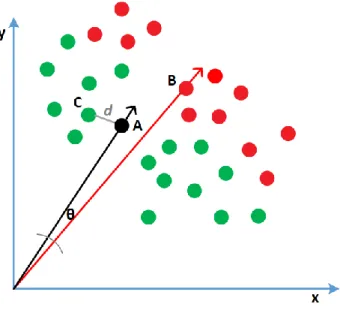
The measure of the distance between two vectors is the measure of similarity between them. The most popular distance measures for vectors includes Euclidean distance, Manhattan distance, Cosine similarity, Dice, and Jaccard Coefficient. Research shows that the Cosine similarity is the best formula for similarity measurement in search engines. With the Cosine formula, the length of the vectors is less relevant; what is important is the angle between them (Turney & Pantel, 2010). The Cosine of angle θ between vectors A and B can be expressed as:
cos(𝜃) = A ∙ B
∥ A ∥∥ B ∥
As noted in (Yin et al., 2016), retrieving the most relevant result is the core problem of commercial search engines. The problem of relevance in search engines is beyond text
matching. The search problem can be treated as a binary problem to filter out irrelevant results from relevant ones. The research work that has been tested and deployed in the Yahoo commercial search engine shows that adding machine learning algorithms increases
relevance. Decision tree algorithms such as Gradient Boosting Decision Tree (GBDT) with logistic loss can find a decision boundary that can classify bad URLs as opposed to relevant ones (Yin et al., 2016).
Search engines can be reinforced by machine learning for accurate search results (Chauhan et al., 2015). There are many machine learning algorithms that can work with VSM. If the machine learning algorithm uses real-valued vectors, it can use vectors from VSM. Machine learning algorithms can handle vector comparison, and vectors from VSM may also be used in semi-supervised learning (Ando & Zhang, 2005). In some studies, network
intrusion detection systems using neural networks showed better detection results than known intrusion detection tools like Snort (Al-Jarrah & Arafat, 2015). Neural networks also achieved better results over other vector-based models (Hung et al., 2017).
2.3.1 Search Engine Libraries
There are several commercial and opensource search engines. Google, Bing, and Yahoo are among the top commercial search engines. Opensource search engines include Lucene, Indri, Terrier, Sphinx, and Xapian. Lucene, Indri, and Terrier are the popular search engine libraries that are tuned up for fast execution time (Mitra et al., 2017) and support multiple language interfaces.
Lucene: Lucene is an opensource fully featured search engine library with advanced analysis capabilities. First started in 1997 by Doug Cutting, it was later donated to the Apache Software Foundation in 2001 (Białecki et al., 2012). Offering VSM and efficient indexing, storage, searching, and ranking functionalities, Lucene can be customized. It has a scalable and high-performance indexing library. Its memory requirement ranges from 1MB through systems with several cores. Lucene also supports concurrent searches (The Apache Software Foundation, 2019). Lucene is used by AOL, Comcast, Disney, Wikipedia, Twitter, Netflix, Instagram, and other search engines (Białecki et al., 2012; Turney & Pantel, 2010).
Indri: An opensource search engine library that can provide text searches and
structure query language, Indri supports multithreading and distributed search, and can run on a cluster of nodes for faster indexing and searching. It allows fine-grained control of searching and low-level access to document repositories (Van Gysel et al., 2017).
Terrier: An opensource Java-based search engine developed at the University of Glasgow, Terrier supports term dependence proximity models and supervised ranking models via learning to rank. Learning to rank in the Terrier search engine means using multiple calculated features in a uniform way during ranking, and learning an appropriate method to
combine those features. The calculated features can be query-dependent or independent (University of Glasgow, 2019).
In a study that compared the two search engines, Lucene and Indri, Indri results were better than Lucene for short queries; however, Lucene is faster than Indri for long queries. The two search engines also yield different documents, especially for short queries (Turtle et al., 2012).
2.4 Network Traffic Analysis Tools
Network traffic analysis tools involve packet capturing and analysis. Packet capturing is a process of collecting packets as they travel over a network. Packet capturing takes place in kernel space, but analysis tools run in the user space (Gracia, 2008). There are several network traffic analysis tools; however, this section mainly reviews the popular network traffic analysis tools that support packet capturing, filtering, and analysis: Microsoft Message Analyzer, Wireshark, NetworkMiner, Fiddler, and OpenNMS.
2.4.1 Microsoft Message Analyzer
The Microsoft Message Analyzer is the successor to Microsoft Network Monitor 3.4, used for capturing, displaying, and analyzing network traffic, events, and application log messages in network and other diagnostic scenarios. It can capture local or remote traffic and live or archived data from multiple data sources simultaneously. Highlighted features include automated data capturing, session filters, flexible user interface, etc. Microsoft Message Analyzer functionalities are enabled for PowerShell scripting environments. This includes stopping a trace session, saving trace session data without stopping the session, injecting a trace filter into a trace session at specific time, and miscellaneous scripting for remote traffic capturing. During a live trace session, data selection can be performed by applying session filters to isolated trace results for analysis. There are several session filter techniques such as fast filter, which operates at the kernel level; keyword filter; and Windows Filtering Platform (WFP) Layer set filter, which consists of kernel-mode TCP/IP stack filters that operate at the Transport layer. These session filter techniques allow selectively enabling or disabling of inbound or outbound packets at the Transport layer when capturing IPv4 or IPv6 messages. Other filter options include HTTP filters, which are enabled to isolate traffic based on the
hostname or port value. Keyword and Level filters can be used when configuring a live trace session that uses a system Event Tracing for a Windows (ETW) Provider (Microsoft, 2016).
2.4.2 Wireshark
Wireshark was first started by Gerald Combs in late 1997 with its original name, Ethereal. In 2006 the Ethereal project was renamed Wireshark, and version 1.0 was released in 2008. Wireshark is an interactive network protocol analyzer and capture tool that provides detailed inspection of several protocols and runs on multiple platforms. An opensource software, Wireshark can decrypt protocols such as SSL/TSL, WEP, WPA/WPA2, Kerberos, and more. Wireshark can capture traffic from many different network media types such as Ethernet, Wireless LAN, Bluetooth, USB, and more. Wireshark has a terminal-based version called TShark. TShark captures data from live traffic or from a previously saved capture file, prints a decoded form of the packets to the standard output, or writes packets to a file. TShark has several options and parameters to perform packet analysis. Without any options set, TShark works like Tcpdump (Wireshark, 2019). The Tcpdump tool prints out a description of contents of packets on a network or saves the packet data to a file. Windump is a clone of Tcpdump for Windows operating systems (Tcpdump, 2019). Wireshark uses Libpcap library to capture packets directly from the network card. Libpcap provides a high-level interface to network packet capturing. It was first developed by McCanne, Leres, and Jacobson in 1994 (Gracia, 2008). Libpcap supports packet filtering at the kernel level for systems that support Berkeley Packet Filter (BPF).
2.4.3 Other Tools
These tools provide specific traffic analysis functionalities such as analyzing specific protocols, extract files, analyzing network status, etc.
Telerik Fiddler: A web application debugging tool that can capture HTTP traffic between the client and the server, Telerik Fiddler allows users to monitor and modify HTTP responses and requests in transition. Fiddler provides detailed information about HTTP traffic and can be used for performance testing and debugging for web applications. Fiddler can also decrypt HTTPS traffic (Telerik, 2019).
NetworkMiner: NetworkMiner captures and parses network packets to extract files, images, and other artifacts to reconstruct events that a user has received on the network.
Classified as a Network Forensic Analysis Tool (NFAT), NetworkMiner can process archived Packet Capture (PCAP) files (Netresec, 2019).
OpenNMS: An opensource network management application that offers event and notification management, OpenNMS has a framework that logically groups related faults (alarms) into higher level objects (situations). The framework supports unsupervised machine learning and deep learning algorithms. OpenNMS has a web-based user interface to display any outages, alarms, or notifications in the network infrastructure (OpenNMS, 2019).
CICFlowMeter: An opensource bidirectional network traffic flow generator. It can generate statistical features from PCAP files and live traffic. (Canadian Institute for
Cybersecurity, 2019). CICFlowMeter will be discussed more later in the next chapters.
2.5 Literature Review Summary
In this section, details of signature-based and anomaly-based threat detection systems and widely used opensource intrusion detection systems have been discussed. In general, the literature review shows that anomaly-based intrusion detection is the most recent development in intrusion detection technologies. It is also likely the future of intrusion detection
technologies. Specific aspects of machine learning techniques, and search engine internals have also been discussed. Decision tree-based classification algorithms show better attack classification than anomaly-based intrusion detection systems. The design of the new
framework, which involves a custom search engine and machine learning techniques, will be discussed in the next chapter.
2.5.1 Basic Design Specifications of the Proposed Framework
In order to improve the existing traffic analysis approach for threat detection, which is the purpose of the research, the following specifications need to be incorporated in the
proposed framework based on the literature review:
1. The proposed network traffic analysis framework should support anomaly-based intrusion detection because anomaly-based detection approach has better detection capability than signature-based detection approaches.
2. A decision tree-based classification algorithm should be used as a primary classifier for machine learning because decision tree-based algorithms achieve greater accuracy than other algorithms.
3. For comprehensive analysis, the proposed framework needs to use the Microsoft ML.NET machine learning framework because it is opensource and actively supported by Microsoft. It also supports the trained models of other machine learning tools such as TensorFlow and CNTK. Microsoft ML.NET is used by security tools like Windows Defender, is well documented, and supports several classification algorithms including decision tree-based algorithms.
4. Lucene needs to be used as a search engine library because Lucene supports several functionalities, is widely used in large-scale search applications like Wikipedia, and is easily extensible.
5. The proposed framework should be evaluated against a large dataset to perform empirical analysis on its performance and accuracy. Most studies reviewed in this literature review used fewer than 20,000 data instances to evaluate intrusion detection approaches.
Chapter 2 illustrated the comparative analysis of existing cyber threat detection tools, intrusion detection approaches, network traffic analysis tools, and detection algorithms. This chapter also discussed existing machine learning and search engine technologies. Finally, this chapter laid out the basic specifications for the new cyber threat detection framework.
CHAPTER 3
SYSTEM DESIGN
This chapter incorporates research methodology as well as the new framework design from a software engineering perspective. Several architectural diagrams, algorithm designs, and use cases are discussed in this chapter. A prototype project analysis is included in this chapter in order to make design decisions on the core algorithms.
3.1 Research Methodology
There are three factors to consider when selecting a research approach: the research problem, the personal experience of the researcher, and the audience of the research. For example, if the problem is to identify factors that influence an outcome, then a quantitative approach is best. If a concept or phenomenon needs to be understood, a qualitative research approach is preferred (Creswell, 2014).
This research is solution-oriented with the primary goal of improving threat detection system by designing new artifacts. Design science has a problem-solving paradigm that seeks to create new and innovative artifacts (Hevner et al., 2004). According to (Wieringa, 2014), design science is the design and investigation of artifacts in a specified context. Artifacts are designed to improve something in that context. In this research, several techniques (artifacts) are used to improve cyber threat detection (context) approaches. Wieringa (2014) defines Technical Action Research (TAR) as a way to validate the artifact in the field. TAR is artifact-driven and part of the validation of an experimental artifact. In TAR, the researcher plays three roles: (a) as a technical researcher, the researcher designs a treatment intended to solve a class of problems; (b) as an empirical researcher, the researcher answers some validation questions about the treatment; (c) as a helper, the researcher applies a client-specific version of the treatment to help a client. In this research, the researcher designs a new approach to improve existing threat detection mechanisms, provides empirical evidence on the validity of
the new approach, and provides a means of applicability of the new approach in the field of cyber threat detection by designing and developing the proposed framework.
The initial survey of (Santos & Travassos, 2009) indicates that there is an increasing tendency to use TAR in software engineering addressing different research topics. Wieringa (2014) stated that single-case mechanism experiments are useful for implementation
evaluation in TAR because they can provide insight into the behavior of artifacts and
problematic phenomena in the real world. Single-case experiments can be done in the lab or in the field. This research employs lab research for evaluation because the researcher can control the lab environment within the scope of this research.
This research comprises three major phases: problem analysis, solution design, and evaluation and validation. The problem analysis was conducted through a literature review. In the literature review, existing cyber threat detection approaches such as signature-based and anomaly-based detection techniques were investigated. The problems of the investigated approaches were clearly identified. Based on the problem analysis, requirements for the new approach were derived. As shown in Figure 1, the new framework solution must be designed with respect to the identified specifications and proposed techniques. Finally, each artifact implementation is evaluated, and the designed solution as a whole is validated.
Figure 1. Conceptual design of the proposed framework.
3.2 Treatment Evaluation and Solution Validation
Evaluation in design science research consists of evaluation of design science theories and artifacts (Pries-Heje et al., 2008). In this research the evaluation phase focuses on the newly developed artifacts such as custom search engine components and machine learning components. Evaluation requires researchers to demonstrate the utility, quality, and efficiency of artifacts using rigorous evaluation methods (Hevner et al., 2004). According to (Olan,
2003), validation is a process designed to ensure confidence that the program functions as intended. As a piece of software engineering research, software engineering phases like unit testing and system testing are employed in the evaluation process. Generally, validation involves testing. Careful testing greatly increases the confidence that a program satisfies its specifications. Therefore, treatment evaluation is supported by unit testing. Unit testing validates the correctness of program components. (Koomen & Pol, 1999). Unlike an observational case study, unit testing requires a unit tester to intervene in each use of the artifact to see “what happens” when using software development tools like debuggers. Once bugs are identified through unit testing, artifacts are modified for improvement until the unit test passes in the defined framework. System testing is applied to validate the interaction of artifacts and optimize efficiency of the system.
3.3 Artifact Design and Implementation
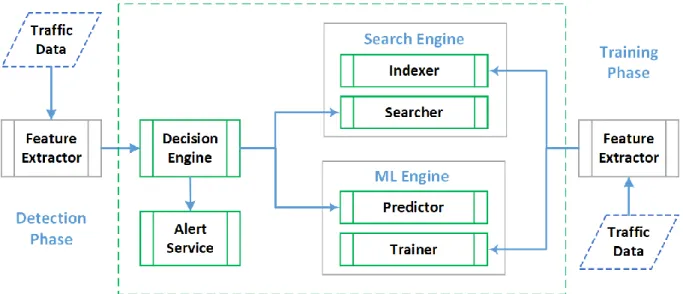
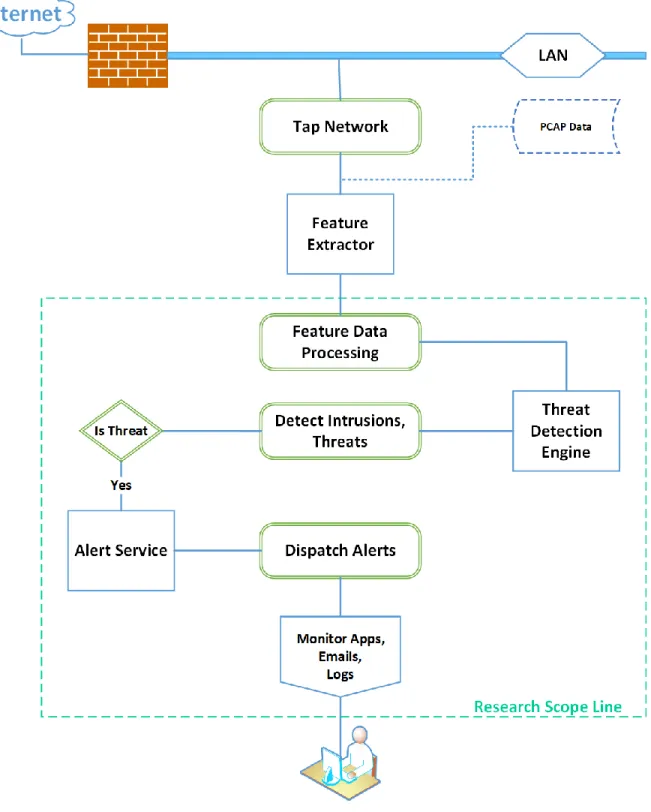
The proposed framework utilizes search engine capabilities such as indexing, searching, and VSM. The indexer and searcher components of the search engine are customized in order to use the VSM feature of the search engine for intrusion detection. In addition to the search engine, the framework uses a binary classifier engine to reinforce the search engine capability because a survey in the related literature shows that a single detection technique is not able to provide accurate detection rate and, therefore, a hybrid technique is suggested to increase detection accuracy (Samrin & Vasumathi, 2017). The framework has two major implementation phases: the training and detection phases. A high-level model of the framework is shown in Figure 2 (with the technical scope of the research marked in the dashed border). Although both the training and detection phases use a feature extractor component, designing a new feature extractor from live traffic is not within the scope of this research. Conceptual framework designs and architectural structures are provided for each major component of the framework in the next sections.
Figure 2. High level model of the framework. 3.3.1 Training Phase
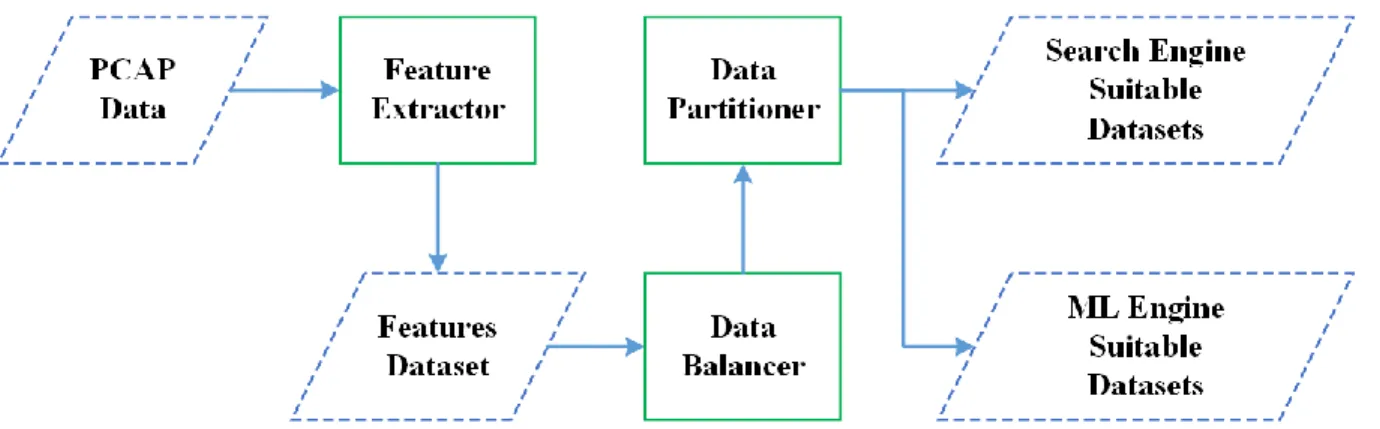
As shown in the process design in Figure 3, the training phase involves the search engine, Machine Learning (ML)-based binary classifier, feature extractor, and indexer components. Since the framework is based on search engine technology that is capable of processing parallel tasks, a training task can be running during the detection phase. This facilitates the self-learning capability of the engine.
Figure 3. Training process.
Feature Extractor: The feature extractor parses the network traffic raw data and extracts features. The extracted feature dataset is used to train the custom search engine and the binary classifier. Feature extractor tools such as CICFlowMeter (Canadian Institute for Cybersecurity, 2019) can extract features from raw traffic data. CICFlowMeter is capable of extracting several features that can be used for anomaly-based detection techniques (Habibi Lashkari et al., 2017). Feature engineering is not a trivial task; generating a reliable and
compressive feature set is critical for anomaly-based intrusion detection systems (Chio & Freeman, 2018).
Search Engine: A fully featured data retrieval engine such as Lucene is used to retrieve data from large datasets. Major features of the search engine include indexing, VSM, ranking, scoring, data storage, parallelism, and distributed deployment support.
Indexer: The indexer is a search engine component that analyzes the classified set of features and systematically adds them to the index storage. Since the search engine is
designed to process text files, the features dataset is converted to indexable text and treated as set of documents in the search engine. Therefore, the indexer component designed in the proposed framework is a customized indexer that overrides the default properties of the search engine, so that each feature set is stored as a vector in the VSM.
ML Binary Classifier: This component is a machine learning-based binary classifier engine used to reinforce the decision engine that uses the search engine as threat detection. The Binary Classifier has two components: the predictor and trainer. The predictor accepts input feature data to determine the traffic state during detection phase. The trainer generates a model during the training phase. The trained model can be used to retrain the search engine for new data or undetermined traffic. During the training phase, both the search engine and the binary classifier train with the same features dataset. But during the detection phase, the binary classifier serves as a decision engine to retrain the search engine when the search engine fails to determine the state of the input traffic with high confidence.
3.3.2 Detection Phase
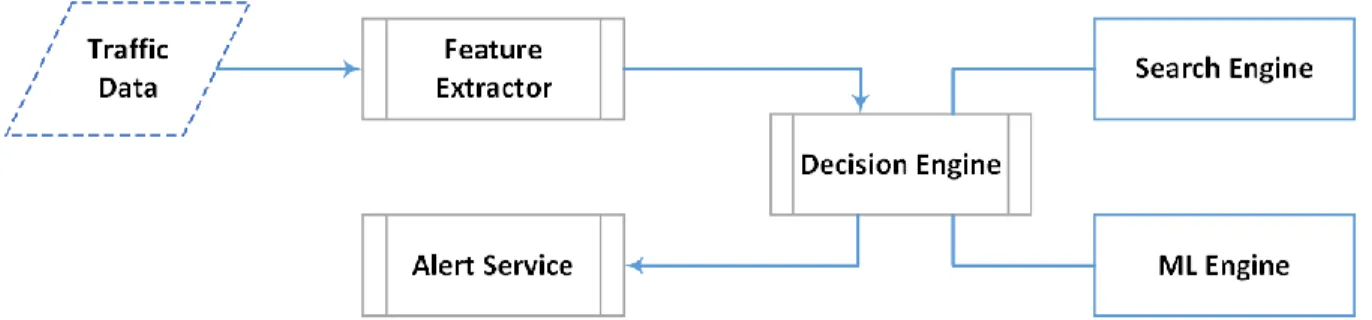
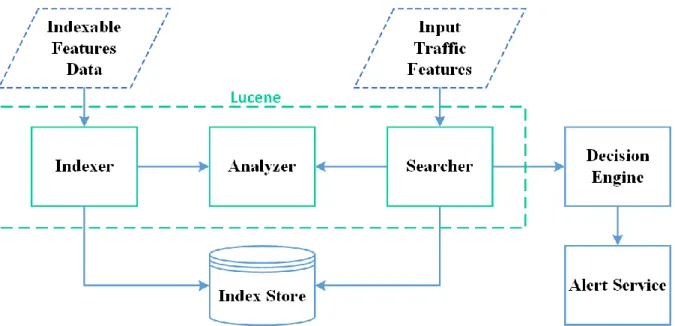
During the detection phase, the same feature extractor component that is used for training is used to extract features from the input traffic data. Once the feature set is extracted, it goes through the decision engine, as shown in the detection process design diagram in Figure 4. Then the decision engine uses the search engine to determine the status of the input. In cases when the search engine detection confidence is low, the decision engine is retrained by the binary classifier.
Figure 4. Detection process.
Searcher: The searcher component takes the input feature data as a query, searches for the best matches, and provides the result to the decision engine. The searcher uses similarity algorithms discussed later in the Similarity Measurements section.
Decision Engine: This component determines the nature of the input traffic based on the search result and decision algorithms. As indicated in Figure 5, the activity diagram of the decision engine, the engine accepts the features set as input and uses the searcher component to search for the top matches. If a threat match is found, it sends a notification to the alert service. If the search yields a low confidence score, the features set goes through the binary classifier. Depending on the binary classifier result, the input data is analyzed to retrain the search engine. This way the search engine learns by itself with the help of the Machine Learning (ML) Engine.
Alert Service: This component is a notifier service used when the system detects a threat. This service receives an alert flag from the decision engine logs and triggers alerts.
3.3.3 Development Tools
Development tools and platform selection for this research are based on the accessibility, adaptability, and performance of the tool, and researcher’s expertise.
Visual Studio: A software development environment that supports multiple programming languages and development tools, Visual Studio is a complete package for software development, testing, and deployment. The Visual Studio Community Edition is free for researchers and small teams, and supports building software using different third-party components, including search engine libraries, Lucene, and the machine learning framework ML.NET (Microsoft, 2019).
Platforms: Windows is the primary development and testing platform. C-Sharp (C#) is used as a primary programming language to develop, test, and validate the framework. PowerShell, Python, and other scripting languages may be used in the evaluation and development phases. Microsoft .NET Core is used as the development platform for the proposed framework, which means the proposed framework is intended to run on Windows, macOS, and Linux as .NET Core runs on these environments.
Search Engine Library: The popular opensource search engine library, Lucene is used as a core search engine. As discussed in the literature review, Lucene has several features, and is well tested, is extensible, and used in large-scale applications.
Machine Learning Framework: The Microsoft machine learning framework ML.NET is used as a machine learning component. As discussed in the literature review, ML.NET is new, supports several other machine learning models, and is used by security tools like Windows Defender.
The proposed cyber threat detection framework that incorporates Lucene, ML.NET, and training and evaluation components is intended to run on different environments but was designed, developed, and tested using Visual Studio on a Windows platform.